
SAT · Practice tests · SAT Math formula sheet and Desmos guide, with worked examples
SAT Math formula sheet and Desmos guide, with worked examples
Need more than one subject? All-notes pass: unlimited downloads of every note for a year: unlimited downloads of every note on the site, PKR 999 a year. All packs and courses.
Opens inside this page. Prefer your own PDF app? Open the PDF.
Check yourself
5 quick questions on SAT
Tap an answer to see if you are right, and why. Free, no sign-up.
Start the free testWas this note useful?
Full text of SAT Math formula sheet and Desmos guide, with worked examples
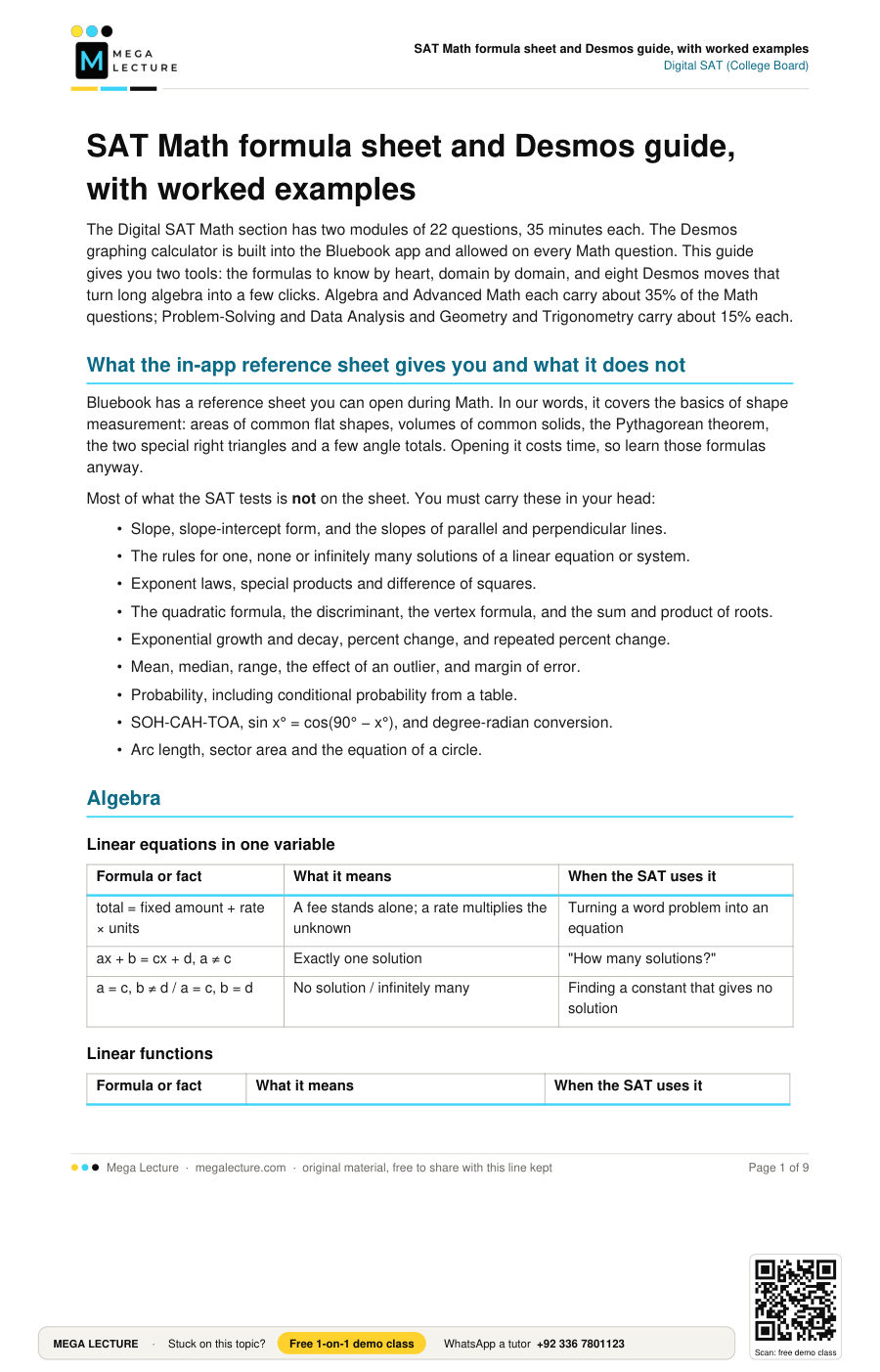
The Digital SAT Math section has two modules of 22 questions, 35 minutes each. The Desmos graphing calculator is built into the Bluebook app and allowed on every Math question. This guide gives you two tools: the formulas to know by heart, domain by domain, and eight Desmos moves that turn long algebra into a few clicks. Algebra and Advanced Math each carry about 35% of the Math questions; Problem-Solving and Data Analysis and Geometry and Trigonometry carry about 15% each.
What the in-app reference sheet gives you and what it does not
Bluebook has a reference sheet you can open during Math. In our words, it covers the basics of shape measurement: areas of common flat shapes, volumes of common solids, the Pythagorean theorem, the two special right triangles and a few angle totals. Opening it costs time, so learn those formulas anyway.
Most of what the SAT tests is not on the sheet. You must carry these in your head:
- Slope, slope-intercept form, and the slopes of parallel and perpendicular lines.
- The rules for one, none or infinitely many solutions of a linear equation or system.
- Exponent laws, special products and difference of squares.
- The quadratic formula, the discriminant, the vertex formula, and the sum and product of roots.
- Exponential growth and decay, percent change, and repeated percent change.
- Mean, median, range, the effect of an outlier, and margin of error.
- Probability, including conditional probability from a table.
- SOH-CAH-TOA, sin x° = cos(90° − x°), and degree-radian conversion.
- Arc length, sector area and the equation of a circle.
Algebra
Linear equations in one variable
| Formula or fact | What it means | When the SAT uses it |
|---|---|---|
| total = fixed amount + rate × units | A fee stands alone; a rate multiplies the unknown | Turning a word problem into an equation |
| ax + b = cx + d, a ≠ c | Exactly one solution | "How many solutions?" |
| a = c, b ≠ d / a = c, b = d | No solution / infinitely many | Finding a constant that gives no solution |
Linear functions
| Formula or fact | What it means | When the SAT uses it |
|---|---|---|
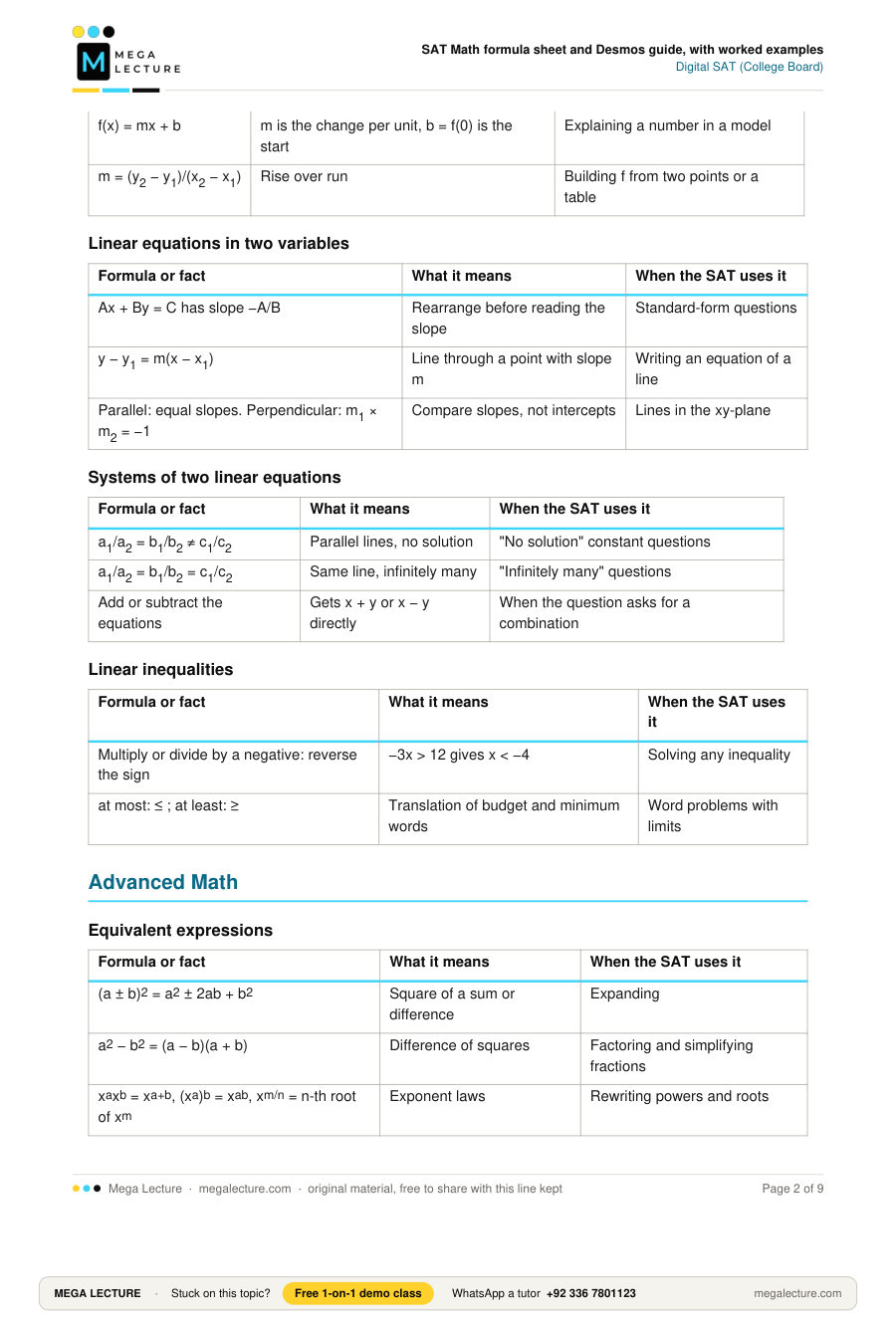
| f(x) = mx + b | m is the change per unit, b = f(0) is the start | Explaining a number in a model |
| m = (y2 − y1)/(x2 − x1) | Rise over run | Building f from two points or a table |
Linear equations in two variables
| Formula or fact | What it means | When the SAT uses it |
|---|---|---|
| Ax + By = C has slope −A/B | Rearrange before reading the slope | Standard-form questions |
| y − y1 = m(x − x1) | Line through a point with slope m | Writing an equation of a line |
| Parallel: equal slopes. Perpendicular: m1 × m2 = −1 | Compare slopes, not intercepts | Lines in the xy-plane |
Systems of two linear equations
| Formula or fact | What it means | When the SAT uses it |
|---|---|---|
| a1/a2 = b1/b2 ≠ c1/c2 | Parallel lines, no solution | "No solution" constant questions |
| a1/a2 = b1/b2 = c1/c2 | Same line, infinitely many | "Infinitely many" questions |
| Add or subtract the equations | Gets x + y or x − y directly | When the question asks for a combination |
Linear inequalities
| Formula or fact | What it means | When the SAT uses it |
|---|---|---|
| Multiply or divide by a negative: reverse the sign | −3x > 12 gives x < −4 | Solving any inequality |
| at most: ≤ ; at least: ≥ | Translation of budget and minimum words | Word problems with limits |
Advanced Math
Equivalent expressions
| Formula or fact | What it means | When the SAT uses it |
|---|---|---|
| (a ± b)2 = a2 ± 2ab + b2 | Square of a sum or difference | Expanding |
| a2 − b2 = (a − b)(a + b) | Difference of squares | Factoring and simplifying fractions |
| xaxb = xa+b, (xa)b = xab, xm/n = n-th root of xm | Exponent laws | Rewriting powers and roots |
Nonlinear equations and systems
| Formula or fact | What it means | When the SAT uses it |
|---|---|---|
| x = (−b ± √(b2 − 4ac))/(2a) | Solves any quadratic | When factoring is slow |
| b2 − 4ac: > 0 two, = 0 one, < 0 none | Number of real solutions | "Exactly one solution" and line-meets-parabola questions |
| Sum of roots −b/a, product c/a | No need to solve | "What is the sum of the solutions?" |
Nonlinear functions
| Formula or fact | What it means | When the SAT uses it |
|---|---|---|
| Vertex at x = −b/(2a); y = a(x − h)2 + k has vertex (h, k) | Location of the maximum or minimum | Greatest height, least cost |
| f(t) = a(b)t, b = 1 ± r/100 | Start a, multiplied by b each period | Growth and decay models |
| f(x − c) moves right c; f(x) + d moves up d | Graph shifts | Transformations |
Problem-Solving and Data Analysis
Ratios, rates, proportions and units
| Formula or fact | What it means | When the SAT uses it |
|---|---|---|
| a/b = c/d gives ad = bc | Cross-multiply a proportion | Missing value questions |
| distance = speed × time | Rate times time | Travel and work rates |
| Scale k: area × k2, volume × k3 | Lengths, areas and volumes scale differently | Maps, models, similar solids |
Percentages
| Formula or fact | What it means | When the SAT uses it |
|---|---|---|
| percent change = (new − old)/old × 100 | Always divide by the original | Increase and decrease questions |
| original = new ÷ multiplier | Undo a change by dividing | "Price before the discount" |
| Changes in a row: multiply multipliers | +10% then −10% is 1.1 × 0.9 = 0.99 | Successive changes |
One-variable data
| Formula or fact | What it means | When the SAT uses it |
|---|---|---|
| sum = mean × count | Work with totals, not means | Adding or removing values |
| Outlier moves the mean, hardly the median | The median resists extremes | Comparing data sets |
| Standard deviation: spread around the mean | Closer to the mean, smaller SD | Comparing two dot plots |
Two-variable data
| Formula or fact | What it means | When the SAT uses it |
|---|---|---|
| Slope of a best-fit line | Predicted change in y per 1 unit of x | Interpreting a scatterplot |
| y = a(b)x, b = 0.94 means 6% decrease per step | Equal ratios mean exponential | Linear or exponential? |
Probability
| Formula or fact | What it means | When the SAT uses it |
|---|---|---|
| P = favorable ÷ total | Count outcomes | Simple selection |
| P(A given B) = cell for both ÷ total for B | The denominator is the given group only | Two-way tables |
| P(not A) = 1 − P(A) | Complement | "At least one" |
Samples, studies and margin of error
| Formula or fact | What it means | When the SAT uses it |
|---|---|---|
| estimate ± margin of error | Plausible range for the population value | Survey results |
| Random sample: generalize. Random assignment: cause | Two different permissions | "Which conclusion is supported?" |
Geometry and Trigonometry
Area and volume
| Formula or fact | What it means | When the SAT uses it |
|---|---|---|
| Cylinder πr2h; cone (1/3)πr2h | A cone holds one third of the matching cylinder | Volume of solids |
| Sphere (4/3)πr3 | Radius cubed | Balls, tanks |
| Trapezoid ½(a + b)h | Average of parallel sides × height | Composite shapes |
Lines, angles and triangles
| Formula or fact | What it means | When the SAT uses it |
|---|---|---|
| Triangle angles sum to 180°; exterior angle = sum of the two far interior angles | Angle chasing | Finding a missing angle |
| Parallel lines: alternate angles equal, same-side interior sum to 180° | Transversal facts | Diagrams with parallel lines |
| Similar triangles: sides ratio k, areas k2 | Same shape, scaled | Missing side in nested triangles |
Right triangles and trigonometry
| Formula or fact | What it means | When the SAT uses it |
|---|---|---|
| sin = opp/hyp, cos = adj/hyp, tan = opp/adj | SOH-CAH-TOA | Any right-triangle ratio |
| sin x° = cos(90° − x°) | The two acute angles swap sine and cosine | "If sin A = 0.6, what is cos B?" |
| 3-4-5, 5-12-13, 8-15-17, 7-24-25 | Whole-number right triangles | Finding the third side fast |
Circles
| Formula or fact | What it means | When the SAT uses it |
|---|---|---|
| (x − h)2 + (y − k)2 = r2 | Center (h, k), radius r | Circle equations |
| Arc = (θ/360) × 2πr; sector = (θ/360) × πr2 | Fraction of the whole circle | Arcs and slices |
| x2 + bx = (x + b/2)2 − (b/2)2 | Completing the square | Finding center and radius |
Desmos: eight techniques
Use Desmos when the algebra is long or when you want a check. Do not use it for one-step arithmetic you can do faster in your head.
1. Solve by intersection
Example: Solve 3(x − 4) + 7 = (x + 15)/3.
Hand: multiply by 3: 9x − 15 = x + 15, so 8x = 30 and x = 3.75.
Desmos: type y = 3(x − 4) + 7 and y = (x + 15)/3. Click the crossing point: (3.75, 6.25). The answer is the x-coordinate.
Check: 3(−0.25) + 7 = 6.25 and 18.75/3 = 6.25.
2. Count solutions
Example: How many real solutions does x2 − 6x + 11 = 2x − 5 have?
Hand: x2 − 8x + 16 = 0, so (x − 4)2 = 0: exactly one solution, x = 4.
Desmos: graph y = x2 − 6x + 11 and y = 2x − 5. The line just touches the parabola at (4, 3): one point, one solution. No crossing would mean no real solution.
3. Find the vertex and zeros
Example: f(x) = −2x2 + 8x + 10. Find the zeros and the maximum value.
Hand: f(x) = −2(x2 − 4x − 5) = −2(x − 5)(x + 1), so the zeros are −1 and 5. Vertex x = −8/(2 × −2) = 2, and f(2) = −8 + 16 + 10 = 18.
Desmos: type the function and click the gray points: (−1, 0), (5, 0) and the top (2, 18). The maximum value is 18, not 2.
4. Regression from a table
Example: x = 0, 1, 2, 3 gives y = 500, 400, 320, 256. Find the model.
Hand: each y is 0.8 times the one before, so y = 500(0.8)x, a 20% decrease per step.
Desmos: add a table (columns x1 and y1), enter the data, then type y1 ~ abx1. Desmos reports a = 500 and b = 0.8. For a line, type y1 ~ mx1 + b.
5. Systems
Example: 3x + 4y = 7 and 5x − 2y = 29.
Hand: double the second: 10x − 4y = 58. Add to the first: 13x = 65, so x = 5. Then 4y = 7 − 15 = −8, so y = −2.
Desmos: type both equations as written (no need to solve for y). Click the intersection: (5, −2).
Check: 15 − 8 = 7 and 25 + 4 = 29.
6. Inequalities and shading
Example: Which point satisfies y ≥ 2x − 3 and y < −x + 6: (4, 2), (0, 7), (3, 2) or (1, 4)?
Desmos: type both inequalities (use >= for ≥). The double-shaded region is the solution set; the < boundary is dashed, so points on it do not count. Type the four points; only (1, 4) sits in the overlap.
Hand check: 4 ≥ 2(1) − 3 = −1 and 4 < −1 + 6 = 5. Both true.
7. Checking answer choices
Example: Which is equivalent to (2x − 3)2 − (x − 1)2?
Hand: 4x2 − 12x + 9 − (x2 − 2x + 1) = 3x2 − 10x + 8 = (3x − 4)(x − 2).
Desmos: graph the original, then graph each choice. The equivalent choice lies exactly on top of the original curve.
Check with x = 0: 9 − 1 = 8 and (−4)(−2) = 8.
8. Sliders
Example: For what positive value of k does the line y = kx meet y = x2 + 4 at exactly one point?
Desmos: type y = kx and accept the slider for k. Drag until the line just touches the parabola: k = 4, touching at (2, 8).
Hand: x2 − kx + 4 = 0 needs discriminant k2 − 16 = 0, so k = 4.
Practice set
Questions 1 to 4, 6 and 7 are multiple choice. Questions 5 and 8 are student-produced responses: type your answer.
A cone has a radius of 6 centimeters and a height of 10 centimeters. What is the volume of the cone, in cubic centimeters?
A) 20π
B) 120π
C) 200π
D) 360πIn the xy-plane, how many points do the graphs of y = x2 − 4x + 1 and y = −2x − 3 have in common?
A) 0
B) 1
C) 2
D) Infinitely manyThe graph of x2 + y2 − 10x + 6y + 18 = 0 in the xy-plane is a circle. What is the radius of the circle?
A) √18
B) 16
C) 4
D) √52A town's population is modeled by an exponential function. The table gives the population P, t years after 2020.
t 0 2 4 P 6,400 7,744 9,370.24 By what percent does the population increase each year?
A) 21%
B) 10.5%
C) 1.1%
D) 10%The mean of 8 test scores is 72. When one score is removed, the mean of the remaining 7 scores is 70. What score was removed?
In right triangle ABC, angle C is a right angle and cos A = 8/17. What is the value of tan B?
A) 8/15
B) 15/8
C) 15/17
D) 8/17The height, in feet, of a ball t seconds after it is thrown is h(t) = −16t2 + 64t + 5. What is the maximum height of the ball, in feet?
A) 2
B) 5
C) 64
D) 69The line y = 3x + c and the parabola y = x2 − 5x + 20 intersect at exactly one point. What is the value of c?
Solutions
1. B
Hand: V = (1/3)πr2h = (1/3)π(36)(10) = 120π. A forgets to square the radius, C swaps radius and height ((1/3)π(100)(6) = 200π), D is the cylinder (no 1/3).
Desmos: type (1/3)π·62·10 and 120π; both give about 376.99.
Skill: Area and volume
2. A
Hand: set equal: x2 − 4x + 1 = −2x − 3, so x2 − 2x + 4 = 0. Discriminant: (−2)2 − 4(1)(4) = 4 − 16 = −12 < 0. No real solution, so no common points.
Desmos: graph both. The parabola's lowest point is (2, −3), while the line is at −7 when x = 2; the line passes below the parabola and never meets it.
Skill: Nonlinear equations and systems
3. C
Hand: group: (x2 − 10x) + (y2 + 6y) = −18. Complete the squares: (x − 5)2 − 25 + (y + 3)2 − 9 = −18, so (x − 5)2 + (y + 3)2 = 16. Radius √16 = 4. B forgets the square root, A uses the constant 18 as r2, D adds 18 instead of subtracting it (25 + 9 + 18 = 52).
Desmos: type the equation. The circle runs from x = 1 to x = 9, a diameter of 8, so the radius is 4.
Skill: Circles
4. D
Hand: P = 6,400bt. At t = 2: 6,400b2 = 7,744, so b2 = 1.21 and b = 1.1, a 10% increase each year. Check: 7,744 × 1.21 = 9,370.24. A is the two-year increase, B halves it (percents do not halve over time), C reads the multiplier as a percent.
Desmos: table x1 = 0, 2, 4 and y1 = 6400, 7744, 9370.24, then y1 ~ abx1 gives a = 6,400 and b = 1.1.
Skill: Nonlinear functions (exponential growth)
5. 86
Hand: sum of 8 scores = 8 × 72 = 576. Sum of 7 scores = 7 × 70 = 490. Removed score = 576 − 490 = 86. Check: (490 + 86)/8 = 72.
Desmos: type 8·72 − 7·70, which gives 86.
Accepted answer: 86 only.
Skill: One-variable data
6. A
Hand: cos A = AC/AB = 8/17, so take AC = 8 and AB = 17. Then BC = √(172 − 82) = √(289 − 64) = √225 = 15 (an 8-15-17 triangle). For angle B, the opposite side is AC = 8 and the adjacent side is BC = 15, so tan B = 8/15. B is tan A, C is sin A, D is sin B (equal to cos A).
Desmos: type √(172 − 82) to get 15, then build the ratio.
Skill: Right triangles and trigonometry
7. D
Hand: the vertex is at t = −b/(2a) = −64/(2 × −16) = 2. h(2) = −16(4) + 64(2) + 5 = −64 + 128 + 5 = 69. A is the time, not the height. B is the starting height. C drops the + 5.
Desmos: type y = −16x2 + 64x + 5 and click the top point: (2, 69).
Skill: Nonlinear functions
8. 4
Hand: set equal: x2 − 5x + 20 = 3x + c, so x2 − 8x + (20 − c) = 0. One point means discriminant 0: 64 − 4(20 − c) = 0, so 64 − 80 + 4c = 0, 4c = 16 and c = 4. Check: x2 − 8x + 16 = (x − 4)2, touching at x = 4, where both give y = 16.
Desmos: type y = x2 − 5x + 20 and y = 3x + c, add the slider, and drag c until the line just touches the parabola: c = 4.
Accepted answer: 4 only.
Skill: Nonlinear equations and systems
