
SAT · Practice tests · SAT Reading and Writing: Expression of Ideas, study guide and worked solutions
SAT Reading and Writing: Expression of Ideas, study guide and worked solutions
Need more than one subject? All-notes pass: unlimited downloads of every note for a year: unlimited downloads of every note on the site, PKR 999 a year. All packs and courses.
Opens inside this page. Prefer your own PDF app? Open the PDF.
Check yourself
5 quick questions on SAT
Tap an answer to see if you are right, and why. Free, no sign-up.
Start the free testWas this note useful?
Full text of SAT Reading and Writing: Expression of Ideas, study guide and worked solutions
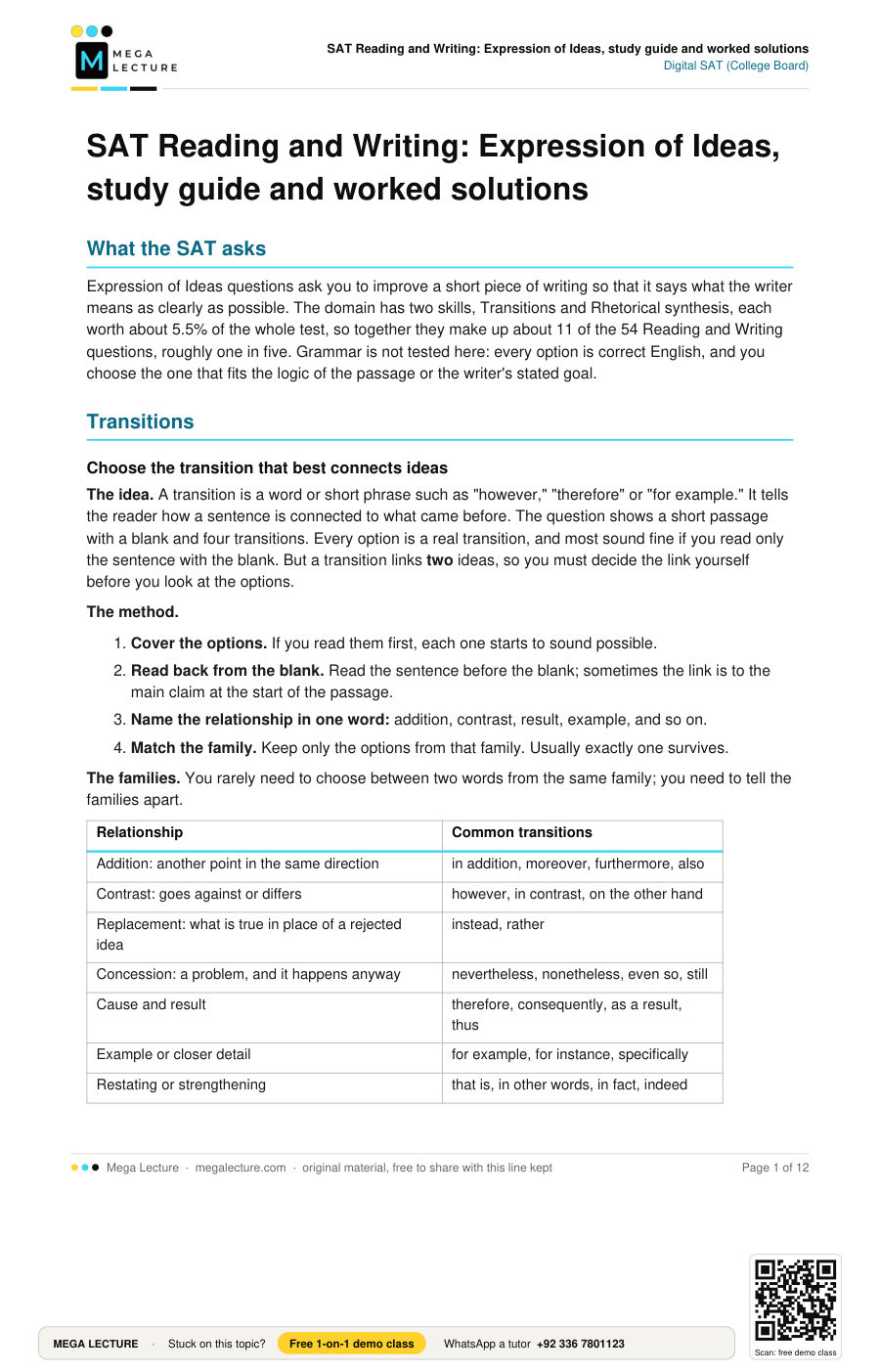
What the SAT asks
Expression of Ideas questions ask you to improve a short piece of writing so that it says what the writer means as clearly as possible. The domain has two skills, Transitions and Rhetorical synthesis, each worth about 5.5% of the whole test, so together they make up about 11 of the 54 Reading and Writing questions, roughly one in five. Grammar is not tested here: every option is correct English, and you choose the one that fits the logic of the passage or the writer's stated goal.
Transitions
Choose the transition that best connects ideas
The idea. A transition is a word or short phrase such as "however," "therefore" or "for example." It tells the reader how a sentence is connected to what came before. The question shows a short passage with a blank and four transitions. Every option is a real transition, and most sound fine if you read only the sentence with the blank. But a transition links two ideas, so you must decide the link yourself before you look at the options.
The method.
- Cover the options. If you read them first, each one starts to sound possible.
- Read back from the blank. Read the sentence before the blank; sometimes the link is to the main claim at the start of the passage.
- Name the relationship in one word: addition, contrast, result, example, and so on.
- Match the family. Keep only the options from that family. Usually exactly one survives.
The families. You rarely need to choose between two words from the same family; you need to tell the families apart.
| Relationship | Common transitions |
|---|---|
| Addition: another point in the same direction | in addition, moreover, furthermore, also |
| Contrast: goes against or differs | however, in contrast, on the other hand |
| Replacement: what is true in place of a rejected idea | instead, rather |
| Concession: a problem, and it happens anyway | nevertheless, nonetheless, even so, still |
| Cause and result | therefore, consequently, as a result, thus |
| Example or closer detail | for example, for instance, specifically |
| Restating or strengthening | that is, in other words, in fact, indeed |
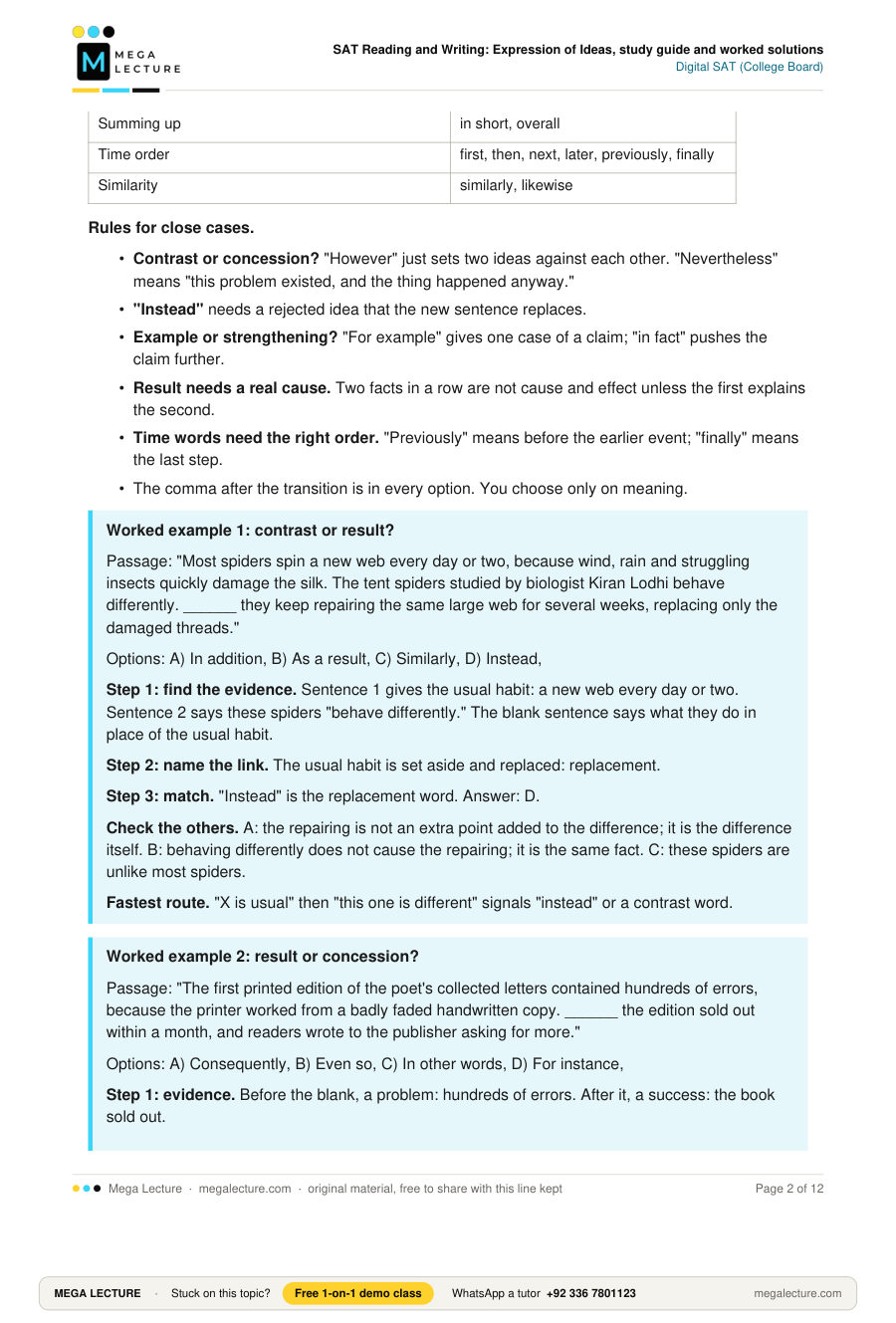
| Summing up | in short, overall |
| Time order | first, then, next, later, previously, finally |
| Similarity | similarly, likewise |
Rules for close cases.
- Contrast or concession? "However" just sets two ideas against each other. "Nevertheless" means "this problem existed, and the thing happened anyway."
- "Instead" needs a rejected idea that the new sentence replaces.
- Example or strengthening? "For example" gives one case of a claim; "in fact" pushes the claim further.
- Result needs a real cause. Two facts in a row are not cause and effect unless the first explains the second.
- Time words need the right order. "Previously" means before the earlier event; "finally" means the last step.
- The comma after the transition is in every option. You choose only on meaning.
Worked example 1: contrast or result?
Passage: "Most spiders spin a new web every day or two, because wind, rain and struggling insects quickly damage the silk. The tent spiders studied by biologist Kiran Lodhi behave differently. ______ they keep repairing the same large web for several weeks, replacing only the damaged threads."
Options: A) In addition, B) As a result, C) Similarly, D) Instead,
Step 1: find the evidence. Sentence 1 gives the usual habit: a new web every day or two. Sentence 2 says these spiders "behave differently." The blank sentence says what they do in place of the usual habit.
Step 2: name the link. The usual habit is set aside and replaced: replacement.
Step 3: match. "Instead" is the replacement word. Answer: D.
Check the others. A: the repairing is not an extra point added to the difference; it is the difference itself. B: behaving differently does not cause the repairing; it is the same fact. C: these spiders are unlike most spiders.
Fastest route. "X is usual" then "this one is different" signals "instead" or a contrast word.
Worked example 2: result or concession?
Passage: "The first printed edition of the poet's collected letters contained hundreds of errors, because the printer worked from a badly faded handwritten copy. ______ the edition sold out within a month, and readers wrote to the publisher asking for more."
Options: A) Consequently, B) Even so, C) In other words, D) For instance,
Step 1: evidence. Before the blank, a problem: hundreds of errors. After it, a success: the book sold out.
Step 2: link. A good outcome in spite of a problem: concession.
Step 3: match. "Even so." Answer: B.
Check the others. A: the errors did not cause the sales. This is the most common mistake, assuming that one event caused the next. C: selling out does not restate having errors. D: selling out is not an example of the errors.
SAT trap: the transition that fits only its own sentence
"As a result, the bridge was closed" and "However, the bridge was closed" both sound fine alone. Only the sentence before tells you which is right. Never choose until you have named the relationship, never choose a word because it sounds formal, and read far enough back: if the sentence before the blank is a detail, the link may be to the main claim, as in Worked example 1.
Rhetorical synthesis
Use notes to write a sentence that meets a stated goal
The idea. You see a student's research notes as bullet points, then a goal, such as "emphasize a similarity between the two rivers," "describe the study's methodology" or "introduce the novel to an audience unfamiliar with the author." You choose the sentence that best uses the notes to meet that goal.
All four options are usually true according to the notes and correct English, so checking facts will not separate them. The only test is the goal. Often you barely need to read the notes: read the goal, then the options, and go back to the notes only if two options survive.
The method.
- Read the goal first. It starts "The student wants to..."
- Turn it into a checklist. "Emphasize a difference between the two bridges" means: both bridges named, a feature where they differ, a contrast word.
- Cross out any option missing a part. Do not reward extra facts.
- If two survive, reread the goal for a word you skipped, such as "compared with" or "unfamiliar."
| Goal says | The sentence must have |
|---|---|
| Emphasize a similarity | Both things named and a shared feature, often with "both," "like" or "also" |
| Emphasize a difference | Both things named and a difference, with "while," "whereas," "but" or "unlike" |
| Describe the methodology | What the researchers did and measured, not what they found |
| Present the results | What was found, not how |
| Introduce X to an unfamiliar audience | A short label saying who or what X is ("Pakistani novelist...") |
| Explain an advantage or disadvantage | The benefit or drawback, and what it is compared with if the goal says so |
| Give a specific item (a date, an example) | Exactly that item from the notes |
Rules for close cases.
- Two-part goals need both parts. "The size and the location" fails if only the size is given.
- "Compared with" or "over" means a comparison must appear in the sentence.
- Direction matters. An advantage is wrong when the goal asks for a disadvantage, even though both are differences.
- A word is not a proof. "Surprisingly" does not meet a goal about surprise unless the sentence shows why the fact is surprising.
Worked example 3: similarity versus difference
Notes:
- The Saltmere Lighthouse and the Graybar Lighthouse stand on the same stretch of coast.
- The Saltmere Lighthouse is 41 meters tall; the Graybar Lighthouse is 18 meters tall.
- Both lighthouses were built of local granite.
- The Graybar Lighthouse is now a museum.
The student wants to emphasize a similarity between the two lighthouses.
A) The Saltmere Lighthouse is 41 meters tall, while the Graybar Lighthouse is only 18 meters tall.
B) The Graybar Lighthouse, which was built of local granite, is now a museum.
C) The Saltmere Lighthouse and the Graybar Lighthouse were both built of local granite.
D) At 41 meters, the Saltmere Lighthouse is the taller of the two.
Step 1: checklist. Both lighthouses named, a shared feature, a similarity word.
Step 2: test. A names both but gives a difference. B names only Graybar. D gives a difference. C names both, gives the shared feature and uses "both."
Answer: C.
Check. The evidence is bullet 3, "Both lighthouses were built of local granite." C uses exactly that bullet; A uses bullet 2, which is about difference.
Worked example 4: methodology versus findings
Notes:
- A research team in Peshawar wanted to know whether reading aloud helps children remember new words.
- They taught 60 nine-year-olds a list of 20 unfamiliar words.
- Half read the list aloud; the other half read it silently.
- A week later, all the children were tested on the words.
- The children who read aloud remembered more words on average.
The student wants to describe how the team carried out the study.
A) Children who read new words aloud remembered more of them a week later than children who read silently.
B) The team taught 60 children 20 new words, with half reading the list aloud and half reading it silently, and tested all of them a week later.
C) A research team in Peshawar wanted to know whether reading aloud helps children remember words.
D) Reading aloud may be a useful way for children to learn new vocabulary.
Step 1: checklist. "How the team carried out the study" is the method: who took part, what they did, how it was measured.
Step 2: test. A is the result (bullet 5). C is the aim (bullet 1), not the method. D is a conclusion. B gives the participants, the task and the test, from bullets 2, 3 and 4.
Answer: B.
Fastest route. Method sentences have action verbs about the researchers ("taught," "divided," "tested"). Result sentences say what happened to the subjects ("remembered more").
SAT trap: the sentence with the most facts
Wrong options are true, well written and often longer or more interesting than the right one. A sentence full of correct facts is still wrong if it does not do the job the goal names. Before you choose, say the goal in a few words ("difference," "method," "new reader") and ask: does this sentence do that? Watch for an option about only one of two things, a difference in the wrong direction, and "surprisingly" with no surprise shown.
Practice set
Fourteen original questions, seven per skill, mixed in difficulty. For transition questions, choose the option that completes the text with the most logical transition. For notes questions, choose the option that best uses information from the notes to meet the student's goal. Aim for about 70 seconds each. All people, places and studies named in the notes are invented for practice unless they are general knowledge.
Question 1
Honeybees use a movement called the waggle dance to tell other bees where food can be found. A forager that has found a good patch of flowers returns to the hive and walks a repeated figure-eight pattern on the comb. ______ the direction of the straight run through the middle of the figure shows the other bees which way to fly.
A) Specifically,
B) However,
C) Nevertheless,
D) Similarly,
Question 2
Marine biologist Lena Varga tracks two kinds of coral growing side by side on the same reef. The branching coral she studies grows quickly, adding several centimeters to its length each year. ______ the boulder coral next to it grows only a few millimeters a year but can survive for centuries.
A) As a result,
B) For instance,
C) In contrast,
D) Likewise,
Question 3
While researching bridges, a student wrote these notes:
- The Karvel Bridge and the Ostin Bridge both cross the Marra River.
- The Karvel Bridge opened in 1931.
- The Ostin Bridge opened in 1998.
- Both are suspension bridges.
- The Ostin Bridge carries a railway line as well as road traffic.
The student wants to emphasize a similarity between the two bridges. Which choice best uses information from the notes to meet this goal?
A) The Karvel Bridge opened in 1931, while the Ostin Bridge opened in 1998.
B) Like the Karvel Bridge, the Ostin Bridge is a suspension bridge that crosses the Marra River.
C) The Ostin Bridge, which opened in 1998, carries both a railway line and road traffic.
D) The Karvel Bridge, a suspension bridge, opened in 1931.
Question 4
Architect Tomás Reyes knew that his design for a library in a hot, dry town would cost more than a standard building, since its thick earth walls needed skilled builders and extra time to construct. ______ he persuaded the town council to approve it, arguing that the walls would keep the rooms cool without air conditioning and lower energy bills for decades.
A) Consequently,
B) For example,
C) In other words,
D) Nevertheless,
Question 5
While researching sleep and memory, a student wrote these notes:
- A team led by Dr. Sana Malik studied 120 secondary school students.
- For two weeks, half the students slept at least eight hours a night, and the other half slept six hours or less.
- All the students then took the same memory test, recalling words from a list.
- Students who had slept at least eight hours recalled about 20 percent more words on average.
The student wants to present the study's results. Which choice best uses information from the notes to meet this goal?
A) In Malik's study, students who slept at least eight hours a night recalled about 20 percent more words on a memory test than students who slept six hours or less.
B) Malik's team divided 120 students into two groups by hours of sleep and then gave all of them the same memory test.
C) A team led by Dr. Sana Malik conducted a study involving 120 secondary school students.
D) For two weeks, half of the students in Malik's study slept at least eight hours a night.
Question 6
Many early photographic plates were sensitive mainly to blue and violet light and reacted only weakly to red light. ______ red objects, such as ripe tomatoes or red flags, often appeared almost black in photographs taken with these plates.
A) However,
B) As a result,
C) Similarly,
D) In addition,
Question 7
While researching Pakistani fiction, a student wrote these notes:
- Ayesha Rahman is a Pakistani novelist born in Multan.
- Her novel The Salt Road (2019) follows three generations of a family of camel traders.
- The novel won the Indus Prize for fiction.
- Critics have praised its descriptions of the Cholistan Desert.
The student wants to introduce The Salt Road to an audience unfamiliar with Ayesha Rahman. Which choice best uses information from the notes to meet this goal?
A) The Salt Road, Rahman's 2019 novel, won the Indus Prize for fiction.
B) Critics have praised Rahman's descriptions of the Cholistan Desert in The Salt Road.
C) Born in Multan, Rahman later wrote a prize-winning novel.
D) Pakistani novelist Ayesha Rahman's 2019 book The Salt Road follows three generations of a family of camel traders.
Question 8
Historian Amna Qureshi has described how paper was made by hand in one nineteenth-century village. Workers first soaked old cotton rags in water for several days until the fibers softened. They then beat the rags with wooden hammers until they turned into a thick pulp. ______ they dipped a fine screen into a vat of the pulp, lifted out a thin layer and pressed it flat to dry into a sheet.
A) Previously,
B) For instance,
C) Finally,
D) In contrast,
Question 9
While researching birds in cities, a student wrote these notes:
- Ecologist Hamid Baig wanted to know whether house sparrows raise more chicks in cities or on farms.
- He put up 40 nest boxes in a city park and 40 in nearby farmland.
- During the breeding season, he checked every box every three days and counted the eggs and chicks.
- Nests in the farmland produced more chicks on average.
The student wants to describe the study's methodology. Which choice best uses information from the notes to meet this goal?
A) On average, house sparrow nests in farmland produced more chicks than nests in a city park.
B) Baig wanted to know whether house sparrows raise more chicks in cities or on farms.
C) Baig put up 40 nest boxes in a city park and 40 in farmland, then counted the eggs and chicks in each box every three days during the breeding season.
D) Baig's study suggests that farmland may be a better place than city parks for house sparrows to raise chicks.
Question 10
The narwhal, a whale of the Arctic, has a long, straight tusk that can grow to more than two meters. Early observers assumed that males used their tusks mainly as weapons, as deer use their antlers. Later studies, however, found little evidence that narwhals regularly fight with them. ______ some researchers now propose that the tusk, which is rich in nerve endings, works partly as a sense organ that detects changes in the surrounding water.
A) In addition,
B) Likewise,
C) For instance,
D) Instead,
Question 11
While researching clean water, a student wrote these notes:
- Engineers compared two ways of making drinking water safe in a village in Sindh.
- Boiling kills almost all germs but uses a lot of fuel.
- A sand filter uses no fuel.
- A sand filter removes most dirt and many germs, but not all germs.
- About the same number of families used each method.
The student wants to emphasize a disadvantage of the sand filter compared with boiling. Which choice best uses information from the notes to meet this goal?
A) Although the sand filter uses no fuel, it does not remove all germs, whereas boiling kills almost all of them.
B) Unlike boiling, which uses a lot of fuel, the sand filter uses none.
C) Boiling and the sand filter were each used by about the same number of families.
D) The sand filter removes most dirt and many germs, but it does not remove all germs.
Question 12
The novelist Mira Haddad revised her work far more than most writers do. She often rewrote a single chapter five or six times before she would show it to her editor. ______ one chapter of her final novel survives in fourteen separate drafts, each covered in her handwritten corrections.
A) Nevertheless,
B) In fact,
C) In contrast,
D) Previously,
Question 13
While researching traditional irrigation, a student wrote these notes:
- A karez is an underground channel used to bring water to fields in parts of Balochistan and Afghanistan.
- It carries groundwater from the foot of hills down to farmland.
- Water flows through it by gravity, so no pumps are needed.
- Because the channel is underground, much less water is lost to evaporation than from an open canal.
- Many karez systems have dried up as deep wells have lowered the water table.
The student wants to explain an advantage of a karez over an open canal. Which choice best uses information from the notes to meet this goal?
A) A karez carries groundwater from the foot of hills down to farmland in parts of Balochistan and Afghanistan.
B) Because a karez runs underground, it loses much less water to evaporation than an open canal does.
C) Water flows through a karez by gravity, so no pumps are needed.
D) Many karez systems have dried up as deep wells have lowered the water table.
Question 14
While researching fossils, a student wrote these notes:
- A team led by geologist Noor Fatima found a large deposit of fossil leaves.
- The deposit holds about 3,000 leaf fossils, about 50 million years old.
- It was found in a desert that now receives less than 100 millimeters of rain a year.
- The leaves belong to kinds of trees that today grow only in wet tropical forests.
The student wants to emphasize why the location of the fossils is surprising. Which choice best uses information from the notes to meet this goal?
A) Surprisingly, the deposit found by Noor Fatima's team holds about 3,000 leaf fossils that are about 50 million years old.
B) Noor Fatima's team found a large deposit of fossil leaves in a desert region.
C) The fossil leaves belong to kinds of trees that today grow only in wet tropical forests.
D) Leaves from trees that now grow only in wet tropical forests were found as fossils in a desert that receives less than 100 millimeters of rain a year.
Solutions
Question 1. Answer: A
Sentence 1 says the waggle dance tells bees where food is. Sentence 2 describes the dance in general: a figure-eight pattern. The blank sentence zooms in on one part of that pattern, the straight run in the middle, and explains exactly what it tells the bees. That is a closer, more specific detail, so "Specifically" is correct.
B, "However," needs a contrast, but the blank sentence continues the description. C, "Nevertheless," needs a problem that is overcome; there is none. D, "Similarly," would mean the straight run is a second, similar thing, but it is part of the same dance.
Skill: Transitions
Question 2. Answer: C
The evidence is the pair of growth rates: the branching coral grows "quickly, adding several centimeters" a year, while the boulder coral grows "only a few millimeters a year." The two corals are set against each other, so a contrast transition, "In contrast," is correct.
A, "As a result," is wrong because the branching coral's fast growth does not cause the boulder coral's slow growth. B, "For instance," is wrong because the boulder coral is not an example of the branching coral. D, "Likewise," says the two are similar, which is the opposite of what the passage shows.
Skill: Transitions
Question 3. Answer: B
Goal checklist: both bridges named, a shared feature, a similarity word. B names both bridges, uses "Like," and gives two shared features from the notes: both are suspension bridges (bullet 4) and both cross the Marra River (bullet 1).
A names both but states a difference (opening dates) with "while." C describes only the Ostin Bridge. D describes only the Karvel Bridge; mentioning that it is a suspension bridge does not show that the other bridge is one too.
Skill: Rhetorical synthesis
Question 4. Answer: D
Before the blank is a problem: the design "would cost more than a standard building." After the blank, Reyes goes ahead and gets the design approved anyway. A problem followed by an outcome that happens in spite of it is concession, so "Nevertheless" is correct.
A, "Consequently," would mean the higher cost caused the council to approve the design, which makes no sense; the cost was a reason against it. B, "For example," is wrong because persuading the council is not an example of the high cost. C, "In other words," is wrong because the second sentence does not restate the first.
Skill: Transitions
Question 5. Answer: A
Goal: the results, meaning what the study found. The finding is in bullet 4: the students who slept at least eight hours recalled about 20 percent more words. A states exactly this and makes clear which group it is compared with.
B describes the method (how the groups were formed and tested), not the result. C only says the study took place and who was in it. D gives one detail of the method for one group. None says what was found.
Skill: Rhetorical synthesis
Question 6. Answer: B
Sentence 1 gives a cause: the plates reacted only weakly to red light. The blank sentence gives the effect: red objects looked almost black. Cause then effect means "As a result" is correct.
A, "However," would need the second sentence to go against the first, but it follows from it. C, "Similarly," would need a second, similar fact, not a consequence. D, "In addition," treats the dark red objects as a separate extra point and hides the cause-and-effect link.
Skill: Transitions
Question 7. Answer: D
Goal checklist: (1) introduce the novel, so say what it is; (2) the audience does not know Ayesha Rahman, so give her a label. D opens with "Pakistani novelist Ayesha Rahman," which tells a new reader who she is, then names the book and says what it is about (bullet 2).
A names the book and its prize but refers to "Rahman" with no label, as if the reader knew her, and says nothing about what the novel is. B also uses only the surname and gives a critical opinion rather than an introduction. C does not name the novel at all, so it does not introduce The Salt Road.
Skill: Rhetorical synthesis
Question 8. Answer: C
The passage lists steps in order: workers "first" soaked the rags, "then" beat them into pulp. The blank sentence gives the last step, forming and drying the sheet, which ends the process. "Finally" marks the last step in a sequence, so C is correct.
A, "Previously," would mean the sheet was formed before the pulp was made, which reverses the order. B, "For instance," would make forming the sheet an example of beating the rags. D, "In contrast," needs an opposing idea, but the steps continue the same process.
Skill: Transitions
Question 9. Answer: C
Goal: methodology, meaning what Baig did. C gives the setup (40 nest boxes in a park and 40 in farmland, bullet 2) and the measurement (counting eggs and chicks every three days in the breeding season, bullet 3). That is the method.
A is the result (bullet 4). B is the research question, which is why he did the study, not how. D is a conclusion drawn from the result.
Skill: Rhetorical synthesis
Question 10. Answer: D
Read back past the sentence just before the blank. The passage gives an old idea (the tusk is a weapon), then says studies did not support it. The blank sentence offers a different explanation to take its place: the tusk may be a sense organ. One idea is rejected and another is put in its place, so "Instead" is correct.
A, "In addition," would mean the sense-organ idea is an extra point added to the weapon idea, but the weapon idea has just been doubted. B, "Likewise," would mean the new idea is similar to the old one, which it is not. C, "For instance," would make the sense-organ idea an example of the lack of fighting, but it is a new explanation, not an example.
Skill: Transitions
Question 11. Answer: A
Goal checklist: (1) a disadvantage of the sand filter, (2) compared with boiling. A gives the drawback ("it does not remove all germs," bullet 4) and sets it against boiling ("whereas boiling kills almost all of them," bullet 2). The "Although" clause admits an advantage, but the main point is the drawback.
B is a comparison, but it gives an advantage of the filter (no fuel), the wrong direction. C states a similarity. D gives the disadvantage but does not compare the filter with boiling, so it misses part 2 of the goal.
Skill: Rhetorical synthesis
Question 12. Answer: B
Sentence 1 makes a claim: Haddad revised far more than most writers. Sentence 2 supports it: five or six rewrites per chapter. The blank sentence goes further: one chapter survives in fourteen drafts, even stronger evidence. A stronger version of a claim takes "In fact," so B is correct.
A, "Nevertheless," needs a problem that is overcome; the fourteen drafts agree with, rather than resist, the earlier sentences. C, "In contrast," would mean the fourteen drafts go against her habit of heavy revision, but they show it. D, "Previously," gives a time order that the passage does not support: the final novel came late in her career, not before the habits described.
Skill: Transitions
Question 13. Answer: B
Goal checklist: (1) an advantage, (2) over an open canal. B gives a benefit (much less water lost to evaporation, bullet 4) and compares it directly with an open canal.
A only describes what a karez does, with no advantage. C gives a feature that sounds like an advantage, but open canals also flow by gravity, and C makes no comparison with an open canal, so it does not show an advantage over one. D is a problem, the opposite of an advantage.
Skill: Rhetorical synthesis
Question 14. Answer: D
Goal: show why the location is surprising. The surprise comes from putting two notes together: the leaves belong to trees of wet tropical forests (bullet 4), but they were found in a very dry desert (bullet 3). D puts both facts in one sentence, so the reader sees the contrast between "wet tropical forests" and "less than 100 millimeters of rain."
A uses the word "Surprisingly" but gives the number and age of the fossils, which says nothing about the location. B gives the location but not the tropical trees, so the reader cannot see why a desert is surprising. C gives the tropical trees but not the desert.
Skill: Rhetorical synthesis
