
SAT · Practice tests · SAT Math: Advanced Math, study guide and worked solutions
SAT Math: Advanced Math, study guide and worked solutions
Need more than one subject? All-notes pass: unlimited downloads of every note for a year: unlimited downloads of every note on the site, PKR 999 a year. All packs and courses.
Opens inside this page. Prefer your own PDF app? Open the PDF.
Check yourself
5 quick questions on SAT
Tap an answer to see if you are right, and why. Free, no sign-up.
Start the free testWas this note useful?
Full text of SAT Math: Advanced Math, study guide and worked solutions
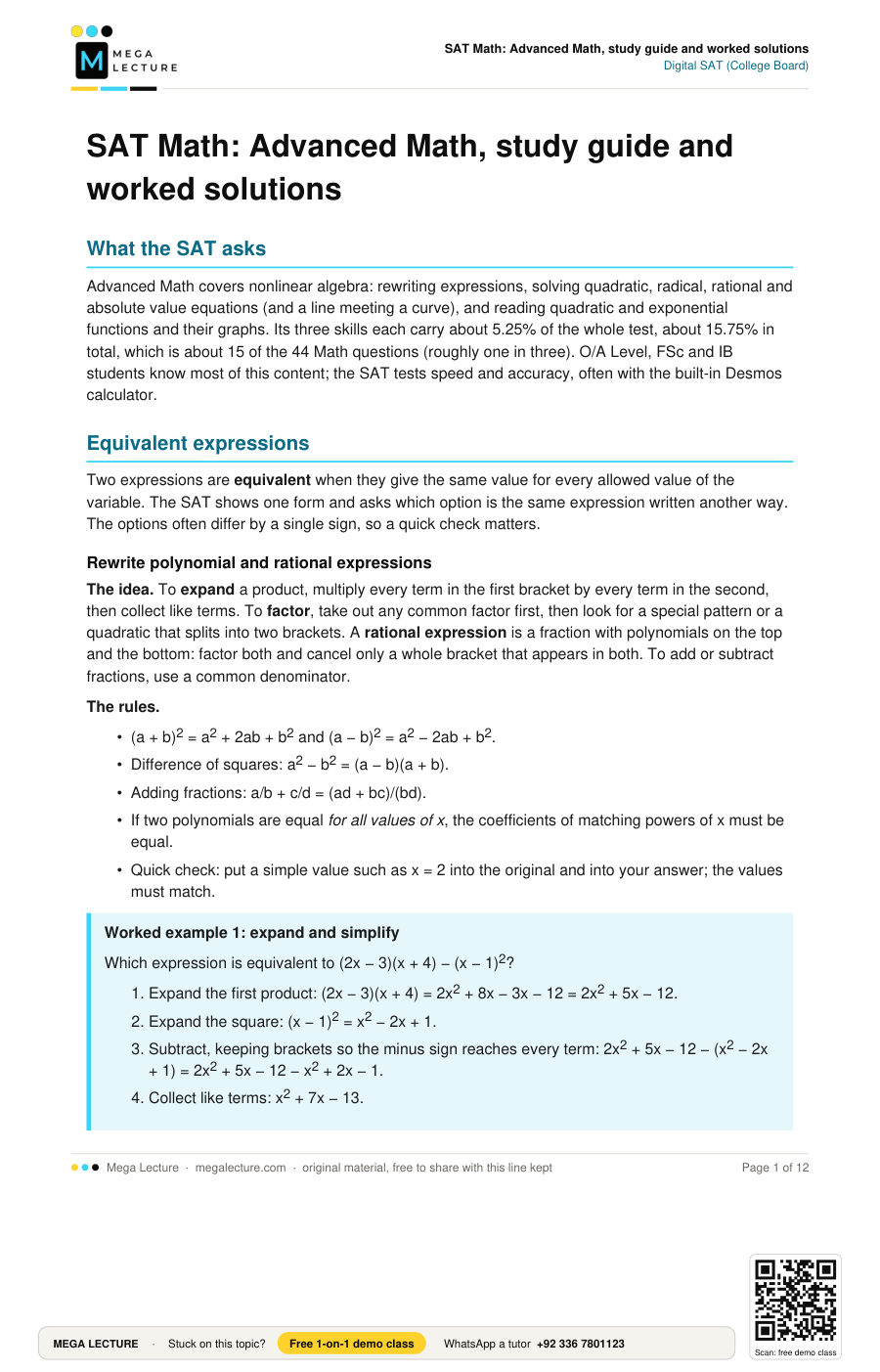
What the SAT asks
Advanced Math covers nonlinear algebra: rewriting expressions, solving quadratic, radical, rational and absolute value equations (and a line meeting a curve), and reading quadratic and exponential functions and their graphs. Its three skills each carry about 5.25% of the whole test, about 15.75% in total, which is about 15 of the 44 Math questions (roughly one in three). O/A Level, FSc and IB students know most of this content; the SAT tests speed and accuracy, often with the built-in Desmos calculator.
Equivalent expressions
Two expressions are equivalent when they give the same value for every allowed value of the variable. The SAT shows one form and asks which option is the same expression written another way. The options often differ by a single sign, so a quick check matters.
Rewrite polynomial and rational expressions
The idea. To expand a product, multiply every term in the first bracket by every term in the second, then collect like terms. To factor, take out any common factor first, then look for a special pattern or a quadratic that splits into two brackets. A rational expression is a fraction with polynomials on the top and the bottom: factor both and cancel only a whole bracket that appears in both. To add or subtract fractions, use a common denominator.
The rules.
- (a + b)2 = a2 + 2ab + b2 and (a − b)2 = a2 − 2ab + b2.
- Difference of squares: a2 − b2 = (a − b)(a + b).
- Adding fractions: a/b + c/d = (ad + bc)/(bd).
- If two polynomials are equal for all values of x, the coefficients of matching powers of x must be equal.
- Quick check: put a simple value such as x = 2 into the original and into your answer; the values must match.
Worked example 1: expand and simplify
Which expression is equivalent to (2x − 3)(x + 4) − (x − 1)2?
- Expand the first product: (2x − 3)(x + 4) = 2x2 + 8x − 3x − 12 = 2x2 + 5x − 12.
- Expand the square: (x − 1)2 = x2 − 2x + 1.
- Subtract, keeping brackets so the minus sign reaches every term: 2x2 + 5x − 12 − (x2 − 2x + 1) = 2x2 + 5x − 12 − x2 + 2x − 1.
- Collect like terms: x2 + 7x − 13.
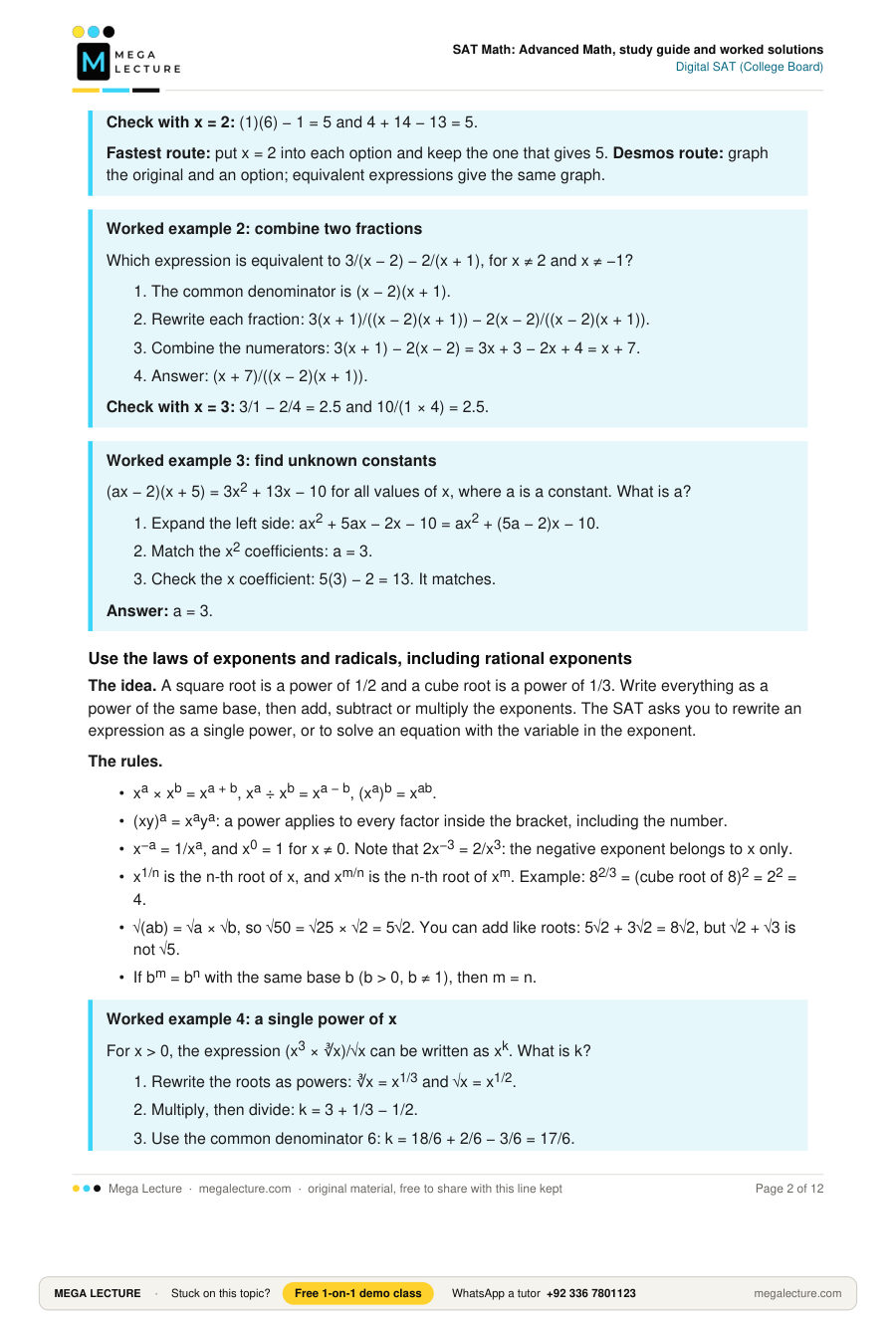
Check with x = 2: (1)(6) − 1 = 5 and 4 + 14 − 13 = 5.
Fastest route: put x = 2 into each option and keep the one that gives 5. Desmos route: graph the original and an option; equivalent expressions give the same graph.
Worked example 2: combine two fractions
Which expression is equivalent to 3/(x − 2) − 2/(x + 1), for x ≠ 2 and x ≠ −1?
- The common denominator is (x − 2)(x + 1).
- Rewrite each fraction: 3(x + 1)/((x − 2)(x + 1)) − 2(x − 2)/((x − 2)(x + 1)).
- Combine the numerators: 3(x + 1) − 2(x − 2) = 3x + 3 − 2x + 4 = x + 7.
- Answer: (x + 7)/((x − 2)(x + 1)).
Check with x = 3: 3/1 − 2/4 = 2.5 and 10/(1 × 4) = 2.5.
Worked example 3: find unknown constants
(ax − 2)(x + 5) = 3x2 + 13x − 10 for all values of x, where a is a constant. What is a?
- Expand the left side: ax2 + 5ax − 2x − 10 = ax2 + (5a − 2)x − 10.
- Match the x2 coefficients: a = 3.
- Check the x coefficient: 5(3) − 2 = 13. It matches.
Answer: a = 3.
Use the laws of exponents and radicals, including rational exponents
The idea. A square root is a power of 1/2 and a cube root is a power of 1/3. Write everything as a power of the same base, then add, subtract or multiply the exponents. The SAT asks you to rewrite an expression as a single power, or to solve an equation with the variable in the exponent.
The rules.
- xa × xb = xa + b, xa ÷ xb = xa − b, (xa)b = xab.
- (xy)a = xaya: a power applies to every factor inside the bracket, including the number.
- x−a = 1/xa, and x0 = 1 for x ≠ 0. Note that 2x−3 = 2/x3: the negative exponent belongs to x only.
- x1/n is the n-th root of x, and xm/n is the n-th root of xm. Example: 82/3 = (cube root of 8)2 = 22 = 4.
- √(ab) = √a × √b, so √50 = √25 × √2 = 5√2. You can add like roots: 5√2 + 3√2 = 8√2, but √2 + √3 is not √5.
- If bm = bn with the same base b (b > 0, b ≠ 1), then m = n.
Worked example 4: a single power of x
For x > 0, the expression (x3 × ∛x)/√x can be written as xk. What is k?
- Rewrite the roots as powers: ∛x = x1/3 and √x = x1/2.
- Multiply, then divide: k = 3 + 1/3 − 1/2.
- Use the common denominator 6: k = 18/6 + 2/6 − 3/6 = 17/6.
Check with x = 64: (262,144 × 4)/8 = 131,072 = 217 = 6417/6.
Worked example 5: the variable in the exponent
If 4x = 8x − 1, what is the value of x?
- Write both sides as powers of 2: 4 = 22 and 8 = 23.
- So (22)x = (23)x − 1, which gives 22x = 23x − 3.
- Same base, so the exponents are equal: 2x = 3x − 3, which gives x = 3.
Check: 43 = 64 and 82 = 64. Correct.
Desmos route: type y = 4^x and y = 8^(x − 1) and click the point where the graphs cross. Desmos shows (3, 64), so x = 3.
SAT trap: equivalent expressions
- Squaring term by term. (x + 3)2 is x2 + 6x + 9, not x2 + 9.
- Canceling terms instead of factors. In (x2 − 9)/(x2 + 5x + 6) you cannot cross out x2. Factor first: (x − 3)(x + 3)/((x + 2)(x + 3)) = (x − 3)/(x + 2).
- Adding fractions top to top and bottom to bottom. 2/(x + 3) + 5/(x − 1) is not 7/(2x + 2). Use a common denominator.
Nonlinear equations and systems
These questions ask you to solve an equation, find where a line meets a curve, or say how many solutions there are. The main danger is extraneous solutions: values your algebra produces that fail the original equation.
Solve quadratic equations and use the discriminant
The idea. Move every term to one side to get ax2 + bx + c = 0. Then factor (fastest with small numbers), use the quadratic formula (always works), or graph in Desmos and read the x-intercepts (fastest with messy numbers). The discriminant, b2 − 4ac, tells you how many real solutions there are without solving; the SAT often asks for a missing constant that gives exactly one solution or none.
The rules.
- Quadratic formula: x = (−b ± √(b2 − 4ac))/(2a).
- b2 − 4ac > 0: two real solutions. b2 − 4ac = 0: exactly one real solution. b2 − 4ac < 0: no real solution.
- For ax2 + bx + c = 0 with real solutions, the sum of the solutions is −b/a and the product is c/a.
- If (x − p)(x − q) = 0, then x = p or x = q.
- Never divide both sides by x (or by a bracket containing x): you may lose the solution that makes it zero. Factor it out instead.
Worked example 6: factor, then confirm with the formula
What are the solutions of 2x2 − 3x = 5?
- Move everything to one side: 2x2 − 3x − 5 = 0. So a = 2, b = −3, c = −5.
- Factor: −5 and 2 multiply to a × c = −10 and add to −3, so 2x2 − 5x + 2x − 5 = x(2x − 5) + 1(2x − 5) = (2x − 5)(x + 1).
- Set each factor to 0: 2x − 5 = 0 gives x = 5/2; x + 1 = 0 gives x = −1.
Check with the formula: b2 − 4ac = 9 + 40 = 49, so x = (3 ± 7)/4 = 5/2 or −1.
Desmos route: type y = 2x^2 − 3x − 5 and click the two x-intercepts: (−1, 0) and (2.5, 0).
Worked example 7: the discriminant with a missing constant
In the equation 3x2 + 4x + c = 0, c is a constant. The equation has no real solutions. Which values of c are possible?
- No real solutions means b2 − 4ac < 0.
- Here a = 3, b = 4, so 16 − 4(3)c < 0, which is 16 − 12c < 0.
- Rearrange: 16 < 12c, so c > 16/12 = 4/3.
Check: c = 2 gives 16 − 24 = −8 < 0 (no real solutions); c = 1 gives 16 − 12 = 4 > 0 (two solutions).
Desmos route: graph y = 3x^2 + 4x + c with a slider for c and watch when the curve leaves the x-axis.
Solve radical, rational and absolute value equations and linear-quadratic systems
The idea and the rules. Each type has one standard move, and each move has a risk.
- Radical equations: isolate the root, then square both sides. √(…) means the non-negative root, so it can never equal a negative number; squaring can create a false solution.
- Rational equations: multiply every term by the common denominator. A value that makes a denominator 0 can never be a solution.
- Absolute value: |A| = k with k ≥ 0 means A = k or A = −k. If k < 0, there is no solution.
- Line and parabola: set the two expressions for y equal. The quadratic you get has 2, 1 or 0 solutions, matching 2, 1 or 0 crossing points. Exactly one point means the line just touches the curve: discriminant = 0.
- After squaring or clearing fractions, check every answer in the original equation.
Worked example 8: a radical equation with a false solution
What is the solution set of √(x + 7) = x − 5?
- The root is already alone. Square both sides: x + 7 = (x − 5)2 = x2 − 10x + 25.
- Rearrange: x2 − 11x + 18 = 0.
- Factor: (x − 9)(x − 2) = 0, so x = 9 or x = 2.
- Check x = 9: √16 = 4 and 9 − 5 = 4. True.
- Check x = 2: √9 = 3 but 2 − 5 = −3. False, so reject x = 2.
Answer: x = 9 only.
Desmos route: type y = √(x + 7) and y = x − 5. The graphs cross only once, at (9, 4).
Worked example 9: a rational equation with no solution
How many solutions does x/(x − 3) = 3/(x − 3) + 2 have?
- x = 3 makes a denominator zero, so x = 3 is not allowed.
- Multiply every term by (x − 3): x = 3 + 2(x − 3).
- Simplify: x = 3 + 2x − 6 = 2x − 3, so x = 3.
- But x = 3 is not allowed, so it is rejected.
Answer: the equation has no solution.
Worked example 10: absolute value
What is the sum of the solutions of |2x − 5| = 9?
- Case 1: 2x − 5 = 9, so 2x = 14 and x = 7.
- Case 2: 2x − 5 = −9, so 2x = −4 and x = −2.
- Sum: 7 + (−2) = 5.
Worked example 11: a line and a parabola
y = x2 − 4x + 1 and y = 2x − 7. Find the points (x, y) that satisfy both equations.
- Set the expressions equal: x2 − 4x + 1 = 2x − 7.
- Move everything to one side: x2 − 6x + 8 = 0.
- Factor: (x − 2)(x − 4) = 0, so x = 2 or x = 4.
- Find y from the line: x = 2 gives y = 4 − 7 = −3; x = 4 gives y = 8 − 7 = 1.
Check in the parabola: 4 − 8 + 1 = −3 and 16 − 16 + 1 = 1. The points are (2, −3) and (4, 1).
Desmos route: type both equations and click the two intersection points.
SAT trap: nonlinear equations
- Keeping every answer after squaring. In worked example 8, x = 2 fails the original equation; the trap option is "2 and 9".
- Dividing by x. From x2 = 5x, dividing by x loses x = 0. Write x(x − 5) = 0: x = 0 or x = 5.
- Forgetting the second case. |x − 4| = 6 has two solutions, 10 and −2.
Nonlinear functions
The SAT gives a function as an equation, table, graph or real-life model and asks what a part of it means or what it gives for an input. The main families are quadratic and exponential functions.
Interpret quadratic and exponential functions, including vertex, zeros and growth or decay
Quadratic functions. The graph is a parabola that opens upward when a > 0 (a minimum) and downward when a < 0 (a maximum). The vertex is the turning point; the zeros are the x-intercepts, and the vertex lies halfway between them. For a thrown ball, the y-intercept is the starting height and the vertex is the greatest height.
Exponential functions. f(t) = a(b)t starts at a and multiplies by b in each unit of time: growth if b > 1, decay if 0 < b < 1. Linear functions add the same amount each step; exponential functions multiply.
The rules.
- Vertex form: y = a(x − h)2 + k has vertex (h, k).
- Standard form: y = ax2 + bx + c has its vertex at x = −b/(2a), and its y-intercept is c.
- Factored form: y = a(x − p)(x − q) has zeros p and q, and the vertex is at x = (p + q)/2.
- Growth of r% per period: b = 1 + r/100. Decay of r% per period: b = 1 − r/100. So 5% growth gives 1.05, and 15% decay gives 0.85.
- In a(b)t/k, the quantity is multiplied by b once every k units of time. For example, 300(2)t/4 doubles every 4 hours.
Worked example 12: a ball in the air
A ball is thrown upward. Its height in meters, t seconds after it is thrown, is h(t) = −5t2 + 20t + 25. Find (a) the starting height, (b) the greatest height, (c) when the ball reaches the ground.
- (a) h(0) = 25, so the ball starts 25 meters up.
- (b) a = −5 < 0, so there is a maximum at t = −b/(2a) = −20/(−10) = 2.
- h(2) = −5(4) + 20(2) + 25 = −20 + 40 + 25 = 45. The greatest height is 45 meters, 2 seconds after the throw.
- (c) Set h(t) = 0: −5t2 + 20t + 25 = 0. Divide by −5: t2 − 4t − 5 = 0, so (t − 5)(t + 1) = 0, and t = 5 or t = −1.
- Time is not negative, so it lands at 5 seconds.
Check: t = 2 is halfway between the zeros −1 and 5.
Desmos route: type y = −5x^2 + 20x + 25. Click the top of the curve to see (2, 45) and the right x-intercept to see (5, 0).
Worked example 13: reading exponential models
- A car's value is V(t) = 18,000(0.85)t dollars, t years after purchase. It starts at 18,000 dollars, and since 0.85 = 1 − 15/100, it loses 15% of its value each year.
- A bacteria count is N(t) = 300(2)t/4, t hours after the start: it doubles every 4 hours. After 12 hours: N(12) = 300(2)3 = 300 × 8 = 2,400.
Check: 300, 600, 1,200, 2,400 at 0, 4, 8 and 12 hours.
Use function notation, composition and transformations of graphs
The idea. f(3) means "put 3 in place of x"; f(x + 1) means "put the whole bracket (x + 1) in place of x". f(g(x)) means: work out g(x) first, then put the result into f; in general f(g(x)) and g(f(x)) are different. Changing the rule of a function moves its graph in four basic ways; check the direction with one point.
The rules.
- y = f(x − c) shifts the graph c units right (for c > 0); y = f(x + c) shifts it c units left.
- y = f(x) + d shifts the graph d units up; y = f(x) − d shifts it d units down.
- y = −f(x) reflects the graph across the x-axis (every y-value changes sign).
- y = f(−x) reflects the graph across the y-axis (every x-value changes sign).
Worked example 14: composition from a table
| x | 1 | 2 | 3 | 4 |
|---|---|---|---|---|
| f(x) | 4 | −1 | 2 | 3 |
| g(x) | 3 | 1 | 4 | 2 |
Using the table, what is f(g(2))?
- Inside first: in the g(x) row, under x = 2, g(2) = 1.
- Now f(1): in the f(x) row, under x = 1, f(1) = 4.
Answer: f(g(2)) = 4.
Worked example 15: moving a vertex
The graph of y = f(x) is a parabola with vertex (2, −1). What is the vertex of the graph of y = f(x + 4) + 3?
- f(x + 4) shifts the graph 4 units left: (2 − 4, −1) = (−2, −1).
- + 3 shifts it 3 units up: (−2, −1 + 3) = (−2, 2).
Check: at x = −2, f(−2 + 4) + 3 = f(2) + 3 = −1 + 3 = 2.
Desmos route: when f is given, say f(x) = (x − 2)^2 − 1, type it, then type y = f(x + 4) + 3 and click the new vertex.
SAT trap: nonlinear functions
- Giving where instead of what. The maximum height is the vertex y-value (45 in worked example 12), not the time (2).
- Mixing up the decay factor. A 15% decrease per year means multiplying by 0.85, not by 0.15. And in 60,000(0.92)t the quantity falls by 8% a year; it does not fall by 92%.
- Shifting the wrong way. f(x − 3) moves the graph right, not left.
Practice set
11 multiple choice and 3 student-produced response questions. Aim for about 75 seconds each; Desmos is allowed.
1. Which expression is equivalent to (3x − 2)(x + 5)?
A) 3x2 − 10
B) 3x2 + 13x − 10
C) 3x2 + 17x − 10
D) 3x2 + 13x + 10
2. For x > 0, which expression is equivalent to (x5)1/2 × x−1?
A) x7/2
B) x−5/2
C) x2
D) √(x3)
3. Which expression is equivalent to 2/(x + 3) + 5/(x − 1), for x ≠ −3 and x ≠ 1?
A) (7x + 13)/((x + 3)(x − 1))
B) 7/(2x + 2)
C) (7x + 17)/((x + 3)(x − 1))
D) (7x + 1)/((x + 3)(x − 1))
4. If 9x + 1 = 27x − 1, what is the value of x?
A) 2
B) −5
C) 5
D) 3
5. (Student-produced response) In the equation (ax + 3)(2x − 5) = 8x2 + bx − 15, a and b are constants, and the equation is true for all values of x. What is the value of a + b?
6. In the equation 2x2 − 8x + c = 0, c is a constant. For which value of c does the equation have exactly one real solution?
A) 2
B) −8
C) 8
D) 16
7. (Student-produced response) What is the sum of the solutions of 3x2 − 12x − 7 = 0?
8. What are all the solutions of x − 1 = √(x + 11)?
A) −2 only
B) 5 only
C) −2 and 5
D) There is no solution.
9. In the xy-plane, the graphs of y = x2 + 2x − 3 and y = 4x + k, where k is a constant, intersect at exactly one point. What is the value of k?
A) −4
B) −3
C) 4
D) −2
10. The population of a town t years after 2020 is modeled by P(t) = 48,000(0.97)t. Which statement best describes the model?
A) The population increases by 97% each year.
B) The population decreases by 97% each year.
C) The population increases by 3% each year.
D) The population decreases by 3% each year.
11. The height, in feet, of a ball t seconds after it is hit is h(t) = −16t2 + 64t + 5. What is the greatest height, in feet, the ball reaches?
A) 2
B) 5
C) 69
D) 197
12. (Student-produced response) A culture starts with 150 bacteria, and the number of bacteria triples every 6 hours. The number of bacteria t hours after the start is modeled by N(t) = 150(3)t/6. After how many hours will there be 4,050 bacteria?
13. The functions f and g are defined by f(x) = 2x − 5 and g(x) = x2 + 1. What is the value of f(g(3))?
A) 15
B) 14
C) 10
D) 2
14. The graph of the quadratic function y = f(x) in the xy-plane has its vertex at (−2, 5). The function g is defined by g(x) = −f(x − 3) + 2. What is the vertex of the graph of y = g(x)?
A) (−5, −3)
B) (1, −3)
C) (1, 7)
D) (1, −7)
Solutions
1. Answer: B
- Multiply term by term: 3x2 + 15x − 2x − 10.
- Collect the x terms: 15x − 2x = 13x.
- Result: 3x2 + 13x − 10.
Check with x = 1: (1)(6) = 6 and 3 + 13 − 10 = 6. A forgets the middle terms, C uses 15x + 2x, and D gets the sign of −2 × 5 wrong.
Skill: Equivalent expressions
2. Answer: D
- (x5)1/2 = x5 × 1/2 = x5/2.
- Multiply by x−1: add the exponents, 5/2 + (−1) = 5/2 − 2/2 = 3/2.
- x3/2 is the square root of x3, so the answer is √(x3).
A adds 1 instead of subtracting it, B multiplies the exponents 5/2 and −1, and C applies the 1/2 power to x−1 as well (√(x4)).
Skill: Equivalent expressions
3. Answer: A
- Common denominator: (x + 3)(x − 1).
- New numerators: 2(x − 1) = 2x − 2 and 5(x + 3) = 5x + 15.
- Add: 2x − 2 + 5x + 15 = 7x + 13.
- Answer: (7x + 13)/((x + 3)(x − 1)).
Check with x = 2: 2/5 + 5/1 = 5.4, and 27/(5 × 1) = 5.4. B adds tops and bottoms separately, C turns −2 into +2, and D forgets to multiply 3 by 5.
Skill: Equivalent expressions
4. Answer: C
- Use base 3: (32)x + 1 = 32x + 2 and (33)x − 1 = 33x − 3.
- Same base, so 2x + 2 = 3x − 3, which gives x = 5.
Check: 96 = 312 and 274 = 312. A comes from 2x + 1 = 3x − 1 (not multiplying the whole exponent), B is a sign error, and D comes from 2x + 2 = 3x − 1.
Skill: Equivalent expressions
5. Answer: −10 (accept −10 only)
- Expand the left side: 2ax2 − 5ax + 6x − 15 = 2ax2 + (6 − 5a)x − 15.
- Match the x2 coefficients: 2a = 8, so a = 4.
- Match the x coefficients: b = 6 − 5a = 6 − 20 = −14.
- a + b = 4 + (−14) = −10.
Check with x = 1: (4 + 3)(2 − 5) = 7 × (−3) = −21, and 8 − 14 − 15 = −21.
Skill: Equivalent expressions
6. Answer: C
- Exactly one real solution means b2 − 4ac = 0.
- Here a = 2, b = −8: (−8)2 − 4(2)c = 64 − 8c = 0.
- So 8c = 64 and c = 8.
Check: 2x2 − 8x + 8 = 2(x − 2)2, which is 0 only at x = 2. A is that solution x = 2, not the value of c. B is a sign error, and D comes from 64 − 4c = 0 (forgetting a = 2).
Skill: Nonlinear equations and systems
7. Answer: 4 (accept 4, 4.0)
- Real solutions exist: b2 − 4ac = 144 + 84 = 228 > 0.
- Sum of solutions = −b/a = −(−12)/3 = 12/3 = 4.
Desmos route: graph y = 3x^2 − 12x − 7, click both x-intercepts (about −0.517 and 4.517) and add them.
Skill: Nonlinear equations and systems
8. Answer: B
- Square both sides: (x − 1)2 = x + 11, so x2 − 2x + 1 = x + 11.
- Rearrange: x2 − 3x − 10 = 0.
- Factor: (x − 5)(x + 2) = 0, so x = 5 or x = −2.
- Check x = 5: left side 5 − 1 = 4, right side √16 = 4. True.
- Check x = −2: left side −2 − 1 = −3, right side √9 = 3. False, so reject it.
C keeps the extraneous solution, A keeps only the wrong one, and D wrongly rejects both.
Skill: Nonlinear equations and systems
9. Answer: A
- Set equal: x2 + 2x − 3 = 4x + k.
- Rearrange: x2 − 2x − (3 + k) = 0, so a = 1, b = −2, c = −3 − k.
- One intersection point means b2 − 4ac = 0: 4 − 4(1)(−3 − k) = 4 + 12 + 4k = 16 + 4k = 0.
- So k = −4.
Check: with k = −4, x2 − 2x + 1 = (x − 1)2 = 0, so x = 1 only, and both graphs pass through (1, 0). B is the parabola's y-intercept, C is a sign error, and D comes from adding 4ac instead of subtracting it: 4 + 4(−3 − k) = 0.
Skill: Nonlinear equations and systems
10. Answer: D
- b = 0.97 is between 0 and 1, so the population decreases.
- 0.97 = 1 − 0.03 = 1 − 3/100, so it decreases by 3% each year (each year the population is 97% of the year before).
A and B read 0.97 as the percent change, and C has the right size but the wrong direction.
Skill: Nonlinear functions
11. Answer: C
- a = −16 < 0, so the parabola opens downward and the vertex is the greatest height.
- Vertex time: t = −b/(2a) = −64/(2 × (−16)) = −64/(−32) = 2.
- h(2) = −16(4) + 64(2) + 5 = −64 + 128 + 5 = 69.
A is the time of the greatest height, not the height. B is the starting height h(0). D comes from a sign error, treating −16(2)2 as +64: 64 + 128 + 5 = 197. Desmos route: graph y = −16x^2 + 64x + 5 and click the top point, (2, 69).
Skill: Nonlinear functions
12. Answer: 18 (accept 18)
- Set N(t) = 4,050: 150(3)t/6 = 4,050.
- Divide by 150: 3t/6 = 27.
- 27 = 33, so t/6 = 3.
- t = 18.
Check: 150, 450, 1,350, 4,050 at 0, 6, 12, 18 hours. Desmos route: type y = 150(3)^(x/6) and y = 4050 and click the intersection, (18, 4050).
Skill: Nonlinear functions
13. Answer: A
- Inside first: g(3) = 32 + 1 = 10.
- Then f(10) = 2(10) − 5 = 15.
B comes from writing f(g(x)) as 2x2 + 1 − 5 (multiplying only x2 by 2) and putting in 3: 18 − 4 = 14. C stops after g(3). D is g(f(3)): f(3) = 1, g(1) = 2, the wrong order.
Skill: Nonlinear functions
14. Answer: B
- f(x − 3) shifts the graph 3 units right: (−2, 5) moves to (1, 5).
- The minus sign in −f(x − 3) reflects across the x-axis: (1, 5) becomes (1, −5).
- + 2 shifts up 2 units: (1, −5) becomes (1, −3).
Check: g(1) = −f(−2) + 2 = −5 + 2 = −3. A shifts left instead of right. C ignores the reflection (5 + 2 = 7). D reflects after adding 2: −(5 + 2) = −7.
Skill: Nonlinear functions
