
Edexcel · Chemistry · The mole concept: counting particles by weighing, with practice
The mole concept: counting particles by weighing, with practice
The Daily 5 Five questions a day on Edexcel Chemistry: two minutes, new every day, with a streak to keep Play today’s →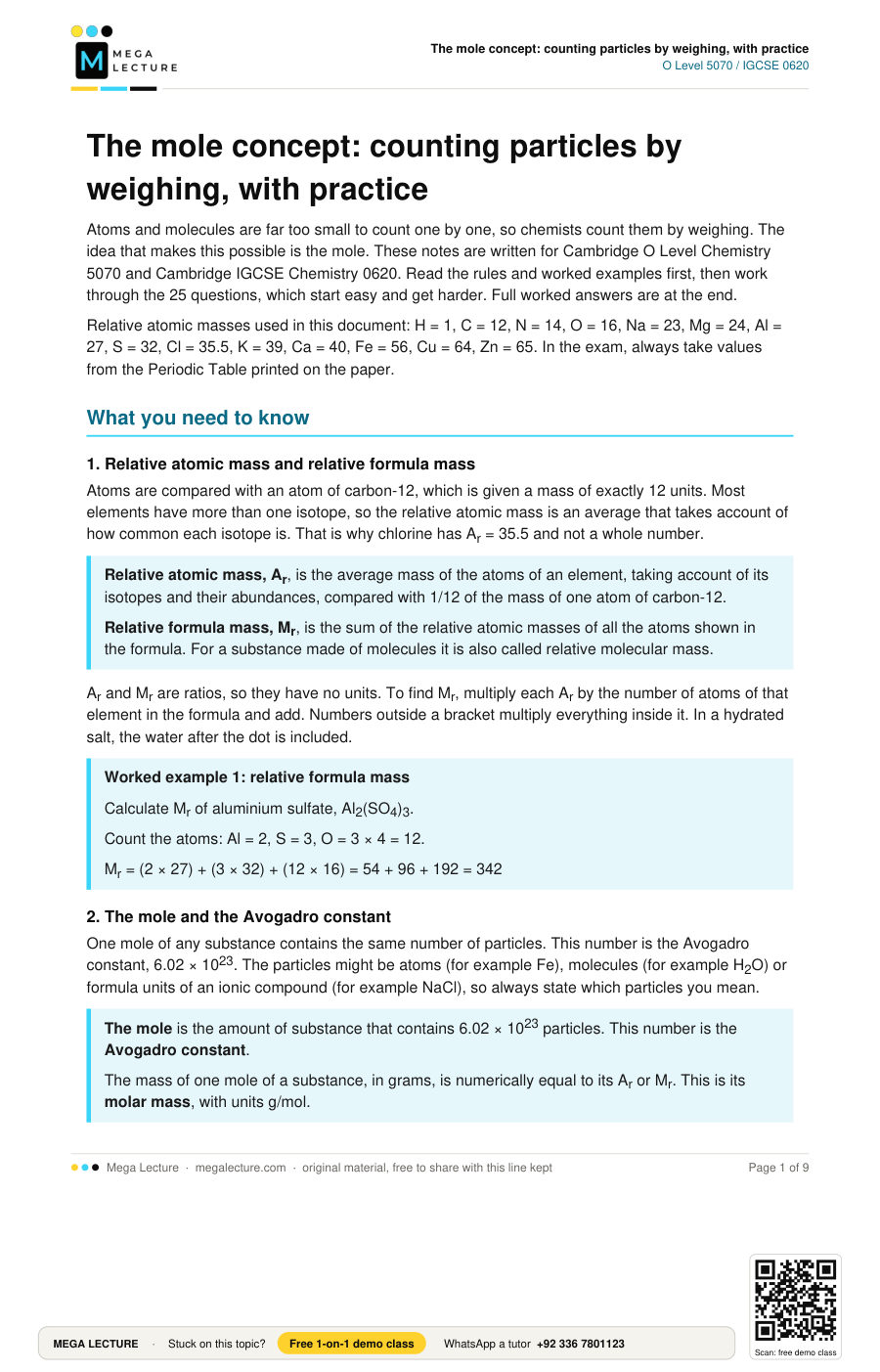
Opens inside this page. Prefer your own PDF app? Open the PDF.
Chemistry batch classes: coming soon. Small live classes at a lower fee than one-to-one. Join the waiting list
Check yourself
5 quick questions on Edexcel Chemistry
Tap an answer to see if you are right, and why. Free, no sign-up.
Start the free testWas this note useful?
Full text of The mole concept: counting particles by weighing, with practice
Atoms and molecules are far too small to count one by one, so chemists count them by weighing. The idea that makes this possible is the mole. These notes are written for Cambridge O Level Chemistry 5070 and Cambridge IGCSE Chemistry 0620. Read the rules and worked examples first, then work through the 25 questions, which start easy and get harder. Full worked answers are at the end.
Relative atomic masses used in this document: H = 1, C = 12, N = 14, O = 16, Na = 23, Mg = 24, Al = 27, S = 32, Cl = 35.5, K = 39, Ca = 40, Fe = 56, Cu = 64, Zn = 65. In the exam, always take values from the Periodic Table printed on the paper.
What you need to know
1. Relative atomic mass and relative formula mass
Atoms are compared with an atom of carbon-12, which is given a mass of exactly 12 units. Most elements have more than one isotope, so the relative atomic mass is an average that takes account of how common each isotope is. That is why chlorine has Ar = 35.5 and not a whole number.
Relative atomic mass, Ar, is the average mass of the atoms of an element, taking account of its isotopes and their abundances, compared with 1/12 of the mass of one atom of carbon-12.
Relative formula mass, Mr, is the sum of the relative atomic masses of all the atoms shown in the formula. For a substance made of molecules it is also called relative molecular mass.
Ar and Mr are ratios, so they have no units. To find Mr, multiply each Ar by the number of atoms of that element in the formula and add. Numbers outside a bracket multiply everything inside it. In a hydrated salt, the water after the dot is included.
Worked example 1: relative formula mass
Calculate Mr of aluminium sulfate, Al2(SO4)3.
Count the atoms: Al = 2, S = 3, O = 3 × 4 = 12.
Mr = (2 × 27) + (3 × 32) + (12 × 16) = 54 + 96 + 192 = 342
2. The mole and the Avogadro constant
One mole of any substance contains the same number of particles. This number is the Avogadro constant, 6.02 × 10²³. The particles might be atoms (for example Fe), molecules (for example H2O) or formula units of an ionic compound (for example NaCl), so always state which particles you mean.
The mole is the amount of substance that contains 6.02 × 10²³ particles. This number is the Avogadro constant.
The mass of one mole of a substance, in grams, is numerically equal to its Ar or Mr. This is its molar mass, with units g/mol.
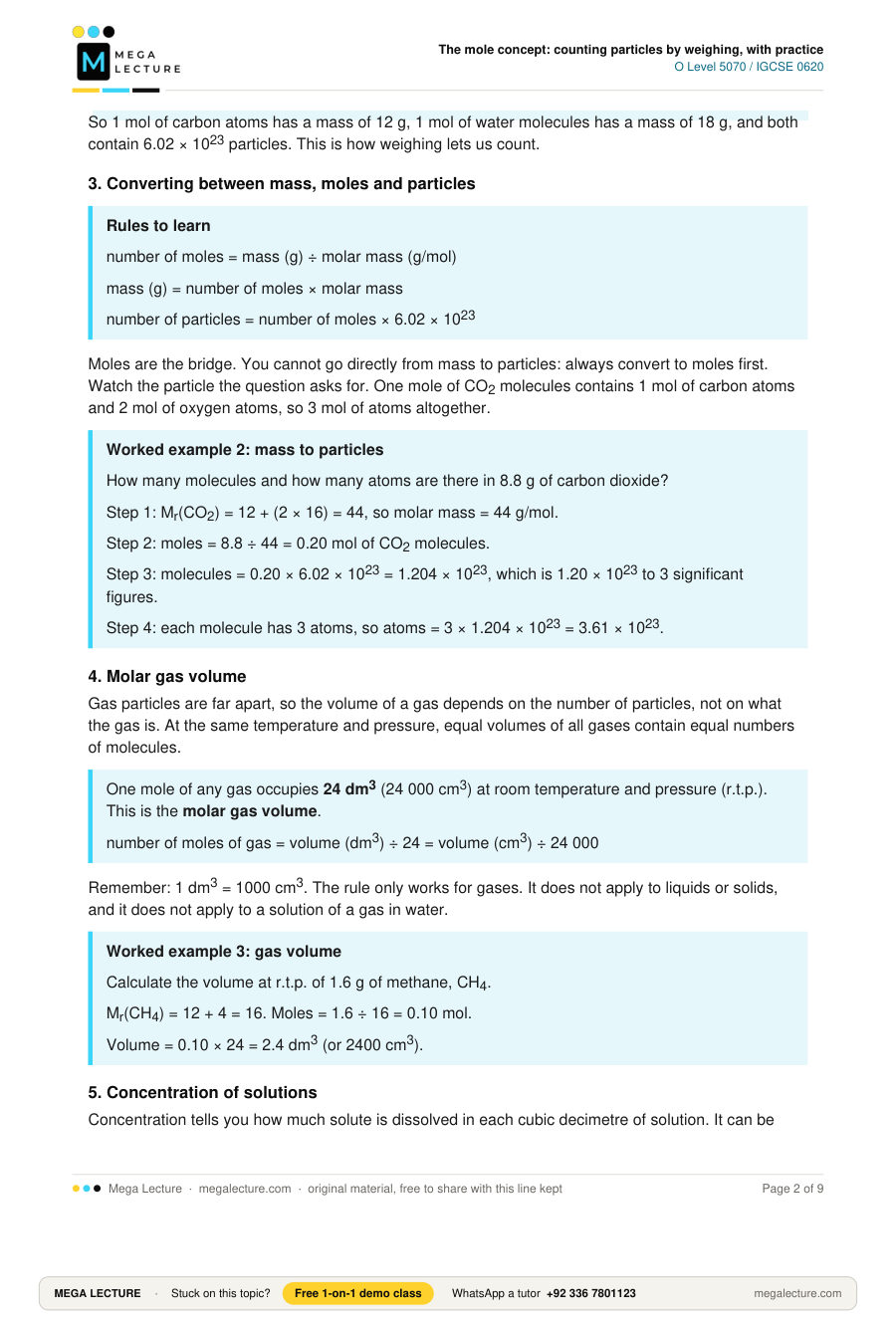
So 1 mol of carbon atoms has a mass of 12 g, 1 mol of water molecules has a mass of 18 g, and both contain 6.02 × 10²³ particles. This is how weighing lets us count.
3. Converting between mass, moles and particles
Rules to learn
number of moles = mass (g) ÷ molar mass (g/mol)
mass (g) = number of moles × molar mass
number of particles = number of moles × 6.02 × 10²³
Moles are the bridge. You cannot go directly from mass to particles: always convert to moles first. Watch the particle the question asks for. One mole of CO2 molecules contains 1 mol of carbon atoms and 2 mol of oxygen atoms, so 3 mol of atoms altogether.
Worked example 2: mass to particles
How many molecules and how many atoms are there in 8.8 g of carbon dioxide?
Step 1: Mr(CO2) = 12 + (2 × 16) = 44, so molar mass = 44 g/mol.
Step 2: moles = 8.8 ÷ 44 = 0.20 mol of CO2 molecules.
Step 3: molecules = 0.20 × 6.02 × 1023 = 1.204 × 10²³, which is 1.20 × 10²³ to 3 significant figures.
Step 4: each molecule has 3 atoms, so atoms = 3 × 1.204 × 1023 = 3.61 × 10²³.
4. Molar gas volume
Gas particles are far apart, so the volume of a gas depends on the number of particles, not on what the gas is. At the same temperature and pressure, equal volumes of all gases contain equal numbers of molecules.
One mole of any gas occupies 24 dm3 (24 000 cm3) at room temperature and pressure (r.t.p.). This is the molar gas volume.
number of moles of gas = volume (dm3) ÷ 24 = volume (cm3) ÷ 24 000
Remember: 1 dm3 = 1000 cm3. The rule only works for gases. It does not apply to liquids or solids, and it does not apply to a solution of a gas in water.
Worked example 3: gas volume
Calculate the volume at r.t.p. of 1.6 g of methane, CH4.
Mr(CH4) = 12 + 4 = 16. Moles = 1.6 ÷ 16 = 0.10 mol.
Volume = 0.10 × 24 = 2.4 dm3 (or 2400 cm3).
5. Concentration of solutions
Concentration tells you how much solute is dissolved in each cubic decimetre of solution. It can be given in moles or in grams.
concentration (mol/dm3) = number of moles of solute ÷ volume of solution (dm3)
concentration (g/dm3) = mass of solute (g) ÷ volume of solution (dm3)
concentration (g/dm3) = concentration (mol/dm3) × molar mass
Volumes in titrations are usually measured in cm3. Divide by 1000 to change cm3 into dm3 before you use the formula. A common slip is to forget this step and get an answer 1000 times too big.
Worked example 4: titration
25.0 cm3 of sodium hydroxide solution is exactly neutralised by 20.0 cm3 of 0.125 mol/dm3 hydrochloric acid. Calculate the concentration of the sodium hydroxide in mol/dm3 and in g/dm3.
Equation: NaOH + HCl → NaCl + H2O (mole ratio 1 : 1)
Moles of HCl = 0.125 × (20.0 ÷ 1000) = 0.00250 mol
Moles of NaOH = 0.00250 mol (1 : 1 ratio)
Concentration of NaOH = 0.00250 ÷ (25.0 ÷ 1000) = 0.100 mol/dm3
Mr(NaOH) = 23 + 16 + 1 = 40, so concentration = 0.100 × 40 = 4.00 g/dm3
6. Empirical and molecular formulae
The empirical formula is the simplest whole number ratio of the atoms of each element in a compound.
The molecular formula is the actual number of atoms of each element in one molecule.
Method for the empirical formula: (1) write the mass or percentage of each element; (2) divide each by its Ar to get moles; (3) divide every answer by the smallest; (4) if a value is close to a half or a third (for example 1.5 or 1.33), multiply all values by 2 or 3 to get whole numbers. Do not round 1.5 to 2.
Method for the molecular formula: find the Mr of the empirical formula, divide the given Mr by it, and multiply every subscript in the empirical formula by the answer.
Worked example 5: empirical and molecular formula
A compound contains 40.0% carbon, 6.7% hydrogen and 53.3% oxygen by mass. Its Mr is 60. Find its empirical and molecular formulae.
| C | H | O | |
|---|---|---|---|
| mass in 100 g | 40.0 | 6.7 | 53.3 |
| moles (÷ Ar) | 40.0 ÷ 12 = 3.33 | 6.7 ÷ 1 = 6.7 | 53.3 ÷ 16 = 3.33 |
| ÷ smallest (3.33) | 1 | 2.0 | 1 |
Empirical formula = CH2O. Its Mr = 12 + 2 + 16 = 30.
60 ÷ 30 = 2, so the molecular formula is C2H4O2.
The same method finds the number of molecules of water of crystallisation, x, in a hydrated salt: work out the moles of anhydrous salt and the moles of water lost on heating, then find the ratio.
7. Reacting masses from equations
A balanced equation gives the ratio of moles, not of masses. The method is always the same three steps.
Three steps for any reacting mass or volume question
1. Change the quantity you know into moles.
2. Use the balanced equation to find the moles of the substance you want (use the mole ratio).
3. Change those moles into the quantity asked for (mass, gas volume, particles or concentration).
Worked example 6: reacting masses
Calculate the mass of aluminium oxide formed when 5.4 g of aluminium burns completely in oxygen.
4Al + 3O2 → 2Al2O3
Step 1: moles of Al = 5.4 ÷ 27 = 0.20 mol
Step 2: ratio Al : Al2O3 = 4 : 2 = 2 : 1, so moles of Al2O3 = 0.20 ÷ 2 = 0.10 mol
Step 3: Mr(Al2O3) = (2 × 27) + (3 × 16) = 102. Mass = 0.10 × 102 = 10.2 g
For large-scale questions in tonnes or kilograms, you can work in grams, or use the fact that the mass ratio stays the same whatever unit you use: if 160 g of a reactant gives 112 g of product, then 160 tonnes gives 112 tonnes.
8. Limiting reagent
In many reactions one reactant is used up first. This is the limiting reagent, and it decides how much product forms. The other reactant is in excess, so some of it is left over.
How to find the limiting reagent
1. Work out the moles of each reactant.
2. Use the equation to find how many moles of the second reactant are needed to react with all of the first.
3. If you have less than that, the second reactant is limiting. If you have more, the first reactant is limiting.
4. Always calculate the amount of product from the limiting reagent.
Worked example 7: limiting reagent
6.5 g of zinc is added to 100 cm3 of 1.00 mol/dm3 hydrochloric acid. Zn + 2HCl → ZnCl2 + H2. Which reactant is in excess, and what volume of hydrogen forms at r.t.p.?
Moles of Zn = 6.5 ÷ 65 = 0.10 mol. Moles of HCl = 1.00 × 0.100 = 0.10 mol.
0.10 mol of Zn would need 2 × 0.10 = 0.20 mol of HCl. Only 0.10 mol is present, so HCl is the limiting reagent and zinc is in excess.
Moles of H2 = 0.10 ÷ 2 = 0.050 mol. Volume = 0.050 × 24 = 1.2 dm3.
9. Percentage yield and percentage purity
percentage yield = (actual mass of product obtained ÷ theoretical maximum mass) × 100
percentage purity = (mass of pure substance in the sample ÷ total mass of the sample) × 100
The theoretical mass is what you calculate from the equation, using the limiting reagent. The actual yield is usually lower because the reaction may be reversible and not go to completion, some product is lost when filtering, transferring or crystallising, and side reactions may form other products. A yield above 100% usually means the product is still wet or impure.
For purity, you usually react the impure sample, measure how much product or gas forms, work back to the mass of pure substance, and compare it with the mass of sample you started with. The method assumes the impurities do not react.
Worked example 8: percentage yield
A student heats 10.0 g of calcium carbonate and obtains 4.9 g of calcium oxide. CaCO3 → CaO + CO2. Calculate the percentage yield.
Mr(CaCO3) = 40 + 12 + 48 = 100. Moles = 10.0 ÷ 100 = 0.100 mol.
Ratio 1 : 1, so 0.100 mol of CaO. Mr(CaO) = 56. Theoretical mass = 0.100 × 56 = 5.6 g.
Percentage yield = (4.9 ÷ 5.6) × 100 = 87.5%
Exam tips
Show every step, with units: method marks are given even if the final number is wrong.
Keep at least 3 significant figures in working and round only at the end. Give the final answer to the same number of significant figures as the data, usually 2 or 3.
Always check that the equation is balanced before you use its mole ratio.
Questions
The questions are grouped from easier to harder. Use the relative atomic masses at the top of this document, the Avogadro constant 6.02 × 10²³ and the molar gas volume 24 dm3 at r.t.p.
Section A: formula mass, moles and particles
1. Calculate the relative formula mass of carbon dioxide, CO2. [1]
2. Calculate the relative formula mass of calcium hydroxide, Ca(OH)2. [1]
3. Calculate the relative formula mass of hydrated copper(II) sulfate, CuSO4.5H2O. [2]
4. Calculate the number of moles in 11 g of carbon dioxide. [1]
5. Calculate the mass of 0.20 mol of sodium hydroxide, NaOH. [2]
6. A beaker contains 9.0 g of water. Calculate (a) the number of water molecules and (b) the total number of atoms. [3]
7. Calculate the percentage by mass of nitrogen in ammonium nitrate, NH4NO3. [2]
Section B: gases and solutions
8. Calculate the volume, in dm3, occupied by 3.2 g of oxygen gas, O2, at r.t.p. [2]
9. Calculate the mass of 600 cm3 of methane, CH4, at r.t.p. [2]
10. 4.0 g of sodium hydroxide is dissolved in water and the solution is made up to 250 cm3. Calculate the concentration in (a) mol/dm3 and (b) g/dm3. [3]
11. Calculate the number of moles, and the mass, of sulfuric acid, H2SO4, in 25.0 cm3 of 0.200 mol/dm3 solution. [3]
Section C: formulae from data
12. A hydrocarbon contains 2.4 g of carbon combined with 0.6 g of hydrogen. Its relative molecular mass is 30. Find (a) the empirical formula and (b) the molecular formula. [4]
13. A white solid contains 32.4% sodium, 22.5% sulfur and 45.1% oxygen by mass. Calculate its empirical formula. [3]
14. 5.00 g of hydrated magnesium sulfate, MgSO4.xH2O, is heated until all the water is lost. The mass of anhydrous MgSO4 left is 2.44 g. Calculate the value of x. [4]
Section D: reacting masses and gas volumes
15. Calcium carbonate decomposes on heating: CaCO3 → CaO + CO2. Calculate the mass of calcium oxide formed from 25 g of calcium carbonate. [3]
16. Using the same reaction, calculate the volume of carbon dioxide, at r.t.p., given off from 25 g of calcium carbonate. [2]
17. In the blast furnace, Fe2O3 + 3CO → 2Fe + 3CO2. Calculate the maximum mass of iron, in tonnes, that can be obtained from 1.6 tonnes of iron(III) oxide. [3]
18. 25.0 cm3 of sodium hydroxide solution is exactly neutralised by 20.0 cm3 of 0.100 mol/dm3 sulfuric acid. H2SO4 + 2NaOH → Na2SO4 + 2H2O. Calculate the concentration of the sodium hydroxide in (a) mol/dm3 and (b) g/dm3. [4]
19. 0.48 g of magnesium ribbon reacts with excess dilute hydrochloric acid. Mg + 2HCl → MgCl2 + H2. Calculate the volume of hydrogen formed, in cm3, at r.t.p. [3]
Section E: limiting reagent, yield and purity
20. 2.4 g of magnesium is added to 50.0 cm3 of 1.00 mol/dm3 hydrochloric acid. Mg + 2HCl → MgCl2 + H2. (a) Show which reactant is limiting. (b) Calculate the volume of hydrogen, in cm3, at r.t.p. (c) Calculate the mass of the reactant left over. [5]
21. 5.6 g of iron is heated with 4.0 g of sulfur. Fe + S → FeS. (a) Identify the limiting reagent. (b) Calculate the maximum mass of iron(II) sulfide formed. (c) Calculate the mass of the excess reactant that remains. [5]
22. 12.0 g of calcium carbonate is heated and 5.6 g of calcium oxide is collected. Calculate the percentage yield. Suggest one reason why the yield is less than 100%. [4]
23. In a test run of the Haber process, N2 + 3H2 ⇌ 2NH3, 14 kg of nitrogen reacts with excess hydrogen and 2.55 kg of ammonia is produced. Calculate the percentage yield and explain why the yield is low. [4]
24. A 10.0 g sample of impure limestone reacts with excess hydrochloric acid. 1.92 dm3 of carbon dioxide is collected at r.t.p. CaCO3 + 2HCl → CaCl2 + H2O + CO2. Calculate the percentage purity of the limestone. State one assumption you have made. [5]
25. A student makes copper(II) sulfate crystals by adding excess copper(II) oxide to 50.0 cm3 of 1.00 mol/dm3 sulfuric acid, filtering, and crystallising the filtrate. CuO + H2SO4 → CuSO4 + H2O. Each mole of CuSO4 gives one mole of CuSO4.5H2O crystals. (a) Explain why copper(II) oxide is added in excess. (b) Calculate the theoretical mass of CuSO4.5H2O crystals. (c) The student obtains 9.5 g of dry crystals. Calculate the percentage yield. (d) Evaluate whether the method could be improved to give a higher yield. [7]
Answers
1. Mr(CO2) = 12 + (2 × 16) = 12 + 32 = 44
2. Ca(OH)2 contains 1 Ca, 2 O and 2 H. Mr = 40 + (2 × 16) + (2 × 1) = 40 + 32 + 2 = 74
3. CuSO4: 64 + 32 + (4 × 16) = 160. Water: 5 × (2 + 16) = 5 × 18 = 90. Mr = 160 + 90 = 250
4. Mr(CO2) = 44. Moles = 11 ÷ 44 = 0.25 mol
5. Mr(NaOH) = 23 + 16 + 1 = 40. Mass = 0.20 × 40 = 8.0 g
6. (a) Mr(H2O) = 18. Moles = 9.0 ÷ 18 = 0.50 mol. Molecules = 0.50 × 6.02 × 1023 = 3.01 × 10²³.
(b) Each H2O molecule has 3 atoms. Atoms = 3 × 3.01 × 1023 = 9.03 × 10²³.
7. Mr(NH4NO3) = (2 × 14) + (4 × 1) + (3 × 16) = 28 + 4 + 48 = 80. There are 2 nitrogen atoms, mass 28. Percentage = (28 ÷ 80) × 100 = 35%
8. Mr(O2) = 32. Moles = 3.2 ÷ 32 = 0.10 mol. Volume = 0.10 × 24 = 2.4 dm3. (Using Ar = 16 instead of Mr = 32 is a common error, because oxygen gas is diatomic.)
9. Moles = 600 ÷ 24 000 = 0.025 mol. Mr(CH4) = 16. Mass = 0.025 × 16 = 0.40 g
10. (a) Moles of NaOH = 4.0 ÷ 40 = 0.10 mol. Volume = 250 ÷ 1000 = 0.250 dm3. Concentration = 0.10 ÷ 0.250 = 0.40 mol/dm3.
(b) Concentration = 4.0 g ÷ 0.250 dm3 = 16 g/dm3 (check: 0.40 × 40 = 16).
11. Moles = 0.200 × (25.0 ÷ 1000) = 0.00500 mol. Mr(H2SO4) = 2 + 32 + 64 = 98. Mass = 0.00500 × 98 = 0.49 g
12. (a) Moles of C = 2.4 ÷ 12 = 0.20. Moles of H = 0.6 ÷ 1 = 0.60. Divide by the smallest (0.20): C = 1, H = 3. Empirical formula = CH3.
(b) Mr(CH3) = 12 + 3 = 15. 30 ÷ 15 = 2. Molecular formula = C2H6 (ethane).
13. Na: 32.4 ÷ 23 = 1.41. S: 22.5 ÷ 32 = 0.703. O: 45.1 ÷ 16 = 2.82.
Divide by the smallest (0.703): Na = 2.00, S = 1, O = 4.01.
Empirical formula = Na2SO4 (sodium sulfate).
14. Mass of water lost = 5.00 − 2.44 = 2.56 g.
Mr(MgSO4) = 24 + 32 + 64 = 120. Moles of MgSO4 = 2.44 ÷ 120 = 0.0203 mol.
Moles of H2O = 2.56 ÷ 18 = 0.142 mol.
Ratio H2O : MgSO4 = 0.142 ÷ 0.0203 = 7.0. So x = 7 and the formula is MgSO4.7H2O.
15. Step 1: Mr(CaCO3) = 100. Moles = 25 ÷ 100 = 0.25 mol.
Step 2: ratio CaCO3 : CaO = 1 : 1, so 0.25 mol of CaO.
Step 3: Mr(CaO) = 40 + 16 = 56. Mass = 0.25 × 56 = 14 g
16. Ratio CaCO3 : CO2 = 1 : 1, so 0.25 mol of CO2. Volume = 0.25 × 24 = 6.0 dm3
17. Mr(Fe2O3) = (2 × 56) + (3 × 16) = 160. From the equation, 1 mol of Fe2O3 (160 g) gives 2 mol of Fe (2 × 56 = 112 g).
So 160 tonnes gives 112 tonnes, and 1.6 tonnes gives 1.6 × (112 ÷ 160) = 1.12 tonnes of iron.
Alternative in grams: 1.6 tonnes = 1.6 × 10⁶ g. Moles of Fe2O3 = 1.6 × 10⁶ ÷ 160 = 1.0 × 10⁴ mol. Moles of Fe = 2.0 × 10⁴ mol. Mass = 2.0 × 104 × 56 = 1.12 × 10⁶ g = 1.12 tonnes.
18. (a) Moles of H2SO4 = 0.100 × (20.0 ÷ 1000) = 0.00200 mol.
Ratio H2SO4 : NaOH = 1 : 2, so moles of NaOH = 2 × 0.00200 = 0.00400 mol.
Concentration of NaOH = 0.00400 ÷ (25.0 ÷ 1000) = 0.160 mol/dm3.
(b) Mr(NaOH) = 40. Concentration = 0.160 × 40 = 6.40 g/dm3.
19. Moles of Mg = 0.48 ÷ 24 = 0.020 mol. Ratio Mg : H2 = 1 : 1, so 0.020 mol of H2.
Volume = 0.020 × 24 000 = 480 cm3
20. (a) Moles of Mg = 2.4 ÷ 24 = 0.10 mol. Moles of HCl = 1.00 × (50.0 ÷ 1000) = 0.050 mol.
0.10 mol of Mg needs 2 × 0.10 = 0.20 mol of HCl, but only 0.050 mol is present. So hydrochloric acid is the limiting reagent and magnesium is in excess.
(b) Moles of H2 = 0.050 ÷ 2 = 0.025 mol. Volume = 0.025 × 24 000 = 600 cm3.
(c) Moles of Mg that react = 0.050 ÷ 2 = 0.025 mol. Moles left = 0.10 − 0.025 = 0.075 mol. Mass left = 0.075 × 24 = 1.8 g of magnesium.
21. (a) Moles of Fe = 5.6 ÷ 56 = 0.10 mol. Moles of S = 4.0 ÷ 32 = 0.125 mol. The ratio is 1 : 1, so 0.10 mol of Fe needs only 0.10 mol of S. Sulfur is in excess and iron is the limiting reagent.
(b) Moles of FeS = 0.10 mol. Mr(FeS) = 56 + 32 = 88. Mass = 0.10 × 88 = 8.8 g.
(c) Sulfur left = 0.125 − 0.10 = 0.025 mol. Mass = 0.025 × 32 = 0.80 g of sulfur.
Check: mass of reactants used = 5.6 + (4.0 − 0.80) = 8.8 g, which equals the mass of FeS, as conservation of mass requires.
22. Moles of CaCO3 = 12.0 ÷ 100 = 0.120 mol, giving 0.120 mol of CaO.
Theoretical mass of CaO = 0.120 × 56 = 6.72 g.
Percentage yield = (5.6 ÷ 6.72) × 100 = 83% (83.3%).
Reason, any one: the calcium carbonate was not heated strongly enough or for long enough, so some did not decompose; some solid was lost when it was transferred; the calcium carbonate was impure.
23. Moles of N2 = 14 000 g ÷ 28 = 500 mol. Ratio N2 : NH3 = 1 : 2, so 1000 mol of NH3.
Mr(NH3) = 14 + 3 = 17. Theoretical mass = 1000 × 17 = 17 000 g = 17 kg.
Percentage yield = (2.55 ÷ 17) × 100 = 15%.
The reaction is reversible (⇌), so it reaches equilibrium and does not go to completion: some ammonia breaks down into nitrogen and hydrogen again as fast as it forms. Only part of the nitrogen is converted in one pass.
24. Moles of CO2 = 1.92 ÷ 24 = 0.0800 mol.
Ratio CaCO3 : CO2 = 1 : 1, so 0.0800 mol of CaCO3 reacted.
Mass of CaCO3 = 0.0800 × 100 = 8.00 g.
Percentage purity = (8.00 ÷ 10.0) × 100 = 80.0%.
Assumption, any one: the impurities do not react with the acid to give carbon dioxide; all the carbon dioxide was collected (none dissolved in the water or escaped).
25. (a) Excess copper(II) oxide makes sure that all the sulfuric acid reacts, so the solution contains only copper(II) sulfate and no acid. The unreacted solid can be removed by filtering.
(b) Moles of H2SO4 = 1.00 × (50.0 ÷ 1000) = 0.0500 mol. The acid is the limiting reagent, so 0.0500 mol of CuSO4 forms, giving 0.0500 mol of CuSO4.5H2O.
Mr(CuSO4.5H2O) = 250. Theoretical mass = 0.0500 × 250 = 12.5 g.
(c) Percentage yield = (9.5 ÷ 12.5) × 100 = 76%.
(d) Some loss is unavoidable, but the yield could be raised: rinse the beaker and filter paper with a little distilled water so that less solution is left behind; after the first crop of crystals, evaporate the remaining solution further to obtain a second crop; avoid overheating, which drives off water of crystallisation and changes the product. Some copper(II) sulfate always stays dissolved in the final solution, so a yield of 100% is not realistic, and a yield near 76% is reasonable for a crystallisation.
