
O Level & IGCSE · Physics 5054 / 0625 · Revision & Reference
O Level Physics Formula Sheet
Opens inside this page. Prefer your own PDF app? Open the PDF.
Check yourself
5 quick questions on O Level Physics
Tap an answer to see if you are right, and why. Free, no sign-up.
Start the free test👍 48 students found these notes useful
Was this note useful?
Full text of O Level Physics Formula Sheet
O Level Physics Formula Sheet
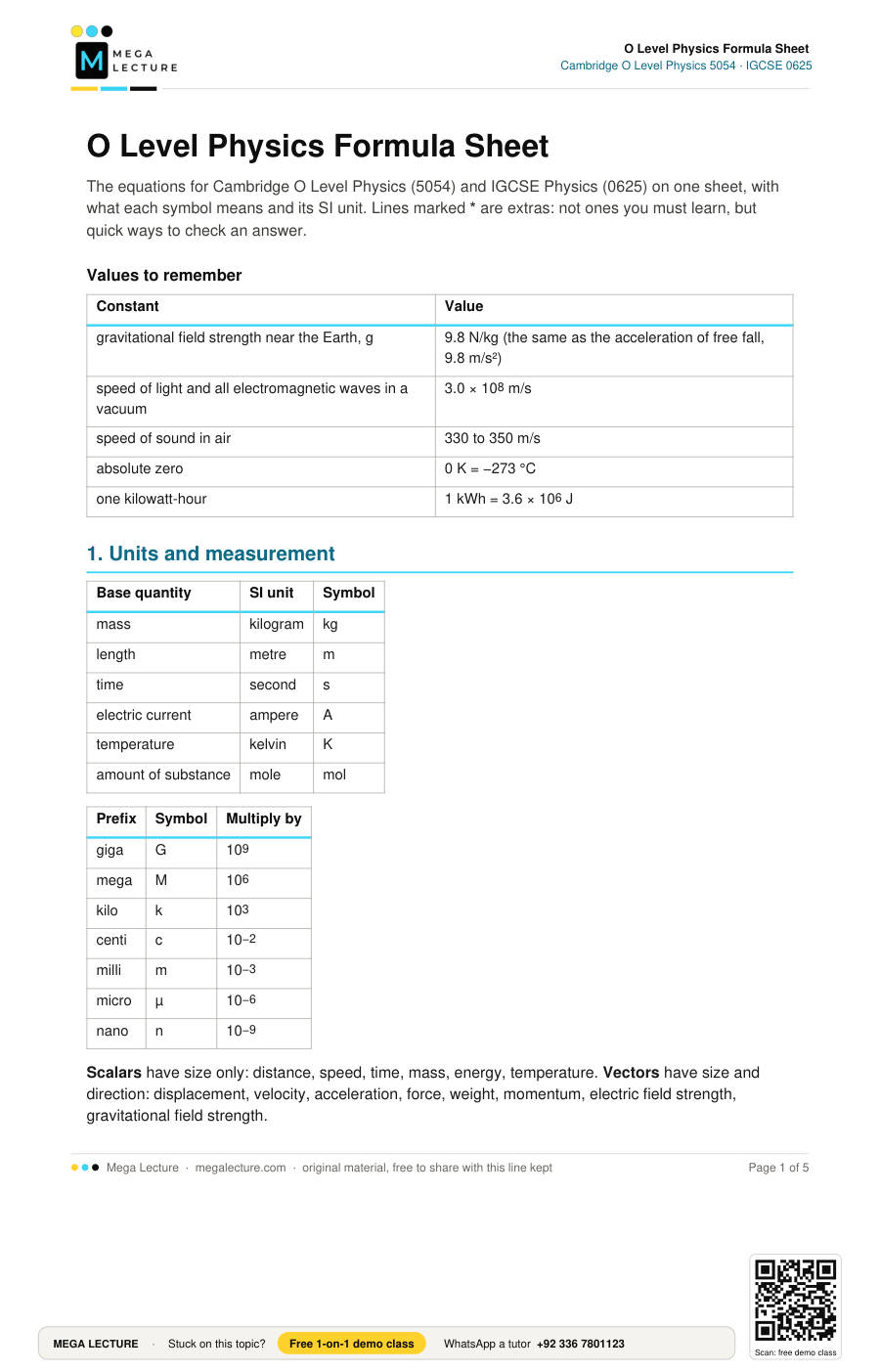
The equations for Cambridge O Level Physics (5054) and IGCSE Physics (0625) on one sheet, with what each symbol means and its SI unit. Lines marked * are extras: not ones you must learn, but quick ways to check an answer.
Values to remember Constant Value
gravitational field strength near the Earth, g 9.8 N/kg (the same as the acceleration of free fall, 9.8 m/s²) speed of light and all electromagnetic waves in a vacuum
3.0 × 10⁸ m/s speed of sound in air 330 to 350 m/s absolute zero 0 K = −273 °C one kilowatt-hour 1 kWh = 3.6 × 10⁶ J
1. Units and measurement Base quantity SI unit Symbol
mass kilogram kg length metre m time second s electric current ampere A temperature kelvin K amount of substance mole mol
Prefix Symbol Multiply by
giga G mega M kilo k centi c 10−2 milli m 10−3 micro µ 10−6 nano n 10−9
Scalars have size only: distance, speed, time, mass, energy, temperature. Vectors have size and direction: displacement, velocity, acceleration, force, weight, momentum, electric field strength, gravitational field strength.
Mega Lecture · megalecture.com · original material, free to share with this line kept
Scan: free demo class
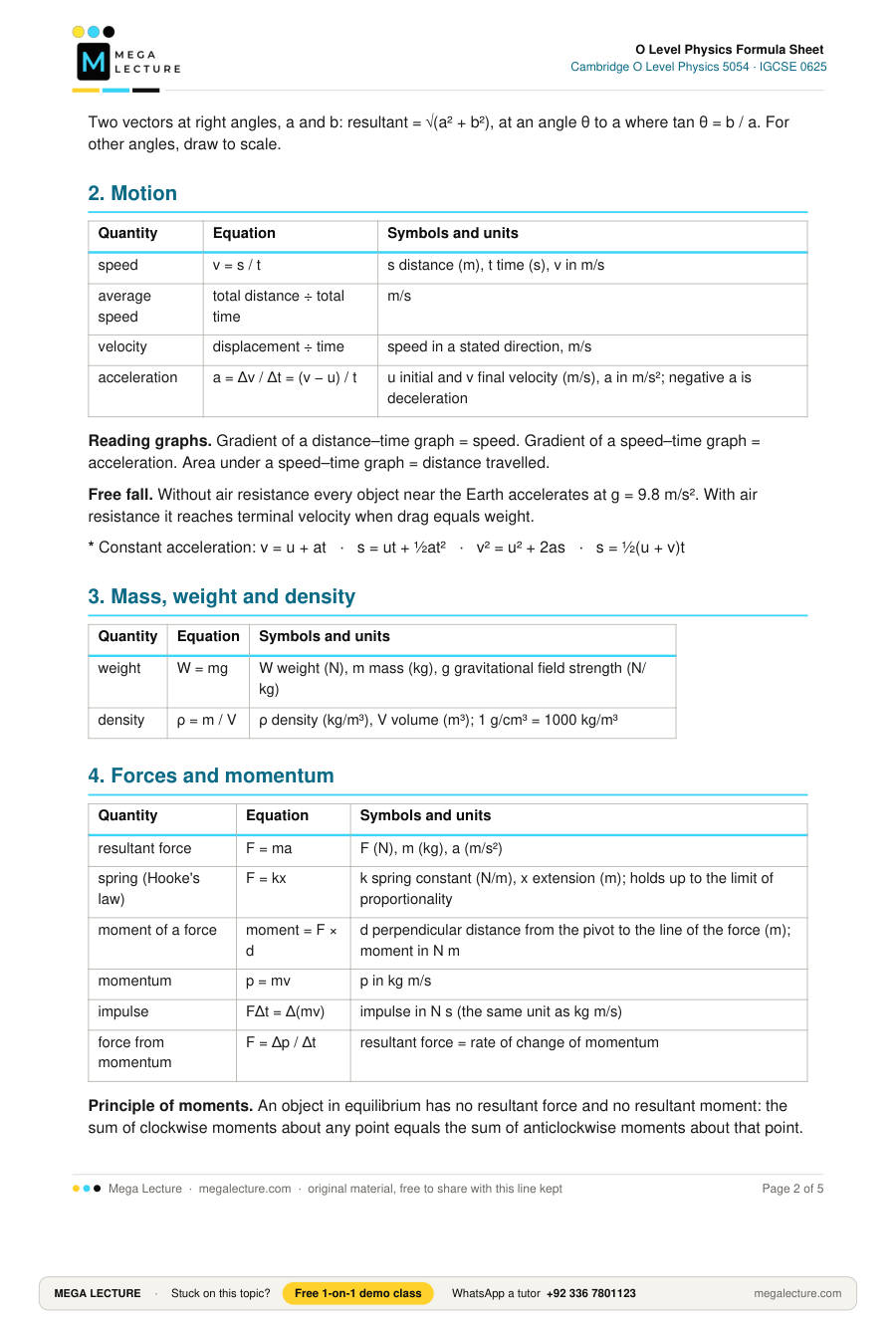
Two vectors at right angles, a and b: resultant = √(a² + b²), at an angle θ to a where tan θ = b / a. For other angles, draw to scale.
2. Motion Quantity Equation Symbols and units
speed v=s/t s distance (m), t time (s), v in m/s average speed total distance ÷ total time m/s velocity displacement ÷ time speed in a stated direction, m/s acceleration a = Δv / Δt = (v − u) / t u initial and v final velocity (m/s), a in m/s²; negative a is deceleration
Reading graphs. Gradient of a distance–time graph = speed. Gradient of a speed–time graph = acceleration. Area under a speed–time graph = distance travelled.
Free fall. Without air resistance every object near the Earth accelerates at g = 9.8 m/s². With air resistance it reaches terminal velocity when drag equals weight.
* Constant acceleration: v = u + at · s = ut + ½at² · v² = u² + 2as · s = ½(u + v)t
3. Mass, weight and density Quantity Equation Symbols and units
weight W = mg W weight (N), m mass (kg), g gravitational field strength (N/ kg) density ρ=m/V ρ density (kg/m³), V volume (m³); 1 g/cm³ = 1000 kg/m³
4. Forces and momentum Quantity Equation Symbols and units
resultant force F = ma F (N), m (kg), a (m/s²) spring (Hooke's law)
F = kx k spring constant (N/m), x extension (m); holds up to the limit of proportionality moment of a force moment = F × d d perpendicular distance from the pivot to the line of the force (m); moment in N m momentum p = mv p in kg m/s impulse FΔt = Δ(mv) impulse in N s (the same unit as kg m/s) force from momentum
F = Δp / Δt resultant force = rate of change of momentum
Principle of moments. An object in equilibrium has no resultant force and no resultant moment: the sum of clockwise moments about any point equals the sum of anticlockwise moments about that point.
Mega Lecture · megalecture.com · original material, free to share with this line kept
Conservation of momentum. With no external force, total momentum before = total momentum after: m1u1 + m2u2 = m1v1 + m2v2. Give momentum a sign for direction.
5. Energy, work and power Quantity Equation Symbols and units
kinetic energy Ek = ½mv² Ek (J), m (kg), v (m/s) change in gravitational potential energy
ΔEp = mgΔh Δh change in height (m) work done W = Fd = ΔE d distance moved in the direction of the force (m); work in J power P = W / t = ΔE / t P in watts (W); 1 W = 1 J/s efficiency (useful energy output ÷ total energy input) × 100% or (useful power output ÷ total power input) × 100%
Energy is conserved: it is only transferred between stores. The part that is not useful is usually dissipated to the surroundings.
6. Pressure Quantity Equation Symbols and units
pressure p=F/A F force at right angles to the surface (N), A area (m²), p in pascals (Pa = N/m²) pressure change in a liquid
Δp = ρgΔh ρ density of the liquid (kg/m³), Δh change in depth (m) gas at constant temperature p1V1 = p2V2
fixed mass of gas; p and V in any units, as long as both sides match
Atmospheric pressure at sea level is about 1.0 × 10⁵ Pa.
7. Thermal physics Quantity Equation Symbols and units
temperature scales
T (K) = θ (°C) + 273 a change of 1 K equals a change of 1 °C specific heat capacity
ΔE = mcΔθ c energy to raise 1 kg by 1 °C, J/(kg °C); Δθ temperature change (°C or K) specific latent heat
E = mL L energy to change the state of 1 kg with no temperature change (J/ kg): fusion for melting, vaporisation for boiling
Temperature stays constant while a substance melts or boils.
Mega Lecture · megalecture.com · original material, free to share with this line kept
8. Waves, light and sound Quantity Equation Symbols and units
wave speed v = fλ f frequency (Hz), λ wavelength (m), v (m/s) period T=1/f T time for one wave (s) reflection angle of incidence = angle of reflection both measured from the normal refractive index n = sin i / sin r i angle in air, r angle in the medium, both from the normal; n has no unit critical angle n = 1 / sin c total internal reflection happens when the angle in the denser medium is greater than c
* refractive index from speeds n = speed of light in a vacuum ÷ speed of light in the medium
* magnification image height ÷ object height no unit
Sound is longitudinal and needs a medium. People hear roughly 20 Hz to 20 000 Hz; ultrasound is above 20 000 Hz. Echo: distance to the reflecting surface = (speed of sound × time for the echo) ÷ 2.
Electromagnetic spectrum, in order of increasing frequency (decreasing wavelength): radio waves, microwaves, infrared, visible light, ultraviolet, X-rays, gamma rays. All travel at 3.0 × 10⁸ m/s in a vacuum.
9. Electricity Quantity Equation Symbols and units
charge Q = It Q charge (C), I current (A), t time (s) e.m.f. and potential difference
V=W/Q energy transferred per unit charge; volts (V) = J/C resistance R=V/I R in ohms (Ω) resistors in series R = R1 + R2 + R3 same current through each; the p.d.s add up to the supply e.m.f.
resistors in parallel 1/R = 1/R1 + 1/R2 same p.d. across each; branch currents add up; total is less than the smallest resistor electrical power P = IV = I²R = V²/R P in W electrical energy E = IVt = Pt E in J cost of electricity energy (kWh) = power (kW) × time (h) cost = energy in kWh × price per kWh potential divider V1 / V2 = R1 / R2 or Vout = Vin × R2 / (R1 + R2), the p.d. across R2
The resistance of a wire is proportional to its length and inversely proportional to its cross-sectional area. A filament lamp's resistance rises as it heats up; a diode lets current through in one direction only; an LDR's resistance falls as light gets brighter and a thermistor's (NTC) falls as it gets hotter.
Mega Lecture · megalecture.com · original material, free to share with this line kept
10. Electromagnetism Quantity Equation Symbols and units
transformer turns Vp / Vs = Np / Ns p primary, s secondary; N number of turns
100% efficient transformer IpVp = IsVs power in = power out power lost in cables P = I²R why electricity is sent at high voltage and low current
Motor effect (Fleming's left-hand rule): First finger = Field, seCond finger = Current, thuMb = Motion (force). Generator (Fleming's right-hand rule): First finger = Field, thuMb = Motion of the wire, seCond finger = induced Current. The induced e.m.f. is bigger with a stronger magnet, more turns or faster movement.
11. Nuclear physics Quantity Equation Symbols and units
nucleon number
A=Z+N A protons + neutrons, Z proton number, N neutron number alpha decay A falls by 4, Z falls by 2 an alpha particle is a helium nucleus, 2 protons + 2 neutrons beta (β−) decay A unchanged, Z rises by 1 a neutron becomes a proton and a fast electron is emitted gamma emission
A and Z unchanged electromagnetic radiation from the nucleus half-life amount left = starting amount × (½)n n = number of half-lives = time ÷ half-life
Ionising effect: alpha is strongest, then beta, then gamma. Penetration is the other way round: alpha is stopped by paper, beta by a few millimetres of aluminium, gamma is reduced by thick lead. Subtract the background count before working out a half-life.
12. Space physics Quantity Equation Symbols and units
orbital speed v = 2πr / T r average radius of the orbit (m), T orbital period (s)
Hubble constant H0 = v / d v speed at which a galaxy moves away, d its distance; H0 ≈ 2.2 × 10⁻¹⁸ per second age of the Universe age ≈ d / v = 1 / H0 in seconds
One light-year, the distance light travels in a year, is about 9.5 × 10¹⁵ m. The Earth spins once in about 24 hours and orbits the Sun in about 365 days; the Moon orbits the Earth in about one month.
Mega Lecture · megalecture.com · original material, free to share with this line kept
