
O Level · History · Thematic & Section Notes
Section Three
Opens inside this page, as often as you like. This note is read online only; the whole set is in the study pack below.
Check yourself
5 quick questions on O Level History
Tap an answer to see if you are right, and why. Free, no sign-up.
Start the free test👍 20 students found these notes useful
Was this note useful?
Full text of Section Three
HISTORY OF PAKISTAN-SECTION III-PAST PAPERS –QUESTIONS & ANSWERS BY USMAN HAMEED 1
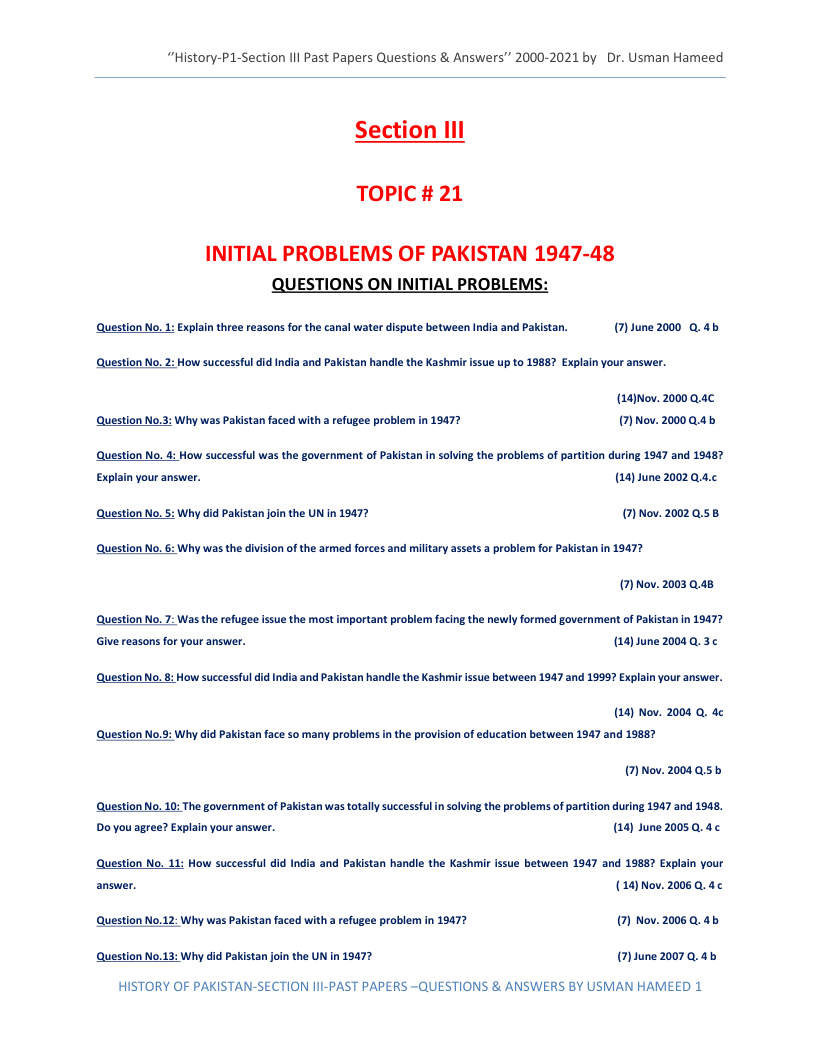
Section III TOPIC # 21 INITIAL PROBLEMS OF PAKISTAN 1947-48 QUESTIONS ON INITIAL PROBLEMS:
Question No. 1: Explain three reasons for the canal water dispute between India and Pakistan. (7) June 2000 Q. 4 b
Question No. 2: How successful did India and Pakistan handle the Kashmir issue up to 1988? Explain your answer.
(14)Nov. 2000 Q.4C
Question No.3: Why was Pakistan faced with a refugee problem in 1947? (7) Nov. 2000 Q.4 b
Question No. 4: How successful was the government of Pakistan in solving the problems of partition during 1947 and 1948?
Explain your answer. (14) June 2002 Q.4.c
Question No. 5: Why did Pakistan join the UN in 1947? (7) Nov. 2002 Q.5 B
Question No. 6: Why was the division of the armed forces and military assets a problem for Pakistan in 1947?
- Nov. 2003 Q.4B
Question No. 7: Was the refugee issue the most important problem facing the newly formed government of Pakistan in 1947?
Give reasons for your answer. (14) June 2004 Q. 3 c
Question No. 8: How successful did India and Pakistan handle the Kashmir issue between 1947 and 1999? Explain your answer.
- Nov. 2004 Q. 4c
Question No.9: Why did Pakistan face so many problems in the provision of education between 1947 and 1988?
- Nov. 2004 Q.5 b
Question No. 10: The government of Pakistan was totally successful in solving the problems of partition during 1947 and 1948.
Do you agree? Explain your answer. (14) June 2005 Q. 4 c
Question No. 11: How successful did India and Pakistan handle the Kashmir issue between 1947 and 1988? Explain your answer. ( 14) Nov. 2006 Q. 4 c
Question No.12: Why was Pakistan faced with a refugee problem in 1947? (7) Nov. 2006 Q. 4 b
Question No.13: Why did Pakistan join the UN in 1947? (7) June 2007 Q. 4 b
HISTORY OF PAKISTAN-SECTION III-PAST PAPERS –QUESTIONS & ANSWERS BY USMAN HAMEED 2
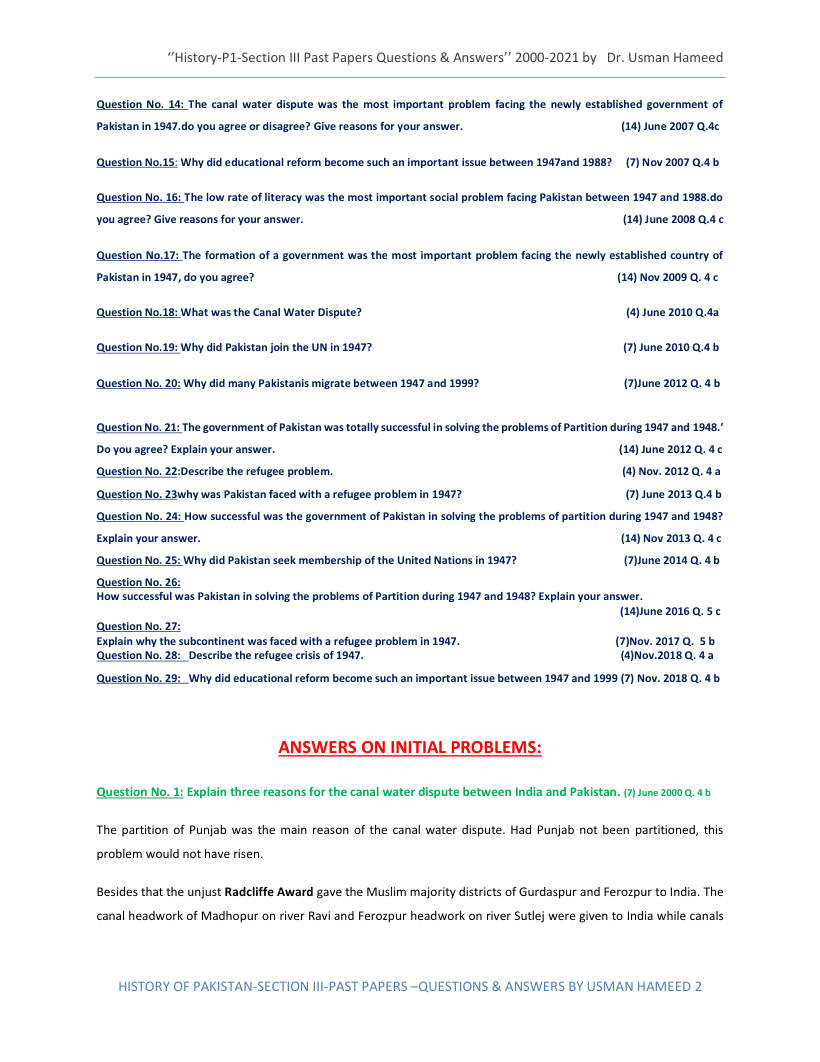
Question No. 14: The canal water dispute was the most important problem facing the newly established government of
Pakistan in 1947.do you agree or disagree? Give reasons for your answer. (14) June 2007 Q.4c
Question No.15: Why did educational reform become such an important issue between 1947and 1988? (7) Nov 2007 Q.4 b
Question No. 16: The low rate of literacy was the most important social problem facing Pakistan between 1947 and 1988.do you agree? Give reasons for your answer. (14) June 2008 Q.4 c
Question No.17: The formation of a government was the most important problem facing the newly established country of
Pakistan in 1947, do you agree? (14) Nov 2009 Q. 4 c
Question No.18: What was the Canal Water Dispute? (4) June 2010 Q.4a
Question No.19: Why did Pakistan join the UN in 1947? (7) June 2010 Q.4 b
Question No. 20: Why did many Pakistanis migrate between 1947 and 1999? (7)June 2012 Q. 4 b
Question No. 21: The government of Pakistan was totally successful in solving the problems of Partition during 1947 and 1948.’
Do you agree? Explain your answer. (14) June 2012 Q. 4 c
Question No. 22:Describe the refugee problem. (4) Nov. 2012 Q. 4 a
Question No. 23why was Pakistan faced with a refugee problem in 1947? (7) June 2013 Q.4 b
Question No. 24: How successful was the government of Pakistan in solving the problems of partition during 1947 and 1948?
Explain your answer. (14) Nov 2013 Q. 4 c
Question No. 25: Why did Pakistan seek membership of the United Nations in 1947? (7)June 2014 Q. 4 b
Question No. 26: How successful was Pakistan in solving the problems of Partition during 1947 and 1948? Explain your answer. (14)June 2016 Q. 5 c Question No. 27: Explain why the subcontinent was faced with a refugee problem in 1947. (7)Nov. 2017 Q. 5 b Question No. 28: Describe the refugee crisis of 1947. (4)Nov.2018 Q. 4 a
Question No. 29: Why did educational reform become such an important issue between 1947 and 1999 (7) Nov. 2018 Q. 4 b
ANSWERS ON INITIAL PROBLEMS:
Question No. 1: Explain three reasons for the canal water dispute between India and Pakistan. (7) June 2000 Q. 4 b
The partition of Punjab was the main reason of the canal water dispute. Had Punjab not been partitioned, this problem would not have risen.
Besides that the unjust Radcliffe Award gave the Muslim majority districts of Gurdaspur and Ferozpur to India. The canal headwork of Madhopur on river Ravi and Ferozpur headwork on river Sutlej were given to India while canals
HISTORY OF PAKISTAN-SECTION III-PAST PAPERS –QUESTIONS & ANSWERS BY USMAN HAMEED 3 coming out of these headworks flowed into Pakistan. Had the Muslim majority districts of Gurdaspur and Ferozpur been given to Pakistan this dispute would not have occurred.
Most importantly, India had promised not to interfere with the waters of these rivers which were vital for the irrigation of west Punjab. But on 1st April 1948 India stopped the supply of water of these canals and the dispute started. India claimed that since the headworks fell in their territory, they had the sole right to use water of these headworks. Pakistan claimed that under international law, Pakistan had the right to use the waters because its agriculture and economy depended upon it.
Question No. 2: How successful did India and Pakistan handle the Kashmir issue up to 1988? Explain your answer.
(14) Nov. 2000 Q. 4 c
India and Pakistan were not completely successful in the handling of the Kashmir issue.
It was erupted because of the wrong decision taken by its maharaja Hari singh who decided to accede to India while the population (77%) of the state wished Kashmir to become a part of Pakistan. Maharaja’s wrong step brought India and Pakistan confrontation with each other and their armies clashed thrice in 1948, 1965 and 1971 over the Kashmir issue. This disputes stills remained unsolved which is clear proof of the fact that both India and Pakistan have not been successful in resolving the problem. India had taken the Kashmir issue to UN in 1948 but later India refused to accept any resolution of the Security Council or proposals of mediators to resolve the dispute.
In late 1980s the Kashmiri people saw that afghan freedom fighters were able to force the Russian army to with draw from Afghanistan. The Kashmiri freedom fighters took up arms and started guerrilla war fare. To suppress the guerrilla freedom fighters, India had deployed 700000 troops in Kashmir but without success. India had not accepted the UNO proposals to hold plebiscite in Kashmir. Kashmiri people demand the right of self-determination. Pakistan being weaker in military power than India, cannot occupy Kashmir by force. Pakistan only depends on the hope the world powers would put pressure on India to solve the problem through a fair and free plebiscite and through peaceful negotiations.
But there were some steps taken by both the governments to resolve the issue. Like in 1948 the first Kashmir war was cease fired with this promise that plebiscite would be held in India. In 1966 Tashkent agreement was signed in which both the states tried to overcome trust deficit. Moreover Simla agreement was also signed in 1972 between
ZAB and Mrs Indira Gandhi and assurance was given by both the states to resolve the Kashmir between them and it would not be discussed on any international forum like UN.
Thus both India and Pakistan have been unsuccessful in handling the Kashmir Issue.
Question No.3:Why was Pakistan faced with a refugee problem in 1947? (7) Nov. 2000 Q.4 b
HISTORY OF PAKISTAN-SECTION III-PAST PAPERS –QUESTIONS & ANSWERS BY USMAN HAMEED 4
During 1947, violence between Hindus and Muslims increased dramatically. Muslims fearful of being killed were forced to leave all their possessions and cross into Pakistan to seek shelter. The Boundary Award had made the problems worse between the two. Since Pakistan had become independent so Muslims were leaving India for their homeland, often with little or no possessions. It was argued that India deliberately made difficulties for the new Pakistani government by forcing Muslims across the border. Hindus and Sikhs, perhaps fearful of reprisals and a genuine desire to live in a Hindu nation, also contributed to the refugee problem by crossing from Pakistan to India. Question No. 4: How successful was the government of Pakistan in solving the problems of partition during 1947
and 1948? Explain your answer. (14) June 2002 Q.4.c BEST ANSWER ON SUCCESSES & FAILURES:
The government of Pakistan remained successful in solving the problems of partition during 1947-48.when Pakistan came into existence in 1947 It faces many difficulties. The most important was the formation of the central government. There were no office equipment and no office workers. The central government offices were set in army barracks and hired residential buildings.
The problem of refuges was a very big problem; communal riots had started in Indian Punjab and Delhi. Millions of
Muslims had to leave their homes and had to run to Pakistan. Division of assets was another problem. The division was to be made at ration of 36:64 between the 2 countries. But all big military stores were there at India. The equipment given to Pakistan was obsolete and consisted of unusable machinery and equipment. Pakistan had to suffer a great a loss and had to start from scratch.
In the division of financial assets again Indian leaders showed great dishonesty and unfairness. The payments were not only withheld for a long time but out of a sum of rupees 750 million, only 700 million paid in several instalments.
50 million never paid at all. Canal water dispute also arose in April 1948 when India stopped the supply of water in the canals coming out of Ravi and Sutlej. Because there head works located in India. A large agriculture area of
Pakistan was badly affected.
The accession of three princely states of Junagarh, Haiderabad, and Kashmir created great problem for Pakistan
.The ruler of Junagarh firmly acceded to Pakistan. The population was mostly non-Muslim. Therefore India occupied the state with the help of armed forces. The state of Haiderabad wanted to remain independent. But in sept. 1948
Indian army forcibly occupied the state. Kashmir had an overwhelmingly Muslim majority population. But the Hindu
Maharaja firmly acceded to India against the wishes of people. India had sent its troops and occupied the state capital Srinagar. Kashmir still remained a disputed territory. India doesn’t obey the resolutions of UNO which had ordered a free and fair plebiscite. Two wars have been fought between Indian and Pakistan and two agreements were finalized.
HISTORY OF PAKISTAN-SECTION III-PAST PAPERS –QUESTIONS & ANSWERS BY USMAN HAMEED 5
However under the guidance of Jinnah and with courage and confidence the difficulties were overcome and the govt. of Pakistan started smoothly. Jinnah and Liaqat ali Khan became the GG and PM respectively. The problem of
Kashmir remained unsolved but there had been long debates to resolve the matter.
The Pakistan govt. also set up camps for the refugees and looked after them. They were gradually settled in the new country. Under the guidance Jinnah a new department created for the rehabilitation for the refugees. Besides that after lengthy negotiations canal water dispute problem was solved with the cooperation of World Bank under the
Indus water treaty in 1960.
Analysis:
Question No. 5:Why did Pakistan join the UN in 1947? (7)Nov. 2002 Q.5 b
Pakistan felt that membership of the United Nations would help their conflict with India over Kashmir by drawing the international community’s attention to it. Also Pakistan took it upon itself to become a spokesman of many Asian
States and movements, especially Muslim countries. Other relevant issues included the World Bank and the Canal
Water Dispute.
Question No. 6: why was the division of the armed forces and military assets a problem for Pakistan in 1947?
(7) Nov. 2003 Q. 4 b
One of the important problems faced by Pakistan at the time of its emergence was the division of armed forces and military assets. The division of the army was not much of a problem. The Muslim soldiers opted for Pakistan while non-Muslims joined India. But there was a great shortage of army officers because the number of Muslim army officers in British Indian army was very small.
The division of army assets created great difficulties for Pakistan. Large army stores were located on Indian side.
India was very unfair in the division of army equipment and supplies. The military equipment which was sent to
Pakistan mostly consisted of obsolete, damaged and unusable material. Of the 16 ordnance factories none was given to Pakistan.
Field Marshal Anchinleck who supervised the division of asses resigned before completing the job. Pakistan could not get its rightful share and division of assets proved to be a problem for Pakistan. Pakistan experienced serious deficiency in stores, supplies and weapons. Pakistan was on a very weak footing in respect of military strength at the time of partition and had to start from a scratch.
Question No. 7: Was the refugee issue the most important problem facing the newly formed government of
Pakistan in 1947? Give reasons for your answer. (14) June 2004 Q. 3 c (BEST ANSWER ON COMPARITIVE QUESTION)
Refugees and the accommodation crises:
HISTORY OF PAKISTAN-SECTION III-PAST PAPERS –QUESTIONS & ANSWERS BY USMAN HAMEED 6
In the years immediately before partition there was widespread violence between Muslims and the non-Muslims communities across India. The summer of 1947 saw rioting which led to numerous deaths. When the boundary
Award was announced in august 1947 things became worse. Millions of people found themselves living in the wrong country and became victims of communal attacks. That year witnessed the largest migration of mankind and also some of the worst scenes of communal violence. Over 20 million people had moved from India to Pakistan or in other direction by Jan. 1948.Many Muslim historians believe that Hindus and Sikhs had an organized programme for the massacre of Muslim refugees. A million men, women and children died as a result of the violence or the rigors of the long journey. Nearly 10 million people were made homeless. Karachi alone received nearly 2 million refugees in 1947.That was impossible for Pakistan to provide accommodations to that mass number of people. In September
1947 the authorities in Delhi had to declare martial law as non-Muslim refugees had begun a slaughter of local
Muslims. India and Pakistan were so concerned about the communal violence that they began to cooperate in trying to control it.
HISTORY OF PAKISTAN-SECTION III-PAST PAPERS –QUESTIONS & ANSWERS BY USMAN HAMEED 7
Geographical problems:
Pakistan was split into two separate parts almost a thousand miles apart. East Pakistan comprised of most of Bengal and the Sylhet which voted in a referendum to join Pakistan. West Pakistan comprised of west Punjab, Sindh, Baluchistan and the NWFP. The princely states of Dir, Swat, Chitral, Amb, Hunza, Gilgit and Bahawalpur also joined Pakistan. These two wings of Pakistan were separated by about a 1000 miles of land that belonged to India. There was nothing common between these two wings except religion.
Political problems:
India inherited government buildings, furnishings even officials from the British. Pakistan had none of these. India had officials, members of the Indian national congress, with political experience to take over the government. In Pakistan, the constituent Assembly members were mostly wealthy landlords with little political experience. Pakistan lacked both the administrative and the government machinery to run the affairs of a new country Quaid-e-azam would need to find a capital, a government and officials to ensure the efficient government of the new state. Perhaps the major problem was that the Quaid-e-azam had suffered from tuberculosis.
Economic problems:
Pakistan was underdeveloped with very little industry. Only Karachi had the modern port but much of Pakistan had no linked to the industrialization that had taken place in central India. Around 90 % people lived in the country side and only 8 towns had a population of 100,000.Pakistan’s agriculture didn’t produce enough of a surplus to create the wealth needed for industrialization. Only jute export produced the major source of foreign exchange earnings for Pakistan but the problems created by partition are exemplified by the fact that in 1947 Pakistan didn’t have a single jute mill. All the jute mills were in the new India.
The percentage of economic assets in Pakistan after partition:
- Industrial enterprises: 10 %
- Industrial workers : 6.5 %
- Electrical capacity : 5%
- Mineral deposits : 10 %
Social problems:
Pakistan was mainly made up of 5 different regions. Some historians have gone as far as suggesting that really it was
5 different nations. Certainly there were five different population groupings.
- the Pakhtuns in the north
- the Balochs in the west
(iii) the Sindhis in the south
- the Punjabis in the north east
- the Bengalis in the east
HISTORY OF PAKISTAN-SECTION III-PAST PAPERS –QUESTIONS & ANSWERS BY USMAN HAMEED 8
These people had different traditions, cultures, languages and lifestyles. Baluchistan and Bengal in 1947 were not completely sure that they now wanted to transfer allegiance to a new Pakistan, where once again the official language Urdu would not be the one they spoke.
The Accession of the princely states:
Lord Mountbatten gave the right to 462 princely states to choose between India and Pakistan. Their location and their religion made the choice a straightforward one. In 1947 the northern areas of Dir, Swat, Chitral, Amb and Hunza joined Pakistan. Bahawalpur also joined Pakistan; Sylhet in East also joined Pakistan through referendum.
Hyderabad was the largest of the princely states with a population of 160 million. It was wealthy with revenue of
160 million rupees. Nizam wanted to join Pakistan but he was pressurized to join India due to non-Muslim population there. In august he filed a complaint before UNO. But before it could be heard Indian troops captured Hyderabad.
Junagarh was a small state on the coast, 300 miles south of Karachi. Its prince was Muslim but population was non-
Muslim. Prince announced to join Pakistan in 1947.But Lord Mountbatten informed Pakistan that the accession of
Junagarh was an encroachment on Indian sovereignty and territory. Ultimately Indian troops surrounded the state and took the control. Pakistan protested to the UNO about the illegal occupation but the matter remains unresolved.
The Kashmir Issue:
The most serious disagreement between India and Pakistan concerned the state of Jammu and Kashmir. Its boundaries with Tibet, China, Afghanistan and Russia gave it great strategic importance. Most of the 4 million inhabitants of Kashmir were Muslims but the maharaja was Hindu. In September 1947 he started a campaign to drive many Muslims out of Kashmir. Over 200,000 fled to Pakistan and finally the Muslims rose in rebellion. The Maharaja was forced to turn to India for help to crush the Muslims. Indian help came and the Maharaja Hari Singh agreed to accede to India. Pakistan also sent troops to help Kashmir
(Muslims).Neither side was strong enough for a long war. So in January 1948 the matter referred to the
UNO.A ceasefire was arranged on Jan. 1949 and Kashmir was divided between India and Pakistan. India retained the largest area of Kashmir including the capital Srinagar. Indian Prime Minister Nehru agreed that a referendum would be held in Kashmir to determine the wishes of the people, once the situation has normalized. This referendum has not been held yet…
The Division of financial and military assets:
It was agreed that the assets were to be divided on the ratio of 17 to India and 5 to Pakistan. This reflected the relative size and populations of the country. In June 1947 it was agreed that Pakistan would be paid 750 million rupees of the 4 billion rupees in the reserve bank. First 200 million rupees were paid but later on
India refused to pay the rest saying Pakistan would only use it to buy arms to fight against India. Gandhi
History-P1- S#3-Past papers Questions and Answers by Dr. Usman Hameed-Page 9 was determined that the division of assets should be fair and took steps to persuade India to pay the due money. He used the threat of a hunger strike and successfully persuaded the Indian government to pay a further 500 million rupees. Armed forces and the military equipment were split 36 % to 64% between
Pakistan and India.
The armed forces personnel were given freedom to opt for whichever country they wanted. Muslim regiments went to Pakistan and non- Muslim to India. Pakistan’s army comprising on 150,000 men and had only 2500 trained Muslim officers. It required 4000 officers; ultimately Jinnah had to hire 500 British officers temporarily. All 16 ordnance factories were in India, and it refused to hand over any. Pakistan had no factory for making military goods. Eventually India agreed to pay 60 million rupees in lieu of handing over ordnance factories. The military supplies which India agreed to hand over were often old, worn, damaged and obsolete.
The canal water dispute:
The canal water dispute had its origin in the partition of Punjab in 1947.West Pakistan relies upon irrigation from a series of canals which draw water from the 3 main rivers in the area, the Indus, the Jhelum, and the
Chenab. The problem for Pakistan was that the flow of water was controlled at a series of ‘headwork’s’ lay in the part of east Punjab (India).Soon India and Pakistan indulge into a canal water dispute. Pakistan called for the matter to be settled by international court of justice but India refused. In May 1948 a temporary agreement was reached and India agreed to allow water from east Punjab to flow into west Punjab.
ANALYSIS:
Question No. 8: How successful did India and Pakistan handle the Kashmir issue between 1947 and
1999? Explain your answer. (14) Nov. 2004 Q. 4c BEST ANSWER ON KASHMIR ISSUE:
India and Pakistan were not completely successful in the handling of the Kashmir issue.
It was erupted because of the wrong decision taken by its maharaja Hari singh who decided to accede to India while the population (77%) of the state wished Kashmir to become a part of Pakistan. Maharaja’s wrong step brought India and Pakistan confrontation with each other and their armies clashed thrice in 1948, 1965 and 1971 over the Kashmir issue. This disputes stills remained unsolved which is clear proof of the fact that both India and Pakistan have not been successful in resolving the problem. India had taken the Kashmir issue to UN in 1948 but later India refused to accept any resolution of the Security Council or proposals of mediators to resolve the dispute.
In late 1980s the Kashmiri people saw that afghan freedom fighters were able to force the Russian army to with draw from Afghanistan. The Kashmiri freedom fighters took up arms and started guerrilla war fare. To suppress the guerrilla freedom fighters, India had deployed 700000 troops in Kashmir but without success.
History-P1- S#3-Past papers Questions and Answers by Dr. Usman Hameed-Page 10
India had not accepted the UNO proposals to hold plebiscite in Kashmir. Kashmiri people demand the right of self-determination. Pakistan being weaker in military power than India, cannot occupy Kashmir by force. Pakistan only depends on the hope the world powers would put pressure on India to solve the problem through a fair and free plebiscite and through peaceful negotiations. The status quo was largely maintained until 1989 when pro-independence and pro-Pakistan guerrillas struck in the Indian Kashmir valley. They established a reign of terror and drove out almost all the Hindus from the valley before the Indian army moved in to flush them out. Meanwhile Indian and Pakistani troops regularly exchanged fire at the border.
India and Pakistan both tested nuclear devices in May 1998, and then in April 1999 test-fired missiles in efforts to perfect delivery systems for their nuclear weapons. But, all hopes of diplomacy disappeared once the cross-LOC firing in Kargil began during the mid-1990s. The death toll, including both soldiers and civilians, was more than 30,000. In the first week of August 1998 Indian and Pakistani troops exchanged artillery fire, described by locals as heavier than that of the 1948 and 1965 wars put together. An estimated 50,000 rounds of ammunition were expended and a large number of soldiers and civilians killed. In the summer of 1999 hostility in Kargil went far beyond the now familiar annual exchange of artillery fire. When India began patrolling the Kargil heights that summer, it found to its horror that many key posts vacated in the winter were occupied by infiltrators. A patrol was ambushed in the first week of May 1999. India belatedly realised the magnitude of the occupation - which was around 10 km deep and spanned almost 100 km of the LOC - and sent MiG fighters into action on May 26. India contended that the infiltrators were trained and armed by Pakistan, and based in "Azad Kashmir" with the full knowledge of the Pakistani government - and that Afghan and other foreign mercenaries accompanied them. Pakistan insisted that those involved were freedom fighters from Kashmir and that it was giving only moral support.
But there were some steps taken by both the governments to resolve the issue. Like in 1948 the first
Kashmir war was cease fired with this promise that plebiscite would be held in India. In 1966 Tashkent agreement was signed in which both the states tried to overcome trust deficit. Moreover Simla agreement was also signed in 1972 between ZAB and Mrs Indira Gandhi and assurance was given by both the states to resolve the Kashmir between them and it would not be discussed on any international forum like UN.
Zia also tried to create good relations through cricket diplomacy but couldn’t resolve Kashmir problem.in the later years Indian Prime Minister, Atal Behari Vajpayee, set out to Lahore by bus on February 20, 1999, inaugurating the four times a week Delhi-Lahore-Delhi bus service, the world felt that such a genuine effort at friendly neighbourhood relations would lower the tension along the Line of Control in Kashmir.
But both the countries are failed to resolve the Kashmir problem.
Question No.9: Why did Pakistan face so many problems in the provision of education between 1947 and
1988? (7) Nov. 2004 Q.5 b BEST ANSWER ON EDUCATIONAL PROBLEMS:
A large number of people are illiterate and many children simply do not go to school at all. An illiterate society means a poor economy and a poorly educated workforce. The major problem is the lack of government investment. This is because the military expenditure is excessively high for a country such as
Pakistan and therefore there is little room for spending on education. Education is expensive in Pakistan.
Children are expected to buy their own books and many children drop out of schools.
History-P1- S#3-Past papers Questions and Answers by Dr. Usman Hameed-Page 11
Govt. has never bothered to reserve the amount for school which are greatly needed for an ever increasing population which has grown five times since independence .there is no money left to spend on research, training and development. Primary education was more neglected than secondary and higher education.
The result is that about 50% of the children of school going age are not enrolled.
Frequent changes in government have been another important factor. With the change in government the previous plans are discarded and new ones are introduced. Junejo government introduced NAI ROSHNI
SCHOOLS in 1985. But the scheme was scratched when new govt. of Benazir came in power in 1988. Infect educational polices are neither properly executed nor implemented. Important educational policies were framed in 1951, 1959 and 1979. But their recommendations were never enforced earnestly.
Besides that the poverty and ignorance of parents is also an important factor. In poor families children are made to work and earn money for the family at the age of 6-7 years instead of going to school. Illiterate parents do not feel the necessity of education and female education is all the more neglected.
Dropout rates are very high. Nearly half of the children leave school before finishing primary education.
Dropout rate is higher among girls. It is also difficult to arrange female teachers for rural areas. Private schools in urban areas are run on commercial basis charging high fees making it beyond the reach of common man .on account of these reasons education in Pakistan is still in backward state and literacy rate was about 30% by 1988 and 48% at present.
Question No. 10: The government of Pakistan was totally successful in solving the problems of partition during 1947 and 1948. Do you agree? Explain your answer. (14) June 2005 Q. 4 c
Successes:
Quaid-e-Azam Relief Fund created to help refugees. He appealed to the people to help the refugees, He toured the provinces encouraging and motivating the people.
Declared himself ‘Protector-General’ of religious minorities
State Bank of Pakistan set up Karachi made capital of Pakistan
Civil Services re-organised
Joined United Nations and attempted to draw their attention to Kashmir problem
Failures:
Kashmir and other Princely States issues not resolved
Canal Water Dispute not resolved until 1959
Millions made homeless or died as a result of Partition
Question No. 11:How successful did India and Pakistan handle the Kashmir issue between 1947 and 1988?
Explain your answer. (14) Nov. 2006 Q. 4 c Successes:
History-P1- S#3-Past papers Questions and Answers by Dr. Usman Hameed-Page 12
A cease-fire was arranged in January 1948 leaving Kashmir divided between India and Pakistan. From 1949 an official cease-fire line was agreed between India and Pakistan and was to be patrolled by UN troops. Pakistan kept up pressure on India by appealing to the UN whenever
Indian moves tried to integrate Indian occupied Kashmir into India. In 1957 the UN reconfirmed that
Kashmir was a disputed territory and that a final solution should be settled by a UN supervised plebiscite.
India promised to hold a plebiscite in Kashmir to determine its future.
Failures:
War has broken out on at least 4 occasions between the 2 countries. Plebiscite still not been held.
Continues to be a source of conflict between the two nations.
Question No.12: Why was Pakistan faced with a refugee problem in 1947? (7) Nov. 2006 Q. 4 b
During 1947, violence between Hindus and Muslims increased dramatically. Muslims fearful of being killed were forced to leave all their possessions and cross into Pakistan to seek shelter.
The Boundary Award had made the problems worse between the two. Since Pakistan had become independent so Muslims were leaving India for their homeland, often with little or no possessions. It was argued that India deliberately made difficulties for the new Pakistani government by forcing Muslims across the border. Hindus and Sikhs, perhaps fearful of reprisals and a genuine desire to live in a Hindu nation, also contributed to the refugee problem by crossing from Pakistan to India.
Question No.13: Why did Pakistan join the UN in 1947? (7) June 2007 Q. 4 b
Pakistan felt that membership of the United Nations would help their conflict with India over Kashmir by drawing the international community’s attention to it. Also Pakistan took it upon itself to become a spokesman of many Asian States and movements, especially Muslim countries. Other relevant issues included the World Bank and the Canal Water Dispute.
Question No. 14: The canal water dispute was the most important problem facing the newly established government of Pakistan in 1947.do you agree or disagree? Give reasons for your answer. (14) June 2007 Q.4c
The Canal Water Dispute was one of the most serious problems since India now controlled the water supply to Pakistan – this brought tensions to a head between the two countries as Pakistan had to depend on India for its water supply. The problem dragged on until 1959.
However there were other problems. Some Muslims in India had been submitted to terrible atrocities and so thousands fled to Pakistan. They needed food and shelter and placed great strain on the new government. It was essential following the creation of Pakistan to have a new government immediately.
Besides that there was a shortage of properly qualified and experienced personnel which made the task of running government departments extremely difficult. The new government was also short of money.
History-P1- S#3-Past papers Questions and Answers by Dr. Usman Hameed-Page 13
Pakistan had been awarded 750 million rupees under the final settlement but only received 200 million at first. This put enormous strain on the new government.
This was also the case with the division of the armed forces and military assets. Many of the assets awarded were obsolete or out of order.
Question No.15:Why did educational reform become such an important issue between 1947and 1988?
(7) Nov 2007 Q.4 b
Some 70% of the population have been illiterate and many children simply did not go to school at all. An illiterate society means a poor economy and a poorly educated workforce. The major problem was the lack of government investment. This is because the military expenditure was excessively high for a country such as Pakistan and therefore there is little room for spending on education. Education has been expensive in
Pakistan. Children have been expected to buy their own books and many children dropped out of schools.
Question No. 16: The low rate of literacy was the most important social problem facing Pakistan between
1947 and 1988.do you agree? Give reasons for your answer. (14) June 2008 Q.4 c
Estimates suggest that the literacy rate in Pakistan is less than 30% and that female literacy is the worst amongst the population – about 14%. This mainly due to the lack of financial investment in education by successive governments who have viewed defence as being more important. Less than 3% of Pakistan’s budget has been spent on education. A major problem has faced primary education with serious under- funding compared to secondary and higher education. Little money remains for non-staff costs to spend on the primary sector. Drop-out rates particularly affect the primary sector with estimates suggesting that half the children joining primary school leave within 5 years and one third of girls drop out within a year. In the secondary sector many private schools have been formed which have been for the more wealthy parts of the population which further emphasises the gap between the rich and the poor.
Note: Candidates may also refer to other social problems such as: cultural differences, refugee problems, medical issues, language problems, population growth, age expectancy, infant mortality rates etc.
Question No.17: The formation of a government was the most important problem facing the newly established country of Pakistan in 1947, do you agree? (14) Nov 2009 Q. 4 c
It was essential following the creation of Pakistan to have a new government immediately. However there was a shortage of properly qualified and experienced personnel which made the task of running a government department extremely difficult. Pakistan had been awarded 750 million rupees under the final settlement but only received 200 million at first. This put enormous strain on the new government since they were unable to use the money appropriately.
History-P1- S#3-Past papers Questions and Answers by Dr. Usman Hameed-Page 14
It was also the case with the division of the armed forces and military assets. Much of the assets awarded were obsolete or out of order.
However there were other difficulties such as the problem of coping with the Muslim refugees from India.
These refugees had been submitted to terrible atrocities and so thousands fled to Pakistan. They needed food and shelter and placed great strain on the new government.
The Canal Water Dispute was one of the most serious problems since India now controlled the water supply to Pakistan which brought tensions to a head between the two countries as Pakistan had to depend on India for its water supply. The problem dragged on until 1959.
The accession of the Princely States and especially Kashmir was a problem. The population of Kashmir was largely Muslim and wanted to join Pakistan whereas the ruler was Hindu and wanted to join India. The border was uncertain between India and Pakistan with respect to Kashmir and this inevitably caused problems.
Question No.18: What was the Canal Water Dispute? (4) June 2010 Q.4a
Threatened agriculture in the Punjab, irrigation system depended on 6 rivers and 30 canals, some of which were in India. April 1948 India shut off waters flowing into Pakistan from Firozpur headwork, threatening millions of acres of agricultural land in Pakistan. Some waters reinstated in May 1948 but not permanently until 1959 and Indus Water Treaty.
Question No.19: Why did Pakistan join the UN in 1947? (7) June 2010 Q.4 b
Pakistan felt that membership of the United Nations would help their conflict with India over Kashmir by drawing the international community’s attention to it. Also Pakistan took it upon itself to become a spokesman of many Asian states and movements, especially Muslim countries. Other issues included the
World Bank and the Canal Water Dispute.
Question No. 20:
Why did many Pakistanis migrate between 1947 and 1999? (7)June 2012 Q. 4 b
BEST ON MIGRTION:
Britain needed lots of workers after World War Two, especially unskilled workers and offered well paid jobs which Pakistanis wanted as they were reliable, hardworking and ambitious to succeed. Many Pakistanis were displaced after partition in 1947 and as a result moved to Britain.
Thousands of Pakistanis were displaced from the Mangla and Terbella Dams area in the 1960s and some used compensation money to move to Britain to join relatives and seek work. The Commonwealth Immigration Act of 1962 introduced a voucher scheme which gave Pakistanis in Britain the opportunity to arrange jobs and vouchers for friends and family to move here. Many Pakistanis went to work in the Middle East where jobs were becoming freely available during times of economic growth especially in the construction and service Industries. Many Pakistanis went to work in USA and Canada for nationality and green card to earn benefits.
History-P1- S#3-Past papers Questions and Answers by Dr. Usman Hameed-Page 15
Question No. 21: The government of Pakistan was totally successful in solving the problems of Partition during 1947 and 1948.’ Do you agree? Explain your answer. (14) June 2012 Q. 4 c
LEVEL 4: Explains successes and failures in terms of solutions [9–13]
Successes:
Quaid-e-Azam Relief Fund created to help refugees. He appealed to the people to help the refugees. He toured the provinces encouraging and motivating the people. Declared himself ‘Protector-General’ of religious minorities. State Bank of Pakistan set up. Karachi made capital of Pakistan. Civil Services re-organised. Joined United Nations and attempted to draw their attention to Kashmir problem.
Failures:
Kashmir and other Princely States issues not resolved. Canal Water Dispute not resolved until 1959. Millions made homeless or died as a result of partition. LEVEL 5: As Level 4 – also produces a judgement or evaluation
Question No. 22:Describe the refugee problem. (4) Nov. 2012 Q. 4 a
Summer 1947 saw rioting and many deaths because of violence between Muslim and non- Muslim communities across India. After the Boundary Award, things got worse with millions of people in the ‘wrong’ country. The largest migration then took place with Muslims moving into Pakistan and non-Muslims moving into India. 10 m people were involved in this migration accompanied by violence and mass slaughter in some places. 1 m may have been killed and 20 m people made homeless. Karachi received 2 m refugees alone.
Question No. 23
Why was Pakistan faced with a refugee problem in 1947? (7) June 2013 Q.4 b
BEST ANSWER ON REFUGEES:
[Escaping Hindus’ Atrocities]
Many parts of India had already seen worst scenes of Hindu-Muslim riots just before partition in 1947. The Hindus and Sikhs in Eastern Punjab were particularly fully charged with anti-Muslim sentiments. In such areas, a large number of Muslims were ruthlessly killed; entire Muslim villages were destroyed. Women were disrespected and even children were slaughtered. There were reports that local Indian authorities were also supporting the violent Hindu mobs. Under such circumstances, the Muslims had no option except to seek refuge in a safe place and therefore they migrated to Pakistan on large scale to escape the brutalities of Hindus.
[Unjust Demarcation]
The boundary demarcation was unjust; a number of Muslim-majority areas like Gurdaspur and Ferozpur were given to India where the Muslims were not feeling secure. They were now vulnerable to the barbarities of Hindus and Pakistan was unable to help them across the border. They therefore left their homes, land and businesses and joined the migrating caravans towards Pakistan.
[Princely States]
When the Muslim. Ruler of Junagadh, a Hindu-majority area, decided to join Pakistan, India forcibly took over its territories putting the Muslims at risk to communal violence. Similarly, Kashmir had about 85% Muslim population but when its Hindu maharajah decided to join India, fighting broke out against him. These incidents further intensified the movement of refugees to Pakistan.
History-P1- S#3-Past papers Questions and Answers by Dr. Usman Hameed-Page 16
[Willing Migration] Since partition was made on the religious lines, a number of Muslims migrated willingly to Pakistan. They could manage to move some of their belongings along with them. They liked to live in a Muslim country. Question No. 24: How successful was the government of Pakistan in solving the problems of partition
during 1947 and 1948? Explain your answer. (14) Nov 2013 Q. 4 c
LEVEL 4: Explains success and failures [9–13]
Successes:
Quaid-e-Azam Relief Fund created to help refugees. He appealed to the people to help the refugees He toured the provinces encouraging and motivating the people. Declared himself‘Protector-General’ of religious minorities State Bank of Pakistan set up Karachi made capital of Pakistan Civil Services re-organised Joined United Nations and attempted to draw their attention to Kashmir problem.
Failures:
Kashmir and other Princely States issues not resolved Canal Water Dispute not resolved until 1959 Millions made homeless or died as a result of partition Only 200 million rupees received at first instead of 750 million under the final settlement There was a shortage of properly qualified and experienced personnel Much of the military assets awarded were obsolete or out of order.
Question No. 25:Why did Pakistan seek membership of the United Nations in 1947? (7)June 2014 Q. 4 (b)
- World’s largest peacekeeping organization
- India already joined it
- Pakistan India confrontation over Kashmir and Canal water
- To support Palestinian cause
- To be recognized by the International community
- To take financial and economic support
Question No. 26: How successful was Pakistan in solving the problems of Partition during 1947 and 1948?
Explain your answer. (14)June 2016 Q. 5 c Successes:
The Quaid-e-Azam Relief Fund was created to help refugees. Quaid-e-Azam toured the provinces encouraging and motivating the people. He appealed to the people to help the refugees. He declared himself ‘Protector-General’ of religious minorities. The State Bank of Pakistan was set up. Karachi was made capital of Pakistan. The Civil Services were reorganised. Pakistan joined the United Nations and attempted to draw their attention to Kashmir issue. Failures: The Kashmir and other Princely States issues were not resolved. The Canal Water Dispute was not resolved until 1959. Millions were made homeless or died as a result of partition. LEVEL 5: As Level 4 – also produces a judgement or evaluation
History-P1- S#3-Past papers Questions and Answers by Dr. Usman Hameed-Page 17
Question No. 27: Explain why the subcontinent was faced with a refugee problem in 1947.
(7)No.2017 Q. No. 5 b
- In 1947, violence between Hindus and Muslims increased dramatically. Many Muslims in India feared being killed crossing into Pakistan to seek shelter, often with few or no possessions. Partition left people of different religions in the country they felt would not support their freedoms. The Boundary Award increased the problems between Pakistan and India. Many Muslims were forced across the border making it difficult for the new Pakistan government to manage such a large number of refugees. Pakistan was a new country and lack of resources meant it struggled to cope. Hindus and Sikhs, perhaps fearful of reprisals and with a genuine desire to live in a Hindu nation, also contributed to the refugee problem by crossing from Pakistan to India.
Question No. 28: Describe the refugee crisis of 1947. (4)Oct No. 2018 Q. 4 a
Level 1: One mark for each relevant point, two marks for a developed statement 1–4 e.g.
- Summer (1947) saw rioting and violence between Muslim and nonMuslim communities across India
- After the Boundary Award, millions of people found themselves in the ‘wrong’ country and vulnerable to attacks
- Migration then took place with Muslims moving into Pakistan and nonMuslims moving into India
- Over 10 million people were involved in this migration
- Communal violence lead to many deaths
- Up to 1 million people may have been killed as a result of the migration or attacks
- 20 million people were made homeless
- Karachi received 2 million refugees.
Question No. 29: Why did educational reform become such an important issue between 1947 and 1999?
(7)Nov. 2018 Q. No. 4 b
- A large proportion of the population was illiterate and many children did not go to school at all. Improving literacy through education will ultimately be of benefit to the economy / nation, e.g. higher GDP, higher growth, less unemployment, reduced poverty
- One challenge was the amount of government investment. Successive governments prioritised defence over education. Therefore there was less money available for spending on education.
- Spending on education takes years to prove effective. Many saw Pakistan’s problems as being immediate and in need of solution then rather than in years’ time.
History-P1- S#3-Past papers Questions and Answers by Dr. Usman Hameed-Page 18
Topic# 22 EARLY YEARS 1947 -1958 QUESTIONS ON EARLY YEARS:
Question No. 1:
Why the mid-1950s, Pakistan still did not have a constitution. At the same time the nation was facing severe economic problems and much hostility from India. In the absence of a new constitution, the power of the government was more centralised and the political Parties failed to accept democratic principles. A constitutional crisis was inevitable and came about in 1954.
- Describe the constitutional crisis of 1954–55. (4) June 2012 Q. 4 a Question No. 2: Who of the following contributed the most to Pakistan’s domestic policies between 1948 and 1958:
- Liaquat Ali Khan;
- Malik Ghulam Muhammad; (iii) Iskander Mirza? Explain your answer with reference to all three of the above. (14) June 2013 Q. 4 c
Question No. 3:
The recommendations of the Basic Principles Committee presented to the Assembly in 1950 regarding a future constitution was so unpopular that they were withdrawn for further consideration. Attempts to improve these in 1952 were also unpopular and were heavily criticised. As a result further changes were not forthcoming largely due to the political uncertainty at the time. However, a new constitution was unveiled a few years later.
- Describe the 1956 Constitution? (4)Nov. 2013 Q. 4 a Question No. 4: Why were there so many governments between 1951 and 1958? (7) Nov. 2014 Q. 4 b Question No. 5: Why was there a constitutional crisis between 1954 and 1955? (7) Nov. 2015 Q. 5 b Question No. 6: What was the ‘One Unit’ Scheme? (4)June2016 Q. 4 a Question No. 7: Which of the following contributed the most to Pakistan’s domestic policies between 1948 and 1958?
- Khwaja Nazimuddin
- Malik Ghulam Muhammad (iii) Iskander Mirza Explain your answer with reference to all three of the above. (14)June2017 Q.4 c Question No. 8:
Explain why there was a constitutional crisis in 1958. (7)June 2018 Q.5 b
Question No. 9: Why were there so many governments between 1951 and 1958? (7)June 2019 Q. 5 b Question No. 10: Explain why there were changes of government between 1951 and 1958. (7)June 2021 Q. 5 b
History-P1- S#3-Past papers Questions and Answers by Dr. Usman Hameed-Page 19
ANSWERS ON EARLY YEARS:
Question No. 1:
Why the mid-1950s, Pakistan still did not have a constitution. At the same time the nation was facing severe economic problems and much hostility from India. In the absence of a new constitution, the power
of the government was more centralised and the political
Parties failed to accept democratic principles. A constitutional crisis was inevitable and came about in 1954.
- Describe the constitutional crisis of 1954–55. (4) June 2012 Q. 4 a M.A. Bogra the PM had little political experience, and GG Ghulam Mohammad expected him to support his authority – do as he was told. Bogra wanted to curb power of GG. GM out of country so Bogra introduced an amendment to 1935 GoI Act, trying to take away some power. Caused a political crisis, GM declared state of emergency and dissolved Assembly. Legal challenges were made against GG who eventually won through.
Question No. 2:
Who of the following contributed the most to Pakistan’s domestic policies between 1948 and 1958:
(i) Liaquat Ali Khan; (ii) Malik Ghulam Muhammad; (iii) Iskander Mirza?
Explain your answer with reference to all three of the above. (14) June 2013 Q. 4 c
BEST ANSWER: Liaquat Ali Khan's contributions to the struggle for independence were numerous. After independence, he was thus the natural choice for the premiership. Liaquat Ali Khan was appointed as the first Prime Minister of Pakistan. Being the first Prime Minister of the country, Liaquat Ali Khan had to deal with a number of difficulties that Pakistan faced in its early days. He helped Quaid-i-Azam in solving the riots and refugee problem and in setting up an effective administrative system for the country. He established the groundwork for Pakistan's foreign policy. He also took steps towards the formulation of the constitution. He presented The Objectives Resolution, an introduction to future constitutions, in the Legislative Assembly. The house passed it on March 12, 1949. Under his leadership a team also drafted the first report of the Basic Principle Committee and work began on the second report.
During his tenure, India and Pakistan agreed to resolve the dispute of Kashmir in a peaceful manner through the efforts of the United Nations. According to this agreement a ceasefire was affected in Kashmir in January 1948. It was decided that a free and impartial plebiscite would be held under the supervision of the UN. After the death of Quaid-i-Azam, he tried to fill the vacuum created by the departure of the Father of the Nation. Liaquat Ali Khan met Nehru to sign the Liaquat-Nehru Pact in 1950. The Liaquat-Nehru Pact was an effort on his part to improve relations and reduce tension between India and Pakistan. An important event during his premiership was the establishment of National Bank of Pakistan in November 1949, and the installation of a paper currency mill in Karachi.
Malik Ghulam Muhammad as Governor General was responsible for the 6 Year Plan for Pakistan that covered agriculture, power, industry and transport. It played an important part in bringing about economic development in Pakistan. However there were severe problems in Pakistan that hampered development at this time such as food shortages and a drought. Rioting followed and the government found difficulty in dealing with these matters and resulted in many changes in personnel. Little constitutional development could take place because of these problems. Malik Ghulam Muhammad resigned in 1955 due to ill health. Iskander Mirza became Governor General and introduced the new Constitution in 1956, under which he was able to become President. However its introduction was short lived as he scrapped it in 1958 and declared Martial Law. He did
History-P1- S#3-Past papers Questions and Answers by Dr. Usman Hameed-Page 20 introduce the One Unit policy in 1955 which he claimed would bring about greater efficiency and development in West Pakistan. In introducing this policy he prevented East Pakistan gaining a majority in the Assembly. His rule became increasingly unpopular and lost the support of many leading politicians despite declaring Martial Law and having appointed Ayub Khan as PM in 1958, he was forced to resign by Ayub Khan. LEVEL 5: As Level 4 – also produces a judgement or evaluation. [14]
Question No. 3:
The recommendations of the Basic Principles Committee presented to the Assembly in 1950 regarding a future constitution was so unpopular that they were withdrawn for further consideration. Attempts to improve these in 1952 were also unpopular and were heavily criticised. As a result further changes were not forthcoming largely due to the political uncertainty at the time. However, a new constitution was unveiled a few years later.
(a) Describe the 1956 Constitution? [4] Nov. 2013 Q. 4 a
- Written and Rigid Constitution. • Islamic Republic of Pakistan • The objective resolution was included as a preamble of the constitution. • The constitution provides for a federal system in the country. Powers was divided between the centre and the provinces. • The legislature would consist of a single house. • Both the wings of the country were given representation in the National Assembly. • Parliamentary system was adopted, according to it the president was the head of state and the Prime Minister the head of government. • The President - required to be a Muslim of at least forty years of age. • The Prime Minister - He was to be the leader of the Parliamentary group • Provincial Autonomy - provided • No law would be passed against the teachings of the Quran and Sunnah. • An independent judiciary in the country. • Fundamental Rights - included freedom of movement, freedom of speech and expression, freedom to choose profession and freedom to profess religion. Right to life, liberty, and property. • Language - Urdu & Bengali
Question No. 4:
Why were there so many governments between 1951 and 1958? (7)Nov. 2014 Q. 4 b
BEST ANSWER:
Just one year after the independence of Pakistan, Jinnah died on September 11, 1948, and Liaquat became the nation’s new leader. In 1951, three years after the tragic death of the “Father of Pakistan,” Liaquat was assassinated and Khawaja Nazimuddin came to power as the next Prime Minister and Ghulam Muhammad became the governor-general. Later, in October 1953, due to violence in relation to religious conflict between those of Islamic and Ahmadiyya faith (a religion, contradictory to Islam) and efforts by the assembly to limit his power, Governor-general Ghulam Muhammad declared a state of emergency, dissolving the elected body of the Constituent Assembly. Ghulam then appointed Muhammad Ali Bogra to be Prime Minister and formed a new cabinet called “Ministry of Talents.” In 1955, Ghulam resigned as governor-general out of health concerns, and was replaced by Major General Iskander Ali Mirza. Mirza, feeling that Pakistan was not ready for true democracy, dismissed Bogra and the national assembly and replaced him with a new Prime Minister, Chaudhry Muhammad Ali. One of Chaudhry’s major acts as Prime Minister was the Constitution of 1956 was established, being the first
History-P1- S#3-Past papers Questions and Answers by Dr. Usman Hameed-Page 21
Pakistani Constitution. The constitution set up a parliamentary government with the Legislative Assembly replacing the Constituent Assembly and the position governor-general became president. This new constitution solved the issue of unequal representation and gave equal seats to both East and West Pakistan in the Legislative Assembly. After a series of Prime Minister Power changes from 1956 to 1957, Malik FeroZ Khan Noon became the Prime Minister and was able to stabilize the government and calm the political chaos. President Mirza, despite his fame, felt threatened and declared martial law. Muhammad Ayub Khan became chief martial law administrator and the constitution of 1956 was suspended, democratic assemblies dissolved, upcoming elections cancelled, and the Muslim League was disbanded. Mirza and Ayub Khan had power disputes and in the end, Ayub Khan had Mirza arrested and named himself president.
Question No. 5:
Why was there a constitutional crisis between 1954 and 1955? (7) Nov. 2015 Q. 5 b •Jinnah had died in 1948 and Khan Liaquat Ali Khan was assassinated in 1951. •The country was struggling to establish itself without these two figures. •The problems of running a new country were very difficult to overcome and joint assets had not been shared. •There was a lack of stability which led to many different governments being formed during these years. •In 1953 Nazimuddin’s government was dismissed and replaced with Bogra who lacked experience. •An example was in the passing of the amendment to Government of India Act in 1954 while Ghulam Muhammad was abroad to limit his powers causing a crisis. When he returned he dissolved the Assembly and declared a state of emergency stating that Bogra had lost the confidence of the people. •This was challenged in court but Ghulam Muhammad prevailed. •besides that the One Unit Policy was also unpopular, causing unrest.
Question No. 6:
What was the ‘One Unit’ Scheme? (4)June 2016 Q.4 a
Iskander Mirza (Acting Governor-General) introduced it in 1955 to unify all of West Pakistan. He claimed it would bring about greater efficiency and enable more rapid development. West Pakistan politicians and administrators feared their influence may be challenged if they did not do this, especially as there were 10 million more people in East Pakistan. By unifying West Pakistan and making West Pakistan and East Pakistan official with equal representation in the Assembly, the One Unit Scheme prevented East Pakistan from gaining a majority in the Assembly. This was very unpopular in East Pakistan.
Question No. 7:
Which of the following contributed the most to Pakistan’s domestic policies between 1948 and 1958?
(i) Khwaja Nazimuddin (ii) Malik Ghulam Muhammad (iii) Iskander Mirza
Explain your answer with reference to all three of the above. (14) June Q.4 c2017
Level 5: Explains with evaluation BEST ANSWER:
History-P1- S#3-Past papers Questions and Answers by Dr. Usman Hameed-Page 22
Sir Khawaja Nazimuddin (19 July 1894 – 22 October 1964) was a conservative Pakistani politician and statesman .Born into the Dhaka Nawab Family, Nazimuddin was educated at M.A.O. College and later at Cambridge. After the establishment of Pakistan, he became the second Governor- General of Pakistan in 1948, following the death of Muhammad Ali Jinnah. After the assassination of Prime Minister Liaquat Ali Khan in 1951, Nazimuddin assumed office as the second Prime Minister of Pakistan. He made Objectives Resolution in 1949. It focussed on the principles of Islam and human rights. It was criticised from religious leaders who wanted the new state to be more Islamic. He drafted a constitution, which attracted much criticism as it was seen by many as being insufficiently Islamic. He kept the economy going and produced surplus budgets for the new state. His government lasted only two years, but saw civil unrest and foreign challenges that led to their final dismissal.
On 17 April 1953, Nazimuddin was dismissed and forced out of the government; he was succeeded by another statesman from Bengal, the Bengali Muhammad Ali Bogra. After a long illness, Nazimuddin died in 1964 at the age of 70, and was given a state funeral. He is in his hometown of Dhaka.
Malik Sir Ghulam Muhammad (20 April 1895 – 12 September 1956) was a Pakistani civil servant who served as the third Governor-General of Pakistan from October 1951 until his dismissal in August 1955. He previously served as the country's first Finance Minister in the cabinet of Prime Minister Liaquat Ali Khan.Educated at Aligarh Muslim University, Ghulam Muhammad worked as a chartered accountant before joining the Indian Railway Services as an auditor for India's Finance Ministry. He opted for Pakistan following independence, and was appointed the new country's first Finance Minister. He drafted Five-Year Plans for the economy in 1948, but was unable to implement them due to lack of staff and sufficient materials. He also organized the International Islamic Economic Conference held at Karachi from November 26 to December 6, 1949, and called for forming a pan-Islamic economic bloc of the Muslim countries. Appointed Governor-General by Prime Minister Khwaja Nazimuddin in 1951, he handled unsuccessfully with the Kashmir dispute with India and unrest in East Pakistan. Following anti-Ahmadi riots in Lahore in 1953, he declared martial law in the city under Lieutenant General Azam Khan. After the army controlled the riots, Ghulam Muhammad sacked Nazimuddin's government, helping Muhammad Ali Bogra replace him as Prime Minister.
When Bogra attempted to lessen the powers of the Governor-General's office via parliament, Ghulam Muhammad dismissed the Constituent Assembly as well in 1954. Affected by paralysis, he took a leave of illness in 1955, and was himself dismissed by acting Governor-General Iskander Mirza. He died in Lahore the following year.
Iskander Ali Mirza, (13 November 1899 – 13 November 1969), was the first President of Pakistan, serving from 1956 to 1958. Prior to that, Mirza was the last Governor-General of Pakistan from 1955 to 1956. A great grandson of Mir Jafar, Mirza was a British Indian army officer, having reached the higher rank of major-general in Military. After a brief period in the British Indian Army, Mirza joined the Indian Political Service. He became the Joint Defence Secretary of India in 1946. After the establishment of Pakistan in 1947, Prime Minister Liaquat Ali Khan appointed Mirza as the first Defence Secretary, one of the most important government positions. He supervised the Indo-Pakistan war of 1947, and the Balochistan conflict in 1948.Serious disorder and civil unrest sparked in East Pakistan as a result of the Bengali Language Movement in 1952, prompting Prime minister Khawaja Nazimuddin to appoint him as the Governor of the province.
History-P1- S#3-Past papers Questions and Answers by Dr. Usman Hameed-Page 23
He oversaw the success of the One Unit programme in East Pakistan in 1954, and succeeded Malik Ghulam Muhammad as the governor general in 1955. After successfully promulgating the 1956 constitution, he became the first president. His presidency saw great political instability, challenges in foreign policy, and the ousting of four prime ministers in two years. He finally imposed martial law in 1958 after suspending the constitution and dissolving democratic institutions, including the Pakistan Parliament. Mirza has the distinction of being the first to bring in military influence in national politics after he appointed his army chief (Ayub) as chief martial law administrator of the country.After only 20 days of martial law, Chief Martial Law Administrator General Ayub Khan forced him out of the presidency. He was exiled to London. Iskander Mirza was buried in Iran.
Iskandir Mirza contributed the most important for Pakistan, at least the first constitution was enforced by him in 1956.
Question No. 8: Explain why there was a constitutional crisis in 1958. (7)June 2018 Q. No. 5 b
- There were a number of Prime Ministers between 1956 and 1958 and it reached a stage where Ayub Khan felt the army should take control until stability had been restored.
- Previous governments endured a number of problems that hampered development such as food shortages and a drought, which led to demonstrations of discontent. As successive governments found difficulty in dealing with these matters, there were many personnel changes to try to find a solution. As a result, little constitutional development could take place.
- Iskander Mirza lost the support of many of the leading politicians and was alarmed at a plan by Prime Minister Suhrawardy to unite the political leadership of Bengal and Punjab against him.
Question No. 9:
why were there so many governments between 1951 and 1958? (7)June 2019 Q. 5 b
Jinnah died in 1948 and Liaquat Ali Khan was assassinated in 1951 without these experienced figures it was more difficult to establish a stable government. • The problems of running a new country were very difficult to overcome, especially as some of the joint assets were withheld after partition. • Relations with India were strained with no agreement on Kashmir. • Food shortages followed a drought 1951-53. This, combined with an economic slump, led to rioting which forced changes in the cabinet. • Resistance to the One Unit Policy from East Pakistan contributed to a loss of support for Iskander Mirza’s government.
Question No. 10:
Explain why there were changes of government between 1951 and 1958. (7)June 2021 Q. 5 b
- Muhammad Ali Jinnah and Liaquat Ali Khan had died • the remaining politicians were inexperienced • In 1953 there was a severe drought causing food shortages • there was some discontent amongst the people who were suffering hardship leading to riots • East Pakistan had faced severe floods causing food shortages in 1955
History-P1- S#3-Past papers Questions and Answers by Dr. Usman Hameed-Page 24
Topic# 23 AYUB KHAN 1958-69:
QUESTIONS ON AYUB KHAN:
Question No.1: Which of the following contributed the most to Pakistan’s domestic policies:
- Liaqat Ali Khan
- Ayub Khan
- Zia ul Haq
Explain your answer with reference to all three of the above. (14) June 2001 Q.4c
Question No.2: Why was Martial Law declared in 1958? (7) Nov.2002 Q.4 b
Question No.3:Which of the following was the most important contribution of ayub Khan’s government during the
Decade of Development between 1958 and 1969.
- Agricultural and economic reforms
- Constitutional reforms
- Foreign policy?
Explain your answer with reference to all three above. (14) Nov.2003 Q.4 c
Question No.4: Why was Martial Law declared in 1958? (7) Nov.2004 Q.4 b
Question No.5: Constitutional Reforms were the most important of Ayub Khan’s domestic policies during the decade of development between 1958 and 1969. Do you agree? Give reasons for your answer. (14) June 2005 Q.5 c
Question No.6: Why did Ayub declare Martial Law in 1958? (7) Nov.2006 Q.5 b
Question No.7: Ayub Khan’s agricultural reforms were more successful than any other of his domestic policies between 1958-1969. Do you agree or disagree? Give reasons for your answer. (14) Nov 2007 Q.4 c
Question No.8: Why were the years 1958-1969 called the decade of Progress? (7) June 2010 Q. 5 b
Question No. 9: What was the Basic Democratic System of Ayub Khan? (4) Nov 2011Q.4a
Question No. 10: ‘Constitutional reforms were the most important of Ayub Khan’s domestic policies during the ‘Decade of Progress’ between 1958 and 1969.’ Do you agree? Give reasons for your answer.
- June 2012 Q. 5 c
History-P1- S#3-Past papers Questions and Answers by Dr. Usman Hameed-Page 25
Question No. 11: Why was Martial Law declared by Ayub Khan in 1958? (7) Nov. 2012 Q. 4 b Question No. 12: why did Ayub Khan come to power in 1958? (7) Nov. 2013 Q. 5 b Question No. 13: were the social reforms of Ayub Khan the most important of his domestic policies during the ‘Decade of Progress’ between 1958 and 1969? Explain your answer. (14) June 2014 Q. 4 c Question No. 14: Why was Islamabad chosen as the new capital of Pakistan? (7)June 2015 Q. 4 b Question No. 15: Explain why Ayub Khan introduced Martial Law in 1958. (7) June 2016 Q. 5 b Question No. 16: What were the Basic Democracies? (4) June 2017 Q.4 a
Question No. 17 Were the economic reforms of Ayub Khan the most important of his domestic policies in the ‘Decade of Progress’ between 1958 and 1969? Explain your answer. (14)JUNE 2019 Q. 5 c
Question No. 18: Who was Fatima Jinnah? (4) June 2020 Q. 5 a
Question No. 19: Explain why Ayub Khan came to power in 1958. (7)NOV. 2020 Q.4 b
Question No. 20: ‘Ayub Khan’s agricultural policies were the most effective of the domestic reforms that took place between 1958 and 1969.’ How far do you agree with this statement? Explain your answer. .
(14 )June2021 Q. 4 c
ANSWERS ON AYUB KHAN:
Question No.1: Which of the following contributed the most to Pakistan’s domestic policies:
•
Liaqat Ali Khan
•
Ayub Khan
•
Zia ul Haq
Explain your answer with reference to all three of the above. (14) June 2001 Q.4c
Liaqat Ali khan was the PM of Pakistan from august 1947 till Oct. 1951. In these early years of the creation of Pakistan the newly born country had to face many problems. Liaqat Ali as PM tackled all these problems successfully and got the government of Pakistan running smoothly. The main problems were the establishment of central government offices at Karachi, the accommodation problem, the division of military and financial assets between the two countries, the refugee problem and canal water problem.
These problems were so grave that proper attention could not be paid to education, agriculture, industry and transport during these early years.
The country faced food shortage after partition. Regional and provincial politicians became stronger and
Liaqat could not control them. He was unfortunately assassinated in Oct. 1951 and therefore did not get much time to carry out his domestic plan policies.
History-P1- S#3-Past papers Questions and Answers by Dr. Usman Hameed-Page 26
On the other hand Ayub khan came to power after declaring Martial; Law in OCT. 1958 and remained as president till March 1969. In these 11 years Ayub contributed the most to the domestic policies. On the agriculture side, the first land reforms were introduced in 1959. Indus water treaty was signed in 1960. The use of chemical fertilizers, HYVs and mechanized farming methods resulted in marked increase in agricultural production which was termed as Green Revolution.
Similarly industrial production doubled during 1960-65. A large number of factories and industrial units were set up. Housing schemes were introduced a number of schools, colleges and universities, medical colleges and polytechnic institutions were opened. New capital Islamabad was built. Ayub’s period was termed as a Decade of progress.
Besides that, Zia’s period of 11 years from 1977 to 1988 was marked by the process of Islamisation. Under this Hadood Ordinance, Zakat and Usher Ordinance, Interest Free Banking, Shariat Court, teaching of
Islamiat and Pakistan studies were introduced. But most of the reforms were on paper and virtually the old system prevailed.
During Zia’s period the invasion of Afghanistan by Russian troops was an important event. It brought evil effects of drugs and use of arms in the country. Zia denationalized the industries which gave a push to industries but his industrial progress was slow.
Of all these periods, the period of Ayub khan was the most important which had a deep effect on domestic affairs.
Question No.2: Why was Martial Law declared in 1958? (7) Nov.2002 Q.4 b
Martial Law was declared in oct.1958 by General Iskander Mirza and he asked General Ayub Khan to act as chief Martial law Administrator. The reason was that political condition in the country was very unstable during 1956-58. Four (4) PMs were changed one after another during this period. There were coalition ministers in provinces and it was difficult to reach a consensus on most matters of state. Muslim league had lost its importance. New political parties created more confusion then coherence. Merger of 4 provinces and creation of West Pakistan under one unit was disliked by people of Sind and East Pakistan.
Pakistan was having a bad name on international scene. There were political crises in the ruling party and prime ministers and President Iskander Mirza could not work in cooperation. Therefore Martial Law was imposed and all provincial assemblies and the central assembly were dissolved. Ayub khan eventually became the chief Martial law Administrator and president.
Question No.3:
Which of the following was the most important contribution of ayub Khan’s government during the
Decade of Development between 1958 and 1969.
•
Agricultural and economic reforms
•
Constitutional reforms
History-P1- S#3-Past papers Questions and Answers by Dr. Usman Hameed-Page 27
•
Foreign policy?
Explain your answer with reference to all three above. (14) Nov.2003 Q.4 c
Ayub Khan called his period a decade of development because of the much needed reforms and development in different fields and sectors especially in agriculture and industry. In agriculture, the land reforms were introduced in which ceiling of 500 acres of irrigated land was fixed for ownership of land. This was done to increase the number of owner cultivated farms and to break the power of land lords. Use of
HYVs, chemical fertilizers and machinery was introduced. The Indus water treaty of 1960 helped to provide more water for irrigation. Thus more land was brought under cultivation. The result was that agricultural production was more than doubled during 1960-1970 period.
Similarly a marked industrial growth was observed because incentive was given to industrialist in the form of tax concessions, import of machinery, financial and technical assistance. A large number industrial unit were set up. The result was that industrial production doubled during 1960-65 period. Pakistan moved from the production of consumer goods to the production of capital goods. Industries of cotton, textile, sugar, edible oil, cement showed marked progress. The GNP showed an impressive growth of 7% which was the highest among the countries of south Asia. There was a general belief that Pakistan would manage to come out of poverty cycle if the rate of progress and development was maintained.
Ayub introduced drastic constitutional reforms. He abrogated the 1956 constitution and enforced a new constitution in 1962 with presidential form of government. System of Basic Democracy was also introduced with indirect elections. This system met with much criticism especially in the east wing and by 1969 Ayub agreed to change back to parliamentary system and direct elections. The constitutional reforms were not that much successful.
In foreign policy, Ayub continued the pro west and pro American policy. Pakistan received formidable military and economic aid from USA. Relations with china improved after the India china was of 1962. Ayub visited china where he was given warm welcome. Relations with India remained cool and war with India over Kashmir in 1965 culminated in Tashkent agreement. Relations with USSR didn’t improve specially on account of the American spy plane which took off from a base near Peshawar. Relations with Muslim countries remained cordial .Ayub initiated cooperation with turkey and Iran and RCD was founded in 1964.
ANALYSIS:
Question No.4: Why was Martial Law declared in 1958? (7) Nov.2004 Q.4 b
There were a number of Prime Ministers between 1956 and 1958 and it reached a stage when Ayub Khan achieved that status that he felt the army should take control until stability had been restored and questions
History-P1- S#3-Past papers Questions and Answers by Dr. Usman Hameed-Page 28 answered. East Pakistan's politicians wanted more say in the running of the central government which increased tension.
Question No.5: Constitutional Reforms were the most important of Ayub Khan’s domestic policies during the decade of development between 1958 and 1969. Do you agree? Give reasons for your answer. (14)
June 2005 Q.5 c
In 1959 Basic Democracies were introduced which a four tier structure of government was allowing elections at various levels. The success of these councils which were set up was such that martial law was lifted.
However, there were other factors which were important aspects of his domestic policies. Land was redistributed to farmers with medium sized farms and agriculture was revitalised to such an extent that crop outputs were at record levels. National growth rate rose more than 7% and the economy grew three times faster than any other South East Asian country. However, the new wealth was concentrated in the hands of a few and the general population did not benefit.
Question No.6: Why did Ayub declare Martial Law in 1958? (7) Nov.2006 Q.5 b
BEST ANSWER:
In 1956, the Constituent Assembly of Pakistan approved a constitution that ended Pakistan's status of an independent Dominion of the British Empire, to create the Islamic Republic of Pakistan. Maj. Gen. Iskander Mirza, the last Governor General of Pakistan, simultaneously became the state's first president. However, the new constitution was followed by political turmoil in Pakistan, which saw a succession of four prime ministers - Chaudhry Muhammad Ali, Huseyn Shaheed Suhrawardy, Ibrahim Ismail Chundrigar and Sir Feroz Khan Noon - in a period of two years. There was already a precedent in Governor General Malik Ghulam Muhammad dismissing prime ministers, and many viewed Mirza as manipulating the constitution and starting dismissals of governments. The One Unit scheme amalgamating the provinces of Pakistan into two wings - West Pakistan and East Pakistan - was politically controversial band proving difficult to administer. The quick succession of prime ministers fostered the view within the military and in the public that Pakistani politicians were too weak and corrupt to govern effectively, and that the parliamentary system was weak. On October 7, President Mirza declared martial law in Pakistan. He abrogated the constitution of 1956, describing it as "unworkable" and full of "dangerous compromises." He dismissed the government of Sir Feroz Khan Noon, dissolved the National Assembly of Pakistan and the provincial legislatures. Mirza also proceeded to outlaw all political parties. He appointed General Ayub Khan, the Commander-in-Chief of the Pakistani army as the Chief Martial Law Administrator and nominated him to become the new Prime Minister of Pakistan, charged with administering the country.
On October 27, Iskander Mirza resigned from the presidency, transferring it to Ayub Khan. Both men saw the other as a rival to their respective positions. Mirza believed his own position had become largely dismissed after Ayub Khan assumed most executive powers as chief martial law administrator and prime minister, and acted to assert himself, while Ayub Khan thought Mirza was conspiring against him. It is widely held that Ayub Khan and generals loyal to him forced Mirza to resign. Mirza was later taken to Quetta, the capital of the province of Baluchistan, before being exiled on November 27 to London, England, where he resided until his death in 1969.
History-P1- S#3-Past papers Questions and Answers by Dr. Usman Hameed-Page 29
Question No.7: Ayub Khan’s agricultural reforms were more successful than any other of his domestic policies between 1958-1969. Do you agree or disagree? Give reasons for your answer.(14) Nov 2007 Q.4 c
Land was redistributed to farmers with medium sized farms and agriculture was revitalised to such an extent that crop outputs were at record levels.
However there were other factors which were important aspects of his domestic policies. In 1962 an oil refinery was established in Karachi and a Mineral Development Corporation was set up for the exploration of mineral deposits. An Export Bonus Scheme was set up offering incentives to industrialists who increased exports. National growth rate rose more than 7% and the economy grew three times faster than any other
South East Asian country.
However the new wealth was concentrated in the hands of a few and the general population didn’t benefit.
As a result of these policies economic growth rose sharply.
In 1959 Basic Democracies were introduced which was a 4 tier structure of government allowing elections at various levels, The success of these councils which were set up was such that martial law was lifted .
Question No.8: Why were the years 1958-1969 called the decade of Progress? (7) June 2010 Q. 5 b
Medical facilities were improved and attempts were made to control the population through a family planning programme. Economic growth was enabled through industrial developments funded by loans from the West. Agricultural reform meant an increase in agricultural production. Ayub Khan also tried to deflect increased criticism of his government by highlighting the reforms which in the main only benefited the wealthy.
Question No. 9:What was the Basic Democratic System of Ayub Khan? (4) Nov 2011Q.4a
- The first step in Ayub Khan’s constitutional reforms came with the introduction of the Basic Democracies order on 26 Oct. 1959. • That was 4 tier systems in which ordinary people elected union council members, who in turn elected tehsil councilors, district councilors and then divisional members were elected respectively. • Later it was stated in the 1962 constitution that the 80,000 elected Basic Democrats would also form the Electoral College for the election of the president and members of the central and provincial legislatures. • At the end of 1959, Ayub asked the basic democrats for a vote of confidence in him and on 17 Feb. 1960 he was confirmed as president. • He then announced the creation of a constitution commission to make recommendations for a new constitution.
History-P1- S#3-Past papers Questions and Answers by Dr. Usman Hameed-Page 30
Question No. 10: ‘Constitutional reforms were the most important of Ayub Khan’s domestic policies during the ‘Decade of Progress’ between 1958 and 1969.’ Do you agree? Give reasons for your answer.
(14) June 2012 Q. 5 c
LEVEL 4: Explains constitutional reforms AND other domestic policies [9–13] Ayub introduced drastic constitutional reforms. He abrogated the 1956 constitution and enforced a new constitution in 1962 with presidential form of government. System of Basic Democracy was also introduced with indirect elections. This system met with much criticism especially in the east wing and by 1969 Ayub agreed to change back to parliamentary system and direct elections. The constitutional reforms were not that much successful.
However there were other factors which were important aspects of his domestic policies. Ayub Khan called his period a decade of development because of the much needed reforms and development in different fields and sectors especially in agriculture and industry. In agriculture, the land reforms were introduced in which ceiling of 500 acres of irrigated land was fixed for ownership of land. This was done to increase the number of owner cultivated farms and to break the power of land lords. Use of
HYVs, chemical fertilizers and machinery was introduced. The Indus water treaty of 1960 helped to provide more water for irrigation. Thus more land was brought under cultivation. The result was that agricultural production was more than doubled during 1960-1970 period.
Similarly a marked industrial growth was observed because incentive was given to industrialist in the form of tax concessions, import of machinery, financial and technical assistance. A large number industrial unit were set up. The result was that industrial production doubled during 1960-65 period. Pakistan moved from the production of consumer goods to the production of capital goods. Industries of cotton, textile, sugar, edible oil, cement showed marked progress. There was a general belief that Pakistan would manage to come out of poverty cycle if the rate of progress and development was maintained. In 1962 an oil refinery was established in Karachi and a Mineral Development Corporation was set up for the exploration of mineral deposits. An Export Bonus Scheme was set up offering incentives to industrialists who increased exports. As a result of these policies, economic growth rose sharply. National growth rate rose more than
7% and the economy grew three times faster than any other South East Asian country. However the new wealth was concentrated in the hands of a few and the general population didn’t benefit.
Ayub Khan took action to prevent people from hoarding goods and selling them on the black market at inflated prices. Profiteers had their goods confiscated and many were arrested. As a result this action brought down the prices of many goods. He also fixed the price of milk and other goods to stop profiteering, which also helped families to manage their weekly budget better. The government set about improving housing for refugees. A massive new housing development provided new homes for refugees in Karachi,
History-P1- S#3-Past papers Questions and Answers by Dr. Usman Hameed-Page 31 which clearly had a beneficial effect on the lives of these people. Women’s rights benefited too from reforms affecting divorce and marriage. Marriages and divorces now had to be registered and further marriage approved by a court. The minimum age of marriage for females became 16.
LEVEL 5: As Level 4 – also produces a judgement or evaluation. Question No. 11: Why was Martial Law declared by Ayub Khan in 1958? (7) Nov. 2012 Q. 4 b There were a number of Prime Ministers between 1956 and 1958 and it reached a stage when Ayub Khan achieved that status that he felt the army should take control until stability had been restored and questions answered. East Pakistan’s politicians wanted more say in the running of the central government which increased tension. Iskander Mirza had lost the support of many of the leading politicians and was alarmed at a plan by Suharwardy to unite the political leadership of Bengal and Punjab against him. Therefore he turned to AK and the military for help. Question No. 12:why did Ayub Khan come to power in 1958? (7) Nov. 2013 Q. 5 b There were a number of Prime Ministers between 1956 and 1958 and it reached a stage when Ayub Khan achieved that status that he felt the army should take control until stability had been restored and questions answered. East Pakistan’s politicians wanted more say in the running of the central government which increased tension. Iskander Mirza had lost the support of many of the leading politicians and was alarmed at a plan by Suharwardy to unite the political leadership of Bengal and Punjab against him. Therefore Ayub Khan and the military decided to take over. Question No. 13: were the social reforms of Ayub Khan the most important of his domestic policies during the ‘Decade of Progress’ between 1958 and 1969? Explain your answer. (14) June 2014 Q. 4 c LEVEL 4: Explains social reforms and other reasons [9–13]
Social and Educational reforms:
- New curriculum for schools and new textbooks were published. • Government began an extensive literacy programme, building new schools and colleges. • Ayub khan appointed General Azam Khan the Rehabilitation Minister to settle 75,000 refugees in newly built dwellings near Karachi. • Laws were passed that factory owners had to provide accommodations for their workers at a reasonable rent. • Family Planning Programmes were also launched (funded by America). • Medical facilities were also improved.
Agricultural reforms / the Green Revolution:
- An experiment of small subsistence holdings had never been efficient. • A law was passed saying that no farm could be smaller than 12.5 acres or larger than 500 acres (irrigated) or 1000 acres (unirrigated). • This meant that many smaller farmers found their land was redistributed. • However the resulting larger farms did produce a steady rise in food output. • Big landlords were forced to find tenants for parts of their land and this too raised productivity as the tenants and smaller farms were often more efficient than the larger , poorly run farms. • Four dams were built to help irrigation. • Loans were also given to farmers to build wells.
History-P1- S#3-Past papers Questions and Answers by Dr. Usman Hameed-Page 32
- Productivity was further increased due to mechanization.
Industrial reforms:
- Industrial development was also considered. • This was carried out with the help of loans from more industrialized western countries.(USA, Germany, UK) • In 1962 an oil refinery was established in Karachi and a Mineral development Corporation set up for the exploration of mineral deposits. • In 1964 an Economic union was formed with Iran and Turkey, the Regional cooperation development (RCD) (to develop ties in Trade, Commerce and industry). • An Export Bonus Scheme was set up offering incentives to industrialists who increased exports. • The average annual rate by which the economy grew in the 1960 was 7 %, three times that of India. • But the new wealth created, did little to benefit the large numbers of Pakistanis living near the poverty line. • It was revealed that just 22 families controlled 66 % of Pakistan’s industrial assets. • The same families also controlled 80 % of Pakistan’s banking and insurance companies. • A small elite group of wealthy Pakistanis had almost complete control of Pakistan’s wealth. • All these families belong to West Pakistan. • Industry was improving rapidly but Pakistan was increasingly dependent on foreign aid.
Political /constitutional reforms:
- The first step in Ayub Khan’s constitutional reforms came with the introduction of the Basic Democracies order on 26 Oct. 1959. • That was 4 tier systems in which ordinary people elected union council members, who in turn elected district and divisional members. • Later it was stated in the 1962 constitution that the 80,000 elected Basic Democrats would also form the Electoral College for the election of the president and members of the central and provincial legislatures. • At the end of 1959, Ayub asked the basic democrats for a vote of confidence in him and on 17 Feb. 1960 he was confirmed as president. • He then announced the creation of a constitution commission to make recommendations for a new constitution.
- The new constitution was announced on 1 March 1962. • Ayub described it as combining “democracy with discipline”. • In reality it set up a presidential form of government. • In Jan 1965 elections were held for the presidency. • Ayub khan was nominated by a new party , the Convention Muslim League • He believed that the opposition parties were too divided to put up a credible opponent in the elections. • He was however wrong, the opposition parties all agreed to support the sister and advisor of the Quaid, Mohtarma Fatima Jinnah. • In the election Ayub Khan won 64 % of the votes, compared to Miss Jinnah’s 36 %.
History-P1- S#3-Past papers Questions and Answers by Dr. Usman Hameed-Page 33
- Since partition the capital had been Karachi. • In 1959 the site of Islamabad was chosen to replace Karachi as the Capital of Pakistan. • In 1967 Islamabad was officially made the capital.
LEVEL 5: As Level 4 – also produces a judgement or evaluation. Question No. 14:Why was Islamabad chosen as the new capital of Pakistan? (7)June 2015 Q. 4 b Government officials would be moved well away from the commercial districts of Karachi that might have some unwanted influences on them. It was also seen as an appropriate movement of the power base from the industrially and commercially developed south to the underdeveloped Punjab region in the north. Ayub Khan wanted to be closer to the army’s command headquarters in the north which he saw as vital in times of martial law. Karachi had a very warm and humid climate and, as a port, it wasn’t felt that it represented the needs of a capital city as the existing buildings were not adequate in number or up to the standards required by a capital. The layout and structure of the existing port city did not allow it to take on the functions of a modern capital. With its position on the coast, it was considered vulnerable to attacks from the Arabian Sea. The vast influx of refugees intensified the existing problems and created new ones. Question No. 15: Explain why Ayub Khan introduced Martial Law in 1958. (7)June 2016 Q. 5 b There were a number of Prime Ministers between 1956 and 1958 and it reached a stage when General Ayub Khan felt the army should take control to restore stability. East Pakistan’s politicians wanted more say in the running of the central government which increased tension. Iskander Mirza had lost the support of many of the leading politicians and was alarmed at a plan by Suharwardy to unite the political leadership of Bengal and Punjab against him. Therefore he turned to Ayub Khan and the military for help.
Question No. 16:What were the Basic Democracies? (7)June 2017 Q.4 a
- The first step in Ayub Khan’s constitutional reforms came with the introduction of the Basic Democracies order on 26 Oct. 1959. • That was 4 tier systems in which ordinary people elected union council members, who in turn elected Tehsil councilors then the district and divisional members. • Later it was stated in the 1962 constitution that the 80,000 elected Basic Democrats would also form the Electoral College for the election of the president and members of the central and provincial legislatures. • At the end of 1959, Ayub asked the basic democrats for a vote of confidence in him and on 17 Feb. 1960 he was confirmed as president.
Question No. 17 Were the economic reforms of Ayub Khan the most important of his domestic policies in the ‘Decade of Progress’ between 1958 and 1969? Explain your answer. (14)JUNE 2019 Q. 5 C
Economic
- The land of smaller farmers was redistributed to farmers with medium sized farms and agriculture was revitalised to such an extent that crop outputs were at record levels.
History-P1- S#3-Past papers Questions and Answers by Dr. Usman Hameed-Page 34
- In 1962, an oil refinery was established in Karachi and a Mineral Development Corporation was set up for the exploration of mineral deposits which contributed significantly to the economy.
- An Export Bonus Scheme was set up offering incentives to industrialists who increased exports.
- The national economic annual growth rate was 7% and the economy grew three times faster than that of other South Asian countries.
- However, the new wealth was concentrated in the hands of a few and did not bring widespread benefits.
Other
- The government set about improving housing for refugees. A massive new housing development provided new homes for refugees in Karachi, which had a beneficial effect on the lives of these people.
- Family Planning Programme used the media to persuade people to limit family size to slow population growth rates. • In 1959, Basic Democracies were introduced. This was a four tier structure of government, allowing elections at various levels. The success of these councils was such that martial law was lifted.
- People were prevented from hoarding goods and selling them on at inflated prices. Profiteers had their goods confiscated and many were arrested. As a result, this action brought prices of many goods down and that benefitted people.
- The price of milk and other goods were fixed to stop profiteering which helped families to manage their weekly budget better.
Question No. 18: Who was Fatima Jinnah? (4) June 2020 Q. 5 a
- The sister of Muhammad Ali Jinnah [1], a dentist [1] who gave up her career to support him especially after the death of his wife [1]; • In 1965 [1], aged 71 [1] she stood in the presidential election (against Ayub
Khan) [1]; • She was very popular [1] and so is known as Khatoon-i-Pakistan (First Lady of Pakistan) [1], and
Madar-i-Millat (Mother of the Nation) [1].
Question No. 19: Explain why Ayub Khan came to power in 1958. (7)NOV. 2020 Q. 4 B
- There were many prime ministers between 1956–1958 • there was a famine/floods • East Pakistan’s politicians wanted more participation in government • the country needed greater stability at that time • Iskander Mirza had lost the support of many of the leading politicians
Question No. 20: ‘Ayub Khan’s agricultural policies were the most effective of the domestic reforms that took place between 1958 and 1969.’ How far do you agree with this statement? Explain your answer. .
(14 )June2021 Q. 4 c
History-P1- S#3-Past papers Questions and Answers by Dr. Usman Hameed-Page 35
May agree that agricultural policies were the most effective of Ayub Khan’s domestic policies: • land was redistributed • tenant farmers were introduced • farmers were given loans • farming productivity increased
- irrigation schemes were introduced • farming mechanisation was introduced Counter-arguments might include: • an oil refinery was built in Karachi • a Mineral Development Corporation was set up • an export bonus scheme was started • economic growth increased • the price of milk was fixed • new houses were built • new schools and a new curriculum were introduced • refugees were found new homes • a family planning programme was established • medical facilities were improved • a new capital was built at Islamabad • a Basic Democracy Scheme was implemented
History-P1- S#3-Past papers Questions and Answers by Dr. Usman Hameed-Page 36
TOPIC # 24 YAHYA KHAN & CREATION OF BANGLADESH 1969-71:
Questions ON Bangladesh:
Question No.1: Explain three reasons why Bangladesh was created in 1971. (7) June 2000 Q.5 b
Question No.2: Why did Mujib Ur Rehman and Awami League demand six points? (7) June 2001 Q.5 b
Question No.3: Why was Pakistan unsuccessful in the 1965 and 1971 wars against India? (7) June 2002 Q.5 b
Question No.4:Why did East Pakistan wish to break away from Pakistan? (7) June 2003 Q.4 b
Question No. 5: Why was India successful in the 1965 and 1971 wars against Pakistan? (7) June 2006 Q.4 b
Question No.6: The six points made y Mujib urRehman and the Awami League was the most important factor in the creation of Bangladesh in 1971. Do you agree? Give reasons for your answer. (14) June 2006 Q.4 c
Question No. 7: The geographical position of East Pakistan was the most important reason for the creation of
Bangladesh in1981. Do you agree or disagree? Give reasons for your answer. (14) Nov 2007 Q. 5 c
Question No.8:Were economic factors more important than any other factor in the creation of Bangladesh in 1971?
Explain your answer. (14) June 2009 Q.5 c
Question No.9:Political factors were more important than any other factor in the creation of Bangladesh in 1971. Do you agree or disagree? Give reasons for your answer. (14) June 2011 Q. 5 c
Question No. 10: Why was India successful in the 1965 and 1971 wars against Pakistan? (7) June 2012 Q. 5 b
Question No. 11: Explain why East Pakistan wished to become independent of West Pakistan. (7) June 2013 Q. 5 b
Question No. 12:Were political concerns more important than economic ones in the creation of Bangladesh in 1971? Explain your answer. (14) June 2014 Q. 5 c Question No. 13: What was Operation Searchlight? (4)Nov. 2015 Q. 4 a
Question No. 14:
SOURCE A
The cyclone that broke Pakistan’s back Cyclone Bhola hit East Pakistan on 12 November 1970. It wiped out villages, destroyed crops and killed nearly one million people. Nearly 85 per cent of the area was destroyed. Three months after the cyclone, 75 per cent of the population was receiving food from relief workers. Historians believe the devastation caused by the cyclone, the view that the government had mismanaged the relief efforts and West Pakistan’s blatant
History-P1- S#3-Past papers Questions and Answers by Dr. Usman Hameed-Page 37 neglect, all contributed to the high levels of anti-West Pakistan feeling. This led to a sweeping victory for the Awami League, and eventually the breakup of Pakistan and the creation of Bangladesh. The catastrophe happened in Pakistan yet it is felt that few Pakistanis even know of it by name. Fewer still remember that it eventually contributed to Pakistan’s breakup.
From The Express Tribune, 18 August 2010. According to Source A, what problems were caused by Cyclone Bhola in 1970? (3)June 2016 Q.1 a Question No. 15:
What does Source B tell us about the outcome of the conflict between East Pakistan and West Pakistan? (5)June 2016 Q.1 b Question No. 16: Why did the victory of the Awami League in the 1970 elections in Pakistan cause a constitutional crisis? (7)June 2016 Q.1 c
ANSWERS ON Bangladesh:
Question No.1:
Explain three reasons why Bangladesh was created in 1971. (7) June 2000 Q.5 b
Political grievances of the people of east Pakistan was one of the most important reasons The province had a larger population (56%) but their political power was in the hands of west wing politicians. They had the grievances of underrepresentation. They demanded more seats in the central assembly and the greater share in the cabinets because of the larger population. They were always more ministers from the west wing than from east Wing in all cabinets. The long presidential rule of Ayub khan increased their sense of deprivation. After the election of 1970 when Awami League won majority of seats in the national assembly Mujib was not allowed to become the PM of Pakistan and to from his cabinet. The other important reason was economic. The export of raw jute from EP was the main source of foreign exchange earnings and revenue to central government. This earning was spent more on the development of the west wing. And the east wing received a small share of development funds. Greater and faster industrial development took place in west wing. The industrial units opened in EP mostly belonged to the industrialist of West Pakistan. The result was that there was the continual transfer of capital from east wing to west wing. Most of the banks insurance companies and big commercial firms had their head offices at Karachi. There was greater prosperity in west wing and more poverty in east wing.
History-P1- S#3-Past papers Questions and Answers by Dr. Usman Hameed-Page 38
The behaviors of west pak. Administrative officers who were posted in East Pakistan were hateful and humiliating with the Bengalis. Hatred developed between the people of east Pakistani people and west Pakistani people. India’s hostile propaganda also poisoned the minds of the people of EP. In the armed forces Bengalis share was only 10 percent. People of EP felt deprived .East Pakistan’s share in central government services was only 15 percent The language problem was also an important reason. It was a big hurdle in creating solidarity and unity in the Pakistani nation. Indian military intervention became the immediate reason. Indian army attacked and entered in EP from many sides in Nov. 1971. This resulted in surrendered of Pakistani army in 16 Dec 1971 when Bangladesh created.
Question No.2: Why did Mujib Ur Rehman and Awami League demand six points? (7) June 2001 Q.5 b
Mujib and AL put forward 6 points because the people of former EP had many grievances. EP had 54% of the population of the country, but had equal number of seats in the NA. Political and economic power was largely concentrated in WP. In the central cabinet there were always more ministers from WP. EP had a small share in govt. services and in the armed forces (10-20%). More development funds were spent on west wing and smaller amount was allocated to east wing. WP saw more and faster industrial development.
Industries in EP were mostly owned by West Pakistani industrialists and profit earned from EP was shifted to WP. All banks and big commercial firms had their head offices in Karachi. In view of these grievances the
AL demanded its 6 points which aimed at directly elected government, separate currencies, provincial autonomy, power of taxation, own troops and foreign trade for east wing.
six points are as follows.
(i)
A directly elected government.
(ii)
The federal government to control defense and foreign policy .all other decisions to be made at provincial level.
(iii)
Separate currencies and financial policies foe East Pakistan, to stop all the money flowing from East Pakistan to West Pakistan.
(iv)
The provinces to tax their people and send a share to the federal government. The federal government not to tax people.
(v)
Each province to set up its own trade agreements with other countries and to control the money spent through this trade.
(vi)
Each province to have its own troops.
History-P1- S#3-Past papers Questions and Answers by Dr. Usman Hameed-Page 39
Question No.3: Why was Pakistan unsuccessful in the 1965 and 1971 wars against India?
(7) June 2002 Q.5 b
On 6th September India launched an attack on Lahore which was forcefully repulsed by Pakistan. This full scale was lasted for 17 days and ended on 23rd sept 1965 when both countries accepted a ceasefire resolution of the security council.it was followed by Tashkent agreement in January 1966. The 1965 war was by no means a total defeat for Pakistan but Pakistan gained little in the end and the Kashmir issue remained unsolved.
In 1971, when the talks between Mujeeb, Yahiya and Bhutto failed, Yahiya khan ordered military action in
EP on 25th march 1971 which was a big mistake. As a result some people crossed into India as refugees. This gave India an excuse to intervene. In Nov. 1971 Indian troops crossed into EP and helped Mukhti Bahini to launch attacks on Pakistan army. Mukhti bahini was a Bengali militant group which was equipped, trained and financed by India. They started guerrilla war fare and inflicted heavy casualties on Pakistan army. In
West Pakistan full scale war broke out on 3rd Dec. 1971. Pakistan forces could not face the Indian strength and surrendered in Dhaka on 16th Dec. 1971.
The main cause of Pakistan being unsuccessful was Indian superiority in men and material. After the Indian china war of 1962, India had collected enormous arms supply from the western powers as well as from
Russia. Pakistan didn’t get any help from the west in spite of the fact that Pakistan was a member of CENTO and SEATO pacts. On the other hand, India had signed a military pact with Russia in Aug. 1971. India received full support and backing from Russia. Pakistan had no such alliance.
Question No.4: Why did East Pakistan wish to break away from Pakistan? (7) June 2003 Q.4 b
EP wished to break away because of a series of grievances which affected the minds of people and they decided to break away.
East Pakistanis had no proper share in political power. They demanded provincial autonomy and more share in central government which were not granted.
Faster industrial and economic development in WP, disparity in per capita income between the two wings, continuous flow of capital from EP to WP, low representation of Bengalis in armed forces, civil services and judiciary, the language problem, the behaviour of west Pakistani officers, all led the new generation to believe that west Pakistan was ruling over them and exploiting them. East Pakistanis started believing that they would be economically better off without the domination of West Pakistan.
History-P1- S#3-Past papers Questions and Answers by Dr. Usman Hameed-Page 40
Lastly the results of 1971 elections were not honoured. Mujeeb was not made the PM of Pakistan. Military action by Pakistan army was a big mistake. Invasion of Indian army in support of Bengalis was an important factor.so all these factors led to the separation of East Pakistan.
Question No. 5: Why was India successful in the 1965 and 1971 wars against Pakistan?
(7) June 2006 Q.4 b
In 1965 the Pakistan army had never expected a full scale war with India over Kashmir. Their plans to encourage an uprising in Indian occupied Kashmir did not work. Indian troops attacked and Lahore was caught unprepared. By 1971, the Indians had developed a much bigger army and used the civil war in East
Pakistan to fight Pakistan. The speed and ease of the Indian victory confirmed the Indian army’s superiority.
Question No.6: The six points made y Mujib urRehman and the Awami League was the most important factor in the creation of Bangladesh in 1971. Do you agree? Give reasons for your answer.
(14) June 2006 Q.4 c
The general election of 1970 saw the Awami League won a majority in East Pakistan. Awami League wanted a federal form of government, which would leave EP to control everything except defence and foreign policy. It wanted a separate currency and fiscal policy with its own taxation. It wanted to negotiate its own trade agreements with other countries and have its own armed forces. In effect they wanted separation from Pakistan which was becoming more evident due to the clear differences between the two. Briefly speaking Political parties who emerged in both parts believed in regionalism rather than national sovereignty remained one of the important factors for the creation of Bangladesh.
However the demands of the Six Points of the Awami League were rejected by Ayub Khan, and its leader
Mujib-ur-Rehman was imprisoned. This caused further discontent and separation began to look inevitable.
Most of the wealth of Pakistan was concentrated in the west not only of individuals but also in terms of government expenditure. This caused great resentment in East Pakistan. A weaker industrial base and a climate ravaged by regular floods led to even more depression in this area which caused further discontent.
Also the eastern province saw little return for the wealth created by the growing of jute in the area. Again all the benefits went to the west.
Question No. 7: The geographical position of East Pakistan was the most important reason for the creation of Bangladesh in1981. Do you agree or disagree? Give reasons for your answer.
History-P1- S#3-Past papers Questions and Answers by Dr. Usman Hameed-Page 41
(14) Nov 2007 Q. 5 c BEST ANSWER:
East Pakistan was at a distance of 1600 km from the west wing with a large hostile Indian territory in between. Had East Pakistan been contiguous to West Pakistan, the separation would never have taken place. Political grievances of the people of east Pakistan was one of the most important reasons .The province had a larger population (56%) but their political power was in the hands of west wing politicians. They had the grievances of underrepresentation. They demanded more seats in the central assembly and the greater share in the cabinets because of the larger population. They were always more ministers from the west wing than from east Wing in all cabinets. The long presidential rule of ayub khan increased their sense of deprivation. After the election of 1970 when Awami League won majority of seats in the national assembly Mujib was not allowed to become the PM of Pakistan and to from his cabinet. The general election of 1970 saw the Awami League won a majority in East Pakistan. Awami League wanted a federal form of government, which would leave EP to control everything except defence and foreign policy. It wanted a separate currency and fiscal policy with its own taxation. It wanted to negotiate its own trade agreements with other countries and have its own armed forces. In effect they wanted separation from Pakistan which was becoming more evident due to the clear differences between the two. Briefly speaking Political parties who emerged in both parts believed in regionalism rather than national sovereignty remained one of the important factors for the creation of Bangladesh.
However the demands of the Six Points of the Awami League were rejected by Ayub Khan, and its leader Mujib-ur-Rehman was imprisoned. This caused further discontent and separation began to look inevitable. The other important reason was economic. The export of raw jute from EP was the main source of foreign exchange earnings and revenue to central government. This earning was spent more on the development of the west wing. And the east wing received a small share of development funds. Greater and faster industrial development took place in west wing. The industrial units opened in EP mostly belonged to the industrialist of West Pakistan. The result was that there was the continual transfer of capital from east wing to west wing. Most of the banks insurance companies and big commercial firms had their head offices at Karachi. There was greater prosperity in west wing and more poverty in east wing. A weaker industrial base and a climate ravaged by regular floods led to even more depression in this area which caused further discontent. Also the eastern province saw little return for the wealth created by the growing of jute in the area. Again all the benefits went to the west. The behaviors of west pak. Administrative officers who were posted in East Pakistan were hateful and humiliating with the Bengalis. Hatred developed between the people of east Pakistani people and west Pakistani people. India’s hostile propaganda also poisoned the minds of the people of EP. In the armed forces Bengalis share was only 10 percent. People of EP felt deprived .East Pakistan’s share in central government services was only 15 percent The language problem was also an important reason. It was a big hurdle in creating solidarity and unity in the Pakistani nation. Indian military intervention became the immediate reason. Indian army attacked and entered in EP from many sides in Nov. 1971. This resulted in surrendered of Pakistani army in 16 Dec 1971 when Bangladesh created.
History-P1- S#3-Past papers Questions and Answers by Dr. Usman Hameed-Page 42
Analysis:
Question No.8: Were economic factors more important than any other factor in the creation of
Bangladesh in 1971? Explain your answer. (14) June 2009 Q.5 c
East Pakistan was a long way from West Pakistan and most of the wealth of Pakistan was concentrated in the West, not only of individuals but also in terms of government expenditure. This caused great resentment in East Pakistan. A weaker industrial base and a climate ravaged by regular floods led to even more depression in the East and this caused further discontent. Also, the eastern province saw little return for the wealth created by the growing of jute in the area. Again, most benefits went to the West.
The general election of 1970 saw the Awami League win a majority in East Pakistan. The League wanted a federal form of government, which would leave East Pakistan in control of everything except defence and foreign policy. It wanted a separate currency and fiscal policy with its own taxation. It wanted to negotiate its own trade agreements with other countries and have its own armed forces. In effect, the Awami League wanted separation from Pakistan which was becoming more evident due to the perceived differences between the two halves of the country. Some politicians in both East and West Pakistan argued more and more for regionalism. The demands of the Six Points of the Awami League were, however, rejected by Ayub
Khan, and the Awami leader Mujib-ur-Rahman was imprisoned. This caused further discontent and separation began to look more possible.
The behaviour of the Pakistan army towards the population of East Pakistan from March 1971 turned most against rule from Islamabad. The intervention of Indian troops in East Pakistan in December resulted in a swift conclusion to the fight and Bangladesh became independent.
Question No.9:
Political factors were more important than any other factor in the creation of Bangladesh in 1971. Do you agree or disagree? Give reasons for your answer. (14) June 2011 Q. 5 c
The general election of 1970 saw the Awami League win a majority in East Pakistan. The League wanted a federal form of government, which would leave EP to control everything except defence and foreign policy.
It wanted a separate currency and fiscal policy with its own taxation. It wanted to negotiate its own trade agreements with other countries and have its own armed forces. In effect they wanted separation from
Pakistan which was becoming more evident due to the perceived differences between the two. Political parties who emerged in both parts believed in regionalism rather than national sovereignty. However the demands of the Six Points of the Awami League were rejected by Ayub Khan and its leader Mujib-ur-Rehman was imprisoned. This caused further discontent and separation began to look inevitable.
Most of the wealth of Pakistan was concentrated in the west not only of individuals but also in terms of government expenditure. This caused great resentment in East Pakistan. A weaker industrial base and a climate ravaged by regular floods led to even more depression in this area which caused further discontent.
History-P1- S#3-Past papers Questions and Answers by Dr. Usman Hameed-Page 43
Also the eastern province saw little return for the wealth created by the growing of jute in the area. Again all the benefits went to the west.
Question No. 10: why was India successful in the 1965 and 1971 wars against Pakistan?
(7) June 2012 Q. 5 b
In 1965 the Pakistan army had never expected a full scale war with India over Kashmir. Their plans to encourage an uprising in Indian occupied Kashmir did not work. Indian troops attacked and Lahore was caught unprepared. By 1971, the Indians had developed a much bigger army and used the civil war in East Pakistan to fight Pakistan. The speed and ease of the Indian victory confirmed the Indian army’s superiority
Question No. 11: Explain why East Pakistan wished to become independent of West Pakistan.
(7) June 2013 Q. 5 b
East Pakistan was resentful of the fact that it was under-represented in the Pakistani army and the Civil Service. Due to the distance from the West it felt under political repression and with an undemocratic government. Because it had a weaker industrial base than the West and suffered from floods it resented that it received little attention from the rest of Pakistan. Question No. 12: were political concerns more important than economic ones in the creation of
Bangladesh in 1971? Explain your answer. (14) June 2014 Q. 5 c
LEVEL 4: Explains both. [9–13] Political: The general election of 1970 saw the Awami League win a majority in East Pakistan. The League wanted a federal form of government, which would leave East Pakistan to control everything except defence and foreign policy. It wanted a separate currency and fiscal policy with its own taxation. It wanted to negotiate its own trade agreements with other countries and have its own armed forces. In effect they wanted separation from Pakistan, which was becoming more evident due to the perceived differences between the two. Political parties who emerged in both parts believed in regionalism rather than national sovereignty. However Ayub Khan rejected the demands of the Six Points of the Awami League. Its leader Mujib-ur-Rehman was imprisoned. This caused further discontent and separation began to look inevitable. Economic: East Pakistan was a long way from the western half and most of the wealth of Pakistan was concentrated in the west not only of individuals but also in terms of government expenditure. This caused great resentment in East Pakistan. A weaker industrial base and a climate ravaged by regular floods led to even more depression in this area, which caused further discontent. Also the eastern province saw little return for the wealth created by the growing of jute in the area. Again all the benefits went to the west. LEVEL 5: As Level 4 – also produces a judgement or evaluation.
Question No. 13: What was Operation Searchlight? (4)Nov. 2015 Q. 4 a
A planned military operation carried out by the Pakistan Army to put down the Bengali nationalist movement in East Pakistan in March 1971. Ordered by the central government in West Pakistan, this was seen as the sequel to "Operation Blitz" which had been launched in November 1970. The original plan envisioned taking control of the major cities on March 26, and then eliminating all opposition, political or military within one month. Bengali resistance was not expected by the Pakistani army and led to many
History-P1- S#3-Past papers Questions and Answers by Dr. Usman Hameed-Page 44 atrocities taking place that caused some 10 million refugees to flee to India. These atrocities enraged the Bengalis, who declared independence from Pakistan, and led to the creation of Bangladesh
Question No. 14:
SOURCE A
The cyclone that broke Pakistan’s back Cyclone Bhola hit East Pakistan on 12 November 1970. It wiped out villages, destroyed crops and killed nearly one million people. Nearly 85 per cent of the area was destroyed. Three months after the cyclone, 75 per cent of the population was receiving food from relief workers. Historians believe the devastation caused by the cyclone, the view that the government had mismanaged the relief efforts and West Pakistan’s blatant neglect, all contributed to the high levels of anti-West Pakistan feeling. This led to a sweeping victory for the Awami League, and eventually the breakup of Pakistan and the creation of Bangladesh. The catastrophe happened in Pakistan yet it is felt that few Pakistanis even know of it by name. Fewer still remember that it eventually contributed to Pakistan’s breakup.
From The Express Tribune, 18 August 2010. According to Source A, what problems were caused by Cyclone Bhola in 1970? (3)June 2016 Q.1 a Reward each correct statement identified from source with 1 mark, up to a maximum of 3. It destroyed villages and crops. Nearly 1 million people died. 85% of the area was destroyed. 3 months later 75% of population were receiving food from aid workers. There were ill feelings towards West Pakistan over the amount of aid
Question No. 15:
What does Source B tell us about the outcome of the conflict between East Pakistan and West Pakistan?
(5)June 2016 Q.1 b
LEVEL 1: Identify surface features from the source [1]
It shows a peace treaty. LEVEL 2: Unsupported inferences [2–3] It suggests that the ending of the conflict was an important event. LEVEL 3: Inference(s) supported by detail from the source and/or contextual knowledge
[4–5] It suggests that the ending of the conflict was an important event because there are military men of high rank witnessing the signing of a peace treaty. The source shows that the Indian army had become involved in the conflict. The end of the conflict led to the formation of Bangladesh. The source suggests that this news was important so would be broadcast around the subcontinent and probably the world.
History-P1- S#3-Past papers Questions and Answers by Dr. Usman Hameed-Page 45
Question No. 16:
Why did the victory of the Awami League in the 1970 elections in Pakistan cause a constitutional crisis?
(7)June 2016 Q.1 c
LEVEL 1: Simplistic answer [1]
It was a popular party. LEVEL 2: Identifies reasons [2–4] The politicians of West Pakistan were worried about the consequences of East Pakistan running the National Assembly.
LEVEL 3: Explains reasons [5–7] President Yahya Khan was not willing to allow the Awami League to take over the National Assembly by forming a government. The Awami League had won a landslide victory in East Pakistan and the National Assembly and was in a position to form a government on its own. The future Prime Minister and the entire cabinet could be formed from the Awami League. Even though Zulfikar Ali Bhutto and the Pakistan People’s Party had won an overwhelming victory in West Pakistan, it was likely it would have no role in the future government. The Awami League had won the election on a programme limiting the power of central government over the provinces. The different areas of the country wanted to have control over their foreign exchange earned from trade which would subsequently reduce the funds to the central government in West Pakistan.
OPERATION SEARCHLIGHT -26 MARCH 1971
MUKHTI BHANIS WAR WITH INDIA BANGLADESH CREATED
History-P1- S#3-Past papers Questions and Answers by Dr. Usman Hameed-Page 46
TOPIC # 25 ZULFIKAR ALI BHUTTO 1971-77:
QUESTIONS ON ZAB:
Question No.1: How successful was ZAB as P.M of Pakistan. Explain your answer. (14) June 2000 Q.4 c
Question No.2: Give the reasons why ZAB was executed in 1979. (7) NOV. 2000 Q.5 b
Question No.3: In which of the following did ZAB have most success,
- Reform and control of the armed forces
- Constitutional reform
- Education and health reforms?
Explain your answer with reference to all three of the above. (14) NOV 2002 Q.4 c
Question no 4:Why did ZAB fall from power in 1979? (7) June 2003 Q.5 b
QuestionNo.5: Constitutional reforms were the most important of ZAB’s domestic policies between 1971 and
1977.do you agree? Give reasons for your answer. (14) June 2004 Q.5 c
Question No. 6: Social reforms were the most important of ZAB’s domestic policies between 1971 and 1977. Do you agree? Give reasons for your answer. (14) June 2006 Q.5 c
Question No. 7: Why was ZAB arrested and subsequently executed in 1979? (7) NOV 2007 Q.5 b.
Question No.8: Education reforms were the most important of ZAB’s domestic policies between 1971 and1977. Do you agree? Give reasons for your answer. (14) NOV 2008 Q. 4 c
Question No.9: Why did ZAB come to power in 1971? (7) NOV 2009 Q. 5 b
Question No.10: What was the Simla Agreement? (4) NOV 2010 Q.5 a
Question No. 11: In December 1971, Zulfikar Ali Bhutto became President and Chief Martial Law Administrator. His party had an overwhelming majority in the National Assembly and he was determined to introduce radical measures to bring about changes in Pakistan. He established a constitution and introduced a range of domestic measures relating to industry, agriculture, education and administrative, health and social reforms. However, he was unable to stay in power and fell from office before the end of the decade.
- Describe Bhutto’s downfall from power. (4)Nov. 2012 Q. No. 5 a Question No. 12:
History-P1- S#3-Past papers Questions and Answers by Dr. Usman Hameed-Page 47
In December 1971, Zulfikar Ali Bhutto became President with an overwhelming majority in the National Assembly.
However, India had just defeated Pakistan and East Pakistan had gained independence, so the morale of Pakistan was low. One highlight, however, came in the Simla Agreement.
Describe the Simla Agreement. (4) June 2013 Q. 4 a Question No. 13: Why was Zulfikar Ali Bhutto executed in 1979? (7) June 2014 Q. 5 b Question No. 14: In 1962, Ayub Khan introduced a new constitution that was largely made up of his own proposals. The new constitution was aimed at making Ayub Khan’s position more secure and guaranteed far-reaching powers for the President. It was disliked by many people, especially those in East Pakistan who felt that they would have little part in governing Pakistan. As a result within a decade there was a need to introduce a new constitution.
- Describe the terms of the 1973 Constitution. (4)Nov. 2014 Q. 4 a Question No. 15: How successful were Zulfiqar Ali Bhutto’s domestic policies between 1971 and 1977? Explain your answer. (14)June 2015 Q. 5 c Question No. 16: How successful was Pakistan in establishing a new constitution between 1947 and1973? Explain your answer. (14)Nov. 2015 Q. 4 c Question No. 17: Explain why Zulfikar Ali Bhutto’s rule ended in 1977. (7)June 2017 Q. 4 b Question No. 18: SOURCE A The aftermath of the High Court Judgement on Zulfiqar Ali Bhutto 1978 When the High Court judgement was announced over the radio, people in Pakistan were stunned. Two villagers in Lahore even offered their sons to be hanged in place of Mr Bhutto. There were peaceful protests, demonstrations, strikes and even riots. Hundreds were arrested and some died in the clashes. The country was brought to a virtual stand-still as men and women, young and old sought to bring home to the authorities the strong opposition to the High Court verdict. From The Trial and Execution of Bhutto, 1978
1(a) According to Source A, what were the effects of the High Court judgement regarding Zulfiqar Ali Bhutto on the people of Pakistan? (3)June 2018 Q.1 a
Question No. 19:
In which of the following did Zulfikar Ali Bhutto have most success?
- reform and control of the armed forces (ii) constitutional reform (iii) education and health reforms
Explain your answer with reference to all three of the above. (14)Nov 2018 Q. 4 c
Question No. 20: To what extent did Pakistan achieve a new constitution between 1949 and 1973? Explain your answer. (14) Nov. 2019 5c
Question No. 21 :Describe the Security of Tenure scheme. (4)Nov. 2020 5 a
Question No. 22: Describe the terms of the Simla Agreement. (4)June. 2021 4 a
History-P1- S#3-Past papers Questions and Answers by Dr. Usman Hameed-Page 48
ANSWERS ON ZAB:
Question No.1: How successful was ZAB as P.M of Pakistan. Explain your answer. (14)June 2000 Q.4 c
After the separation of East Pakistan, ZAB was handed over the power in Pakistan. He became the civilian
Martial Law Administrator and the president of Pakistan. After the new constitution was enforced in 1973, he became the PM of Pakistan and remained in power till 1977.The people of Pakistan were in a state of shock and were country’s pride at home and rebuilt its image abroad.
The first important step taken by Bhutto was the signing of simla agreement with Indian govt. in July 1972 under which 95000 Pakistani prisoners of war were released from Indian war camps. ZAB gave a new constitution which was enforced in Aug. 1973. It was a federal constitution with parliamentary system of government and was Islamic in nature. Bhutto arranged 2nd OIC at Lahore in Feb. 1974. It was attended by heads of many Muslim countries. Many important resolutions were passed, all intending to promote
Muslim unity and betterment of economic needs of the Muslim world. Bhutto also established good relationship with USSR and china without endangering with USA and European countries.
Massive literacy programmes were launched. Many primary schools were opened. Islamabad University and Allama Iqbal Open University were founded.
Bhutto introduced land reforms in 1972 which reduced the ceiling of landownership. Owners of 12.5 acres of land were exempted from land revenue and concessions were given to small farmers.
But he was not completely successful as PM. He nationalized the industries. Banks and insurance companies were also nationalized. This step proved very harmful to the country in the long run. On political side Bhutto dismissed the Baluchistan govt. at which the NWFP govt. resigned. Unrest started in balochisan.it started tribal uprising which was suppressed with the help of the army.
On the whole, Bhutto was successful as PM. He restored Pakistan’s prestige internationally and also started nuclear programme. Most importantly he restored democracy.
Question No.2: Give the reasons why ZAB was executed in 1979. (7) NOV. 2000 Q.5 b
ZAB remained in power from 1972 to 1977. Towards the later part of this period he lost the support of the labour class, the students and the press. He greatly antagonised the army by his remarks and steps. Bhutto also annoyed the west because of his leanings towards Russia. The defence forces were heavily banking upon the west for military supplies.
Bhutto tries to form as Islamic block and suggested the oil producing countries to use oil weapon against the west. His nuclear programme greatly irritated the west and America. Henry Kissinger, the US foreign
History-P1- S#3-Past papers Questions and Answers by Dr. Usman Hameed-Page 49 secretary clearly threatened Bhutto that US would make a horrible example of him if he didn’t give up the nuclear programme.
Bhutto was arrested when ZIA imposed martial Law on July 5th 1977. He was soon released but was re- arrested in a murder case of Nawab Ahmed khan. The trial started and continued during the following year.
The Lahore high court announced its decision on March 18, 1978 and found him guilty of participating in a conspiracy to murder a political opponent. The Supreme Court upheld the decision of Lahore High Court and Bhutto was executed in Rawalpindi jail on April 4th 1979.
Question No.3: In which of the following did ZAB have most success,
•
Reform and control of the armed forces
•
Constitutional reform
•
Education and health reforms?
Explain your answer with reference to all three of the above. (14) NOV 2002 Q.4 c
ZAB came to power after the separation of Bangladesh in Dec. 1971. He wanted to control; the army and limit its powers in country’s politics. Soon after coming in power, Bhutto removed top 6 military commanders. He demanded resignation from the heads of army and air force i.e. General Gul Hassan and
Air Marshal Rahim Khan. He appointed General Zia ul Haq as Chief of the army staff although he was junior to several other generals and had no distinguished service record. But in July 1977, Zia enforced Martial
Law in the country and all political leaders were taken into the custody and constitution was also suspended. Therefore he was not that much successful in the reform and control of the armed forces.
Bhutto gave the 1973 constitution which was enforced on 14 Aug. 1973. The constitution brought federal, parliamentary system with Prime Minister as the executive head of the government. According to this constitution, Islam was to be the state religion and Pakistan was declared as Islamic Republic. President was to act on the binding advice of the PM. First time, a senate or upper House was to be elected. Urdu was to be the official language of Pakistan. This constitution was agreed upon by all political parties and was passed by a democratically elected assembly. This constitution is still running in the country although many amendments were made in it.
Under the educational reforms, all private school and colleges were nationalized. Several universities were opened including Allama Iqbal Open University. A large number of primary schools were opened. Education was declared compulsory and free, but this could not be implemented on account of lack of funds. The nationalization of institutions did not have a good effect on educational standard. In the health centres and
History-P1- S#3-Past papers Questions and Answers by Dr. Usman Hameed-Page 50 basic Health Units were opened in rural areas. Medical names were given to medicines instead of brand names in order to reduce prices of medicines. But this scheme failed miserably.
Therefore it can be said that Bhutto was most successful in constitution making and constitutional reforms re-establishing democratic system in the country.
Question no 4: Why did ZAB fall from power in 1979? (7) June 2003 Q.5 b
ZAB fall from power in July 1977 when Zia imposed martial Law. The reason was that Bhutto had called an election in 1977. Nine different parties combined to form the Pakistan National Alliance to contest the elections against PPP. When results were announced PPP won 154 seats while PNA got 38 seats out of 200.
The PNA was greatly dissatisfied and demanded fresh elections and recount of votes on many seats which
ZAB refused. Mass protest was started by PNA and situation became so violent and dangerous that army was to be called in major cities.
The PNA leadership was arrested and lengthy negotiations between ZAB and PNA leaders took place which came to no result. There was danger of wide spread civil disobedience. Zia, the chief of army staff declared martial law in the country on 5th July 1977. ZAB and all major political leaders were arrested. Later Bhutto was tired for the murder of a political opponent and was sentenced to death in April 1979.
QuestionNo.5: Constitutional reforms were the most important of ZAB’s domestic policies between 1971 and 1977.do you agree? Give reasons for your answer. (14) June 2004 Q.5 c
The new constitution drawn up in 1973 established a Senate which offered the opportunity for professionals, academics and specialists to work together. It also safeguarded the interests of minority provinces which now had an equal status in the Senate.
However other aspects of his domestic policies were also important. Free primary education was introduced. New schools were to be built and all private sector schools were nationalized. The aim was to increase the literacy rate and raise academic standards. He also tried to improve the infant mortality and age expectancy rates by introducing Rural Health Centres and Basic Health Units.
Question No. 6: Social reforms were the most important of ZAB’s domestic policies between 1971 and
1977. Do you agree? Give reasons for your answer. (14) June 2006 Q.5 c Social Reforms:
- Pakistan had the highest infant mortality rate and life expectancy was very low. • In august 1972 Bhutto launched a health scheme designed to correct these anomalies.
(i)
He introduced Rural Health Centre (RHCs) and Basic Health Units (BHUs) in urban areas to provide more widespread healthcare. The plan was to set up 1 RHC for every 60,000 people and 1 BHU for every 20,000 people.
(ii)
Training colleges for doctors and nurses were expected to admit students on merits. Once qualified, doctors had to work the first year wherever the government placed them.
History-P1- S#3-Past papers Questions and Answers by Dr. Usman Hameed-Page 51
(iii)
The sale of medicines under brand names was also banned which reduced the costs of medicines. Medicines were made available without prescription.
Problems for health policies:
- There were always a shortage of doctors and nurses. • The removal of brand names from medicines also saw a fall in the income of chemists and many international drug companies closed down their operations in Pakistan as they could not make profits.
Education:
- The standard of education was very deplorable. • Only 50 % children attending the school and literary rate were 25 %. • Bhutto’s government outlined 8 ambitious goals.
(i)
to eradicate ignorance
(ii)
Education for all including women, mentally impaired and illiterate adults.
(iii)
To ensure that the curriculum meets Pakistan’s social, economic and political needs.
(iv)
To ensure uniformity of education
(v)
To raise the self-confidence of the common man.
(vi)
To raise aspiration for higher education.
(vii)
To develop each person’s personality and potential.
(viii)
To develop Pakistani culture and identity.
- Government nationalized all private schools and colleges to remove discrepancies. • More schools were built to provide free primary education for all.
Problems for new education policies:
- In remote areas these policies were not implemented effectively. • Only 13 % budget was allocated for education which was not sufficient. • Education was free even then rural people couldn’t afford the loss of earnings they faced it they sent a child to school instead of sending it out to work. • Standard of education was not maintained due to high strength of students. • Non availability of trained teachers. • Instead of all the government efforts the literacy rate was not increased more than 1 %.
POLITICAL REFORMS:
Controlling Army:
- 20 December 1971, Zulfikar Ali Bhutto became President and chief martial law administrator. • The 1970 election however had given the PPP an overwhelming majority in the NA. • He was determined to limit the powers of the army so that it would not intervene to thwart his policies. • He removed the most important army leaders (29 in Bhutto’s first four months in power).amongst these were the head of the Air Force, Air Marshal Rahim khan and the C.in-C of the army, General Gul Hasan. • Appointing his own leaders for example, General Tikka Khan was placed in charge of the army in a new post named “Chief of Army Staff”. • Setting up the FSF from October 1972, a government controlled military force set up “assist the police force”.
History-P1- S#3-Past papers Questions and Answers by Dr. Usman Hameed-Page 52
‘’History-P1-Section III Past Papers Questions & Answers’’ 2000-2021 by Dr. Usman Hameed
DPC–Decent Photo Copier ‘’Get O/A Levels Notes & Past Papers at Doorstep’’ 0300-0313-4576929 Page
The Simla Agreement:
- On 2 July 1972 Bhutto signed the Simla agreement with the Prime minister of India, Indira Gandhi. • India agreed to return prisoners of war to Pakistan in return for a promise from Pakistan that the Kashmir problem would be discussed directly with India and not in international forums such as UN. • Bhutto’s popularity increased by bringing home the prisoners of war.
Establishing a new constitution:
- In April 1972 martial law was lifted and a new assembly was called. • A committee was set up with representatives from different parties in the assembly to draw up a new constitution. • The committee reported in April 1973 and its recommendations received almost unanimous support in the Assembly. • On 14 august 1973 the new constitution became law.
Industrial Reforms:
(i)
Bhutto wanted to Control industrial output and channel investment into industrialization.
(ii)
He wanted to raise the workers living and working standards including the provision of cheap housing. And also allow the workers to set up unions.
(iii)
He wanted to erase the inequalities that had collected most of the industrial wealth into a few hands.20 industrial houses owned 80 % of Pakistan’s large scale industry.
(iv)
He wanted to create the wealth to help fund other government reforms.
(v)
He wanted to raise the popularity of the PPP.
(vi)
Bhutto also wanted to bring down inflation from 25 %. • For that he introduced the programme of nationalization. • The sugar, cotton, vegetable oil and rice industries together with the banking and insurance sectors were taken under the government control. • 70 major industrial units were placed under the control of a Federal Ministry of production.
Problems for nationalization policy:
(i)
Pakistan’s education system was not yet producing sufficiently educated workers to take managerial positions in the industries under the Federal Ministry of Production.
(ii)
Capable factory owner were often replaced by civil servants with little understanding of commerce.
(iii)
The changes took place at a time when the world was going through a recession .the nationalized industries faced a declining demand for their goods across the world and private companies were forced to close.
- Despite these problems Bhutto’s industrial reforms did have some success and inflation fell to just 6 % in 1976. • Economic growth also began to increase.
Agricultural reforms:
- Bhutto believed that improved technology and better farming methods had raised production. • So landowners could maintain their income on smaller, more productive, areas of land. • He therefore cut the ceiling (top limit) to 250 acres from 500 acres irrigated and 500 from 1000 acres un-irrigated. • The surplus land could be sold to the smaller peasant/farmers to make better profits. • Bhutto also wanted to give tenants security of tenure of the land they farmed. • The tenants can purchase their farmed land from landlord but cannot sell to a third party who might then evict the tenants.
‘’History-P1-Section III Past Papers Questions & Answers’’ 2000-2021 by Dr. Usman Hameed
DPC–Decent Photo Copier ‘’Get O/A Levels Notes & Past Papers at Doorstep’’ 0300-0313-4576929 Page
- Such a measure encouraged tenants to make improvements on their lands as they knew they would not be evicted. • The cunning big landlords started transferring their holding to their members or to their trusted tenants. • Bribery and corruption emerged among patwaris.
ANALYSIS: Question No. 7: Why was ZAB arrested and subsequently executed in 1979? (7) NOV 2007 Q.5 b.
One of the main weaknesses of his government was that the focal point of political power lay with the party leadership and Bhutto in particular. When things went wrong the blame was clearly laid at his feet. The changes in education led to overcrowding in existing schools whist new ones could be built. The reforms were not very successful since the building of new schools and the recruitment of new teachers could not be achieved quickly and was also very expensive. Many families resented the educational reforms since it meant a loss of earnings to them. Bhutto was finally accused of conspiracy to murder a political opponent and was found guilty. He refused to plead for clemency to the President.
Question No.8: Education reforms were the most important of ZAB’s domestic policies between 1971 and1977. Do you agree? Give reasons for your answer. (14) NOV 2008 Q. 4 c
Amongst Bhutto’s education reforms, free primary education was introduced. New schools were to be built and all private sector schools were nationalized. Several universities were opened including Allama Iqbal Open
University. A large number of primary schools were opened and Education was declared compulsory and free, but this could not be implemented on account of lack of funds. The nationalization of institutions did not have a good effect on educational standard. The aim was to increase the literacy rate and raise academic standards.
The changes in education led to overcrowding in existing schools whist new ones could be built. The reforms were not very successful since the building of new schools and the recruitment of new teachers could not be achieved quickly and was also very expensive. Many families resented the educational reforms since it meant a loss of earnings to them.
However other aspects of his domestic policies were also important. He also tried to improve the infant mortality and age expectancy rates by introducing Rural Health Centres and Basic Health Units. Pharmaceutical companies were banned from charging for a particular medical brand name and so medicines became cheaper. However this did see the profits of chemists fall drastically and many international drug companies closed down their operations in Pakistan.
A new constitution drawn up in 1973 established a senate which offered the opportunity for professionals, academics and specialists to work together. It also safeguarded the interests of minority provinces which now had an equal status in the Senate. He produced the 1973 Constitution in an attempt to return to a form of parliamentary democracy and it was important since it is the basis upon which Pakistan has been governed to the end of the 20th Century (apart from when it was suspended due to martial law). The constitution also
‘’History-P1-Section III Past Papers Questions & Answers’’ 2000-2021 by Dr. Usman Hameed
DPC–Decent Photo Copier ‘’Get O/A Levels Notes & Past Papers at Doorstep’’ 0300-0313-4576929 Page brought federal, parliamentary system with Prime Minister as the executive head of the government. According to this constitution, Islam was to be the state religion and Pakistan was declared as Islamic Republic. President was to act on the binding advice of the PM. First time, a senate or upper House was to be elected. Urdu was to be the official language of Pakistan. This constitution was agreed upon by all political parties and was passed by a democratically elected assembly. This constitution is still running in the country although many amendments were made in it. One of the main weaknesses of the new constitution was that the focal point of political power lay with the party leadership and Bhutto in particular. When things went wrong, the blame was clearly laid at his feet. Another important step taken by Bhutto was the signing of simla agreement with Indian govt. in July
1972 under which 95000 Pakistani prisoners of war were released from Indian war camps. Bhutto also arranged 2nd OIC at Lahore in Feb. 1974. It was attended by heads of many Muslim countries. Many important resolutions were passed, all intending to promote Muslim unity and betterment of economic needs of the
Muslim world. Bhutto also established good relationship with USSR and china without endangering with USA and European countries.
Bhutto introduced land reforms in 1972 which reduced the ceiling of landownership. Owners of 12.5 acres of land were exempted from land revenue and concessions were given to small farmers.
ZAB came to power after the separation of Bangladesh in Dec. 1971. He wanted to control; the army and limit its powers in country’s politics. Soon after coming in power, Bhutto removed top 6 military commanders. He demanded resignation from the heads of army and air force i.e. General Gul Hassan and Air Marshal Rahim Khan.
He appointed General Zia ul Haq as Chief of the army staff although he was junior to several other generals and had no distinguished service record. But in July 1977, Zia enforced Martial Law in the country and all political leaders were taken into the custody and constitution was also suspended. Therefore he was not that much successful in the reform and control of the armed forces.
Therefore it can be said that Bhutto was most successful in constitution making and constitutional reforms re- establishing democratic system in the country.
Question No.9: Why did ZAB come to power in 1971? (7) NOV 2009 Q. 5 b
The army had been defeated by India and was at low ebb. Yayha Khan had been disgraced and Bhutto took the opportunity to seek power. Pakistan also lost East Pakistan which became Bangladesh and again Yayha Khan and the army were blamed – and Bhutto took advantage.
His programme of reform was attractive and appealed to the electorate. As a result Bhutto’s party won an overall majority in the National Assembly. He was also able to establish power by taking control of the army and appointing his own leaders. The FSF (secret police) further established his power base.
Question No.10: What was the Simla Agreement? (4) NOV 2010 Q.5 a
An agreement signed in July 1972 between Bhutto and Indira Gandhi. India agreed to return prisoners of war to
Pakistan in return for a promise from Pakistan that the Kashmir problem would be discussed with India and not
‘’History-P1-Section III Past Papers Questions & Answers’’ 2000-2021 by Dr. Usman Hameed
DPC–Decent Photo Copier ‘’Get O/A Levels Notes & Past Papers at Doorstep’’ 0300-0313-4576929 Page with bodies such as the UN. It improved Pakistan’s international reputation and increased Bhutto’s popularity by bringing home POWs.
Question No. 11:
In December 1971, Zulfikar Ali Bhutto became President and Chief Martial Law Administrator. His party had an overwhelming majority in the National Assembly and he was determined to introduce radical measures to bring about changes in Pakistan. He established a constitution and introduced a range of domestic measures relating to industry, agriculture, education and administrative, health and social reforms. However, he was unable to stay in power and fell from office before the end of the decade.
(a) Describe Bhutto’s downfall from power. [4] Nov. 2012 Q. No. 5 a
In 1977, rumours of armed government thugs disrupting PNA election rallies in 1977. PPP won election but protests over vote rigging from PNA who demanded fresh election. Bhutto refused and rioting followed. His FSF couldn’t stop it and Bhutto had to negotiate with PNP offering concessions and some elections in disputed constituencies. Declared a state of emergency and Pakistan placed under Martial law at same time, PNP leadership arrested and 000s of supporters. Army saw weaknesses in Bhutto and carried out a coup called ‘Operation Fairplay’. Bhutto arrested and Pakistan under army control with Zia in charge
Question No. 12:
In December 1971, Zulfikar Ali Bhutto became President with an overwhelming majority in the National
Assembly. However, India had just defeated Pakistan and East Pakistan had gained independence, so the morale of Pakistan was low. One highlight, however, came in the Simla Agreement.
Describe the Simla Agreement. [4] June 2013 Q. 4 a
1972 (2 July), Bhutto signed Simla Agreement with Indira Gandhi of India. She agreed to return prisoners of war in a return for a promise from Pakistan that the Kashmir problem would be discussed with India and not with others e.g. UN. Increased his popularity in Pakistan, international reputation enhanced, not given up on Kashmir
Question No. 13: Why was Zulfikar Ali Bhutto executed in 1979? (7) June 2014 Q. 5 b
One of the main weaknesses of his government was that the focal point of political power lay with the party leadership and Bhutto in particular. When things went wrong the blame was clearly laid at his feet. Bhutto was accused of conspiracy to murder a political opponent by sending the FSF to kill him and was found guilty. He refused to plead for clemency to the President. Zia wanted to get rid of Bhutto to demonstrate his growing power and his lack of weakness to the army in particular. Question No. 14: In 1962, Ayub Khan introduced a new constitution that was largely made up of his own proposals. The new constitution was aimed at making Ayub Khan’s position more secure and guaranteed far- reaching powers for the President. It was disliked by many people, especially those in East Pakistan who felt that they would have little part in governing Pakistan. As a result within a decade there was a need to introduce a new constitution.
(a) Describe the terms of the 1973 Constitution. (4) Nov. 2014 Q. 4 a (i)
There would be two houses, the senate and the Assembly. The assembly would be elected for a period of 5 years and the members of the senate would be nominated in equal numbers from each of the 4 provinces.
(ii)
The leader of the party with a majority in the Assembly would become PM and select a cabinet.
(iii)
The president became largely a figurehead, whose orders had to be signed by the PM.
‘’History-P1-Section III Past Papers Questions & Answers’’ 2000-2021 by Dr. Usman Hameed
DPC–Decent Photo Copier ‘’Get O/A Levels Notes & Past Papers at Doorstep’’ 0300-0313-4576929 Page
(iv)
Pakistan was an Islamic Republic and both the PM and president had to be Muslims.
(v)
Pakistan was a federal state. Each province had its own assembly, elected by universal adult suffrage with the majority party forming the provincial government. The national Assembly could only change the political leadership in the provinces by amending the constitution which required at least a 75 % majority in a vote.
(vi)
All fundamental basic human rights were guaranteed.
Question No. 15:
How successful were Zulfiqar Ali Bhutto’s domestic policies between 1971 and 1977?
Explain your answer. (14)June 2015 Q. 5 c
LEVEL 1: Simplistic statement [1–2]
They were all successful. LEVEL 2: Identifies/describes the policies [3–6] There was a new Islamic constitution drawn up in 1973.
LEVEL 3: Explains successes OR failures [7–10]
LEVEL 4: Explains both [9–13]
Successes
A new constitution drawn up in 1973 established a Senate which offered the opportunity for professionals, academics and specialists to work together. It also safeguarded the interests of minority provinces which now had equal status in the Senate. He produced the 1973 Constitution in an attempt to return to a form of parliamentary democracy and it was important since it is the basis upon which Pakistan has been governed to the end of the 20thcentury, apart from when it was suspended due to martial law. He also tried to improve the infant mortality and age expectancy rates by introducing Rural Health Centres and Basic Health Units. Pharmaceutical companies were banned from charging for a particular medical brand name and so medicines became cheaper. Amongst Bhutto’s education reforms, free primary education was introduced. New schools were to be built and all private sector schools were nationalised. The aim was to increase the literacy rate and raise academic standards.
Failures
One of the main weaknesses of the new constitution was that the focal point of political power lay with the party leadership and Bhutto in particular. When things went wrong, Bhutto was blamed. Banning pharmaceutical companies from charging for a medical brand and making medicines cheaper did see the profits of chemists fall drastically and as a result many international drug companies closed down their operations in Pakistan. The changes in education led to overcrowding in existing schools while new ones were built. The reforms were not very successful since the building of new schools and the recruitment of new teachers could not be achieved quickly and was also very expensive. Many families resented the reforms since it meant a loss of earnings for them.
LEVEL 5: As Level 4 – also produces a judgement or evaluation
Question No. 16:
How successful was Pakistan in establishing a new constitution between 1947 and1973? Explain your answer.
Oct Nov. 2015 Q. 4 c 14 marks Successes:
The first attempt to set up a constitution came in 1949 with the Objectives Resolution which tried to pave the way towards a new constitution. It attempted to set out a plan to enshrine Islamic principles in an eventual constitution. In 1952 a revised Basic Principles Committee presented a report which made firm steps towards an Islamic constitution by stating that the Head of State should be Muslim and that he would appoint a committee of Islamic specialists to ensure that all legislation conformed to Islamic law.
‘’History-P1-Section III Past Papers Questions & Answers’’ 2000-2021 by Dr. Usman Hameed
DPC–Decent Photo Copier ‘’Get O/A Levels Notes & Past Papers at Doorstep’’ 0300-0313-4576929 Page
In 1956 the long awaited constitution emerged with the important declaration that Pakistan was to be an Islamic Republic and that Urdu and Bengali would be the official languages, which was an attempt to placate the people of East Pakistan. In 1959 Basic Democracies were introduced by Ayub Khan which was a 4 tier structure of government, allowing elections at various levels. The success of these councils which were set up was such that martial law was lifted in 1962 after a new constitution was introduced. The 1973 Constitution revived the power of the National Assembly and as a result political parties became more important.
Failures:
The Objectives Resolution of 1949 was criticised especially by East Pakistan who resented the fact that Urdu, not Bengali was to be the official language despite the much larger population. It also resented the idea of equal representation in the National Assembly, again due to the size of its population. The death of Liaquat Ali Khan meant that constitutional change had to wait until a new leader could be found and had time to settle in The Basic Principles Committee’s report which was criticised because the official language issue was still not settled and East Pakistan was determined to oppose the selection of Urdu. Political uncertainties and change meant that further discussions towards establishing a new constitution were put on hold for a few years until 1956. The 1956 constitution was heavily criticised since it didn’t solve the political problems of Pakistan. The constitution promised a parliamentary system of government but whilst the President held the power to intervene or even suspend the Assembly. East Pakistan was very unhappy at not having a majority in the Assembly that it believed its vast population deserved. The 1962 constitution increased the powers of the ruling elite which happened because the major landlords dominated the elections to the Basic Democracies and often used force or bribery to influence the results .The constitution also upset the people of East Pakistan as they felt they were going to have little part in the governing of Pakistan and that the power was held by the military and civil officials of West Pakistan. As far as 1973 constitution is concerned there are several amendments included in it which make it a fragile and incompetent constitution.
Analysis:
Question No. 17:
Explain why Zulfikar Ali Bhutto’s rule ended in 1977. (7)June 2017 Q. 4 b
- The focal point of political power lay with the party leadership and with Bhutto in particular, so when things went wrong he was blamed. • The changes in education were criticised as they led to overcrowding in existing schools whilst new ones were built/the building of new schools/ the recruitment of new teachers could not be achieved quickly/was very expensive. • Many families resented the educational reforms because it meant a loss of earnings for them. • Opponents alleged that Bhutto and his party manipulated the election in March 1977, which led to protests that were put down by the police. • Martial law was imposed in Karachi, Lahore and Hyderabad and strikes by bus and truck drivers in Karachi (Operation Wheel Jam), caused further problems for Bhutto. • During Bhutto’s time in office the economy declined which contributed to unrest and reduced support for his government.
Question No. 18:
SOURCE A The aftermath of the High Court Judgement on Zulfiqar Ali Bhutto 1978 When the High Court judgement was announced over the radio, people in Pakistan were stunned. Two villagers in Lahore even offered their sons to be hanged in place of Mr Bhutto. There were peaceful protests, demonstrations, strikes
‘’History-P1-Section III Past Papers Questions & Answers’’ 2000-2021 by Dr. Usman Hameed
DPC–Decent Photo Copier ‘’Get O/A Levels Notes & Past Papers at Doorstep’’ 0300-0313-4576929 Page and even riots. Hundreds were arrested and some died in the clashes. The country was brought to a virtual stand-still as men and women, young and old sought to bring home to the authorities the strong opposition to the High Court verdict. From The Trial and Execution of Bhutto, 1978
1(a) According to Source A, what were the effects of the High Court judgement regarding Zulfiqar Ali Bhutto
on the people of Pakistan? (3)June 2018 Q. No. 1 a
- People were stunned
- There were arrests
- Some people died in clashes
- There was strong opposition
- There were strikes
- There were peaceful protests
- There were demonstrations
Question No. 19: In which of the following did Zulfikar Ali Bhutto have most success?
(i) Reform and control of the armed forces (ii) Constitutional reform (iii) Education and health reforms
Explain your answer with reference to all three of the above. (14)Nov 2018 Q. 4 c
- Bhutto was concerned about the army and decided that he should assert his control. He made the army and air-force chiefs resign. This made his position more secure.
- A new constitution in 1973 established a Senate giving the opportunity for professionals, academics and specialists to work together. It also safeguarded the interests of minority provinces, which now had an equal status in the Senate. It marked the return to a form of parliamentary democracy, the basis upon which Pakistan has been governed to the end of the twentieth century, apart from when it was suspended due to martial law. One of the main weaknesses of the new constitution was that the focal point of political power lay with the party leadership and Bhutto in particular. When things went wrong he was blamed, which made him vulnerable
- His education reforms, introduced free primary education. New schools were planned and all private sector schools were nationalised. The aim was to increase the literacy rate and raise academic standards. The changes in education led to overcrowding in existing schools whilst new ones could be built. The reforms had limitations since the building of new schools and the recruitment of new teachers could not be achieved quickly and was also very expensive.
- His health reforms attempted to improve infant mortality and age expectancy rates by introducing Rural Health Centres and Basic Health Units. Pharmaceutical companies were banned from charging for a particular medical brand name and so medicines became cheaper. However, this did see the
‘’History-P1-Section III Past Papers Questions & Answers’’ 2000-2021 by Dr. Usman Hameed
DPC–Decent Photo Copier ‘’Get O/A Levels Notes & Past Papers at Doorstep’’ 0300-0313-4576929 Page profits of chemists fall drastically and many international drug companies closed down their operations in Pakistan, meaning that Pakistan lost income.
Question No. 20:To what extent did Pakistan achieve a new constitution between 1949 and 1973? Explain
your answer. (14) Nov. 2019 5 C
e.g. Able to achieve
- The first attempt to set up a constitution was the Objectives Resolution in 1949, which set out a plan to enshrine Islamic principles in an eventual constitution; • In 1952 a revised Basic Principles Committee made steps towards an Islamic constitution, stating that the Head of State should be Muslim and appoint a committee of Islamic specialists ensuring all legislation conformed to Islamic law;
- In 1956 the constitution emerged with the declaration that Pakistan was to be an Islamic Republic and that Urdu and Bengali would be the official languages, a conciliatory move towards the people of East Pakistan;
- In 1959 Basic Democracies were introduced by Ayub Khan which was a 4 tier structure of government, allowing elections at various levels. The success of these councils was such that martial law was lifted in 1962 after a new constitution was introduced;
- The 1973 Constitution revived the power of the National Assembly and as a result political parties became more important.
Unable to achieve
- The Objectives Resolution of 1949 was criticised by East Pakistan as Urdu, not Bengali was to be the official language despite its larger population. The death of Liaquat Ali Khan meant that constitutional change had to wait until a new leader could be found and had time to settle in; • The Basic Principles Committee’s report was criticised because the official language issue was not settled and East Pakistan was determined to oppose the selection of Urdu. Political change meant that further discussions on a new constitution were put on hold until 1956; • The constitution promised a parliamentary system of government but the President held the power to intervene or even suspend the Assembly;
- The 1962 constitution increased the powers of the ruling elite as the major landlords dominated the elections to the Basic Democracies.
Question No. 21:Describe the Security of Tenure scheme. (4)Nov. 2020 5 a
- Zulfikar Ali Bhutto introduced this scheme • he wanted tenant farmers to have security of tenure • he gave tenant farmers the first right of purchase of the land they worked • landowners could not sell the land to a third party [1] who might then evict the tenant farmers [1] • tenant farmers were encouraged to make improvements on their land [1] as they knew they would not be evicted [1] • many landowners circumvented the scheme [1] to evict their tenant farmers [1] • landowners had too much power and influence to make the scheme work Other relevant responses should also be credited.
Question No. 22:
Describe the terms of the Simla Agreement. (4)June. 2021 4 a
‘’History-P1-Section III Past Papers Questions & Answers’’ 2000-2021 by Dr. Usman Hameed
DPC–Decent Photo Copier ‘’Get O/A Levels Notes & Past Papers at Doorstep’’ 0300-0313-4576929 Page
- an agreement signed in July 1972 [1] between Bhutto [1] and Gandhi [1] • India agreed to return imprisoned soldiers [1] • Both countries promised to discuss the Kashmir issue [1] • and not with organisations such as the United Nations [1]
TOPIC # 26 ZIA UL HAQ 1977-88 QUESTIONS ON ZIA:
Question no.1: Was the promotion of Islamic values the most important achievement of General Zia between 1977-88?
Explain your answer. (14) Nov 2000 Q.5 c
Question No.2: How successful have governments been in the Islamisation of Pakistan between 1947 and 1988? Explain your answer. (14) June 2002 Q.5 c
Question No. 3: In which of the following did Zia have most success between 1977 and 1988:
- Islamization
- Economic affairs
- Political affairs
Explain your answer with reference to all three of the above. (14) June 2003 Q.4 c
Question No.4: Islamic reforms were the most important of Zia ul Haq’s domestic policies between 1977 and 1988. Do you agree? Give reasons for your answer. (14) Nov 2005 Q.5 c
Question No. 5: Why did Zia introduce his Islamic reforms between 1977 and 1988? (7) June 2006 Q. 5 b
Question No. 6: Zia’s foreign policy was more successful than his domestic reforms. Do you agree or disagree? Give reasons for your answer. (14) June 2007 Q. 5 c
QuestionNo.7: Why did ZIA introduce a series of Islamic laws between 1979 and 1988? (7) June 2008 Q 5 b
Question No. 8: How successful have governments been in Islamization of Pakistan between 1947 and 1988? Explain your answer. (14) Nov. 2009 Q. 5 c
QuestionNo.9: Islamic reforms were the most important of Zia’s domestic policies between 1977 and 1988. Do you agree or disagree? Give reasons for your answer. (14) June 2010 Q. 4 c
Question No. 10: Why did ZIA introduce his package of Islamic laws between 1979 and 1988? (7) June 2011 Q.5 c
‘’History-P1-Section III Past Papers Questions & Answers’’ 2000-2021 by Dr. Usman Hameed
DPC–Decent Photo Copier ‘’Get O/A Levels Notes & Past Papers at Doorstep’’ 0300-0313-4576929 Page
Question No 11:‘Economic reforms were the most important of Zia-ul-Haq’s domestic policies between 1977 and 1988.’
Do you agree? Give reasons for your answer. (14) Nov 2012 Q. 5 c
Question No. 12:
Zia-ul-Haq wanted to run Pakistan with a strong government based on Islamic values countering the socialist reforms that Bhutto introduced. This would help win the support of the religious elements within Pakistan’s political parties. He also felt that by portraying a strong Islamic country facing up to the invasion of Afghanistan by Russia, he would win support from the West. As a result he embarked on an Islamisation programme.
- What were the Hudood Ordinances? [4] Nov 2013 Q. 5 a Question No. 13: was the promotion of Islamic values the most important achievement of General Zia-ul-Haq’s domestic policies between 1977 and 1988? Explain your answer. (14) Nov 2014 Q. 4 c
Question No. 14: How does Source B help us to understand the way Zia-ul-Haq governed Pakistan? (5)June 2018 Q. 1 b 5
Question No. 15: Why did Zia-ul-Haq introduce his Islamisation reforms? (7)June 2018 Q. 1 c
Question No. 16: How successful was Zia-ul-Haq’s foreign policy between 1978 and 1988? Explain your answer.
(10)June 2018 Q. 1 D
Question No. 17: What was the Eighth Amendment? (4)Nov 2018 Q.5 a
Question No. 18: Describe the Zakat Ordinance. (4)June 2019 Q. 4 a
Question No. 19:Explain why it became more challenging for Zia-ul-Haq to govern Pakistan effectively during the late
1980s. (7) Nov. 2020 5. B
ANSWERS ON ZIA:
Question no.1:Was the promotion of Islamic values the most important achievement of General Zia between
1977-88? Explain your answer. (14) Nov 2000 Q.5 c
The promotion of Islamic reforms were one of the most important achievements of Zia.it included Hadood
Ordinances which recommended Islamic punishments for theft, adultery, false accusation of adultery and use of wine. Zakat and Usher ordinance also enforced in June 1980 meant compulsory deduction of 2.5 % from all bank accounts of Muslims and collection of 10% of all agricultural produce. The zakat Ordinance is continuing and many poor people got help. But the system is full of loopholes. Shariat court also established to decide if
‘’History-P1-Section III Past Papers Questions & Answers’’ 2000-2021 by Dr. Usman Hameed
DPC–Decent Photo Copier ‘’Get O/A Levels Notes & Past Papers at Doorstep’’ 0300-0313-4576929 Page any of the existing laws was against Islam. Interest free banking also introduced on 1st Jan. 1981 enforced Profit and Loss sharing system. It was only a change of name; otherwise virtually the old system prevailed. Compulsory teaching of Islamiat and Pak. Studies was introduced. Teaching of Arabic language was also encouraged. Sanctity of Ramzan was also enforced. Besides above the use of national dress was popularized. But all this didn’t bring the desired change in Pakistan society.
The process of Islamisation was therefore not the most important achievement of Zia. Economic reforms were also very successful. In economic affairs Zia announced the policy of denationalization of industries. Some nationalized industries were returned to the owner. Incentives were given in the form of fiscal and monetary concessions, and in import of machinery and raw material. Foreign investment was welcomed and full protection was granted. Industrialization gradually started and Zia’s policy was successful. Steel mill was completed and
Karakorum highway was built. Industrial and agricultural production showed an increase. Therefore it can be said that Zia had most success in economic affairs.
Besides that he also focused on the political development .Pakistan got the membership of NAM in 1979. Zia attended Havana conference and clarified Pakistan’s nuclear policy and other issues. Zia attended the OIC meetings and gave full support to the Arab cause in Palestine. Zia supported the afghan mujahidin against the
Russian forces in Afghanistan. With American military and financial help Russian forces were pushed out in
1988. Zia’s Afghanistan policy was also a success. Taking full advantage of the situation he strengthened the armed forces and continued the nuclear programme which was very creditable. Besides that Zia promised election within 90 days. But he established a nominated Assembly called Majlis-e – shoora which had limited powers and worked from 1981 to 1985. In 1985 elections were held on non-party basis and re-elected assembly was formed. M. khan junejo became the PM and martial law was lifted. But Junejo govt. was dismissed and assembly was dissolved in May 1988. Zia promised fresh elections in Oct. 1988.Passing of 8th amendment, peace restoration in Baluchistan, Military courts and induction of Military officers in bureaucracy were some other political developments by Zia.
Analysis:
Question No.2: How successful have governments been in the Islamisation of Pakistan between 1947 and
1988? Explain your answer. (14) June 2002 Q.5 c
Government of Pakistan was successful in Islamisation. The first step for Islamisation was taken up in the
Objective Resolution of 1949 which contained those principles which were to be taken for the fulfilment of the basic aim of the establishment of an Islamic society in Pakistan. The Objective resolution declared that the sovereignty of the universe belonged to Allah and that the authority delegated by God was a sacred trust which will be used by the representatives of the people in the light of Holy Quran and Sunnah.
Islamic provisions were introduced in the constitutions of 1956, 1962 and 1973. For example, Pakistan was named Islamic Republic of Pakistan, the head of the state was to be a Muslim and Islam was declared as state religion in 1973 constitution. Also Islamic Advisory council was set up to advice the government for framing
‘’History-P1-Section III Past Papers Questions & Answers’’ 2000-2021 by Dr. Usman Hameed
DPC–Decent Photo Copier ‘’Get O/A Levels Notes & Past Papers at Doorstep’’ 0300-0313-4576929 Page
Islamic laws and that no law will be repugnant to Islamic principles. The council would also guide the people to order their lives in accordance with the Islamic principles. But these attempts could not bring any real change.
The main attempts towards Islamisation were made during the time of Zia when Hadood Ordinance was enforced in 1977. Islamic punishments were enforced for thefts, use of liquor, adultery and false allegation.
Federal shariat court was set up to see if any law in Pakistan was against Quran and Sunna. Teaching of Islamiat and pak. studies was made compulsory. In 1980 Zakat and usher ordinance was enforced and interest free banking was introduced in 1981. Hadood ordinance could not be enforced. The Zakat system is continuing but with many loop holes. Shia sect is exempted from zakat. Interest free banking was also not successful.
Analysis:
Question No. 3: In which of the following did Zia have most success between 1977 and 1988:
•
Islamization
•
Economic affairs
•
Political affairs
Explain your answer with reference to all three of the above. (14) June 2003 Q.4 c
Zia remained in power from 1977 to 1988. Soon after assuming power he embarked upon a process of
Islamisation in all sincerity. In 1979 the Hadood Ordinance was enforced which meant the application of Islamic punishment for several crimes. Like the preparation, transportation and use of liquor were prohibited and were punishable by lashes and imprisonment. Besides that the crime of theft was to be punished by amputation of hand. The punishment of stoning to death was also to be given for the act of adultery. Act of false allegation or
Qazaf was punishable by fine or imprisonment.
Zakat and usher Ordinance , interest free banking ordinance, establishment of shariat courts, ordinance for the sanctity of Ramzan and compulsory teaching of Pak studies and Islamiat were enforced. But unfortunately the measures to Islamise the society proved unrealistic and were not successful. None of the Islamic punishments could be awarded. Only zakat system is continuing but the Shia sect has been exempted. In interest free banking the word interest is now called profit, otherwise there has been no change in the banking system.
In economic affairs Zia announced the policy of denationalization of industries. Some nationalized industries were returned to the owner. Incentives were given in the form of fiscal and monetary concessions, and in import of machinery and raw material. Foreign investment was welcomed and full protection was granted.
Industrialization gradually started and Zia’s policy was successful. Steel mill was completed and Karakorum highway was built. Industrial and agricultural production showed an increase. Therefore it can be said that Zia had most success in economic affairs.
‘’History-P1-Section III Past Papers Questions & Answers’’ 2000-2021 by Dr. Usman Hameed
DPC–Decent Photo Copier ‘’Get O/A Levels Notes & Past Papers at Doorstep’’ 0300-0313-4576929 Page
Pakistan got the membership of NAM in 1979. Zia attended Havana conference and clarified Pakistan’s nuclear policy and other issues. Zia attended the OIC meetings and gave full support to the Arab cause in Palestine. Zia supported the afghan mujahidin against the Russian forces in Afghanistan. With American military and financial help Russian forces were pushed out in 1988. Zia’s Afghanistan policy was a success. Besides that Zia promised election within 90 days. He established a nominated Assembly called Majlis-e – shoora which had limited powers and worked from 1981 to 1985. In 1985 elections were held on non-party basis and re-elected assembly was formed. M. khan Junejo became the PM and martial law was lifted. But Junejo govt. was dismissed and assembly was dissolved in May 1988. Zia promised fresh elections in Oct. 1988.
Analysis:
Question No.4: Islamic reforms were the most important of Zia ul Haq’s domestic policies between 1977 and
1988. Do you agree? Give reasons for your answer. (14) Nov 2005 Q.5 c
Zia introduced Islamic laws in an attempt to produce a strong and stable government managed by people committed to Islamic values. He ignored the political process and therefore the Islamic laws were very strict in order to produce a strong government. With regard to economic affairs, efforts to increase investment were met with some success since many of the previous nationalisation programmes were reversed and the private sector was encouraged to re-invest. Efforts were also made to increase the efficiency of government-run industries. There was a need by Zia to establish a measure of legitimacy to his presidency by declaring legal all the military actions since 1977. The passing of the Eighth Amendment in 1985 gave the President the power to dismiss The Prime Minister of the time. As a result of this martial law was lifted but Zia remained President, unchallenged.
Question No. 5: Why did Zia introduce his Islamic reforms between 1977 and 1988? (7) June 2006 Q. 5 b
Zia introduced the Islamic laws in an attempt to produce a strong and stable government managed by people committed to Islamic values. He ignored the political process because he felt that Pakistan was weaker as a result of these. He therefore made the Islamic laws very strict in order to produce a strong government by imposing a strict legal code.
He also wanted to implement laws which punished people for showing disrespect towards the Holy Prophet and ensured that Islamic education was implemented in schools so as to raise Islamic awareness amongst students.
He also wanted to distribute some wealth to the poor and needy by introducing Islamic taxes.
Question No. 6: Zia’s foreign policy was more successful than his domestic reforms. Do you agree or disagree?
Give reasons for your answer. (14) June 2007 Q. 5 c Foreign policy
‘’History-P1-Section III Past Papers Questions & Answers’’ 2000-2021 by Dr. Usman Hameed
DPC–Decent Photo Copier ‘’Get O/A Levels Notes & Past Papers at Doorstep’’ 0300-0313-4576929 Page
The Soviet invasion of Afghanistan in 1979 led to the West working very closely with Pakistan and providing military and economic support in return for becoming a base for anti-Soviet activities. Zia’s standing in the West increased and he was able with their support to sell military assistance to other Muslim countries. By 1985 there were in excess of 50,000 Pakistanis working in the Middle East as a direct result of this policy.
Domestic policies
Zia introduced Islamic laws in an attempt to produce a strong and stable government managed by people committed to Islamic values. He ignored the political process and therefore the Islamic laws were very strict in order to produce a strong government. With regard to economic affairs, efforts to increase investment were met with some success since many of the previous nationalisation programmes were reversed and the private sector was encouraged to re-invest. Efforts were also made to increase the efficiency of government-run industries. There was a need by Zia to establish a measure of legitimacy to his presidency by declaring legal all the military actions since 1977. The passing of the Eighth Amendment in 1985 gave the President the power to dismiss the Prime Minister of the time. As a result of this, martial law was lifted but Zia remained President, unchallenged.
QuestionNo.7: Why did ZIA introduce a series of Islamic laws between 1979 and 1988? (7) June 2008 Q 5 b
Zia introduced the Islamic laws in an attempt to produce a strong and stable government managed by people committed to Islamic values. He ignored the political process because he felt that Pakistan was weaker as a result of these. He therefore made the Islamic laws very strict in order to produce a strong government by imposing a strict legal code. He also wanted to implement laws which punished people for showing disrespect towards the
Holy Prophet and ensured that Islamic education was implemented in schools so as to raise Islamic awareness amongst students. He also wanted to distribute some wealth to the poor and needy by introducing Islamic taxes.
Question No. 8:How successful have governments been in Islamization of Pakistan between 1947 and 1988?
Explain your answer. (14) Nov. 2009 Q. 5 c Successes:
Will make comments on the laws passed by Zia e.g. According to Zia, Pakistan needed a strong and stable government managed by people committed to Islamic values. Thus he introduced the laws. Will make comments on the Islamic provisions of the 1956 and 1973 Constitutions
Failures:
May refer to the 1962 Constitution which failed to establish an Islamic system and follow up the two previous ones. Martial Law was imposed in 1969. Zia’s ultimate failure.
‘’History-P1-Section III Past Papers Questions & Answers’’ 2000-2021 by Dr. Usman Hameed
DPC–Decent Photo Copier ‘’Get O/A Levels Notes & Past Papers at Doorstep’’ 0300-0313-4576929 Page
QuestionNo.9:Islamic reforms were the most important of Zia’s domestic policies between 1977 and 1988. Do you agree or disagree? Give reasons for your answer. (14) June 2010 Q. 4 c
Zia introduced Islamic laws in an attempt to produce a strong and stable government managed by people committed to Islamic values. He ignored the political process and therefore the Islamic laws were very strict in order to produce a strong government. With regard to economic affairs, efforts to increase investment were met with some success since many of the previous nationalization programmes were reversed and the private sector was encouraged to re-invest.
Efforts were also made to increase the efficiency of government run industries. There was a need by Zia to establish a measure of legitimacy to his presidency by declaring legal all the military actions since 1977. The passing of the Eighth Amendment in 1985 gave the President the power to dismiss the Prime Minister of the time. As a result of this, martial law was lifted but Zia remained President, unchallenged.
Question No. 10: Why did ZIA introduce his package of Islamic laws between 1979 and 1988?
(7) June 2011 Q.5 c
When Zia-ul-Haq took the power in his hands, there was a popular conception that every government paid only lip service to Islam and no sincere effort was ever made in this direction; the ruling class had rather resisted the enforcement of Islam. General Zia was aware of such feelings. So, he directed his attention to the taking of practical measure. Thus the following few points can be enumerated in this regard: creation of favourable atmosphere for Islamisation, reforms in information media, ban on obscene adds, contact with Ulama and
Mashaikh, eradication of lawlessness, prayer in congregation, respect for Ramazan, better facilities for Hajj, reorientation of education policy, making of International Islamic University Islamabad, enforcement of Hudood ordinance, setting up of Sharia court, sharia bench of Supreme court, Qazi courts, progress towards Islamic economic system, National language and national dress, decisions about Qadianis, enforcement of Sharia ordinance 1988.
These steps brought support from the religious community for him. Through this way he was successful in removing sympathies of the people for Zulfikar Ali Bhutto. Other Islamic countries particularly Saudi Arabia started supporting his rule. Most importantly USA started considering him as a defender against pagan communist.
Besides that Zia wanted Islamic laws in an attempt to produce a strong and stable government managed by people committed to Islamic values. He ignored the political process because he felt that Pakistan was weaker as a result of these. He therefore made the Islamic laws very strict in order to produce a strong government by imposing a strict legal code. He also wanted to implement laws which punished people for showing disrespect towards the Holy Prophet and ensured that Islamic education was implemented in schools so as to raise Islamic awareness amongst students. He also wanted to distribute some wealth to the poor and needy by introducing
Islamic taxes.
‘’History-P1-Section III Past Papers Questions & Answers’’ 2000-2021 by Dr. Usman Hameed
DPC–Decent Photo Copier ‘’Get O/A Levels Notes & Past Papers at Doorstep’’ 0300-0313-4576929 Page
Question No 11:‘Economic reforms were the most important of Zia-ul-Haq’s domestic policies between 1977 and 1988.’ Do you agree? Give reasons for your answer. (14) Nov 2012 Q. No. 5 c
LEVEL 4: Explains economic reforms AND other domestic policies [9–13] With regard to economic affairs, efforts to increase investment were met with some success since many of the previous nationalisation programmes were reversed and the private sector was encouraged to re-invest. Efforts were also made to increase the efficiency of government-run industries. However there were other important domestic policies. Zia introduced Islamic laws in an attempt to produce a strong and stable government managed by people committed to Islamic values. He ignored the political process and therefore the Islamic laws were very strict in order to produce a strong government. There was also a need for Zia to establish a measure of legitimacy to his presidency by declaring legal all the military actions since 1977. The passing of the Eighth Amendment in 1985 gave the President the power to dismiss the Prime Minister of the time. As a result of this martial law was lifted but Zia remained President, unchallenged. Question No. 12:Zia-ul-Haq wanted to run Pakistan with a strong government based on Islamic values countering the socialist reforms that Bhutto introduced. This would help win the support of the religious elements within Pakistan’s political parties. He also felt that by portraying a strong Islamic country facing up to the invasion of Afghanistan by Russia, he would win support from the West. As a result he embarked on an
Islamisation programme. (a) What were the Hudood Ordinances? [4] Nov 2013 Q. 5 a
Part of his Islamisation programme, 1977 onwards, including Offences against Property, Zina, Qazaf and Prohibition Ordinances. Islamic punishments for gambling, drinking, theft and adultery, e.g. amputation of right hand for theft and 80 stripes of the cane for drinking alcohol. 1980 Zakat Ordinance imposed a 2.5% wealth tax to be given to the poor, Ushr Ordinance 5% tax on agricultural income which supported Zakat.
Question No. 13: was the promotion of Islamic values the most important achievement of General Zia-ul-
Haq’s domestic policies between 1977 and 1988? Explain your answer. (14) Nov 2014 Q. 4 c
LEVEL 4: Explains promotion of Islamic values and other domestic policies [9–13] Zia introduced Islamic laws in an attempt to produce a strong and stable government managed by people committed to Islamic values. He ignored the political process and therefore the Islamic laws were very strict in order to produce a strong government. With regard to economic affairs, efforts to increase investment were met with some success since many of the previous nationalisation programmes were reversed and the private sector was encouraged to re-invest. Between 1977 and 1986, the average growth rate was 6.2%, amongst the highest in the world at that time. Pakistanis working overseas contributed to this growth by sending money home to their families. Zia tried to build up investors. Confidence in Pakistani industry was increased by de-nationalising many firms. This aimed to increase local and foreign investment in industries. Efforts were also made to increase the efficiency of government-run industries. There was a need by Zia to establish a measure of legitimacy to his presidency by declaring legal all the military actions since 1977. The passing of the Eighth Amendment in 1985 gave the President the power to dismiss the Prime Minister of the time. As a result of this, martial law was lifted but Zia remained President, unchallenged.
Question No. 14:How does Source B help us to understand the way Zia-ul-Haq governed Pakistan? (5) June 2018 Q. 1 b
‘’History-P1-Section III Past Papers Questions & Answers’’ 2000-2021 by Dr. Usman Hameed
DPC–Decent Photo Copier ‘’Get O/A Levels Notes & Past Papers at Doorstep’’ 0300-0313-4576929 Page
Level 3:
Inference(s) supported by detail from the source and/or contextual knowledge
4–5 (Four marks for one supported valid inference, five marks for two or more supported valid inferences) e.g.
- Zia-ul-Haq is firmly in charge of Pakistan. This can be seen by him wearing a military uniform.
- He is a figure of power / authority / determination / vision / decisiveness / commitment. This can be seen by him raising his arm / pointing his finger.
- He wants to display his power. This can be seen by the decorative surroundings which emphasise the power and majesty of the office of the President.
- He wants his message to be heard / he believes what he is saying is very important / communication is very important. This can be seen by the many microphones in front of him. • He used martial law to demonstrate control, which was enhanced by the passing of the Eighth Amendment in 1985.
Question No. 15: Why did Zia-ul-Haq introduce his Islamisation reforms? (7)June 2018 Q. 1 c
- To produce a strong and stable government managed by people committed to Islamic values.
- He wanted to provide a counter to Zulfiqar Ali Bhutto’s socialist government which he saw as liberal / westernised.
- He made the Islamic laws strict in order to produce a strong government by imposing a strict legal code.
‘’History-P1-Section III Past Papers Questions & Answers’’ 2000-2021 by Dr. Usman Hameed
DPC–Decent Photo Copier ‘’Get O/A Levels Notes & Past Papers at Doorstep’’ 0300-0313-4576929 Page
- He wanted to implement laws which punished people for showing disrespect towards the Prophet and ensured that Islamic education was implemented in schools to raise Islamic awareness.
- He wanted to distribute some wealth to the poor and needy by introducing Islamic taxes following Islamic principles.
Question No. 16:How successful was Zia-ul-Haq’s foreign policy between 1978 and 1988? Explain your answer.
(10)June 2018 Q. 1 D
Level 5:
Explains and makes judgement / evaluation 10 (As top of Level 4 plus judgement / evaluation)
Level 4:
Explains success AND less success 6–9 (Two explanations, one on success and one on less success, are worth 6 or 7 marks. Additional explanations on the same two factors cannot be awarded more than 8 marks.
Explanation of all success and less success is worth 9 marks) e.g. Success
- Pakistan’s relationship with China was strengthened in 1978 with the opening of the Karakoram Highway between the two countries, opening up huge areas of both countries to trade and tourism.
CHINA ASSISTED PAK.IN THE COMPLETION OF STEEL MILL AT TAXILA/IN NUCLEAR FIELD (CHASHMA)/BIN
QASIM PORT
- Pakistan received support from the West to assist Afghan fighters in their conflict with Russia in 1979.
The USA gave Pakistan $3.2 billion over six years to help cope with the influx of refugees from Afghanistan
(the Afghan Miracle).
- Negotiations between Pakistan and Bangladesh on tourism, culture and trade, brought an extra $40 billion a year into Pakistan by 1986.
RELATIONS WITH OTHER MUSLIM COUNTRIES PAK. JOINED NAM PAK. ATTENDED HAVANA CONFERENCES PAK. ATTENDED OIC MEETINGS
CRICKET DIPLOMACY –India
Less success
‘’History-P1-Section III Past Papers Questions & Answers’’ 2000-2021 by Dr. Usman Hameed
DPC–Decent Photo Copier ‘’Get O/A Levels Notes & Past Papers at Doorstep’’ 0300-0313-4576929 Page
- Pakistan became a target of Russia as a result of supplying Afghans with arms. Border villages were bombed and a series of explosions happened across the country.
- Threats to law and order as a consequence of the Afghan Miracle.
Question No. 17:What was the Eighth Amendment? (4)Nov 2018 Q.5 a
- 1985 • Introduced by Zia, after lifting of martial law
- It confirmed all previous acts of the martial law period with no right of appeal
- President could appoint Prime Minister, Governors of Provinces and other officials
- President could dismiss Prime Minister and National Assembly
- Firmly established Presidential rule.
Question No. 18: Describe the Zakat Ordinance. (4)June 2019 Q. 4 a
- In 1980, Zia-ul-Haq imposed a 2.5% wealth tax on savings over a certain amount.
- Money raised was given to Zakat committees in villages and towns for the poor.
- Some Muslim groups protested against this since their view of Islamic law was that giving should be voluntary.
- In 1984, these groups held demonstrations in Islamabad forcing Zia-ulHaq to accept their objections and exempt them from paying the tax.
Question No. 19:
Explain why it became more challenging for Zia-ul-Haq to govern Pakistan effectively during the late 1980s.
(7) Nov. 2020 5. B
- the provinces became more difficult to administer • there was increasing violence in Sindh • NWFP became critical of the government • there was a surge in arms smuggling • it became harder to maintain law and order • the drug trade grew • greater challenge from Muhammad Khan Junejo • pressure from the MRD • opposition from Benazir Bhutto • an explosion at a weapons dump at
Ojhri Camp
- PAK. had to look after and feed more than three million Afghan refugees that had crossed over to
Pakistan. The refugees were a great economic burden on Pakistan. Not only this but, they also caused the problem of drugs and gunrunning in the country.
‘’History-P1-Section III Past Papers Questions & Answers’’ 2000-2021 by Dr. Usman Hameed
DPC–Decent Photo Copier ‘’Get O/A Levels Notes & Past Papers at Doorstep’’ 0300-0313-4576929 Page
Question No. 20:
Describe the main events of Muhammad Khan Junejo’s political career. (4)June 2021 5. a
- Zia-ul-Haq [1] chose him as Prime Minister [1] in 1985 [1] • Muhammad Khan Junejo worked to develop the new Muslim League party • he called an all-Party Conference [1] in 1988 [1] to discuss the Afghan situation [1] • he announced an inquiry into an explosion at the army weapons dump/ Ojhri Camp [1] in 1988 [1] promising justice [1] • he was dismissed from office [1] by Zia-ul-Haq [1] on 29 May 1988 [1]
TOPIC # 27 BENAZIR & NAWAZ SHARIF 1988-1999
QUESTIONS ON BB & NS
Question No.1: What was the Pucca Qila Massacre? (4) June 2010 Q.5 a
Question No.2: Why did Benazir Bhutto fall from office in 1990? (7) Nov.2010 Q. 5 b
Question No.3: What problems did Nawaz Sharif face as Prime Minister during the 1990s? (4) June 2011 Q.5 a
Question No.4: Why did General Mushraff come to power in 1999? (7) Nov.2011 Q.5 b
Question No. 5:
Benazir Bhutto described her return from exile in her book published in 1988 as an emotional one. ‘Hundreds of coloured balloons soared into the sky as the airport gates opened. Rose petals, not tear gas, filled the air. Garlands of flowers flew through the air. I saw a girl whose brother had been hanged and threw a garland to her ... Benazir will come, revolution will come.’
- What problems did Benazir Bhutto face as Prime Minister of Pakistan? [4] June 2012 Q. 5 a Question No. 6: why did Benazir Bhutto fall from office for a second time in 1996? (7) June 2012 Q. 5 b
‘’History-P1-Section III Past Papers Questions & Answers’’ 2000-2021 by Dr. Usman Hameed
DPC–Decent Photo Copier ‘’Get O/A Levels Notes & Past Papers at Doorstep’’ 0300-0313-4576929 Page
Question No 7:
In 1997, Nawaz Sharif came back to power as Prime Minister but he faced many serious problems. Pakistan’s relations with the USA were damaged because of Pakistan’s support for the Taliban in Afghanistan, and her army was forced to pull back from territory it had gained in Kargil, Kashmir. Perhaps the greatest threat came from General Pervez Musharraf.
Describe General Pervez Musharraf’s coup. [4] June 2013 Q. 5 a
Question No. 8: Why did Nawaz Sharif fall from office in 1993? (7) Nov. 2013 Q. 5 b
Question No. 9: During the 1980s, relations between India and Pakistan were fraught with difficulties. The situation in Kashmir was far from resolved and both sides were developing nuclear weapons. Neither side was willing to sign the Nuclear Proliferation Treaty. By the 1990s tension was increasing again regarding nuclear weapons and Kashmir. Eventually an attempt was made to reduce tensions between the two countries by ending nuclear testing and then the Kargil Conflict happened. What was the Kargil Conflict? [4] June 2014 Q. 5 a
Question 10:
Benazir Bhutto’s government had to deal with accusations of encouraging corruption when she was in office in the late
1980s. Faced with increasing opposition to her rule, she was dismissed from office in 1990 by the President Ghulam Ishaq
Khan. Nawaz Sharif became Prime Minister. He believed he could solve Pakistan’s problems and move away from the corruption accusations of the previous government. However, he did encounter a number of problems, one of which was regarding the Co-operative societies.
What was the Co-operative society’s scandal? [4] June 2014 Q. 4 a Question No. 11:
Benazir Bhutto described her time as Prime Minister as problematic: ‘I found that people opposed me simply on the grounds that I was a woman. The clerics took to the mosque saying that Pakistan had thrown itself outside the Muslim world by voting for a woman, that a woman had taken a man’s place in an Islamic society. My opponents reduced themselves to verbal abuse rather than discuss issues simply because I was a woman.’
- Describe the problems caused by family feuds that faced the Benazir Bhutto governments. [4]Nov. 2014 Q. 5 a
Question No. 12: Explain why General Musharraf was able to gain power in 1999. (7)June 2015 Q. 5 b Question No. 13: Why was Benazir Bhutto dismissed from office a second time in 1996? (7)Nov 2015 Q. 5 b Question No. 14: Describe General Pervez Musharraf’s rise to power in 1999. (4)Nov 2016 Q. 5a Question No. 15: Why did being a nuclear power create difficulties for Pakistan in the 1980s and 1990s? (7)June 2017 Q. 5 b Question No. 16: What happened at Pucca Qila? (4)Nov. 2017 Q. 5 a Question No. 17: Were the challenges facing Benazir Bhutto in Sindh the main reason why she left office in 1990? Explain your answer. (14)June 2018 Q. 5 C
Question No. 18: Explain why Benazir Bhutto’s government ended in 1996. (7)June 2020 Q No. 5b
Question No. 19: Was the collapse of the Bank of Credit and Commerce International (BCCI) the main reason for the government ending in 1993? Explain your answer. (14)June 2020 Q. 5 c
‘’History-P1-Section III Past Papers Questions & Answers’’ 2000-2021 by Dr. Usman Hameed
DPC–Decent Photo Copier ‘’Get O/A Levels Notes & Past Papers at Doorstep’’ 0300-0313-4576929 Page
Question No. 20: To what extent did Benazir Bhutto’s privatisation policy contribute to the government being replaced in
1996? Explain your answer. (14) Nov.2020 Q. 5 c
ANSWERS ON BB & NS
Question No.1:
What was the Pucca Qila Massacre? (4) June 2010 Q.5 a
May 1990, in Hyderabad, 40 supporters of MQM killed by police. Women and children included. Such violence led to the President (Ghulam Ishaq Khan) dismissing her government in August 1990.
Question No.2: Why did Benazir Bhutto fall from office in 1990? (7) Nov.2010 Q. 5 b
BEST ANSWER:
BB faced a lot of problems since beginning. PPP gained majority in Sindh but not in other provinces.so she had to form a coalition with MQM but she had to face fierce opposition by IJI led by Nawaz Sharif who controlled the provincial government of Punjab. Other political parties also opposed her and within 11 months the opposition parties organised Non Confidence Motion in the National Assembly.
BB also faced resistance from ISI; Army couldn’t support Benazir’s government. Religious community also condemn women rule in Pakistan. Benazir also lost public support as it was unable to deliver on its promised employment and economic development. Education and health schemes couldn’t be launched. Besides that she faced accusations that there was a corruption within her government and her husband Asif ali Zardari was later arrested on charges of blackmail and was jailed for two years. Her government was also faced to deal with the country’s growing drug abuse problem.
Critical situation created when Sindhis and Mahajirs confrontation became severe. Widespread riots in Karachi ended MQM alliance with PPP in august 1989.BB also had the clashes with President and a major area of disagreements was over appointments to positions in the military and judiciary. This brought power struggle between prime minister and president. The unemployment and labor strikes began to take place which halted and jammed the economic wheel of the country and Benazir Bhutto was unable to solve these issues due to in a cold war with the President. In November 1990, after a long political battle, Khan finally used the Eighth Amendment to dismiss Benazir Bhutto’s government following charges of corruption, nepotism, and despotism. Khan soon called for new elections in 1990 where Bhutto accepted her defeat.
Question No.3:
What problems did Nawaz Sharif face as Prime Minister during the 1990s? (4) June 2011 Q.5 a
Divided nation, supporters of BB wanted him to fail, difficult to promote economic progress and religious ideas at same time, lost USA aid, accused of involvement in death of Asif
‘’History-P1-Section III Past Papers Questions & Answers’’ 2000-2021 by Dr. Usman Hameed
DPC–Decent Photo Copier ‘’Get O/A Levels Notes & Past Papers at Doorstep’’ 0300-0313-4576929 Page
Nawaz, army Commander-in-Chief, dismissed, lost aid and support from other nations in 2nd term of office following nuclear testing, failures in fighting in Kashmir – blamed Musharraf,
Whom he tried to sack/Over thrown.
Question No.4: Why did General Mushraff come to power in 1999? (7) Nov.2011 Q.5 b
Sharif was giving support for the Taliban in Afghanistan and this damaged relations with USA, as they refused to hand over Osama bin Laden, suspected of bombing the US embassy in Kenya.
Pakistan also tested nuclear weapons, which angered a number of countries who then halted aid to Pakistan and brought Sharif much criticism.
He also blamed Musharraf for the embarrassing retreat from the fighting in Kashmir. The army refused to accept this criticism. Sharif tried to sack Musharraf whilst he was visiting Sri Lanka and, as a result, the army decided to intervene in the government and overthrew Sharif.
Question No. 5:
Benazir Bhutto described her return from exile in her book published in 1988 as an emotional one. ‘Hundreds of coloured balloons soared into the sky as the airport gates opened. Rose petals, not tear gas, filled the air.
Garlands of flowers flew through the air. I saw a girl whose brother had been hanged and threw a garland to
her ... Benazir will come, revolution will come.’
- What problems did Benazir Bhutto face as Prime Minister of Pakistan? [4] June 2012 Q. 5 a 1988-90, 1993-96. Faced opposition from politicians who wanted her to fail, Husband Zardari accused of corruption, divisions within her party (PPP), IJI criticised government of being close to USA. Confrontations with provincial govts, violent protests, and Coalition party MQM joined with IJI, Pucca Qila massacre.
Question No. 6:
why did Benazir Bhutto fall from office for a second time in 1996? (7) June 2012 Q. 5 b She was opposed by all sides, her own party the PPP and especially from her mother and brother who was eventually killed by police in Karachi. This was the last straw for the president as rumours blamed opposition and government involvement in the killing. Nawaz Sharif mounted a personal attack on Bhutto focussing on her business interests and political methods and also held rallies and demonstrations in several cities. There was much violence and killing as a result which reflected badly on her government. Her husband Zardari was rumoured to be involved in shady business dealings that undermined her position. Pakistan’s economic problems led to a request for a loan from the IMF which led to strict financial controls that were blamed on the government. Finally the government refused to carry out the Supreme Court’s decision to dismiss 20 judges appointed by the government which caused a political crisis. The dismissal of the Chief Minister in the Punjab after he had upset the PPP also attracted much criticism of Bhutto’s handling of the matter.
Question No 7:
In 1997, Nawaz Sharif came back to power as Prime Minister but he faced many serious problems. Pakistan’s relations with the USA were damaged because of Pakistan’s support for the Taliban in Afghanistan, and her
‘’History-P1-Section III Past Papers Questions & Answers’’ 2000-2021 by Dr. Usman Hameed
DPC–Decent Photo Copier ‘’Get O/A Levels Notes & Past Papers at Doorstep’’ 0300-0313-4576929 Page army was forced to pull back from territory it had gained in Kargil, Kashmir. Perhaps the greatest threat came from General Pervez Musharraf.
Describe General Pervez Musharraf’s coup. [4] June 2013 Q. 5 a
1999, Nawaz tried to blame Kashmir retreat on Pervez Musharraf but not accepted. Nawaz Sharif tried to sack him when he was visiting Sri Lanka and not allowing him to return to Pakistan. His army staff overthrew Nawaz Sharif and Pervez Musharraf returned and put Pakistan under military rule. A bloodless coup, life allowed to get on as normal.
Question No. 8:
Why did Nawaz Sharif fall from office in 1993? (7) Nov. 2013 Q. 5 b
He attempted to solve Pakistan’s unemployment problem by providing cheap loans to men to buy taxis that he had imported. Few of the loans were repaid which put a strain on the economy. This was made worse when he tried to finance major investment projects that depended upon foreign aid especially from the USA. This aid was in decline and placed a severe strain on Pakistan’s finances. The closure of a major bank also made matters worse. As a result of these policies Sharif and his government were blamed. The mismanagement of the Cooperative societies led to millions of Pakistanis losing their money and again the government was blamed. In particular his family’s association with loans that were made led to his image being harmed. Violence in Pakistan that related to drugs and the use of guns led to a strong response from Sharif but his actions were criticised by the opposition parties for being too repressive. Sharif came into conflict with the President over the appointment of an army chief of staff and also with the Eighth Amendment. Sharif was dismissed on charges of corruption.
Question No. 9:
During the 1980s, relations between India and Pakistan were fraught with difficulties. The situation in Kashmir was far from resolved and both sides were developing nuclear weapons. Neither side was willing to sign the Nuclear Proliferation Treaty. By the 1990s tension was increasing again regarding nuclear weapons and Kashmir. Eventually an attempt was made to reduce tensions between the two countries by ending nuclear testing and then the Kargil Conflict happened.
What was the Kargil Conflict? [4] June 2014 Q. 5 a
1999, Muslim Kashmiri guerrillas crossed the Line of Control and captured the Indian occupied towns of Kargil and Drass. Pakistan government denied any involvement (but later admitted). India launched counter attack and 2 of its aircraft crossed into Pakistani airspace. One was shot down. Pakistani forces pushed back and were eventually persuaded by USA to withdraw behind Line of Control. A major blow to Pakistan-India relations.
Question 10:
Benazir Bhutto’s government had to deal with accusations of encouraging corruption when she was in office in the late 1980s. Faced with increasing opposition to her rule, she was dismissed from office in 1990 by the
President Ghulam Ishaq Khan. Nawaz Sharif became Prime Minister. He believed he could solve Pakistan’s problems and move away from the corruption accusations of the previous government. However, he did encounter a number of problems, one of which was regarding the Co-operative societies.
What was the Co-operative society’s scandal? [4] June 2014 Q. 4 a
‘’History-P1-Section III Past Papers Questions & Answers’’ 2000-2021 by Dr. Usman Hameed
DPC–Decent Photo Copier ‘’Get O/A Levels Notes & Past Papers at Doorstep’’ 0300-0313-4576929 Page
Co-operative Societies accepted money from members and could make loans for purposes that were to the benefit of the society and its members. Mismanagement of these led to a major collapse in which millions of Pakistanis lost money by 1992. In Nawaz Sharif’s state of Punjab, 700000 poor people lost all their savings when the societies went bankrupt. The societies had loaned billions of rupees to Nawaz Sharif’s family business. He repaid the loans but his reputation was damaged and was one of the reasons why he lost office the following year 1993
Question No. 11:
Benazir Bhutto described her time as Prime Minister as problematic: ‘I found that people opposed me simply on the grounds that I was a woman. The clerics took to the mosque saying that Pakistan had thrown itself outside the Muslim world by voting for a woman, that a woman had taken a man’s place in an Islamic society. My opponents reduced themselves to verbal abuse rather than discuss issues simply because I was a woman.’
- Describe the problems caused by family feuds that faced the Benazir Bhutto governments.
[4] Nov. 2014 Q. 5 a
Quarrelled with her mother Begum Nusrat Bhutto over control of the PPP, with Begum favouring Benazir’s brother Mir Murtaza as leader. Begum removed from a leading role in the PPP. Murtaza went into exile and founded the Al-Zulfikar Organisation. He used this to criticise Benazir. He also opposed her husband’s involvement in the PPP because of the allegations of corruption against him. Zardani accused of paybacks on property and government deals and being involved in political murders. Known as Mr 10%. Murtaza arrested on his return to Pakistan on charges of terrorism in 1993. In 1996 he was killed in a police ambush and a judicial review of the incident found government involvement in it. Question No. 12: Explain why General Musharraf was able to gain power in 1999. (7)June 2015 Q. 5 b
BEST ANSWER:
To lose the Kargil war would remain one of the greatest tragedies for Pakistan, and it’s still hard to find out a culprit. Military officials from Musharraf's Joint Staff Headquarters (JS HQ) met with regional corps commanders three times in late September 1999 in anticipation of a possible coup. To banish rumors of a fallout between Musharraf and Sharif, Sharif officially certified Musharraf's remaining two years of his term on 30 September.
Musharraf had left for a weekend trip to take part in Sri Lanka's Army's 50th-anniversary celebrations. When Pervez Musharraf was returning from an official visit to Colombo his flight was denied landing permissions to Karachi International Airport after orders were issued from the Prime Minister's office.] Upon hearing the announcement of Nawaz Sharif, replacing Pervez Musharraf by Khwaja Ziauddin, the third replacement of the top military commander of the country in less than two years, local military commanders began to mobilize troops towards Islamabad from nearby Rawalpindi. The military placed Sharif under house arrest,] but in a last- ditch effort Sharif privately ordered Karachi air traffic controllers to redirect Musharraf's flight to India. The plan failed after soldiers in Karachi surrounded the airport control tower. At 2:50 am on 13 October, Musharraf addressed the nation with a recorded message.]
Musharraf met with President Rafiq Tarar on 13 October to deliberate on legitimising the coup. On 15 October, Musharraf ended emerging hopes of a quick transition to democracy after he declared a state of emergency, suspended the Constitution and assumed power as Chief Executive. He also quickly removed the government of political enemies, notably Ziauddin and national airline chief Shahid Khaqan Abbassi. On 17 October, he gave his second national address and established a seven-member military-civilian council to govern the country. He named three retired military officers and a judge as provincial administrators on 21 October. Ultimately, Musharraf assumed executive powers but did not obtain the office of the Prime minister. The Prime minister's secretariat (official residence of Prime minister of Pakistan) was closed by the military police and its staff was fired by Musharraf immediately.
‘’History-P1-Section III Past Papers Questions & Answers’’ 2000-2021 by Dr. Usman Hameed
DPC–Decent Photo Copier ‘’Get O/A Levels Notes & Past Papers at Doorstep’’ 0300-0313-4576929 Page
There were no organized protests within the country to the coup that was widely criticized by the international community. Consequently, Pakistan was suspended from the Commonwealth of Nations. Sharif was put under house arrest and later exiled to Saudi Arabia on his personal request and under a contract.
Question No. 13:
Why was Benazir Bhutto dismissed from office a second time in 1996? (7)Nov 2015 Q. 5 b Opposition from Nawaz Sharif tried to undermine her government with some success, organising strikes, marches and critical speeches. Opposition increased when these leaders were arrested. Family feuds over control of the PPP also highlighted the problems she faced especially as these were well publicised. The killing of her brother Mir Murtaza in a police ambush raised suspicions of government involvement especially when none of the police involved were arrested and some were promoted. Her husband Asif Ali Zardari was accused of receiving money from government deals and being involved in political murders and although the allegations were never proved, the inference was that the government was tarred with corruption.
Question No. 14:
Describe General Pervez Musharraf’s rise to power in 1999. (4)Nov 2016 Q. 5a •Nawaz Sharif tried to blame the Kashmir retreat on Pervez Musharraf but this was not accepted. •Nawaz Sharif tried unsuccessfully to replace him as the chief of army when he was visiting Sri Lanka. •Nawaz Sharif would not give permission for his plane to land in Pakistan. •Pervez Musharraf’s army staff overthrew Nawaz Sharif, allowing his plane to land. •He then put Pakistan under military rule. •It was a bloodless coup which allowed life to go on as normal.
Question No. 15:
Why did being a nuclear power create difficulties for Pakistan in the 1980s and 1990s? (7)June 2017 Q. 5 b
BEST ANSWER:
It was probably the loss of East Pakistan and defeat by India that prompted Pakistan to develop nuclear weapons. It was known that India was close to having a nuclear weapon. Pakistan’s research was carried on in great secrecy under Dr. A. Khan. Of course foreign intelligence services were aware that something was going on. In 1989 the USA learned that Pakistan had a nuclear warhead. This led to a cut off in military and financial aid under the Pressler Amendment. May 1998 witnessed the start of a new nuclear era for both nations. India exploded 5 nuclear devices without warning on 11 and 13 May in the western state of Rajasthan. Two weeks later, on 28 and 30 May, Pakistan replied by texting 6 nuclear devices in the deserts of Baluchistan. Now Pakistan’s nuclear programme, a secret since 1987, was out in the open. On the other hand, the US government opposed the development and imposed aid and trade sanctions on Pakistan. Other nations did the same. In spite of US pressure Pakistan didn’t sign Non
- proliferation Treaty. US diplomats expressed concern that Pakistan may have nuclear weapons, and would not give aid to Pakistan, stating Pakistan was in contravention of the 1985 Pressler Amendment. The USA had promised $4 million in an economic package to help Pakistan to refurbish their military forces. The reduction in aid seriously affected Pakistan. In particular, the delivery of 28 F-16 fighter jets in which weakened Pakistan’s relationship with USA. Pakistani government always expressed concerns about the status of India as a nuclear power.
Question No. 16:
‘’History-P1-Section III Past Papers Questions & Answers’’ 2000-2021 by Dr. Usman Hameed
DPC–Decent Photo Copier ‘’Get O/A Levels Notes & Past Papers at Doorstep’’ 0300-0313-4576929 Page
What happened at Pucca Qila? (4)Nov. 2017 Q. 5 a
- May 1990, in Hyderabad, supporters of Muhajir Quami Movement (MQM) killed by police • Including women and children who held copies of the Quran over their heads as they faced the police • The violence led to the President (Ghulam Ishaq Khan) dismissing the government in August 1990
Question No. 17:
Were the challenges facing Benazir Bhutto in Sindh the main reason why she left office in 1990? Explain your
answer. (14)June 2018 Q. 5c
Level 5: Explains with evaluation 14 As top of Level 4 plus judgement or evaluation
Level 4: Explains challenges in Sindh AND other reasons 9–13 (Two explanations, one on the challenges in Sindh and one on another reason are worth 9 marks. Additional explanations awarded up to 13 marks)
Sindh
- Well educated muhajirs opposed the special rights for Sindhis introduced by Benazir Bhutto and increasingly supported the Muhajir Quami Movement (MQM).
- Sindh was an area of growing opposition to the Pakistan People’s Party (PPP) and growing support for the MQM.
- Benazir Bhutto tried in vain to gain the support of the MQM to form a coalition government by promising to protect the interests of all the people of Sindh.
Other challenges
- Her government was damaged by an unsuccessful no-confidence motion tabled by opposition parties including Islami Jamhuri Ittehad (IJI) led by Nawaz Sharif.
- President Ghulam Ishaq Khan refused to appoint the judges and military personnel she wished, making it difficult for her to govern Pakistan effectively.
- Promised economic development programmes and social and health reforms did not produce the effects hoped for. The government lost support as unemployment, inflation and population grew rapidly making progress difficult.
- Accusations from political opponents regarding mismanagement leading to the arrest and jailing of her husband Asif Ali Zardari. Further rumours weakened the government enabling President Ghulam Ishaq Khan to use the Eighth Amendment to dismiss the government in 1990.
Question No. 18:
Explain why Benazir Bhutto’s government ended in 1996. (7)June 2020 Q No. 5b
- The opposition (PML) undermined her government with some success by organising strikes, marches and critical speeches, which reducing the government’s efficiency. The PPP responded by arresting senior PML leaders which increased opposition to the government;
- Benazir Bhutto was criticised for not improving the social services or bringing in measures for women. The PPP had campaigned on in their ‘Agenda for Change’ in the 1993 elections. Not fulfilling their election promises made the government less popular;
‘’History-P1-Section III Past Papers Questions & Answers’’ 2000-2021 by Dr. Usman Hameed
DPC–Decent Photo Copier ‘’Get O/A Levels Notes & Past Papers at Doorstep’’ 0300-0313-4576929 Page
- Her government was unable to overcome multiple economic problems despite the sale of nationalised industry. This contributed to the government losing credibility;
- The government lacked unity as there were well publicised family disputes over control of the PPP.
Question No. 19:
Was the collapse of the Bank of Credit and Commerce International (BCCI) the main reason for the
government ending in 1993? Explain your answer. (14)June 2020 Q. 5 c BEST ANSWER:
Level 5:
Explains with evaluation 14 (As top Level 4 plus a judgement or evaluation)
Level 4:
Explains WHY the BCCI collapse AND other reasons were the main reason for the government ending in 1993. 9–13 (Two explanations, one on the achievements and one on another reason, are worth nine marks. Additional explanations awarded up to 13 marks)
BCCI
- The Bank of Credit and Commerce International (BCCI) was an international bank founded in 1972 by Agha Hasan Abedi, a Pakistani financier. The Bank was registered in Luxembourg with head offices in Karachi and London. A decade after opening, BCCI had over 400 branches in 78 countries and assets in excess of US$20 billion, making it the seventh largest private bank in the world.
BCCI came under the scrutiny of financial regulators and intelligence agencies in the 1980s, due to concerns that it was poorly regulated. Subsequent investigations revealed that it was involved in massive money laundering and other financial crimes, and had illegally gained the controlling interest in a major American bank. BCCI became the focus of a massive regulatory battle in 1991, and, on 5 July of that year, customs and bank regulators in seven countries raided and locked down records of its branch offices. The collapse of BCCI bank in 1991 led to investors losing huge sums of money harming Pakistan’s finances. This caused the government to lose a lot of political support.
Sharif suffered a major loss of political support from the co-operatives societies’ scandal. These societies accept deposits from members and can legally make loans only to members for purposes to the benefit of the membership. However, mismanagement led to a collapse affecting millions of Pakistanis in 1992. In Punjab and Kashmir, around 700,000 people lost their savings, and it was discovered that billions of rupees had been granted to the Ittefaq Group of Industries– Sharif's steel mill. Although the loans were hurriedly repaid, Sharif's reputation was severely damaged
Sharif made the nuclear weapons and energy programme one of his top priorities. He expanded the nuclear energy program, and continued an atomic programme. This resulted in a nuclear crisis with the United States which tightened its embargo on Pakistan in December 1990 and reportedly offered substantial economic aid to halt the country's uranium enrichment programme. Responding to US embargo, Sharif announced that Pakistan had no atomic bomb, and would sign the Nuclear Non-proliferation Treaty if India did as well. The embargo
‘’History-P1-Section III Past Papers Questions & Answers’’ 2000-2021 by Dr. Usman Hameed
DPC–Decent Photo Copier ‘’Get O/A Levels Notes & Past Papers at Doorstep’’ 0300-0313-4576929 Page blocked plans for a French-built nuclear power plant, so Sharif's advisors intensively lobbied the International Atomic Energy Agency(IAEA), which allowed China to establish CHASNUPP-I nuclear power plant and upgrade KANUPP-I.
Sharif's nuclear policy was considered less aggressive towards India with its focus on public usage through nuclear power .In 1993, Sharif established the Institute of Nuclear Engineering (INE) to promote his policy for the peaceful use of nuclear energy but US aid was restricted and USA tried to pressurise Pakistan into ending the nuclear programme causing further economic and political problems.
Sharif had developed serious issues of authority with conservative President Ghulam Ishaq Khan, who had raised Sharif to prominence during the Zia dictatorship. On 18 April, ahead of the 1993 Parliamentary election, Khan used his reserve powers (58-2b) to dissolve the National Assembly, and with the support of the army appointed Mir Balakh Sher as interim prime minister. Sharif refused to accept this act and raised a challenge at the Supreme Court of Pakistan. On 26 May, the Supreme Court ruled 10–1 that the presidential order was unconstitutional, that the president could dissolve the assembly only if a constitutional breakdown had occurred and that the government's incompetence or corruption was irrelevant.
Issues of authority continued. In July 1993, under pressure from the armed forces, Sharif resigned under an agreement that also removed President Khan from power. Chief of Army Staff General Abdul Vahied Kakar forced Khan to resign from the presidency and ended the political standoff, new parliamentary election was held after three months.
Other
- US had provided support during the Soviet-Afghan war, which was reduced when the war ended causing economic problems;
- Support for Afghan warlords had led to guns becoming freely available increasing crime, kidnappings and murder. There were also drug problems associated with refugees from the Soviet-Afghan war flooding into towns and cities. Both increased pressure on the government;
- The Shariat Bill was unpopular with groups in the alliance who wanted Islam to play an even greater role in government and others in opposition who wanted it decreased.
Question No. 20:
To what extent did Benazir Bhutto’s privatisation policy contribute to the government being replaced in 1996?
Explain your answer. (14) Nov.2020 Q. 5 c BEST ANSWER:
During her second term, Bhutto continued to follow former Prime Minister Nawaz Sharif's privatisation policies. After the 1993 general elections, the privatisation programme of state-owned banks and utilities accelerated; more than ₨ 42 billion was raised from the sale of nationalised corporations and industries, and another US$20 billion from the foreign investment. After 1993, the country's national economy again entered in the second period of the inflation and more roughly began bite the country's financial resources and the financial capital. Bhutto's second government found it extremely difficult to counter the second era of inflation.
In 1996 BB attempted to privatize United Bank and raise much needed funds from the government.
Unfortunately, offers made from the bank fell well short of what was expected. Even so the government
‘’History-P1-Section III Past Papers Questions & Answers’’ 2000-2021 by Dr. Usman Hameed
DPC–Decent Photo Copier ‘’Get O/A Levels Notes & Past Papers at Doorstep’’ 0300-0313-4576929 Page proposed going ahead with the sale of the bank to an apparently Saudi-based company. With claims of corruption and that the buyers were actually a group of Pakistani businessmen, the sale was halted. This further damaged Bhutto’s government. She was criticised for doing this by wealthy industrialists and politicians from all sides, besides government officials made it harder to privatise nationalised industries.
Besides that opposition also came from two sides. Splits in BB party, the PPP were difficult to deal with especially when her mother and brother, Murtaza, sided against her. But the main opposition came from her long term adversary, Nawaz Sharif. Angry at his loss of office, he was a determined and popular leader of the opposition. After BB installed a PPP government in NWFP Sharif mobilized the opposition with rallies and demonstrations in Peshawar, Lahore and the capital .As rumours circulated about BBs political methods and business interests. Sharif was able to mount a very personal attack on the PM. He criticized her for trying to manipulate the judicial system and allowing her husband, Zardari, and other members of her family to have too much influence. He claimed that zardari was engaged in questionable business dealings. This was successful in undermining her position and caused her to fear that once again she might be forced out of office. Demonstrations and strikes often led to violence including, sometimes, the deaths of demonstrators. Assassinations and bombings were commonplace.
BB was worried that a group of army officers was planning to remove her from office. She said they wanted an Islamic state. The conspirators had obtained weapons from tribal areas and planned to storm a meeting of military commanders. In fact that conspiracy seems to have had very little support.
On 4rth November 1996, President Leghari dismissed BB’s government. Since the death of Zia ul Haq, military leaders had said that they would not intervene in politics and would stick to their professional duties. In reality, however, army chiefs were involved in many important political decisions. There is no doubt that the support of the army chiefs made it possible for leghari to act. Army units were stationed at key points in Islamabad and soldiers arrested the PM’s husband, Asif Ali zardari. For President Leghari, the killing of Murtaza, BB’s brother, by police in Karachi, was the last straw. Rumours blamed both opposition and government supporters for the killing.
Counter-arguments might include:
- In March 1996, the Supreme Court dismissed 20 judges appointed by the government including three women judges. Claims that attempts had been made to intimidate the chief justice did terrible damage to the government’s image. The government’s refusal to carry out the Supreme Court decision caused a crisis.
•Manzoor Wattoo was removed as chief minister in the Punjab after he had upset the PPP and their allies by governing in a very independent manner.
- Benazir Bhutto did not introduce the PPP’s social policies.
- Strikes and protests were organised by the opposition in 1994
- Multiple economic problems including unemployment and inflation /GDP and manufacturing growth rates slowed
‘’History-P1-Section III Past Papers Questions & Answers’’ 2000-2021 by Dr. Usman Hameed
DPC–Decent Photo Copier ‘’Get O/A Levels Notes & Past Papers at Doorstep’’ 0300-0313-4576929 Page
- the strict economic policies imposed on Pakistan by the International Monetary Fund (IMF) in return for a loan
- the rupee was devalued
- the USA’s financial and military embargo began to affect the economy
- the government was inefficient
- a lack of unity within the government
TOPIC # 28 INTERNATIONAL RELATIONS OF PAKISTAN
QUESTIONS ON FOREIGN RELATIONS:
Question No. 1: Why did Pakistan leave SEATO in 1972? (7) June 2004 Q. 5 b
Question No. 2: How successful was Pakistan in its relationship with Afghanistan between 1947 and 1988?
- Nov. 2004 Q. 5 c
Question No. 3: Why was membership of the United Nations important to Pakistan between 1947 and 1988?
- June 2005 Q. 5 b
Question No. 4: How successful was Pakistan’s relationship with the USSR between 1947 and 1988? Explain your answer.
- Nov. 2006 Q. 5 c
Question No. 5: How successful was Pakistan in its relationship with USA between 1947 and 1988? Explain your answer.
‘’History-P1-Section III Past Papers Questions & Answers’’ 2000-2021 by Dr. Usman Hameed
DPC–Decent Photo Copier ‘’Get O/A Levels Notes & Past Papers at Doorstep’’ 0300-0313-4576929 Page
- June 2008 Q. 5 c
Question No. 6: Why did Pakistan support the Palestinian cause between 1947 and 1988? (7) Nov 2008 Q. 5 b
Question No.7: How successful was Pakistan in its relationship with Afghanistan between 1947 and 1999?
- June 2010 Q. 5 c
Question No. 8:How successful was Pakistan in its relationship with China between 1947 and 1999?
- Nov 2010 Q. 5 c
Question No. 9: Describe Pakistan’s involvement in the U2 crises. (4) Nov 2011 Q.5 a
Question No 10: How successful was Pakistan’s relationship with the USSR between 1947 and 1999? Explain your answer. (14)Nov. 2012 Q. 4 c Question No. 11: How successful has Pakistan been as a member of world organisations between 1947and 1999? Explain your answer.
- June 2013 Q. 4 c Question No. 12: How successful was Pakistan in its relationship with Great Britain and the Commonwealth between 1947 and 1999? Explain your answer. [14] June 2013 Q. 5 c Question No. 13:
How successful was Pakistan in its relationship with India between 1947 and 1999? Explain your answer.
- Nov. 2013 Q.5 c
Question No. 14: why did Pakistan seek membership of the United Nations in 1947? (7) June 2014 Q. 4 b
Question No. 15: why did Pakistan distrust India so much between 1971 and 1988? (7) Nov 2014 Q. 5 b Question No. 16: How successful was Pakistan in its relationship with Afghanistan between 1947 and 1999?
- Nov. 2014. 5 c
Question No. 17: What was the ‘Afghan Miracle’? (4)June 2015 Q. 4 a
Question No. 18: How successful was Pakistan in its relationship with the U.S.A. between 1947 and 1999? Explain your answer. (14)June 2015 Q. 4 c Question No. 19: What has been the importance of the Siachen Glacier to both India and Pakistan? [4] June 2015 Q. 5 a Question No. 20: why did Pakistan support the Palestinian cause between 1947 and 1999? (7)Nov 2015 Q. 4 b Question No. 21: What is the Karakoram Highway? (4)Nov. 2015 Q. 5 a Question No. 22-:
‘’History-P1-Section III Past Papers Questions & Answers’’ 2000-2021 by Dr. Usman Hameed
DPC–Decent Photo Copier ‘’Get O/A Levels Notes & Past Papers at Doorstep’’ 0300-0313-4576929 Page
How successful have India and Pakistan been in finding a solution to the Kashmir issue between 1947 and 1999? Explain your answer. (14)Nov. 2015 Q. 5 c Question No. 23: How successful have relations between Pakistan and Bangladesh been from 1971 to 1999? Explain your answer.
- June 2016 Q.1 D Question No. 24-: How successful was Pakistan’s relationship with the UK and the Commonwealth in the years 1947 to 1999? Explain your answer. (14) Nov. 2016 Q. 5 c Question No. 25: What was SEATO? (4) June 2017 Q. 5 a Question No. 26: Why did being a nuclear power create difficulties for Pakistan in the 1980s and 1990s? (7)June 2017 Q.5 b Question No. 27:To what extent was the relationship between Pakistan and its neighbour Afghanistan successful from 1947 to 1999? (14)June 2017 Q. 5 c Question No. 28: How effective has Pakistan been as a member of world organisations between 1947 and 1999? Explain your answer. (14)Nov 2017 Q. 4 c Question No. 29: To what extent was the relationship between Pakistan and USSR successful from 1947 to 1999? Explain your answer. (14)Nov 2017 Q. 5 c Question No. 30:What was CENTO? (4)June 2018 Q. 5 a Question No. 31:How successful was Pakistan in its relationship with China between 1947 and 1999? Give reasons for your answer. (14)Nov 2018 Q. 5 c Question No. 32: What is the Karakoram Highway? (4) NOV. 2019 5 A Question No. 33: Why did Pakistan apply for membership of the United Nations in 1947? (7)NOV. 2019 5 B Question No. 34: ‘Pakistan has had good relations with the United Kingdom and the Commonwealth since 1947.’ How far do you agree with this statement? Explain your answer. (14)NOV. 2020 4 C Question No. 34: ‘Pakistan has had good relations with the United States of America since 1947.’ How far do you agree with this statement? Explain your answer. . (14)June 2021 5 C
ANSWERS ON FOREIGN RELATIONS:
Question No. 1: Why did Pakistan leave SEATO in 1972? (7) June 2004 Q. 5 b
America saw it as only applying to Communist aggression and Pakistan realised that it would not apply to their protection against India.
Further uncertainties were caused when the Pakistan government delayed its ratification despite the Treaty being signed by its Foreign Minister. Therefore weaknesses were apparent. Pakistan tried to secure further aid as a result of its membership and a permanent military force to protect member states. Both of these were refused which further weakened Pakistan’s resolve.
When the organisation failed to support Pakistan in its wars with India withdrawal seemed to edge closer.
Pakistan firmly believed SEATO should have supported it and became disenchanted with it.
Question No. 2: How successful was Pakistan in its relationship with Afghanistan between 1947 and 1988?
‘’History-P1-Section III Past Papers Questions & Answers’’ 2000-2021 by Dr. Usman Hameed
DPC–Decent Photo Copier ‘’Get O/A Levels Notes & Past Papers at Doorstep’’ 0300-0313-4576929 Page
(14) Nov. 2004 Q. 5 c BEST ANSWER:
Afghanistan is the immediate neighbor and shares a long border with Pakistan in the north-west. There have been strong historic bonds of religion, culture and language between the two countries. Kabul and Kandahar have been parts of Indian Kingdom during the Muslim and Mughal rule. Pushto speaking people live on both sides of the border which is called the Durand Line. Afghanistan is a land locked country and her foreign trade passes through Pakistan using the port of Karachi.
But the Afghan government has been hostile and unfriendly from the very beginning under the influence of
Russia and India. Afghanistan opposed Pakistan's membership to United Nations in September 1947. It strongly supported the 'Pakhtoonistan' separatist movement which was a clear attempt to weaken and destabilize
Pakistan. The Afghan government refused to accept the Durand Line as the international boundary line between the two countries. In spite of this Pakistan has been trying to establish good relations with the brotherly Muslim country. Gen. Iskandar Mirza in 1956 and later Ayub Khan visited Kabul for this purpose.
Twice diplomatic relations were broken in 1955 and in 1961 when Pakistan Embassy in Kabul was attacked and damaged. However, relations were restored and normalized during Ayub Khan's period and further improved during Z.A Bhutto's period. Afghanistan remained neutral during the 1965 and 1971 India-Pakistan wars. Z. A.
Bhutto and King Zahir Shah exchanged visits, but soon King Zahir Shah was deposed and exiled in 1973. Sardar
Daud also visited Pakistan. During the period of successive prime ministers of Afghanistan relations remained strained.
In December 1979, Russian forces invaded Afghanistan. The Afghanistan government was pro-Russian, but the people rose up and took up arms against the Russian forces. The Afghan-freedom fighters (Mujahideen) were given full and whole-hearted support by Pakistan with arms, supplies and training. Pakistan also gave shelter to over 3 million Afghan refugees on humanitarian grounds and they were housed in refugee camps near Peshawar and Quetta. Pakistan however had to pay heavy price for this. Soviet and Afghan planes bombed Pakistani territories several times and drug trafficking and proliferation of arms became common in Pakistan. Afghanistan was caught in civil war after the withdrawal of Russian troops. While Pakistan has been willing to develop good relations with any stable government in Afghanistan in future.
‘’History-P1-Section III Past Papers Questions & Answers’’ 2000-2021 by Dr. Usman Hameed
DPC–Decent Photo Copier ‘’Get O/A Levels Notes & Past Papers at Doorstep’’ 0300-0313-4576929 Page
Analysis:
Question No. 3: Why was membership of the United Nations important to Pakistan between 1947 and 1988?
(7) June 2005 Q. 5 b BEST ANSWER:
Pakistan was a newly born independent state, which emerged on the world map on 14 August 1947 as the largest
Muslim country in the world. Pakistan was eager to be recognized as a sovereign state by all nations of the world.
Therefore Pakistan wished to join the UNO as soon as possible…INDIA -UNO
From the very beginning Pakistan got involved in arguments for the rights of Kashmiris. It also raised the question of Hyderabad and Junagarh in the Security Council. Therefore Pakistan's membership of UNO was essential.
Pakistan also wanted to play its role in peace keeping in the world under the charter of the UNO, and was against any act of territorial aggression, colonialism, nuclear arms race and racial discrimination all over the world. With these purposes and ideals, Pakistan joined the United Nations in September 1947.
Question No. 4: How successful was Pakistan’s relationship with the USSR between 1947 and 1988? Explain
your answer. (14) Nov. 2006 Q. 5 c
Relations between Pakistan and USSR have remained strained from the very beginning. In 1950 Liaquat Ali Khan received an invitation to visit the U.S.S.R. But this visit did not take place and Liaquat Ali Khan visited USA instead.
At this Russia got inclined towards India which caused great difficulties for Pakistan in later years. Relations further worsened when Pakistan entered into CENTO and SEATO pacts which were designed to check any possibility of Russian expansion.
Russia openly supported India on Kashmir issue and also supported the Pakhtoonistan movement. One of the most serious incidents in Soviet-Pakistan relations occurred in May 1960 when an American spy plane, known as U2, flew from an American airbase near Peshawar and was shot down while flying over U.S.S.R. Russia gave a very stern warning to Pakistan.
In 1962 the India-China war helped to improve Pakistan's relations with Russia who was greatly annoyed by
India's acceptance of arms from USA. U.S.S.R agreed to give a loan of 150 million dollars to Pakistan for oil exploration. Trade agreements also took place.
Relations improved when President Ayub Khan visited Russia in April 1965. After the India-Pakistan War of 1965,
‘’History-P1-Section III Past Papers Questions & Answers’’ 2000-2021 by Dr. Usman Hameed
DPC–Decent Photo Copier ‘’Get O/A Levels Notes & Past Papers at Doorstep’’ 0300-0313-4576929 Page the Tashkent agreement was signed between the two countries through the efforts of Russian president. But during 1971 crisis Russia fully supported India with military assistance and Pakistan lost its Eastern Wing.
Z. A. Bhutto visited Russia in 1972 and relations improved. Russia helped Pakistan in setting up a steel mill at
Karachi, which has been a great asset to Pakistan.
In December 1979 Russian troops invaded Afghanistan and relations between the two countries deteriorated badly after this because Pakistan was helping the Mujahideen who were fighting against the Russian troops.
Russian planes bombed Pakistan territory in NWFP. Thus till 1988 Pakistan was not successful in having good relations with the U.S.S.R. However, after the withdrawal of Russian troops from Afghanistan in 1989 the relations have improved.
Question No. 5: How successful was Pakistan in its relationship with USA between 1947 and 1988? Explain
your answer. (14) June 2008 Q. 5 c
Close and good relations existed between Pakistan and USA from the very beginning; especially after Liaqat Ali
Khan's visit to USA in 1950 the relations became cordial. Pakistan needed food grains and military equipment which USA could supply. On the other hand, USA wanted a supporter in the region against communism.
Therefore, in 1954 and 1955, Pakistan signed the SEATO and CENTO pacts which were meant to check Russian expansion. With the help of these pacts Pakistan received financial and military assistance from U.S.A.
Relations worsened in 1962 because USA gave huge military aid to Bharat against China. Pakistan's protests were of no avail. Relations also worsened because Pakistan turned to China in 1962 for friendship and Ayub Khan made a visit to China. During the 1965 War, USA did not help Pakistan and instead stopped the usual aid.
Relations gradually improved when Pakistan played an important role in bringing USA and China closer in 1969 during the period of Yahya Khan. In 1971 crises again Pakistan received no help from USA, and in 1972 Mr. Bhutto left the SEATO pact.
In 1979, the American Embassy in Islamabad was attacked by a mob and relations worsened. This was the lowest point of Pakistan - USA relations. All American aid programmes were suspended or cancelled. Pakistan had to pay Rs.20 million by way of compensation. But soon after the relations improved when Russia attacked
Afghanistan in December 1979. Pakistan supported and helped the Afghan freedom fighters (Mujahideen) who fought against Russian aggression. Massive military and financial aid came to Pakistan from USA for this purpose.
‘’History-P1-Section III Past Papers Questions & Answers’’ 2000-2021 by Dr. Usman Hameed
DPC–Decent Photo Copier ‘’Get O/A Levels Notes & Past Papers at Doorstep’’ 0300-0313-4576929 Page
But after the withdrawal of Soviet troops from Afghanistan, Pakistan's importance gradually decreased and
American aid was also reduced.
However, on the whole, Pakistan has been successful in having good relations with USA between 1947 and 1999.
Question No. 6: Why did Pakistan support the Palestinian cause between 1947 and 1988? (7) Nov 2008 Q. 5 b
The Palestine problem has been the cause of unrest for the entire Muslim world. The people and government of Pakistan continue with their support and have always acknowledged the right of the Palestinian people. Pakistan has always spoken strongly in favour of the Arab cause in the United Nations, the Security
Council and at all other international forums such as NAM etc.
At all OIC meetings Pakistan has stressed for the protection of the rights and interests of the Palestinian people and has always pressed for a just and honorable solution of the problem. Pakistan has always demanded that
Israel should vacate the occupied Arab territories and should stop its expansionist designs. Also Israel should stop the killing of innocent Palestinian people.
During the Second OIC summit Conference at Lahore in 1974, the Israeli attitude was strongly condemned. It was demanded that Israel should withdraw from occupied Arab territories and the former status of Jerusalem should be restored. Pakistan recognizes the PLO as the true representative of the Palestinian people. Pakistan does not recognize the state of Israel and has never shown any intention to develop diplomatic relations with that-state.
Question No.7: How successful was Pakistan in its relationship with Afghanistan between 1947 and 1999?
(14) June 2010 Q. 5 c Successes:
Leaders of the two countries visited each other which helped to improve relationships between them. Zahir Shah wanted to be friendly with Pakistan and during the 1965 War remained neutral despite pressure from India and
Russia.
Failures:
Afghanistan violated a trade agreement on several occasions. Diplomatic relations were severed due to hostility between the two countries but later renewed. During the Afghan – Russian War, Afghanistan violated Pakistan airspace and bombed Pakistani areas. Problems relating to drugs, armed robberies, kidnappings and gun battles between rival gangs in the border region. Increase in terrorist problems.
‘’History-P1-Section III Past Papers Questions & Answers’’ 2000-2021 by Dr. Usman Hameed
DPC–Decent Photo Copier ‘’Get O/A Levels Notes & Past Papers at Doorstep’’ 0300-0313-4576929 Page
Question No. 8: How successful was Pakistan in its relationship with China between 1947 and 1999?
(14) Nov 2010 Q. 5 c BEST ON PAK CHINA RELATIONS:
Pakistan recognized the communist government of China in 1950 and supported it in regaining the UNO membership. During 1956-60, leaders of both countries visited each other's country to strengthen economic and cultural relations. In 1963, the boundary line between the two countries was demarcated to avoid any conflict in future.
A series of trade agreements were signed in 1960s. China granted $60 million interest free loan and became the world's largest importer of Pakistan's cotton. Pakistan imported industrial machinery and developed the Heavy
Mechanical Complex at Taxila. Pakistan International Airline started regular flights to China which resulted in increased business. KaraKoram Highway is the road link that flourishes trade and tourism between the two countries.
China has supported Pakistan's stand on Kashmir issue. During the 1965 war with India, China supplied military aid to Pakistan along with diplomatic assistance. In 1986, the two countries signed a nuclear cooperation treaty which is an indication of very good relations. China gave the Chashma Nuclear Power Plant to Pakistan, constructed near Mianwali and which started operation in 1999.
Now coming to the weaker side, Pakistan did not have good relations with China in its early few years after independence due to pro-American policies (USA and China were rivals). In 1959 Pakistan condemned military action in Tibet which was displeasure for China.
In the 1971 war with India, China did not support Pakistan due to former USSR pressure that supported
India. During 1990s China wanted Pakistan to resolve its issue of Kashmir with India. Perhaps she wanted a compromise which was a cause of resentment for Pakistan.
‘’History-P1-Section III Past Papers Questions & Answers’’ 2000-2021 by Dr. Usman Hameed
DPC–Decent Photo Copier ‘’Get O/A Levels Notes & Past Papers at Doorstep’’ 0300-0313-4576929 Page
Conclusively, it can be said that as a whole Pakistan has maintained cordial relations with China. The two countries have been living in harmony. Delegations from almost all walks of life exchanged visits. Up to 1999, there were strong economic, trade and cultural ties between the two countries. And Pakistan received significant military and industrial equipment from China.
Question No. 9: Describe Pakistan’s involvement in the U2 crises. (4) Nov 2011 Q.5 a
1960, spy flights over USSR, Gary Powers shot down, flown from a US base in Pakistan, USSR angry with Pakistan threatening military action, told USA could no longer use airbase unless destination known of aircraft, showed how close the two countries had become.
Question No 10: How successful was Pakistan’s relationship with the USSR between 1947 and 1999? Explain your answer. (14)Nov. 2012 Q. 4 c LEVEL 4: Explains successes AND failures [9–13]
Successes:
Soviet oil exploration in Pakistan in 1961 India accepted Western arms in Indo-Chinese War 1962 £11 million loan to Pakistan in 1963 Ayub Khan visits USSR in 1965 – improves understanding Soviets hold Peace Conference between Pakistan and India 1966 Soviet arms supplied to Pakistan from 1968 Bhutto visits USSR in 1972 USSR support for building a steel mill
Failures:
Liaquat Khan visits USA rather than USSR in 1949 Soviet pro-Indian stance on Kashmir Pakistan joins USA sponsored military pacts in 1954 and 1955 USSR gives economic and technical assistance to India Pakistan refuses USSR aid in 1956 USA spy plane scandal 1960 – plane took off from Pakistan Pakistan involvement in USA-Chinese diplomatic ties in 1971 leads to greater pro-Indian support by USSR Pakistan support for Afghanistan in war with USSR in 1979 Growth of economic and cultural ties slow due to Afghanistan effect USSR unhappy with Pakistan’s nuclear programme LEVEL 5: As Level 4 – also produces a judgement or evaluation
Question No. 11: How successful has Pakistan been as a member of world organisations between 1947and
1999? Explain your answer. (14) June 2013 Q. 4 c
LEVEL 4: Explains both. [9–13]
Successes
As a member of the UN Pakistan has raised the question of Kashmir on several occasions and also became the spokesperson for many Asian states who had not gained independence during the 1950s. It has supported the Palestinian cause and has also contributed to a number of UN peacekeeping forces throughout the world.
‘’History-P1-Section III Past Papers Questions & Answers’’ 2000-2021 by Dr. Usman Hameed
DPC–Decent Photo Copier ‘’Get O/A Levels Notes & Past Papers at Doorstep’’ 0300-0313-4576929 Page
Its membership of CENTO was treated enthusiastically because many of its fellow members were Muslim countries. Membership of OIC has reinforced the image of Pakistan as one of the world’s leading Muslim nations and has provided it with much needed interest free loans and grants. This has also been the case through its membership of RCD. Has received financial and technical support from the World Bank through the Indus Water Treaty in 1959 as well as finance to help establish hydro-electric and soil reclamation programmes which has been vital for the stimulation of Pakistan’s economy and industries.
Failures
The downside of Pakistan’s membership of the UN is its failure to gain a solution to the Kashmir problem. Membership of SEATO failed to secure any protection for its problems with India or during the Bangladesh crisis and was mainly designed to prevent communist aggression in South East Asia. Pakistan also failed to secure aid through the organisation as well as a permanent military force to protect its members. As a result Pakistan left in 1972. Membership of CENTO lapsed in 1979 mainly as a result of the failure of the USA to join the organisation. LEVEL 5: As Level 4 – also produces a judgement or evaluation. [14]
Question No. 12: How successful was Pakistan in its relationship with Great Britain and the Commonwealth
between 1947 and 1999? Explain your answer. [14] June 2013 Q. 5 c BEST ANSWER:
Pakistan maintained good and friendly relations with Britain because of the colonial attachment of more than
100 years. Pakistan joined SEATO and CENTO of which UK was a very important member. In 1965 Britain played an important role in finalizing an agreement to solve RANN OF KUTCH dispute with India. Britain remained neutral in 1965 war although it suspended sale of arms to Pakistan.
Britain again remained neutral during 1971 crises and advised Pakistan to have a political solution. During the
Afghan crisis the British government was firm in support of Pakistan and offered formidable financial assistance for Afghan refugees.
Britain gave much assistance in educational sector through the agency of British Council. Britain remains an important trading partner of Pakistan on account of old colonial links. For historic, economic and political reasons,
Britain has remained a valuable ally of Pakistan between 1947 and 1988.
The Commonwealth is an organization of all the former British colonies including UK itself. It was a useful platform for states to exchange views. However, Pakistan withdrew from the commonwealth during Z. A.
Bhutto's time on the point of recognition of Bangladesh. During the period of 1972-1988 Pakistan remained cut
‘’History-P1-Section III Past Papers Questions & Answers’’ 2000-2021 by Dr. Usman Hameed
DPC–Decent Photo Copier ‘’Get O/A Levels Notes & Past Papers at Doorstep’’ 0300-0313-4576929 Page off from the Commonwealth. But later Pakistan rejoined the Commonwealth during the time of Prime Minister
Benazir Bhutto in 1989.
The richer Commonwealth countries have always supplied Pakistan with economic and technical aid.
Government of Canada, New Zealand and Australia have been providing valuable financial and technical assistance to Pakistan. Substantial aid has been given to Pakistan for Warsak Project, Mangia Dam and for development of railway and irrigation systems.
On the whole, Pakistan has been successful in having good relations with Britain and Commonwealth countries.
Question No. 13: How successful was Pakistan in its relationship with India between 1947 and 1999? Explain
your answer. (14) Nov. 2013 Q.5 c BEST ON India Pak. Relations:
India is the closest neighbor of Pakistan sharing a common border of over 2000 Kms from Arabian Sea to the mountains of Kashmir. But their relations have been tense and strained right from the time of partition. Since partition, the main thorn between the good relations has been the Kashmir issue. Kashmir has been the main bone of contention between the two over which the two sides had fought various wars. In 1948, there was a war because of the forceful accession of Hindu Maharaja to India. UNO ordered a cease-fire, promising to hold plebiscite, but over till now, no such plebiscite has been organised. In addition, in 1965, there was another war on the same issue, resulting from the Pakistani tries to free Kashmir by force as after the Indo-China war, the
Pakistan army had believed that these events showed that Indians had ‘no stomach’ for a fight. Thus, began to think in terms of military solution to the Kashmir dispute. The Indians, however, dropped their objections to western military aid and began a vigorous rearmament campaign after the humiliating defeat they suffered at the hands of Chinese. The stage was now set for a military showdown between India and Pakistan. The two sides also went to a war in 1971 over Bangladesh-East-Pakistan Crisis. India had the golden chance to cut down it rivals. They availed the opportunity and separated the two wings of its enemy. India also had grievances over
Pakistan’s involvement in Defence Pact with USA, but USA confirmed India that this was only against any communist aggression.
Pakistan was shocked when India tested its nuclear device in Rajasthan in 1974. As Pakistan’s relations with India further deteriorated, both countries stepped up their nuclear development programmes. In May 1998, India
‘’History-P1-Section III Past Papers Questions & Answers’’ 2000-2021 by Dr. Usman Hameed
DPC–Decent Photo Copier ‘’Get O/A Levels Notes & Past Papers at Doorstep’’ 0300-0313-4576929 Page shocked the world by testing five nuclear devices. Just a few weeks later, Pakistan detonated its own nuclear devices in Ras Koh hills. This initiated the nuclear arms race between the two states which continues to this date.
In early 1980s, India accused Pakistan in helping separatist elements of Sikhs who were demanding a separate homeland, Khalistan, for Sikhs. Pakistan rejected this allegation. Later on, the aftermath of the assassination of
Indira Gandhi had adverse effects on relations with India. Rajiv, son of Indira Gandhi, again accused Pakistan for his mother’s killing. Both sides were almost on a brink of an undeclared war. India started ‘exercises’ near borders of Pakistan, but it was a great master stroke of Zia which saved the two countries from war. The Kargil conflict in 1999, further pumped up the Indo-Pak hostility. In April 1999, Muslims Kashmiri guerrillas crossed the
Line of Control and captured the Indian occupied towns of Kargil and Drass. The Pak govt., however, denied any involvement. In May, India launched a counter-attack during which it fired over 250,000 shells and rockets. Two of its aircrafts also crossed into Pakistan air space and one was shot down. The Kargil conflict was a major blow to Pakistan-India relations. Other problems like division of assets and Canal Water Dispute also contributed to the poor relations b/w the two.
On the contrary, there were also some successes in the relations. In April 1950, there was a formal agreement, called the ‘Minorities Agreement’, signed between Liaqat Ali Khan and Nehru. According to the agreement, both governments were responsible to protect the religious minorities in their states and to encourage them to stay on rather than to migrate. Moreover, another agreement had also been reached in December 1948 which allowed for a neutral tribunal to demarcate the exact borders between East Bengal and Assam. The Tashkent agreement of 1966 after 1965 war helped the two states to agree to resolve disputes peacefully. The Simla
Agreement was also a major step in developing good ties between the two states. India agreed to free 90,000 war prisoners of Pakistan and Pakistan agreed to talk over Kashmir issue bilaterally and not going to the world community. The Indus water treaty, 1960, also helped in establishment of good relations. Besides that the public of both countries has a keen desire of good relations. There have been strong cultural relations between the two countries. Cricket and hockey matches are played. Singers and artists exchange visits. Pilgrims of one country visit sacred places in the other country. Divided families are eager to visit their relatives.
Pakistan has always expressed her intentions to have friendly relations with India and wants to solve all problems
‘’History-P1-Section III Past Papers Questions & Answers’’ 2000-2021 by Dr. Usman Hameed
DPC–Decent Photo Copier ‘’Get O/A Levels Notes & Past Papers at Doorstep’’ 0300-0313-4576929 Page through peaceful negotiations. It is clear that without solving the Kashmir problem all efforts of lasting peace and friendly relations would be fruitless.
Question No. 14: why did Pakistan seek membership of the United Nations in 1947? (7) June 2014 Q. 4 b
Pakistan felt that membership of the United Nations would help their conflict with India over Kashmir by drawing the international community’s attention to it. Also Pakistan took it upon itself to become a spokesman of many Asian States and movements especially Muslim countries. Other issues included the World Bank and the Canal Water Dispute Question No. 15:why did Pakistan distrust India so much between 1971 and 1988? (7) Nov 2014 Q. 5 b Pakistan was unhappy with the Simla agreement signed with India following the war. In return for the release of 90000 prisoners of war, Pakistan agreed not to pursue a solution to the Kashmir problem in international forums. This annoyed Pakistan which had sought a solution through the United Nations. Pakistan was also shocked at India’s nuclear test programme in 1974. It raised real fears that its neighbour had a nuclear capability. Relations became even worse when India suspected that Pakistan was training Sikh extremists and when Indira Gandhi was assassinated by a Sikh in 1984.
Question No. 16: how successful was Pakistan in its relationship with Afghanistan between 1947 and 1999?
(14) Nov. 2014. 5 c
LEVEL 4: Explains successes and failures [9–13]
Successes
Leaders of the two countries have visited each other which has helped to improve relationships between them. Zahir Shah wanted to be friendly with Pakistan and during the 1965 war remained neutral despite pressure from India and Russia.
Failures
Afghanistan has violated a trade agreement on several occasions. Diplomatic relations were severed due to hostility between the two countries but were later renewed. During the Afghan–Russian war, Afghanistan violated Pakistan airspace and bombed Pakistani areas. Problems relating to drugs, armed robberies, kidnappings and gun battles between rival gangs in the border region. Increase in terrorist problem. LEVEL 5: As Level 4 – also produces a judgement or evaluation
Question No. 17: What was the ‘Afghan Miracle’? (4)June 2015 Q. 4 a
USSR’s invasion of Afghanistan in 1979 led to an immediate impact on Pakistan’s relationship with other countries. Zia was seen as leader of a Muslim nation on the frontline against communist forces. Economic and military support came from the West and Pakistan became an important base against the Soviets. Pakistan became a leading country in world politics and this led to huge sums of money coming into the country to pay for the care of refugees and the armed forces. Zia was able to use some of the funds to make economic progress and reform the economy
Question No. 18:
‘’History-P1-Section III Past Papers Questions & Answers’’ 2000-2021 by Dr. Usman Hameed
DPC–Decent Photo Copier ‘’Get O/A Levels Notes & Past Papers at Doorstep’’ 0300-0313-4576929 Page
How successful was Pakistan in its relationship with the U.S.A. between 1947 and 1999? Explain your answer.
(14)June 2015 Q. 4 c BEST ANSWER:
After partition in 1947, Pakistan decided to ally itself with USA. But at this time, USA was working towards an anti-communist alliance with India, so it was reluctant to have an alliance with Pakistan. During independence struggle, the America had often talked of need of unity between Muslims and Hindus, but Muslims wanted a separate homeland, so they were disturbed by this. It also took several years before USA sent an ambassador to
Pakistan. Liaqat Ali khan was frustrated by coolness of Americans towards an alliance with Pakistan. He accepted the offer to visit Soviet Union in 1949. He was successful (by this visit) in forcing Americans into closer alliance.
An offer came immediately to visit USA and Liaqat Ali Khan made his visit in 1950. He made arrangements for a
Pakistan Embassy to be built in USA. India was reluctant to sign an anti-communist alliance in return for military and economic aid. Agreement was signed and American aid began to flow into Pakistan. The relations became warm and good.
In 1954, Pakistan and USA signed Mutual Defence Assistance Agreement. In same year SEATO was set up.
Pakistan also joined, but the decision faced opposition from within the govt. so the treaty was ratified until 1955.
But Pakistan soon realised that its membership was of little importance as treaty only applied to help against communist aggression. So Pakistan was received no support in its wars against India. In 1972, Bhutto withdrew
Pakistan from the organisation. In 1955, Baghdad pact was also signed which was renamed ‘The Central Asian
Treaty Organisation’ [CENTO] after Iraq left in 1959 because of a revolution. However, despite regular meetings, the group never developed a permanent structure or a system for raising troops for mutual defence. USA supported it, but never actually joined. To sum up, these treaties explain why Pakistan was called the ‘most allied ally’ of USA in 1950s.
However, during 1960s and 1970s relations were often strained. In 1962, China went to a war with India. As
China was communist so USA provided military aid to help India fight. Pakistan was angered over this because
USA did not consult Pakistan before providing aid. In 1962, Ayub Khan visited China and in 1965 he visited Soviet
Union. As both were communist, so these visits displeased USA. Pakistan was not provided any help or special aid during its wars with India (in 1965 and 1971) by USA. Although Ayub displeased USA by visiting communist
‘’History-P1-Section III Past Papers Questions & Answers’’ 2000-2021 by Dr. Usman Hameed
DPC–Decent Photo Copier ‘’Get O/A Levels Notes & Past Papers at Doorstep’’ 0300-0313-4576929 Page countries, he is known as architect of good relations with USA. He allowed them to build air bases in Pakistan and remained loyal to USA even during the embarrassing ‘U2 Affair’. So relations were good. But when he was deposed and replaced by Bhutto, Americans became concerned as he was not as pro-American as his predecessors and relations deteriorated. Bhutto even accused Americans of organising opposition against him in 1977.
When Zia came, relations reached rock bottom as Americans did not approve of military regimes. In 1979 US
Embassy in Islamabad was burned. USA accused Zia’s involvement in the attack. It also recalled many of its senior officials and all aid programmes were cancelled. However, during same year, situation changed overnight when soviets attacked Afghanistan. USA began to provide military and economic aid to Pakistan to help it buy modern
US weapons and also to support Afghan rebels. Relations became very good and warm. Pakistan enjoyed rapid economic development and became leading military nation in the region. But when peace agreements were signed in 1988, Pak lost its strategic importance to USA. Aid was reduced dramatically which became a big problem for new govt. of Benazir Bhutto.
Americans were previously concerned about Pakistan’s nuclear programme. Bhutto had to work to maintain the relationship with the USA as American officials were not convinced that Pakistan had no nuclear weapons. In
1985 the Pressler Amendment had said that the USA could only give aid to a country after American President had declared that country had no nuclear weapons and was not developing them. After Afghan crisis was over,
President Bush refused to declare that this was the case with Pakistan and he blocked aid to country. He also stopped sale of 28 F-16 fighter jets which Pak had ordered (and paid for). Pakistan complained bitterly that the
Pressler Amendment seems to apply only to Pakistan, not India and was not fair. President Clinton, wanting to restore relations b/w two countries, agreed that Pressler Amendment had led to unfair treatment and suggested that if Pakistan stopped producing Weapon grade Uranium he would agree to sale of F-16s. In 1995, Defence secretary, William Perry, visited Pakistan and declared that Pressler Amendment had been a mistake. In 1996,
Brown amendment authorised the US govt. to reimburse Pak for F-16 payments and provide $388 million in military equipment. The thaw in the relations was further highlighted when First Lady Hillary Clinton and her daughter, Chelsa, visited Pakistan in 1996. Thus, relations b/w two varied in the period, but was generally good.
‘’History-P1-Section III Past Papers Questions & Answers’’ 2000-2021 by Dr. Usman Hameed
DPC–Decent Photo Copier ‘’Get O/A Levels Notes & Past Papers at Doorstep’’ 0300-0313-4576929 Page
However, it could be said that they were not successful because USA would probably have preferred to have allied with India and only had good relations with Pak when events meant it was necessary.
Question No. 19:
What has been the importance of the Siachen Glacier to both India and Pakistan? [4] May June 2015 Q. 5 a 1977 Indian colonel Kumar first climbed the glacier and Returned in 1981. Pakistan discovered that Indians had been there and decided to defend its interests before India claimed the glacier, especially as the border in that part of Kashmir had never been drawn properly. When Pakistan soldiers moved up to the glacier they discovered 300 Indian troops there. This meant that both sets of troops had to stay there as the glacier was an important symbol to both sides. Pakistan tried several times to remove the Indian troops from there without success. In 1987 Musharraf led one of these assaults. In 1989 Bhutto visited the glacier to reinforce Pakistan’s view of it. No official figures exist of the death toll on the glacier with estimates between 3000 and 5000, but many of these have probably been due to avalanches and falls. No settlement has been reached, even though several meetings have been held to discuss the situation since 1989
Question No. 20:
why did Pakistan support the Palestinian cause between 1947 and 1999? (7)Nov 2015 Q. 4 b
BEST ANSWER:
The Palestine problem has been the cause of unrest for the entire Muslim world. The people and government of Pakistan continue with their support and have always acknowledged the right of the Palestinian people.
Pakistan has always spoken strongly in favor of the Arab cause in the United Nations, the Security Council and at all other international forums such as NAM etc.
At all OIC meetings Pakistan has stressed for the protection of the rights and interests of the Palestinian people and has always pressed for a just and honorable solution of the problem. Pakistan has always demanded that
Israel should vacate the occupied Arab territories and should stop its expansionist designs. Also Israel should stop the killing of innocent Palestinian people. During the Second OIC summit Conference at Lahore in 1974, the Israeli attitude was strongly condemned. It was demanded that Israel should withdraw from occupied Arab territories and the former status of Jerusalem should be restored.
Pakistan recognizes the PLO as the true representative of the Palestinian people. Pakistan does not recognize the state of Israel and has never shown any intention to develop diplomatic relations with that-state. Pakistan has been supporting Palestinian cause. Pakistan has not recognised Israel. Ever since the emergence of Israel state in 1948, Pakistan has opposed the unjust and unfair policy of western powers that arranged and supported
‘’History-P1-Section III Past Papers Questions & Answers’’ 2000-2021 by Dr. Usman Hameed
DPC–Decent Photo Copier ‘’Get O/A Levels Notes & Past Papers at Doorstep’’ 0300-0313-4576929 Page the settlement of Jews from all parts of the world or unlawfully occupied Arab lands. Pakistan has raised on the forum of OIC for the rights of Palestinian people and withdrawal of Israeli forces from the occupied territories.
Question No. 21:
What is the Karakoram Highway? (4)Nov. 2015 Q. 5 a
1966 joint China-Pakistan project to construct an 800 mile highway, opened in 1978. Known as the Friendship Highway in China .Financed with Chinese money and built by its engineers. Very difficult and dangerous road to build and claimed many lives. Follows the Silk Road route from China.highest point for trade.
Question No. 22-:
How successful have India and Pakistan been in finding a solution to the Kashmir issue between 1947 and 1999? Explain your answer. (14)Nov . 2015 Q. 5 c
Successes:
A cease-fire was arranged in January 1948 leaving Kashmir divided between India and Pakistan. From 1949 an official cease-fire line was agreed between India and Pakistan and was to be patrolled by UN troops. Pakistan kept up pressure on India by appealing to the UN whenever Indian moves tried to integrate Indian- occupied Kashmir into India. In 1957 the UN reconfirmed that Kashmir was a disputed territory and that a final solution should be settled by a UN supervised plebiscite. India promised to hold a plebiscite in Kashmir to determine its future.
Failures:
War has broken out on at least 2 occasions between the 2 countries. Plebiscite still not been held. In 1987 elections were rigged by India in an attempt to show popular support for its occupation. 1999 Kargil crisis brings threat of nuclear war between the 2 sides. Continues to be a source of conflict between the two nations.
Question No. 23:
How successful have relations between Pakistan and Bangladesh been from 1971 to 1999? Explain your
answer. (10)june 2016 Q.1 D Successes:
In 1974 the Prime Minister Sheikh Mujib was invited to meeting of the Organisation of Islamic Countries in Lahore. Pakistan agreed to officially recognise Bangladesh. The countries agreed to view each other as Muslim friends and to resolve their differences. In 1975/6 there was an exchange of ambassadors and an agreement was reached to cooperate on trade, tourism and the media. In 1986 trade between the two countries reached a value of $40 million. In 1985 and 1988 Pakistan was the first country to provide aid to Bangladesh due to severe weather.
Failures:
Pakistan withdrew from Commonwealth and SEATO. Some non-Bengalis reported facing persecution and deprivation in Bangladesh. In 1974 Zulfiqar Ali Bhutto visited Bangladesh to discuss the redistribution of shared assets but nothing was agreed. There was disagreement over the role of non-Bengalis in Bangladesh. LEVEL 5: As Level 4 – also produces a judgement or evaluation
‘’History-P1-Section III Past Papers Questions & Answers’’ 2000-2021 by Dr. Usman Hameed
DPC–Decent Photo Copier ‘’Get O/A Levels Notes & Past Papers at Doorstep’’ 0300-0313-4576929 Page
Bangladesh was created after a lot of hostilities when the former East Pakistan got separated in December
1971. In the beginning relations remained strained and Pakistan did not recognize Bangladesh for 2 years. It was on the occasion of the OIC Summit Conference at Lahore in Feb. 1974 that Pakistan recognized Bangladesh.
Sheikh Mujeeb-ur-Rehman was called to attend the OIC Conference.
Proper diplomatic relations started in 1975 after the visit of Z. A. Bhutto to Bangladesh. Bangladesh demanded division of assets from Pakistan but did not agree to share any liabilities.
Communication link and air services were started in 1976. Close relations developed during the period of president Zia-ur-Rehman. Pakistan offered food and material assistance in 1985 and 1988 floods. In 1979 trade agreements were signed. Trade between the two countries has been steadily increasing. Bangladesh exports tea, jute and jute goods to Pakistan. Pakistan exports machinery, spare parts, and cloth and sports goods to
Bangladesh.
Bangladesh and Pakistan support each other on international forums. Bangladesh supports Pakistan on the
Kashmir issue. Both are members of the SAARC organization under- which a number of agreements have been finalized for the promotion of trade, tourism and exchange of cultural programmes. Trade delegations of both countries exchange visits regularly and the trade between them has been gradually increasing.
Question No. 24-:
How successful was Pakistan’s relationship with the UK and the Commonwealth in the years 1947 to 1999?
Explain your answer. (14)Oct Nov. 2016 Q. 5 c Success
•British personnel remained in Pakistan post 1947 •Britain helped to broker a peace deal in 1965 •Margaret Thatcher visited in 1981 •£46m aid for Afghan refugees in Pakistan, an important trading partner •Commonwealth member until 1971, aid given to Pakistan by other Commonwealth countries •Britain supported Pakistan’s support of Afghanistan during conflict with Russia and gave £30m aid in support of Afghan refugees in Pakistan •By 1986, there was some £376m worth of trade between Pakistan and the UK Pakistan re-joined the Commonwealth in 1989.
Less success
•Britain refused to interfere in Kashmir problem •Pakistan criticism over Suez crisis •Britain abstained at United Nations over Bangladesh issues •Pakistan withdrew from the Commonwealth in 1971 •Pakistan was suspended from the Commonwealth in 1999 due to the military coup.
‘’History-P1-Section III Past Papers Questions & Answers’’ 2000-2021 by Dr. Usman Hameed
DPC–Decent Photo Copier ‘’Get O/A Levels Notes & Past Papers at Doorstep’’ 0300-0313-4576929 Page
LEVEL 5: As Level 4 – also produces a judgement or evaluation
Question No. 25:
What was SEATO? (4)June 2017 Q. 5 a
- 1955 South East Asia Treaty Organisation.
- Also included USA and Britain.
- Sometimes called Manila Pact in Pakistan.
- Joined in 1955. Withdrew in 1972.
- Aimed to resist Communist expansion.
- Pakistan surprised other Muslim countries by being so closely allied with USA.
Question No. 26:
Why did being a nuclear power create difficulties for Pakistan in the 1980s and 1990s? (7)June 2017 Q.5 b BEST ANSWER:
It was probably the loss of East Pakistan and defeat by India that prompted Pakistan to develop nuclear weapons. It was known that India was close to having a nuclear weapon. Pakistan’s research was carried on in great secrecy under Dr. A. Khan. Of course foreign intelligence services were aware that something was going on. In 1989 the USA learned that Pakistan had a nuclear warhead. This led to a cut off in military and financial aid under the Pressler Amendment. May 1998 witnessed the start of a new nuclear era for both nations. India exploded 5 nuclear devices without warning on 11 and 13 May in the western state of Rajasthan. Two weeks later, on 28 and 30 May, Pakistan replied by texting 6 nuclear devices in the deserts of Baluchistan. Now Pakistan’s nuclear programme, a secret since 1987, was out in the open. On the other hand, the US government opposed the development and imposed aid and trade sanctions on Pakistan. Other nations did the same. In spite of US pressure Pakistan didn’t sign Non
- proliferation Treaty. US diplomats expressed concern that Pakistan may have nuclear weapons, and would not give aid to Pakistan, stating Pakistan was in contravention of the 1985 Pressler Amendment. The USA had promised $4 million in an economic package to help Pakistan to refurbish their military forces. The reduction in aid seriously affected Pakistan. In particular, the delivery of 28 F-16 fighter jets in which weakened Pakistan’s relationship with USA. Pakistani government always expressed concerns about the status of India as a nuclear
Question No. 27:
To what extent was the relationship between Pakistan and its neighbour Afghanistan successful from 1947
to 1999? (14) june 2017 Q. 5 c Successful
- During Zahir Shah’s time in office relations between Afghanistan and Pakistan were friendly and during the 1965 War remained neutral despite pressure from other powers.
- There were good relations when an Islamic foreign policy was introduced, leading to visits between both countries by Bhutto and later Zia-ul-Haq and Daud in 1970’s.
- There was humane treatment in Pakistan of Afghan refugees following outbreak of Afghan–Russian War.
Less successful
- Afghanistan had territorial claims to part of the North West Frontier Province (NWFP) following establishment of Pakistan in 1947.
- Afghanistan voted against Pakistan joining UN in 1947.
- Afghanistan did not always adhere to a trade agreement with Pakistan;
- Diplomatic relations between the two countries were withdrawn in 1955 but later renewed.
‘’History-P1-Section III Past Papers Questions & Answers’’ 2000-2021 by Dr. Usman Hameed
DPC–Decent Photo Copier ‘’Get O/A Levels Notes & Past Papers at Doorstep’’ 0300-0313-4576929 Page
- During the Afghan–Russian War, planes entered Pakistani airspace and some of the Pakistani frontier areas were bombed.
- After the war, law and order was hard to restore in Afghanistan; problems spread into the border region relating to drugs, armed robberies, kidnappings and gun battles between rival gangs.
- There was an increase in Islamic militancy following support given to the Taliban in Afghanistan.
Question No. 28:
How effective has Pakistan been as a member of world organisations between 1947 and 1999? Explain your
answer. (14)Nov 2017 Q. 4 c Effective:
- It has supported the Palestinian cause
- Contributed to a number of UN peacekeeping forces throughout the world. Pakistan became influential by raising the Kashmir question on several occasions and also became the spokesperson for many Asian states who had not gained independence during the 1950s.
- Its membership of CENTO was treated enthusiastically because many fellow members were Muslim countries.
- OIC provided interest free loans and grants and membership reinforced the image of Pakistan as one of the world’s leading Muslim nations.
- As a member of the Commonwealth Pakistan supported Britain with a workforce (depleted by World War 2), this brought the benefit of remittances.
Less effective:
- The Kashmir question is on-going.
- Membership of SEATO did not secure aid for Pakistan, support in its difficulties with India or during the East Pakistan break away. As a result, Pakistan left in 1972.
- CENTO dissolved in 1979 after failing to develop a permanent structure.
- Pakistan left the Commonwealth in 1971 when Britain recognised Bangladesh.
Question No. 29:
To what extent was the relationship between Pakistan and USSR successful from 1947 to 1999? Explain your
answer. (14)Nov 2017 Q. 5 c BEST ANSWER:
Relations between Pakistan and USSR have remained strained from the very beginning. Relations between
Pakistan and USSR have undergone many ups and downs between 1947 and 1999. Russia has always tried to have sincere relations with Pakistan but Pakistani leaders never thought in this context. From 1947 to 1950,
Russia had remained neutral in her relations with Pakistan. In 1950, USSR invited Liaqat Ali Khan to visit Moscow.
However, at the same time USA invited him to visit Washington. Liaqat Ali Khan chose to go to Washington. This, clearly, snubbed the Soviet Union and in turn relations between the two suffered for some time.
By 1950, the Soviet Union started to back over with India over the Kashmir issue. When Pakistan joined SEATO and CENTO in the mid-1950s, the Soviet Union took this as a firm declaration in favour of the USA. This greatly worsened the relations between USSR and Pakistan. In 1955, USSR officially backed India over the Kashmir
‘’History-P1-Section III Past Papers Questions & Answers’’ 2000-2021 by Dr. Usman Hameed
DPC–Decent Photo Copier ‘’Get O/A Levels Notes & Past Papers at Doorstep’’ 0300-0313-4576929 Page problem and promised whole-hearted support; moreover, USSR also began to Press Pakistan over the Afghan claims in ‘Pakhtoonistan’. However, Soviet Union always desired to have good relations with Pakistan. In 1956, it offered Pak aid together with a promise to build a steel mill, if only Pak broke off its alliance with USA. Pakistan refused to do so.
The relations reached the rock bottom when in May, 1960; an American Spy Plane (U2) flew from an American base near Peshawar and was shot down while flying over Russia. Russia gave a serious warning to Pakistan. On the contrary, the relations after 1960s greatly elevated. In 1961, the soviets, as a gesture of goodwill, agreed to begin exploring for oil in Pakistan. When India accepted help from USA in its war with China, the effect was to drive Pakistan and the USSR closer together. When China began to give Pak aid in 1963, the soviets decided to take even more decisive steps to ally with Pakistan. In 1963, it loaned Pakistan £11 million and shifted from its previous inclination towards India over Kashmir to neutral stance. The relations sky-rocketed when Ayub Khan paid an official visit to Soviet Union and further agreements on trade and oil exploration were reached. After the Pakistan-India was of 1965, the Tashkent Agreement took place through the efforts of Russian president.
Relations, however, were at very low ebb during 1969-71 because Pakistanis effort to bring USA and China closer greatly annoyed USSR. In 1971 Russia fully supported India with military aid and Pakistan lost its East
Wing. The Period of 1972-77 was a period of good relations because Z. A. Bhutto visited Russia in 1972. Bhutto had no liking for USA. Russia had become neutral on Kashmir issue and Russia helped Pak in setting up a steel mill at Karachi which has been a great asset to Pakistan – thanks to the good relations between the two.
However, the improved relations were short-lived. The soviet occupation of Afghanistan in 1979 caused an open rift when Pakistan accepted American aid to support the mujahidin rebels. Although Zia visited Moscow in 1984 for the funeral of Andropov, he got a cold reception. Later that year, the Soviet Union, which also disapproved of Pak’s nuclear programme began bombing raids on Pakistan.
Hostile relations continued until 1988, when the soviets finally withdrew from Afghanistan. Several high levels of exchanges of trips have taken place between the two sides since 1991. Russian foreign minister in April, 1993, and first Russian deputy foreign minister in 1994 visited Pakistan. A broad range of bilateral issues were discussed during these visits. Russia had moved away from its unconditional support to India on all issues. Pak
‘’History-P1-Section III Past Papers Questions & Answers’’ 2000-2021 by Dr. Usman Hameed
DPC–Decent Photo Copier ‘’Get O/A Levels Notes & Past Papers at Doorstep’’ 0300-0313-4576929 Page and Russia cooperated in UN sponsored talks at Tajikistan. The Russian president extended the invitation to
Pak’s Prime Minister to visit Moscow. In April 1998, Pak PM visited Moscow. During this visit many important bilateral issues were signed. On the whole, Pakistan was not successful in keeping good relations with USSR because periods of improved relations were short lived.
Question No. 30: What was CENTO? (4)June 2018 Q. 5 a
Level 1: One mark for each relevant point, two marks for a developed statement 1–4 e.g.
- Originally the Baghdad Pact formed in 1955 with Turkey and Iraq. Later that year Pakistan, Iran and Britain joined to establish an anti-Communist alliance against the Soviet Union
- All except Britain were Muslim countries
- Pact renamed CENTO (Central Treaty Organisation) after Iraq left in 1959
- Never developed a permanent structure or system for raising troops for mutual defence and was dissolved in
- USA supported the organisation but did not become a member Question No. 31: How successful was Pakistan in its relationship with China between 1947 and 1999? Give
reasons for your answer. (14)Nov 2018 Q. 5 c Success
- Support for China joining the UN in 1952 following China’s support of Pakistan’s Kashmir policy showed the two countries were willing to work together
- Boundary issues settled in the 1963 agreement showed the two countries were looking to the future rather than the past
- Trade developed in 1960s – a $60 million long term interest free loan regarding import of machinery
- China permitted Pakistan International Airlines to use any Chinese airport in 1963 increasing movement and trade between the countries
- Increased numbers of visitors from China – journalists, engineers, scientists etc.
- China gave Pakistan full support during the 1965 war with India, including military aid which indicated strong relationships (money, weapons)
- In 1978, Karakoram Highway provided the first road link and opened 2 countries up to trade and tourism
- In 1986, a nuclear power treaty was signed, indicating the wish of the two countries to be allies and work together. Less Success • In 1958/9 Pakistan was developing closer relations with USA and voted against China’s admission to UN and condemned China’s military involvement in Tibet
- During the 1971 war, China could offer less support to Pakistan due to pressure from the USSR on China
- There were differences of opinion over Kashmir
- China cooled relations due to concerns that dissent/instability might be caused amongst Muslims living in China.
Question No. 32:
What is the Karakoram Highway? (4)NOV. 2019 5 A
- Built between 1966 and 1978 / took 12 years to build;
- The first major road built between China and Pakistan;
- Largely financed by Chinese money and built by Chinese engineers;
- Lots of construction workers lost their lives in its building due to the dangerous terrain;
- It follows the old Silk Road;
‘’History-P1-Section III Past Papers Questions & Answers’’ 2000-2021 by Dr. Usman Hameed
DPC–Decent Photo Copier ‘’Get O/A Levels Notes & Past Papers at Doorstep’’ 0300-0313-4576929 Page
Question No. 33:
Why did Pakistan apply for membership of the United Nations in 1947? (7)NOV. 2019 5 B
- Pakistan wanted to become a spokesperson of many Asian States and movements especially Muslim nations;
- To obtain assistance to solve the Canal Water Dispute. Subsequently the President of the World Bank recommended that the UN should provide financial and technical support to resolve the Canal Water Dispute.
- Pakistan felt that membership of the United Nations (UN) might help their differences with India as it would draw the international community’s attention to the issues;
Question No. 34:
‘Pakistan has had good relations with the United Kingdom and the Commonwealth since 1947.’ How far do
you agree with this statement? Explain your answer. (14)NOV. 2020 4 C
May agree that Pakistan has had good relations with the United Kingdom (UK) and the Commonwealth since 1947:
- Post-partition Britain facilitated Pakistan to function independently
- UK backed Pakistan in the Afghanistan-Russia conflict
- UK gave £30 million aid to help Afghan refugees in Pakistan
- the British Prime Minister was the first Western leader to visit in 1981
- there have been good trade links between Pakistan and the UK
- UK gave £16 million to help refugees in Balochistan and the NWFP • Pakistan was a Commonwealth member until 1971
- political and economic support received from the Commonwealth
- the ‘Colombo Plan’ was established in 1950 to provide aid
- Pakistan re-joined the Commonwealth in 1989 Counter arguments might include:
- The Commonwealth did not always give political support
- The Commonwealth did not support the policy of military rule
- Pakistan questioned British involvement in the Suez conflict
- Lack of UK support in the 1965 conflict
- UK recognition of Bangladesh in 1971
- Pakistan left the Commonwealth in protest
Question No. 34:
‘Pakistan has had good relations with the United States of America since 1947.’ How far do you
agree with this statement? Explain your answer. . (14)June 2021 5 C
May agree that Pakistan has had good relations with the United States of America since 1947: • Pakistan signed the Mutual Defence Assistance Agreement in 1954 • Pakistan joined SEATO in 1955 • Ayub Khan allowed USA to build air bases in Pakistan • USA gave aid packages of $1.6 billion spread over five years in 1981 and $4.2 billion in 1986 • President Clinton restored sales of aircraft to Pakistan in 1993
- First Lady of the USA visited Pakistan in 1996 • Benazir Bhutto visited USA in 1996 • USA reimbursed Pakistan for the F-16 payments and provided military equipment worth $388 million in 1996 counter- arguments might include: • USA provided military equipment to India during its war with China in 1962
- Pakistan turned away from USA to China for friendship in 1962 • USA placed an arms embargo on India and Pakistan in 1965 • USA aid was suspended in 1977 and 1979 during Zia-ul-Haq’s rule • at the end of the Afghan conflict USA would not declare Pakistan nuclear free and blocked aid • In 1992 the USA placed economic sanctions on Pakistan • USA objected to Pakistan’s nuclear tests in 1998
‘’History-P1-Section III Past Papers Questions & Answers’’ 2000-2021 by Dr. Usman Hameed
DPC–Decent Photo Copier ‘’Get O/A Levels Notes & Past Papers at Doorstep’’ 0300-0313-4576929 Page
