
Edexcel · Chemistry · Acids, bases and salts: O Level and IGCSE Chemistry notes
Acids, bases and salts: O Level and IGCSE Chemistry notes
The Daily 5 Five questions a day on Edexcel Chemistry: two minutes, new every day, with a streak to keep Play today’s →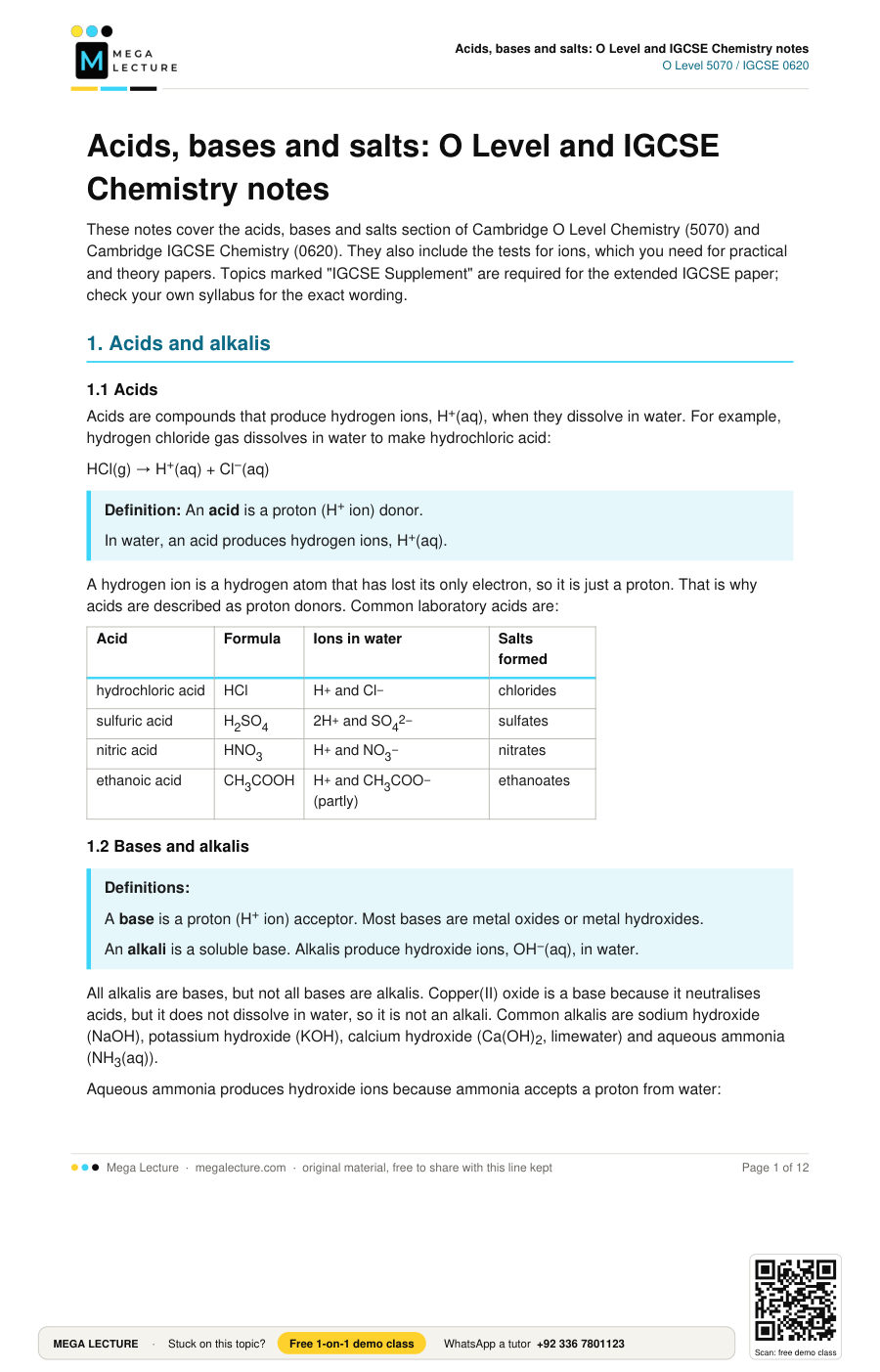
Opens inside this page. Prefer your own PDF app? Open the PDF.
Chemistry batch classes: coming soon. Small live classes at a lower fee than one-to-one. Join the waiting list
Check yourself
5 quick questions on Edexcel Chemistry
Tap an answer to see if you are right, and why. Free, no sign-up.
Start the free testWas this note useful?
Full text of Acids, bases and salts: O Level and IGCSE Chemistry notes
These notes cover the acids, bases and salts section of Cambridge O Level Chemistry (5070) and Cambridge IGCSE Chemistry (0620). They also include the tests for ions, which you need for practical and theory papers. Topics marked "IGCSE Supplement" are required for the extended IGCSE paper; check your own syllabus for the exact wording.
1. Acids and alkalis
1.1 Acids
Acids are compounds that produce hydrogen ions, H+(aq), when they dissolve in water. For example, hydrogen chloride gas dissolves in water to make hydrochloric acid:
HCl(g) → H+(aq) + Cl−(aq)
Definition: An acid is a proton (H+ ion) donor.
In water, an acid produces hydrogen ions, H+(aq).
A hydrogen ion is a hydrogen atom that has lost its only electron, so it is just a proton. That is why acids are described as proton donors. Common laboratory acids are:
| Acid | Formula | Ions in water | Salts formed |
|---|---|---|---|
| hydrochloric acid | HCl | H+ and Cl− | chlorides |
| sulfuric acid | H2SO4 | 2H+ and SO42− | sulfates |
| nitric acid | HNO3 | H+ and NO3− | nitrates |
| ethanoic acid | CH3COOH | H+ and CH3COO− (partly) | ethanoates |
1.2 Bases and alkalis
Definitions:
A base is a proton (H+ ion) acceptor. Most bases are metal oxides or metal hydroxides.
An alkali is a soluble base. Alkalis produce hydroxide ions, OH−(aq), in water.
All alkalis are bases, but not all bases are alkalis. Copper(II) oxide is a base because it neutralises acids, but it does not dissolve in water, so it is not an alkali. Common alkalis are sodium hydroxide (NaOH), potassium hydroxide (KOH), calcium hydroxide (Ca(OH)2, limewater) and aqueous ammonia (NH3(aq)).
Aqueous ammonia produces hydroxide ions because ammonia accepts a proton from water:
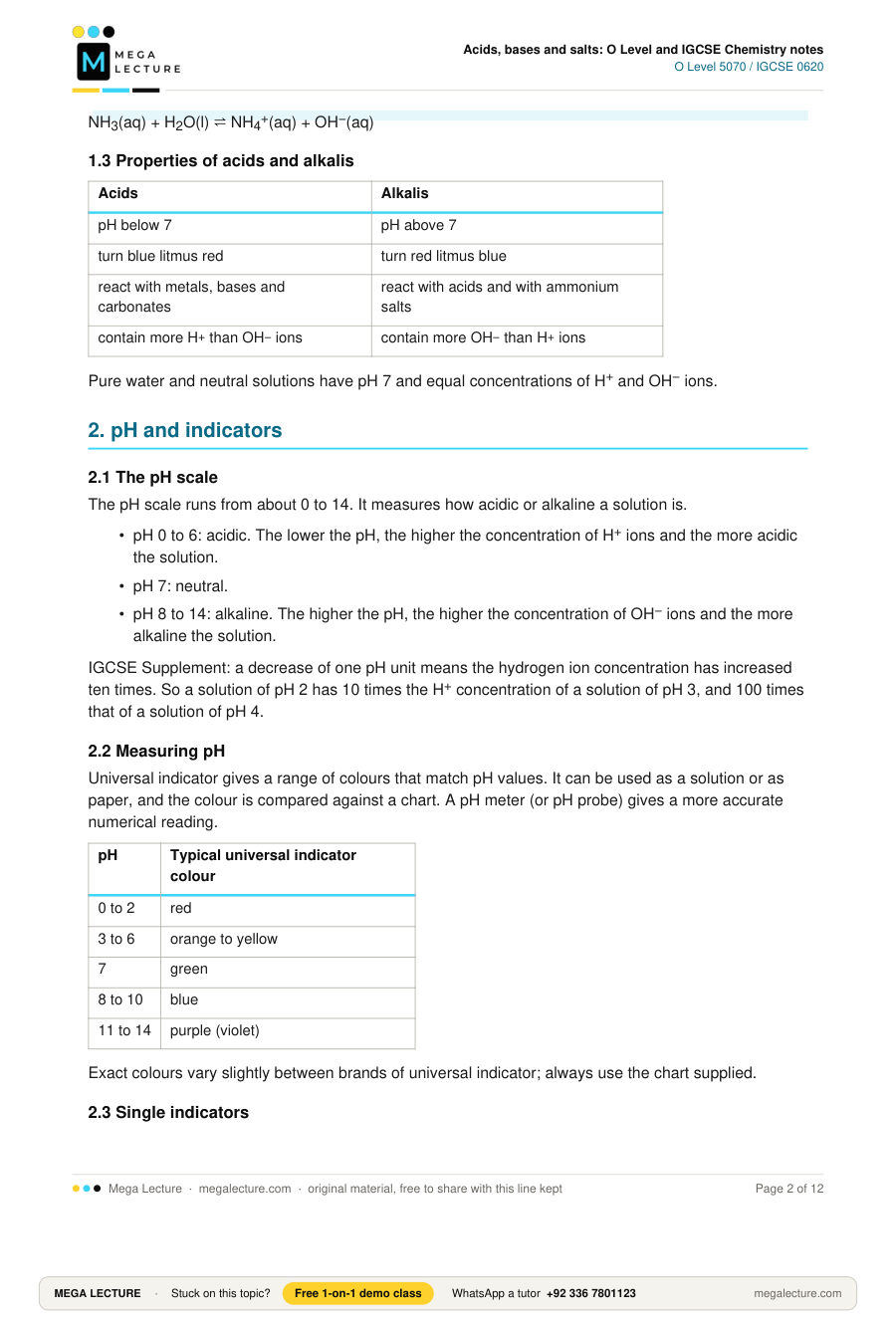
NH3(aq) + H2O(l) ⇌ NH4+(aq) + OH−(aq)
1.3 Properties of acids and alkalis
| Acids | Alkalis |
|---|---|
| pH below 7 | pH above 7 |
| turn blue litmus red | turn red litmus blue |
| react with metals, bases and carbonates | react with acids and with ammonium salts |
| contain more H+ than OH− ions | contain more OH− than H+ ions |
Pure water and neutral solutions have pH 7 and equal concentrations of H+ and OH− ions.
2. pH and indicators
2.1 The pH scale
The pH scale runs from about 0 to 14. It measures how acidic or alkaline a solution is.
- pH 0 to 6: acidic. The lower the pH, the higher the concentration of H+ ions and the more acidic the solution.
- pH 7: neutral.
- pH 8 to 14: alkaline. The higher the pH, the higher the concentration of OH− ions and the more alkaline the solution.
IGCSE Supplement: a decrease of one pH unit means the hydrogen ion concentration has increased ten times. So a solution of pH 2 has 10 times the H+ concentration of a solution of pH 3, and 100 times that of a solution of pH 4.
2.2 Measuring pH
Universal indicator gives a range of colours that match pH values. It can be used as a solution or as paper, and the colour is compared against a chart. A pH meter (or pH probe) gives a more accurate numerical reading.
| pH | Typical universal indicator colour |
|---|---|
| 0 to 2 | red |
| 3 to 6 | orange to yellow |
| 7 | green |
| 8 to 10 | blue |
| 11 to 14 | purple (violet) |
Exact colours vary slightly between brands of universal indicator; always use the chart supplied.
2.3 Single indicators
Single indicators change sharply from one colour to another. They are used in titrations because the colour change is easy to see.
| Indicator | Colour in acid | Colour in alkali |
|---|---|---|
| litmus | red | blue |
| methyl orange | red | yellow |
| thymolphthalein | colourless | blue |
| phenolphthalein | colourless | pink |
Current Cambridge syllabuses name thymolphthalein and methyl orange; phenolphthalein appears in older papers and many textbooks.
3. Strong and weak acids and alkalis
Definitions:
A strong acid is an acid that is completely dissociated (ionised) in aqueous solution.
A weak acid is an acid that is partially dissociated (ionised) in aqueous solution.
Hydrochloric acid is a strong acid. Every HCl molecule gives up its proton:
HCl(aq) → H+(aq) + Cl−(aq)
Ethanoic acid is a weak acid. Only a small fraction of its molecules dissociate at any time, so the reaction is reversible:
CH3COOH(aq) ⇌ H+(aq) + CH3COO−(aq)
Strong alkalis such as sodium hydroxide are completely dissociated into ions. Aqueous ammonia is a weak alkali: only a small proportion of the ammonia molecules react to form OH− ions.
3.1 Strength is not the same as concentration
Concentration tells you how much acid is dissolved in a given volume of water (for example 0.1 mol/dm3 or 2.0 mol/dm3). Strength tells you how completely the acid dissociates. A dilute strong acid and a concentrated weak acid are both possible.
3.2 Comparing a strong and a weak acid of the same concentration
| Test | 0.1 mol/dm3 hydrochloric acid (strong) | 0.1 mol/dm3 ethanoic acid (weak) |
|---|---|---|
| pH | lower (about 1) | higher (about 3) |
| reaction with magnesium ribbon | fast, many bubbles | slower, fewer bubbles at any moment |
| electrical conductivity | good | poorer |
| total volume of hydrogen with excess magnesium | the same | the same |
The pH values in the table are approximate. The final volume of hydrogen is the same because, as the weak acid reacts, more molecules dissociate to replace the H+ ions used up, until all the acid has reacted. Only the rate differs.
4. Reactions of acids
Acids react with metals, bases (metal oxides and hydroxides) and carbonates. Each reaction makes a salt.
Definition: A salt is a compound formed when the hydrogen ions of an acid are replaced by metal ions or by ammonium ions.
4.1 Acid + metal → salt + hydrogen
Metals above hydrogen in the reactivity series react with dilute acids. Copper, silver and gold do not.
Mg(s) + 2HCl(aq) → MgCl2(aq) + H2(g)
Zn(s) + H2SO4(aq) → ZnSO4(aq) + H2(g)
Observations: bubbles (effervescence), the metal gets smaller and disappears if the acid is in excess, the solution may get warm. Test for hydrogen: it gives a "pop" with a lighted splint.
4.2 Acid + base → salt + water
CuO(s) + H2SO4(aq) → CuSO4(aq) + H2O(l)
NaOH(aq) + HCl(aq) → NaCl(aq) + H2O(l)
With black copper(II) oxide and warm dilute sulfuric acid, the black solid dissolves and a blue solution forms.
4.3 Acid + carbonate → salt + water + carbon dioxide
CaCO3(s) + 2HCl(aq) → CaCl2(aq) + H2O(l) + CO2(g)
Na2CO3(aq) + H2SO4(aq) → Na2SO4(aq) + H2O(l) + CO2(g)
Observations: effervescence; the gas turns limewater milky.
4.4 Alkalis with ammonium salts
When an ammonium salt is warmed with an alkali, ammonia gas is given off. This is used both to make ammonia and to test for ammonium ions.
NH4Cl(s) + NaOH(aq) → NaCl(aq) + H2O(l) + NH3(g)
5. Neutralisation
When an acid reacts with an alkali, the H+ ions from the acid react with the OH− ions from the alkali to form water. The other ions are spectator ions and stay in solution.
Ionic equation for neutralisation (learn this):
H+(aq) + OH−(aq) → H2O(l)
Neutralisation is exothermic: the temperature of the mixture rises.
Worked example: writing an ionic equation.
Write the ionic equation for the reaction of potassium hydroxide with nitric acid.
Full equation: KOH(aq) + HNO3(aq) → KNO3(aq) + H2O(l)
Split the aqueous ionic compounds into ions: K+ + OH− + H+ + NO3− → K+ + NO3− + H2O
Cancel the ions that appear on both sides (K+ and NO3−): H+(aq) + OH−(aq) → H2O(l)
Everyday uses of neutralisation include adding calcium hydroxide (slaked lime) or calcium carbonate (limestone) to acidic soil, and treating excess stomach acid with antacids that contain bases such as magnesium hydroxide.
6. Types of oxide
Oxides are classified by how they react with acids and bases.
| Type | Typical elements | Examples | Behaviour |
|---|---|---|---|
| acidic | non-metals | CO2, SO2, SO3, NO2, P4O10 | react with bases/alkalis to form a salt and water; many dissolve in water to give acidic solutions |
| basic | metals | Na2O, CaO, MgO, CuO | react with acids to form a salt and water |
| amphoteric | some metals | Al2O3, ZnO | react with both acids and bases |
| neutral | some non-metals | CO, NO, N2O | react with neither acids nor bases |
Definition: An amphoteric oxide is an oxide that reacts with both acids and bases to produce a salt and water.
Examples of acidic and basic oxide reactions:
CO2(g) + 2NaOH(aq) → Na2CO3(aq) + H2O(l)
MgO(s) + 2HCl(aq) → MgCl2(aq) + H2O(l)
Zinc oxide shows amphoteric behaviour. With acid: ZnO + 2HCl → ZnCl2 + H2O. It also dissolves in excess aqueous sodium hydroxide to form a soluble zincate salt. You may be asked to describe this behaviour; the equation for the reaction with alkali is not usually required at this level.
7. Solubility rules
Before you choose a method to make a salt, you must know whether it is soluble in water. Learn these rules.
| Compounds | Soluble | Insoluble (main exceptions) |
|---|---|---|
| sodium, potassium and ammonium compounds | all soluble | none |
| nitrates | all soluble | none |
| chlorides (and bromides, iodides) | most soluble | silver and lead(II) |
| sulfates | most soluble | barium, calcium and lead(II) |
| carbonates | sodium, potassium and ammonium only | all others |
| hydroxides | sodium, potassium and ammonium; calcium is slightly soluble | all others |
Calcium sulfate is often described as "slightly soluble". For choosing a preparation method, treat it as insoluble.
8. Preparing salts
Which method you use depends on the solubility of the salt and of the starting materials.
| The salt is... | Method | Example |
|---|---|---|
| soluble, and made from an insoluble metal, base or carbonate | A: excess solid | copper(II) sulfate from copper(II) oxide |
| soluble, a sodium, potassium or ammonium salt | B: titration | sodium chloride from sodium hydroxide |
| insoluble | C: precipitation | barium sulfate, silver chloride |
8.1 Method A: soluble salt from an insoluble solid (excess solid method)
Method: preparing hydrated copper(II) sulfate crystals from copper(II) oxide
- Pour dilute sulfuric acid into a beaker and warm it gently.
- Add copper(II) oxide a little at a time, stirring, until some black solid remains unreacted. This shows the solid is in excess and all the acid has been used up.
- Filter to remove the excess copper(II) oxide. The filtrate is copper(II) sulfate solution.
- Heat the filtrate in an evaporating basin to evaporate some of the water until the solution is saturated (the crystallisation point). Test by dipping in a cold glass rod: crystals form on it.
- Leave the solution to cool so that crystals form.
- Filter off the crystals, wash them with a little cold distilled water and dry them between filter papers or in a warm place.
Equation: CuO(s) + H2SO4(aq) → CuSO4(aq) + H2O(l)
Reasons examiners ask for:
- Why use excess solid? To make sure all the acid reacts, so the salt is not contaminated with acid.
- Why not evaporate to dryness? Strong heating would drive off the water of crystallisation and give a powder of the anhydrous salt (and could decompose it), instead of crystals of the hydrated salt.
The same method works with an insoluble carbonate (stop adding when effervescence stops and solid remains) or an unreactive-enough metal such as zinc or magnesium (stop when bubbling stops and metal remains). It does not work for metals that are too reactive, such as sodium, which is dangerous with acid, or for metals below hydrogen, such as copper, which do not react with dilute acids.
8.2 Method B: titration
Sodium, potassium and ammonium salts are made from a soluble alkali (or carbonate) and an acid. Both reactants are solutions, so you cannot add one in excess and filter it off. Instead, you find the exact volumes that react by titration.
Method: preparing sodium chloride crystals by titration
- Use a pipette to put 25.0 cm3 of sodium hydroxide solution into a conical flask. Add a few drops of indicator (for example methyl orange or thymolphthalein).
- Fill a burette with hydrochloric acid and record the starting reading.
- Add the acid from the burette, swirling, until the indicator just changes colour. Record the final reading and work out the volume of acid used.
- Repeat with 25.0 cm3 of fresh sodium hydroxide and the same volume of acid, but with no indicator, so the salt is not contaminated with indicator.
- Evaporate the solution to the crystallisation point, leave it to cool and crystallise, then filter and dry the crystals.
Equation: NaOH(aq) + HCl(aq) → NaCl(aq) + H2O(l)
An alternative to step 4 is to add powdered activated charcoal to remove the indicator, then filter.
8.3 Method C: insoluble salts by precipitation
Method: preparing barium sulfate by precipitation
- Mix a solution containing barium ions (for example aqueous barium chloride) with a solution containing sulfate ions (for example dilute sulfuric acid or aqueous sodium sulfate).
- A white precipitate of barium sulfate forms immediately.
- Filter the mixture. The barium sulfate stays on the filter paper.
- Wash the residue with distilled water to remove the soluble impurities (the spectator ions).
- Dry the solid in a warm oven or between filter papers.
Equation: BaCl2(aq) + Na2SO4(aq) → BaSO4(s) + 2NaCl(aq)
Ionic equation: Ba2+(aq) + SO42−(aq) → BaSO4(s)
To choose the two solutions, pick one soluble compound that supplies the metal ion and one that supplies the anion. Nitrates and sodium salts are useful because they are always soluble.
8.4 Water of crystallisation
Definitions:
Hydrated substance: a substance that is chemically combined with water.
Anhydrous substance: a substance that contains no water.
Water of crystallisation: water molecules present in the crystals of a hydrated salt.
Examples: CuSO4•5H2O (blue) and CoCl2•6H2O (pink). Heating blue hydrated copper(II) sulfate gives white anhydrous copper(II) sulfate; adding water turns it blue again. This reversible change is a test for water.
Worked example: mass of salt from a preparation.
A student reacts excess zinc carbonate with 50.0 cm3 of 1.00 mol/dm3 sulfuric acid. Calculate the maximum mass of anhydrous zinc sulfate that could be obtained. (Ar: Zn = 65, S = 32, O = 16)
Equation: ZnCO3 + H2SO4 → ZnSO4 + H2O + CO2
Moles of H2SO4 = 1.00 × 50.0/1000 = 0.0500 mol
Mole ratio H2SO4 : ZnSO4 = 1 : 1, so moles of ZnSO4 = 0.0500 mol
Mr of ZnSO4 = 65 + 32 + (4 × 16) = 161
Mass = 0.0500 × 161 = 8.05 g
9. Tests for ions
9.1 Tests for cations using aqueous sodium hydroxide and aqueous ammonia
Add a few drops of the reagent to the test solution, then add the reagent in excess. Many metal hydroxides are insoluble and form coloured precipitates.
| Cation | Aqueous sodium hydroxide | Aqueous ammonia |
|---|---|---|
| aluminium, Al3+ | white precipitate, soluble in excess giving a colourless solution | white precipitate, insoluble in excess |
| ammonium, NH4+ | ammonia produced on warming (turns damp red litmus paper blue) | not applicable |
| calcium, Ca2+ | white precipitate, insoluble in excess | no precipitate or very slight white precipitate |
| chromium(III), Cr3+ | green precipitate, soluble in excess | green precipitate, insoluble in excess |
| copper(II), Cu2+ | light blue precipitate, insoluble in excess | light blue precipitate, soluble in excess giving a dark blue solution |
| iron(II), Fe2+ | green precipitate, insoluble in excess | green precipitate, insoluble in excess |
| iron(III), Fe3+ | red-brown precipitate, insoluble in excess | red-brown precipitate, insoluble in excess |
| zinc, Zn2+ | white precipitate, soluble in excess giving a colourless solution | white precipitate, soluble in excess giving a colourless solution |
Ionic equations for precipitates are written in the same way each time, for example:
Cu2+(aq) + 2OH−(aq) → Cu(OH)2(s)
Fe3+(aq) + 3OH−(aq) → Fe(OH)3(s)
Exam tip: telling aluminium from zinc. Both give a white precipitate that dissolves in excess sodium hydroxide. Use aqueous ammonia: the zinc precipitate dissolves in excess, the aluminium precipitate does not. Similarly, calcium gives a white precipitate with sodium hydroxide that does not dissolve in excess, but little or no precipitate with ammonia.
9.2 Flame tests
Dip a clean wire (nichrome or platinum) in concentrated hydrochloric acid, then into the solid, and hold it in a blue Bunsen flame.
| Cation | Flame colour |
|---|---|
| lithium, Li+ | red |
| sodium, Na+ | yellow |
| potassium, K+ | lilac |
| calcium, Ca2+ | orange-red |
| barium, Ba2+ | light green |
| copper(II), Cu2+ | blue-green |
Flame tests are listed in the IGCSE 0620 syllabus; check whether they appear in your O Level syllabus edition.
9.3 Tests for anions
| Anion | Test | Positive result |
|---|---|---|
| carbonate, CO32− | add dilute acid; bubble the gas through limewater | effervescence; carbon dioxide turns limewater milky |
| chloride, Cl− | acidify with dilute nitric acid, then add aqueous silver nitrate | white precipitate |
| bromide, Br− | acidify with dilute nitric acid, then add aqueous silver nitrate | cream precipitate |
| iodide, I− | acidify with dilute nitric acid, then add aqueous silver nitrate | yellow precipitate |
| sulfate, SO42− | acidify with dilute nitric acid, then add aqueous barium nitrate | white precipitate |
| sulfite, SO32− | add acidified aqueous potassium manganate(VII) | colour changes from purple to colourless |
| nitrate, NO3− | add aqueous sodium hydroxide, then aluminium foil; warm carefully | ammonia produced (turns damp red litmus blue) |
Why acidify first? Carbonate ions would also give a precipitate with silver ions or barium ions, which could give a false positive. The dilute nitric acid removes carbonate as carbon dioxide. Do not acidify with hydrochloric acid in the halide test, because it adds chloride ions, or with sulfuric acid in the sulfate test, because it adds sulfate ions. Some textbooks and older papers use barium chloride with hydrochloric acid for the sulfate test; follow the reagents in your syllabus.
Ionic equations: Ag+(aq) + Cl−(aq) → AgCl(s) and Ba2+(aq) + SO42−(aq) → BaSO4(s).
Quick check
- Define (a) an acid and (b) an alkali in terms of ions or protons. [2]
- Explain the difference between a base and an alkali, using copper(II) oxide and sodium hydroxide as examples. [2]
- Solution P has pH 2 and solution Q has pH 4. (a) Which is more acidic? (b) IGCSE Supplement: how many times greater is the hydrogen ion concentration in P than in Q? [2]
- State the colour of (a) methyl orange in sodium hydroxide solution, (b) thymolphthalein in hydrochloric acid, (c) universal indicator in pure water. [3]
- Ethanoic acid is described as a weak acid. (a) Explain what "weak" means. (b) Write an equation to show this. (c) Describe one test that would show that 0.1 mol/dm3 ethanoic acid is weaker than 0.1 mol/dm3 hydrochloric acid, and give the result. [5]
- Write balanced equations, with state symbols, for the reactions of dilute hydrochloric acid with (a) zinc, (b) magnesium oxide, (c) sodium carbonate solution. [6]
- Write the ionic equation for neutralisation and use it to explain what happens to the sodium and chloride ions when sodium hydroxide reacts with hydrochloric acid. [3]
- Classify each oxide as acidic, basic, amphoteric or neutral: sulfur dioxide, calcium oxide, aluminium oxide, carbon monoxide. Describe a test that shows aluminium oxide is amphoteric. [6]
- Use the solubility rules to state whether each of these is soluble or insoluble in water: lead(II) chloride, potassium carbonate, silver nitrate, barium sulfate, copper(II) hydroxide. [5]
- Describe how to prepare pure, dry crystals of zinc sulfate from zinc oxide. Give the equation. [6]
- Explain why sodium sulfate is prepared by titration and not by adding excess solid sodium hydroxide to sulfuric acid. [2]
- Describe how to prepare a pure, dry sample of insoluble lead(II) iodide. Name the two solutions you would use and write the ionic equation. [5]
- A student adds excess copper(II) carbonate to 40.0 cm3 of 0.500 mol/dm3 sulfuric acid. Calculate the maximum mass of anhydrous copper(II) sulfate that could form. (Ar: Cu = 64, S = 32, O = 16) [3]
- Solution X gives a light blue precipitate with aqueous sodium hydroxide. With aqueous ammonia it gives a light blue precipitate that dissolves in excess to form a dark blue solution. When X is acidified with dilute nitric acid and aqueous barium nitrate is added, a white precipitate forms. Identify X and write ionic equations for the two precipitation reactions. [4]
- Two white solids are known to be zinc chloride and aluminium chloride. Describe how you could use aqueous ammonia to tell them apart, and describe a test to confirm that both contain chloride ions. [4]
Answers
1. (a) An acid is a proton (H+ ion) donor; in water it produces H+(aq) ions. (b) An alkali is a soluble base, which produces OH−(aq) ions in water.
2. A base is any substance that accepts protons (neutralises an acid); an alkali is a base that is soluble in water. Copper(II) oxide neutralises acids but is insoluble, so it is a base but not an alkali. Sodium hydroxide neutralises acids and dissolves in water to give OH− ions, so it is both a base and an alkali.
3. (a) P, because it has the lower pH. (b) The difference is 2 pH units. Each unit is a factor of 10, so the factor is 10 × 10 = 100. P has 100 times the hydrogen ion concentration of Q.
4. (a) Yellow. (b) Colourless. (c) Green (pH 7).
5. (a) A weak acid is only partially dissociated (ionised) in aqueous solution. (b) CH3COOH(aq) ⇌ H+(aq) + CH3COO−(aq). (c) Any one, with result: measure the pH with a pH meter or universal indicator, ethanoic acid has a higher pH; add equal pieces of magnesium ribbon, ethanoic acid bubbles more slowly; measure electrical conductivity, ethanoic acid conducts less well. The concentration of H+ ions is lower in the weak acid because fewer molecules are dissociated.
6. (a) Zn(s) + 2HCl(aq) → ZnCl2(aq) + H2(g). (b) MgO(s) + 2HCl(aq) → MgCl2(aq) + H2O(l). (c) Na2CO3(aq) + 2HCl(aq) → 2NaCl(aq) + H2O(l) + CO2(g). One mark for correct formulae and one for balancing in each.
7. H+(aq) + OH−(aq) → H2O(l). The H+ ions from the acid combine with the OH− ions from the alkali to form water. Na+ and Cl− ions take no part; they are spectator ions and remain in solution as aqueous sodium chloride.
8. Sulfur dioxide: acidic. Calcium oxide: basic. Aluminium oxide: amphoteric. Carbon monoxide: neutral. Test: add aluminium oxide to warm dilute hydrochloric acid in one tube and to warm aqueous sodium hydroxide in another. It reacts and dissolves in both, showing that it reacts with an acid and with a base, so it is amphoteric. (Al2O3 + 6HCl → 2AlCl3 + 3H2O for the acid reaction.)
9. Lead(II) chloride: insoluble (lead is an exception for chlorides). Potassium carbonate: soluble (all potassium compounds are soluble). Silver nitrate: soluble (all nitrates are soluble). Barium sulfate: insoluble (barium is an exception for sulfates). Copper(II) hydroxide: insoluble (only sodium, potassium and ammonium hydroxides are soluble, calcium slightly).
10. Warm some dilute sulfuric acid in a beaker. Add zinc oxide a little at a time with stirring until some solid remains undissolved, so that all the acid has reacted. Filter off the excess zinc oxide. Heat the filtrate to evaporate some water until it reaches the crystallisation point (crystals form on a cold glass rod dipped into it). Leave to cool and crystallise. Filter off the crystals, wash with a little cold distilled water and dry between filter papers. Equation: ZnO(s) + H2SO4(aq) → ZnSO4(aq) + H2O(l).
11. Sodium hydroxide is soluble, so any excess would dissolve and could not be removed by filtration; the salt would be contaminated with sodium hydroxide. Titration finds the exact volumes of acid and alkali that react, so no excess of either remains.
12. Use aqueous lead(II) nitrate and aqueous potassium iodide (or sodium iodide). Mix the solutions; a yellow precipitate of lead(II) iodide forms. Filter, wash the residue on the filter paper with distilled water to remove soluble potassium nitrate, then dry the solid in a warm oven or between filter papers. Ionic equation: Pb2+(aq) + 2I−(aq) → PbI2(s).
13. CuCO3 + H2SO4 → CuSO4 + H2O + CO2. Moles of H2SO4 = 0.500 × 40.0/1000 = 0.0200 mol. The ratio is 1 : 1, so moles of CuSO4 = 0.0200 mol. Mr of CuSO4 = 64 + 32 + (4 × 16) = 160. Mass = 0.0200 × 160 = 3.20 g.
14. X is copper(II) sulfate, CuSO4. The light blue precipitate that dissolves in excess ammonia to give a dark blue solution shows Cu2+; the white precipitate with acidified barium nitrate shows SO42−. Ionic equations: Cu2+(aq) + 2OH−(aq) → Cu(OH)2(s); Ba2+(aq) + SO42−(aq) → BaSO4(s).
15. Dissolve each solid in distilled water. Add aqueous ammonia dropwise, then in excess. Both give a white precipitate at first. With zinc chloride the precipitate dissolves in excess ammonia to give a colourless solution; with aluminium chloride the precipitate does not dissolve in excess. To confirm chloride: acidify each solution with dilute nitric acid and add aqueous silver nitrate; a white precipitate (silver chloride) forms in both.
