
NUST NET · Entry test preparation · NUST NET practice: verbal and analytical reasoning (60 MCQs)
NUST NET practice: verbal and analytical reasoning (60 MCQs)
Opens inside this page. Prefer your own PDF app? Open the PDF.
New: small group classes for NUST entry test are opening, at a lower fee than one-to-one. Join the waiting list
Check yourself
5 quick questions on NUST entry test
Tap an answer to see if you are right, and why. Free, no sign-up.
Start the free test13 of 16 students found these notes useful
Was this note useful?
Full text of NUST NET practice: verbal and analytical reasoning (60 MCQs)
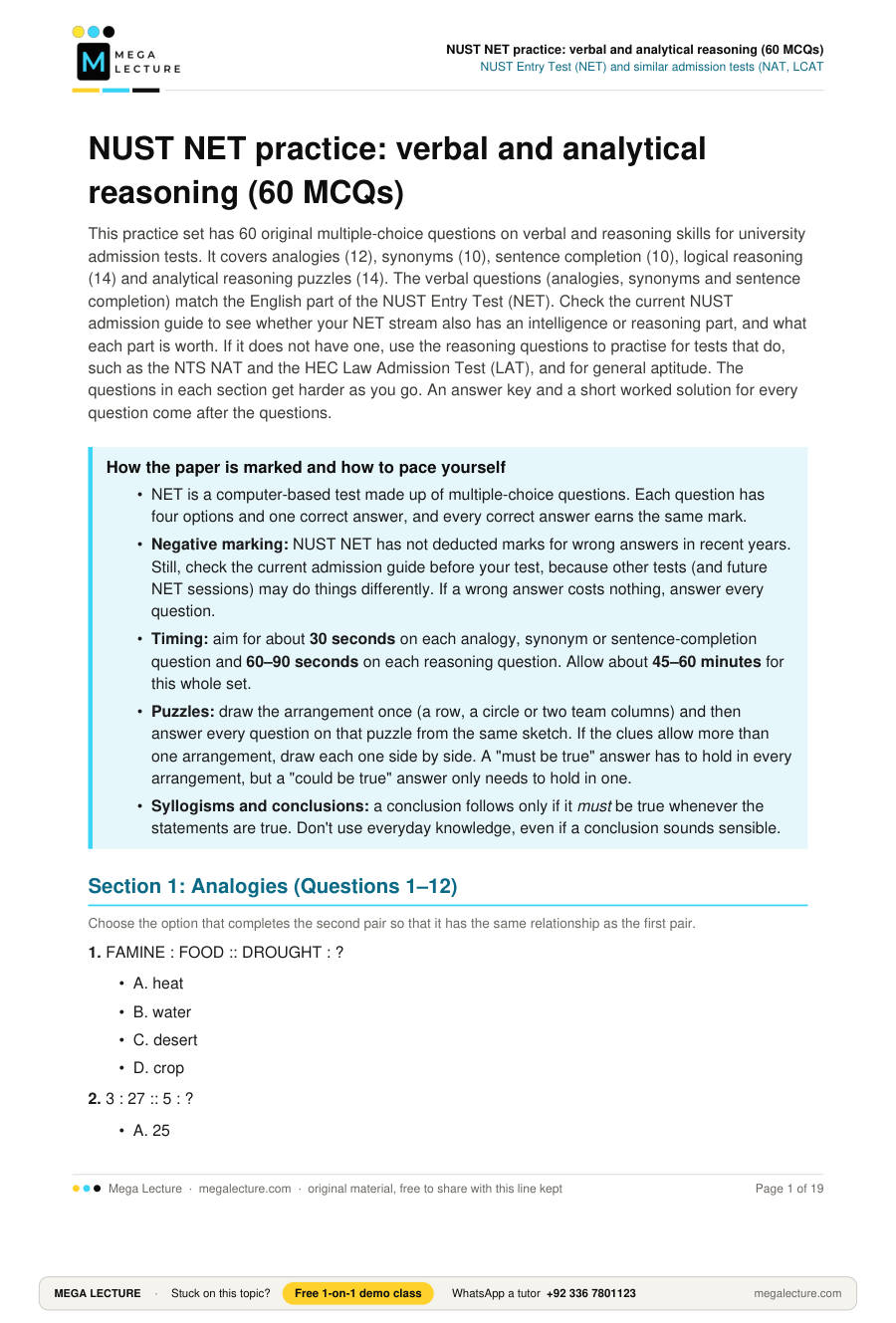
This practice set has 60 original multiple-choice questions on verbal and reasoning skills for university admission tests. It covers analogies (12), synonyms (10), sentence completion (10), logical reasoning (14) and analytical reasoning puzzles (14). The verbal questions (analogies, synonyms and sentence completion) match the English part of the NUST Entry Test (NET). Check the current NUST admission guide to see whether your NET stream also has an intelligence or reasoning part, and what each part is worth. If it does not have one, use the reasoning questions to practise for tests that do, such as the NTS NAT and the HEC Law Admission Test (LAT), and for general aptitude. The questions in each section get harder as you go. An answer key and a short worked solution for every question come after the questions.
How the paper is marked and how to pace yourself
- NET is a computer-based test made up of multiple-choice questions. Each question has four options and one correct answer, and every correct answer earns the same mark.
- Negative marking: NUST NET has not deducted marks for wrong answers in recent years. Still, check the current admission guide before your test, because other tests (and future NET sessions) may do things differently. If a wrong answer costs nothing, answer every question.
- Timing: aim for about 30 seconds on each analogy, synonym or sentence-completion question and 60–90 seconds on each reasoning question. Allow about 45–60 minutes for this whole set.
- Puzzles: draw the arrangement once (a row, a circle or two team columns) and then answer every question on that puzzle from the same sketch. If the clues allow more than one arrangement, draw each one side by side. A "must be true" answer has to hold in every arrangement, but a "could be true" answer only needs to hold in one.
- Syllogisms and conclusions: a conclusion follows only if it must be true whenever the statements are true. Don't use everyday knowledge, even if a conclusion sounds sensible.
Section 1: Analogies (Questions 1–12)
Choose the option that completes the second pair so that it has the same relationship as the first pair.
1. FAMINE : FOOD :: DROUGHT : ?
- A. heat
- B. water
- C. desert
- D. crop
2. 3 : 27 :: 5 : ?
- A. 25
- B. 75
- C. 100
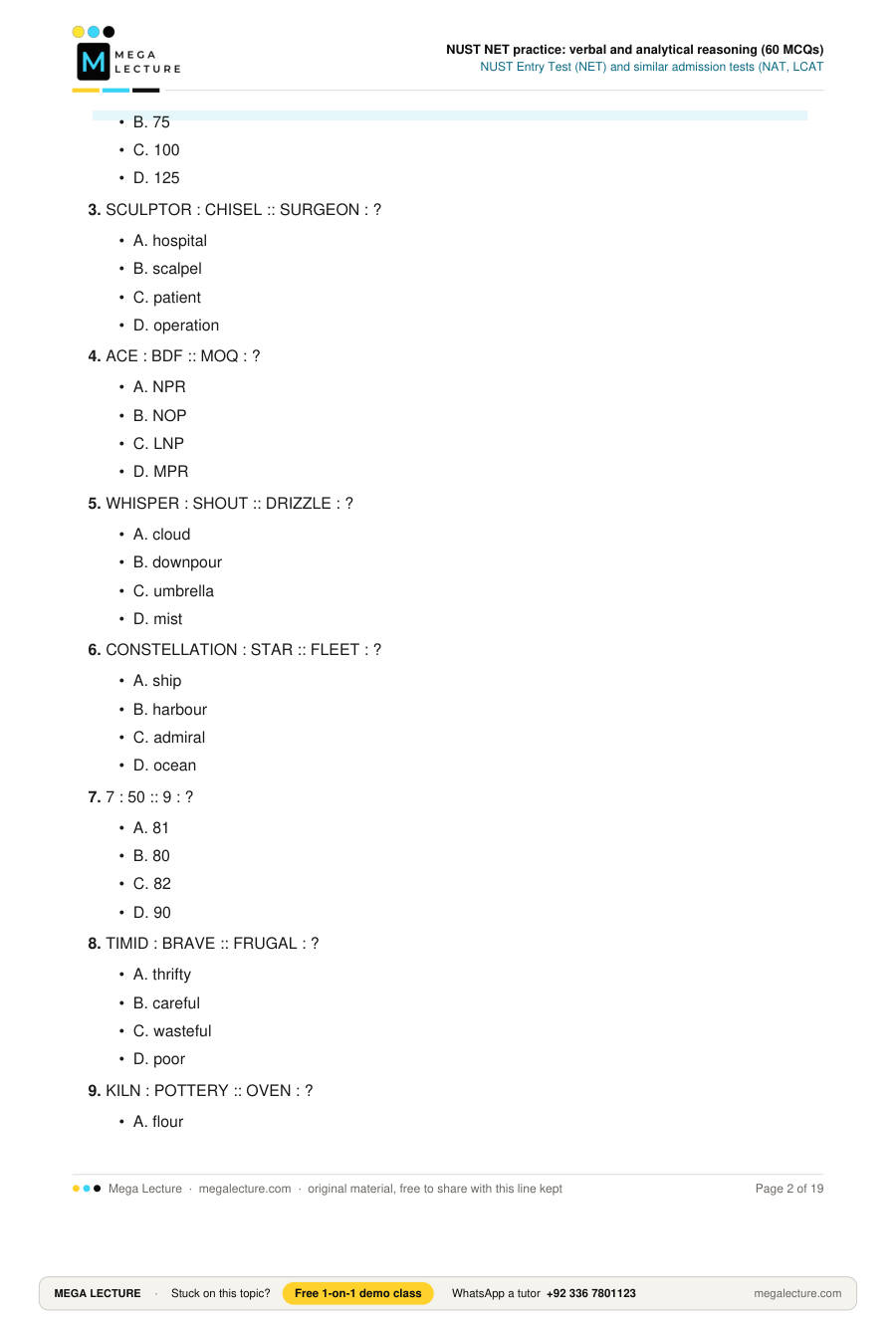
- D. 125
3. SCULPTOR : CHISEL :: SURGEON : ?
- A. hospital
- B. scalpel
- C. patient
- D. operation
4. ACE : BDF :: MOQ : ?
- A. NPR
- B. NOP
- C. LNP
- D. MPR
5. WHISPER : SHOUT :: DRIZZLE : ?
- A. cloud
- B. downpour
- C. umbrella
- D. mist
6. CONSTELLATION : STAR :: FLEET : ?
- A. ship
- B. harbour
- C. admiral
- D. ocean
7. 7 : 50 :: 9 : ?
- A. 81
- B. 80
- C. 82
- D. 90
8. TIMID : BRAVE :: FRUGAL : ?
- A. thrifty
- B. careful
- C. wasteful
- D. poor
9. KILN : POTTERY :: OVEN : ?
- A. flour
- B. bread
- C. baker
- D. heat
10. SEISMOGRAPH : EARTHQUAKE :: ODOMETER : ?
- A. speed
- B. fuel used
- C. distance travelled
- D. engine temperature
11. PROLOGUE : NOVEL :: OVERTURE : ?
- A. curtain
- B. singer
- C. conductor
- D. opera
12. HOROLOGIST : CLOCKS :: NUMISMATIST : ?
- A. coins
- B. numbers
- C. stamps
- D. names
Section 2: Synonyms (Questions 13–22)
Choose the word closest in meaning to the word in capitals.
13. ADVERSARY
- A. partner
- B. advisor
- C. witness
- D. opponent
14. ERRONEOUS
- A. incorrect
- B. deliberate
- C. hidden
- D. irregular
15. OBSOLETE
- A. modern
- B. rare
- C. outdated
- D. broken
16. CANDID
- A. frank
- B. secretive
- C. sweet
- D. bright
17. LUCID
- A. luxurious
- B. lucky
- C. clear
- D. drowsy
18. METICULOUS
- A. painstaking
- B. hasty
- C. generous
- D. anxious
19. TRANSIENT
- A. permanent
- B. transparent
- C. transferable
- D. short-lived
20. SANGUINE
- A. bloodthirsty
- B. optimistic
- C. solemn
- D. sickly
21. MAGNANIMOUS
- A. enormous
- B. magnetic
- C. arrogant
- D. generous
22. LACONIC
- A. lethargic
- B. terse
- C. loquacious
- D. lackadaisical
Section 3: Sentence completion (Questions 23–32)
Choose the option that best completes the sentence.
23. Ahmed's explanation was so ______ that even the youngest students understood it at once.
- A. convoluted
- B. vague
- C. obscure
- D. clear
24. Neither the teacher nor the students ______ aware of the change in the timetable.
- A. was
- B. were
- C. is
- D. has been
25. The committee's decision was ______; not a single member voted against it.
- A. controversial
- B. divided
- C. postponed
- D. unanimous
26. Despite the ______ weather forecast, the cricket match went ahead in bright sunshine.
- A. sunny
- B. gloomy
- C. accurate
- D. pleasant
27. The scientist was ______ about her results: she repeated the experiment three times before publishing.
- A. cautious
- B. careless
- C. indifferent
- D. reckless
28. The old bridge, once busy with traffic, now stands ______, used only by the occasional walker.
- A. crowded
- B. noisy
- C. deserted
- D. demolished
29. The medicine ______ the pain but did nothing to cure the infection.
- A. alleviated
- B. aggravated
- C. caused
- D. ignored
30. Because the evidence against him was ______, the jury took only an hour to ______ him.
- A. flimsy … convict
- B. overwhelming … convict
- C. overwhelming … acquit
- D. weak … sentence
31. Although the plan seemed ______ on paper, it proved ______ in practice.
- A. sound … unworkable
- B. flawed … useless
- C. simple … easy
- D. expensive … costly
32. Far from being ______, the new manager listened patiently to every complaint and changed her plans whenever staff raised a good point.
- A. patient
- B. attentive
- C. obstinate
- D. flexible
Section 4: Logical reasoning (Questions 33–46)
For questions that give conclusions I and II, take the statements as true even if they seem to disagree with known facts. Assume that every group named in the statements has at least one member. Then decide which conclusion(s) must follow. Unless a question says otherwise, the options are: A. Only I follows; B. Only II follows; C. Both I and II follow; D. Neither I nor II follows.
33. Statements: Every flight from Islamabad to Karachi this week was delayed. Sadia took a flight from Islamabad to Karachi this week.
Conclusions: I. Sadia's flight was delayed. II. The delays were caused by bad weather.
- A. Only I follows
- B. Only II follows
- C. Both I and II follow
- D. Neither I nor II follows
34. In a survey of 500 households in Lahore, 70% said they own at least one smartphone. Which conclusion is best supported by this information alone?
- A. 70% of all households in Pakistan own a smartphone.
- B. Smartphones are cheaper in Lahore than elsewhere.
- C. 30% of the surveyed households own a laptop.
- D. Most of the surveyed households own a smartphone.
35. Statements: Some doctors are writers. All writers are readers.
Conclusions: I. Some doctors are readers. II. Some readers are doctors.
- A. Only I follows
- B. Only II follows
- C. Both I and II follow
- D. Neither I nor II follows
36. Statements: All engineers are graduates. Some graduates are athletes.
Conclusions: I. Some engineers are athletes. II. Some athletes are graduates.
- A. Only I follows
- B. Only II follows
- C. Both I and II follow
- D. Neither I nor II follows
37. If the reservoir level is below 20%, the city rations water. This week the city is not rationing water. Which of the following must be true?
- A. The reservoir level is below 20%.
- B. The reservoir is full.
- C. The reservoir level may or may not be below 20%.
- D. The reservoir level is not below 20%.
38. Statements: Every member of the chess club is also a member of the maths society. Hina is not a member of the maths society.
Conclusions: I. Hina plays chess. II. Hina is not a member of the chess club.
- A. Only I follows
- B. Only II follows
- C. Both I and II follow
- D. Neither I nor II follows
39. Statement: A notice at a railway station reads, "Book your seat online to avoid long queues at the ticket window."
Assumptions: I. At least some passengers are able to book online. II. There are sometimes long queues at the ticket window.
- A. Only I is implicit
- B. Only II is implicit
- C. Both I and II are implicit
- D. Neither I nor II is implicit
40. Statements: Some books are novels. Some novels are films.
Conclusions: I. Some books are films. II. All films are novels.
- A. Only I follows
- B. Only II follows
- C. Both I and II follow
- D. Neither I nor II follows
41. Statements: All pens are tools. No tool is edible.
Conclusions: I. No pen is edible. II. Some tools are pens.
- A. Only I follows
- B. Only II follows
- C. Both I and II follow
- D. Neither I nor II follows
42. Statements: No squares are circles. All circles are shapes.
Conclusions: I. Some shapes are not squares. II. No shape is a square.
- A. Only I follows
- B. Only II follows
- C. Both I and II follow
- D. Neither I nor II follows
43. Which statement is the logical negation of "All the lights in the hall are on"?
- A. All the lights in the hall are off.
- B. No light in the hall is on.
- C. Some lights in the hall are on.
- D. At least one light in the hall is off.
44. If a student passes the test, she receives a certificate. Sana received a certificate. Which of the following must be true?
- A. Sana passed the test.
- B. Sana did not pass the test.
- C. Sana may or may not have passed the test.
- D. No other student received a certificate.
45. Statements: Only students who scored above 80% were invited to the award ceremony. Bilal was invited.
Conclusions: I. Everyone who scored above 80% was invited. II. Bilal scored above 80%.
- A. Only I follows
- B. Only II follows
- C. Both I and II follow
- D. Neither I nor II follows
46. Statements: All roses are flowers. Some flowers are red. No red thing is blue.
Conclusions: I. Some flowers are not blue. II. No rose is blue.
- A. Only I follows
- B. Only II follows
- C. Both I and II follow
- D. Neither I nor II follows
Section 5: Analytical reasoning (Questions 47–60)
47. In a queue, Sara is 7th from the front and Omar is 5th from the back. Omar is behind Sara, and exactly 3 people stand between them. How many people are in the queue?
- A. 14
- B. 16
- C. 15
- D. 12
48. Five people, Imran, Javed, Kiran, Laila and Maryam, live on the five floors of a building, one per floor, with floor 1 the lowest. Kiran lives on the floor directly below Laila. Javed lives on the floor directly above Maryam. Imran lives on neither the top floor nor the bottom floor. Who lives on floor 3?
- A. Imran
- B. Javed
- C. Kiran
- D. Maryam
Puzzle 1 (Questions 49–51). Six students, P, Q, R, S, T and U, took a test, and no two of them got the same score.
- Q scored more than R but less than P.
- S had the lowest score.
- T scored more than Q.
- U scored less than R but more than S.
49. Which of the following must be true?
- A. P had the highest score.
- B. T had the highest score.
- C. R is ranked fourth.
- D. U is ranked fourth.
50. If T scored more than P, who is ranked second?
- A. Q
- B. P
- C. T
- D. U
51. How many students scored more than Q?
- A. 2
- B. 3
- C. 1
- D. 4
Puzzle 2 (Questions 52–54). Six friends, Ali, Bina, Faraz, Hira, Kamran and Nadia, sit equally spaced around a round table.
- Ali sits directly opposite Hira.
- Faraz sits between Hira and Nadia, next to both of them.
- Kamran does not sit next to Ali.
52. Who sits directly opposite Nadia?
- A. Bina
- B. Faraz
- C. Hira
- D. Kamran
53. Which pair sits next to each other?
- A. Ali and Kamran
- B. Bina and Faraz
- C. Hira and Kamran
- D. Nadia and Hira
54. Who are Ali's two neighbours?
- A. Bina and Nadia
- B. Bina and Kamran
- C. Nadia and Faraz
- D. Faraz and Kamran
Puzzle 3 (Questions 55–57). Five cars are parked in a row of spaces numbered 1 to 5 from left to right. The cars are white, black, red, silver and blue.
- The blue car is in an even-numbered space.
- The black car is immediately to the right of the red car.
- The silver car is not next to the blue car.
55. Which of the following must be true?
- A. The white car is in space 1.
- B. The silver car is in space 5.
- C. The red car is in space 3.
- D. The white car and the silver car are at opposite ends of the row.
56. If the white car is in space 1, which car is immediately to the left of the red car?
- A. White
- B. Blue
- C. Black
- D. Silver
57. If the blue car is in space 4, how many cars are parked between the white car and the red car?
- A. 1
- B. 2
- C. 3
- D. 0
Puzzle 4 (Questions 58–60). Six trainees, G, H, J, K, L and M, are split into two teams of three: Red and Blue.
- L is in the Red team.
- M is not in the same team as L.
- J is in the same team as K.
58. Which of the following must be true?
- A. G is in the Red team.
- B. H is in the Blue team.
- C. G and H are in the same team.
- D. J is in the Blue team.
59. If K is in the Red team, which of the following must be true?
- A. G is in the Red team.
- B. H is in the same team as L.
- C. J is in the Blue team.
- D. G is in the same team as M.
60. Which of the following could be true?
- A. M is in the Red team.
- B. G and H are in different teams.
- C. J is in the same team as L, and G is in the Red team.
- D. H is in the same team as M.
Answer key
| Question | Answer | Question | Answer | Question | Answer |
|---|---|---|---|---|---|
| 1 | B | 21 | D | 41 | C |
| 2 | D | 22 | B | 42 | A |
| 3 | B | 23 | D | 43 | D |
| 4 | A | 24 | B | 44 | C |
| 5 | B | 25 | D | 45 | B |
| 6 | A | 26 | B | 46 | A |
| 7 | C | 27 | A | 47 | C |
| 8 | C | 28 | C | 48 | A |
| 9 | B | 29 | A | 49 | C |
| 10 | C | 30 | B | 50 | B |
| 11 | D | 31 | A | 51 | A |
| 12 | A | 32 | C | 52 | D |
| 13 | D | 33 | A | 53 | C |
| 14 | A | 34 | D | 54 | A |
| 15 | C | 35 | C | 55 | D |
| 16 | A | 36 | B | 56 | B |
| 17 | C | 37 | D | 57 | B |
| 18 | A | 38 | B | 58 | C |
| 19 | D | 39 | C | 59 | D |
| 20 | B | 40 | D | 60 | D |
Answer spread: A = 15, B = 15, C = 15, D = 15.
Worked solutions
Analogies
1. B. A famine is a severe shortage of food. A drought is a severe shortage of water.
2. D. 27 = 33, so the rule is "cube the number": 53 = 5 × 5 × 5 = 125.
3. B. A chisel is a cutting tool used by a sculptor. A scalpel is a cutting tool used by a surgeon.
4. A. Each letter moves forward one place: A→B, C→D, E→F. Doing the same to MOQ gives M→N, O→P, Q→R, which is NPR.
5. B. A whisper is a very soft sound and a shout is a very loud one. A drizzle is very light rain and a downpour is very heavy rain. Both pairs go from low to high intensity.
6. A. A constellation is a group of stars, and a fleet is a group of ships. An admiral commands a fleet and a harbour is where it docks, but neither is a member of the group.
7. C. 50 = 72 + 1 = 49 + 1. So the answer is 92 + 1 = 81 + 1 = 82. Option A (81) is the trap for anyone who forgets the +1.
8. C. The first pair are antonyms, so we need the opposite of frugal (careful with money), which is wasteful. "Thrifty" is a trap because it is a synonym of frugal.
9. B. A kiln is the oven in which pottery is fired. An oven is where bread is baked. The link is "place where the product is made by heating".
10. C. A seismograph records earthquakes. An odometer records the distance a vehicle has travelled. Speed is measured by a speedometer, which is the look-alike trap.
11. D. A prologue is the opening section of a novel. An overture is the instrumental piece that opens an opera.
12. A. A horologist studies or makes clocks and watches. A numismatist studies or collects coins. Stamps belong to a philatelist, and "numbers" is a trap based only on the look of "num-".
Synonyms
13. D. An adversary is someone you compete or fight against, so the answer is opponent. A partner or ally would be the opposite.
14. A. Erroneous means containing an error, so it means incorrect.
15. C. Obsolete means no longer in use, or out of date. Something obsolete may still work, so "broken" is wrong.
16. A. Candid means open and honest, even when the truth is unwelcome, which is the same as frank.
17. C. Lucid means clearly expressed and easy to understand.
18. A. Meticulous means taking great care over every detail, so the closest word is painstaking. Hasty is nearly the opposite.
19. D. Transient means lasting only a short time, so short-lived fits. Permanent is the antonym, and "transparent" and "transferable" are there only because they look similar.
20. B. Sanguine means cheerfully optimistic, especially when things look difficult. It comes from the Latin word for blood, which is why "bloodthirsty" is a trap. That meaning belongs to a different word, "sanguinary".
21. D. Magnanimous means generous and forgiving, especially towards a rival or someone weaker. "Enormous" is a trap because "magna" means great, and "magnetic" only looks similar.
22. B. Laconic means using very few words, which is the same as terse. Loquacious (talkative) is the antonym. Lethargic and lackadaisical only sound similar.
Sentence completion
23. D. "Even the youngest students understood it" means the explanation was clear. The other three options all mean hard to understand.
24. B. With "neither … nor", the verb agrees with the nearer subject, "the students", which is plural. So the verb must be plural, and "were" is the only plural option ("was", "is" and "has been" are all singular).
25. D. If nobody voted against, everyone agreed, and that is what unanimous means.
26. B. "Despite" tells you the forecast contrasted with the bright sunshine, so it must have been gloomy.
27. A. The colon introduces the evidence: repeating the experiment three times shows that she was cautious.
28. C. "Once busy" sets up a contrast, and walkers still use the bridge, so it cannot have been demolished. Deserted is the only word that fits both clues.
29. A. "But did nothing to cure" shows the medicine helped in some way. Alleviated means eased or relieved. Aggravated would mean it made the pain worse.
30. B. "Because" signals cause and effect, so both blanks must point the same way. Overwhelming evidence explains a quick decision to convict. In A and D weak evidence would not lead to a quick conviction or sentence, and in C strong evidence would not lead to an acquittal.
31. A. "Although" signals a contrast, so the two blanks need opposite ideas: good on paper (sound) and failing in practice (unworkable). Options B, C and D have no contrast.
32. C. "Far from being" means the blank is the opposite of how she actually behaved. She listened and changed her plans, so she was not obstinate (stubborn and unwilling to change). Patient, attentive and flexible all describe what she was.
Logical reasoning
33. A. Every Islamabad–Karachi flight this week was delayed, and Sadia took one, so her flight was delayed (I). The statements say nothing about why, so II does not follow.
34. D. 70% of the 500 surveyed households is more than half, so "most" is supported. A spreads the result from one city's sample to the whole country, and B and C bring in information the survey never mentions.
35. C. The doctors who are writers are also readers, so some doctors are readers (I). Reversing that "some" statement gives II. Both follow.
36. B. The athletes who are graduates may not be engineers at all, so I is not certain. II is simply "Some graduates are athletes" turned round, and a "some" statement can always be reversed like this, so II follows.
37. D. "If below 20%, then rationing" means the same as "if no rationing, then not below 20%" (the contrapositive). The city is not rationing, so the level is not below 20%. "Full" (B) is more than we can prove.
38. B. "Chess club → maths society" also means "not in the maths society → not in the chess club", so II follows. Whether Hina plays chess anywhere else is not known, so I does not follow.
39. C. Advising people to book online only makes sense if some of them can (I). Promising to help them "avoid long queues" only makes sense if queues sometimes form (II). Both are assumed.
40. D. The novels that are books and the novels that are films may be completely different novels, so I is not certain. Nothing tells us that every film is a novel, so II does not follow either.
41. C. Every pen is a tool and no tool is edible, so no pen is edible (I). In these tests we assume the groups named (pens, tools) actually exist, so "All pens are tools" can be turned round to "Some tools are pens" (II). Both follow.
42. A. The circles are shapes (and, by the set's rule, at least one circle exists), and none of them is a square, so some shapes are not squares (I). Other shapes might still be squares, so II does not follow.
43. D. To make "all … are on" false, you only need one light that is not on. So the negation is "at least one light is off". Option A is too strong, because it rules out the case where some lights are on.
44. C. The rule says passing leads to a certificate. It does not say a certificate can only come from passing. Concluding that Sana passed would be the error of "affirming the consequent", so we can't tell either way.
45. B. "Only those above 80% were invited" means "invited → above 80%". Bilal was invited, so he scored above 80% (II). The rule does not say every such student was invited, so I does not follow.
46. A. Some flowers are red, and no red thing is blue, so those red flowers are not blue (I). The roses might not be among the red flowers, so II is not certain.
Analytical reasoning
47. C. Sara is in position 7. The 3 people between them take positions 8, 9 and 10, so Omar is in position 11. Omar is 5th from the back, so 4 people stand behind him. Total = 11 + 4 = 15 (or 7 + 3 + 5 = 15). Option D (12) is the trap for anyone who forgets the 3 people in between.
48. A. Kiran–Laila and Maryam–Javed are each a pair on neighbouring floors. If Imran were on floor 2, floor 1 would be left on its own with no room for a pair. If he were on floor 4, floor 5 would be left on its own. Imran is not on floor 1 or 5, so he must be on floor 3, with the two pairs on floors 1–2 and 4–5 (in either order).
Solving Puzzle 1.
- From clue 1: P > Q > R.
- From clue 4: R > U > S, and clue 2 confirms that S is last. So P > Q > R > U > S.
- From clue 3: T > Q, so T is above Q, but the clues do not say whether T is above or below P.
- So T and P take ranks 1 and 2 in some order, and the rest are fixed: Q third, R fourth, U fifth, S sixth.
| Rank | 1 | 2 | 3 | 4 | 5 | 6 |
|---|---|---|---|---|---|---|
| Student | T or P | P or T | Q | R | U | S |
49. C. R is fourth in both possible orders. A and B are each true in only one order, and U is fifth, not fourth.
50. B. If T is above P, the order is T, P, Q, R, U, S, so P is second.
51. A. Only T and P scored more than Q, which makes 2 students, whichever of them is first.
Solving Puzzle 2. Number the seats 1 to 6 clockwise and put Ali in seat 1. Hira is opposite Ali, so she is in seat 4.
- Faraz is next to Hira, so he is in seat 3 or seat 5. Nadia then goes on Faraz's other side, in seat 2 or seat 6.
- Case 1: Faraz in 3 and Nadia in 2. That leaves seats 5 and 6 for Bina and Kamran. Seat 6 is next to Ali, so Kamran must be in seat 5 and Bina in seat 6.
- Case 2: Faraz in 5 and Nadia in 6. That leaves seats 2 and 3. Seat 2 is next to Ali, so Kamran is in seat 3 and Bina in seat 2.
- The two cases are mirror images of each other, so they give the same neighbours and the same opposite pairs.
| Seat | 1 | 2 | 3 | 4 | 5 | 6 |
|---|---|---|---|---|---|---|
| Case 1 | Ali | Nadia | Faraz | Hira | Kamran | Bina |
| Case 2 | Ali | Bina | Kamran | Hira | Faraz | Nadia |
Opposite pairs (seats 1–4, 2–5, 3–6): Ali–Hira, Nadia–Kamran and Faraz–Bina, the same in both cases.
52. D. In both cases Kamran sits opposite Nadia (seats 2 and 5 in Case 1, seats 6 and 3 in Case 2).
53. C. Hira's neighbours are Faraz and Kamran in both cases. Every other pair listed is separated.
54. A. Seats 2 and 6 are next to Ali, and in both cases Bina and Nadia sit there.
Solving Puzzle 3. Blue is in space 2 or space 4. Test each one.
- Blue in 2. Red–black needs two neighbouring free spaces, so it goes in 3–4 or 4–5. If it goes in 4–5, spaces 1 and 3 are left, and both are next to blue, so silver has nowhere to go. So red is in 3 and black in 4. Spaces 1 and 5 are left, and space 1 is next to blue, so silver is in 5 and white is in 1.
- Blue in 4. Red–black goes in 1–2 or 2–3. If it goes in 1–2, spaces 3 and 5 are left, and both are next to blue, so this fails. So red is in 2 and black in 3. Spaces 1 and 5 are left, and space 5 is next to blue, so silver is in 1 and white is in 5.
| Space | 1 | 2 | 3 | 4 | 5 |
|---|---|---|---|---|---|
| Case 1 (blue in 2) | White | Blue | Red | Black | Silver |
| Case 2 (blue in 4) | Silver | Red | Black | Blue | White |
55. D. White and silver are in spaces 1 and 5 in both cases, so they are always at opposite ends. A, B and C are true only in Case 1.
56. B. White in space 1 means Case 1. Red is in space 3, and space 2 (to its left) holds the blue car.
57. B. Blue in space 4 means Case 2. White is in space 5 and red is in space 2, so spaces 3 and 4 are between them. That is 2 cars.
Solving Puzzle 4.
- L is in Red, and M is not with L, so M is in Blue.
- J and K must be together, so they fill either the two remaining Red places or the two remaining Blue places.
- G and H take whichever two places are left, so they are always in the same team.
| Red | Blue | |
|---|---|---|
| Case 1 (J and K in Red) | L, J, K | M, G, H |
| Case 2 (J and K in Blue) | L, G, H | M, J, K |
58. C. G and H are together in both cases. A, B and D are each true in only one case.
59. D. K in Red means J is in Red too (Case 1), so Blue is M, G, H and G is with M. A, B and C are all false in Case 1.
60. D. In Case 1, H is in Blue with M, so D could be true. A breaks the rule that M is not with L. B is impossible because G and H are always together. C is impossible because if J is with L, the Red team is L, J, K and G must be in Blue.
Common traps to watch for
- Analogies: spot the relationship type first (tool–user, part–whole, degree, antonym, product–place), then look for the option with the same type. A word from the same topic is not enough.
- Synonyms: test papers often include the antonym and a word that only looks or sounds similar (transient/transparent, magnanimous/enormous). Rule those out first.
- Sentence completion: signal words such as despite, although, because, but, even and "far from" decide whether the blank continues or reverses the idea.
- Conditionals: "If P then Q" lets you conclude "not Q → not P". It does not let you conclude "Q → P".
- Puzzles: when a clue leaves two cases, test each one quickly. Often one case breaks a later clue, as in Puzzle 3. If both cases survive, "must be true" means true in both.
