
CSS · Islamiyat · Recommended Books & Readings
Islamic Studies Course Outline
Need more than one subject? All-notes pass: unlimited downloads of every note for a year: unlimited downloads of every note on the site, PKR 999 a year. All packs and courses.
Opens inside this page. Prefer your own PDF app? Open the PDF.
Check yourself
5 quick questions on CSS Islamiyat
Tap an answer to see if you are right, and why. Free, no sign-up.
Start the free test👍 11 students found these notes useful
Was this note useful?
Full text of Islamic Studies Course Outline
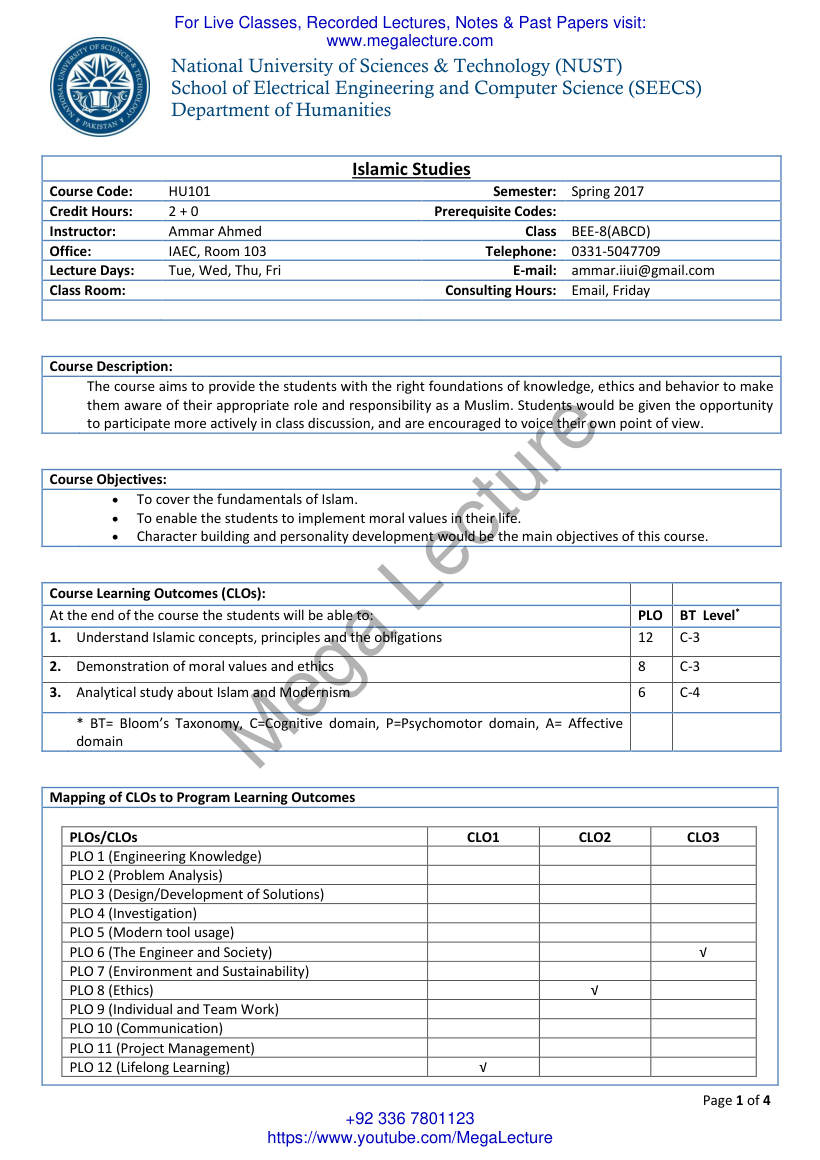
National University of Sciences & Technology (NUST) School of Electrical Engineering and Computer Science (SEECS)
Department of Humanities Islamic Studies Course Code:
HU101 Semester: Spring 2017
Credit Hours:
2 + 0
Prerequisite Codes:
Instructor:
Ammar Ahmed Class BEE-8(ABCD)
Office:
IAEC, Room 103 Telephone: 0331-5047709
Lecture Days:
Tue, Wed, Thu, Fri E-mail: ammar.iiui@gmail.com
Class Room:
Consulting Hours: Email, Friday
Course Description:
The course aims to provide the students with the right foundations of knowledge, ethics and behavior to make them aware of their appropriate role and responsibility as a Muslim. Students would be given the opportunity to participate more actively in class discussion, and are encouraged to voice their own point of view.
Course Objectives:
To cover the fundamentals of Islam. To enable the students to implement moral values in their life. Character building and personality development would be the main objectives of this course.
Course Learning Outcomes (CLOs):
At the end of the course the students will be able to:
PLO BT Level*
- Understand Islamic concepts, principles and the obligations C-3
- Demonstration of moral values and ethics C-3
- Analytical study about Islam and Modernism C-4
* BT= Bloom’s Taxonomy, C=Cognitive domain, P=Psychomotor domain, A= Affective domain
Mapping of CLOs to Program Learning Outcomes PLOs/CLOs CLO1 CLO2 CLO3
PLO 1 (Engineering Knowledge) PLO 2 (Problem Analysis) PLO 3 (Design/Development of Solutions) PLO 4 (Investigation) PLO 5 (Modern tool usage) PLO 6 (The Engineer and Society) √ PLO 7 (Environment and Sustainability) PLO 8 (Ethics) √ PLO 9 (Individual and Team Work) PLO 10 (Communication) PLO 11 (Project Management) PLO 12 (Lifelong Learning) √
Mega Lecture
www.megalecture.com
Free notes, practice tests and live classes Back to megalecture.com
School of Electrical Engineering and Computer Science (SEECS) Department of Humanities
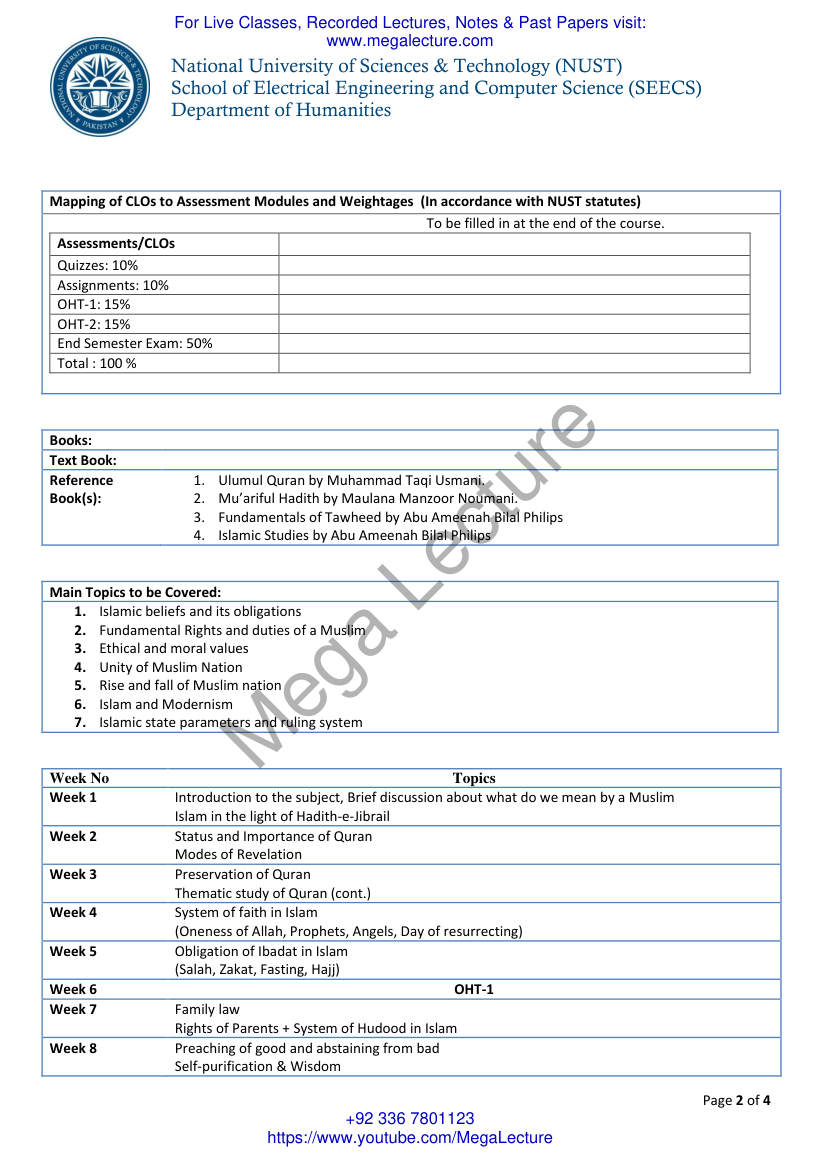
Mapping of CLOs to Assessment Modules and Weightages (In accordance with NUST statutes) To be filled in at the end of the course.
Assessments/CLOs
Quizzes: 10% Assignments: 10% OHT-1: 15% OHT-2: 15% End Semester Exam: 50% Total : 100 %
Books:
Text Book:
Reference Book(s):
- Ulumul Quran by Muhammad Taqi Usmani.
- Mu’ariful Hadith by Maulana Manzoor Noumani.
- Fundamentals of Tawheed by Abu Ameenah Bilal Philips
- Islamic Studies by Abu Ameenah Bilal Philips
Main Topics to be Covered:
- Islamic beliefs and its obligations
- Fundamental Rights and duties of a Muslim
- Ethical and moral values
- Unity of Muslim Nation
- Rise and fall of Muslim nation
- Islam and Modernism
- Islamic state parameters and ruling system
Week No Topics Week 1
Introduction to the subject, Brief discussion about what do we mean by a Muslim Islam in the light of Hadith-e-Jibrail
Week 2
Status and Importance of Quran Modes of Revelation
Week 3
Preservation of Quran Thematic study of Quran (cont.)
Week 4
System of faith in Islam (Oneness of Allah, Prophets, Angels, Day of resurrecting)
Week 5
Obligation of Ibadat in Islam (Salah, Zakat, Fasting, Hajj)
Week 6 OHT-1 Week 7
Family law Rights of Parents + System of Hudood in Islam
Week 8
Preaching of good and abstaining from bad Self-purification & Wisdom
Mega Lecture
School of Electrical Engineering and Computer Science (SEECS) Department of Humanities Week 9
Right to life Right to Property
Week 10
Right to protect one's honor Right to justice + Last sermon of the Prophet
Week 11
Forgiveness Tolerance & Honesty
Week 12 OHT-2 Week 13
Truthfulness & Etiquette of conversation Sincerity & Fulfillment of promise
Week 14
Islamic Civilization Islam in our times (cont.)
Week 15
Islam in our times Islam & State (cont.)
Week 16
Islam and state Geo-political dynamics
Week 17
Rise and Fall of the Muslim nation Muslim as a Universal citizen
Week 18 End Semester Exam Grading Policy:
Quiz Policy:
The quizzes will be unannounced and normally last for ten to fifteen minutes. The question framed is to test the concepts involved in last few lectures. Number of quizzes that will be used for evaluation is at the instructor’s discretion. Grading for quizzes will be on a fixed scale of 0 to
- A score of 10 indicates an exceptional attempt towards the answer and a score of 1 indicates your answer is entirely wrong but you made a reasonable effort towards the solution. Scores in between indicate very good (8-9), good (6-7), satisfactory (4-5), and poor (2-3) attempt. Failure to make a reasonable effort to answer a question scores a 0.
Assignment Policy:
In order to develop comprehensive understanding of the subject, assignments will be given. Late assignments will not be accepted / graded. All assignments will count towards the total (No ‘best- of’ policy). The students are advised to do the assignment themselves. Copying of assignments is highly discouraged and violations will be dealt with severely by referring any occurrences to the disciplinary committee. The questions in the assignment are meant to be challenging to give students confidence and extensive knowledge about the subject matter and enable them to prepare for the exams.
Plagiarism:
SEECS maintains a zero tolerance policy towards plagiarism. While collaboration in this course is highly encouraged, you must ensure that you do not claim other people’s work/ ideas as your own. Plagiarism occurs when the words, ideas, assertions, theories, figures, images, programming codes of others are presented as your own work. You must cite and acknowledge all sources of information in your assignments. Failing to comply with the SEECS plagiarism policy will lead to strict penalties including zero marks in assignments and referral to the academic coordination office for disciplinary action.
Mega Lecture
School of Electrical Engineering and Computer Science (SEECS) Department of Humanities PLO Description
- Engineering Knowledge: An ability to apply knowledge of mathematics, science, engineering fundamentals and an engineering specialization to the solution of complex engineering problems.
- Problem Analysis: An ability to identify, formulate, research literature, and analyse complex engineering problems reaching substantiated conclusions using first principles of mathematics, natural sciences and engineering sciences. (iii) Design/Development of Solutions: An ability to design solutions for complex engineering problems and design systems, components or processes that meet specified needs with appropriate consideration for public health and safety, cultural, societal, and environmental considerations.
- Investigation: An ability to investigate complex engineering problems in a methodical way including literature survey, design and conduct of experiments, analysis and interpretation of experimental data, and synthesis of information to derive valid conclusions.
- Modern Tool Usage: An ability to create, select and apply appropriate techniques, resources, and modern engineering and IT tools, including prediction and modelling, to complex engineering activities, with an understanding of the limitations.
- The Engineer and Society: An ability to apply reasoning informed by contextual knowledge to assess societal, health, safety, legal and cultural issues and the consequent responsibilities relevant to professional engineering practice and solution to complex engineering problems. (vii) Environment and Sustainability: An ability to understand the impact of professional engineering solutions in societal and environmental contexts and demonstrate knowledge of and need for sustainable development. (viii) Ethics: Apply ethical principles and commit to professional ethics and responsibilities and norms of engineering practice.
- Individual and Team Work: An ability to work effectively, as an individual or in a team, on multifaceted and /or multidisciplinary settings.
- Communication: An ability to communicate effectively, orally as well as in writing, on complex engineering activities with the engineering community and with society at large, such as being able to comprehend and write effective reports and design documentation, make effective presentations, and give and receive clear instructions.
- Project Management: An ability to demonstrate management skills and apply engineering principles to one’s own work, as a member and/or leader in a team, to manage projects in a multidisciplinary environment. (xii) Lifelong Learning: An ability to recognize importance of, and pursue lifelong learning in the broader context of innovation and technological developments.
