
IB Diploma · Physics · SL / HL · Theme C: Wave Behaviour
C.1 Simple Harmonic Motion
Opens inside this page. Prefer your own PDF app? Open the PDF.
Full text of C.1 Simple Harmonic Motion
IB DP PHYSICS Theme C: Wave Behaviour C.1 Simple Harmonic Motion
Revision Notes · Standard and Higher Level Fahad H. Ahmad
+92 323 509 4443 | Megalecture.com
Original notes prepared for the IB Diploma Programme Physics course (first assessment 2025)
What the syllabus requires
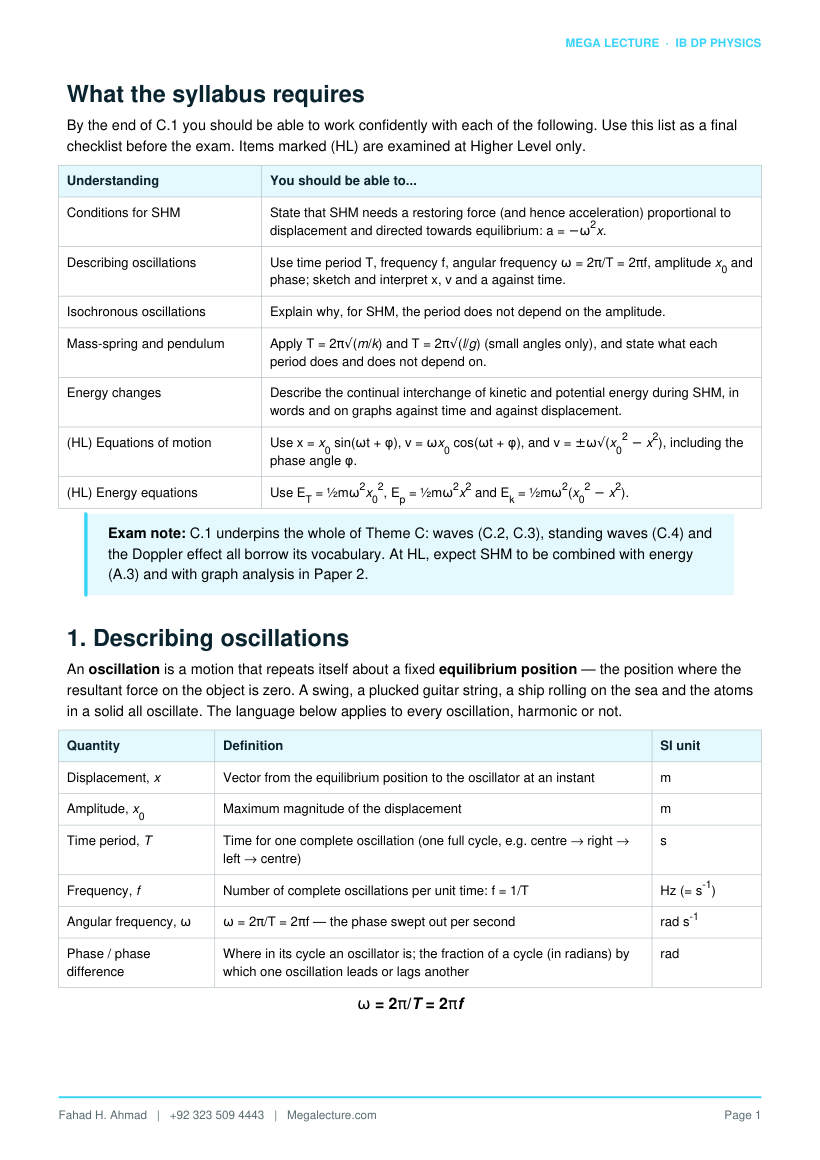
By the end of C.1 you should be able to work confidently with each of the following. Use this list as a final checklist before the exam. Items marked (HL) are examined at Higher Level only.
Understanding You should be able to...
Conditions for SHM State that SHM needs a restoring force (and hence acceleration) proportional to displacement and directed towards equilibrium: a = −ω2x.
Describing oscillations Use time period T, frequency f, angular frequency ω = 2π/T = 2πf, amplitude x0 and phase; sketch and interpret x, v and a against time.
Isochronous oscillations Explain why, for SHM, the period does not depend on the amplitude.
Mass-spring and pendulum Apply T = 2π√(m/k) and T = 2π√(l/g) (small angles only), and state what each period does and does not depend on.
Energy changes Describe the continual interchange of kinetic and potential energy during SHM, in words and on graphs against time and against displacement.
(HL) Equations of motion Use x = x0 sin(ωt + φ), v = ωx0 cos(ωt + φ), and v = ±ω√(x0
2 − x2), including the phase angle φ.
(HL) Energy equations Use ET = ½mω2x0
2, Ep = ½mω2x2 and Ek = ½mω2(x0 2 − x2).
Exam note: C.1 underpins the whole of Theme C: waves (C.2, C.3), standing waves (C.4) and the Doppler effect all borrow its vocabulary. At HL, expect SHM to be combined with energy (A.3) and with graph analysis in Paper 2.
1. Describing oscillations
An oscillation is a motion that repeats itself about a fixed equilibrium position — the position where the resultant force on the object is zero. A swing, a plucked guitar string, a ship rolling on the sea and the atoms in a solid all oscillate. The language below applies to every oscillation, harmonic or not.
Quantity Definition SI unit
Displacement, x Vector from the equilibrium position to the oscillator at an instant m
Amplitude, x0 Maximum magnitude of the displacement m
Time period, T Time for one complete oscillation (one full cycle, e.g. centre → right → left → centre) s
Frequency, f Number of complete oscillations per unit time: f = 1/T Hz (= s-1)
Angular frequency, ω ω = 2π/T = 2πf — the phase swept out per second rad s-1
Phase / phase difference
Where in its cycle an oscillator is; the fraction of a cycle (in radians) by which one oscillation leads or lags another rad
ω = 2π/T = 2πf
Angular frequency deserves care. One complete cycle corresponds to a phase of 2π radians (exactly like one revolution of a circle), so an oscillator completing f cycles per second sweeps phase at a rate ω = 2πf radians per second. ω is not a speed in metres per second — it measures how fast the cycle progresses, not how fast the object moves.
Phase difference
Two oscillators with the same frequency are in phase if they reach their maxima together (phase difference 0 or 2π), and in antiphase if one is at its maximum when the other is at its minimum (phase difference π). A quarter-cycle offset is a phase difference of π/2. A time lag Δt between identical oscillations corresponds to a phase difference Δφ = 2πΔt/T.
Worked example 1 — timing an oscillation
A student times 20 complete oscillations of a pendulum at 16.0 s. Find the period, the frequency and the angular frequency.
T = 16.0 / 20 = 0.800 s. f = 1/T = 1.25 Hz.
ω = 2π/T = 2π / 0.800 = 7.85 rad s-1.
Timing many oscillations and dividing reduces the percentage uncertainty from the reaction-time error — say this explicitly in practical questions.
Worked example 2 — phase difference
Two identical pendulums (T = 2.0 s) swing with the same amplitude, but the second is released 0.25 s after the first. Find the phase difference between them.
Δφ = 2πΔt/T = 2π × 0.25/2.0 = π/4 = 0.79 rad.
The second pendulum lags the first by one eighth of a cycle. A delay of 1.0 s (half a period) would put them in antiphase (π rad); a delay of 2.0 s (a whole period) would leave them in phase again.
Isochronous oscillations: An oscillation whose period is independent of its amplitude is called isochronous. SHM is exactly isochronous — halve or double the amplitude of an ideal mass-spring system and T is unchanged. This is why springs and (small-swing) pendulums make good clocks.
2. The defining condition of SHM
Displace an oscillator from equilibrium and something pulls it back: the restoring force. Simple harmonic motion is the special — and remarkably common — case in which the restoring force, and therefore the acceleration, is directly proportional to the displacement and always directed towards the equilibrium position:
a ∝ −x → a = −ω2x
The minus sign carries the physics: when the displacement is to the right (positive), the acceleration points to the left (negative), and vice versa. The constant of proportionality is written ω2 so that ω turns out to be exactly the angular frequency of Section 1 — a stiffer restoring force per unit displacement means a larger ω and a shorter period.
Both requirements must hold for motion to be simple harmonic:
- Proportionality: doubling the displacement doubles the magnitude of the acceleration.
- Direction: the acceleration always points towards equilibrium (opposite to x).
Periodic is not the same as simple harmonic
Every SHM is periodic, but not every periodic motion is SHM. A ball bouncing elastically on a hard floor repeats perfectly, yet between bounces its acceleration is a constant g, not proportional to displacement — periodic, not SHM. The Earth orbiting the Sun is periodic but not SHM (no linear restoring relation along a line). A pendulum swinging through a large angle is periodic but only approximately SHM. To test for SHM, ask one question: is a proportional to −x?
Motion Periodic? SHM? Reason
Mass on a spring (small oscillations) yes yes Hooke's law: F = −kx exactly
Pendulum, small swings (< 10°) yes approximately sin θ ≈ θ, so F ≈ −(mg/l)x
Pendulum, large swings yes no F ∝ sin θ, not ∝ displacement
Ball bouncing elastically on a floor yes no a = g (constant) between bounces, not ∝ −x
Planet in circular orbit yes no no linear restoring relation along a line
Vibrating atom in a molecule yes approximately bond force nearly linear for small stretch
Worked example 3 — recognising SHM from its equation
A 0.30 kg trolley between two springs oscillates so that its acceleration obeys a = −25x (SI units). Find the angular frequency, the period, and the maximum force on the trolley if the amplitude is 8.0 cm.
Comparing a = −25x with a = −ω2x gives ω2 = 25, so ω = 5.0 rad s-1.
T = 2π/ω = 2π/5.0 = 1.3 s (1.26 s).
Maximum acceleration occurs at maximum displacement: amax = 25 × 0.080 = 2.0 m s-2, so Fmax = mamax = 0.30 × 2.0 = 0.60 N, directed towards equilibrium.
Exam technique: When asked to show a motion is SHM, derive the resultant force at a general displacement x, show it has the form F = −(constant)x, and say the acceleration is proportional to displacement and directed towards equilibrium. Both clauses earn marks.
3. The two standard systems
Mass on a spring
A trolley of mass m attached to a light spring of spring constant k obeys Hooke's law: displaced by x, it feels a restoring force F = −kx. Newton's second law then gives ma = −kx → a = −(k/m)x → ω2 = k/m → T = 2π √(m/k)
The period increases with mass (more inertia, sluggish response) and decreases with stiffness (stronger restoring force). It does not depend on the amplitude, and — perhaps surprisingly — not on g either: a vertical mass-spring system has exactly the same period as a horizontal one, because gravity only shifts the equilibrium position, about which the same Hooke's-law oscillation occurs. A mass-spring clock would keep time on the Moon.
The simple pendulum
A bob of mass m on a light string of length l, displaced by angle θ, feels a restoring force along its arc of F = −mg sin θ. For small angles (in radians) sin θ ≈ θ = x/l, where x is the arc displacement, so
F ≈ −(mg/l)x → a = −(g/l)x → ω2 = g/l → T = 2π √(l/g)
The mass m cancels: a heavy bob and a light bob on equal strings swing together, for the same reason all objects free-fall together. The period grows with length and shrinks with g — the same pendulum swings more slowly on the Moon. The small-angle condition (roughly θ < 10°) is essential: at larger amplitudes sin θ < θ, the restoring force is weaker than proportionality requires, and the period lengthens slightly — the motion is then periodic but no longer simple harmonic.
System Period Depends on Does NOT depend on
Mass-spring T = 2π √(m/k) mass m, spring constant k amplitude, g, orientation
Simple pendulum T = 2π √(l/g) length l, gravitational field strength g amplitude (small), mass of bob
Worked example 4 — mass on a spring
A 250 g mass hangs from a spring of spring constant 40 N m-1. Find the period and frequency of small vertical oscillations. What happens to T if the mass is doubled?
T = 2π √(m/k) = 2π √(0.250/40) = 2π × 0.0791 = 0.50 s (0.497 s).
f = 1/T = 2.0 Hz.
T ∝ √m, so doubling m multiplies T by √2: T′ = 0.497 × 1.414 = 0.70 s.
Worked example 5 — period from the static extension
A mass hung on a spring stretches it by 6.0 cm at equilibrium. Without knowing m or k separately, find the period of small vertical oscillations.
At equilibrium the spring force balances the weight: ke = mg, so k/m = g/e where e = 0.060 m is the static extension.
Then ω2 = k/m = g/e, so T = 2π √(e/g) = 2π √(0.060/9.81) = 2π × 0.0782 = 0.49 s.
A neat exam shortcut: the mass-spring period looks exactly like a pendulum of length equal to the static extension.
Worked example 6 — the simple pendulum
- Find the period of a simple pendulum of length 64.0 cm where g = 9.81 m s-2. (b) What length gives a period of exactly 1.00 s?
- T = 2π √(l/g) = 2π √(0.640/9.81) = 2π × 0.2554 = 1.60 s.
- Rearranging: l = gT2/(4π2) = 9.81 × 1.00 / 39.48 = 0.248 m ≈ 25 cm.
Check the physics: shorter pendulum, shorter period — consistent.
Practical link: Measuring g with a pendulum is a classic IA. Plot T2 against l: the graph is a straight line through the origin with gradient 4π2/g, so g = 4π2/gradient. Linearising this way is far better than a single measurement.
Worked example 7 — measuring g from a pendulum experiment
A student measures the period of a simple pendulum for six lengths and plots T2 (y-axis) against l (x-axis). The points lie on a straight line through the origin with gradient 4.02 s2 m-1. Find g.
Squaring T = 2π √(l/g) gives T2 = (4π2/g) l, so the gradient is 4π2/g.
g = 4π2/gradient = 39.48/4.02 = 9.82 m s-2 — consistent with the accepted 9.81 m s-2 to three significant figures.
Figure 3. Simple pendulum: for small angles θ the period is T = 2π √(L/g). With L = 0.640 m and g = 9.81 m s−2, T = 1.605 s
(independent of the bob mass and, for small θ, of amplitude).
4. Graphs of displacement, velocity and acceleration
Because a = −ω2x, the displacement of any simple harmonic oscillator varies sinusoidally with time, and its velocity and acceleration are sinusoids of the same period, shifted in phase:
t T 2T
+x0
-x0 x (displacement) v (velocity) a (acceleration) x, v and a against time for SHM starting at equilibrium and moving in the positive direction (amplitudes normalised for comparison — they are not to the same scale).
- v leads x by π/2 (a quarter of a cycle): the velocity is a maximum as the oscillator sweeps through equilibrium, and zero at the extremes where the motion reverses.
- a is in antiphase with x (phase difference π): the acceleration is greatest in magnitude at the extremes and zero at equilibrium — it is just the x-graph flipped and rescaled by ω2.
- a leads v by π/2, completing the pattern.
Figure 1. For x = A cos(ωt): velocity v = −Aω sin(ωt) leads x by a quarter cycle, and acceleration a = −Aω2 cos(ωt) = −ω2x is in antiphase with x (peaks where x is at its extremes, zero at equilibrium).
The graphs are linked by gradients: v is the gradient of the x-t graph, and a is the gradient of the v-t graph. Wherever the x-t graph is at a peak (gradient zero), v = 0; wherever the x-t graph is steepest (at equilibrium), v is maximal. This is how examiners expect you to justify the phase relationships.
Reading a graph
From an x-t graph you can extract everything: the amplitude is the peak value, the period is the time between successive corresponding points (peak to peak, or every second zero-crossing), and the phase is fixed by where the curve starts. From these, ω = 2π/T, vmax = ωx0 and amax = ω2x0 follow at once.
Worked example 8 — from graph to numbers
An x-t graph for an oscillating ruler tip shows peaks of 5.0 cm and a peak-to-peak time of 0.40 s. Find ω, the maximum speed and the maximum acceleration.
x0 = 0.050 m and T = 0.40 s, so ω = 2π/0.40 = 15.7 rad s-1.
vmax = ωx0 = 15.7 × 0.050 = 0.79 m s-1 (at the equilibrium position).
amax = ω2x0 = 15.72 × 0.050 = 246.7 × 0.050 = 12 m s-2 (at the extremes).
Common error: Zero-crossings of x are one half-period apart, not one period. Reading T as the gap between successive zeros halves T and wrecks every later answer. Measure peak to peak, over several cycles if the graph allows.
Where the sine shape comes from: the circle connection
Watch a point moving in a circle of radius x0 at steady angular speed ω, but view it edge-on: its projection (shadow) on a diameter moves back and forth in exact simple harmonic motion, x = x0 sin ωt. One revolution of the circle is one oscillation of the shadow, which is why the angular-speed symbol ω reappears as angular frequency, why phase is measured in radians, and why a full cycle is 2π. The projection picture also explains the shapes: the shadow crawls near the edges of its path (the circle's motion is almost entirely perpendicular to the diameter there — v = 0 at the extremes) and races through the centre (motion parallel to the diameter — v maximal at equilibrium).
One full cycle at a glance
Instant (for x = x0 sin ωt) Displacement x Velocity v Acceleration a t = 0 0 (equilibrium) +ωx0 (maximum) t = T/4 +x0 (extreme) −ω2x0 (max magnitude) t = T/2 0 (equilibrium) −ωx0 (maximum) t = 3T/4 −x0 (extreme) +ω2x0 (max magnitude) t = T 0 (equilibrium) +ωx0 — cycle repeats
5. (HL) The equations of motion
At Higher Level the graphical relationships of Section 4 become explicit formulae. The general solution of a = −ω2x is x = x0 sin(ωt + φ)
Differentiating once and twice (or reading gradients):
v = ωx0 cos(ωt + φ) a = −ω2x0 sin(ωt + φ) = −ω2x
The phase angle φ simply records where in its cycle the oscillator is at t = 0; it is fixed by the initial conditions, not by the physics of the oscillator.
Situation at t = 0 Phase angle Convenient form
At equilibrium, moving in + direction φ = 0 x = x0 sin ωt
At maximum positive displacement (released from rest)
φ = π/2 x = x0 cos ωt
At equilibrium, moving in − direction φ = π x = −x0 sin ωt
Speed at a given displacement
Eliminating t between the x and v equations (using sin2 + cos2 = 1) gives the enormously useful v = ±ω √(x0
2 − x2)
The ± reflects that the oscillator passes each position twice per cycle, once in each direction. Setting x = 0 gives the maximum speed vmax = ωx0; setting x = ±x0 gives v = 0 at the extremes. Use this equation whenever a question links speed to position rather than to time.
Worked example 9 — using the full solutions
An oscillator obeys x = 0.050 sin(8.0t) (SI units). Find (a) the amplitude and period, (b) the maximum speed and maximum acceleration, (c) the speed when x = 0.030 m.
- x0 = 0.050 m; ω = 8.0 rad s-1, so T = 2π/8.0 = 0.79 s.
- vmax = ωx0 = 8.0 × 0.050 = 0.40 m s-1; amax = ω2x0 = 64 × 0.050 = 3.2 m s-2.
- v = ±ω √(x0
2 − x2) = ±8.0 × √(0.0502 − 0.0302) = ±8.0 × √0.0016 = ±8.0 × 0.040 = ±0.32 m s-1.
Worked example 10 — the phase angle (and the radian trap)
A mass on a spring (ω = 5.0 rad s-1) is pulled to x = +0.12 m and released from rest at t = 0. (a) Write x(t). (b) Find x at t = 0.30 s. (c) When does it first pass through equilibrium?
- Released from rest at maximum displacement, so φ = π/2: x = 0.12 cos(5.0t).
- x = 0.12 cos(5.0 × 0.30) = 0.12 cos(1.5 rad) = 0.12 × 0.0707 = 8.5 × 10⁻³ m — almost at equilibrium.
- x = 0 first when 5.0t = π/2, i.e. t = π/10 = 0.31 s — consistent with (b), which found it just short of equilibrium at 0.30 s.
Calculator warning: in degrees mode, cos(1.5°) = 0.9997 and you would get x = 0.12 m — barely moved, and obviously wrong after nearly a quarter period. The argument ωt is in radians, always.
A reliable method for SHM calculations
- Find ω first — from T or f, or from the system itself (ω2 = k/m for a spring, ω2 = g/l for a pendulum). 2. Decide what the question links: position to time needs x = x0 sin(ωt + φ); speed to position needs v = ±ω √(x0
2 − x2). 3. Fix φ from the state at t = 0 (released from rest at an extreme → cos; pushed from equilibrium → sin). 4. Work in radians and convert every length to metres. 5. Sanity-check against the limits: v = 0 at x = ±x0, and |v| = ωx0 at x = 0.
6. Energy in simple harmonic motion
An undamped oscillator continually converts energy between kinetic and potential forms while the total energy stays constant. As the mass sweeps through equilibrium it moves fastest: all the energy is kinetic. As it reaches an extreme it is momentarily at rest with the spring fully stretched (or the pendulum at maximum height): all the energy is potential. In between, the sum Ek + Ep is the same at every instant.
-x0 +x0 energy ET
Ep
Ek
Energy against displacement: Ep is a parabola, Ek its mirror image, and their sum ET is constant (undamped SHM).
Against displacement, Ep ∝ x2 is a parabola with its minimum (zero) at equilibrium, and Ek is the inverted parabola ET − Ep. Against time, Ek and Ep oscillate between 0 and ET — and they do so at frequency 2f, twice the oscillation frequency, because the oscillator passes through equilibrium (maximum Ek) twice per cycle. Energy, depending on v2 and x2, never goes negative.
t energy
T 2T
ET Ek Ep
Energy against time for x = x0 sin ωt: Ek and Ep swap back and forth at frequency 2f, always summing to ET.
Worked example 11 — energy interchange in a pendulum
A pendulum bob of mass 0.20 kg is pulled aside until it has risen 5.0 cm above its lowest point, then released. Ignoring air resistance, find the maximum kinetic energy and the maximum speed of the bob, and state where each occurs.
At the release point all the energy is gravitational potential: Ep,max = mgh = 0.20 × 9.81 × 0.050 = 0.098 J.
At the lowest point (equilibrium) it has all become kinetic: Ek,max = 0.098 J, so vmax = √(2gh) = √(2 × 9.81 × 0.050) = √0.981 = 0.99 m s-1.
No SHM formula was needed — pure energy conservation, which is why this style of question is fully accessible at SL.
Figure 2. Energy against displacement. PE = ½k x2 (rising parabola) and KE = ½k (A2 − x2) (falling parabola) always sum to the constant total E = ½k A2; KE is greatest at equilibrium and PE greatest at the amplitude.
(HL) Energy equations
Substituting v = ±ω√(x0
2 − x2) into Ek = ½mv2 gives the three data-booklet results:
ET = ½mω2x0
2 Ep = ½mω2x2 Ek = ½mω2(x0 2 − x2)
Quantity Maximum (value and where) Zero (where)
Ek ½mω2x0
2 at x = 0 (equilibrium) at x = ±x0 (extremes)
Ep ½mω2x0
2 at x = ±x0 (extremes) at x = 0 (equilibrium)
ET constant: ½mω2x0
2 everywhere never (unless the oscillation stops)
Notice that ET ∝ x0
2 and ET ∝ ω2: doubling the amplitude quadruples the stored energy, and a faster oscillator of the same amplitude carries more energy. For a mass-spring system, mω2 = k, so these reduce to the familiar ½kx0
2 and ½kx2 of Theme A.3.
Worked example 12 — (HL) energy bookkeeping
A 150 g mass oscillates with ω = 12 rad s-1 and amplitude 4.0 cm. Find (a) the total energy, (b) Ek and Ep at x = 2.0 cm, (c) the displacement at which Ek = Ep.
- ET = ½mω2x0
2 = ½ × 0.150 × 144 × 0.0402 = ½ × 0.150 × 144 × 0.0016 = 1.7 × 10⁻² J (17.3 mJ).
- Ek = ½ × 0.150 × 144 × (0.0402 − 0.0202) = ½ × 0.150 × 144 × 0.0012 = 13.0 mJ; Ep = ½ × 0.150 × 144 × 0.0202 = 4.3 mJ. Check: 13.0 + 4.3 = 17.3 mJ = ET.
- Ek = Ep requires x2 = x0
2/2, so x = x0/√2 = 0.040/1.414 = 2.8 cm — not halfway to the extreme, a favourite multiple-choice distractor.
SL vs HL: At SL you describe and sketch the energy interchange qualitatively. Only HL candidates are required to calculate with ET = ½mω2x0
2 and its companions — but strong SL students find the equations make the graphs easier to remember.
7. SHM in practical contexts
The syllabus expects qualitative familiarity with oscillations beyond springs and pendulums. In each case the test is the same: find the restoring force and check it is proportional to displacement.
Liquid column in a U-tube
Push the liquid down one arm of a U-tube by x and it rises by x in the other: the unbalanced column has height 2x, and its weight provides a restoring force proportional to x. The liquid therefore oscillates harmonically about the level position, with a period set by the total length of the liquid column and by g — but independent of the liquid's density, which cancels just as the pendulum bob's mass does.
Worked example 13 — the oscillating liquid column
Water fills a U-tube of uniform cross-section A; the total length of the water column is L = 40 cm. Show that small oscillations are simple harmonic and estimate their period.
Displace the surface in one arm down by x: it rises by x in the other, so a column of height 2x is unbalanced. The restoring force is its weight, F = −ρgA(2x), while the whole column of mass ρAL accelerates.
a = F/m = −(2g/L)x — proportional to displacement and towards equilibrium, so SHM with ω2 = 2g/L.
T = 2π √(L/2g) = 2π √(0.40/19.6) = 2π × 0.143 = 0.90 s. The density has cancelled: mercury in the same tube would slosh with the same period.
Floating object bobbing
Push a floating cylinder down by x and the extra submerged volume produces extra upthrust (buoyancy) proportional to x; lift it by x and the lost upthrust leaves a net downward force, again proportional to x. Small vertical oscillations of a boat, a buoy or a hydrometer are therefore simple harmonic — provided the sides are vertical at the waterline, so that upthrust really does change linearly with depth, and drag is neglected.
Molecular vibrations
The bond between two atoms behaves, for small displacements, like a stiff spring: stretch it and attraction pulls the atoms back, compress it and repulsion pushes them apart. Molecules therefore vibrate about their equilibrium separation in approximate SHM, at natural frequencies around 1013 to 1014 Hz. This is why greenhouse gases absorb infrared radiation strongly at specific frequencies (resonance with molecular vibrations — link to B.2), and it underpins the model of a solid as atoms connected by springs (B.1).
Big picture: SHM is universal because near almost any stable equilibrium, the restoring force is approximately proportional to small displacements. That is why the same mathematics describes springs, pendulums, buoys, molecules and even car suspensions.
8. Common pitfalls
- Degrees vs radians. Everything in SHM — ω, phase, sin(ωt + φ) — lives in radians. Put your calculator in radian mode before Paper 2 and leave it there.
- Confusing ω with v. Angular frequency (rad s-1) is not a linear speed (m s-1); the maximum linear speed is vmax = ωx0.
- Forgetting the minus sign in a = −ω2x, or being unable to explain what it means (acceleration towards equilibrium).
- Claiming a larger amplitude means a longer period — for SHM the period is independent of amplitude (isochronous).
- Using T = 2π √(l/g) at large swing angles, where the small-angle approximation has broken down.
- Saying acceleration is zero at the extremes. At the extremes v = 0 but |a| is maximum; at equilibrium a = 0 but |v| is maximum. They are never zero together.
- Sketching Ek or Ep against time with negative parts, or at frequency f instead of 2f.
- (HL) Using v = ±ω√(x0 2 − x2) with x and x0 in different units (cm mixed with m).
9. Quick reference
Result Statement
Angular frequency ω = 2π/T = 2πf
Defining equation a = −ω2x (restoring, proportional to displacement)
Mass-spring T = 2π √(m/k) — independent of amplitude and g
Simple pendulum T = 2π √(l/g) — small angles; independent of mass and amplitude
Extremes / equilibrium extremes: v = 0, |a| max, Ep max; equilibrium: |v| max, a = 0, Ek max
Phase relations v leads x by π/2; a in antiphase with x
(HL) Motion x = x0 sin(ωt + φ); v = ωx0 cos(ωt + φ); v = ±ω √(x0
2 − x2)
(HL) Maxima vmax = ωx0; amax = ω2x0
Result Statement
(HL) Energy ET = ½mω2x0
2; Ep = ½mω2x2; Ek = ½mω2(x0 2 − x2)
10. Test yourself
Attempt these without notes; full answers below. Questions marked (HL) require Higher Level equations.
- Mains electricity makes a transformer core hum at 50 Hz. State the period of the vibration and calculate its angular frequency.
- An oscillating cart has acceleration 4.9 m s-2 directed towards equilibrium when its displacement is 0.10
- Assuming SHM, find ω and the period.
- A 0.50 kg mass on a spring oscillates with period 1.2 s. Find the spring constant, and the new period if the mass is doubled.
- What length of simple pendulum has a period of 2.0 s where g = 9.81 m s-2? Why do grandfather clocks need adjusting when moved to a different latitude?
- From an x-t graph: amplitude 8.0 cm, period 0.50 s. Find the maximum speed and maximum acceleration.
- (HL) An oscillator obeys x = 0.060 sin(4πt) (SI units). Find the first time at which x = 0.030 m.
- (HL) An SHM system has ω = 6.0 rad s-1 and amplitude 0.10 m. Find the speed when the displacement is half the amplitude.
- (HL) A 0.40 kg mass oscillates with ω = 5.0 rad s-1 and amplitude 0.12 m. Find the total energy, and the displacement at which the kinetic and potential energies are equal.
- A pendulum is set swinging with a very large amplitude (60°). Explain why its motion is periodic but not simple harmonic, and what happens to its period compared with small swings.
- A wooden cylinder floats upright in water. Explain, in terms of forces, why small vertical displacements lead to simple harmonic motion.
Answers
- T = 1/f = 1/50 = 0.020 s. ω = 2πf = 2π × 50 = 314 rad s-1.
- a = ω2x in magnitude, so ω2 = 4.9/0.10 = 49 and ω = 7.0 rad s-1. T = 2π/7.0 = 0.90 s.
- From T = 2π √(m/k): k = 4π2m/T2 = 39.48 × 0.50 / 1.44 = 14 N m-1 (13.7). Doubling m multiplies T by √2: T′ = 1.2 × 1.414 = 1.7 s.
- l = gT2/(4π2) = 9.81 × 4.0 / 39.48 = 0.99 m. g varies slightly with latitude, so T = 2π √(l/g) changes and the pendulum length must be re-tuned for the clock to keep time.
- ω = 2π/0.50 = 12.6 rad s-1. vmax = ωx0 = 12.6 × 0.080 = 1.0 m s-1; amax = ω2x0 = 158 × 0.080 = 13 m s-2
(12.6).
- 0.030 = 0.060 sin(4πt) gives sin(4πt) = 0.50, so 4πt = π/6 (first solution) and t = 1/24 = 0.042 s.
- v = ω √(x0 2 − x2) = 6.0 × √(0.102 − 0.0502) = 6.0 × √0.0075 = 6.0 × 0.0866 = 0.52 m s-1.
- ET = ½mω2x0 2 = ½ × 0.40 × 25 × 0.122 = ½ × 0.40 × 25 × 0.0144 = 0.072 J. Ek = Ep when x2 = x0 2/2, i.e. x = 0.12/√2 = 0.085 m.
- The restoring force is −mg sin θ, and at 60° sin θ is noticeably smaller than θ (in radians), so the force is not proportional to displacement — the defining condition of SHM fails. The motion still repeats (periodic), but with a weaker-than-proportional restoring force the period is slightly longer than 2π √(l/g).
- At equilibrium, upthrust balances weight. Pushed down a distance x, the extra submerged volume Ax produces extra upthrust ρgAx upward; raised by x, the deficit gives a net force ρgAx downward. The net force is proportional to the displacement and directed towards equilibrium, so (neglecting drag) the motion is simple harmonic.
