
IB Diploma · Chemistry · SL / HL · Worksheets
Structure 1 Worksheet
Need more than one subject? All-notes pass: unlimited downloads of every note for a year: unlimited downloads of every note on the site, PKR 999 a year. All packs and courses.
Opens inside this page. Prefer your own PDF app? Open the PDF.
Chemistry batch classes: coming soon. Small live classes at a lower fee than one-to-one. Join the waiting list
Check yourself
5 quick questions on Structure 1: Models of the particulate nature of matter
Tap an answer to see if you are right, and why. Free, no sign-up.
Start the free testWas this note useful?
Full text of Structure 1 Worksheet
IB DP CHEMISTRY Structure 1 · Models of the Particulate Nature of Matter TOPICAL WORKSHEET
S1.1 The Particulate Nature of Matter · S1.2 The Nuclear Atom · S1.3 Electron Configurations
S1.4 Counting Particles: The Mole · S1.5 Ideal Gases
Standard and Higher Level · Syllabus 2025
Fahad H. Ahmad
Original exam-style questions written for the IB Diploma Programme Chemistry course (first assessment 2025)
Free notes, practice tests and live classes Back to megalecture.com
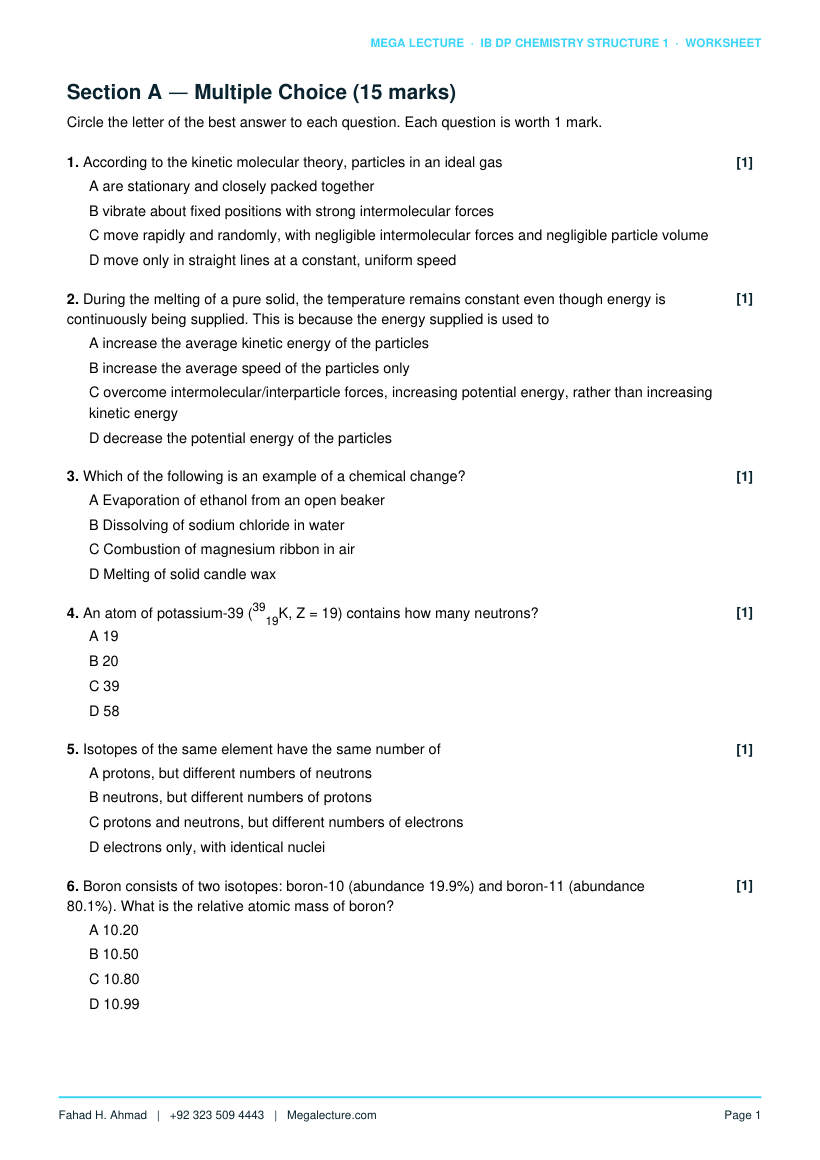
Section A — Multiple Choice (15 marks)
Circle the letter of the best answer to each question. Each question is worth 1 mark.
- According to the kinetic molecular theory, particles in an ideal gas [1]
A are stationary and closely packed together
B vibrate about fixed positions with strong intermolecular forces
C move rapidly and randomly, with negligible intermolecular forces and negligible particle volume
D move only in straight lines at a constant, uniform speed
- During the melting of a pure solid, the temperature remains constant even though energy is continuously being supplied. This is because the energy supplied is used to
[1]
A increase the average kinetic energy of the particles
B increase the average speed of the particles only
C overcome intermolecular/interparticle forces, increasing potential energy, rather than increasing kinetic energy
D decrease the potential energy of the particles
- Which of the following is an example of a chemical change? [1]
A Evaporation of ethanol from an open beaker
B Dissolving of sodium chloride in water
C Combustion of magnesium ribbon in air
D Melting of solid candle wax
- An atom of potassium-39 (39 19K, Z = 19) contains how many neutrons? [1]
A 19
B 20
C 39
D 58
- Isotopes of the same element have the same number of [1]
A protons, but different numbers of neutrons
B neutrons, but different numbers of protons
C protons and neutrons, but different numbers of electrons
D electrons only, with identical nuclei
- Boron consists of two isotopes: boron-10 (abundance 19.9%) and boron-11 (abundance 80.1%). What is the relative atomic mass of boron?
[1]
A 10.20
B 10.50
C 10.80
D 10.99
- What is the full electron configuration of a ground-state chlorine atom (Z = 17)? [1]
A 1s22s22p63s23p5
B 1s22s22p63s23p6
C 1s22s22p53s23p6
D 1s22s62p63s23p3
- The first ionization energy of an element is defined as the energy required to [1]
A remove all the electrons from one mole of gaseous atoms
B remove one electron from a single gaseous atom
C remove one electron from each atom in one mole of gaseous atoms in their ground state, forming one mole of gaseous 1+ ions
D add one electron to one mole of gaseous atoms in their ground state
- An element shows a very large increase between its 2nd and 3rd successive ionization energies. This suggests that the element
[1]
A has 2 electrons in its outermost occupied shell
B has 3 electrons in its outermost occupied shell
C is a noble gas
D has no electrons in its outermost shell
- What amount, in moles, is present in 25.0 g of sodium hydroxide, NaOH (M = 40.00 g mol-1)? [1]
A 0.625 mol
B 1.60 mol
C 16.0 mol
D 62.5 mol
- The Avogadro constant, NA, is best described as [1]
A the mass of one mole of any substance, in grams
B the volume occupied by one mole of gas at STP
C the number of elementary entities (e.g. atoms or molecules) in one mole of a substance
D the number of protons in the nucleus of an atom
- What volume, in dm3, is occupied by 0.100 mol of an ideal gas at STP (molar volume = 22.7 dm3 mol-1)?
[1]
A 0.227 dm3
B 2.27 dm3
C 22.7 dm3
D 227 dm3
- A 1.00 dm3 sample of gas at 300 K and 1.00×10⁵ Pa contains approximately how many moles of gas? (R = 8.31 J mol-1 K-1)
[1]
A 0.0401 mol
B 0.401 mol
C 4.01 mol
D 40.1 mol
- Boyle's law states that, for a fixed mass of gas at constant temperature, the pressure of the gas is
[1]
A directly proportional to its volume
B inversely proportional to its volume
C directly proportional to the square of its volume
D independent of its volume
- According to the IB data booklet, standard temperature and pressure (STP) is defined as [1]
A 0 K and 1.00×10⁵ Pa
B 273 K and 1.00×10⁵ Pa
C 298 K and 1.01×10⁵ Pa
D 273 K and 1.01×10⁵ Pa
Section B — Structured Questions (65 marks)
Answer all questions in the space provided. Working must be shown for full marks.
S1.1 Particulate Nature of Matter
Question 1 [7 marks]
A pure liquid substance is allowed to cool slowly. The graph shows how its temperature changes with time as it solidifies.
Cooling curve for the substance (temperatures and times are given data).
- Identify the freezing point of the substance and the time interval over which freezing occurs. [2]
- Explain, in terms of particle behaviour, why the temperature remains constant during this plateau even though the substance is continuously losing thermal energy.
[3]
- State the physical state(s) of the substance present during the plateau, and describe how the arrangement of particles changes over this time interval.
[2]
Question 2 [6 marks]
Classify each of the following changes as a physical change or a chemical change, giving a brief reason in each case.
- Ice melting to form liquid water. [2]
- Iron rusting in damp air. [2]
- Sugar dissolving in water. [2]
S1.2 The Nuclear Atom
Question 3 [7 marks]
A sample of chlorine gas is analysed using a mass spectrometer. The graph shows the relative abundance of each isotope present.
Mass spectrum of chlorine (isotopic masses and abundances are given data).
- State the mass number and percentage abundance of each isotope of chlorine shown in the spectrum.
[2]
- Calculate the relative atomic mass of chlorine, to 2 decimal places, using this data. [3]
- State the number of protons, neutrons, and electrons in a neutral atom of chlorine-37. [2]
Question 4 [6 marks]
An atom of a particular isotope has 26 protons and a mass number of 56.
- Identify the element, and write the full isotopic symbol for this atom (in the form mass-number-element or A
ZE notation).
[2]
- Calculate the number of neutrons in this atom. [2]
- This atom loses two electrons to form an Fe2+ ion. State the number of electrons in this ion. [2]
S1.3 Electron Configurations
Question 5 [7 marks]
The graph shows the first ionization energy of the elements across Period 3, from sodium to argon.
First ionization energy across Period 3 (given data).
- Describe and explain the general trend in first ionization energy from sodium to argon. [2]
- Explain, in terms of electron configuration, why the first ionization energy of aluminium is lower than that of magnesium, despite aluminium having a greater nuclear charge.
[3]
- Explain why the first ionization energy of sulfur is lower than that of phosphorus. [2]
Question 6 [6 marks]
Vanadium, V, has atomic number 23.
- Write the full ground-state electron configuration of a vanadium atom. [2]
- State the number of unpaired electrons in a ground-state vanadium atom. [2]
- Write the electron configuration of the V3+ ion. [2]
S1.4 Counting Particles: The Mole
Question 7 [7 marks]
Hydrogen gas reacts with oxygen gas to form water vapour, as shown: 2H2(g) + O2(g) → 2H2O(g). In an experiment, 10.0 g of hydrogen gas reacts completely. (Mr: H2 = 2.02, O2 = 32.00, H2O = 18.02.)
Particle (mole-ratio) representation of the balanced equation.
- Calculate the amount, in moles, of H2 reacted. [2]
- Using the mole ratio in the equation, calculate the mass of O2 required to react completely with this hydrogen.
[2]
- Calculate the mass of water produced in this reaction. [3]
Question 8 [6 marks]
A compound contains 40.0% carbon, 6.7% hydrogen, and 53.3% oxygen by mass. (Ar: C = 12.01, H = 1.01, O = 16.00.)
- Determine the empirical formula of the compound. [3]
- The molar mass of the compound is 180.16 g mol-1. Determine its molecular formula. [2]
- Suggest an identity for this compound. [1]
S1.5 Ideal Gases
Question 9 [7 marks]
The graph shows how the volume of a sample of ideal gas at STP (273 K, 1.00×10⁵ Pa) varies with the amount of gas present, in moles.
Volume against amount of gas at STP (given data).
- Use the graph to determine the molar volume of an ideal gas at STP. [2]
- Calculate the volume occupied by 3.0 mol of an ideal gas at STP. [2]
- A sample of carbon dioxide gas (M = 44.01 g mol-1) has a volume of 5.68 dm3 at STP. Calculate the amount, in moles, and the mass of this gas.
[3]
Question 10 [6 marks]
A 2.00 dm3 container holds a sample of nitrogen gas, N2 (M = 28.01 g mol-1), at a pressure of 150 kPa and a temperature of 298 K. (R = 8.31 J mol-1 K-1.)
- Calculate the amount, in moles, of gas present. [2]
- Calculate the mass of nitrogen gas present. [2]
- State and explain what would happen to the pressure of the gas if the temperature were increased, with the volume kept constant.
[2]
