
Edexcel · Chemistry · Notes by Topic
Oxidation & Reduction
The Daily 5 Five questions a day on Edexcel Chemistry: two minutes, new every day, with a streak to keep Play today’s →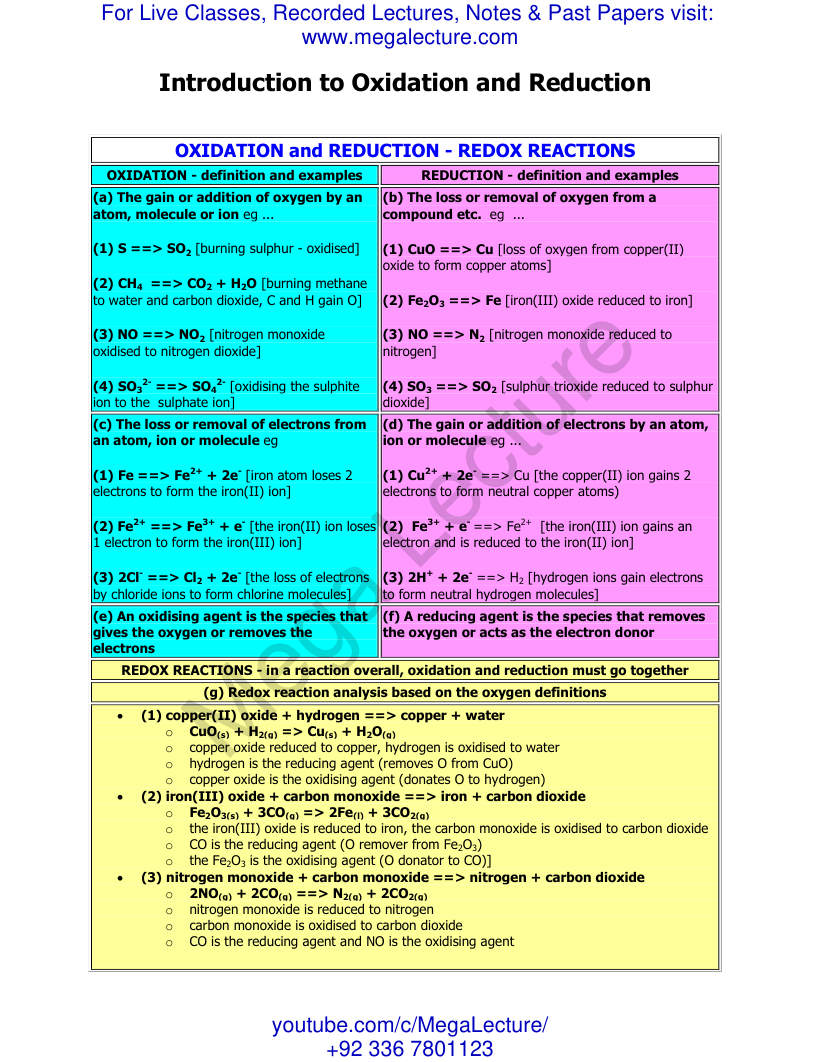
Opens inside this page. Prefer your own PDF app? Open the PDF.
Chemistry batch classes: coming soon. Small live classes at a lower fee than one-to-one. Join the waiting list
Check yourself
5 quick questions on Edexcel Chemistry
Tap an answer to see if you are right, and why. Free, no sign-up.
Start the free testWas this note useful?
Full text of Oxidation & Reduction
Introduction to Oxidation and Reduction
OXIDATION and REDUCTION - REDOX REACTIONS OXIDATION - definition and examples REDUCTION - definition and examples
(a) The gain or addition of oxygen by an
atom, molecule or ion eg ...
- S ==> SO2 [burning sulphur - oxidised]
- CH4 ==> CO2 + H2O [burning methane to water and carbon dioxide, C and H gain O]
- NO ==> NO2 [nitrogen monoxide oxidised to nitrogen dioxide]
(4) SO3 2- ==> SO4
2- [oxidising the sulphite ion to the sulphate ion]
(b) The loss or removal of oxygen from a
compound etc. eg ...
- CuO ==> Cu [loss of oxygen from copper(II) oxide to form copper atoms]
- Fe2O3 ==> Fe [iron(III) oxide reduced to iron]
- NO ==> N2 [nitrogen monoxide reduced to nitrogen]
- SO3 ==> SO2 [sulphur trioxide reduced to sulphur dioxide]
(c) The loss or removal of electrons from
an atom, ion or molecule eg
- Fe ==> Fe2+ + 2e- [iron atom loses 2 electrons to form the iron(II) ion]
- Fe2+ ==> Fe3+ + e- [the iron(II) ion loses 1 electron to form the iron(III) ion]
- 2Cl- ==> Cl2 + 2e- [the loss of electrons by chloride ions to form chlorine molecules]
(d) The gain or addition of electrons by an atom,
ion or molecule eg ...
- Cu2+ + 2e- ==> Cu [the copper(II) ion gains 2 electrons to form neutral copper atoms)
- Fe3+ + e- ==> Fe2+ [the iron(III) ion gains an electron and is reduced to the iron(II) ion]
- 2H+ + 2e- ==> H2 [hydrogen ions gain electrons to form neutral hydrogen molecules]
(e) An oxidising agent is the species that gives the oxygen or removes the electrons
(f) A reducing agent is the species that removes the oxygen or acts as the electron donor
REDOX REACTIONS - in a reaction overall, oxidation and reduction must go together
(g) Redox reaction analysis based on the oxygen definitions
(1) copper(II) oxide + hydrogen ==> copper + water
o
CuO(s) + H2(g) => Cu(s) + H2O(g)
o copper oxide reduced to copper, hydrogen is oxidised to water o hydrogen is the reducing agent (removes O from CuO) o copper oxide is the oxidising agent (donates O to hydrogen)
(2) iron(III) oxide + carbon monoxide ==> iron + carbon dioxide
o
Fe2O3(s) + 3CO(g) => 2Fe(l) + 3CO2(g)
o the iron(III) oxide is reduced to iron, the carbon monoxide is oxidised to carbon dioxide o CO is the reducing agent (O remover from Fe2O3) o the Fe2O3 is the oxidising agent (O donator to CO)]
(3) nitrogen monoxide + carbon monoxide ==> nitrogen + carbon dioxide
o
2NO(g) + 2CO(g) ==> N2(g) + 2CO2(g)
o nitrogen monoxide is reduced to nitrogen o carbon monoxide is oxidised to carbon dioxide o CO is the reducing agent and NO is the oxidising agent
Mega Lecture
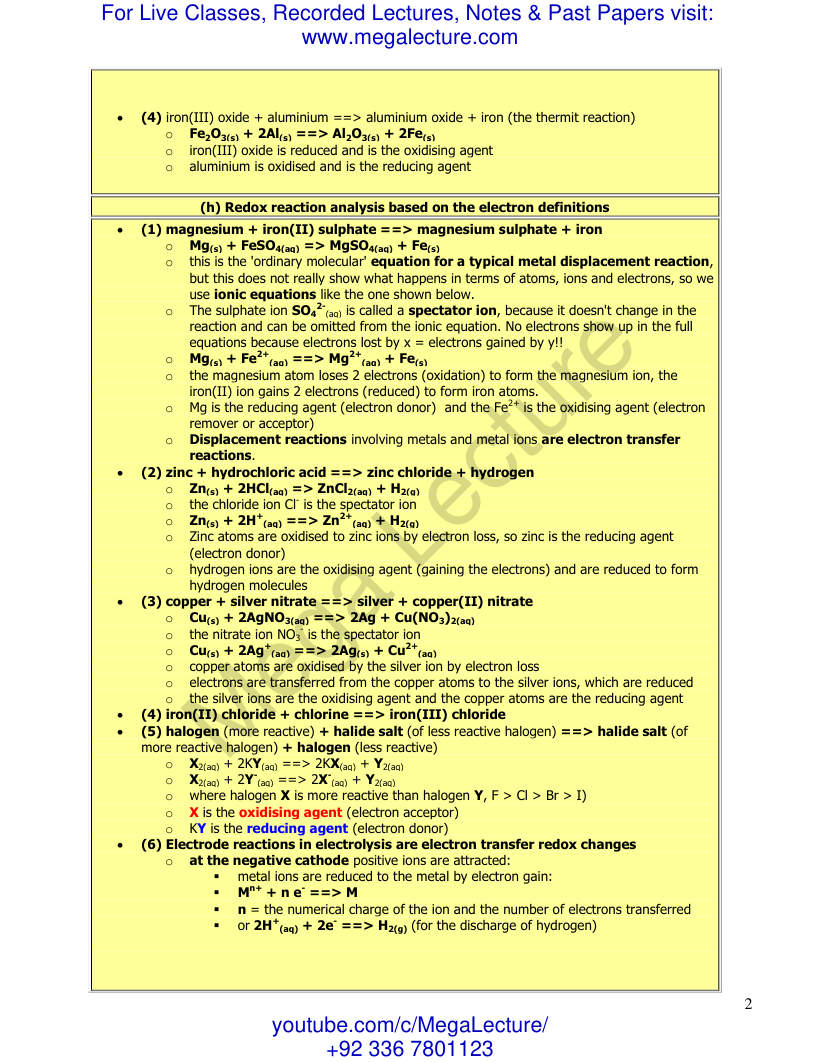
- iron(III) oxide + aluminium ==> aluminium oxide + iron (the thermit reaction) o
Fe2O3(s) + 2Al(s) ==> Al2O3(s) + 2Fe(s)
o iron(III) oxide is reduced and is the oxidising agent o aluminium is oxidised and is the reducing agent
(h) Redox reaction analysis based on the electron definitions
(1) magnesium + iron(II) sulphate ==> magnesium sulphate + iron
o
Mg(s) + FeSO4(aq) => MgSO4(aq) + Fe(s)
o this is the 'ordinary molecular' equation for a typical metal displacement reaction, but this does not really show what happens in terms of atoms, ions and electrons, so we use ionic equations like the one shown below. o The sulphate ion SO4
2-
- is called a spectator ion, because it doesn't change in the reaction and can be omitted from the ionic equation. No electrons show up in the full equations because electrons lost by x = electrons gained by y!! o
Mg(s) + Fe2+ (aq) ==> Mg2+ (aq) + Fe(s)
o the magnesium atom loses 2 electrons (oxidation) to form the magnesium ion, the iron(II) ion gains 2 electrons (reduced) to form iron atoms. o Mg is the reducing agent (electron donor) and the Fe2+ is the oxidising agent (electron remover or acceptor) o Displacement reactions involving metals and metal ions are electron transfer reactions.
(2) zinc + hydrochloric acid ==> zinc chloride + hydrogen
o
Zn(s) + 2HCl(aq) => ZnCl2(aq) + H2(g)
o the chloride ion Cl- is the spectator ion o
Zn(s) + 2H+ (aq) ==> Zn2+ (aq) + H2(g)
o Zinc atoms are oxidised to zinc ions by electron loss, so zinc is the reducing agent (electron donor) o hydrogen ions are the oxidising agent (gaining the electrons) and are reduced to form hydrogen molecules
(3) copper + silver nitrate ==> silver + copper(II) nitrate
o
Cu(s) + 2AgNO3(aq) ==> 2Ag + Cu(NO3)2(aq)
o the nitrate ion NO3
- is the spectator ion o
Cu(s) + 2Ag+ (aq) ==> 2Ag(s) + Cu2+
- o copper atoms are oxidised by the silver ion by electron loss o electrons are transferred from the copper atoms to the silver ions, which are reduced o the silver ions are the oxidising agent and the copper atoms are the reducing agent
(4) iron(II) chloride + chlorine ==> iron(III) chloride
- halogen (more reactive) + halide salt (of less reactive halogen) ==> halide salt (of more reactive halogen) + halogen (less reactive) o X2(aq) + 2KY(aq) ==> 2KX(aq) + Y2(aq) o X2(aq) + 2Y-
- ==> 2X-
- + Y2(aq) o where halogen X is more reactive than halogen Y, F > Cl > Br > I) o X is the oxidising agent (electron acceptor) o KY is the reducing agent (electron donor)
- Electrode reactions in electrolysis are electron transfer redox changes o at the negative cathode positive ions are attracted:
metal ions are reduced to the metal by electron gain:
Mn+ + n e- ==> M
n = the numerical charge of the ion and the number of electrons transferred or 2H+
- + 2e- ==> H2(g) (for the discharge of hydrogen)
Mega Lecture
o at the positive anode negative ions are attracted:
negative non-metal ions are oxidised by electron loss eg for oxide ions: 2O2- - 4e- ==> O2 or 2O2- ==> O2 + 4e- for hydroxide ion: 4OH- - 4e- ==> O2 + 2H2O or 4OH- ==> O2 + 2H2O +
4e-
for halide ions (X = F, Cl, Br, I): 2X- - 2e- ==> X2 or 2X- ==> X2 + 2e-
Miscellaneous Redox Notes
Redox changes can often be observed as significant colour changes eg o
iron + copper(II) sulphate ==> iron(II) sulphate + iron
Mg(s) + FeSO4(aq) => MgSO4(aq) + Fe(s)
Mg(s) + Fe2+ (aq) ==> Mg2+ (aq) + Fe(s)
Sulphate, SO4
2- (aq), is colourless BUT a blue to pale green colour change is observed in the solution as the blue copper(II) ion is replaced by the pale green iron(II) ion. o Potassium manganate(VII) is a powerful oxidising agent and an intense purple colour in water due to the MnO4
- ion. In acidified solution it changes to an almost colourless* manganese(II) ion, Mn2+ when it oxidises something (* which actually is a very pale pink transition metal ion). o Potassium dichromate(VI) is another strong oxidising agent and is orange due to
the dichromate(VI) ion, Cr2O7
2- ion. When it oxidises something it changes to the green chromium(III) ion, Cr3+. o Potassium iodide is a colourless salt dissolving in water to form a colourless solution. If it is oxidised eg with chlorine a yellow=>orange==>brown colour develops as iodine is formed from the colourless iodide ion. The use of Roman Numerals in names:
o This indicates what is called the oxidation state of an atom in a molecule or ion. o It is easy to follow for simple metal ions because it equals the charge on the ion
eg the oxidation state of copper in the copper(II) ion is referred to as +2
the more electrons removed from the atom or ion by oxidation, the higher its oxidation state eg Fe2+ - e- ==> Fe3+, gives iron the oxidation state of +3 in the iron(III) ion (via a suitable oxidising agent). but for more complex ions things are not so simple.
in manganate(VII) ion, the Mn is in the +7 oxidation state in dichromate(VI) ion, the Cr is in the +6 oxidation state o This topic is dealt with at AS-A2 advanced level chemistry (there is an introduction on another web page) but not for KS4-GCSE!
Oxidation Number Oxidation numbers are a useful tool for determining whether a substance has been oxidized or
reduced. An element that undergoes a change in oxidation number in the course of a reaction has
been oxidized or reduced. Let's learn how to assign oxidation numbers.
Mega Lecture
Assigning Oxidation Numbers 1. At atom in its elemental state has an oxidation number of 0.
Na H2 Cl2 S Xe Each atom in these elements has an oxidation number of 0.
2. An atom in a monoatomic ion has an oxidation number identical to its charge.
Na+ Ba2+ Al3+ Br– S2– +1 +2 +3 –1 –2 The oxidation number is equal to the charge on the monoatomic ion.
3. An atom in a polyatomic ion or a molecular compound usually has the same oxidation
number it would have if it were in a monoatomic ion.
a. Elements to the left on the periodic table are "cationlike" and have positive oxidation numbers.
b. Elements to the right on the periodic table are "anionlike" and have negative oxidation numbers.
Consider NH3.
N has an oxidation number of –3; each H has an oxidation number of +1.
c. Hydrogen has a +1 oxidation number when bonded to nonmetals, and has a –1 oxidation number when bonded to a metal.
NaH (H –1 oxidation number) H2O (H +1 oxidation number) d. Oxygen often has a –2 oxidation number, but
can have a –1 oxidation number in the peroxide ion, O2 2–.
H2O (O –2 oxidation number)
Mega Lecture
HOOH (O –1 oxidation number) e. Halogens usually have an oxidation number of –1,
Unless bonded to oxygen, when they have a positive oxidation number.
HCl (Cl –1 oxidation number) HOCl (Cl +1 oxidation number)
4. The sum of the oxidation numbers is 0 for a neutral compound and is equal to the net charge for a polyatomic ion.
Oxidizing and Reducing agents
Oxidation and reduction always occur together. Whenever one atom loses electrons (is
oxidized), another atom must gain those electrons (be reduced). The reactants can be
classified as either a reducing agent or an oxidizing agent.
Reducing agent
causes reduction
loses one or more electrons
is oxidized
oxidation number of atom increases Oxidizing agent
causes oxidation
gains one or more electrons
is reduced
