
CSS · English · CSS English vocabulary builder: 300 high-frequency words
CSS English vocabulary builder: 300 high-frequency words
Opens inside this page. Prefer your own PDF app? Open the PDF.
Check yourself
5 quick questions on CSS English
Tap an answer to see if you are right, and why. Free, no sign-up.
Start the free test4 of 5 students found these notes useful
Was this note useful?
Full text of CSS English vocabulary builder: 300 high-frequency words
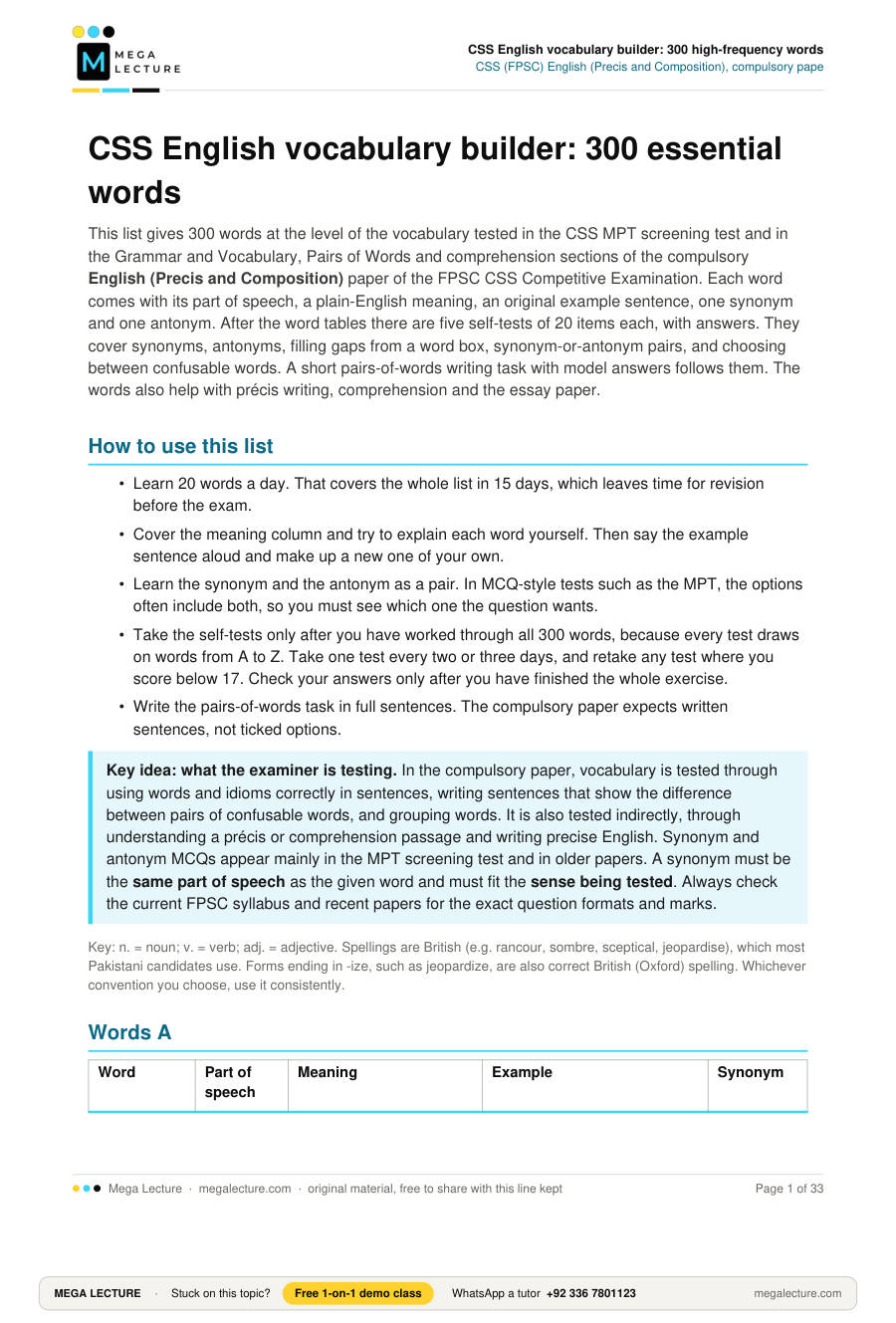
This list gives 300 words at the level of the vocabulary tested in the CSS MPT screening test and in the Grammar and Vocabulary, Pairs of Words and comprehension sections of the compulsory English (Precis and Composition) paper of the FPSC CSS Competitive Examination. Each word comes with its part of speech, a plain-English meaning, an original example sentence, one synonym and one antonym. After the word tables there are five self-tests of 20 items each, with answers. They cover synonyms, antonyms, filling gaps from a word box, synonym-or-antonym pairs, and choosing between confusable words. A short pairs-of-words writing task with model answers follows them. The words also help with précis writing, comprehension and the essay paper.
How to use this list
- Learn 20 words a day. That covers the whole list in 15 days, which leaves time for revision before the exam.
- Cover the meaning column and try to explain each word yourself. Then say the example sentence aloud and make up a new one of your own.
- Learn the synonym and the antonym as a pair. In MCQ-style tests such as the MPT, the options often include both, so you must see which one the question wants.
- Take the self-tests only after you have worked through all 300 words, because every test draws on words from A to Z. Take one test every two or three days, and retake any test where you score below 17. Check your answers only after you have finished the whole exercise.
- Write the pairs-of-words task in full sentences. The compulsory paper expects written sentences, not ticked options.
Key: n. = noun; v. = verb; adj. = adjective. Spellings are British (e.g. rancour, sombre, sceptical, jeopardise), which most Pakistani candidates use. Forms ending in -ize, such as jeopardize, are also correct British (Oxford) spelling. Whichever convention you choose, use it consistently.
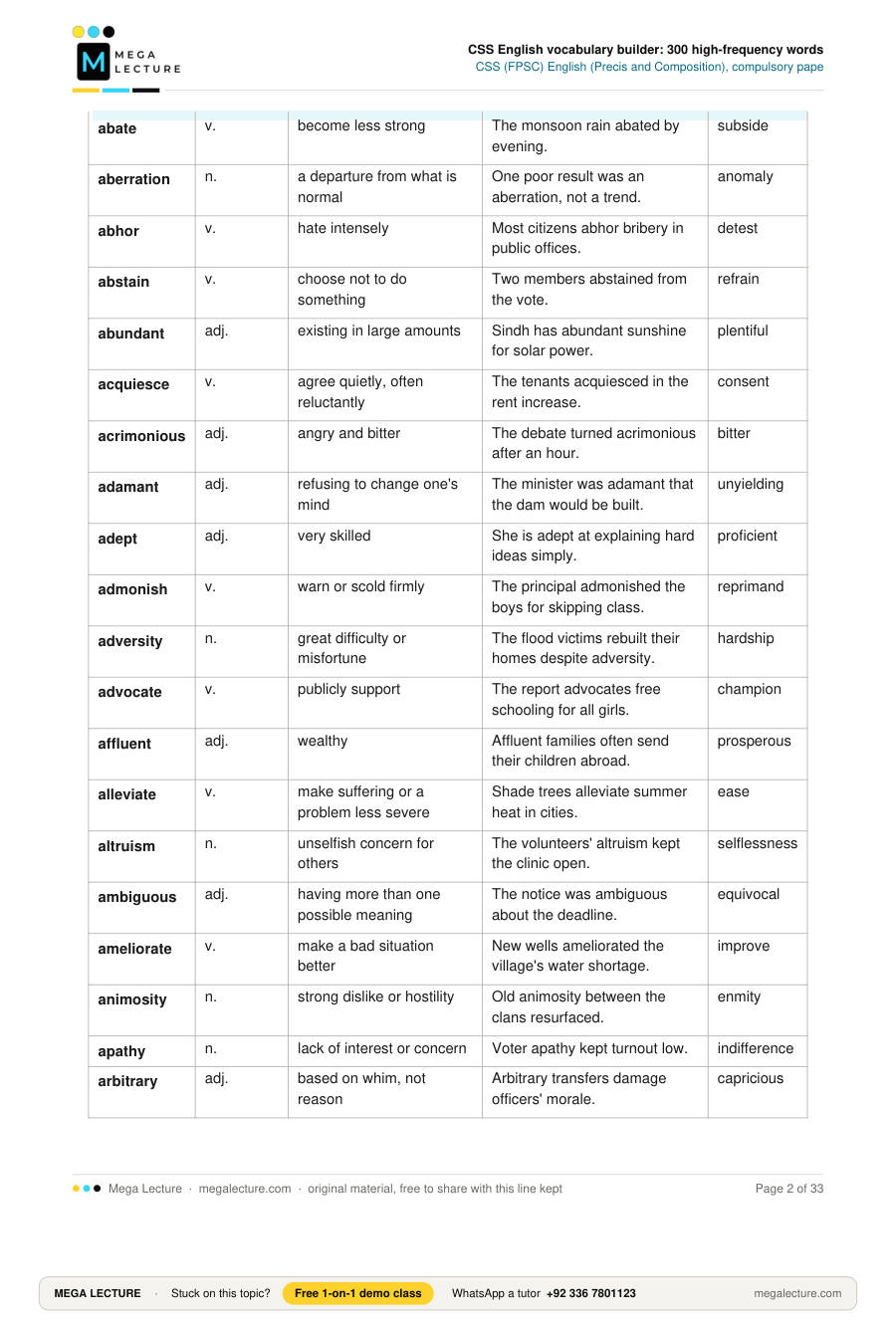
Words A
| Word | Part of speech | Meaning | Example | Synonym | Antonym |
|---|---|---|---|---|---|
| abate | v. | become less strong | The monsoon rain abated by evening. | subside | intensify |
| aberration | n. | a departure from what is normal | One poor result was an aberration, not a trend. | anomaly | norm |
| abhor | v. | hate intensely | Most citizens abhor bribery in public offices. | detest | adore |
| abstain | v. | choose not to do something | Two members abstained from the vote. | refrain | indulge |
| abundant | adj. | existing in large amounts | Sindh has abundant sunshine for solar power. | plentiful | scarce |
| acquiesce | v. | agree quietly, often reluctantly | The tenants acquiesced in the rent increase. | consent | resist |
| acrimonious | adj. | angry and bitter | The debate turned acrimonious after an hour. | bitter | amicable |
| adamant | adj. | refusing to change one's mind | The minister was adamant that the dam would be built. | unyielding | flexible |
| adept | adj. | very skilled | She is adept at explaining hard ideas simply. | proficient | inept |
| admonish | v. | warn or scold firmly | The principal admonished the boys for skipping class. | reprimand | praise |
| adversity | n. | great difficulty or misfortune | The flood victims rebuilt their homes despite adversity. | hardship | prosperity |
| advocate | v. | publicly support | The report advocates free schooling for all girls. | champion | oppose |
| affluent | adj. | wealthy | Affluent families often send their children abroad. | prosperous | impoverished |
| alleviate | v. | make suffering or a problem less severe | Shade trees alleviate summer heat in cities. | ease | aggravate |
| altruism | n. | unselfish concern for others | The volunteers' altruism kept the clinic open. | selflessness | selfishness |
| ambiguous | adj. | having more than one possible meaning | The notice was ambiguous about the deadline. | equivocal | clear |
| ameliorate | v. | make a bad situation better | New wells ameliorated the village's water shortage. | improve | impair |
| animosity | n. | strong dislike or hostility | Old animosity between the clans resurfaced. | enmity | goodwill |
| apathy | n. | lack of interest or concern | Voter apathy kept turnout low. | indifference | enthusiasm |
| arbitrary | adj. | based on whim, not reason | Arbitrary transfers damage officers' morale. | capricious | reasoned |
| ardent | adj. | very enthusiastic | He is an ardent supporter of local cricket. | fervent | lukewarm |
| articulate | adj. | able to express ideas clearly | An articulate candidate impresses the interview panel. | fluent | incoherent |
| astute | adj. | quick to judge situations and gain advantage | An astute trader bought wheat before prices rose. | shrewd | naive |
| audacious | adj. | bold and willing to take risks | The audacious plan surprised even her allies. | daring | timid |
| austere | adj. | plain and without comfort; strict | The hostel rooms were austere but clean. | spartan | luxurious |
| avarice | n. | extreme greed for wealth | Avarice led the officer to accept bribes. | greed | generosity |
| averse | adj. | strongly disliking or opposed | He is not averse to working late. | opposed | eager |
Words B–C
| Word | Part of speech | Meaning | Example | Synonym | Antonym |
|---|---|---|---|---|---|
| banal | adj. | dull and unoriginal | His speech was full of banal slogans. | trite | original |
| belligerent | adj. | hostile and eager to fight | The belligerent customer shouted at the cashier. | combative | peaceable |
| benevolent | adj. | kind and generous | A benevolent landlord waived rent during the lockdown. | charitable | malevolent |
| benign | adj. | gentle; not harmful | The doctor confirmed the lump was benign. | harmless | malignant |
| blatant | adj. | done openly and shamelessly | It was a blatant breach of traffic rules. | flagrant | subtle |
| bolster | v. | support or strengthen | Remittances bolstered the country's reserves. | reinforce | undermine |
| brevity | n. | shortness; use of few words | Brevity is the first virtue of a précis. | conciseness | verbosity |
| buoyant | adj. | cheerful and optimistic; tending to rise | Exporters were buoyant after the trade deal. | upbeat | despondent |
| burgeon | v. | grow or expand quickly | Online businesses have burgeoned in Lahore. | mushroom | dwindle |
| cajole | v. | persuade by flattery or gentle urging | She cajoled her brother into helping at the shop. | coax | force |
| callous | adj. | cruelly insensitive | His callous remark upset the grieving family. | heartless | compassionate |
| candid | adj. | honest and direct | The coach gave a candid assessment of the team. | frank | evasive |
| capricious | adj. | changing suddenly and unpredictably | Capricious weather damaged the wheat harvest. | fickle | steady |
| castigate | v. | criticise very severely | The editorial castigated the city for its broken roads. | rebuke | commend |
| caustic | adj. | sarcastic in a hurtful way | Her caustic review stung the young author. | scathing | mild |
| censure | n. | formal, strong disapproval | The officer faced censure for misusing funds. | condemnation | approval |
| chronic | adj. | lasting a long time or recurring often | Karachi suffers from chronic water shortages. | long-standing | acute |
| circumspect | adj. | cautious; weighing the risks | Be circumspect when sharing personal data online. | wary | reckless |
| clandestine | adj. | kept secret, often because illegal | Police raided a clandestine fireworks factory. | covert | public |
| coerce | v. | force someone by threats | No witness should be coerced into giving evidence. | compel | coax |
| cogent | adj. | clear, logical and convincing | She made a cogent case for tax reform. | compelling | unconvincing |
| coherent | adj. | logical and well connected | A coherent essay moves smoothly from point to point. | logical | muddled |
| complacent | adj. | too self-satisfied to notice danger | Leading teams often become complacent in the final overs. | smug | vigilant |
| comprehensive | adj. | including everything | The guide gives a comprehensive list of past topics. | thorough | partial |
| concede | v. | admit, often unwillingly | The candidate conceded defeat before midnight. | acknowledge | deny |
| concise | adj. | giving much information in few words | Keep your précis concise and accurate. | succinct | verbose |
| condone | v. | accept or overlook wrongdoing | Silence can seem to condone corruption. | excuse | condemn |
| conducive | adj. | helping something to happen | A quiet room is conducive to study. | favourable | detrimental |
| conspicuous | adj. | easily noticed | His red turban was conspicuous in the crowd. | noticeable | unobtrusive |
| contempt | n. | the feeling that something is worthless | He spoke of the rules with open contempt. | scorn | respect |
| contentious | adj. | likely to cause argument | Water sharing is a contentious issue between provinces. | controversial | undisputed |
| corroborate | v. | confirm with further evidence | CCTV footage corroborated the guard's account. | confirm | contradict |
| credible | adj. | able to be believed | The witness gave a credible explanation. | plausible | far-fetched |
| culpable | adj. | deserving blame | The inquiry found the contractor culpable for the collapse. | blameworthy | blameless |
| cursory | adj. | quick and not thorough | A cursory glance missed the error in line two. | superficial | painstaking |
| cynical | adj. | believing people act only from self-interest | Years of broken promises made voters cynical. | distrustful | idealistic |
Words D
| Word | Part of speech | Meaning | Example | Synonym | Antonym |
|---|---|---|---|---|---|
| dearth | n. | a lack or shortage | There is a dearth of trained nurses in rural areas. | shortage | abundance |
| debilitate | v. | seriously weaken | Dengue can debilitate a patient for weeks. | enfeeble | strengthen |
| decorum | n. | polite, proper behaviour | Members must maintain decorum in the assembly. | propriety | impropriety |
| defer | v. | put off to a later time | The board deferred its decision until March. | postpone | expedite |
| deference | n. | polite respect | Students stood in deference to the visiting judge. | respect | disrespect |
| deleterious | adj. | causing harm | Smog has deleterious effects on children's lungs. | harmful | beneficial |
| delineate | v. | describe or mark out precisely | The agreement delineates the boundary along the river. | outline | obscure |
| denounce | v. | publicly condemn | Religious scholars denounced the attack on the school. | condemn | extol |
| deplete | v. | use up the supply of | Over-pumping has depleted groundwater in Quetta. | exhaust | replenish |
| deplore | v. | express strong disapproval of | We deplore violence against journalists. | decry | applaud |
| deride | v. | mock with contempt | Critics derided the plan as unrealistic. | ridicule | laud |
| despondent | adj. | without hope; low in spirits | The team was despondent after the loss. | dejected | hopeful |
| destitute | adj. | extremely poor, lacking necessities | The earthquake left thousands destitute. | penniless | wealthy |
| deter | v. | discourage from acting | Heavy fines deter people from littering. | discourage | encourage |
| devious | adj. | sly and dishonest | He used devious methods to win the tender. | cunning | straightforward |
| dexterity | n. | skill, especially with the hands | Embroidery requires great dexterity. | deftness | clumsiness |
| diffident | adj. | shy; lacking self-confidence | The diffident student rarely spoke in class. | bashful | self-assured |
| diligent | adj. | hard-working and careful | Diligent revision beats last-minute cramming. | industrious | lazy |
| discern | v. | notice or understand, often with effort | It is hard to discern the truth among rumours. | perceive | overlook |
| discord | n. | disagreement; lack of harmony | Discord within the party weakened its campaign. | strife | harmony |
| disparity | n. | a great difference | The disparity between urban and rural schools is wide. | inequality | parity |
| disseminate | v. | spread information widely | Health workers disseminated advice on clean water. | circulate | suppress |
| docile | adj. | quiet and easily controlled | The docile buffalo followed the boy home. | submissive | unruly |
| dogmatic | adj. | insisting that one's opinions are certainly right | A dogmatic reader ignores evidence against his view. | opinionated | open-minded |
| dubious | adj. | doubtful; possibly dishonest | The website made dubious claims about quick profits. | questionable | reliable |
| durable | adj. | able to last a long time | Steel utensils are more durable than plastic ones. | long-lasting | perishable |
- eminent (famous, respected) vs imminent (about to happen)
- deter (discourage) vs defer (postpone; also show respect, as in deference)
- deplete (use up) vs deplore (strongly disapprove of)
- illicit (illegal) vs elicit (draw out a reply or reaction)
- ingenious (clever, inventive) vs ingenuous (innocent, too trusting)
- credible (believable) vs credulous (too ready to believe)
- tentative (not yet fixed) vs tenacious (holding on firmly)
- elusive (hard to catch or achieve) vs evasive (deliberately avoiding a question or commitment)
Worked example: pairs of words in sentences. The pairs-of-words question asks you to use each word in a sentence that shows the difference in meaning.
eminent / imminent: The eminent jurist chaired the inquiry. / A storm is imminent, so fishermen stayed ashore.
Each sentence must make the meaning clear from its context. A sentence such as "He is eminent" is correct English, but it does not show what the word means, so it earns little credit.
Words E–F
| Word | Part of speech | Meaning | Example | Synonym | Antonym |
|---|---|---|---|---|---|
| eccentric | adj. | unusual in behaviour | The eccentric professor lectured in slippers. | odd | conventional |
| efficacy | n. | ability to produce the intended result | Trials tested the efficacy of the new vaccine. | effectiveness | ineffectiveness |
| elated | adj. | extremely happy | She was elated to see her name on the merit list. | jubilant | crestfallen |
| eloquent | adj. | fluent and persuasive | His eloquent speech moved the audience. | articulate | inarticulate |
| elusive | adj. | hard to find, catch or achieve | Lasting peace has proved elusive in the region. | unattainable | achievable |
| embellish | v. | decorate; add untrue details to a story | He embellished the story to impress his friends. | exaggerate | understate |
| eminent | adj. | famous and highly respected | An eminent economist chaired the commission. | distinguished | unknown |
| empirical | adj. | based on observation or experiment | The claim needs empirical evidence, not opinion. | observational | theoretical |
| endorse | v. | publicly approve or support | Three parties endorsed the independent candidate. | back | reject |
| enervate | v. | drain of energy | The humid heat enervated the labourers. | weaken | invigorate |
| enigmatic | adj. | mysterious; hard to interpret | The minister gave an enigmatic smile. | puzzling | transparent |
| ephemeral | adj. | lasting a very short time | Social media fame is often ephemeral. | transient | permanent |
| equanimity | n. | calmness, especially under pressure | She accepted the result with equanimity. | composure | agitation |
| equitable | adj. | fair and impartial | River water must be shared in an equitable way. | fair | biased |
| eradicate | v. | destroy completely | Pakistan aims to eradicate polio. | eliminate | establish |
| erratic | adj. | not regular or predictable | Erratic power supply damages electrical goods. | inconsistent | regular |
| erudite | adj. | having great knowledge from study | The erudite scholar quoted Rumi from memory. | scholarly | ignorant |
| exacerbate | v. | make a problem worse | Deforestation exacerbates flooding. | aggravate | mitigate |
| exemplary | adj. | so good that it serves as a model | The nurse was honoured for exemplary service. | admirable | deplorable |
| exonerate | v. | officially clear of blame | The court exonerated the driver. | acquit | convict |
| explicit | adj. | stated clearly and fully | The rules give explicit instructions on word limits. | unambiguous | implicit |
| extol | v. | praise enthusiastically | Tourists extol the beauty of Hunza. | acclaim | disparage |
| extravagant | adj. | spending or using too much | The extravagant wedding cost millions. | lavish | frugal |
| facetious | adj. | joking about serious matters at the wrong time | His facetious reply annoyed the interviewer. | flippant | serious |
| fallacy | n. | a mistaken belief or faulty argument | It is a fallacy that rich countries have no poverty. | misconception | truth |
| fastidious | adj. | very attentive to detail and cleanliness | A fastidious editor checks every comma. | fussy | slovenly |
| feasible | adj. | possible and practical to do | Engineers judged the bridge feasible within the budget. | viable | impracticable |
| flamboyant | adj. | showy and confident | The flamboyant batsman loved to hit sixes. | dashing | understated |
| flourish | v. | grow or develop well | Small industries flourish when power is reliable. | thrive | wither |
| formidable | adj. | impressive and hard to overcome | The team faced a formidable opponent in the final. | daunting | feeble |
| fortitude | n. | courage in pain or trouble | The patient bore her illness with fortitude. | endurance | cowardice |
| frivolous | adj. | not serious; silly | The court dismissed the frivolous complaint. | trivial | weighty |
| frugal | adj. | careful with money; economical | A frugal student can save from a small stipend. | thrifty | wasteful |
| futile | adj. | pointless; having no effect | Arguing with the umpire was futile. | fruitless | worthwhile |
Words G–I
| Word | Part of speech | Meaning | Example | Synonym | Antonym |
|---|---|---|---|---|---|
| garrulous | adj. | talking too much about trivial things | The garrulous passenger talked all the way to Multan. | loquacious | taciturn |
| grandiose | adj. | made to look impressive but unrealistic in scale | The grandiose scheme was never funded. | overambitious | modest |
| gratuitous | adj. | unnecessary and unjustified | The film was criticised for gratuitous violence. | unwarranted | justified |
| gregarious | adj. | fond of company; sociable | Gregarious people enjoy group projects. | outgoing | reclusive |
| gullible | adj. | easily fooled | Gullible investors lost money in the fake scheme. | credulous | discerning |
| hackneyed | adj. | overused and no longer fresh | Avoid hackneyed openings in your essay. | clichéd | fresh |
| haphazard | adj. | lacking order or plan | Haphazard construction blocked the drains. | unsystematic | methodical |
| haughty | adj. | arrogantly superior | The haughty clerk ignored the elderly man. | arrogant | humble |
| heinous | adj. | utterly wicked | Kidnapping a child is a heinous crime. | atrocious | admirable |
| hinder | v. | get in the way of | Load-shedding hinders students' studies. | impede | facilitate |
| hypocrisy | n. | claiming standards one does not follow | Preaching thrift while living lavishly is hypocrisy. | insincerity | sincerity |
| ignominious | adj. | causing public shame | The team suffered an ignominious defeat. | humiliating | honourable |
| illicit | adj. | forbidden by law or custom | Customs seized illicit cigarettes at the border. | unlawful | legitimate |
| imminent | adj. | about to happen | Forecasters warned of imminent heavy rain. | impending | distant |
| impartial | adj. | treating all sides equally | An umpire must remain impartial. | neutral | partisan |
| impeccable | adj. | without any fault | She speaks impeccable English. | flawless | flawed |
| imperative | adj. | absolutely necessary | It is imperative that you reach the centre early. | vital | unnecessary |
| impetuous | adj. | acting quickly without thought | An impetuous decision cost him the job. | rash | deliberate |
| implicit | adj. | suggested but not stated directly | There was an implicit threat in his words. | implied | explicit |
| incessant | adj. | never stopping | Incessant honking makes traffic stressful. | ceaseless | intermittent |
| incisive | adj. | sharp and clear in thinking | The panel asked incisive questions. | penetrating | vague |
| incongruous | adj. | out of place; not fitting | A glass tower looks incongruous in the old city. | discordant | fitting |
| indefatigable | adj. | never tiring | The indefatigable volunteer worked through the night. | tireless | flagging |
| indolent | adj. | lazy | Indolent workers slowed the whole project. | slothful | industrious |
| induce | v. | persuade or cause | Low prices induced shoppers to buy in bulk. | prompt | dissuade |
| inevitable | adj. | certain to happen | Some delay was inevitable in the rain. | unavoidable | avoidable |
| infallible | adj. | never wrong | No textbook is infallible. | unerring | fallible |
| ingenious | adj. | clever and original | An ingenious pump runs on bicycle power. | inventive | unimaginative |
| inherent | adj. | existing as a natural part | Every investment carries inherent risk. | intrinsic | extrinsic |
| innate | adj. | present from birth | She has an innate talent for music. | inborn | acquired |
| innocuous | adj. | harmless; not offensive | His innocuous joke was misunderstood. | inoffensive | harmful |
| insipid | adj. | lacking flavour or interest | The hostel dal was insipid. | bland | flavourful |
| integrity | n. | honesty and strong moral principles | Voters want leaders of integrity. | probity | corruption |
| intrepid | adj. | fearless; adventurous | Intrepid climbers attempted K2 in winter. | dauntless | cowardly |
| intricate | adj. | having many detailed parts | Intricate truck art covers the lorry's sides. | elaborate | simple |
| irascible | adj. | easily made angry | The irascible shopkeeper argued with every customer. | irritable | placid |
| irrevocable | adj. | impossible to change or undo | Once signed, the decision is irrevocable. | irreversible | reversible |
Words J–L
| Word | Part of speech | Meaning | Example | Synonym | Antonym |
|---|---|---|---|---|---|
| jeopardise | v. | put in danger | Cheating could jeopardise your career. | endanger | safeguard |
| jovial | adj. | cheerful and friendly | Our jovial driver sang the whole way. | merry | morose |
| judicious | adj. | showing good judgement | Judicious use of fertiliser raised yields. | prudent | unwise |
| kindle | v. | light a fire; arouse a feeling | A good teacher kindles curiosity. | ignite | extinguish |
| laconic | adj. | using very few words | His laconic reply was simply "No." | terse | long-winded |
| lament | v. | express grief or regret | Elders lament the loss of old traditions. | mourn | rejoice |
| languid | adj. | slow and relaxed; lacking energy | We spent a languid afternoon by the river. | listless | vigorous |
| latent | adj. | present but not yet active or visible | The course unlocked her latent talent. | hidden | manifest |
| laudable | adj. | deserving praise | The clean-up drive was a laudable effort. | commendable | shameful |
| lethargic | adj. | sluggish and drowsy | Heavy meals make students lethargic. | torpid | energetic |
| lucid | adj. | clear and easy to understand | Her lucid notes made revision easy. | intelligible | obscure |
| lucrative | adj. | producing much profit | Software exports are a lucrative sector. | profitable | loss-making |
| ludicrous | adj. | so absurd as to be laughable | A seaport in Islamabad is a ludicrous idea. | absurd | sensible |
Words M–O
| Word | Part of speech | Meaning | Example | Synonym | Antonym |
|---|---|---|---|---|---|
| magnanimous | adj. | generous, especially to a rival | The magnanimous winner praised his opponent. | big-hearted | petty |
| malevolent | adj. | wishing harm to others | Malevolent rumours spread about the family. | malicious | benevolent |
| malleable | adj. | easily shaped or influenced | Gold is a malleable metal. | pliable | rigid |
| mandatory | adj. | required by rule | Helmets are mandatory for motorcyclists. | compulsory | optional |
| meagre | adj. | small in amount; inadequate | Daily-wage workers live on meagre incomes. | scanty | ample |
| mediocre | adj. | of only average quality | A mediocre essay merely repeats the question. | second-rate | excellent |
| meticulous | adj. | extremely careful with detail | Meticulous record-keeping saved the audit. | precise | sloppy |
| mitigate | v. | make less severe | Early warning systems mitigate flood damage. | lessen | worsen |
| momentous | adj. | of great importance | Independence in 1947 was a momentous event. | historic | insignificant |
| mundane | adj. | ordinary and dull | Filing reports is mundane but necessary. | everyday | extraordinary |
| munificent | adj. | very generous | A munificent donor funded the new library. | bountiful | miserly |
| myopic | adj. | lacking foresight (literally, short-sighted) | Cutting the education budget is a myopic policy. | short-sighted | far-sighted |
| naive | adj. | lacking experience; too trusting | It is naive to believe every forwarded message. | inexperienced | worldly |
| nefarious | adj. | wicked; criminal | Smugglers used the port for nefarious purposes. | villainous | righteous |
| negligent | adj. | failing to take proper care | The negligent guard left the gate open. | remiss | conscientious |
| negligible | adj. | too small to matter | The price change was negligible. | minimal | substantial |
| nonchalant | adj. | calm and unconcerned | He looked nonchalant despite the pressure. | blasé | anxious |
| notorious | adj. | famous for something bad | The road is notorious for accidents. | infamous | reputable |
| novice | n. | a beginner | As a novice, she practised on short passages. | beginner | expert |
| nurture | v. | care for and help to grow | Parents nurture a child's confidence. | foster | neglect |
| obdurate | adj. | stubbornly refusing to change | The obdurate official rejected every appeal. | obstinate | amenable |
| obliterate | v. | destroy completely | The landslide obliterated the mountain road. | demolish | preserve |
| obscure | adj. | not well known; unclear | The quotation came from an obscure poet. | little-known | famous |
| obsequious | adj. | too eager to please or obey | The obsequious assistant agreed with everything. | servile | assertive |
| obsolete | adj. | no longer in use; out of date | Fax machines are almost obsolete. | outdated | current |
| ominous | adj. | suggesting that something bad will happen | Ominous clouds gathered over the valley. | threatening | promising |
| onerous | adj. | heavy and burdensome | Filing tax returns should not be an onerous task. | burdensome | effortless |
| opaque | adj. | not see-through; hard to understand | The tender process was opaque. | murky | transparent |
| opulent | adj. | rich and luxurious | The hotel lobby was opulent. | luxurious | squalid |
| ostentatious | adj. | showy, designed to impress | The ostentatious display of wealth offended villagers. | pretentious | modest |
| ostracise | v. | exclude from a group | Classmates ostracised the boy who reported bullying. | shun | welcome |
| overt | adj. | done openly | There was overt pressure on the witness. | open | covert |
Words P–Q
| Word | Part of speech | Meaning | Example | Synonym | Antonym |
|---|---|---|---|---|---|
| palpable | adj. | so strong it can almost be felt | Tension in the exam hall was palpable. | tangible | imperceptible |
| paramount | adj. | more important than anything else | Passenger safety is paramount. | supreme | minor |
| parochial | adj. | narrow in outlook; local | Parochial politics ignores national needs. | provincial | cosmopolitan |
| parsimonious | adj. | extremely unwilling to spend | The parsimonious uncle never paid for tea. | stingy | generous |
| partisan | adj. | strongly favouring one side | Partisan reporting misleads viewers. | one-sided | even-handed |
| paucity | n. | the presence of too little | A paucity of evidence weakened the case. | scarcity | plenty |
| pedantic | adj. | too concerned with minor rules and details | The pedantic critic counted commas and ignored the argument. | nit-picking | easy-going |
| perfunctory | adj. | done as a routine, without care | The inspector made a perfunctory check. | half-hearted | thorough |
| perilous | adj. | full of danger | Mountain roads can be perilous in winter. | hazardous | safe |
| pernicious | adj. | harmful, often gradually | Rote learning has a pernicious effect on thinking. | destructive | wholesome |
| perpetual | adj. | never ending or changing | The city lives in perpetual traffic. | everlasting | temporary |
| persevere | v. | keep going despite difficulty | Candidates who persevere often pass at the second attempt. | persist | quit |
| pertinent | adj. | relevant to the matter | Include only pertinent facts in a précis. | relevant | irrelevant |
| pervasive | adj. | spreading widely through something | Mobile phones have a pervasive influence on youth. | widespread | localised |
| placate | v. | calm someone who is angry | The manager placated the customer with a refund. | appease | provoke |
| plethora | n. | a very large amount, often too much | A plethora of apps compete for attention. | surfeit | dearth |
| pragmatic | adj. | dealing with things practically | A pragmatic approach solves problems step by step. | practical | idealistic |
| precarious | adj. | not secure; likely to fall or fail | The shack stood in a precarious position on the slope. | shaky | secure |
| prevalent | adj. | widespread at a particular time | Anaemia is prevalent among young women. | common | uncommon |
| pristine | adj. | in original, unspoilt condition | The pristine lakes of Neelum Valley draw tourists. | unspoilt | contaminated |
| procrastinate | v. | keep delaying something that must be done | If you procrastinate, the syllabus will overwhelm you. | delay | act |
| prolific | adj. | producing a great deal | A prolific writer, she published a novel every year. | productive | unproductive |
| propensity | n. | a natural tendency | He has a propensity to exaggerate. | inclination | aversion |
| provocative | adj. | causing anger or a strong reaction | The provocative post started a quarrel. | inflammatory | soothing |
| prudent | adj. | wise and careful about the future | It is prudent to save part of every salary. | sensible | reckless |
| pugnacious | adj. | eager to argue or fight | The pugnacious anchor interrupted every guest. | quarrelsome | conciliatory |
| pusillanimous | adj. | cowardly; lacking courage | A pusillanimous response emboldened the bully. | spineless | brave |
| quandary | n. | uncertainty about what to do | She was in a quandary over which offer to accept. | dilemma | certainty |
| quell | v. | put an end to, usually by force | Police quelled the riot within hours. | crush | incite |
| querulous | adj. | complaining in a peevish way | The querulous passenger grumbled about everything. | peevish | contented |
| quintessential | adj. | representing the most typical example of something | Chai is the quintessential Pakistani drink. | archetypal | atypical |
| quixotic | adj. | idealistic but unrealistic | His quixotic plan was to end poverty in a year. | impractical | realistic |
Words R–S
| Word | Part of speech | Meaning | Example | Synonym | Antonym |
|---|---|---|---|---|---|
| rampant | adj. | spreading without control | Rampant inflation eroded people's savings. | unchecked | controlled |
| rancour | n. | long-lasting bitterness | He left the firm without rancour. | resentment | goodwill |
| rapport | n. | a close, friendly understanding | The teacher built a strong rapport with her class. | affinity | estrangement |
| rational | adj. | based on reason | Make a rational choice, not an emotional one. | reasonable | illogical |
| recalcitrant | adj. | stubbornly uncooperative | Recalcitrant landowners refused to pay tax. | intractable | cooperative |
| reconcile | v. | restore friendly relations | Elders reconciled the two families. | reunite | alienate |
| redundant | adj. | no longer needed | Cut redundant words from your précis. | surplus | required |
| refute | v. | prove to be false | The data refuted the minister's claim. | disprove | confirm |
| relinquish | v. | give up willingly | The founder relinquished control of the company. | surrender | retain |
| remorse | n. | deep regret for wrongdoing | The accused showed no remorse. | contrition | shamelessness |
| reprehensible | adj. | deserving strong criticism | Mocking disabled people is reprehensible. | disgraceful | praiseworthy |
| resilient | adj. | able to recover quickly | Resilient communities rebuilt after the floods. | hardy | fragile |
| reticent | adj. | not revealing one's thoughts readily | He was reticent about his salary. | reserved | forthcoming |
| robust | adj. | strong and healthy; sturdy | The economy needs a robust tax base. | sturdy | frail |
| rudimentary | adj. | basic; not developed | The village clinic had only rudimentary equipment. | elementary | advanced |
| ruthless | adj. | without pity | A ruthless landlord evicted the widow. | merciless | merciful |
| sagacious | adj. | wise and shrewd | A sagacious elder settled the dispute. | wise | foolish |
| salient | adj. | most noticeable or important | List the salient points of the passage. | prominent | peripheral |
| sanguine | adj. | optimistic, especially in difficulty | She was sanguine about her chances. | optimistic | pessimistic |
| sceptical | adj. | doubting that something is true | Economists were sceptical of the growth forecast. | doubtful | credulous |
| scrupulous | adj. | careful to do what is honest and correct | A scrupulous accountant never fudges figures. | principled | dishonest |
| scrutinise | v. | examine very closely | Examiners scrutinise every answer for relevance. | inspect | skim |
| serene | adj. | calm and peaceful | The lake at dawn was serene. | tranquil | turbulent |
| solace | n. | comfort in sorrow | Poetry gave him solace after his father's death. | consolation | anguish |
| sombre | adj. | dark or serious in mood | The nation was sombre after the tragedy. | gloomy | cheerful |
| sporadic | adj. | happening at irregular intervals | Sporadic firing was heard at night. | occasional | frequent |
| spurious | adj. | false or fake | The article made spurious links between vaccines and illness. | bogus | genuine |
| squander | v. | waste foolishly | He squandered his inheritance on cars. | waste | conserve |
| stagnant | adj. | not moving or growing | Stagnant water breeds mosquitoes. | static | flowing |
| stringent | adj. | strict and precise | Stringent rules govern the sale of pesticides. | rigorous | lax |
| substantiate | v. | give evidence to prove | You must substantiate every allegation. | support | invalidate |
| superfluous | adj. | more than is needed | Remove superfluous adjectives from your draft. | unnecessary | essential |
| surreptitious | adj. | done secretly | He took a surreptitious look at his phone. | stealthy | open |
| sycophant | n. | a person who flatters to gain favour | The boss surrounded himself with sycophants. | toady | critic |
Words T–Z
| Word | Part of speech | Meaning | Example | Synonym | Antonym |
|---|---|---|---|---|---|
| taciturn | adj. | saying very little | The taciturn farmer nodded but said nothing. | uncommunicative | talkative |
| tangible | adj. | real; able to be touched or measured | The reform produced tangible benefits. | concrete | abstract |
| tedious | adj. | long and boring | Copying notes by hand is tedious. | monotonous | exciting |
| temperate | adj. | mild; showing self-control | Murree has a temperate summer climate. | mild | extreme |
| tenacious | adj. | holding firmly; persistent | The tenacious lawyer pursued the case for years. | persistent | irresolute |
| tentative | adj. | not certain or fixed | The dates are tentative until confirmed. | provisional | definite |
| tenuous | adj. | very weak or slight | The link between the two events is tenuous. | flimsy | strong |
| trepidation | n. | fear about what may happen | She opened the result with trepidation. | apprehension | confidence |
| ubiquitous | adj. | found everywhere | Rickshaws are ubiquitous in our cities. | omnipresent | rare |
| unanimous | adj. | agreed by everyone | The resolution passed by a unanimous vote. | united | divided |
| unprecedented | adj. | never done or known before | The heatwave caused unprecedented demand for electricity. | unparalleled | commonplace |
| urbane | adj. | polished and courteous | The urbane diplomat charmed his hosts. | suave | boorish |
| usurp | v. | take power wrongly or by force | The younger brother tried to usurp the throne. | seize | abdicate |
| utilitarian | adj. | designed to be useful rather than attractive | The office furniture was purely utilitarian. | functional | decorative |
| vacillate | v. | keep changing one's mind | He vacillated between law and medicine. | waver | decide |
| valid | adj. | logically sound; legally acceptable | Bring a valid CNIC to the exam centre. | sound | void |
| venerate | v. | regard with great respect | Villagers venerate the old shrine. | revere | despise |
| verbose | adj. | using more words than needed | Verbose answers waste the examiner's time. | wordy | concise |
| vigilant | adj. | watchful for danger | Stay vigilant against phishing messages. | watchful | careless |
| vindicate | v. | prove right or clear of blame | The results vindicated the coach's choices. | justify | discredit |
| virulent | adj. | extremely harmful; bitterly hostile | A virulent strain of flu spread quickly. | deadly | harmless |
| volatile | adj. | liable to change suddenly | Fuel prices remain volatile. | unstable | stable |
| voracious | adj. | wanting great quantities of something | She is a voracious reader of history. | insatiable | reluctant |
| wary | adj. | cautious about possible danger | Be wary of offers that sound too good. | cautious | trusting |
| whimsical | adj. | playfully unusual | The children's book has whimsical drawings. | playful | serious |
| wily | adj. | clever at deceiving | The wily fox escaped the trap. | crafty | artless |
| wistful | adj. | sadly longing for something | She gave a wistful look at her old school. | yearning | content |
| zealous | adj. | full of enthusiasm for a cause | Zealous volunteers cleaned the beach. | passionate | indifferent |
| zenith | n. | the highest point | Her career reached its zenith with the award. | peak | nadir |
| Word | Preposition | Example |
|---|---|---|
| conducive | to | conducive to learning |
| averse | to | averse to risk |
| adept | at / in | adept at negotiation |
| abstain | from | abstain from voting |
| acquiesce | in (formal) / to | acquiesce in a decision |
| deference | to | in deference to elders |
| contempt | for | contempt for the law |
| disparity | between / in | disparity between regions |
| propensity | for / to | a propensity for exaggeration |
- Recall the meaning: astute means quick to judge a situation and turn it to your advantage.
- Remove the traps: (a) only looks like the word, because both begin with "ast"; (c) is the antonym; (d) describes character, not sharpness of judgement.
- Check the part of speech and test it in a sentence: both words are adjectives, and "A shrewd trader bought wheat before prices rose" keeps the meaning of "An astute trader bought wheat before prices rose". Answer: (b).
Self-test 1: Synonyms [20]
Choose the word closest in meaning to the word in bold.
- abate: (a) intensify (b) abandon (c) subside (d) debate
- cogent: (a) convincing (b) confused (c) hidden (d) talkative
- dearth: (a) death (b) surplus (c) wealth (d) shortage
- ephemeral: (a) heavenly (b) short-lived (c) permanent (d) urgent
- frugal: (a) fruitful (b) thrifty (c) wasteful (d) fragile
- garrulous: (a) talkative (b) aggressive (c) gloomy (d) silent
- impeccable: (a) guilty (b) impatient (c) cheap (d) flawless
- laconic: (a) lazy (b) wordy (c) terse (d) lacking
- meagre: (a) scanty (b) average (c) generous (d) meaningful
- obdurate: (a) obedient (b) enduring (c) obstinate (d) outdated
- paucity: (a) purity (b) plenty (c) pause (d) scarcity
- querulous: (a) curious (b) peevish (c) questioning (d) quiet
- rancour: (a) resentment (b) reward (c) rank (d) regret
- sanguine: (a) sanitary (b) sad (c) optimistic (d) calm
- tenuous: (a) tense (b) flimsy (c) tenfold (d) lasting
- ubiquitous: (a) unique (b) ugly (c) rare (d) omnipresent
- venerate: (a) revere (b) ventilate (c) vary (d) mock
- wily: (a) weak (b) willing (c) crafty (d) wild
- zenith: (a) lowest point (b) peak (c) direction (d) calm
- exonerate: (a) exaggerate (b) exhaust (c) accuse (d) acquit
Self-test 2: Antonyms [20]
Choose the word most nearly opposite in meaning to the word in bold.
- abundant: (a) plentiful (b) scarce (c) abrupt (d) wealthy
- benevolent: (a) kind (b) beneficial (c) valiant (d) malevolent
- candid: (a) evasive (b) sweet (c) brave (d) honest
- deleterious: (a) harmful (b) delicious (c) beneficial (d) deliberate
- eminent: (a) imminent (b) unknown (c) famous (d) evident
- futile: (a) worthwhile (b) fertile (c) useless (d) futuristic
- hinder: (a) obstruct (b) hide (c) delay (d) facilitate
- impartial: (a) neutral (b) complete (c) partisan (d) fair
- lucid: (a) clear (b) lucky (c) obscure (d) bright
- mandatory: (a) optional (b) manual (c) compulsory (d) legal
- novice: (a) beginner (b) expert (c) student (d) novelist
- obsolete: (a) outdated (b) absolute (c) broken (d) current
- placate: (a) appease (b) provoke (c) place (d) plead
- prudent: (a) wise (b) proud (c) prudish (d) reckless
- rudimentary: (a) advanced (b) rude (c) elementary (d) basic
- serene: (a) tranquil (b) serious (c) turbulent (d) clear
- stringent: (a) lax (b) strict (c) harsh (d) sharp
- taciturn: (a) silent (b) talkative (c) tactful (d) tired
- vigilant: (a) watchful (b) violent (c) vain (d) careless
- zealous: (a) passionate (b) jealous (c) indifferent (d) zany
Self-test 3: Fill the gap [20]
Fill each gap with one word from the box. Use each word once and change its form if needed (e.g. add -d or -ed).
acquiesce, adamant, alleviate, ambiguous, brevity, complacent, conducive, corroborate, disparity, eradicate, exacerbate, inevitable, jeopardise, lucrative, meticulous, pertinent, precarious, scrutinise, sporadic, tentative- Two independent witnesses were able to ______ the victim's statement.
- Blocked drains will only ______ the flooding when the rains come.
- The instructions were so ______ that half the class answered the wrong question.
- A calm, well-lit room is ______ to concentration.
- Include only facts that are ______ to the question.
- After weeks of protest, the council finally ______ in the residents' demands.
- The campaign aims to ______ illiteracy from the district within ten years.
- The ______ between what men and women earn remains large.
- Missing the deadline could ______ your whole application.
- Perched on the edge of the eroded riverbank, the hut was in a ______ position.
- With a strict word limit, ______ matters more than ornament.
- The exam dates are ______ and may still change.
- Cheap medicines can ______ the suffering of poor patients.
- Having won three times, the champions became ______ and lost to a weaker side.
- The accountant was ______ in checking every receipt.
- Given rising fuel costs, a fare increase was ______.
- Apart from a few ______ showers, the week will stay dry.
- She was ______ that she would not withdraw her complaint.
- Mobile phone repair has become a ______ trade in small towns.
- The committee will ______ each proposal before funding it.
Self-test 4: Synonym or antonym? [20]
Write S if the two words are synonyms and A if they are antonyms. Some pairs use words that are not in the tables, so think about the meaning rather than recalling a column.
- austere – lavish
- castigate – rebuke
- exacerbate – aggravate
- acrimonious – amicable
- candid – forthright
- lethargic – sprightly
- bolster – undermine
- nefarious – villainous
- obscure – renowned
- ephemeral – fleeting
- enigmatic – transparent
- innate – acquired
- reticent – reserved
- placate – pacify
- meticulous – slapdash
- volatile – unstable
- gregarious – reclusive
- wistful – yearning
- parochial – cosmopolitan
- spurious – genuine
Self-test 5: Fill the gap: choose the correct word [20]
Fill each gap with the correct word from the brackets.
- Heavy rain is (eminent / imminent), so the match may be called off.
- Doctors tested the (efficacy / equanimity) of the new treatment.
- A (tentative / tenacious) defender refused to give up the ball.
- The notice was (implicit / explicit): "Write no more than 300 words."
- The long siege (depleted / deplored) the town's food stocks.
- Customs officers seized (illicit / elicit) drugs at the airport.
- A (prolific / pervasive) author, he wrote forty books.
- Heavy fines are meant to (deter / defer) reckless drivers.
- The rules are so (stringent / stagnant) that few firms qualify.
- An (eminent / imminent) historian wrote the foreword to the book.
- His (callous / cogent) treatment of the injured dog shocked the neighbours.
- Religious leaders (depleted / deplored) the attack on the market.
- Their agreement is only (tentative / tenacious); nothing has been signed.
- The (frugal / frivolous) family saved enough to buy a house.
- Her silence carried an (implicit / explicit) criticism of the plan.
- The hearing was (deterred / deferred) until next month.
- The (diffident / dogmatic) boy blushed whenever he was asked to speak.
- The smell of smoke was (pervasive / prolific) throughout the building.
- Lawyers must (substantiate / squander) their claims with documents.
- The (ingenious / ingenuous) engineer designed a pump that runs on sunlight.
Scoring guide: 17–20 in a test means the words are secure; 12–16 means revise the words you missed and retest in three days; below 12 means go back to the tables and use each word in two sentences of your own.
Pairs of words: use each pair in sentences [5]
Use each pair in two sentences of your own that show the difference in meaning. Each sentence must make the meaning clear from its context. Model answers follow, but any sentences that clearly show both meanings are correct.
- credible / credulous
- ingenious / ingenuous
- illicit / elicit
- deter / defer
- deplete / deplore
- The witness's account was credible because the CCTV footage matched it. / Credulous shoppers believed an advert that promised weight loss in a week.
- An ingenious farmer built a drip-irrigation system from old plastic bottles. / The ingenuous newcomer gave his PIN to a caller who claimed to be from the bank.
- Forest guards seized illicit timber cut from a protected area. / The teacher's question failed to elicit a single answer from the class.
- Speed cameras deter drivers from racing on the motorway. / The university deferred the exams by two weeks because of the floods.
- Overfishing has depleted fish stocks along the Makran coast. / Rights groups deplore the use of child labour in brick kilns.
Common mistakes
- Judging by sound or root. Querulous does not mean "questioning". Sanguine almost always means optimistic; its old sense of "blood-red" is rare and literary. Enervate means weaken, not energise. Learn the meaning itself; do not guess it from the look of the word.
- Picking the synonym in an antonym question. In MCQ-style tests such as the MPT, the options often include both. Underline the word opposite or similar in the question before you choose.
- Ignoring the part of speech. An adjective needs an adjective: the synonym of frugal is thrifty, not thrift.
- Choosing a related word instead of an opposite. The antonym of frugal is wasteful or extravagant, not poor. Being poor is about how much money you have, not how you spend it.
- Mixing up look-alikes: eminent/imminent, deter/defer, deplete/deplore, illicit/elicit, ingenious/ingenuous, credible/credulous, elusive/evasive.
- Wrong preposition: write conducive to, averse to, abstain from, contempt for. "Conducive for" and "abstain to" are errors.
- Mixed spelling. Choose one convention and keep to it. This list uses British forms such as rancour, sombre, meagre, sceptical, jeopardise and ostracise. Do not switch between British and American spellings in one answer.
- Showing off in essays and précis. A hard word used in the wrong sense costs more than a plain word used correctly. In a précis, brevity and clarity are the aim, not rare vocabulary.
- Learning lists without sentences. A word you have only seen in a list is easily forgotten. Write your own sentence for every word you get wrong in a self-test.
