
CSS · English · CSS English: sentence correction and common errors
CSS English: sentence correction and common errors
Opens inside this page. Prefer your own PDF app? Open the PDF.
Check yourself
5 quick questions on CSS English
Tap an answer to see if you are right, and why. Free, no sign-up.
Start the free test4 of 5 students found these notes useful
Was this note useful?
Full text of CSS English: sentence correction and common errors
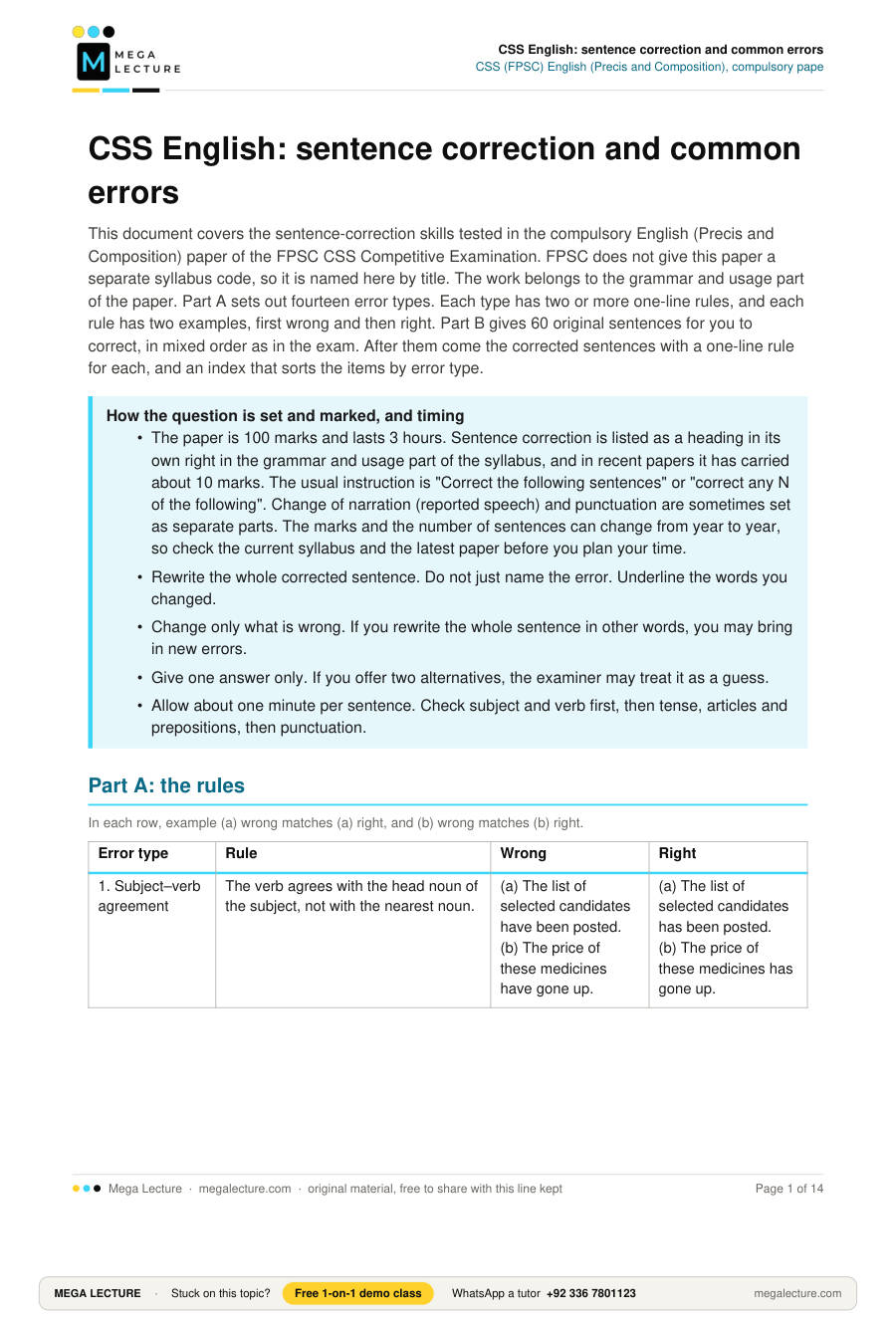
This document covers the sentence-correction skills tested in the compulsory English (Precis and Composition) paper of the FPSC CSS Competitive Examination. FPSC does not give this paper a separate syllabus code, so it is named here by title. The work belongs to the grammar and usage part of the paper. Part A sets out fourteen error types. Each type has two or more one-line rules, and each rule has two examples, first wrong and then right. Part B gives 60 original sentences for you to correct, in mixed order as in the exam. After them come the corrected sentences with a one-line rule for each, and an index that sorts the items by error type.
How the question is set and marked, and timing- The paper is 100 marks and lasts 3 hours. Sentence correction is listed as a heading in its own right in the grammar and usage part of the syllabus, and in recent papers it has carried about 10 marks. The usual instruction is "Correct the following sentences" or "correct any N of the following". Change of narration (reported speech) and punctuation are sometimes set as separate parts. The marks and the number of sentences can change from year to year, so check the current syllabus and the latest paper before you plan your time.
- Rewrite the whole corrected sentence. Do not just name the error. Underline the words you changed.
- Change only what is wrong. If you rewrite the whole sentence in other words, you may bring in new errors.
- Give one answer only. If you offer two alternatives, the examiner may treat it as a guess.
- Allow about one minute per sentence. Check subject and verb first, then tense, articles and prepositions, then punctuation.
Part A: the rules
In each row, example (a) wrong matches (a) right, and (b) wrong matches (b) right.
| Error type | Rule | Wrong | Right |
|---|---|---|---|
| 1. Subject–verb agreement | The verb agrees with the head noun of the subject, not with the nearest noun. | (a) The list of selected candidates have been posted. (b) The price of these medicines have gone up. | (a) The list of selected candidates has been posted. (b) The price of these medicines has gone up. |
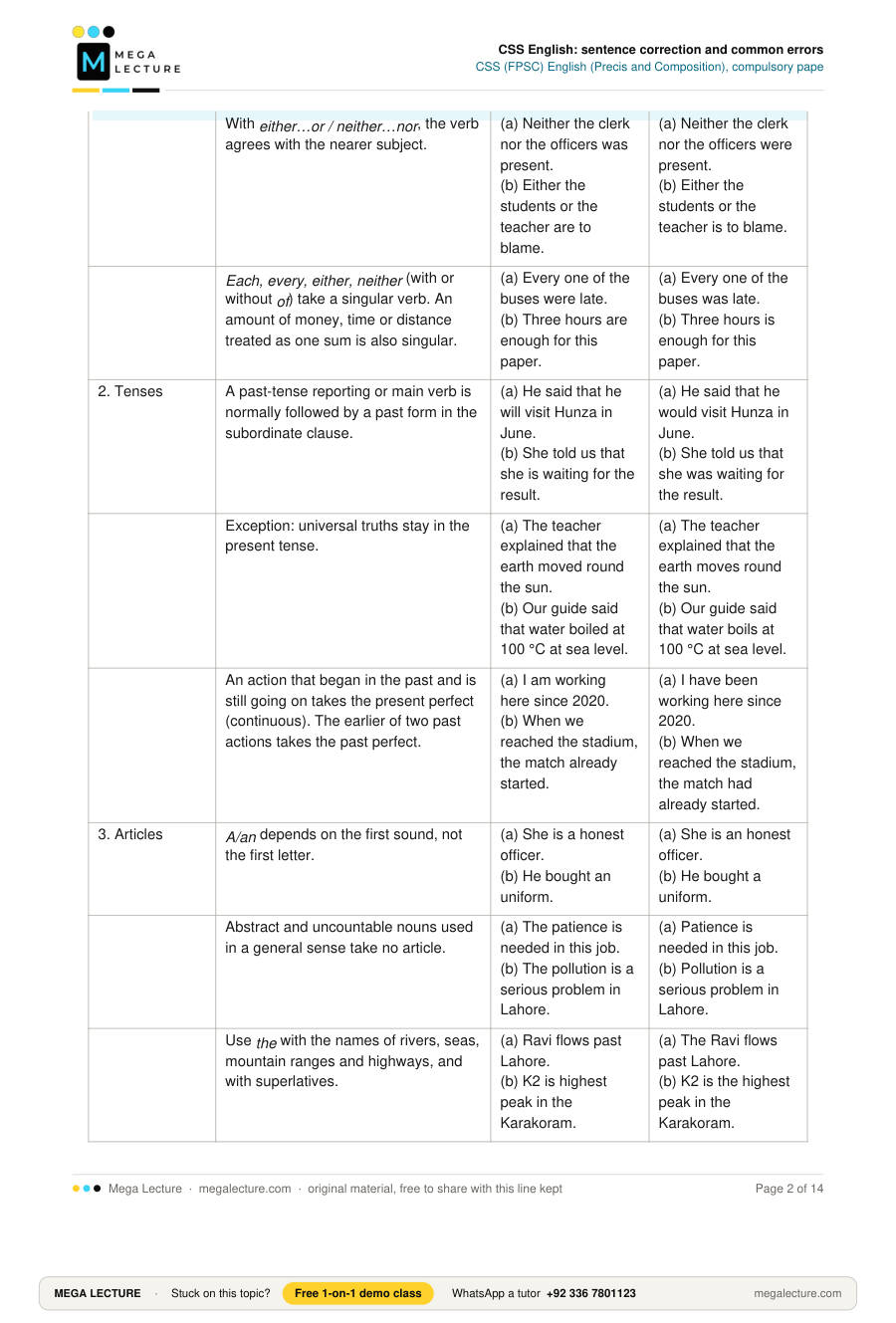
| With either…or / neither…nor, the verb agrees with the nearer subject. | (a) Neither the clerk nor the officers was present. (b) Either the students or the teacher are to blame. | (a) Neither the clerk nor the officers were present. (b) Either the students or the teacher is to blame. | |
| Each, every, either, neither (with or without of) take a singular verb. An amount of money, time or distance treated as one sum is also singular. | (a) Every one of the buses were late. (b) Three hours are enough for this paper. | (a) Every one of the buses was late. (b) Three hours is enough for this paper. | |
| 2. Tenses | A past-tense reporting or main verb is normally followed by a past form in the subordinate clause. | (a) He said that he will visit Hunza in June. (b) She told us that she is waiting for the result. | (a) He said that he would visit Hunza in June. (b) She told us that she was waiting for the result. |
| Exception: universal truths stay in the present tense. | (a) The teacher explained that the earth moved round the sun. (b) Our guide said that water boiled at 100 °C at sea level. | (a) The teacher explained that the earth moves round the sun. (b) Our guide said that water boils at 100 °C at sea level. | |
| An action that began in the past and is still going on takes the present perfect (continuous). The earlier of two past actions takes the past perfect. | (a) I am working here since 2020. (b) When we reached the stadium, the match already started. | (a) I have been working here since 2020. (b) When we reached the stadium, the match had already started. | |
| 3. Articles | A/an depends on the first sound, not the first letter. | (a) She is a honest officer. (b) He bought an uniform. | (a) She is an honest officer. (b) He bought a uniform. |
| Abstract and uncountable nouns used in a general sense take no article. | (a) The patience is needed in this job. (b) The pollution is a serious problem in Lahore. | (a) Patience is needed in this job. (b) Pollution is a serious problem in Lahore. | |
| Use the with the names of rivers, seas, mountain ranges and highways, and with superlatives. | (a) Ravi flows past Lahore. (b) K2 is highest peak in the Karakoram. | (a) The Ravi flows past Lahore. (b) K2 is the highest peak in the Karakoram. | |
| 4. Prepositions | Many verbs and adjectives take a fixed preposition (good at, angry with, accused of, insist on, arrive at). | (a) She is good in mathematics. (b) He was angry on his driver. | (a) She is good at mathematics. (b) He was angry with his driver. |
| Since marks a point in time; for marks a length of time. | (a) The road has been closed since two weeks. (b) He has lived in Sukkur for 2015. | (a) The road has been closed for two weeks. (b) He has lived in Sukkur since 2015. | |
| Some verbs take a direct object with no preposition (discuss, reach, enter, resemble). | (a) They reached at the airport late. (b) She resembles to her grandmother. | (a) They reached the airport late. (b) She resembles her grandmother. | |
| 5. Pronoun case and reference | A pronoun that is the object of a verb or preposition takes the object case (me, him, her, us, them). After be, formal English keeps the subject case (It is I). | (a) The fee was paid by my brother and I. (b) The manager invited Sana and I to lunch. | (a) The fee was paid by my brother and me. (b) The manager invited Sana and me to lunch. |
| A pronoun must have a clear noun to refer to, and it must be clear which noun that is. | (a) When Ali met Kamran, he was tired. (b) Hira told her mother that her phone was broken. | (a) Ali was tired when he met Kamran. (b) Hira said to her mother, "My phone is broken." | |
| 6. Modifiers | Misplaced: put a modifier next to the word it describes. | (a) The minister spoke about the new dam wearing a green scarf. (b) I nearly read the whole book in one night. | (a) Wearing a green scarf, the minister spoke about the new dam. (b) I read nearly the whole book in one night. |
| Dangling: an opening phrase must describe the subject of the main clause. | (a) Walking to the office, the rain soaked my files. (b) After finishing lunch, the meeting started again. | (a) As I walked to the office, the rain soaked my files. (b) After we had finished lunch, the meeting started again. | |
| 7. Parallelism | Items in a list or a pair must have the same grammatical form. | (a) She likes reading, writing and to swim. (b) The job involves checking files, meeting clients and to write reports. | (a) She likes reading, writing and swimming. (b) The job involves checking files, meeting clients and writing reports. |
| Correlatives (not only…but also, either…or, both…and) join matching parts. | (a) The job requires not only patience but also to be honest. (b) He either will resign or apologise. | (a) The job requires not only patience but also honesty. (b) He will either resign or apologise. | |
| 8. Comparatives and superlatives | Never use a double comparative or superlative. | (a) This is the most cheapest route. (b) Ali is more taller than Asad. | (a) This is the cheapest route. (b) Ali is taller than Asad. |
| When only two things are compared, use the comparative, not the superlative. | (a) Of the two sisters, Ayesha is the tallest. (b) Which is best, tea or coffee? | (a) Of the two sisters, Ayesha is the taller. (b) Which is better, tea or coffee? | |
| When you compare something with the rest of its own group, use any other. Latin comparatives (senior, junior, superior, inferior, prior) take to, not than. | (a) Lahore is bigger than any city in Punjab. (b) The new model is superior than the old one. | (a) Lahore is bigger than any other city in Punjab. (b) The new model is superior to the old one. | |
| Compare like with like: use that of (singular) or those of/in (plural). | (a) The population of Karachi is larger than Lahore. (b) The prices in Islamabad are higher than Multan. | (a) The population of Karachi is larger than that of Lahore. (b) The prices in Islamabad are higher than those in Multan. | |
| 9. Confusing word pairs | Affect is usually a verb; effect is usually a noun. | (a) The new policy will effect every farmer. (b) The medicine had no affect on him. | (a) The new policy will affect every farmer. (b) The medicine had no effect on him. |
| Principal means the head of a school or college, or "main"; principle means a rule or belief. | (a) The principle of the college has retired. (b) Free speech is a basic principal of democracy. | (a) The principal of the college has retired. (b) Free speech is a basic principle of democracy. | |
| Other pairs: stationary (not moving) / stationery (paper and pens); compliment (praise) / complement (something that completes); beside (next to) / besides (in addition to); lose (misplace) / loose (not tight). | (a) The bus was stationery for an hour. (b) Beside cricket, he plays hockey. | (a) The bus was stationary for an hour. (b) Besides cricket, he plays hockey. | |
| 10. Redundancy | Do not repeat an idea that a word already contains. | (a) The minister will revisit the site again next week. (b) The final outcome of the talks is not yet known. | (a) The minister will revisit the site next week. (b) The outcome of the talks is not yet known. |
| Reason already means "cause", so do not write "the reason is because" or "due to the reason that". | (a) The reason for the delay is because the pilot was ill. (b) The flight was late due to the reason that fog covered the runway. | (a) The reason for the delay is that the pilot was ill. (b) The flight was late because fog covered the runway. | |
| 11. Idioms and fixed expressions | In look forward to and be used to, to is a preposition, so it takes an -ing form. | (a) I look forward to meet you. (b) She is used to work late. | (a) I look forward to meeting you. (b) She is used to working late. |
| Prefer X to Y, not than. Would rather + bare infinitive … than + bare infinitive. | (a) She prefers the train than the bus. (b) I would rather walk than to wait for the bus. | (a) She prefers the train to the bus. (b) I would rather walk than wait for the bus. | |
| No sooner … than; Hardly/Scarcely … when. When these open the sentence, invert the verb (had he, had the rain). | (a) No sooner the rain stopped than the children went out. (b) Hardly had the shop opened than a crowd gathered. | (a) No sooner had the rain stopped than the children went out. (b) Hardly had the shop opened when a crowd gathered. | |
| 12. Conditionals | First conditional: if + present simple, then will + verb. Do not put will in the if-clause. | (a) If it will rain, the match will be cancelled. (b) If you will call me, I will come. | (a) If it rains, the match will be cancelled. (b) If you call me, I will come. |
| Second conditional (imaginary present): if + past simple (were for all persons in formal English), then would + verb. | (a) If I was rich, I would buy a farm. (b) If he knew the answer, he will tell us. | (a) If I were rich, I would buy a farm. (b) If he knew the answer, he would tell us. | |
| Third conditional: if + past perfect, then would have + past participle. Never put would have in the if-clause. | (a) If he had studied, he would pass the exam last year. (b) If we would have left earlier, we would have caught the bus. | (a) If he had studied, he would have passed the exam last year. (b) If we had left earlier, we would have caught the bus. | |
| Unless already means "if not": do not add another not, and do not use will in the unless-clause. | (a) Unless you do not hurry, you will miss the train. (b) Unless it will stop raining, the match will not start. | (a) Unless you hurry, you will miss the train. (b) Unless it stops raining, the match will not start. | |
| 13. Reported speech | Reported questions use statement word order, with no that and no question mark. | (a) She asked me where was I going. (b) He asked me that what my name was. | (a) She asked me where I was going. (b) He asked me what my name was. |
| Tell takes the listener as its object (told me). Say does not: use said to + listener, or leave the listener out. | (a) He said me that he was busy. (b) She told that the office was closed. | (a) He told me that he was busy. (b) She said that the office was closed. | |
| When the words are reported later, change pronouns and time and place words: today → that day, tomorrow → the next day, here → there. | (a) He said that he was tired today. (b) She said that she would come here tomorrow. | (a) He said that he was tired that day. (b) She said that she would come there the next day. | |
| 14. Punctuation | When however joins two main clauses, put a semicolon before it and a comma after it. | (a) The committee submitted its report, however, the minister rejected it. (b) Prices rose sharply, however, wages stayed the same. | (a) The committee submitted its report; however, the minister rejected it. (b) Prices rose sharply; however, wages stayed the same. |
| Comma splice: a comma alone cannot join two main clauses. Use a full stop, a semicolon or a joining word. | (a) The train was late, we missed the interview. (b) It is raining, take an umbrella. | (a) The train was late, so we missed the interview. (b) It is raining. Take an umbrella. | |
| Its is possessive; it's means "it is" or "it has". | (a) The dog wagged it's tail. (b) Its time to leave. | (a) The dog wagged its tail. (b) It's time to leave. | |
| Plural nouns not ending in -s take 's (women's). Plural nouns ending in -s take only an apostrophe (girls'). | (a) The womens' hostel is full. (b) The girls's hostel is near the gate. | (a) The women's hostel is full. (b) The girls' hostel is near the gate. | |
| Do not put commas round a defining (restrictive) clause, and never put a single comma between a subject and its verb. | (a) Passengers, who have no ticket, will be fined. (b) The book that I lent you, is overdue. | (a) Passengers who have no ticket will be fined. (b) The book that I lent you is overdue. | |
| An indirect question is a statement, so it ends with a full stop. | (a) She asked whether the office was open? (b) I wonder why he left early? | (a) She asked whether the office was open. (b) I wonder why he left early. |
Some of these rules are formal conventions (for example any other, prefer…to, If I were, It is I, and backshift after a past reporting verb). Everyday English is sometimes looser, but the CSS examiner expects formal written usage.
Part B: 60 sentences to correct
Correct the following sentences. Rewrite each sentence in full.
The error types are mixed, as in the exam. Sentences 1–30 contain one error each. Sentences 31–50 contain one less obvious error. Sentences 51–60 may contain more than one error, or none: if a sentence is already correct, write "Correct".
- The standard of the hostel rooms are poor.
- He was accused for stealing a motorbike.
- The flood had a serious affect on the wheat harvest.
- If the train will be late, we will miss the ceremony.
- She earned a MBA from a university in Peshawar.
- The officer asked me where did I live.
- The road to Skardu is more narrower than the road to Gilgit.
- I look forward to meet the selection board.
- The company has changed it's logo.
- Each of the nurses have a separate locker.
- The course trains officers to plan, to budget and managing staff.
- My uncle has been working in Dubai since six years.
- Walking along the canal, a snake frightened my sister.
- Yesterday the manager said that he will announce the results on Monday.
- The coach selected Hamza and I for the final.
- The two parties merged together to form an alliance.
- Karakoram Highway links Pakistan with China.
- Please accept my complements on your selection.
- I am living in Gwadar since 2021.
- My brother is a lawyer, but I have no interest in it.
- We discussed about the new syllabus for an hour.
- Most students prefer online classes than lectures in the hall.
- Neither the coach nor the players was happy with the pitch.
- The fee was reduced, however few students applied.
- He resigned on principal when he was asked to change the figures.
- By the time the fire brigade arrived, the shop already burnt down.
- The main reason for the delay was because of the strike.
- He is one of those doctors who has never taken a bribe.
- No sooner had the bell rung when the pupils rushed out.
- He insisted to pay for the dinner.
- Five hundred rupees are too much for a bus ticket.
- The salary of a nurse is lower than a doctor.
- The warden told that the gate would close at nine.
- Of the two proposals, the second is the best.
- If I was the chief minister, I would build more schools.
- The office has run out of stationary.
- The candidates who arrived late, were not allowed into the hall.
- Our new principal is junior than two of her teachers.
- Full of spelling mistakes, the teacher returned my essay.
- The jirga finally arrived to a decision after midnight.
- Unless you do not pay the fee by Monday, your admission will be cancelled.
- Beside Urdu, she speaks Balochi and Brahui.
- The childrens' ward has been moved to the new block.
- If she had left on time, she would catch the flight yesterday.
- The meeting will start at 10 a.m. in the morning.
- The coach said the players not to drink cold water.
- The new officer is both honest and works hard.
- Karachi is larger than any city in Pakistan.
- She asked whether the bank was open on Saturday?
- Scarcely had the plane landed than the passengers stood up.
- Neither of the candidates have been seen since two days.
- Hardly had the guests arrived when the power failed.
- The unemployment are rising in the most of the cities.
- The council approved it's budget, however the mayor vetoed it.
- She told me last week that she has finished the report and will send it tomorrow.
- Being a rainy day, the school was closed early.
- Each of the players has been given a new kit.
- The captain said me that I am selected for the national team.
- If I were in your place, I would apologise to him.
- She would rather to resign than accepting a bribe.
Corrections and rules
Each answer gives the corrected sentence, with the changed words in bold, and then the rule in one line. Where a second correction is also acceptable, it is given in brackets. In the exam, write only one.
1. The standard of the hostel rooms is poor.Rule: the verb agrees with the head noun standard, not with rooms. 2. He was accused of stealing a motorbike.
Rule: accused of is fixed (compare charged with). 3. The flood had a serious effect on the wheat harvest.
Rule: after a serious you need the noun effect; affect is the verb. 4. If the train is late, we will miss the ceremony.
Rule: first conditional: present simple in the if-clause, will only in the main clause. 5. She earned an MBA from a university in Peshawar.
Rule: MBA begins with the vowel sound "em", so it takes an. 6. The officer asked me where I lived.
Rule: a reported question uses statement word order. 7. The road to Skardu is narrower than the road to Gilgit.
Rule: use one comparative form only, never more + -er. 8. I look forward to meeting the selection board.
Rule: in look forward to, to is a preposition, so it takes the -ing form. 9. The company has changed its logo.
Rule: its is possessive; it's means "it is" or "it has". 10. Each of the nurses has a separate locker.
Rule: each is singular, so it takes a singular verb. 11. The course trains officers to plan, budget and manage staff.
Rule: items in a list take the same form. (To plan, to budget and to manage is also correct.) 12. My uncle has been working in Dubai for six years.
Rule: for + a length of time; since + a point in time. 13. As my sister was walking along the canal, a snake frightened her.
Rule: the opening phrase must describe the subject; as written, the snake was walking. (Walking along the canal, my sister was frightened by a snake is also correct.) 14. Yesterday the manager said that he would announce the results on Monday.
Rule: after a past reporting verb, will becomes would. 15. The coach selected Hamza and me for the final.
Rule: the object of a verb takes the object case. Test it by removing Hamza: "selected me". 16. The two parties merged to form an alliance.
Rule: merge already means "come together", so together is redundant. 17. The Karakoram Highway links Pakistan with China.
Rule: the names of highways, like the names of rivers, take the. 18. Please accept my compliments on your selection.
Rule: compliment means praise; complement means something that completes. 19. I have been living in Gwadar since 2021.
Rule: an action that began in the past and is still going on takes the present perfect (continuous) with since. 20. My brother is a lawyer, but I have no interest in law.
Rule: a pronoun needs a noun to refer to. The sentence mentions lawyer, not law, so it has nothing to refer to. 21. We discussed the new syllabus for an hour.
Rule: discuss takes a direct object with no preposition. 22. Most students prefer online classes to lectures in the hall.
Rule: prefer X to Y, not than. 23. Neither the coach nor the players were happy with the pitch.
Rule: with neither…nor, the verb agrees with the nearer subject, players. 24. The fee was reduced; however, few students applied.
Rule: when however joins two main clauses, put a semicolon before it and a comma after it. 25. He resigned on principle when he was asked to change the figures.
Rule: on principle means "because of a moral rule"; principal means head or main. 26. By the time the fire brigade arrived, the shop had already burnt down.
Rule: the earlier of two past actions takes the past perfect. 27. The main reason for the delay was the strike.
Rule: reason already means cause, so drop because of. 28. He is one of those doctors who have never taken a bribe.
Rule: who refers to doctors (plural), so the verb is plural. The singular is common in everyday writing, but formal usage requires the plural verb. 29. No sooner had the bell rung than the pupils rushed out.
Rule: no sooner is paired with than, not when. 30. He insisted on paying for the dinner.
Rule: insist on + -ing form. 31. Five hundred rupees is too much for a bus ticket.
Rule: an amount of money treated as one sum takes a singular verb. 32. The salary of a nurse is lower than that of a doctor.
Rule: compare like with like: a salary with a salary, not a salary with a person. 33. The warden said that the gate would close at nine.
Rule: tell needs the listener as its object; with no listener named, use say. (The warden told us that… is also correct.) 34. Of the two proposals, the second is the better.
Rule: when only two things are compared, use the comparative. 35. If I were the chief minister, I would build more schools.
Rule: second conditional: formal English uses were for all persons. 36. The office has run out of stationery.
Rule: stationery means paper and pens; stationary means not moving. 37. The candidates who arrived late were not allowed into the hall. (comma removed)
Rule: a defining clause takes no commas, and a single comma must never separate a subject from its verb. 38. Our new principal is junior to two of her teachers.
Rule: Latin comparatives such as junior take to, not than. 39. The teacher returned my essay, which was full of spelling mistakes.
Rule: an opening phrase describes the subject that follows it; as written, the teacher is full of mistakes. 40. The jirga finally arrived at a decision after midnight.
Rule: the fixed expression is arrive at a decision. 41. Unless you pay the fee by Monday, your admission will be cancelled.
Rule: unless already means "if not", so do not add another not. 42. Besides Urdu, she speaks Balochi and Brahui.
Rule: besides means "in addition to"; beside means "next to". 43. The children's ward has been moved to the new block.
Rule: children is already plural and does not end in -s, so it takes 's. 44. If she had left on time, she would have caught the flight yesterday.
Rule: third conditional: if + past perfect, then would have + past participle. 45. The meeting will start at 10 a.m.
Rule: a.m. already means "in the morning". (At 10 in the morning is also correct.) 46. The coach told the players not to drink cold water.
Rule: say cannot take the listener as its object. A reported command uses told/advised + listener + (not) to-infinitive. 47. The new officer is both honest and hard-working.
Rule: both…and joins matching parts, here two adjectives. 48. Karachi is larger than any other city in Pakistan.
Rule: Karachi is itself a city in Pakistan, so compare it with any other. 49. She asked whether the bank was open on Saturday.
Rule: an indirect question is a statement, so it ends with a full stop. 50. Scarcely had the plane landed when the passengers stood up.
Rule: scarcely and hardly are paired with when, not than. 51. Neither of the candidates has been seen for two days. (two errors)
Rule: neither of takes a singular verb; for + a length of time. 52. Correct.
Rule: Hardly + inverted verb (had the guests arrived) … when. 53. Unemployment is rising in most of the cities. (three errors)
Rule: an abstract noun used in a general sense takes no article and a singular verb; the phrase is most of, not the most of. 54. The council approved its budget; however, the mayor vetoed it. (two errors)
Rule: its is possessive; however between two main clauses needs a semicolon before it and a comma after it. 55. She told me last week that she had finished the report and would send it the next day. (three errors)
Rule: after a past reporting verb, backshift the tenses and change tomorrow to the next day. Everyday English sometimes keeps the present tense when the fact is still true, but in the exam always backshift after a past reporting verb unless the statement is a universal truth. 56. As it was a rainy day, the school was closed early.
Rule: the opening phrase must describe the subject; the school was not "being a rainy day". 57. Correct.
Rule: each of takes a singular verb (has). 58. The captain told me that I had been selected for the national team. (two errors)
Rule: say cannot take the listener as its object, so use told me; after a past reporting verb, am selected (meaning "have been selected") moves back to had been selected. 59. Correct.
Rule: second conditional with were in the if-clause and would + verb in the main clause. 60. She would rather resign than accept a bribe. (two errors)
Rule: would rather + bare infinitive … than + bare infinitive.
Index of items by error type
Use this after you have attempted the set, to find the error types you need to revise. Some items appear under two types.
| Error type (Part A row) | Items |
|---|---|
| 1. Subject–verb agreement | 1, 10, 23, 28, 31, 51, 53, 57 |
| 2. Tenses | 14, 19, 26, 55, 58 |
| 3. Articles | 5, 17, 53 |
| 4. Prepositions | 2, 12, 21, 30, 40, 51 |
| 5. Pronoun case and reference | 15, 20 |
| 6. Modifiers | 13, 39, 56 |
| 7. Parallelism | 11, 47 |
| 8. Comparatives and superlatives | 7, 32, 34, 38, 48 |
| 9. Confusing word pairs | 3, 18, 25, 36, 42 |
| 10. Redundancy | 16, 27, 45 |
| 11. Idioms and fixed expressions | 8, 22, 29, 50, 52, 60 |
| 12. Conditionals | 4, 35, 41, 44, 59 |
| 13. Reported speech | 6, 33, 46, 55, 58 |
| 14. Punctuation | 9, 24, 37, 43, 49, 54 |
