
AS Level · Chemistry 9701 · AS Chemistry organic chemistry: 40 multiple-choice questions with explained answers
AS Chemistry organic chemistry: 40 multiple-choice questions with explained answers
Need more than one subject? All-notes pass: unlimited downloads of every note for a year: unlimited downloads of every note on the site, PKR 999 a year. All packs and courses.
Opens inside this page. Prefer your own PDF app? Open the PDF.
Chemistry batch classes: coming soon. Small live classes at a lower fee than one-to-one. Join the waiting list
Check yourself
5 quick questions on AS Chemistry
Tap an answer to see if you are right, and why. Free, no sign-up.
Start the free test👍 25 students found these notes useful
Was this note useful?
Full text of AS Chemistry organic chemistry: 40 multiple-choice questions with explained answers
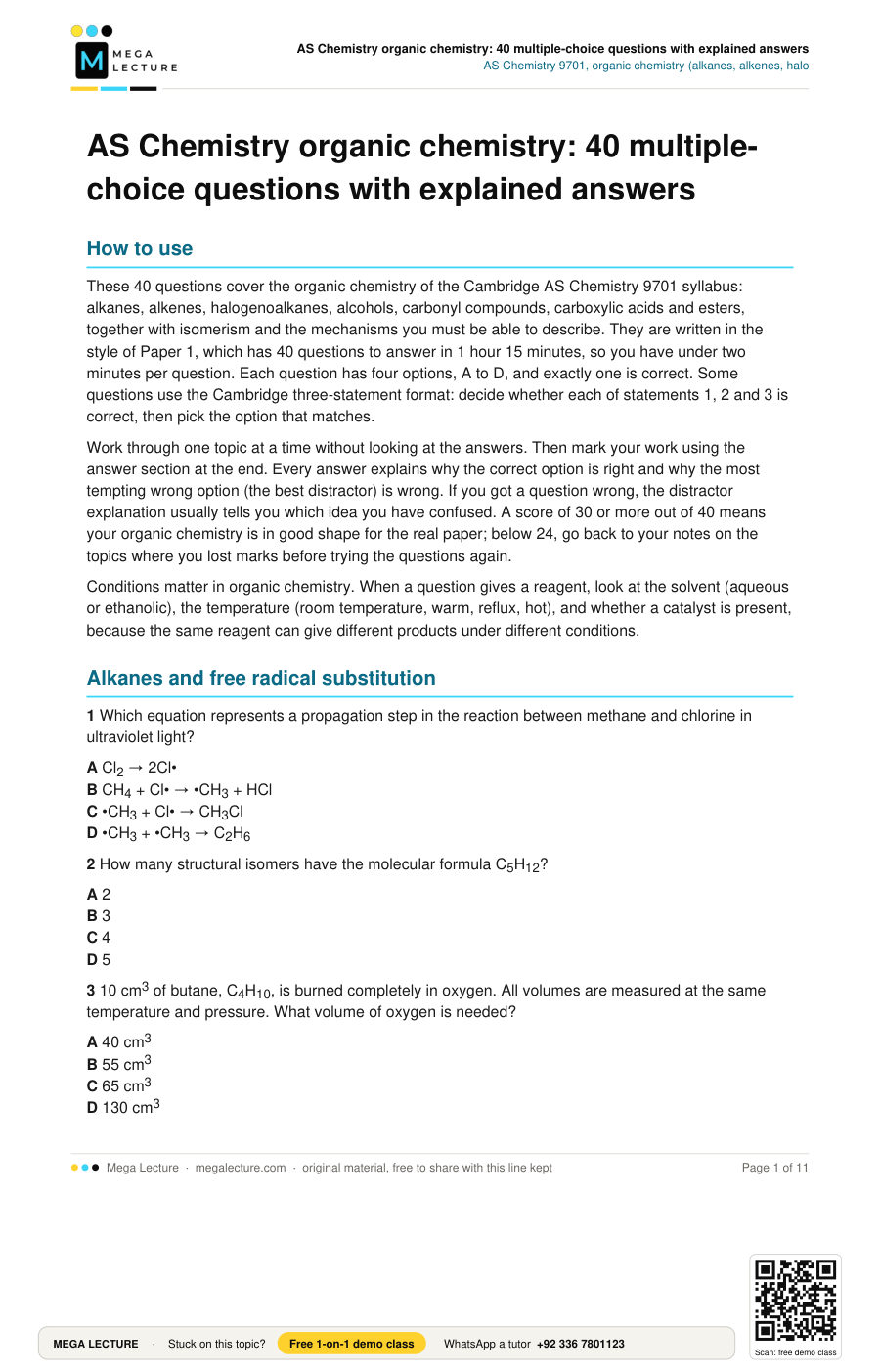
How to use
These 40 questions cover the organic chemistry of the Cambridge AS Chemistry 9701 syllabus: alkanes, alkenes, halogenoalkanes, alcohols, carbonyl compounds, carboxylic acids and esters, together with isomerism and the mechanisms you must be able to describe. They are written in the style of Paper 1, which has 40 questions to answer in 1 hour 15 minutes, so you have under two minutes per question. Each question has four options, A to D, and exactly one is correct. Some questions use the Cambridge three-statement format: decide whether each of statements 1, 2 and 3 is correct, then pick the option that matches.
Work through one topic at a time without looking at the answers. Then mark your work using the answer section at the end. Every answer explains why the correct option is right and why the most tempting wrong option (the best distractor) is wrong. If you got a question wrong, the distractor explanation usually tells you which idea you have confused. A score of 30 or more out of 40 means your organic chemistry is in good shape for the real paper; below 24, go back to your notes on the topics where you lost marks before trying the questions again.
Conditions matter in organic chemistry. When a question gives a reagent, look at the solvent (aqueous or ethanolic), the temperature (room temperature, warm, reflux, hot), and whether a catalyst is present, because the same reagent can give different products under different conditions.
Alkanes and free radical substitution
1 Which equation represents a propagation step in the reaction between methane and chlorine in ultraviolet light?
A Cl2 → 2Cl•
B CH4 + Cl• → •CH3 + HCl
C •CH3 + Cl• → CH3Cl
D •CH3 + •CH3 → C2H6
2 How many structural isomers have the molecular formula C5H12?
A 2
B 3
C 4
D 5
3 10 cm3 of butane, C4H10, is burned completely in oxygen. All volumes are measured at the same temperature and pressure. What volume of oxygen is needed?
A 40 cm3
B 55 cm3
C 65 cm3
D 130 cm3
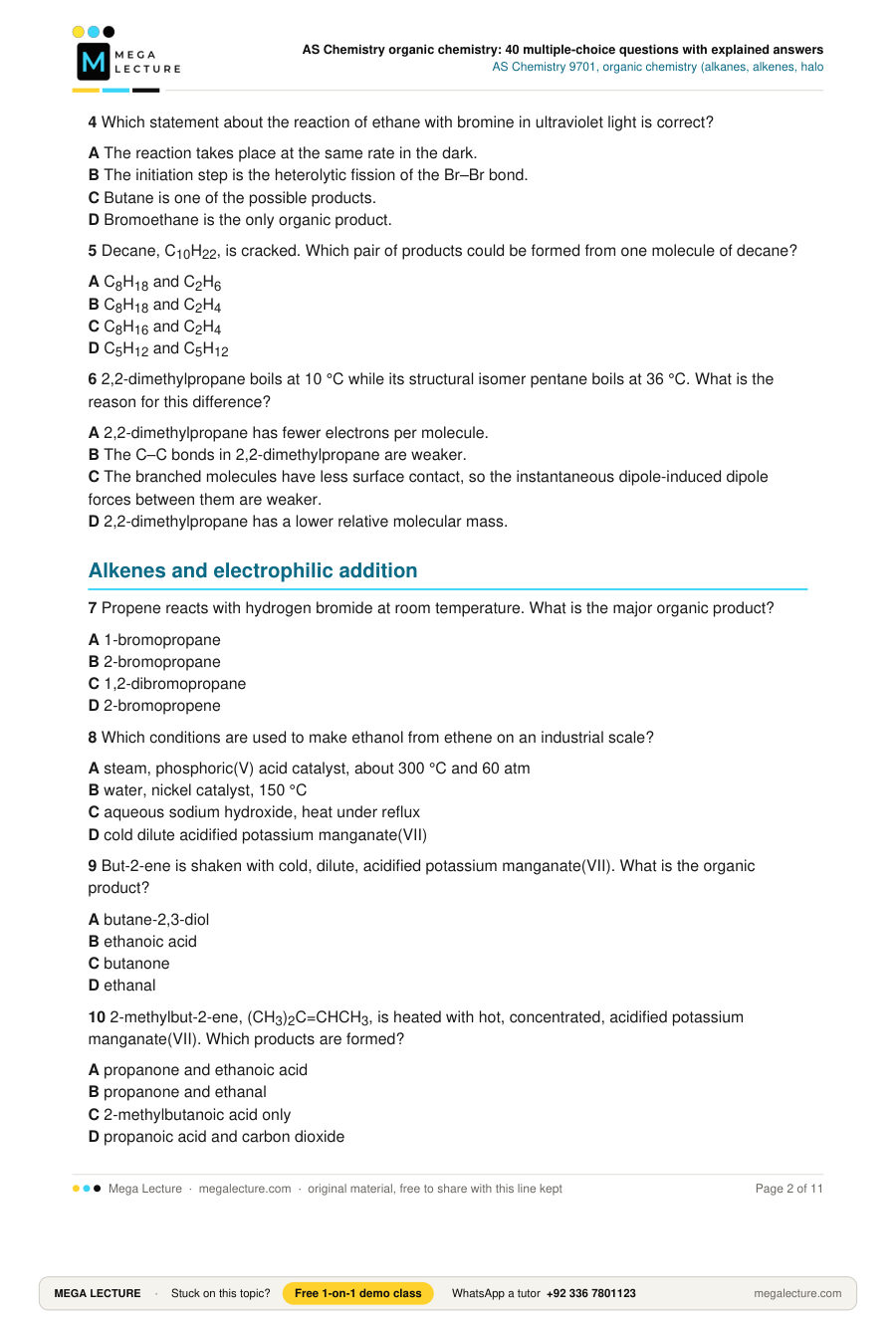
4 Which statement about the reaction of ethane with bromine in ultraviolet light is correct?
A The reaction takes place at the same rate in the dark.
B The initiation step is the heterolytic fission of the Br–Br bond.
C Butane is one of the possible products.
D Bromoethane is the only organic product.
5 Decane, C10H22, is cracked. Which pair of products could be formed from one molecule of decane?
A C8H18 and C2H6
B C8H18 and C2H4
C C8H16 and C2H4
D C5H12 and C5H12
6 2,2-dimethylpropane boils at 10 °C while its structural isomer pentane boils at 36 °C. What is the reason for this difference?
A 2,2-dimethylpropane has fewer electrons per molecule.
B The C–C bonds in 2,2-dimethylpropane are weaker.
C The branched molecules have less surface contact, so the instantaneous dipole-induced dipole forces between them are weaker.
D 2,2-dimethylpropane has a lower relative molecular mass.
Alkenes and electrophilic addition
7 Propene reacts with hydrogen bromide at room temperature. What is the major organic product?
A 1-bromopropane
B 2-bromopropane
C 1,2-dibromopropane
D 2-bromopropene
8 Which conditions are used to make ethanol from ethene on an industrial scale?
A steam, phosphoric(V) acid catalyst, about 300 °C and 60 atm
B water, nickel catalyst, 150 °C
C aqueous sodium hydroxide, heat under reflux
D cold dilute acidified potassium manganate(VII)
9 But-2-ene is shaken with cold, dilute, acidified potassium manganate(VII). What is the organic product?
A butane-2,3-diol
B ethanoic acid
C butanone
D ethanal
10 2-methylbut-2-ene, (CH3)2C=CHCH3, is heated with hot, concentrated, acidified potassium manganate(VII). Which products are formed?
A propanone and ethanoic acid
B propanone and ethanal
C 2-methylbutanoic acid only
D propanoic acid and carbon dioxide
11 Which alkene shows cis-trans (geometrical) isomerism?
A propene
B but-1-ene
C 2-methylpropene
D pent-2-ene
12 A section of an addition polymer has the structure –CH2–CHCl–CH2–CHCl–CH2–CHCl–. Which monomer was used to make it?
A chloroethane
B chloroethene
C 1,2-dichloroethene
D 1,1-dichloroethene
Halogenoalkanes: nucleophilic substitution and elimination
13 1-bromobutane is heated under reflux with potassium cyanide dissolved in ethanol. What is the organic product?
A butanenitrile
B pentanenitrile
C butylamine
D butan-1-ol
14 Separate samples of 1-chlorobutane, 1-bromobutane and 1-iodobutane are warmed with aqueous silver nitrate in ethanol. Which precipitate appears first, and why?
A a white precipitate, because the C–Cl bond is the most polar
B a yellow precipitate, because the C–I bond is the weakest
C a cream precipitate, because bromine is the most reactive halogen
D all three appear at the same time, because the mechanism is the same
15 2-bromo-2-methylpropane is hydrolysed by water. Which statement about the mechanism is correct?
A It is a one-step SN2 reaction in which water attacks as the C–Br bond breaks.
B It is a two-step SN1 reaction that passes through a tertiary carbocation.
C It is a free radical substitution started by homolytic fission of the C–Br bond.
D It is an elimination reaction giving 2-methylpropene.
16 2-bromobutane is heated with a concentrated solution of potassium hydroxide in ethanol. Which organic products are formed?
A butan-2-ol only
B but-1-ene and but-2-ene
C butane
D but-1-ene only
17 Which reagent and conditions convert bromoethane into ethylamine, CH3CH2NH2?
A aqueous sodium hydroxide, heated under reflux
B potassium cyanide in ethanol, heated under reflux
C aqueous ammonia at room temperature in an open flask
D excess concentrated ammonia in ethanol, heated in a sealed tube
18 Chlorofluorocarbons (CFCs) such as CCl2F2 damage the ozone layer. Which statement explains why?
A Ultraviolet light breaks the C–Cl bond homolytically, giving chlorine radicals that catalyse the breakdown of ozone.
B CFC molecules react directly with ozone in a nucleophilic substitution.
C Ultraviolet light breaks the C–F bond, giving fluorine radicals.
D CFCs are acidic gases that neutralise ozone.
Alcohols
19 Which alcohol is not oxidised when heated with acidified potassium dichromate(VI)?
A butan-1-ol
B butan-2-ol
C 2-methylpropan-2-ol
D 2-methylpropan-1-ol
20 Propan-1-ol is heated under reflux with an excess of acidified potassium dichromate(VI). What is the main organic product?
A propanal
B propanone
C propanoic acid
D propene
21 Butan-2-ol vapour is passed over heated aluminium oxide. Which alkenes can be formed?
A but-1-ene only
B but-2-ene only
C but-1-ene, cis-but-2-ene and trans-but-2-ene
D 2-methylpropene only
22 Which alcohol gives a yellow precipitate when warmed with alkaline aqueous iodine?
A propan-1-ol
B propan-2-ol
C 2-methylpropan-1-ol
D butan-1-ol
23 1.0 mol of ethane-1,2-diol, HOCH2CH2OH, reacts completely with an excess of sodium. What volume of hydrogen is produced at room temperature and pressure? (Molar gas volume = 24.0 dm3 at r.t.p.)
A 12.0 dm3
B 24.0 dm3
C 48.0 dm3
D 72.0 dm3
24 Which test distinguishes propan-1-ol from propan-2-ol?
A adding a small piece of sodium
B warming with acidified potassium dichromate(VI)
C warming with alkaline aqueous iodine
D adding 2,4-dinitrophenylhydrazine reagent
Carbonyl compounds
25 Which compound gives a silver mirror when warmed with Tollens' reagent?
A propanone
B propan-1-ol
C propanoic acid
D propanal
26 Propanone reacts with hydrogen cyanide in the presence of a little potassium cyanide. What is the organic product?
A 2-hydroxy-2-methylpropanenitrile
B 2-hydroxybutanenitrile
C propanenitrile
D 2-methylpropanenitrile
27 Which reagent converts butanone into butan-2-ol?
A acidified potassium dichromate(VI), heated under reflux
B Tollens' reagent, warmed
C concentrated sulfuric acid, heated
D sodium tetrahydridoborate(III), NaBH4, in water
28 Which of the following compounds give a yellow precipitate when warmed with alkaline aqueous iodine?
1 ethanal
2 butanone
3 propanal
A 1 and 2 only
B 1 and 3 only
C 2 and 3 only
D 1 only
29 In the reaction of ethanal with hydrogen cyanide, what is the first step of the mechanism?
A A hydrogen ion bonds to the oxygen atom of the C=O group.
B The lone pair on the carbon atom of the cyanide ion attacks the δ+ carbon atom of the C=O group.
C The C=O π bond breaks heterolytically to give a carbocation.
D A molecule of HCN bonds to the oxygen atom of the C=O group.
Carboxylic acids and esters
30 Which reaction produces ethanoic acid?
A warming ethanal with sodium tetrahydridoborate(III)
B adding sodium to ethanol
C heating ethyl ethanoate with aqueous sodium hydroxide, then distilling the product
D heating ethanenitrile under reflux with dilute hydrochloric acid
31 Methanol is warmed with propanoic acid in the presence of a few drops of concentrated sulfuric acid. What is the name of the ester formed?
A propyl methanoate
B methyl propanoate
C methyl ethanoate
D ethyl propanoate
32 Ethyl ethanoate is heated under reflux with aqueous sodium hydroxide. Which organic products are formed?
A ethanoic acid and ethanol
B sodium ethanoate and ethanol
C sodium ethanoate and ethanal
D ethanol and ethanal
33 Which compound gives effervescence when added to aqueous sodium carbonate?
A ethanol
B ethanal
C ethanoic acid
D ethyl ethanoate
34 Which statements about ethyl ethanoate are correct?
1 It can be hydrolysed by heating under reflux with dilute sulfuric acid.
2 It has the molecular formula C4H8O2.
3 It is a structural isomer of butanoic acid.
A 1, 2 and 3
B 1 and 2 only
C 2 and 3 only
D 1 only
Isomerism and mechanisms overview
35 Which compound has a chiral centre and so can exist as a pair of optical isomers?
A butan-1-ol
B propan-2-ol
C 2-methylpropan-2-ol
D butan-2-ol
36 Which compound is a functional group isomer of propanal?
A propanone
B propan-1-ol
C propanoic acid
D propene
37 How many structural isomers have the molecular formula C4H9Br?
A 2
B 3
C 4
D 5
38 Which reaction proceeds by an electrophilic addition mechanism?
A ethene with bromine at room temperature
B ethane with bromine in ultraviolet light
C bromoethane with aqueous sodium hydroxide
D ethanol with concentrated sulfuric acid at 170 °C
39 Which description of a nucleophile is correct?
A a species that accepts a pair of electrons from a region of high electron density
B a species with an unpaired electron that attacks a C–H bond
C a positively charged ion that is attracted to a π bond
D a species with a lone pair of electrons that it donates to form a covalent bond with an electron-deficient carbon atom
40 Which statement about the SN2 mechanism of nucleophilic substitution is correct?
A It takes place in a single step, and it is the main mechanism for primary halogenoalkanes.
B It takes place in two steps, the first being the formation of a carbocation.
C It is the main mechanism for tertiary halogenoalkanes because the carbocation is stabilised by three alkyl groups.
D The nucleophile attacks the carbon atom from the same side as the leaving halogen atom.
Answers
1 B. Propagation steps use a radical and make a new radical, so the chain continues: Cl• removes H from CH4 to give HCl and a methyl radical, which then attacks Cl2.
A is wrong because it is the initiation step (one molecule gives two radicals); C and D are termination steps, where two radicals join and the chain stops.
2 B. The three isomers are pentane (straight chain), 2-methylbutane (one branch) and 2,2-dimethylpropane (two branches on the same carbon).
C is the best distractor: 3-methylbutane is the same molecule as 2-methylbutane numbered from the wrong end, so it does not count as a fourth isomer.
3 C. C4H10 + 6.5O2 → 4CO2 + 5H2O (or 2C4H10 + 13O2 → 8CO2 + 10H2O); 10 cm3 of butane needs 10 × 6.5 = 65 cm3 of oxygen, because volumes of gases are in the same ratio as the moles.
D is wrong because 130 cm3 uses the coefficient 13 from the doubled equation without halving the volume of butane.
4 C. In a termination step two ethyl radicals can combine, •C2H5 + •C2H5 → C4H10, so a small amount of butane forms; further substitution also gives dibromoethanes and so on.
D is wrong because free radical substitution gives a mixture of products; B is wrong because initiation is homolytic fission (each Br keeps one electron), and A is wrong because light is needed to start the reaction.
5 B. Cracking breaks a C–C bond to give a shorter alkane and an alkene; the atoms must balance: C8H18 + C2H4 has 10 carbons and 22 hydrogens.
A and D are wrong because two alkanes cannot come from one alkane (the hydrogens do not balance: 18 + 6 = 24, 12 + 12 = 24); C has only 20 hydrogens.
6 C. Both isomers have the same number of electrons (and the same Mr), so the only difference is shape: the compact branched molecule has less surface area in contact with its neighbours, so the instantaneous dipole-induced dipole (van der Waals') forces are weaker and less energy is needed to separate the molecules.
A and D are wrong because isomers have identical molecular formulae; B is wrong because boiling does not break covalent bonds.
7 B. In electrophilic addition the H adds first, and the more stable carbocation forms: adding H to carbon 1 of propene gives a secondary carbocation on carbon 2 (stabilised by two alkyl groups), which the Br– then attacks, giving 2-bromopropane (Markovnikov's rule).
A is the minor product, formed through the less stable primary carbocation; C would need Br2, not HBr.
8 A. Ethene is hydrated directly with steam over a phosphoric(V) acid catalyst at about 300 °C and 60 to 70 atm, adding H and OH across the double bond.
B is wrong because nickel is the catalyst for hydrogenation (adding H2), not hydration; D gives ethane-1,2-diol, not ethanol.
9 A. Cold, dilute, acidified KMnO4 adds an OH group to each carbon of the double bond, giving a diol: CH3CH(OH)CH(OH)CH3, butane-2,3-diol; the purple colour is removed.
B is wrong because cleavage of the double bond to give two molecules of ethanoic acid needs hot, concentrated KMnO4.
10 A. Hot, concentrated, acidified KMnO4 breaks the C=C bond completely; the carbon bearing two methyl groups becomes a ketone (propanone) and the carbon bearing one H and one methyl group becomes a carboxylic acid (ethanoic acid).
B is wrong because any aldehyde formed is oxidised further to the acid under these conditions; D would need a terminal =CH2 group, which is oxidised to CO2.
11 D. Cis-trans isomerism needs each carbon of the C=C bond to carry two different groups; in pent-2-ene one carbon has H and CH3 and the other has H and C2H5, so the two alkyl groups can be on the same side or opposite sides.
C is the best distractor: 2-methylpropene has two identical CH3 groups on one carbon and two H atoms on the other, so swapping gives the same molecule; A and B have CH2= at one end.
12 B. The repeat unit is –CH2–CHCl–, which comes from opening the double bond of chloroethene, CH2=CHCl (the polymer is PVC).
A is wrong because chloroethane has no double bond and cannot undergo addition polymerisation; C would give –CHCl–CHCl– and D would give –CH2–CCl2–.
13 B. The cyanide ion is the nucleophile, replacing Br and adding one carbon to the chain: CH3CH2CH2CH2CN has five carbons, so it is pentanenitrile.
A is the best distractor: the nitrile carbon counts in the name, so a four-carbon halogenoalkane gives a five-carbon nitrile, not butanenitrile.
14 B. The rate of hydrolysis depends on the strength of the carbon-halogen bond, not its polarity; C–I is the longest and weakest bond, so it breaks fastest and the iodide ions released give a yellow precipitate of AgI first.
A is wrong because although C–Cl is the most polar bond, it is also the strongest, and 1-chlorobutane hydrolyses slowest (the white AgCl precipitate appears last).
15 B. 2-bromo-2-methylpropane is a tertiary halogenoalkane; the C–Br bond breaks first to give a tertiary carbocation stabilised by three electron-donating alkyl groups, and the water then attacks in a second step.
A is wrong because the three bulky methyl groups hinder attack from behind and the stable carbocation makes the SN1 route faster; D describes what would happen with ethanolic KOH, not water.
16 B. Hot ethanolic KOH causes elimination of HBr; an H can be removed from carbon 1 (giving but-1-ene) or from carbon 3 (giving but-2-ene, as cis and trans isomers), so a mixture forms.
A is wrong because substitution to give the alcohol needs aqueous, not ethanolic, hydroxide; D ignores the hydrogen on carbon 3.
17 D. Ammonia acts as a nucleophile; heating with a large excess of concentrated ammonia in ethanol in a sealed tube (to stop the ammonia escaping) gives mainly the primary amine.
B is the best distractor because it also forms a C–N bond, but the product is propanenitrile, not an amine; A gives ethanol.
18 A. In the stratosphere ultraviolet light breaks the C–Cl bond (weaker than C–F) homolytically; the Cl• radical reacts with O3 to give ClO• and O2, and ClO• then regenerates Cl•, so one chlorine radical destroys many ozone molecules.
C is wrong because the C–F bond is very strong and is not broken by ultraviolet light, which is why fluorine radicals are not involved.
19 C. 2-methylpropan-2-ol is a tertiary alcohol: the carbon bearing the OH group has no hydrogen atom attached, so there is no C–H bond for the oxidising agent to remove, and the solution stays orange.
D is the best distractor: 2-methylpropan-1-ol is branched but it is still a primary alcohol (the OH carbon has two H atoms), so it is oxidised.
20 C. Under reflux with excess oxidising agent, the primary alcohol is oxidised first to the aldehyde and then, because it cannot escape from the flask, on to the carboxylic acid.
A is the best distractor: propanal is obtained only if the aldehyde is distilled off as it forms, using a limited amount of oxidising agent.
21 C. Dehydration removes the OH and a hydrogen from a neighbouring carbon; removing H from carbon 1 gives but-1-ene, and removing H from carbon 3 gives but-2-ene, which exists as cis and trans isomers.
B is wrong because although but-2-ene is the main product, but-1-ene also forms; D would require a branched skeleton that butan-2-ol does not have.
22 B. The tri-iodomethane (iodoform) test is positive for alcohols containing the CH3CH(OH)– group; propan-2-ol, CH3CH(OH)CH3, has this group and is oxidised in situ to propanone, which then gives yellow CHI3.
A is wrong because propan-1-ol has CH2(OH) at the end of the chain, not CH3CH(OH)–, so no yellow precipitate forms.
23 B. Each OH group reacts with sodium to give half a molecule of H2: HOCH2CH2OH + 2Na → NaOCH2CH2ONa + H2, so 1.0 mol of the diol gives 1.0 mol of hydrogen, 24.0 dm3.
A is the answer for a single alcohol such as ethanol; C counts a whole mole of H2 for each OH group.
24 C. Only propan-2-ol has the CH3CH(OH)– group, so only it gives a yellow precipitate of CHI3 with alkaline aqueous iodine.
B is the best distractor: both alcohols are oxidised (primary to the aldehyde or acid, secondary to the ketone), so both turn the dichromate from orange to green and no distinction is seen.
25 D. Tollens' reagent is a mild oxidising agent that oxidises aldehydes to carboxylic acids while the silver(I) ions are reduced to metallic silver, which coats the tube.
A is wrong because ketones have no hydrogen atom on the carbonyl carbon and are not oxidised by Tollens' reagent; C is already fully oxidised.
26 A. The CN– ion adds to the carbonyl carbon and the oxygen picks up H+, giving (CH3)2C(OH)CN; the longest chain containing the nitrile carbon has three carbons, with OH and CH3 on carbon 2.
B is the best distractor: 2-hydroxybutanenitrile, CH3CH2CH(OH)CN, is the product from propanal, where the three carbons are in a straight chain.
27 D. NaBH4 supplies hydride ions (H–), which attack the carbonyl carbon in a nucleophilic addition; the ketone is reduced to the secondary alcohol.
A is wrong because it is an oxidising agent, and a ketone cannot be oxidised further under these conditions, let alone reduced; C would dehydrate an alcohol, not reduce a ketone.
28 A. The tri-iodomethane test needs a CH3CO– group (a methyl ketone or ethanal): ethanal is CH3CHO and butanone is CH3COCH2CH3, so both give yellow CHI3.
Propanal, CH3CH2CHO, is an aldehyde but has CH3CH2– attached to the carbonyl carbon, not CH3–, so options B and C that include statement 3 are wrong.
29 B. The carbonyl group is polar (C δ+, O δ–); the nucleophile CN– (from the KCN catalyst) attacks the δ+ carbon, the π electrons move onto oxygen to give an alkoxide intermediate, which then takes H+ from HCN or water.
A is wrong because the mechanism is nucleophilic addition, not electrophilic: the carbon, not the oxygen, is attacked first; C is wrong because the C=O π bond does not break on its own.
30 D. Heating a nitrile under reflux with dilute acid hydrolyses the C≡N group to a carboxylic acid group: CH3CN + 2H2O + H+ → CH3COOH + NH4+.
C is the best distractor: alkaline hydrolysis of the ester gives the ethanoate ion (sodium ethanoate), and the acid is only obtained after acidifying, which the option does not mention; A is a reduction, giving ethanol.
31 B. The ester takes the alkyl part of its name from the alcohol (methyl, from methanol) and the second part from the acid (propanoate, from propanoic acid): CH3CH2COOCH3.
A is the best distractor, with the two halves of the name swapped: propyl methanoate, HCOOCH2CH2CH3, would come from propan-1-ol and methanoic acid.
32 B. Alkaline hydrolysis of an ester gives the alcohol and the salt of the acid, because the sodium hydroxide neutralises the ethanoic acid as it forms; the reaction goes to completion: CH3COOC2H5 + NaOH → CH3COONa + C2H5OH.
A is the best distractor: the free acid and the alcohol are the products of acid hydrolysis (dilute H2SO4), which is reversible, not of alkaline hydrolysis.
33 C. Carboxylic acids are weak acids but strong enough to react with carbonates, releasing carbon dioxide: 2CH3COOH + Na2CO3 → 2CH3COONa + H2O + CO2.
A is wrong because the OH group of an alcohol is far too weakly acidic to react with a carbonate, even though ethanol does react with sodium metal.
34 A. Statement 1: esters are hydrolysed by dilute acid under reflux to the acid and alcohol. Statement 2: CH3COOCH2CH3 contains 4 C, 8 H and 2 O. Statement 3: butanoic acid, CH3CH2CH2COOH, is also C4H8O2 with a different functional group, so it is a functional group isomer.
B is the best distractor for students who count the ester and acid as different molecular formulae; they share the formula, so all three statements are correct.
35 D. Carbon 2 of butan-2-ol carries four different groups (H, OH, CH3 and C2H5), so it is a chiral centre and the molecule and its mirror image cannot be superimposed.
B is the best distractor: in propan-2-ol carbon 2 carries two identical CH3 groups, so it is not chiral; A and C have no carbon with four different groups.
36 A. Propanal (CH3CH2CHO) and propanone (CH3COCH3) both have the molecular formula C3H6O but different functional groups (aldehyde and ketone), which is the definition of functional group isomerism.
B is wrong because propan-1-ol is C3H8O; isomers must share the same molecular formula, so having a different functional group is not enough on its own.
37 C. The four isomers are 1-bromobutane, 2-bromobutane (which also exists as optical isomers, but these are stereoisomers, not structural isomers), 1-bromo-2-methylpropane and 2-bromo-2-methylpropane.
D is the best distractor for students who count the two optical isomers of 2-bromobutane as separate structural isomers, or who count 3-bromo-2-methylpropane, which is the same compound as 1-bromo-2-methylpropane numbered from the wrong end.
38 A. The electron-rich π bond of ethene polarises the Br2 molecule, and the δ+ bromine acts as the electrophile, adding across the double bond through a carbocation intermediate.
B is the best distractor because it also involves bromine, but alkanes have no π bond and react by free radical substitution in ultraviolet light; C is nucleophilic substitution and D is elimination.
39 D. A nucleophile ("nucleus-loving") is an electron pair donor; it uses a lone pair to form a new covalent bond with an electron-deficient (δ+) atom, as OH–, CN– and NH3 do with the δ+ carbon of a halogenoalkane.
A is the definition of an electrophile, the opposite species; B describes a free radical.
40 A. In SN2 the nucleophile attacks the δ+ carbon from the side opposite the halogen while the C–halogen bond breaks, in one step through a five-bonded transition state; primary halogenoalkanes react this way because their carbon atom is unhindered and a primary carbocation would be too unstable for SN1.
C is the best distractor: it correctly describes why tertiary carbocations are stable, but that is exactly why tertiary halogenoalkanes react by SN1, not SN2; D is wrong because attack is from the opposite side.
