
A Level · Biology 9700 · Transport in plants: summary notes
Transport in plants: summary notes
Opens inside this page. Prefer your own PDF app? Open the PDF.
Check yourself
5 quick questions on A Level Biology
Tap an answer to see if you are right, and why. Free, no sign-up.
Start the free test12 of 12 students found these notes useful
Was this note useful?
Full text of Transport in plants: summary notes
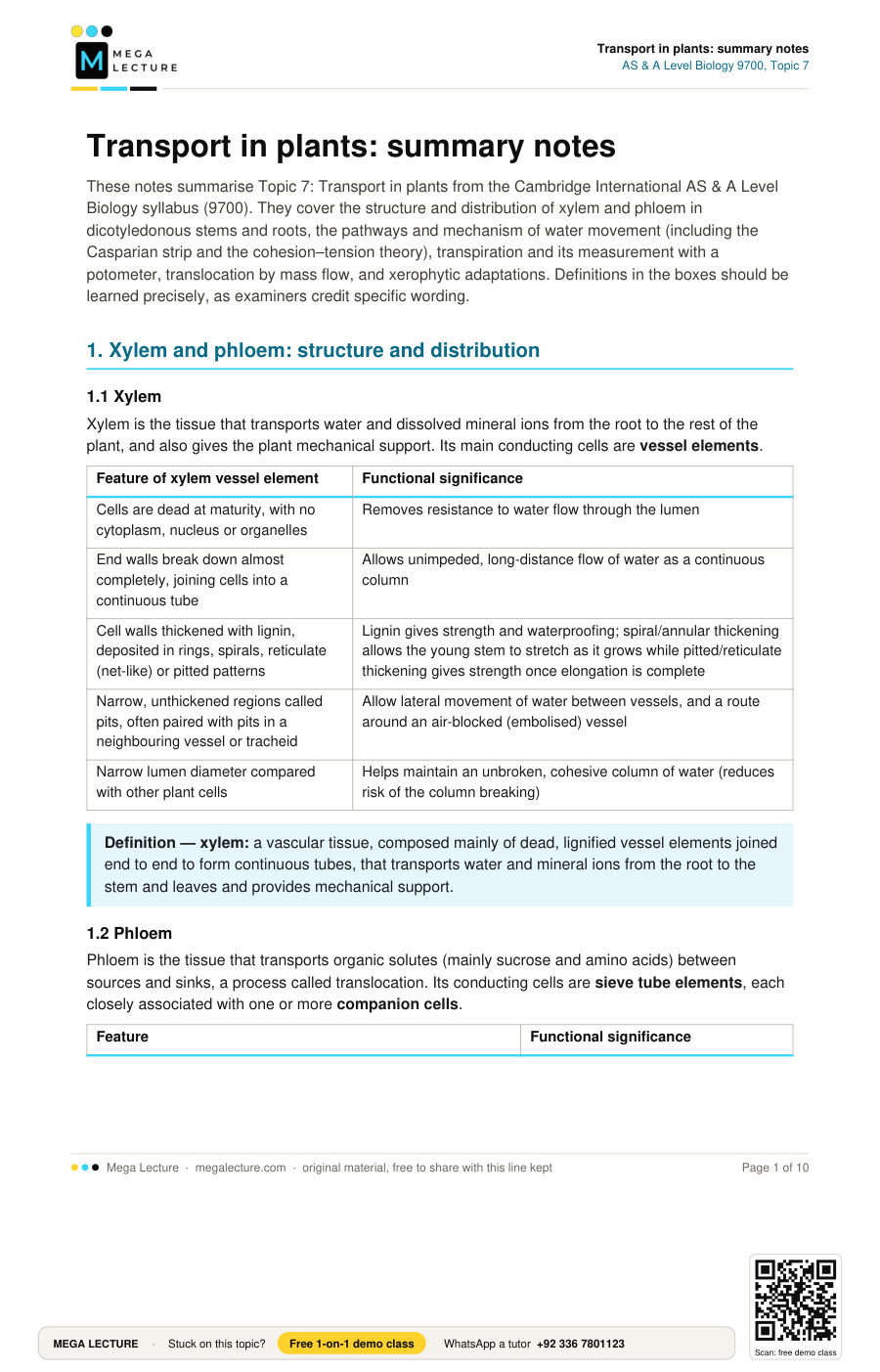
These notes summarise Topic 7: Transport in plants from the Cambridge International AS & A Level Biology syllabus (9700). They cover the structure and distribution of xylem and phloem in dicotyledonous stems and roots, the pathways and mechanism of water movement (including the Casparian strip and the cohesion–tension theory), transpiration and its measurement with a potometer, translocation by mass flow, and xerophytic adaptations. Definitions in the boxes should be learned precisely, as examiners credit specific wording.
1. Xylem and phloem: structure and distribution
1.1 Xylem
Xylem is the tissue that transports water and dissolved mineral ions from the root to the rest of the plant, and also gives the plant mechanical support. Its main conducting cells are vessel elements.
| Feature of xylem vessel element | Functional significance |
|---|---|
| Cells are dead at maturity, with no cytoplasm, nucleus or organelles | Removes resistance to water flow through the lumen |
| End walls break down almost completely, joining cells into a continuous tube | Allows unimpeded, long-distance flow of water as a continuous column |
| Cell walls thickened with lignin, deposited in rings, spirals, reticulate (net-like) or pitted patterns | Lignin gives strength and waterproofing; spiral/annular thickening allows the young stem to stretch as it grows while pitted/reticulate thickening gives strength once elongation is complete |
| Narrow, unthickened regions called pits, often paired with pits in a neighbouring vessel or tracheid | Allow lateral movement of water between vessels, and a route around an air-blocked (embolised) vessel |
| Narrow lumen diameter compared with other plant cells | Helps maintain an unbroken, cohesive column of water (reduces risk of the column breaking) |
Definition — xylem: a vascular tissue, composed mainly of dead, lignified vessel elements joined end to end to form continuous tubes, that transports water and mineral ions from the root to the stem and leaves and provides mechanical support.
1.2 Phloem
Phloem is the tissue that transports organic solutes (mainly sucrose and amino acids) between sources and sinks, a process called translocation. Its conducting cells are sieve tube elements, each closely associated with one or more companion cells.
| Feature | Functional significance |
|---|---|
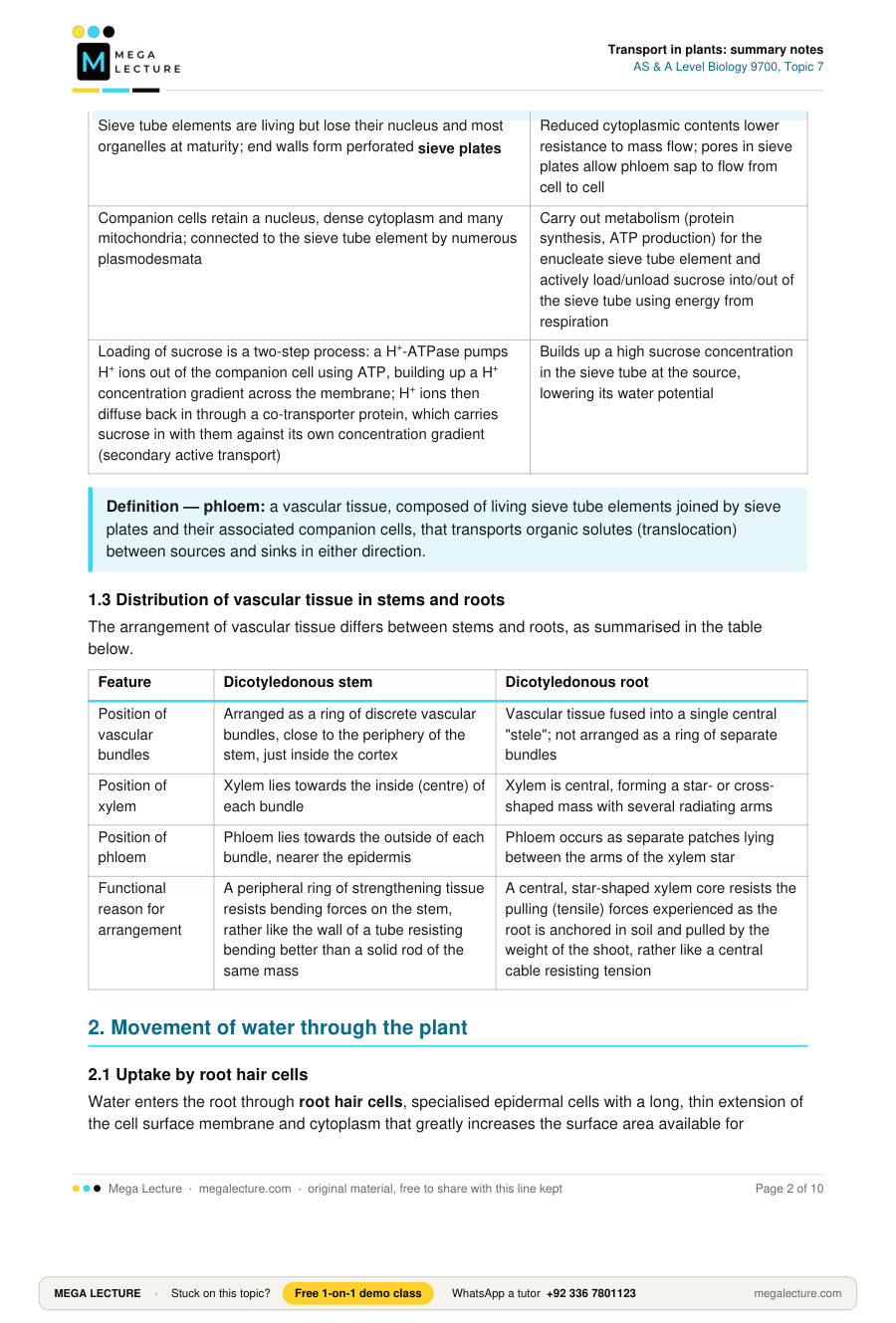
| Sieve tube elements are living but lose their nucleus and most organelles at maturity; end walls form perforated sieve plates | Reduced cytoplasmic contents lower resistance to mass flow; pores in sieve plates allow phloem sap to flow from cell to cell |
| Companion cells retain a nucleus, dense cytoplasm and many mitochondria; connected to the sieve tube element by numerous plasmodesmata | Carry out metabolism (protein synthesis, ATP production) for the enucleate sieve tube element and actively load/unload sucrose into/out of the sieve tube using energy from respiration |
| Loading of sucrose is a two-step process: a H⁺-ATPase pumps H⁺ ions out of the companion cell using ATP, building up a H⁺ concentration gradient across the membrane; H⁺ ions then diffuse back in through a co-transporter protein, which carries sucrose in with them against its own concentration gradient (secondary active transport) | Builds up a high sucrose concentration in the sieve tube at the source, lowering its water potential |
Definition — phloem: a vascular tissue, composed of living sieve tube elements joined by sieve plates and their associated companion cells, that transports organic solutes (translocation) between sources and sinks in either direction.
1.3 Distribution of vascular tissue in stems and roots
The arrangement of vascular tissue differs between stems and roots, as summarised in the table below.
| Feature | Dicotyledonous stem | Dicotyledonous root |
|---|---|---|
| Position of vascular bundles | Arranged as a ring of discrete vascular bundles, close to the periphery of the stem, just inside the cortex | Vascular tissue fused into a single central "stele"; not arranged as a ring of separate bundles |
| Position of xylem | Xylem lies towards the inside (centre) of each bundle | Xylem is central, forming a star- or cross-shaped mass with several radiating arms |
| Position of phloem | Phloem lies towards the outside of each bundle, nearer the epidermis | Phloem occurs as separate patches lying between the arms of the xylem star |
| Functional reason for arrangement | A peripheral ring of strengthening tissue resists bending forces on the stem, rather like the wall of a tube resisting bending better than a solid rod of the same mass | A central, star-shaped xylem core resists the pulling (tensile) forces experienced as the root is anchored in soil and pulled by the weight of the shoot, rather like a central cable resisting tension |
2. Movement of water through the plant
2.1 Uptake by root hair cells
Water enters the root through root hair cells, specialised epidermal cells with a long, thin extension of the cell surface membrane and cytoplasm that greatly increases the surface area available for absorption. Root hair cells also have a large surface area of cell surface membrane containing carrier and channel proteins for the active and facilitated uptake of mineral ions, which lowers the water potential inside the cell and draws water in by osmosis down a water potential gradient.
2.2 Apoplast and symplast pathways
Once inside the root, water can travel across the cortex to the xylem by two pathways.
- Apoplast pathway: water moves through the cell walls and the water-filled spaces between cells, by mass flow, without ever crossing a cell surface membrane. Water travels easily this way because cellulose cell walls are freely permeable to water.
- Symplast pathway: water crosses a cell surface membrane once, at the root hair cell, entering the cytoplasm; it then passes from cell to cell through the cytoplasm via plasmodesmata (cytoplasmic connections that cross adjoining cell walls), moving down a water potential gradient created by active uptake of mineral ions.
2.3 The Casparian strip
Definition — Casparian strip: a band of a waterproof substance called suberin, deposited in the radial and transverse (but not the inner or outer tangential) walls of endodermal cells surrounding the vascular tissue of the root, which is impermeable to water and dissolved ions.
The Casparian strip blocks the apoplast pathway at the endodermis: water and solutes moving through the cell walls cannot cross the suberised band, so they are forced to enter the cytoplasm of an endodermal cell (joining the symplast pathway) in order to continue inward. This is functionally important because it allows the endodermis to act as a checkpoint: the plant can use active transport at the endodermal cell surface membrane to control which mineral ions pass into the xylem, rather than ions simply diffusing in through the apoplast. Once past the endodermis, water re-enters the apoplast pathway and passes into the dead, hollow xylem vessels, from where it moves up the plant.
2.4 Cohesion–tension theory
Definition — transpiration: the loss of water vapour from the aerial parts of a plant, mainly through the stomata, by evaporation from the moist cell walls of mesophyll cells followed by diffusion out of the leaf.
The cohesion–tension theory explains how water is pulled up the xylem from root to leaf, entirely by physical forces, with no metabolic energy expended by the xylem itself.
- Water evaporates from the moist walls of mesophyll cells into the sub-stomatal air spaces and diffuses out through open stomata (transpiration).
- This lowers the water potential of the mesophyll cells, so water moves into them by osmosis from neighbouring cells, and ultimately from the xylem in the leaf veins, down a water potential gradient.
- Removal of water from the top of the xylem creates a tension (a negative pressure) that is transmitted down the whole water column, because water molecules show strong cohesion — mutual attraction due to hydrogen bonding between adjacent water molecules — which holds the column together as a continuous, unbroken thread.
- This tension pulls the entire water column upward through the xylem vessels, from root to leaf, as though it were being pulled up a drinking straw.
- Adhesion of water molecules to the hydrophilic (lignified but pitted) walls of the xylem vessels also helps to support the water column and resist it falling back under gravity.
- The tension generated at the top of the xylem is transmitted right down to the root, where it helps to draw water in from the soil, replacing the water lost by transpiration.
Key idea: transpiration pull (evaporation + diffusion out of the leaf) generates tension in the xylem; cohesion between water molecules transmits this tension down the water column as a pull; adhesion to vessel walls helps prevent the column breaking. Together these explain water movement up the plant without any input of metabolic energy by the xylem tissue.
3. Factors affecting transpiration rate; measuring it with a potometer
3.1 Factors affecting the rate of transpiration
The definition of transpiration is given in Section 2.4.
| Factor | Effect on transpiration rate | Explanation |
|---|---|---|
| Light intensity | Increases as light intensity increases (up to a point) | Light causes stomata to open (to allow CO₂ in for photosynthesis), increasing the area through which water vapour can diffuse out |
| Temperature | Increases as temperature rises | Higher temperature increases the kinetic energy of water molecules, increasing the rate of evaporation from cell walls, and increases the saturated vapour pressure inside the leaf, steepening the diffusion gradient to the air outside |
| Humidity | Decreases as humidity increases | High humidity reduces the water vapour concentration (potential) gradient between the leaf air spaces and the atmosphere, reducing the rate of diffusion out through stomata |
| Air movement (wind) | Increases as wind speed increases | Moving air sweeps away the humid layer of air next to the leaf surface (the boundary layer), maintaining a steep water vapour concentration gradient |
3.2 Using a potometer
A potometer measures the rate at which a leafy shoot takes up water, which is used as an estimate of the rate of transpiration (they are not exactly equal, because a small proportion of water taken up is used in photosynthesis, cell expansion and other metabolic processes rather than being transpired).
A typical bubble potometer consists of a leafy shoot with its cut end pushed, under water, into a rubber tubing connected to a capillary tube. The apparatus is filled completely with water so that no air is trapped, and the shoot is left to acclimatise. A single air bubble is introduced into the capillary tube (by briefly removing the shoot's cut end from the water and reinserting it), and its position is marked with a scale, or measured against a ruler. As the shoot transpires, it draws water up through the capillary tube, pulling the air bubble along with it; the distance moved by the bubble in a measured time interval is recorded. A reservoir tap allows the bubble to be returned to the starting point so that repeat readings can be taken.
Worked example. In a potometer investigation, the air bubble moved 32 mm along the capillary tube in 5 minutes. The internal diameter of the capillary tube was 1.0 mm. Calculate the rate of water uptake by the shoot, in mm³ per minute.
Step 1 — find the radius of the capillary tube:
radius = diameter ÷ 2 = 1.0 ÷ 2 = 0.5 mm
Step 2 — find the cross-sectional area of the tube (volume of water moved per mm the bubble travels):
area = π × r2 = π × 0.52 = π × 0.25 = 0.7854 mm2 (4 s.f.)
Step 3 — find the volume of water corresponding to the distance moved:
volume = area × distance = 0.7854 × 32 = 25.13 mm3 (4 s.f.)
Step 4 — divide by time to find the rate:
rate = volume ÷ time = 25.13 ÷ 5 = 5.03 mm3 per minute (3 s.f.)
4. Translocation in phloem
Definition — source: a part of a plant that actively loads sucrose into the phloem, and is therefore a net exporter of organic solutes, e.g. a photosynthesising leaf, or a storage organ (such as a tuber) while it is mobilising stored food.
Definition — sink: a part of a plant that removes sucrose from the phloem for use in respiration/growth or for storage, and is therefore a net importer of organic solutes, e.g. a root tip, a growing fruit, or a storage organ while it is being filled.
Note that the same organ can switch between being a source and a sink at different times, for example a potato tuber is a sink while it is growing and storing starch, but becomes a source when that starch is broken down to sucrose and exported to a new shoot the following season.
4.1 The mass flow hypothesis
- At the source, a H⁺-ATPase in the companion cell plasma membrane uses ATP to actively pump H⁺ ions out of the companion cell into the cell wall space, building up a high H⁺ concentration outside the cell.
- H⁺ ions then diffuse back into the companion cell down this concentration gradient through a co-transporter protein in the plasma membrane, which simultaneously carries sucrose into the companion cell (and then into the sieve tube via plasmodesmata) against its own concentration gradient (facilitated/secondary active transport).
- This lowers the water potential inside the sieve tube at the source, so water moves in by osmosis from the adjacent xylem, down a water potential gradient.
- The inflow of water raises the hydrostatic (turgor) pressure inside the sieve tube at the source end.
- At the sink, sucrose is actively and/or passively removed from the sieve tube (used in respiration or converted to starch for storage), raising the water potential inside the sieve tube.
- Water therefore leaves the sieve tube by osmosis at the sink, moving into surrounding cells or back into the xylem, lowering the hydrostatic pressure at the sink end.
- This creates a hydrostatic pressure gradient along the sieve tube, from high pressure at the source to low pressure at the sink, and phloem sap (water, sucrose and other solutes together) flows down this pressure gradient by mass flow, through the pores in the sieve plates, from source to sink.
4.2 Evidence for and against the mass flow hypothesis
| Evidence supporting mass flow | Observations not fully explained by mass flow |
|---|---|
| Sap exudes under pressure when phloem sieve tubes are cut, or when an aphid's feeding stylet is severed while inserted in a sieve tube — showing that sap is under positive hydrostatic pressure, as the hypothesis predicts | Different solutes have been observed moving simultaneously at different rates, and sometimes in different directions, within the phloem of the same plant — difficult to explain if all sap in a sieve tube is carried by a single, uniform mass flow |
| Sucrose concentration is consistently measured as higher in source tissues (e.g. leaves) than in sink tissues (e.g. roots), consistent with the water potential gradient the hypothesis requires | Sieve plates, with their narrow pores, should offer considerable resistance to flow; calculations suggest the hydrostatic pressure gradients actually measured may be too small to drive mass flow through this resistance at the observed rates |
| Companion cells contain unusually large numbers of mitochondria, consistent with the high ATP demand of active sucrose loading required by the hypothesis | The precise role of sieve plates is not fully explained by a purely passive, physical mass flow mechanism; some evidence suggests an active component to movement across sieve plates that mass flow alone does not account for |
| Radioactively labelled carbon dioxide (containing ¹⁴C) fed to a leaf is incorporated into sucrose by photosynthesis and can later be detected moving down the stem to the roots, confirming source-to-sink movement of the products of photosynthesis | – |
5. Xerophytic adaptations
Definition — xerophyte: a plant adapted, structurally and/or physiologically, to survive in a habitat where water availability is limited or unreliable.
| Adaptation | How it reduces water loss |
|---|---|
| Thick, waxy cuticle over the epidermis | Waterproofs the leaf surface, reducing evaporation directly through the epidermis (cuticular transpiration) |
| Sunken stomata, often in pits or grooves (crypts) | Traps a pocket of still, humid air next to the stomata, reducing the water vapour concentration gradient between the leaf interior and the pocket of air, so diffusion of water vapour out is slower |
| Rolled or folded leaves | Encloses the stomata (often on the inner, rolled surface) within a chamber of humid air, reducing the diffusion gradient in the same way as sunken stomata |
| Dense covering of hairs (trichomes) over the epidermis | Traps a boundary layer of still, humid air close to the leaf surface, reducing air movement over the stomata and so reducing the diffusion gradient for water vapour |
| Reduced leaf surface area, e.g. small, needle-like or spine-like leaves | Reduces the total area of stomata and epidermis exposed, reducing overall water loss (spines may also reduce loss of leaves to herbivores, which is a secondary benefit) |
| Fewer stomata per unit area of leaf | Reduces the total area through which water vapour can diffuse out of the leaf |
| Stomatal closure during the hottest/driest part of the day | Avoids gas exchange during conditions of highest evaporative demand, when the water vapour concentration gradient out of the leaf would be steepest |
| Thick, fleshy stems or leaves (succulence) | Provide internal tissue for storing water, allowing the plant to survive extended dry periods between rainfall |
| Extensive, widely spreading or very deep root systems | Increase the volume of soil from which water can be absorbed, or reach deep, more reliable water tables |
Key terms
| Term | Definition |
|---|---|
| Xylem | Vascular tissue composed mainly of dead, lignified vessel elements that transports water and mineral ions from root to leaf and provides mechanical support |
| Phloem | Vascular tissue composed of living sieve tube elements and companion cells that transports organic solutes between sources and sinks (translocation) |
| Transpiration | Loss of water vapour from the aerial parts of a plant, mainly through the stomata, by evaporation and diffusion |
| Translocation | Mass flow movement of organic solutes through phloem sieve tubes from a source to a sink |
| Apoplast pathway | Movement of water through cell walls and intercellular spaces, by mass flow, without crossing any cell surface membrane |
| Symplast pathway | Movement of water through the cytoplasm of connected cells via plasmodesmata, after crossing a cell surface membrane once |
| Casparian strip | Waterproof band of suberin in the radial and transverse walls of endodermal cells that blocks the apoplast pathway, forcing water and ions into the symplast |
| Cohesion | Mutual attraction between water molecules, due to hydrogen bonding, that holds a continuous column of water together in the xylem |
| Adhesion | Attraction between water molecules and the walls of xylem vessels, which helps support the water column |
| Water potential | A measure of the tendency of water molecules to move out of a solution or system; water moves from a higher (less negative) to a lower (more negative) water potential |
| Turgor pressure | The pressure exerted by cell contents on the cell wall as water enters by osmosis, which prevents further water entry and stops the cell bursting |
| Source | A part of the plant that loads sucrose into the phloem; a net exporter of organic solutes |
| Sink | A part of the plant that removes sucrose from the phloem for use or storage; a net importer of organic solutes |
| Mass flow hypothesis | The theory that translocation occurs by bulk flow of phloem sap down a hydrostatic pressure gradient from source to sink |
| Potometer | Apparatus that measures the rate of water uptake by a cut shoot, used as an estimate of transpiration rate |
| Xerophyte | A plant adapted to survive in a habitat with limited or unreliable water availability |
| Root hair cell | A specialised root epidermal cell with a long, thin extension that increases surface area for water and mineral ion uptake |
| Companion cell | A living cell closely linked to a sieve tube element by plasmodesmata; it carries out metabolism and actively loads/unloads sucrose for the sieve tube |
| Sieve tube element | A living, enucleate phloem cell joined to others by sieve plates, forming the sieve tube through which phloem sap flows |
Quick check
- State the two types of vascular tissue found in a vascular bundle. [2]
- Name the pathway by which water and mineral ions cross the endodermis once they have been blocked by the Casparian strip. [1]
- Describe the structure of a xylem vessel element, and explain how two features of its structure are related to its function. [4]
- Describe how root hair cells are adapted for the uptake of water and mineral ions. [3]
- Explain how the Casparian strip allows the endodermis to control the mineral ions that enter the xylem. [3]
- Explain how transpiration, cohesion and adhesion together account for the movement of water up the xylem, according to the cohesion–tension theory. [5]
- In a potometer investigation, an air bubble moved 45 mm along a capillary tube of internal diameter 0.8 mm in 3 minutes. Calculate the rate of water uptake by the shoot, in mm3 per minute. Show your working. [4]
- Suggest two reasons why the rate of water uptake measured using a potometer is not exactly equal to the rate of transpiration from the shoot. [2]
- Compare the mechanisms by which water moves through xylem and organic solutes move through phloem. [4]
- Explain the evidence that supports the mass flow hypothesis as an explanation of translocation in phloem. [4]
- Describe two observations that are not fully explained by the mass flow hypothesis, and explain why each is problematic. [3]
- A xerophyte native to a hot desert and a fern native to a shaded, humid forest are compared. Using named xerophytic adaptations, explain how the desert plant is better adapted than the fern to reduce water loss. [5]
1. Xylem and phloem.
2. The symplast pathway.
3. A xylem vessel element is a dead, hollow tube with no cytoplasm or organelles, its walls thickened with lignin, and its end walls broken down so that elements join end to end into continuous tubes. Two features and their functions: (1) the cells are dead with no cytoplasm/organelles, which removes resistance to water flow through the lumen; (2) the walls are thickened with lignin, deposited in rings, spirals, reticulate or pitted patterns, which gives mechanical strength and waterproofing, while the pits allow lateral movement of water.
4. Root hair cells have a long, thin extension of the cell surface membrane and cytoplasm that greatly increases the surface area for absorption; the cell surface membrane contains carrier/channel proteins for active and facilitated uptake of mineral ions; active uptake of ions lowers the water potential of the cell, so water enters by osmosis down a water potential gradient.
5. The Casparian strip is impermeable to water and ions, so it blocks the apoplast pathway at the endodermis; this forces water and ions to cross the endodermal cell surface membrane and enter the symplast; because ions must cross a selectively permeable membrane to do this, the endodermal cells can use carrier proteins/active transport to control which ions pass through into the xylem, rather than ions moving in freely and unselectively as they could through the apoplast.
6. Water evaporates from the moist cell walls of mesophyll cells and diffuses out through open stomata (transpiration); this lowers the water potential of the mesophyll cells, so water is drawn out of the xylem in the leaf by osmosis down a water potential gradient; removal of water from the top of the xylem creates a tension (negative pressure); cohesion (hydrogen bonding) between water molecules transmits this tension down the whole water column as a pull, drawing more water up from the root; adhesion of water molecules to the walls of the xylem vessels helps support the water column and prevents it breaking/falling back.
7. Radius = 0.8 ÷ 2 = 0.4 mm. Area = π × r2 = π × 0.42 = π × 0.16 = 0.5027 mm2 (4 s.f.). Volume = area × distance = 0.5027 × 45 = 22.62 mm3 (4 s.f.). Rate = volume ÷ time = 22.62 ÷ 3 = 7.54 mm3 per minute (3 s.f.).
8. Any two of: some of the water taken up is used in photosynthesis rather than lost as vapour; some water is used in cell expansion/growth or other metabolic reactions rather than being transpired; some water taken up is retained in the plant's tissues/cells (increasing turgor) rather than being lost; a small amount of water may also be lost by evaporation directly from stem/other surfaces not accounted for by uptake through the cut end.
9. Similarities: both involve movement of a fluid through a network of tube-like cells; both can be described as mass/bulk flow. Differences: xylem flow is driven by a tension (negative pressure) generated by transpiration and needs no metabolic energy, moving in dead, hollow vessels in one direction only (root to leaf); phloem flow is driven by a hydrostatic (positive) pressure gradient created by active loading of sucrose using ATP, moving in living sieve tube elements in either direction depending on the position of sources and sinks.
10. Sap exudes under pressure from cut phloem or severed aphid stylets, showing sieve tubes are under positive hydrostatic pressure, as predicted; sucrose concentration is consistently higher in source tissues than sink tissues, matching the water potential gradient the hypothesis requires; companion cells contain unusually high numbers of mitochondria, consistent with the high ATP demand for active loading; radioactively labelled (¹⁴C) sucrose made in a leaf can be tracked moving down the stem to the roots, confirming source-to-sink movement as the hypothesis predicts.
11. Any two of: different solutes have been found moving at different rates, and sometimes in opposite directions, in the phloem of the same plant at the same time, which is hard to explain if a single mass flow carries all the sap; the narrow pores of sieve plates should create more resistance to flow than the measured pressure gradients seem able to overcome, suggesting an additional (possibly active) mechanism may be involved; the precise function of sieve plates is not fully accounted for by a purely passive physical flow model.
12. The desert xerophyte is likely to show a thick waxy cuticle, reducing evaporation through the epidermis, and sunken stomata or rolled leaves, which trap humid air next to the stomata and reduce the diffusion gradient for water vapour, whereas the shaded forest fern (growing in already humid air with lower evaporative demand) is unlikely to need these features; the xerophyte may also have reduced leaf surface area and/or a dense covering of hairs to trap a boundary layer of still air, further reducing water loss, and deep or extensive roots to access limited soil water, none of which the fern requires in its consistently moist habitat.
