
AS Level · Chemistry 9701 · Periodicity: trends across Period 3 (AS Chemistry notes)
Periodicity: trends across Period 3 (AS Chemistry notes)
The Daily 5 Five questions a day on AS Chemistry: two minutes, new every day, with a streak to keep Play today’s →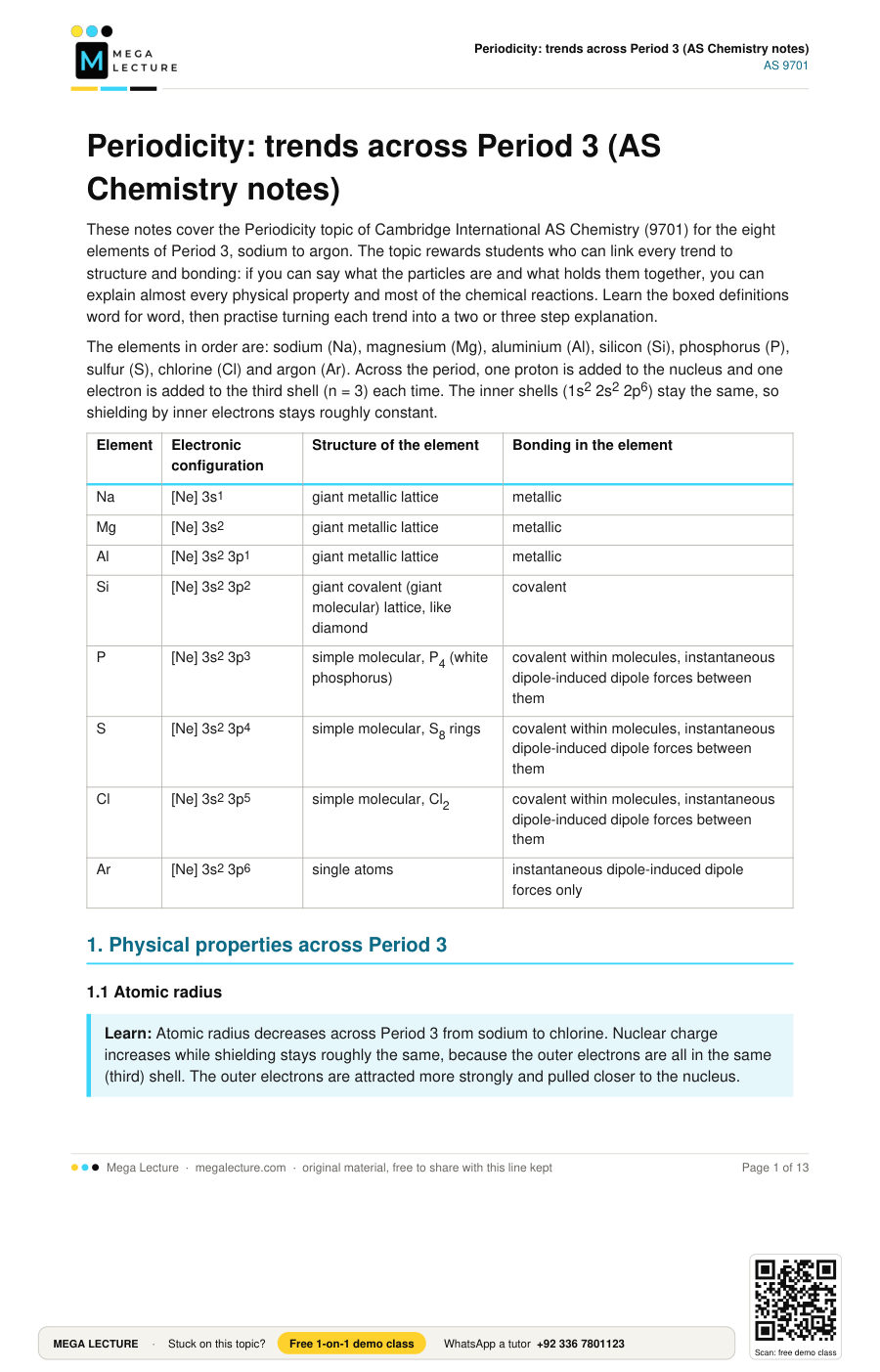
Opens inside this page. Prefer your own PDF app? Open the PDF.
Chemistry batch classes: coming soon. Small live classes at a lower fee than one-to-one. Join the waiting list
Check yourself
5 quick questions on AS Chemistry
Tap an answer to see if you are right, and why. Free, no sign-up.
Start the free test18 of 23 students found these notes useful
Was this note useful?
Full text of Periodicity: trends across Period 3 (AS Chemistry notes)
These notes cover the Periodicity topic of Cambridge International AS Chemistry (9701) for the eight elements of Period 3, sodium to argon. The topic rewards students who can link every trend to structure and bonding: if you can say what the particles are and what holds them together, you can explain almost every physical property and most of the chemical reactions. Learn the boxed definitions word for word, then practise turning each trend into a two or three step explanation.
The elements in order are: sodium (Na), magnesium (Mg), aluminium (Al), silicon (Si), phosphorus (P), sulfur (S), chlorine (Cl) and argon (Ar). Across the period, one proton is added to the nucleus and one electron is added to the third shell (n = 3) each time. The inner shells (1s2 2s2 2p6) stay the same, so shielding by inner electrons stays roughly constant.
| Element | Electronic configuration | Structure of the element | Bonding in the element |
|---|---|---|---|
| Na | [Ne] 3s1 | giant metallic lattice | metallic |
| Mg | [Ne] 3s2 | giant metallic lattice | metallic |
| Al | [Ne] 3s2 3p1 | giant metallic lattice | metallic |
| Si | [Ne] 3s2 3p2 | giant covalent (giant molecular) lattice, like diamond | covalent |
| P | [Ne] 3s2 3p3 | simple molecular, P4 (white phosphorus) | covalent within molecules, instantaneous dipole-induced dipole forces between them |
| S | [Ne] 3s2 3p4 | simple molecular, S8 rings | covalent within molecules, instantaneous dipole-induced dipole forces between them |
| Cl | [Ne] 3s2 3p5 | simple molecular, Cl2 | covalent within molecules, instantaneous dipole-induced dipole forces between them |
| Ar | [Ne] 3s2 3p6 | single atoms | instantaneous dipole-induced dipole forces only |
1. Physical properties across Period 3
1.1 Atomic radius
Learn: Atomic radius decreases across Period 3 from sodium to chlorine. Nuclear charge increases while shielding stays roughly the same, because the outer electrons are all in the same (third) shell. The outer electrons are attracted more strongly and pulled closer to the nucleus.The explanation has three parts and examiners expect all three:
- Nuclear charge increases by one proton per element (11 for Na up to 17 for Cl).
- Shielding is similar: each element has the same inner shells (two shells, ten electrons) between the nucleus and the outer electrons, and electrons added to the same shell shield each other only poorly.
- Attraction increases, so the outer shell is pulled in and the radius falls.
Graph sketch in words. Plot atomic radius (y axis) against element (x axis, Na to Cl). The line falls steadily from left to right: the drop is largest at the start (Na to Mg) and the curve flattens slightly towards chlorine. Argon is usually left off this graph, or shown separately, because no covalent or metallic radius can be measured for it: its radius is a van der Waals radius measured between non-bonded atoms, which is a different quantity and always larger. Do not use argon to argue that the trend reverses.
Exact values are listed in the Cambridge data booklet. Use the booklet values in calculations or comparisons; the trend is what you must explain.
1.2 Ionic radius
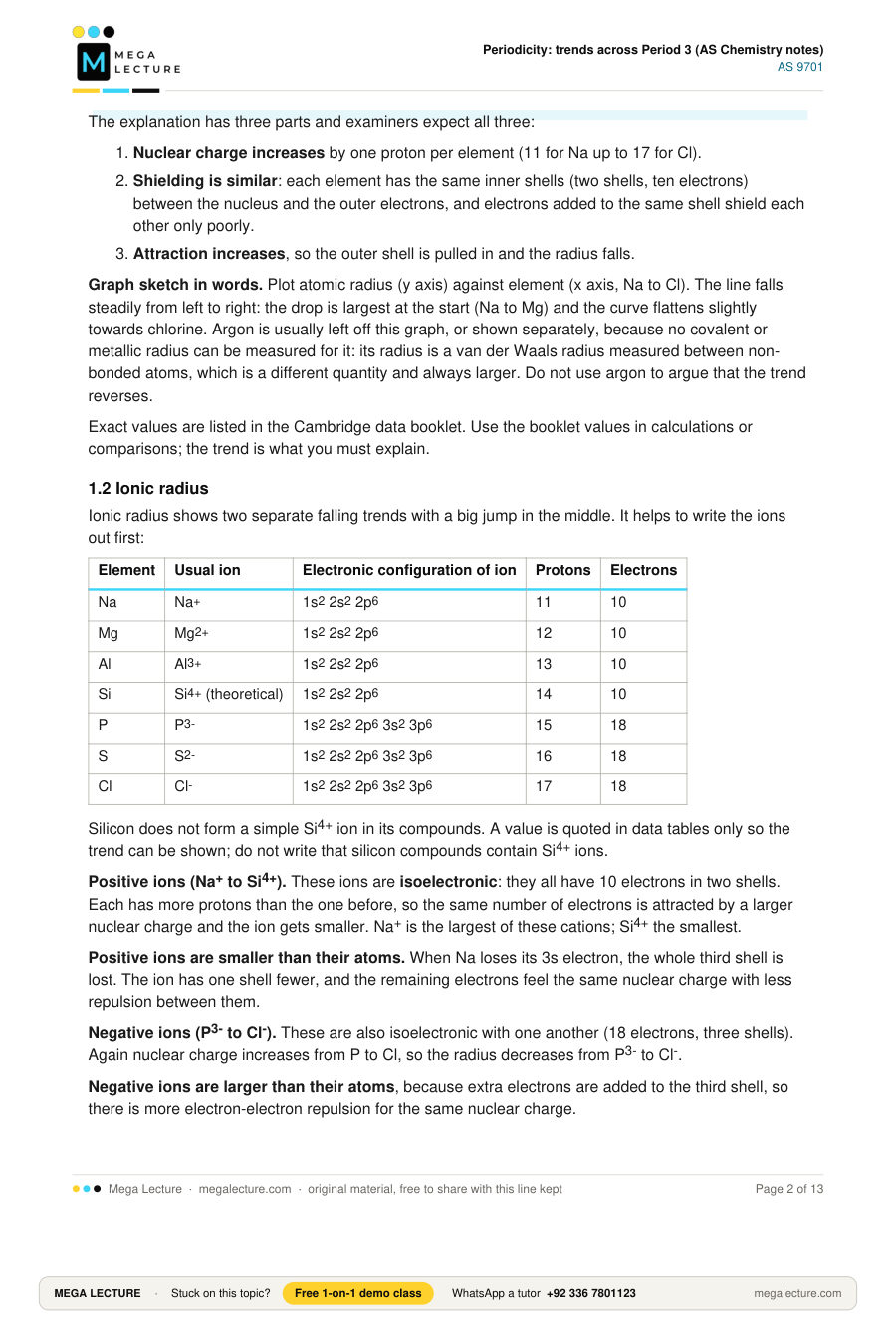
Ionic radius shows two separate falling trends with a big jump in the middle. It helps to write the ions out first:
| Element | Usual ion | Electronic configuration of ion | Protons | Electrons |
|---|---|---|---|---|
| Na | Na+ | 1s2 2s2 2p6 | 11 | 10 |
| Mg | Mg2+ | 1s2 2s2 2p6 | 12 | 10 |
| Al | Al3+ | 1s2 2s2 2p6 | 13 | 10 |
| Si | Si4+ (theoretical) | 1s2 2s2 2p6 | 14 | 10 |
| P | P3- | 1s2 2s2 2p6 3s2 3p6 | 15 | 18 |
| S | S2- | 1s2 2s2 2p6 3s2 3p6 | 16 | 18 |
| Cl | Cl- | 1s2 2s2 2p6 3s2 3p6 | 17 | 18 |
Silicon does not form a simple Si4+ ion in its compounds. A value is quoted in data tables only so the trend can be shown; do not write that silicon compounds contain Si4+ ions.
Positive ions (Na+ to Si4+). These ions are isoelectronic: they all have 10 electrons in two shells. Each has more protons than the one before, so the same number of electrons is attracted by a larger nuclear charge and the ion gets smaller. Na+ is the largest of these cations; Si4+ the smallest.
Positive ions are smaller than their atoms. When Na loses its 3s electron, the whole third shell is lost. The ion has one shell fewer, and the remaining electrons feel the same nuclear charge with less repulsion between them.
Negative ions (P3- to Cl-). These are also isoelectronic with one another (18 electrons, three shells). Again nuclear charge increases from P to Cl, so the radius decreases from P3- to Cl-.
Negative ions are larger than their atoms, because extra electrons are added to the third shell, so there is more electron-electron repulsion for the same nuclear charge.
The jump. Between Si4+ and P3- the radius increases sharply because the anions have a whole extra occupied shell (three shells compared with two).
Graph sketch in words. Ionic radius on the y axis, element on the x axis. A falling line from Na+ to Si4+, then a vertical jump up to P3- (the largest ion in the period), then a second falling line from P3- to Cl-. Every anion is larger than every cation in the period.
Worked example: explaining an ionic radius comparisonQuestion: Explain why the radius of Mg2+ is smaller than the radius of Na+.
Answer: Both ions have the electronic configuration 1s2 2s2 2p6 (they are isoelectronic, with 10 electrons in two shells). Mg2+ has 12 protons, Na+ has 11. The greater nuclear charge in Mg2+ attracts the same number of electrons more strongly, so they are held closer to the nucleus and the ion is smaller.
1.3 Melting point
Melting point is controlled by the type of structure and the strength of the forces that must be overcome. Approximate values are given below for comparison; your data booklet or textbook may round differently.
| Element | Approximate melting point / °C | What is overcome on melting |
|---|---|---|
| Na | 98 | metallic bonding (weakened, not broken completely) |
| Mg | 650 | metallic bonding |
| Al | 660 | metallic bonding |
| Si | about 1410 | many strong covalent bonds |
| P (white, P4) | 44 | instantaneous dipole-induced dipole forces between P4 molecules |
| S (S8) | about 115 | instantaneous dipole-induced dipole forces between S8 molecules |
| Cl (Cl2) | -101 | instantaneous dipole-induced dipole forces between Cl2 molecules |
| Ar | -189 | instantaneous dipole-induced dipole forces between Ar atoms |
Graph sketch in words. Melting point on the y axis. The line rises from Na to Mg and only slightly from Mg to Al, climbs steeply to a sharp peak at Si, then drops dramatically to P. There is a small rise to S, then a fall through Cl to Ar, which has the lowest melting point in the period.
Explaining each section of the graph
Na to Al (metals). In a metal, positive ions are held in a lattice by electrostatic attraction to a sea of delocalised electrons. From Na to Al:
- the number of delocalised electrons per atom increases (1, 2, then 3);
- the charge on the metal ions increases (Na+, Mg2+, Al3+);
- the ions get smaller.
All three make the attraction between the ions and the delocalised electrons stronger, so metallic bonding gets stronger and more energy is needed to melt the solid. The rise from Mg to Al is smaller than you might expect; at AS level you only need the general increase in metallic bond strength.
Si (giant covalent). Each silicon atom is covalently bonded to four others in a tetrahedral arrangement throughout a giant lattice. Melting requires many strong covalent bonds to be broken, which needs a very large amount of energy. This is why silicon has the highest melting point in Period 3.
P, S, Cl, Ar (simple molecular or atomic). On melting, only the weak intermolecular forces are overcome; the covalent bonds within the molecules do not break. The strength of instantaneous dipole-induced dipole forces depends on the number of electrons in each molecule (and the surface area of contact). The order of melting points follows the number of electrons per particle:
| Particle | Electrons per particle | Melting point order |
|---|---|---|
| S8 | 8 × 16 = 128 | highest of the four |
| P4 | 4 × 15 = 60 | second |
| Cl2 | 2 × 17 = 34 | third |
| Ar | 18 | lowest |
1.4 Electrical conductivity
| Element | Conductivity | Reason |
|---|---|---|
| Na, Mg, Al | good, increasing from Na to Al | delocalised electrons can move through the lattice and carry charge; the number of delocalised electrons per atom increases (1, 2, 3) |
| Si | low (a semiconductor) | electrons are held in covalent bonds; only a few become free to move, and more do as temperature rises |
| P, S, Cl, Ar | do not conduct (insulators) | all electrons are held in covalent bonds or in atoms; there are no mobile charged particles |
Graph sketch in words. Conductivity on the y axis. A rise from Na to Mg to Al (Al the highest), a large drop to a very low value at Si, and essentially zero from P to Ar.
1.5 First ionisation energy
Definition to learn: The first ionisation energy is the energy needed to remove one electron from each atom in one mole of gaseous atoms to form one mole of gaseous 1+ ions.For example: Na(g) → Na+(g) + e-
| Element | First ionisation energy / kJ mol-1 (approximate) | Electron removed |
|---|---|---|
| Na | 496 | 3s |
| Mg | 738 | 3s (from a full 3s orbital) |
| Al | 578 | 3p |
| Si | 789 | 3p |
| P | 1012 | 3p (each 3p orbital singly occupied) |
| S | 1000 | 3p (from a paired 3p orbital) |
| Cl | 1251 | 3p |
| Ar | 1521 | 3p |
General trend. First ionisation energy increases across the period. Nuclear charge increases, shielding is similar (same shell), and the atomic radius decreases, so the outer electron is attracted more strongly and more energy is needed to remove it.
Graph sketch in words. First ionisation energy on the y axis. A general rise from Na (the lowest) to Ar (the highest), with two small dips: one from Mg down to Al, and one from P down to S. After each dip the rise resumes.
Dip 1: Mg to Al. In aluminium the electron removed is in a 3p subshell; in magnesium it is in the 3s subshell. The 3p electron is at a slightly higher energy and further from the nucleus on average, and it is partly shielded by the 3s electrons. Less energy is needed to remove it, so Al has a lower first ionisation energy than Mg despite its extra proton.
Dip 2: P to S. Phosphorus has three 3p electrons, one in each 3p orbital. Sulfur has four, so one 3p orbital holds a pair. The two electrons in the same orbital repel each other, which makes one of them easier to remove. So S has a lower first ionisation energy than P.
Worked example: a full ionisation energy explanationQuestion: Explain why the first ionisation energy of sulfur is less than that of phosphorus.
Answer: P is [Ne] 3s2 3p3, with one electron in each of the three 3p orbitals. S is [Ne] 3s2 3p4, with two electrons paired in one 3p orbital. The paired electrons repel each other (spin-pair repulsion), so less energy is needed to remove one of them. This effect outweighs the increase in nuclear charge from P to S.
1.6 Electronegativity (supporting trend)
You need electronegativity to explain the bonding in the oxides and chlorides later in these notes.
Definition to learn: Electronegativity is the power of an atom to attract the electrons in a covalent bond towards itself.Electronegativity increases from Na to Cl, for the same reasons as ionisation energy: increasing nuclear charge, similar shielding and decreasing atomic radius. Argon is usually not given a value because it forms no stable compounds.
The difference in electronegativity between a Period 3 element and oxygen (or chlorine) decides the bonding: a large difference gives ionic bonding (Na, Mg), a smaller difference gives covalent bonding (Si to S, or Al to P for chlorides).
2. Reactions of the Period 3 elements
2.1 Reactions with oxygen
| Element | Equation | Observations and conditions |
|---|---|---|
| Na | 4Na(s) + O2(g) → 2Na2O(s) | burns vigorously with a bright yellow-orange flame; white solid forms |
| Mg | 2Mg(s) + O2(g) → 2MgO(s) | burns with a brilliant white flame; white powder forms |
| Al | 4Al(s) + 3O2(g) → 2Al2O3(s) | aluminium powder burns with a bright white flame on heating; white solid. Bulk aluminium is protected by a thin oxide layer. |
| Si | Si(s) + O2(g) → SiO2(s) | reacts slowly on strong heating; white solid |
| P | P4(s) + 5O2(g) → P4O10(s) | white phosphorus ignites spontaneously in air; bright flame and dense white smoke of P4O10. In limited oxygen P4O6 forms. |
| S | S(s) + O2(g) → SO2(g) | burns with a blue flame; colourless, choking gas |
| Cl, Ar | no direct reaction | chlorine oxides exist but are not made by burning chlorine in oxygen; argon is unreactive |
Sulfur trioxide. SO3 is not formed directly when sulfur burns. It is made by further oxidation of SO2 using a vanadium(V) oxide catalyst (the Contact process):
2SO2(g) + O2(g) ⇌ 2SO3(g)
Sodium peroxide. In excess oxygen sodium also forms some sodium peroxide, Na2O2. For this syllabus, the expected oxide of sodium is Na2O.
2.2 Reactions with chlorine
All the elements from Na to P react with chlorine when heated. Sulfur also reacts, but its chlorides are not required at this level.
| Element | Equation | Observations |
|---|---|---|
| Na | 2Na(s) + Cl2(g) → 2NaCl(s) | burns vigorously with a bright yellow-orange flame; white solid |
| Mg | Mg(s) + Cl2(g) → MgCl2(s) | burns with a bright white flame; white solid |
| Al | 2Al(s) + 3Cl2(g) → 2AlCl3(s) | vigorous reaction on heating; pale yellow-white solid that sublimes easily |
| Si | Si(s) + 2Cl2(g) → SiCl4(l) | on strong heating; colourless liquid |
| P | P4(s) + 10Cl2(g) → 4PCl5(s) | with excess chlorine; off-white/pale yellow solid. With limited chlorine the liquid PCl3 forms: P4 + 6Cl2 → 4PCl3 |
Aluminium chloride as a dimer. In the vapour at moderate temperatures, aluminium chloride exists as Al2Cl6 molecules. Two AlCl3 units are joined by two dative (co-ordinate) bonds: a lone pair on a chlorine atom of one unit is donated into the empty orbital on the aluminium atom of the other. This gives each aluminium atom four electron pairs around it.
2.3 Reactions with water
Only sodium and magnesium are required.
Sodium reacts vigorously with cold water. It floats, melts into a ball, fizzes and moves around on the surface, and the solution becomes strongly alkaline.
2Na(s) + 2H2O(l) → 2NaOH(aq) + H2(g) : pH of solution about 13 to 14
Magnesium reacts only very slowly with cold water, giving a few bubbles of hydrogen over a long time and a weakly alkaline solution, because magnesium hydroxide is only slightly soluble.
Mg(s) + 2H2O(l) → Mg(OH)2(s) + H2(g) : pH of solution about 9 to 10
Magnesium reacts much more quickly with steam, glowing with a bright white light and forming magnesium oxide:
Mg(s) + H2O(g) → MgO(s) + H2(g)
The difference in reactivity is explained by ionisation energies: sodium loses one electron more easily than magnesium loses two.
3. Oxides of Period 3
3.1 Oxidation numbers
The oxidation number of the Period 3 element in its highest oxide rises by one each time, and equals the number of outer electrons. This is because the element uses all its outer electrons in bonding to oxygen, which is more electronegative.
| Oxide | Na2O | MgO | Al2O3 | SiO2 | P4O10 | SO2 / SO3 |
|---|---|---|---|---|---|---|
| Oxidation number of the Period 3 element | +1 | +2 | +3 | +4 | +5 | +4 / +6 |
3.2 Structure and bonding of the oxides
| Oxide | Bonding | Structure | Melting point |
|---|---|---|---|
| Na2O | ionic | giant ionic lattice | high |
| MgO | ionic | giant ionic lattice | very high (higher than Na2O) |
| Al2O3 | ionic with some covalent character | giant ionic lattice | very high |
| SiO2 | covalent | giant covalent lattice | very high |
| P4O10 | covalent | simple molecular | low |
| SO2, SO3 | covalent | simple molecular | low (SO2 is a gas at room temperature) |
Why bonding changes from ionic to covalent. The electronegativity difference between the element and oxygen gets smaller across the period. Sodium and magnesium transfer electrons to oxygen and form ions. By silicon the difference is too small for electron transfer and the electrons are shared.
Why MgO has a higher melting point than Na2O. Mg2+ has a greater charge and a smaller radius than Na+, so the electrostatic attraction between Mg2+ and O2- ions is stronger than between Na+ and O2- ions.
Covalent character in Al2O3. The small, highly charged Al3+ ion has a high charge density. It polarises (distorts) the electron cloud of the neighbouring oxide ion, drawing electron density back towards itself. This gives the bonding some covalent character. This is why Al2O3 has a lower melting point than MgO, even though Al3+ carries a higher charge than Mg2+.
SiO2. Each silicon atom is bonded to four oxygen atoms and each oxygen to two silicon atoms in a giant lattice. Melting breaks many strong covalent bonds.
P4O10, SO2, SO3. Only weak intermolecular forces hold the molecules together, so little energy is needed to melt or boil them.
Electrical conductivity when molten. Molten Na2O, MgO and Al2O3 conduct because their ions are free to move. SiO2 and the molecular oxides do not conduct because they contain no ions.
3.3 Reactions of the oxides with water
| Oxide | Equation | Approximate pH of resulting solution |
|---|---|---|
| Na2O | Na2O(s) + H2O(l) → 2NaOH(aq) | 13 to 14 |
| MgO | MgO(s) + H2O(l) → Mg(OH)2(s) | about 9 to 10 (Mg(OH)2 is only slightly soluble) |
| Al2O3 | no reaction (insoluble) | 7 |
| SiO2 | no reaction (insoluble) | 7 |
| P4O10 | P4O10(s) + 6H2O(l) → 4H3PO4(aq) | about 0 to 2 |
| SO2 | SO2(g) + H2O(l) → H2SO3(aq) | about 2 to 3 |
| SO3 | SO3(g) + H2O(l) → H2SO4(aq) | about 0 to 1 |
Quoted pH values depend on concentration, so treat them as typical ranges. The exam expects the pattern: strongly alkaline for Na2O, weakly alkaline for MgO, neutral for the insoluble Al2O3 and SiO2, and strongly acidic for the oxides of P and S.
Explanation. The ionic oxides of Na and Mg contain the oxide ion, O2-, which is a strong base. It takes a proton from water:
O2- + H2O → 2OH-
The covalent oxides of P and S react with water to form acids that release H+ ions into solution. H2SO3 is a weaker acid than H2SO4, which is why the SO2 solution has a higher pH.
3.4 Acid-base behaviour of the oxides
Learn:A basic oxide reacts with acids to form a salt and water.
An acidic oxide reacts with bases to form a salt and water.
An amphoteric oxide reacts with both acids and bases.
| Oxide | Nature |
|---|---|
| Na2O, MgO | basic |
| Al2O3 | amphoteric |
| SiO2, P4O10, SO2, SO3 | acidic |
The pattern follows the bonding: ionic oxides of metals are basic, covalent oxides of non-metals are acidic, and aluminium oxide, which sits between ionic and covalent, is amphoteric.
Equations you must be able to write
Basic oxides with acid:
Na2O(s) + 2HCl(aq) → 2NaCl(aq) + H2O(l)
MgO(s) + 2HCl(aq) → MgCl2(aq) + H2O(l)
MgO(s) + H2SO4(aq) → MgSO4(aq) + H2O(l)
Amphoteric aluminium oxide:
with acid: Al2O3(s) + 6HCl(aq) → 2AlCl3(aq) + 3H2O(l)
with hot, concentrated alkali: Al2O3(s) + 2NaOH(aq) + 3H2O(l) → 2NaAl(OH)4(aq)
The product with alkali is sodium tetrahydroxoaluminate. Some textbooks write the product of fusing with solid NaOH as NaAlO2; follow the form your teacher uses.
Acidic oxides with base:
SiO2(s) + 2NaOH(aq) → Na2SiO3(aq) + H2O(l) (hot, concentrated NaOH needed)
P4O10(s) + 12NaOH(aq) → 4Na3PO4(aq) + 6H2O(l)
SO2(g) + 2NaOH(aq) → Na2SO3(aq) + H2O(l)
SO3(g) + 2NaOH(aq) → Na2SO4(aq) + H2O(l)
Exam tip: Silicon dioxide does not react with water, so you cannot show it is acidic by measuring pH. Its acidic nature is shown by its reaction with hot, concentrated sodium hydroxide. Likewise, Al2O3 is insoluble (pH 7), but it is amphoteric because it reacts with both acids and alkalis.4. Chlorides of Period 3
4.1 Formulae, oxidation numbers and structure
| Chloride | Oxidation number of element | Bonding | Structure | State at room temperature |
|---|---|---|---|---|
| NaCl | +1 | ionic | giant ionic lattice | white solid, high melting point |
| MgCl2 | +2 | ionic | giant ionic lattice | white solid, high melting point |
| AlCl3 | +3 | covalent (with ionic character in the solid) | simple molecular in the vapour (Al2Cl6 dimers) | pale yellow-white solid; sublimes at a low temperature |
| SiCl4 | +4 | covalent | simple molecular, tetrahedral | colourless liquid |
| PCl5 | +5 | covalent | simple molecular in the vapour | pale yellow/off-white solid |
As with the oxides, the oxidation number equals the number of outer electrons, and bonding changes from ionic to covalent as the electronegativity difference between the element and chlorine falls. The change happens one element earlier than for the oxides (at aluminium), because chlorine is less electronegative than oxygen and the chloride ion is larger and more easily polarised.
Melting points. NaCl and MgCl2 have high melting points because strong ionic bonds throughout the lattice must be overcome. AlCl3, SiCl4 and PCl5 have low melting or sublimation points because only intermolecular forces must be overcome.
Conductivity. Molten NaCl and MgCl2 conduct electricity (mobile ions). SiCl4 does not conduct in any state.
4.2 Reactions of the chlorides with water
Ionic chlorides simply dissolve. Covalent chlorides are hydrolysed: water molecules attack and break the bonds, producing HCl, so the solutions are strongly acidic and steamy white fumes of hydrogen chloride are often seen.
Definition to learn: Hydrolysis is the breaking of a bond in a molecule by reaction with water.| Chloride | What happens in water | Equation | Approximate pH |
|---|---|---|---|
| NaCl | dissolves; ions become hydrated; no reaction with water | NaCl(s) + aq → Na+(aq) + Cl-(aq) | 7 |
| MgCl2 | dissolves; very slight hydrolysis | MgCl2(s) + aq → Mg2+(aq) + 2Cl-(aq) | about 6.5 |
| AlCl3 | reacts; hydrated ion releases H+; with little water, steamy fumes of HCl | see below | about 3 |
| SiCl4 | reacts vigorously; white solid and steamy fumes of HCl | SiCl4(l) + 2H2O(l) → SiO2(s) + 4HCl(aq) | about 1 to 2 |
| PCl5 | reacts vigorously; steamy fumes of HCl | PCl5(s) + 4H2O(l) → H3PO4(aq) + 5HCl(aq) | about 1 to 2 |
Aluminium chloride in water. In excess water, AlCl3 dissolves to form the hydrated ion [Al(H2O)6]3+. The small, highly charged Al3+ ion polarises the O-H bonds of the water molecules bonded to it, so one of them loses a proton:
[Al(H2O)6]3+(aq) ⇌ [Al(H2O)5(OH)]2+(aq) + H+(aq)
This releases H+ ions, so the solution is acidic. With only a few drops of water, the reaction goes further and HCl gas is given off as steamy fumes:
AlCl3(s) + 3H2O(l) → Al(OH)3(s) + 3HCl(g)
Why MgCl2 is very slightly acidic. The Mg2+ ion has a lower charge density than Al3+, so it polarises its water molecules much less and only a tiny amount of H+ is released.
Why SiCl4 is hydrolysed but CCl4 is not. This is a common extension question. Silicon is a larger atom than carbon and has accessible empty orbitals in its third shell, so a water molecule can attack it. The four chlorine atoms around carbon block attack and carbon has no low-energy empty orbitals. Treat this as background; check whether your teacher wants it.
PCl5 with limited water. With a small amount of water, phosphorus(V) chloride forms POCl3: PCl5 + H2O → POCl3 + 2HCl. In excess water, the full hydrolysis to H3PO4 occurs.
5. Summary: the whole period in one table
| Na | Mg | Al | Si | P | S | Cl | Ar | |
|---|---|---|---|---|---|---|---|---|
| Structure | giant metallic | giant metallic | giant metallic | giant covalent | simple molecular | simple molecular | simple molecular | atomic |
| Conducts? | yes | yes | yes | semiconductor | no | no | no | no |
| Oxide | Na2O | MgO | Al2O3 | SiO2 | P4O10 | SO2, SO3 | (not required) | none |
| Oxide nature | basic | basic | amphoteric | acidic | acidic | acidic | ||
| Chloride | NaCl | MgCl2 | AlCl3 | SiCl4 | PCl5 | (not required) | ||
| pH of chloride in water | 7 | 6.5 | 3 | 1 to 2 | 1 to 2 |
1. Name the structure (giant metallic, giant ionic, giant covalent, simple molecular).
2. Name the particles and the force between them.
3. Say whether that force is strong or weak and how much energy is needed to overcome it.
4. Link to the property (melting point, conductivity, pH).
Following these four steps in order earns most of the marks on any Period 3 explanation.
Quick check
- State and explain the trend in atomic radius from sodium to chlorine. [3]
- The radius of the P3- ion is much larger than the radius of the Si4+ ion. Explain why. [2]
- Explain why silicon has a much higher melting point than phosphorus. [3]
- Explain why sulfur has a higher melting point than chlorine. [2]
- Describe and explain the trend in electrical conductivity from sodium to aluminium. [3]
- (a) Write an equation, with state symbols, for the first ionisation energy of aluminium. [1]
(b) Explain why the first ionisation energy of aluminium is lower than that of magnesium. [2] - Describe what you would see when sodium and magnesium are each added to cold water. Write an equation for each reaction and state the approximate pH of each resulting solution. [5]
- Write equations for the reactions of (a) phosphorus and (b) sulfur with oxygen, and state the flame colour seen when sulfur burns. [3]
- Aluminium oxide is described as amphoteric.
(a) State what is meant by amphoteric. [1]
(b) Write equations to show the amphoteric behaviour of aluminium oxide. [2] - Explain, in terms of structure and bonding, why magnesium oxide has a high melting point and phosphorus(V) oxide has a low melting point. [4]
- Silicon tetrachloride is added to water.
(a) Describe what is seen. [2]
(b) Write an equation for the reaction. [1]
(c) State the approximate pH of the resulting mixture. [1] - A student adds sodium chloride to one test tube of water and aluminium chloride to another. Explain why the two solutions have different pH values. Include an equation in your answer. [4]
Answers
1. Atomic radius decreases from Na to Cl. Nuclear charge increases (from 11 to 17 protons). The outer electrons are all in the third shell, so shielding by the inner electrons is similar. The outer electrons are therefore attracted more strongly to the nucleus and are pulled closer, so the radius falls.
2. Si4+ has the configuration 1s2 2s2 2p6 (two occupied shells); P3- has 1s2 2s2 2p6 3s2 3p6 (three occupied shells). P3- has an extra shell, and it has 18 electrons attracted by only 15 protons, whereas Si4+ has 10 electrons attracted by 14 protons. So P3- is much larger.
3. Silicon has a giant covalent structure in which each atom is bonded to four others. Melting requires many strong covalent bonds to be broken, which needs a lot of energy. Phosphorus is simple molecular (P4); on melting only the weak instantaneous dipole-induced dipole forces between molecules are overcome, which needs little energy. The covalent bonds in P4 are not broken.
4. Both are simple molecular. Sulfur exists as S8 molecules (128 electrons each) and chlorine as Cl2 molecules (34 electrons each). S8 has many more electrons, so the instantaneous dipole-induced dipole forces between S8 molecules are stronger and need more energy to overcome.
5. Conductivity increases from Na to Mg to Al. All three are metals with delocalised electrons that can move and carry charge. The number of delocalised electrons per atom increases from 1 (Na) to 2 (Mg) to 3 (Al), so there are more mobile charge carriers.
6. (a) Al(g) → Al+(g) + e-
(b) In Al the electron removed is in a 3p subshell, while in Mg it comes from the 3s subshell. The 3p electron is higher in energy, further from the nucleus on average and is shielded by the 3s electrons, so less energy is needed to remove it even though Al has one more proton.
7. Sodium: floats, melts into a ball, fizzes vigorously and moves around on the surface, and gets smaller until it disappears. 2Na(s) + 2H2O(l) → 2NaOH(aq) + H2(g). pH about 13 to 14.
Magnesium: reacts very slowly; only a few small bubbles of gas form over a long time. Mg(s) + 2H2O(l) → Mg(OH)2(s) + H2(g). pH about 9 to 10, because magnesium hydroxide is only slightly soluble.
8. (a) P4(s) + 5O2(g) → P4O10(s)
(b) S(s) + O2(g) → SO2(g)
Sulfur burns with a blue flame.
9. (a) An amphoteric oxide reacts with both acids and bases.
(b) With acid: Al2O3 + 6HCl → 2AlCl3 + 3H2O
With base: Al2O3 + 2NaOH + 3H2O → 2NaAl(OH)4
10. Magnesium oxide has a giant ionic lattice of Mg2+ and O2- ions. There is strong electrostatic attraction between the oppositely charged ions throughout the lattice (both ions are doubly charged), so a lot of energy is needed to overcome it. Phosphorus(V) oxide consists of simple P4O10 molecules. Only weak intermolecular forces hold the molecules together, and only these are overcome on melting, so little energy is needed. The covalent bonds within the molecules do not break.
11. (a) A vigorous reaction; steamy white fumes (of HCl) are given off and a white solid (SiO2) forms. The mixture may get warm.
(b) SiCl4(l) + 2H2O(l) → SiO2(s) + 4HCl(aq)
(c) pH about 1 to 2.
12. Sodium chloride is ionic. It dissolves and its ions become hydrated, but neither ion reacts with water, so the solution is neutral, pH 7. Aluminium chloride forms the hydrated ion [Al(H2O)6]3+. Al3+ is small and highly charged (high charge density), so it polarises the water molecules bonded to it and one loses a proton:
[Al(H2O)6]3+ ⇌ [Al(H2O)5(OH)]2+ + H+
The H+ ions make the solution acidic, about pH 3.
