
AS Level · Chemistry 9701 · Nitrogen and sulfur: AS Chemistry notes
Nitrogen and sulfur: AS Chemistry notes
The Daily 5 Five questions a day on AS Chemistry: two minutes, new every day, with a streak to keep Play today’s →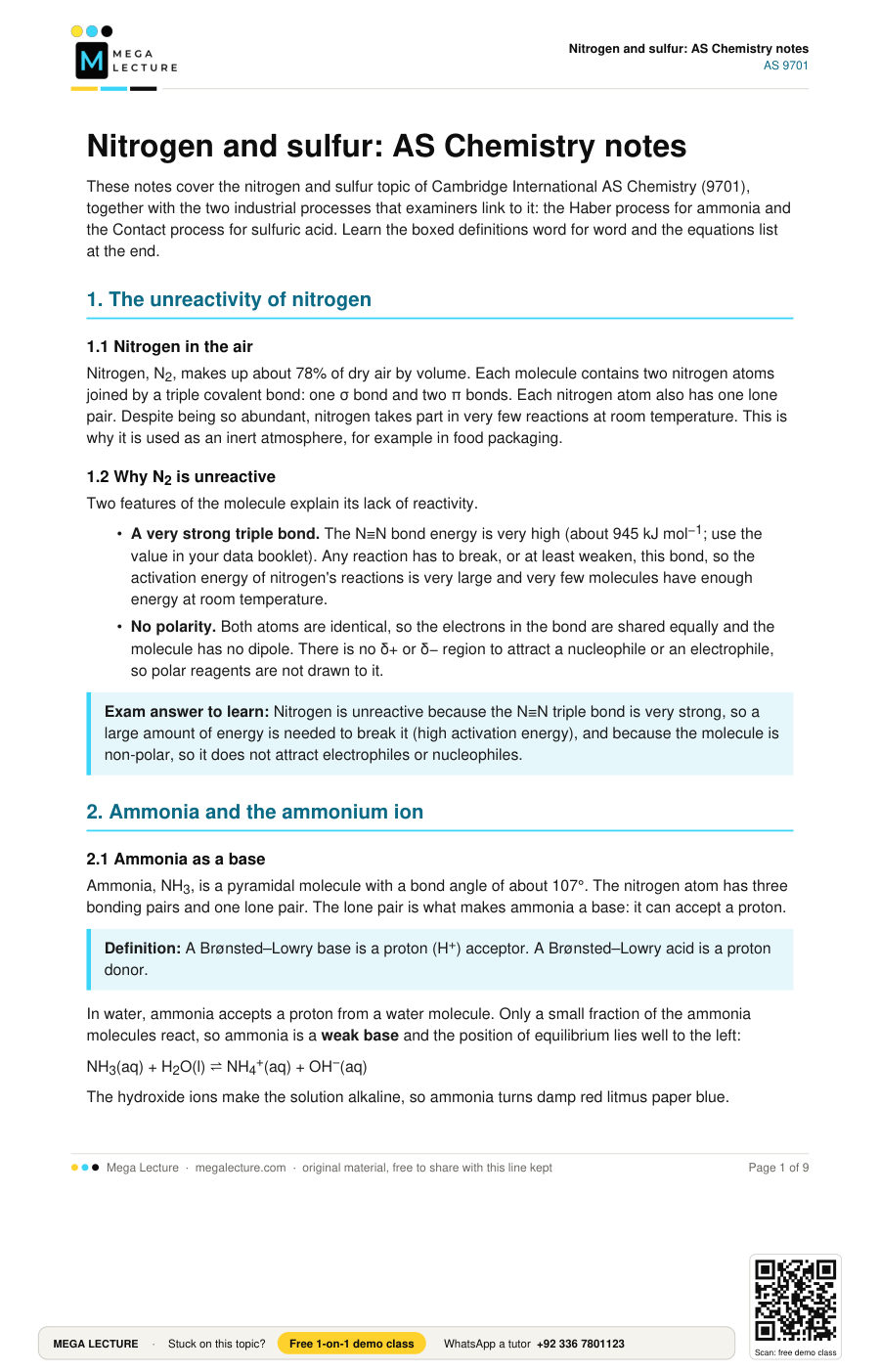
Opens inside this page. Prefer your own PDF app? Open the PDF.
Chemistry batch classes: coming soon. Small live classes at a lower fee than one-to-one. Join the waiting list
Check yourself
5 quick questions on AS Chemistry
Tap an answer to see if you are right, and why. Free, no sign-up.
Start the free test18 of 23 students found these notes useful
Was this note useful?
Full text of Nitrogen and sulfur: AS Chemistry notes
These notes cover the nitrogen and sulfur topic of Cambridge International AS Chemistry (9701), together with the two industrial processes that examiners link to it: the Haber process for ammonia and the Contact process for sulfuric acid. Learn the boxed definitions word for word and the equations list at the end.
1. The unreactivity of nitrogen
1.1 Nitrogen in the air
Nitrogen, N2, makes up about 78% of dry air by volume. Each molecule contains two nitrogen atoms joined by a triple covalent bond: one σ bond and two π bonds. Each nitrogen atom also has one lone pair. Despite being so abundant, nitrogen takes part in very few reactions at room temperature. This is why it is used as an inert atmosphere, for example in food packaging.
1.2 Why N2 is unreactive
Two features of the molecule explain its lack of reactivity.
- A very strong triple bond. The N≡N bond energy is very high (about 945 kJ mol−1; use the value in your data booklet). Any reaction has to break, or at least weaken, this bond, so the activation energy of nitrogen's reactions is very large and very few molecules have enough energy at room temperature.
- No polarity. Both atoms are identical, so the electrons in the bond are shared equally and the molecule has no dipole. There is no δ+ or δ− region to attract a nucleophile or an electrophile, so polar reagents are not drawn to it.
2. Ammonia and the ammonium ion
2.1 Ammonia as a base
Ammonia, NH3, is a pyramidal molecule with a bond angle of about 107°. The nitrogen atom has three bonding pairs and one lone pair. The lone pair is what makes ammonia a base: it can accept a proton.
Definition: A Brønsted–Lowry base is a proton (H+) acceptor. A Brønsted–Lowry acid is a proton donor.In water, ammonia accepts a proton from a water molecule. Only a small fraction of the ammonia molecules react, so ammonia is a weak base and the position of equilibrium lies well to the left:
NH3(aq) + H2O(l) ⇌ NH4+(aq) + OH−(aq)
The hydroxide ions make the solution alkaline, so ammonia turns damp red litmus paper blue.
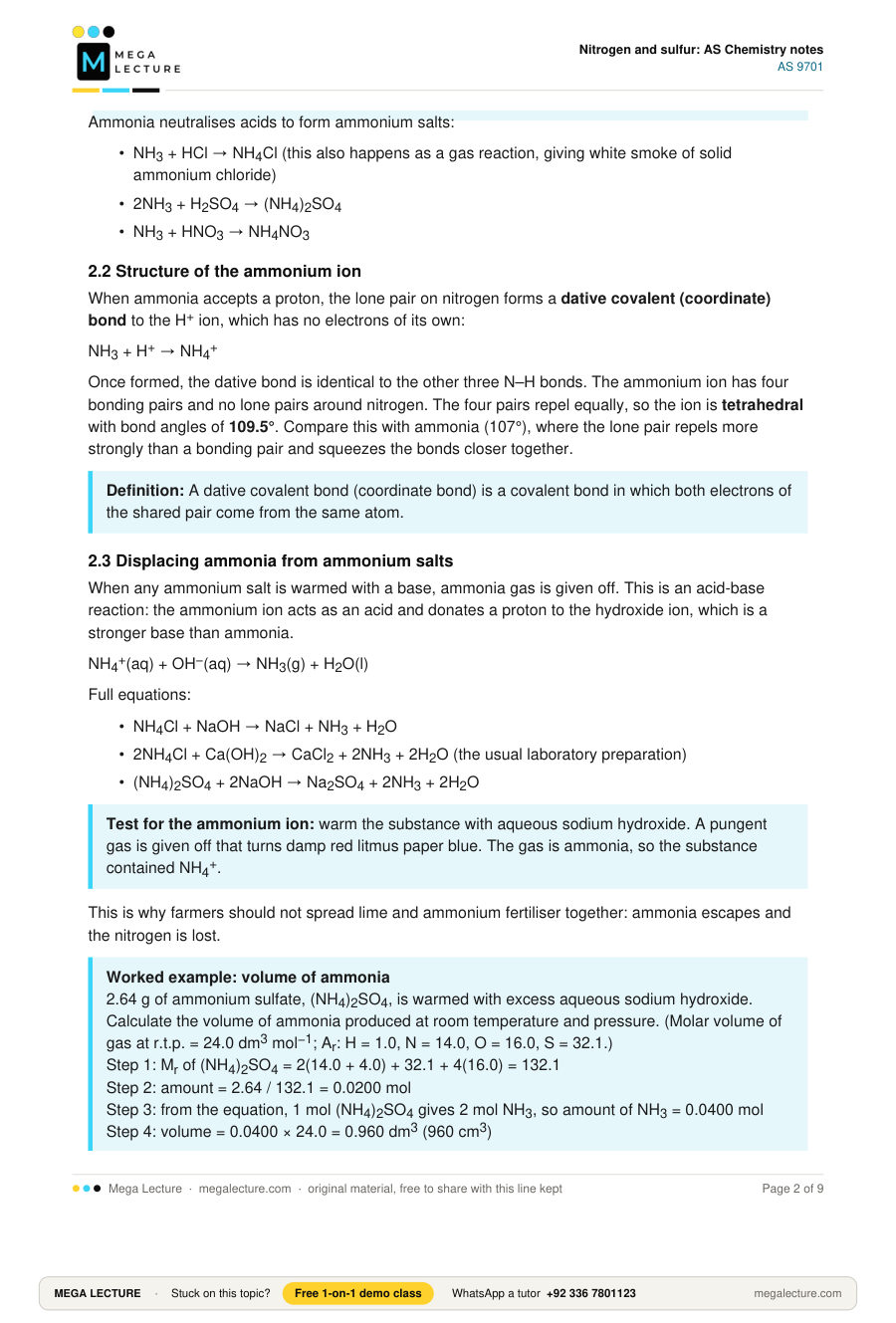
Ammonia neutralises acids to form ammonium salts:
- NH3 + HCl → NH4Cl (this also happens as a gas reaction, giving white smoke of solid ammonium chloride)
- 2NH3 + H2SO4 → (NH4)2SO4
- NH3 + HNO3 → NH4NO3
2.2 Structure of the ammonium ion
When ammonia accepts a proton, the lone pair on nitrogen forms a dative covalent (coordinate) bond to the H+ ion, which has no electrons of its own:
NH3 + H+ → NH4+
Once formed, the dative bond is identical to the other three N–H bonds. The ammonium ion has four bonding pairs and no lone pairs around nitrogen. The four pairs repel equally, so the ion is tetrahedral with bond angles of 109.5°. Compare this with ammonia (107°), where the lone pair repels more strongly than a bonding pair and squeezes the bonds closer together.
Definition: A dative covalent bond (coordinate bond) is a covalent bond in which both electrons of the shared pair come from the same atom.2.3 Displacing ammonia from ammonium salts
When any ammonium salt is warmed with a base, ammonia gas is given off. This is an acid-base reaction: the ammonium ion acts as an acid and donates a proton to the hydroxide ion, which is a stronger base than ammonia.
NH4+(aq) + OH−(aq) → NH3(g) + H2O(l)
Full equations:
- NH4Cl + NaOH → NaCl + NH3 + H2O
- 2NH4Cl + Ca(OH)2 → CaCl2 + 2NH3 + 2H2O (the usual laboratory preparation)
- (NH4)2SO4 + 2NaOH → Na2SO4 + 2NH3 + 2H2O
This is why farmers should not spread lime and ammonium fertiliser together: ammonia escapes and the nitrogen is lost.
Worked example: volume of ammonia2.64 g of ammonium sulfate, (NH4)2SO4, is warmed with excess aqueous sodium hydroxide. Calculate the volume of ammonia produced at room temperature and pressure. (Molar volume of gas at r.t.p. = 24.0 dm3 mol−1; Ar: H = 1.0, N = 14.0, O = 16.0, S = 32.1.)
Step 1: Mr of (NH4)2SO4 = 2(14.0 + 4.0) + 32.1 + 4(16.0) = 132.1
Step 2: amount = 2.64 / 132.1 = 0.0200 mol
Step 3: from the equation, 1 mol (NH4)2SO4 gives 2 mol NH3, so amount of NH3 = 0.0400 mol
Step 4: volume = 0.0400 × 24.0 = 0.960 dm3 (960 cm3)
3. The Haber process
3.1 The reaction
Ammonia is manufactured by combining nitrogen (from the air) with hydrogen (usually made from methane and steam). The reaction is reversible and exothermic:
N2(g) + 3H2(g) ⇌ 2NH3(g) ΔH = −92 kJ mol−1
3.2 Operating conditions
| Condition | Typical value | Reason |
|---|---|---|
| Temperature | about 400 to 450 °C | The forward reaction is exothermic, so a low temperature would give a higher equilibrium yield, but the rate would be far too slow. 400 to 450 °C is a compromise between yield and rate, and the iron catalyst works well in this range. |
| Pressure | about 200 atm (roughly 20 MPa; plants range from about 100 to 300 atm) | There are 4 mol of gas on the left and 2 mol on the right, so high pressure moves the equilibrium to the right and increases the yield. High pressure also increases the rate. Higher pressures are not used because the plant, pipework and compressors become very expensive and the safety risk increases. |
| Catalyst | iron (often with promoters) | Provides an alternative route with a lower activation energy, so equilibrium is reached faster. It does not change the position of equilibrium or the yield at equilibrium. |
Only around 15% of the reactants are converted on each pass (this varies by plant). The mixture is cooled so that ammonia condenses and is removed as a liquid, and the unreacted nitrogen and hydrogen are recycled. Recycling means the overall conversion is very high even though the yield per pass is low.
Exam tip: When asked to explain a compromise temperature, always give both sides: "a lower temperature would give a higher yield because the forward reaction is exothermic, but the rate would be too slow." One half on its own earns only one mark.Most ammonia is used to make fertilisers (ammonium nitrate, ammonium sulfate, urea) and nitric acid.
4. Nitrogen oxides from engines and their removal
4.1 How nitrogen oxides form
Nitrogen and oxygen do not react at ordinary temperatures, but they do combine in two situations where a great deal of energy is available:
- Natural: in lightning strikes, where the temperature of the air is extremely high.
- Man-made: in internal combustion engines (and power stations and furnaces), where the burning fuel produces very high temperatures. The nitrogen comes from the air drawn into the engine, not from the fuel.
N2(g) + O2(g) → 2NO(g)
Nitrogen monoxide (NO) is colourless. In air it is slowly oxidised to brown nitrogen dioxide:
2NO(g) + O2(g) → 2NO2(g)
Together, NO and NO2 are referred to as NOx.
4.2 Catalytic converters
A catalytic converter is fitted to the exhaust of a petrol car. Exhaust gas passes over a thin layer of precious metals, typically platinum, palladium and rhodium, spread over a ceramic honeycomb. The honeycomb gives a very large surface area. Pollutant molecules are adsorbed onto the metal surface, react, and the products desorb.
The key reaction removes nitrogen monoxide and carbon monoxide together:
2CO(g) + 2NO(g) → 2CO2(g) + N2(g)
In this reaction NO is reduced (the oxidation number of N falls from +2 to 0) and CO is oxidised (C rises from +2 to +4). Unburnt hydrocarbons are also oxidised to carbon dioxide and water.
A converter does not remove carbon dioxide, which is a greenhouse gas, and it works only once it is hot, so it is less effective on short journeys.
4.3 NOx and photochemical smog
In sunlight, nitrogen oxides react with unburnt hydrocarbons from vehicle exhausts to form a mixture of secondary pollutants called photochemical smog. This includes ground-level ozone and peroxyacetyl nitrate (PAN), which irritate the eyes and lungs.
5. NOx and acid rain
5.1 Direct role
Nitrogen dioxide dissolves in rainwater and, with oxygen, forms nitric acid:
4NO2(g) + O2(g) + 2H2O(l) → 4HNO3(aq)
Without oxygen, nitrogen dioxide and water give a mixture of nitric and nitrous acids:
2NO2(g) + H2O(l) → HNO3(aq) + HNO2(aq)
5.2 Catalytic role in the oxidation of sulfur dioxide
Sulfur dioxide in the atmosphere is oxidised to sulfur trioxide, which then dissolves in water to form sulfuric acid. Nitrogen dioxide speeds up this oxidation and is regenerated, so it acts as a catalyst:
Step 1: SO2(g) + NO2(g) → SO3(g) + NO(g)
Step 2: NO(g) + ½O2(g) → NO2(g)
Overall: SO2(g) + ½O2(g) → SO3(g)
Then: SO3(g) + H2O(l) → H2SO4(aq)
Exam tip: To show that NO2 is a catalyst, write both steps and point out that NO2 is used up in step 1 but formed again in step 2, so it does not appear in the overall equation. In step 1 NO2 is the oxidising agent: sulfur goes from +4 to +6 and nitrogen goes from +4 to +2.6. Sulfur dioxide and its uses
6.1 Sources
Sulfur dioxide, a toxic gas, is formed whenever sulfur or sulfur compounds burn:
S(s) + O2(g) → SO2(g)
The main man-made source is the burning of fossil fuels that contain sulfur impurities, especially coal and heavy fuel oil in power stations. Volcanoes are the main natural source.
6.2 Properties
SO2 is an acidic oxide. It dissolves in water to form a weakly acidic solution, often written as sulfurous acid:
SO2(g) + H2O(l) ⇌ H2SO3(aq)
Sulfur in SO2 has an oxidation number of +4, so it can be oxidised to +6 (in SO3 or sulfate). This makes SO2 a good reducing agent. For example, it decolourises acidified potassium manganate(VII), turning it from purple to colourless.
6.3 Uses
- Making sulfuric acid in the Contact process (by far the largest use).
- Food preservative (E220): it is added to dried fruit, fruit juices and wine. It kills or inhibits bacteria and moulds, and as a reducing agent it acts as an antioxidant, reacting with oxygen and so slowing the oxidation that spoils food and wine.
- Bleaching wood pulp for paper and some fabrics.
7. The Contact process
7.1 Stages
- Sulfur is burned in air to make sulfur dioxide: S + O2 → SO2
- Sulfur dioxide is oxidised to sulfur trioxide in a reversible, exothermic reaction (the equilibrium step):
2SO2(g) + O2(g) ⇌ 2SO3(g) ΔH = −197 kJ mol−1 - Sulfur trioxide is absorbed in concentrated sulfuric acid to form oleum: SO3 + H2SO4 → H2S2O7
- Oleum is diluted carefully with water: H2S2O7 + H2O → 2H2SO4
7.2 Conditions for the equilibrium step
| Condition | Typical value | Reason |
|---|---|---|
| Temperature | about 400 to 450 °C | Exothermic forward reaction, so lower temperature favours SO3, but the rate would be too slow. This is a compromise, and the catalyst needs this temperature to work. |
| Pressure | about 1 to 2 atm (slightly above atmospheric) | 3 mol of gas go to 2 mol, so high pressure would increase the yield, but the conversion is already very high (well over 95%) at low pressure. The small gain would not justify the cost of high-pressure equipment. |
| Catalyst | vanadium(V) oxide, V2O5 | Increases the rate by providing a route with lower activation energy. It does not change the equilibrium yield. |
| Oxygen | excess air | Increasing the concentration of O2 moves the equilibrium to the right and increases conversion of the more valuable SO2. |
Sulfuric acid is used to make fertilisers, detergents and paints, and in car batteries.
8. Environmental consequences
8.1 Acid rain
Ordinary rain is slightly acidic (about pH 5.6) because carbon dioxide dissolves in it. Rain with a lower pH than this, caused mainly by sulfuric and nitric acids from SO2 and NOx, is called acid rain. Its effects include:
- Lakes and rivers become acidic, which kills fish and other aquatic life. Aluminium ions leached from soils are toxic to fish.
- Nutrients such as calcium and magnesium ions are washed out of soils, and trees are damaged, especially in coniferous forests.
- Buildings and statues made of limestone or marble are eroded: CaCO3 + H2SO4 → CaSO4 + H2O + CO2
8.2 Reducing the problem
- Removing sulfur from fuels before they are burned.
- Flue gas desulfurisation in power stations: the waste gases are passed through a slurry of calcium carbonate or calcium oxide, which reacts with the acidic SO2. For example: CaO + SO2 → CaSO3. The calcium sulfite can be oxidised to calcium sulfate (gypsum), which is sold for plasterboard.
- Catalytic converters on vehicles to remove NOx.
8.3 Other effects
SO2 and NO2 both irritate the lungs and make asthma worse. NOx also contributes to photochemical smog and ground-level ozone (section 4.3). Nitrate from fertilisers can wash into lakes and cause eutrophication: algae grow rapidly, then decay and use up dissolved oxygen.
Equations list
| Topic | Equation |
|---|---|
| Ammonia in water | NH3 + H2O ⇌ NH4+ + OH− |
| Forming ammonium ion | NH3 + H+ → NH4+ |
| Ammonia with hydrogen chloride | NH3 + HCl → NH4Cl |
| Displacing ammonia | NH4+ + OH− → NH3 + H2O |
| Laboratory preparation | 2NH4Cl + Ca(OH)2 → CaCl2 + 2NH3 + 2H2O |
| Haber process | N2 + 3H2 ⇌ 2NH3 ΔH = −92 kJ mol−1 |
| Nitrogen monoxide formation | N2 + O2 → 2NO |
| Oxidation of NO | 2NO + O2 → 2NO2 |
| Catalytic converter | 2CO + 2NO → 2CO2 + N2 |
| Nitric acid in rain | 4NO2 + O2 + 2H2O → 4HNO3 |
| NO2 catalysis, step 1 | SO2 + NO2 → SO3 + NO |
| NO2 catalysis, step 2 | NO + ½O2 → NO2 |
| Sulfuric acid in rain | SO3 + H2O → H2SO4 |
| Burning sulfur | S + O2 → SO2 |
| SO2 in water | SO2 + H2O ⇌ H2SO3 |
| Contact process | 2SO2 + O2 ⇌ 2SO3 ΔH = −197 kJ mol−1 |
| Oleum | SO3 + H2SO4 → H2S2O7 |
| Diluting oleum | H2S2O7 + H2O → 2H2SO4 |
| Flue gas desulfurisation | CaO + SO2 → CaSO3 |
Quick check
Use Ar values: H = 1.0, N = 14.0, O = 16.0, S = 32.1, Cl = 35.5. Molar volume of gas at r.t.p. = 24.0 dm3 mol−1.
- Explain why nitrogen gas is very unreactive. [2]
- (a) Write an equation to show ammonia acting as a Brønsted–Lowry base in water. (b) State the shape and bond angle of the ammonium ion and explain why its bond angle is larger than that in ammonia. [4]
- A sample of ammonium chloride is warmed with aqueous calcium hydroxide. (a) Write a balanced equation for the reaction. (b) Describe a test to identify the gas produced. (c) Explain why this is described as an acid-base reaction. [4]
- 1.07 g of ammonium chloride, NH4Cl, reacts completely with excess sodium hydroxide. Calculate the volume of ammonia produced at r.t.p. [3]
- For the Haber process: (a) state the catalyst and typical pressure used, (b) explain why a temperature of about 450 °C is used rather than a lower one, (c) explain why a pressure much higher than 200 atm is not used. [5]
- (a) Explain how nitrogen monoxide is formed in a car engine. (b) Write an equation for the reaction that removes both NO and CO in a catalytic converter, and state the change in oxidation number of nitrogen. [4]
- Nitrogen dioxide plays a direct and a catalytic role in the formation of acid rain. Write equations to show both roles and explain why NO2 is described as a catalyst in the second. [5]
- State two uses of sulfur dioxide, and explain why it is effective as a food preservative. [3]
- For the equilibrium step in the Contact process: (a) state the catalyst, temperature and pressure used, (b) explain why the reaction is not carried out at high pressure, (c) explain why sulfur trioxide is absorbed in concentrated sulfuric acid rather than in water. [6]
- A plant burns 1.00 tonne of sulfur. The overall conversion of sulfur into sulfuric acid is 96.0%. Calculate the mass of H2SO4 produced, in tonnes. [3]
1. The N≡N triple bond is very strong (high bond energy), so a lot of energy is needed to break it and reactions have a very high activation energy. The molecule is non-polar (the two atoms have equal electronegativity), so it has no partial charges to attract electrophiles or nucleophiles.
2. (a) NH3(aq) + H2O(l) ⇌ NH4+(aq) + OH−(aq). NH3 accepts a proton from water.
(b) Tetrahedral, 109.5°. In NH4+ there are four bonding pairs and no lone pairs, so all four pairs repel equally. In NH3 there are three bonding pairs and one lone pair; a lone pair repels more strongly than a bonding pair, so the H–N–H angle is squeezed to about 107°.
3. (a) 2NH4Cl + Ca(OH)2 → CaCl2 + 2NH3 + 2H2O
(b) Hold damp red litmus paper in the gas: it turns blue (ammonia is the only common alkaline gas).
(c) The ammonium ion donates a proton (acts as an acid) to the hydroxide ion, which accepts it (acts as a base): NH4+ + OH− → NH3 + H2O.
4. Mr(NH4Cl) = 14.0 + 4(1.0) + 35.5 = 53.5.
Amount = 1.07 / 53.5 = 0.0200 mol.
NH4Cl + NaOH → NaCl + NH3 + H2O, so 1 : 1 and amount of NH3 = 0.0200 mol.
Volume = 0.0200 × 24.0 = 0.480 dm3 (480 cm3).
5. (a) Iron catalyst; about 200 atm (accept roughly 100 to 300 atm).
(b) The forward reaction is exothermic, so a lower temperature would give a higher equilibrium yield, but the rate would be too slow (and the catalyst less effective). 450 °C is a compromise that gives an acceptable yield at an acceptable rate.
(c) Very high pressure would increase the yield (4 mol of gas → 2 mol), but the equipment needed is very expensive to build and run, compressing the gas uses a lot of energy, and the risk of leaks or explosion increases. The extra yield does not justify the extra cost.
6. (a) Air containing nitrogen and oxygen is drawn into the engine. The combustion of fuel produces a very high temperature, which supplies enough energy to break the strong N≡N bond, so nitrogen combines with oxygen: N2 + O2 → 2NO.
(b) 2CO + 2NO → 2CO2 + N2. The oxidation number of nitrogen falls from +2 in NO to 0 in N2 (NO is reduced).
7. Direct role: NO2 dissolves in rainwater to form nitric acid: 4NO2 + O2 + 2H2O → 4HNO3 (or 2NO2 + H2O → HNO3 + HNO2).
Catalytic role: SO2 + NO2 → SO3 + NO, then NO + ½O2 → NO2. The SO3 then forms sulfuric acid: SO3 + H2O → H2SO4.
NO2 is a catalyst because it is used in the first step but regenerated in the second, so it is not used up overall; it speeds up the oxidation of SO2 by oxygen (overall SO2 + ½O2 → SO3).
8. Any two of: making sulfuric acid (Contact process); preserving food and drink such as dried fruit, juice and wine; bleaching wood pulp for paper.
As a preservative: it kills or stops the growth of bacteria and moulds, and it is a reducing agent, so it acts as an antioxidant by reacting with oxygen before the food does.
9. (a) Vanadium(V) oxide, V2O5; about 400 to 450 °C; about 1 to 2 atm.
(b) Although high pressure would shift the equilibrium to the right (3 mol of gas → 2 mol), the conversion is already very high at low pressure, so the small extra yield would not cover the cost of high-pressure equipment.
(c) The reaction of SO3 with water is very exothermic. The heat boils the water and produces a mist of fine sulfuric acid droplets that is difficult to condense and is hazardous. Absorbing SO3 in concentrated H2SO4 forms oleum, H2S2O7, which is then diluted safely: H2S2O7 + H2O → 2H2SO4.
10. Each S atom ends up in one H2SO4 molecule, so 1 mol S → 1 mol H2SO4.
Mr(H2SO4) = 2(1.0) + 32.1 + 4(16.0) = 98.1.
Theoretical mass = 1.00 × 98.1 / 32.1 = 3.056 tonnes.
Actual mass = 3.056 × 0.960 = 2.93 tonnes.
