
AS Level · Physics 9702 · Measurements & Units
Physical Quantities Units
The Daily 5 Five questions a day on AS Level Physics: two minutes, new every day, with a streak to keep Play today’s →
Opens inside this page, as often as you like. This note is read online only; the whole set is in the study pack below.
Check yourself
5 quick questions on Physical quantities and units
Tap an answer to see if you are right, and why. Free, no sign-up.
Start the free test👍 13 students found these notes useful
Was this note useful?
Full text of Physical Quantities Units
General Physics
Physical Quantities & Units AS level
Marline Kurishingal
www.megalecture.com
www.youtube.com/megalecture mob: +92 323 509 4443, email: megalecture@gmail.com
Scan: free demo class
MEGA LECTURE · Free notes, practice tests and live classes Back to megalecture.com
Read these notes online, free
On megalecture.com, with a quick free test on this topic
Open free version
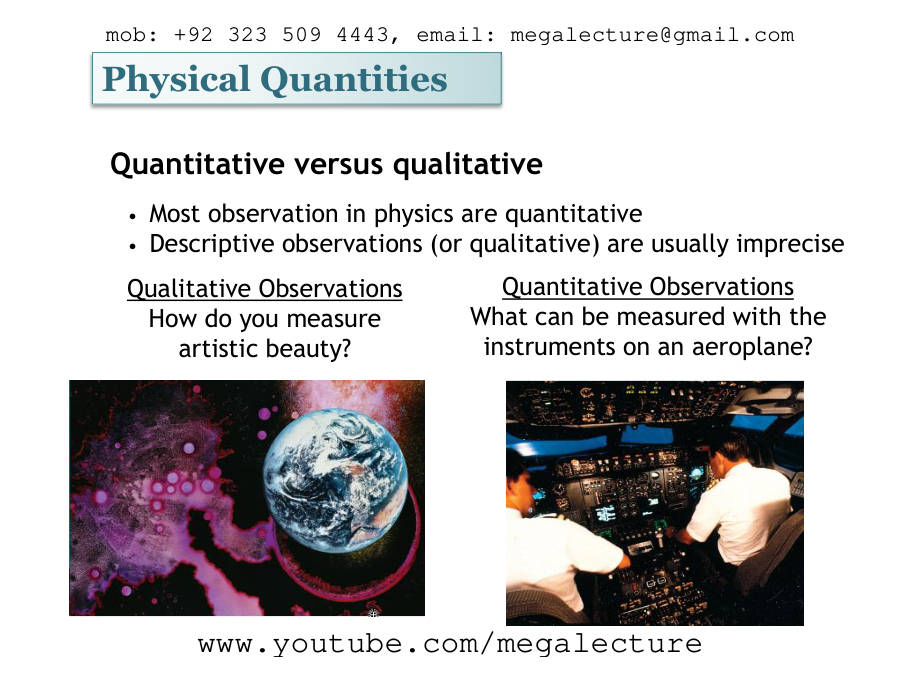
Quantitative Observations What can be measured with the instruments on an aeroplane?
Qualitative Observations
How do you measure artistic beauty?
Physical Quantities
Quantitative versus qualitative
- Most observation in physics are quantitative
- Descriptive observations (or qualitative) are usually imprecise www.youtube.com/megalecture mob: +92 323 509 4443, email: megalecture@gmail.com
Physical Quantities
- A physical quantity is one that can be measured and consists of a magnitude and unit.
SI units are used in Scientific works
Measuring length
km/h
4.5 m
www.megalecture.com
www.youtube.com/megalecture mob: +92 323 509 4443, email: megalecture@gmail.com
Are classified into two types:
- Base quantities
- Derived quantities
Physical Quantities
Base quantity For example : is like the brick – the basic building block of a house
Derived quantity For example : is like the house that was build up from a collection of bricks (basic quantity) www.youtube.com/megalecture mob: +92 323 509 4443, email: megalecture@gmail.com
Definitions :- • Base quantities are the quantities on the basis of which other quantities are expressed.
• The quantities that are expressed in terms of base quantities are called derived quantities www.megalecture.com
www.youtube.com/megalecture mob: +92 323 509 4443, email: megalecture@gmail.com
SI Units for Base Quantity
Base Quantities Name of Unit Symbol of Unit length metre m mass kilogram kg time second s electric current ampere A temperature kelvin K amount of substance mole mol
- SI Units – International System of Units www.youtube.com/megalecture mob: +92 323 509 4443, email: megalecture@gmail.com
Derived quantity & equations
- A derived quantity has an equation which links to other quantities.
- It enables us to express a derived unit in terms of base-unit equivalent. Example: F = ma ; Newton = kg m s-2 P = F/A ; Pascal = kg m s-2/m2 = kg m-1 s-2
www.megalecture.com
www.youtube.com/megalecture mob: +92 323 509 4443, email: megalecture@gmail.com
Some derived units
Derived quantity Base equivalent units _______ Symbol
area square meter m²
volume cubic meter m³
speed, velocity meter per second m/s or m s-1
acceleration meter per second squared m/s/s or m s-2
density kilogram per cubic meter kg m-3
amount concentration mole per cubic meter mol m-3
force kg m s-2 Newton
work/energy kg m2 s-2 Joule
power kg m2 s-3 Watt
pressure kg m-1 s-2 Pascal
frequency s-1 Hertz www.youtube.com/megalecture mob: +92 323 509 4443, email: megalecture@gmail.com
SI Units
- Equation: area = length × width
In terms of base units: Units of area = m × m = m2
- Equation: volume = length × width × height
In terms of base units: Units of volume = m × m × m = m3
- Equation: density = mass ÷ volume
In terms of base units: Units of density = kg m−3
www.megalecture.com
www.youtube.com/megalecture mob: +92 323 509 4443, email: megalecture@gmail.com
SI Units
- Work out the derived quantities for:
- Equation: speed =
In terms of base units: Units of speed = ms−1
- Equation: acceleration =
In terms of base units: Units of acceleration = ms−2
- Equation: force = mass × acceleration In terms of base units: Units of force = kg ms-2 time distance time velocity www.youtube.com/megalecture mob: +92 323 509 4443, email: megalecture@gmail.com
SI Units
- Work out the derived quantities for:
- Equation: Pressure =
In terms of base units: Units of pressure = Kgm−1 s−2
- Equation: Work = Force × Displacement In terms of base units: Units of work = Kgm²s−2
- Equation: Power = In terms of units: Units of power =
Area Force
Time done Work
Kgm²s−3
www.megalecture.com
www.youtube.com/megalecture mob: +92 323 509 4443, email: megalecture@gmail.com
Derived Quantity Relation with Base and
Derived Quantities Unit Special
Name
Momentum
Electric Charge
Potential Difference
Resistance
SI Units – Fill in…
www.youtube.com/megalecture mob: +92 323 509 4443, email: megalecture@gmail.com
For you to know… www.megalecture.com
www.youtube.com/megalecture mob: +92 323 509 4443, email: megalecture@gmail.com
Reference Link – Physical quantities • http://thinkzone.wlonk.com/Units/PhysQuantit ies.htm
www.youtube.com/megalecture mob: +92 323 509 4443, email: megalecture@gmail.com
- A physical quantity is a quantity that can be measured and consists of a numerical magnitude and a unit.
- The physical quantities can be classified into base quantities and derived quantities.
- There are seven base quantities: length, mass, time, current, temperature, amount of substance and luminous intensity.
- The SI units for length, mass, time, temperature and amount of substance, electric current are metre, kilogram, second, kelvin, mole and ampere respectively.
www.megalecture.com
www.youtube.com/megalecture mob: +92 323 509 4443, email: megalecture@gmail.com
Homogeneity of an equation
- An equation is homogeneous if quantities
on BOTH sides of the equation has the
same unit.
- E.g. s = ut + ½ at2
- LHS : unit of s = m
- RHS : unit of ut = ms-1xs = m
- unit of at2 = ms-2xs2 = m
- Unit on LHS = unit on RHS
- Hence equation is homogeneous www.youtube.com/megalecture mob: +92 323 509 4443, email: megalecture@gmail.com
Non-homogeneous
• P = ρgh2 • LHS ; unit of P = Nm-2 = kgm-1s-2 • RHS : unit of ρgh2 = kgm-3(ms-2)(m2) = kgs-2
• Unit on LHS = unit on RHS • Hence equation is not homogeneous www.megalecture.com
www.youtube.com/megalecture mob: +92 323 509 4443, email: megalecture@gmail.com
- Note: numbers has no unit
- some constants have no unit.
- e.g. ,
- A homogeneous eqn may not be physically
correct but a physically correct eqn is definitely homogeneous
- E.g. s = 2ut + at2 (homogenous but not correct)
- F = ma (homogeneous and correct)
Homogeneity of an equation
www.youtube.com/megalecture mob: +92 323 509 4443, email: megalecture@gmail.com
Magnitude
- Prefix : magnitudes of physical quantity range from very large to very small.
- E.g. mass of sun is 1030 kg and mass of electron is 10-31 kg.
- Hence, prefix is used to describe these magnitudes.
www.megalecture.com
www.youtube.com/megalecture mob: +92 323 509 4443, email: megalecture@gmail.com
Significant number
- Magnitudes of physical quantities are often quoted in terms of significant number.
- Can you tell how many sig. fig. in these
numbers?
- 103, 100.0 , 0.030, 0.4004, 200
- If you multiply 2.3 and 1.45, how many sf should
you quote?
- 3.19, 3.335 , 3.48
- 3.312, 3.335, 3.358 www.youtube.com/megalecture mob: +92 323 509 4443, email: megalecture@gmail.com
The rules for identifying significant figures
The rules for identifying significant figures when writing or interpreting numbers are as follows:-
- All non-zero digits are considered significant. For example, 91 has two significant figures (9 and 1), while 123.45 has five significant figures (1, 2, 3, 4 and 5).
- Zeros appearing anywhere between two non-zero digits are significant. Example: 101.1203 has seven significant figures: 1, 0, 1, 1, 2, 0 and 3.
- Leading zeros are not significant. For example, 0.00052 has two significant figures: 5 and 2.
www.megalecture.com
www.youtube.com/megalecture mob: +92 323 509 4443, email: megalecture@gmail.com
The rules for identifying significant figures (cont) • Trailing zeros in a number containing a decimal
point are significant. For example, 12.2300 has six significant figures: 1, 2, 2, 3, 0 and 0. The
number 0.000122300 still has only six significant figures (the zeros before the 1 are not
significant). In addition, 120.00 has five significant figures since it has three trailing zeros.
www.youtube.com/megalecture mob: +92 323 509 4443, email: megalecture@gmail.com
- Often you will be asked to estimate some magnitudes of physical quantities around you.
- E.g. estimate the height of the ceiling, volume of
an apple, mass of an apple, diameter of a strand of hair, Reference link :
http://www.xtremepapers.com/revision/a- level/physics/measurement.php
www.megalecture.com
www.youtube.com/megalecture mob: +92 323 509 4443, email: megalecture@gmail.com
Estimates of physical quantities
- When making an estimate, it is only reasonable to give the figure to 1 or at most 2 significant figures since an estimate is not very precise.
- Occasionally, students are asked to estimate the area under a graph. The usual method of counting squares within the enclosed area is used.
Physical Quantity Reasonable Estimate Mass of 3 cans (330 ml) of
Pepsi 1 kg
Mass of a medium-sized car 1000 kg Length of a football field 100 m Reaction time of a young man 0.2 s www.youtube.com/megalecture mob: +92 323 509 4443, email: megalecture@gmail.com
Convention for labelling tables and graphs
t/s v/ms−1
2.5
1.0 4.0
2.0 5.5
- The symbol / unit is indicated at the italics as indicated in the data column left.
- Then fill in the data with pure numbers.
- Then plot the graph after labelling x axis and y axis [Illustration with sample graph on left]
www.megalecture.com
www.youtube.com/megalecture mob: +92 323 509 4443, email: megalecture@gmail.com
Prefixes • For very large or very small numbers, we can use standard prefixes with the base units.
• The main prefixes that you need to know are shown in the table. (next slide)
www.youtube.com/megalecture mob: +92 323 509 4443, email: megalecture@gmail.com
Prefixes
- Prefixes simplify the writing of very large or very small quantities
Prefix Abbreviation Power nano n 10−9 micro 10−6 milli m 10−3 centi c 10−2 deci d 10−1 kilo k mega M giga G
Tera ?
??
www.megalecture.com
www.youtube.com/megalecture mob: +92 323 509 4443, email: megalecture@gmail.com
Prefixes
- Alternative writing method
- Using standard form
- N × 10n where 1 N < 10 and n is an integer
This galaxy is about 2.5 × 10⁶ light years from the Earth.
The diameter of this atom is about 1 × 10⁻¹⁰ m.
www.youtube.com/megalecture mob: +92 323 509 4443, email: megalecture@gmail.com
Scalars and Vectors
- Scalar quantities are quantities that have magnitude only. Two examples are shown below:
Measuring Mass
Measuring Temperature
www.megalecture.com
www.youtube.com/megalecture mob: +92 323 509 4443, email: megalecture@gmail.com
Scalars and Vectors
- Scalar quantities are added or subtracted by using simple arithmetic. Example: 4 kg plus 6 kg gives the answer 10 kg
+ =
4 kg 6 kg
10 kg www.youtube.com/megalecture mob: +92 323 509 4443, email: megalecture@gmail.com
Scalars and Vectors
- Vector quantities are quantities that have both magnitude and direction
Magnitude = 100 N
Direction = Left
A Force
www.megalecture.com
www.youtube.com/megalecture mob: +92 323 509 4443, email: megalecture@gmail.com
Scalars and Vectors
- Examples of scalars and vectors
Scalars Vectors distance displacement speed velocity mass weight time acceleration pressure force energy momentum volume density www.youtube.com/megalecture mob: +92 323 509 4443, email: megalecture@gmail.com
Direction of vector www.megalecture.com
www.youtube.com/megalecture mob: +92 323 509 4443, email: megalecture@gmail.com
Scalars and Vectors
Adding/Subtracting Vectors using Graphical Method
- Parallel vectors can be added arithmetically
2 N
4 N
6 N 4 N
2 N
2 N www.youtube.com/megalecture mob: +92 323 509 4443, email: megalecture@gmail.com
Scalars and Vectors
Adding Vectors using Graphical Method
- Non-parallel vectors are added by graphical means using the parallelogram law
- Vectors can be represented graphically by arrows
- The length of the arrow represents the magnitude of the vector
- The direction of the arrow represents the direction of the vector
- The magnitude and direction of the resultant vector can be found using an accurate scale drawing
5.0 cm 20.0 N
Direction = right
www.megalecture.com
www.youtube.com/megalecture mob: +92 323 509 4443, email: megalecture@gmail.com
Vector addition
www.youtube.com/megalecture mob: +92 323 509 4443, email: megalecture@gmail.com
Vector operation
- Vector problem must be solved vectorically unlike scalar quantity.
- E.g. 3 N + 4 N = 5 N
3N
4 N 5 N
www.megalecture.com
www.youtube.com/megalecture mob: +92 323 509 4443, email: megalecture@gmail.com
Addition using drawing method
www.youtube.com/megalecture mob: +92 323 509 4443, email: megalecture@gmail.com
Reference link : Vector addition • http://www.physicsclassroom.com/class/vector s/u3l1b.cfm www.megalecture.com
www.youtube.com/megalecture mob: +92 323 509 4443, email: megalecture@gmail.com
- if D = A – B
Subtraction using drawing method www.youtube.com/megalecture mob: +92 323 509 4443, email: megalecture@gmail.com
- The parallelogram law of vector addition states that if two vectors acting at a point are represented by the sides of a parallelogram drawn from that point, their resultant is represented by the diagonal which passes through that point of the parallelogram
Scalars and Vectors www.megalecture.com
www.youtube.com/megalecture mob: +92 323 509 4443, email: megalecture@gmail.com
Coplanar vectors • When 3 or more vectors need to be added, the same principles apply, provided the vectors are
all on the same plane i.e. coplanar • To subtract 2 vectors, reverse the direction i.e.
change the sign of the vector to be subtracted, and add
www.youtube.com/megalecture mob: +92 323 509 4443, email: megalecture@gmail.com
Change in a Vector
Case 1
- If an object changes it's direction but not speed, then velocity vector will only change its direction but not magnitude. Case 2
- If an object changes it's direction and also speed, vector will change its direction as well as magnitude. So the change in the vector would be final minus initial.
www.megalecture.com
www.youtube.com/megalecture mob: +92 323 509 4443, email: megalecture@gmail.com
Components of a Vector
- Any vector directed in two dimensions can be thought of as having an influence in two different directions. That is, it can be thought of as having two parts. Each part of a vector is known as a component.
- 2N + 4N = 6N (2N and 4N are the components of 6N)
- The components of a vector depict the influence of that vector in a given direction. The combined influence of the two components is equivalent to the influence of the single vector. The single vector could be replaced by the two components. www.youtube.com/megalecture mob: +92 323 509 4443, email: megalecture@gmail.com
Components of a Vector • Any vector can be thought of as having two different components. The component of a
single vector describes the influence of that vector in a given direction.
- 3N +4N = 7N (3N and 4N are the components of 7N)
www.megalecture.com
www.youtube.com/megalecture mob: +92 323 509 4443, email: megalecture@gmail.com
Resolution of vectors
- Resolving vectors into two perpendicular components A vector can be broken down into components, which are perpendicular to each other, so that the vector sum of these two components, is equal to the original vector. Splitting a vector into two components is called resolving the vector. It is the reverse of using Pythagoras' theorem to add two perpendicular vectors, and so adding the two components will give you the original vector.
www.youtube.com/megalecture mob: +92 323 509 4443, email: megalecture@gmail.com
Resolution of vectors
- Resolving vectors into two perpendicular components
- Resolving a vector requires some simple trigonometry. In the diagram, the vector to be resolved is the force, F for angle A; the horizontal component of F : the vertical component of F : Note that the two components do not have to be horizontal and vertical. The angle can be changed to any required direction, and both components will still be perpendicular to each other
www.megalecture.com
www.youtube.com/megalecture mob: +92 323 509 4443, email: megalecture@gmail.com
Resolution of vectors
- Resolving vectors into two perpendicular components www.youtube.com/megalecture mob: +92 323 509 4443, email: megalecture@gmail.com
In short… •Vectors addition and subtraction can be performed using diagram method or the resolve and recombine method
www.megalecture.com
www.youtube.com/megalecture mob: +92 323 509 4443, email: megalecture@gmail.com
Reference links – Vector Resolution • http://www.physicsclassroom.com/class/vector s/u3l1d.cfm
• http://www.physicsclassroom.com/class/vector s/U3l1e.cfm
www.youtube.com/megalecture mob: +92 323 509 4443, email: megalecture@gmail.com
- Scalar quantities are quantities that only have magnitudes
- Vector quantities are quantities that have both magnitude and direction
- Parallel vectors can be added arithmetically
- Non-parallel vectors are added by graphical means using the parallelogram law.
- Vectors addition and subtraction can be performed using diagram method or the resolve and recombine method
www.megalecture.com
www.youtube.com/megalecture mob: +92 323 509 4443, email: megalecture@gmail.com
Youtube videos links with explanation on :
General Physics - Physical quantities • http://www.youtube.com/watch?v=kuoQUv7bY 2Y
• http://www.youtube.com/watch?v=Rmy85_Ew L0Y&feature=related
www.youtube.com/megalecture mob: +92 323 509 4443, email: megalecture@gmail.com
www.megalecture.com
www.youtube.com/megalecture mob: +92 323 509 4443, email: megalecture@gmail.com
