
AS Level · Chemistry 9701 · Group 17 (the halogens): AS Chemistry notes
Group 17 (the halogens): AS Chemistry notes
The Daily 5 Five questions a day on AS Chemistry: two minutes, new every day, with a streak to keep Play today’s →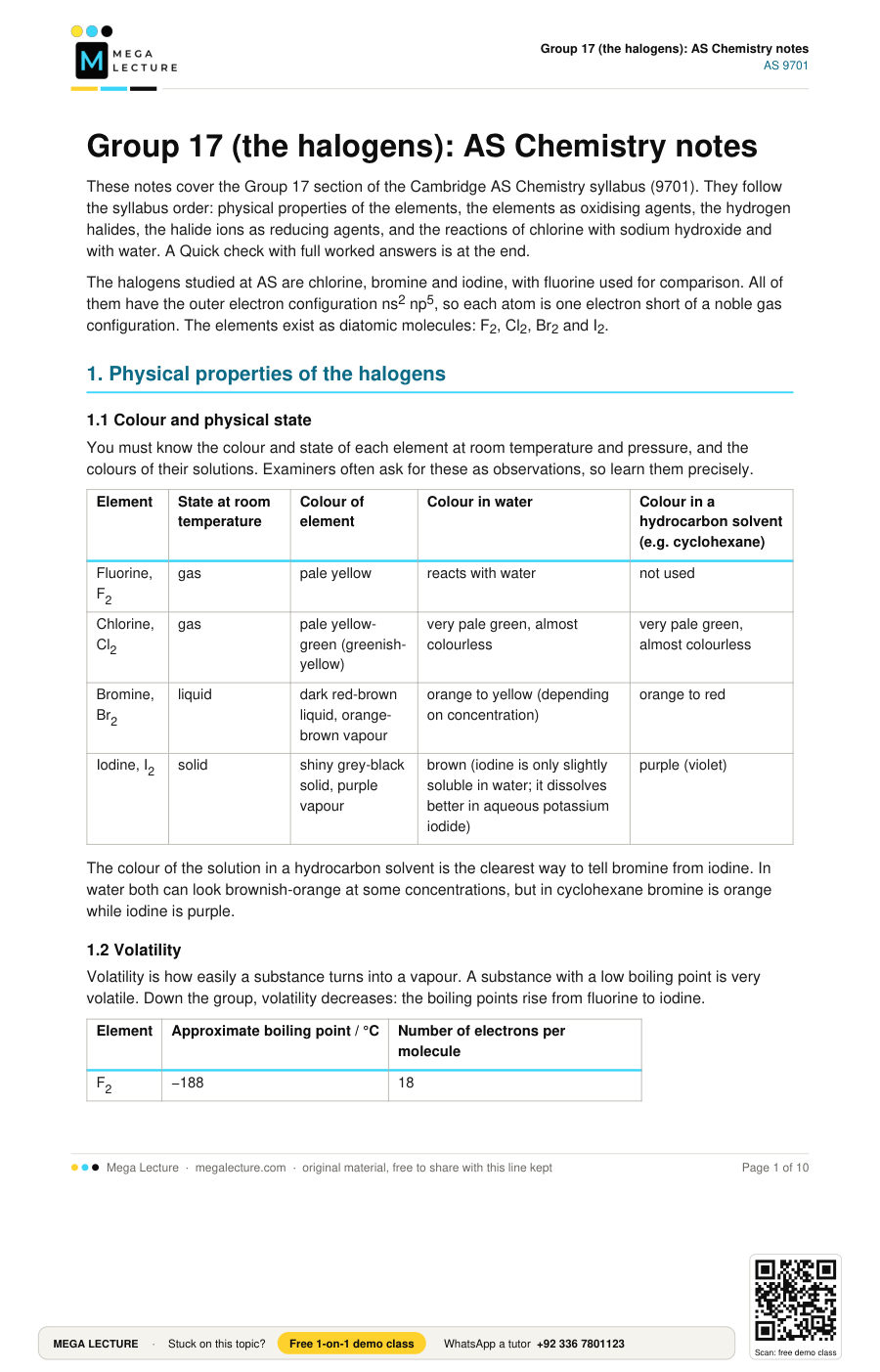
Opens inside this page. Prefer your own PDF app? Open the PDF.
Chemistry batch classes: coming soon. Small live classes at a lower fee than one-to-one. Join the waiting list
Check yourself
5 quick questions on AS Chemistry
Tap an answer to see if you are right, and why. Free, no sign-up.
Start the free test18 of 23 students found these notes useful
Was this note useful?
Full text of Group 17 (the halogens): AS Chemistry notes
These notes cover the Group 17 section of the Cambridge AS Chemistry syllabus (9701). They follow the syllabus order: physical properties of the elements, the elements as oxidising agents, the hydrogen halides, the halide ions as reducing agents, and the reactions of chlorine with sodium hydroxide and with water. A Quick check with full worked answers is at the end.
The halogens studied at AS are chlorine, bromine and iodine, with fluorine used for comparison. All of them have the outer electron configuration ns2 np5, so each atom is one electron short of a noble gas configuration. The elements exist as diatomic molecules: F2, Cl2, Br2 and I2.
1. Physical properties of the halogens
1.1 Colour and physical state
You must know the colour and state of each element at room temperature and pressure, and the colours of their solutions. Examiners often ask for these as observations, so learn them precisely.
| Element | State at room temperature | Colour of element | Colour in water | Colour in a hydrocarbon solvent (e.g. cyclohexane) |
|---|---|---|---|---|
| Fluorine, F2 | gas | pale yellow | reacts with water | not used |
| Chlorine, Cl2 | gas | pale yellow-green (greenish-yellow) | very pale green, almost colourless | very pale green, almost colourless |
| Bromine, Br2 | liquid | dark red-brown liquid, orange-brown vapour | orange to yellow (depending on concentration) | orange to red |
| Iodine, I2 | solid | shiny grey-black solid, purple vapour | brown (iodine is only slightly soluble in water; it dissolves better in aqueous potassium iodide) | purple (violet) |
The colour of the solution in a hydrocarbon solvent is the clearest way to tell bromine from iodine. In water both can look brownish-orange at some concentrations, but in cyclohexane bromine is orange while iodine is purple.
1.2 Volatility
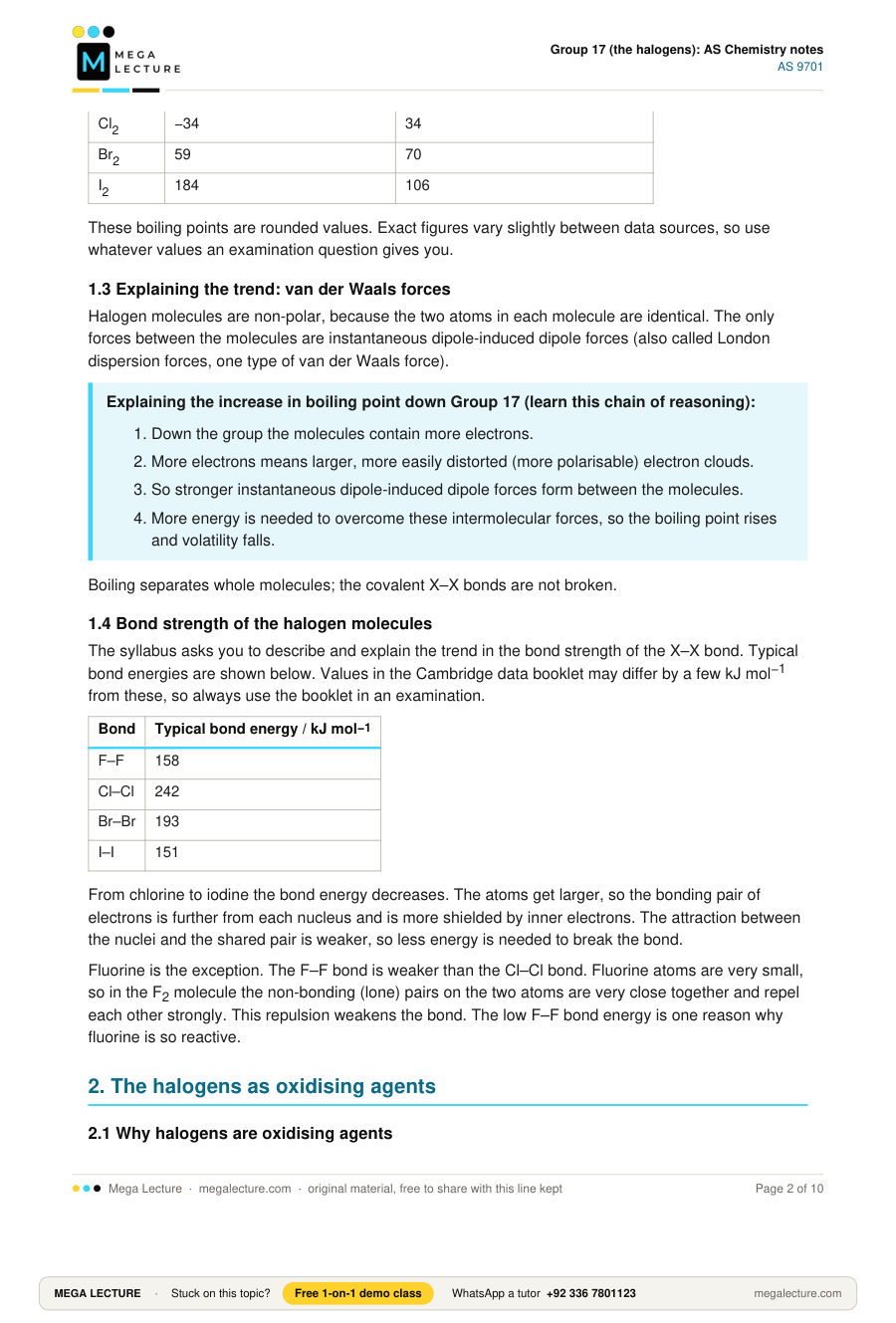
Volatility is how easily a substance turns into a vapour. A substance with a low boiling point is very volatile. Down the group, volatility decreases: the boiling points rise from fluorine to iodine.
| Element | Approximate boiling point / °C | Number of electrons per molecule |
|---|---|---|
| F2 | −188 | 18 |
| Cl2 | −34 | 34 |
| Br2 | 59 | 70 |
| I2 | 184 | 106 |
These boiling points are rounded values. Exact figures vary slightly between data sources, so use whatever values an examination question gives you.
1.3 Explaining the trend: van der Waals forces
Halogen molecules are non-polar, because the two atoms in each molecule are identical. The only forces between the molecules are instantaneous dipole-induced dipole forces (also called London dispersion forces, one type of van der Waals force).
Explaining the increase in boiling point down Group 17 (learn this chain of reasoning):
- Down the group the molecules contain more electrons.
- More electrons means larger, more easily distorted (more polarisable) electron clouds.
- So stronger instantaneous dipole-induced dipole forces form between the molecules.
- More energy is needed to overcome these intermolecular forces, so the boiling point rises and volatility falls.
Boiling separates whole molecules; the covalent X–X bonds are not broken.
1.4 Bond strength of the halogen molecules
The syllabus asks you to describe and explain the trend in the bond strength of the X–X bond. Typical bond energies are shown below. Values in the Cambridge data booklet may differ by a few kJ mol−1 from these, so always use the booklet in an examination.
| Bond | Typical bond energy / kJ mol−1 |
|---|---|
| F–F | 158 |
| Cl–Cl | 242 |
| Br–Br | 193 |
| I–I | 151 |
From chlorine to iodine the bond energy decreases. The atoms get larger, so the bonding pair of electrons is further from each nucleus and is more shielded by inner electrons. The attraction between the nuclei and the shared pair is weaker, so less energy is needed to break the bond.
Fluorine is the exception. The F–F bond is weaker than the Cl–Cl bond. Fluorine atoms are very small, so in the F2 molecule the non-bonding (lone) pairs on the two atoms are very close together and repel each other strongly. This repulsion weakens the bond. The low F–F bond energy is one reason why fluorine is so reactive.
2. The halogens as oxidising agents
2.1 Why halogens are oxidising agents
When a halogen reacts it usually gains electrons to form halide ions:
X2 + 2e− → 2X−
The halogen is reduced (its oxidation number falls from 0 to −1), so it oxidises whatever gave it the electrons. That makes it an oxidising agent.
Definition: An oxidising agent is a species that oxidises another species by removing electrons from it; the oxidising agent is itself reduced.
2.2 Trend in oxidising power
Oxidising power decreases down the group: F2 > Cl2 > Br2 > I2.
Explanation of the trend (learn this): Down the group the atoms get larger and have more inner shells of electrons. An incoming electron is added to a shell further from the nucleus and is more shielded from it. Although the nuclear charge increases, the extra distance and shielding outweigh it, so the attraction for the incoming electron is weaker. The halogen therefore gains electrons less readily and is a weaker oxidising agent.
Electronegativity shows the same pattern. Approximate Pauling values are F 4.0, Cl 3.2, Br 3.0 and I 2.7; check the values in your data source if a question depends on them.
2.3 Displacement reactions
A more reactive halogen oxidises the halide ions of a less reactive halogen. This is called a displacement reaction. For example, chlorine water added to aqueous potassium bromide:
Cl2(aq) + 2KBr(aq) → 2KCl(aq) + Br2(aq)
Ionic equation: Cl2 + 2Br− → 2Cl− + Br2
Chlorine is reduced (0 to −1) and bromide ions are oxidised (−1 to 0).
| Halogen added | to Cl−(aq) | to Br−(aq) | to I−(aq) |
|---|---|---|---|
| Cl2(aq) | no reaction | orange/yellow solution forms (Br2) | brown solution forms (I2) |
| Br2(aq) | no reaction, solution stays orange | no reaction | brown solution forms (I2) |
| I2(aq) | no reaction | no reaction | no reaction |
Because bromine water is orange and iodine solution is brown, the colour change when bromine water is added to iodide can be hard to see. Shaking the mixture with cyclohexane settles it: a purple upper organic layer shows that iodine has formed.
Worked example. Write the ionic equation for the reaction of bromine with aqueous sodium iodide, and state the changes in oxidation number.
Br2 + 2I− → 2Br− + I2
Bromine: 0 → −1 (reduced). Iodine: −1 → 0 (oxidised). Bromine is the oxidising agent and the iodide ion is the reducing agent. Sodium ions are spectator ions and do not appear in the ionic equation.
3. Reactions with hydrogen and the hydrogen halides
3.1 Reactions of the halogens with hydrogen
All the halogens react with hydrogen to form hydrogen halides, H2 + X2 → 2HX. The vigour of the reaction falls down the group, matching the fall in oxidising power.
| Halogen | Conditions and vigour of reaction with hydrogen |
|---|---|
| Fluorine | explosive, even in the dark and at low temperature |
| Chlorine | explosive in sunlight (or other ultraviolet light); slow in the dark |
| Bromine | needs heating (about 300 °C) and a platinum catalyst; reacts steadily but not explosively |
| Iodine | needs continuous heating with a platinum catalyst; slow, reversible and incomplete: H2 + I2 ⇌ 2HI |
3.2 Thermal stability of the hydrogen halides
Thermal stability is the resistance of a compound to being broken down by heat. Thermal stability of the hydrogen halides decreases down the group: HF is the most stable and HI the least.
| Bond | Typical bond energy / kJ mol−1 | Effect of a red-hot wire or glass rod |
|---|---|---|
| H–F | 562 | no decomposition |
| H–Cl | 431 | no decomposition |
| H–Br | 366 | slight decomposition; a little orange-brown bromine vapour may be seen |
| H–I | 299 | decomposes readily; purple iodine vapour seen: 2HI → H2 + I2 |
Explanation of the trend (learn this): Down the group the halogen atom gets larger, so the H–X bond gets longer. The bonding pair is further from the halogen nucleus and the overlap of orbitals is less effective, so the bond is weaker (lower bond energy). Less energy is needed to break the H–X bond, so the hydrogen halide decomposes more easily on heating.
4. The halide ions
4.1 Halide ions as reducing agents
A reducing agent gives electrons away. Halide ions can lose an electron each and form the halogen:
2X− → X2 + 2e−
Reducing power increases down the group: I− > Br− > Cl− > F−. A larger ion holds its outer electrons further from the nucleus with more shielding, so it loses an electron more easily. This is the reverse of the trend in oxidising power of the elements: the weaker the halogen is as an oxidising agent, the stronger its halide ion is as a reducing agent.
4.2 Testing for halide ions with silver nitrate
Method: Add dilute nitric acid to the solution of the halide, then add aqueous silver nitrate. Note the colour of any precipitate. Then test the solubility of the precipitate in dilute and in concentrated aqueous ammonia.
The dilute nitric acid is added first to remove ions such as carbonate, which would also give a precipitate with silver ions. Hydrochloric acid must not be used because it adds chloride ions, and sulfuric acid is avoided because silver sulfate can also precipitate from fairly concentrated solutions.
The precipitates form by the ionic equation Ag+(aq) + X−(aq) → AgX(s).
| Halide ion | Precipitate with AgNO3(aq) | Effect of dilute NH3(aq) | Effect of concentrated NH3(aq) |
|---|---|---|---|
| F− | no precipitate (AgF is soluble) | not applicable | not applicable |
| Cl− | white precipitate of AgCl | dissolves | dissolves |
| Br− | cream precipitate of AgBr | does not dissolve (may dissolve very slightly) | dissolves |
| I− | yellow precipitate of AgI | does not dissolve | does not dissolve |
4.3 Why the precipitates differ in their solubility in ammonia
Ammonia forms a soluble complex ion with silver ions:
Ag+(aq) + 2NH3(aq) ⇌ [Ag(NH3)2]+(aq)
Each silver halide is in equilibrium with a very small concentration of Ag+ ions in solution. The solubility of the silver halides decreases from AgCl to AgI, so the concentration of free Ag+ ions is greatest above AgCl and smallest above AgI.
- AgCl gives enough Ag+ for even dilute ammonia to remove it as the complex. The equilibrium AgCl(s) ⇌ Ag+(aq) + Cl−(aq) shifts to the right and the solid dissolves.
- AgBr gives fewer Ag+ ions, so a higher concentration of ammonia is needed to pull its equilibrium to the right.
- AgI is so insoluble that even concentrated ammonia cannot lower the Ag+ concentration enough for it to dissolve.
The overall equation for dissolving silver chloride is AgCl(s) + 2NH3(aq) → [Ag(NH3)2]+(aq) + Cl−(aq).
4.4 Reactions of solid halides with concentrated sulfuric acid
This is the classic demonstration of the increasing reducing power of the halide ions. Concentrated sulfuric acid is added to the solid sodium (or potassium) halide.
Step 1 (all halides): acid-base reaction. Concentrated sulfuric acid is a strong acid and is involatile, so it displaces the volatile hydrogen halide:
NaX(s) + H2SO4(l) → NaHSO4(s) + HX(g)
The hydrogen halide is seen as steamy (misty) fumes in moist air. This is not a redox reaction: no oxidation numbers change.
Step 2: redox, depending on the halide. Whether the hydrogen halide goes on to reduce the sulfuric acid depends on its reducing power.
Sodium chloride. HCl is not a strong enough reducing agent to reduce sulfuric acid. Only step 1 happens.
NaCl + H2SO4 → NaHSO4 + HCl
Observation: steamy white fumes of HCl.
Sodium bromide. Some of the HBr formed reduces the sulfuric acid to sulfur dioxide (sulfur goes from +6 to +4):
NaBr + H2SO4 → NaHSO4 + HBr
2HBr + H2SO4 → Br2 + SO2 + 2H2O
Observations: steamy fumes of HBr, and orange-brown fumes of bromine. Sulfur dioxide is a colourless gas with a choking smell.
Sodium iodide. HI is a strong reducing agent. It reduces sulfuric acid to sulfur dioxide (+4), to sulfur (0) and to hydrogen sulfide (−2):
NaI + H2SO4 → NaHSO4 + HI
2HI + H2SO4 → I2 + SO2 + 2H2O
6HI + H2SO4 → 3I2 + S + 4H2O
8HI + H2SO4 → 4I2 + H2S + 4H2O
Observations: some steamy fumes, purple fumes of iodine and a grey-black solid (iodine), a yellow solid (sulfur), and a smell of bad eggs (hydrogen sulfide). The mixture also gets hot.
| Halide | Products | Lowest oxidation number of sulfur reached | Key observations |
|---|---|---|---|
| NaCl | HCl | +6 (no reduction) | steamy fumes |
| NaBr | HBr, Br2, SO2 | +4 | steamy fumes, orange-brown fumes |
| NaI | HI, I2, SO2, S, H2S | −2 | purple fumes, black solid, yellow solid, bad-egg smell |
Exam tip. The further the sulfur is reduced, the stronger the reducing agent. Iodide takes sulfur all the way from +6 to −2, bromide only to +4, chloride not at all. This is the evidence that reducing power increases Cl− < Br− < I−. To prepare pure HBr or HI in the laboratory, use phosphoric(V) acid instead of sulfuric acid, because it is not an oxidising agent.
5. Reactions of chlorine
5.1 Disproportionation
Definition: Disproportionation is a redox reaction in which the same element is simultaneously oxidised and reduced.
Chlorine has oxidation number 0 in Cl2. In its reactions with sodium hydroxide some chlorine atoms go up in oxidation number and others go down.
5.2 Chlorine with cold, dilute aqueous sodium hydroxide
At room temperature or below (about 15 °C):
Cl2 + 2NaOH → NaCl + NaClO + H2O
Ionic equation: Cl2 + 2OH− → Cl− + ClO− + H2O
Oxidation numbers of chlorine: 0 in Cl2, −1 in NaCl (reduced) and +1 in NaClO (oxidised). NaClO is sodium chlorate(I), also called sodium hypochlorite. Its solution is household bleach.
5.3 Chlorine with hot, concentrated aqueous sodium hydroxide
At about 70 °C with concentrated alkali, the chlorate(I) ions formed at first themselves disproportionate, and the overall reaction is:
3Cl2 + 6NaOH → 5NaCl + NaClO3 + 3H2O
Ionic equation: 3Cl2 + 6OH− → 5Cl− + ClO3− + 3H2O
Oxidation numbers of chlorine: 0 in Cl2, −1 in NaCl (reduced) and +5 in NaClO3, sodium chlorate(V) (oxidised).
Worked example: checking the electron balance in the hot reaction.
Six chlorine atoms react (3Cl2). Five go from 0 to −1: total change −5, so 5 electrons gained. One goes from 0 to +5: total change +5, so 5 electrons lost. Electrons lost = electrons gained, so the equation is balanced for electrons as well as atoms.
The same check for the cold reaction: one Cl goes 0 to −1 (1 electron gained), one goes 0 to +1 (1 electron lost).
| Conditions | Equation | Oxidation numbers of Cl in products |
|---|---|---|
| cold, dilute NaOH(aq) | Cl2 + 2NaOH → NaCl + NaClO + H2O | −1 and +1 |
| hot, concentrated NaOH(aq) | 3Cl2 + 6NaOH → 5NaCl + NaClO3 + 3H2O | −1 and +5 |
5.4 Chlorine in water purification
Chlorine is added to drinking water and swimming pools to kill bacteria. When chlorine dissolves in water it disproportionates in a reversible reaction:
Cl2(aq) + H2O(l) ⇌ HCl(aq) + HClO(aq)
HClO is chloric(I) acid (hypochlorous acid). Chlorine goes from 0 to −1 in HCl and from 0 to +1 in HClO. HClO is a weak acid and partially dissociates:
HClO(aq) ⇌ H+(aq) + ClO−(aq)
The active species that kill bacteria are HClO and the chlorate(I) ion, ClO−. Both are oxidising agents. HClO is the more effective of the two.
- Benefit: chlorination kills disease-causing bacteria such as those that cause cholera and typhoid, and gives lasting protection in the pipes because some chlorine remains in the water.
- Risks: chlorine is toxic, so the dose must be controlled. Chlorine can also react with organic matter in water to form chlorinated organic compounds, some of which are suspected to be harmful. The benefits are generally judged to outweigh the risks.
6. Summary of trends
| Property | Trend down the group (Cl → Br → I) | Main reason |
|---|---|---|
| Boiling point | increases | more electrons, stronger instantaneous dipole-induced dipole forces |
| Volatility | decreases | as above |
| X–X bond energy | decreases (F–F is anomalously low) | larger atoms, bonding pair further from nuclei; lone-pair repulsion in F2 |
| Oxidising power of X2 | decreases | incoming electron further from nucleus and more shielded |
| Reaction with H2 | less vigorous | weaker oxidising agent |
| Thermal stability of HX | decreases | H–X bond longer and weaker |
| Reducing power of X− | increases | outer electrons further from nucleus and more shielded, lost more easily |
| Solubility of AgX in NH3(aq) | decreases | AgX less soluble, fewer free Ag+ ions |
Quick check
- State the colour of (a) chlorine gas, (b) iodine vapour, (c) bromine dissolved in cyclohexane. [3]
- Explain why the boiling point of iodine is higher than that of chlorine. [3]
- The bond energy of F–F is lower than that of Cl–Cl. Explain why. [2]
- Aqueous chlorine is added to aqueous potassium iodide. (a) Describe what you would see. (b) Write the ionic equation. (c) Identify the oxidising agent and explain your choice using oxidation numbers. [4]
- Explain why chlorine is a stronger oxidising agent than bromine. [3]
- Describe how the reactions of chlorine and of iodine with hydrogen differ in their conditions and extent. [3]
- A student holds a red-hot glass rod in samples of hydrogen chloride and hydrogen iodide. State and explain what is observed in each case. [4]
- A colourless solution is thought to contain bromide ions. Describe a test, including the use of aqueous ammonia, that would confirm this. Give the observations and an ionic equation. [5]
- Explain why silver chloride dissolves in dilute aqueous ammonia but silver iodide does not dissolve even in concentrated aqueous ammonia. [3]
- Concentrated sulfuric acid is added to solid sodium bromide. (a) Write equations for the two reactions that occur. (b) State two observations. (c) Explain why sodium chloride gives fewer products under the same conditions. [6]
- Chlorine is bubbled into hot, concentrated aqueous sodium hydroxide. (a) Write the equation. (b) Give the oxidation number of chlorine in each chlorine-containing product. (c) Explain why this reaction is described as disproportionation. [4]
- Chlorine is used to treat drinking water. (a) Write the equation for the reaction of chlorine with water. (b) Name the species responsible for killing bacteria. (c) Give one risk of chlorinating water. [4]
Answers
1. (a) Pale yellow-green (greenish-yellow). (b) Purple. (c) Orange (orange-red).
2. Iodine molecules (106 electrons) contain many more electrons than chlorine molecules (34 electrons). Their electron clouds are larger and more polarisable, so stronger instantaneous dipole-induced dipole (van der Waals) forces form between I2 molecules. More energy is needed to overcome these intermolecular forces, so iodine has the higher boiling point. No covalent bonds are broken on boiling.
3. Fluorine atoms are very small, so the F–F bond is short and the lone pairs on the two fluorine atoms are very close together. Their strong mutual repulsion weakens the bond, so less energy is needed to break it than to break Cl–Cl.
4. (a) The colourless solution turns brown (yellow-brown if dilute); a dark precipitate of iodine may form if concentrated. (b) Cl2 + 2I− → 2Cl− + I2. (c) Chlorine is the oxidising agent. Its oxidation number decreases from 0 to −1, so it is reduced, and it causes iodide ions to be oxidised from −1 to 0.
5. A chlorine atom is smaller than a bromine atom, with one fewer shell of electrons. An electron gained by chlorine enters a shell closer to the nucleus and is less shielded, so it is attracted more strongly. Chlorine therefore gains electrons more readily than bromine, which makes it the stronger oxidising agent.
6. Chlorine reacts explosively with hydrogen in sunlight (UV light), and the reaction goes to completion: H2 + Cl2 → 2HCl. Iodine reacts only slowly when heated continuously with a platinum catalyst, and the reaction is reversible, so it is incomplete: H2 + I2 ⇌ 2HI. This reflects the lower reactivity (weaker oxidising power) of iodine.
7. Hydrogen chloride: no visible change, because the H–Cl bond is strong (about 431 kJ mol−1) and is not broken at the temperature of the rod. Hydrogen iodide: purple fumes of iodine appear, because the H–I bond is much weaker (about 299 kJ mol−1) and HI decomposes: 2HI → H2 + I2. The H–I bond is weaker because the iodine atom is larger, so the bond is longer and the bonding pair is held less strongly.
8. Acidify a sample with dilute nitric acid, then add aqueous silver nitrate. A cream precipitate forms: Ag+(aq) + Br−(aq) → AgBr(s). Add dilute aqueous ammonia: the precipitate does not dissolve (or dissolves only very slightly). Add concentrated aqueous ammonia to a fresh precipitate: it dissolves. A cream precipitate insoluble in dilute but soluble in concentrated ammonia confirms bromide. (Nitric acid is used to remove carbonate ions, which would otherwise also form a precipitate.)
9. Ammonia removes Ag+ ions from solution by forming the complex ion [Ag(NH3)2]+, which shifts the equilibrium AgX(s) ⇌ Ag+(aq) + X−(aq) to the right. AgCl is the most soluble of the silver halides, so there are enough free Ag+ ions for even dilute ammonia to complex them and dissolve the solid. AgI is far less soluble; the concentration of free Ag+ is so low that even concentrated ammonia cannot shift its equilibrium far enough to dissolve it.
10. (a) NaBr + H2SO4 → NaHSO4 + HBr, then 2HBr + H2SO4 → Br2 + SO2 + 2H2O. (b) Any two of: steamy (misty) fumes; orange-brown fumes; a choking smell (SO2). (c) HCl is a weaker reducing agent than HBr. The chloride ion is smaller, so its outer electrons are held more strongly and are not easily lost. HCl cannot reduce sulfuric acid, so only the acid-base reaction occurs and the only product besides NaHSO4 is HCl.
11. (a) 3Cl2 + 6NaOH → 5NaCl + NaClO3 + 3H2O. (b) NaCl: −1. NaClO3: +5 (Na is +1, three O are −6 in total, so Cl = +5 for an overall charge of zero). (c) Chlorine starts at oxidation number 0. Some chlorine atoms are reduced to −1 and others are oxidised to +5 in the same reaction. An element being oxidised and reduced at the same time is disproportionation.
12. (a) Cl2 + H2O ⇌ HCl + HClO. (b) Chloric(I) acid, HClO, and the chlorate(I) ion, ClO−, formed when HClO dissociates (HClO ⇌ H+ + ClO−). (c) Any one of: chlorine is toxic, so excess is harmful; chlorine can react with organic matter in the water to form chlorinated organic compounds that may be harmful.
