
AS Level · Chemistry 9701 · Chemical Periodicity
Periodic Trends — Worksheet
The Daily 5 Five questions a day on AS Chemistry: two minutes, new every day, with a streak to keep Play today’s →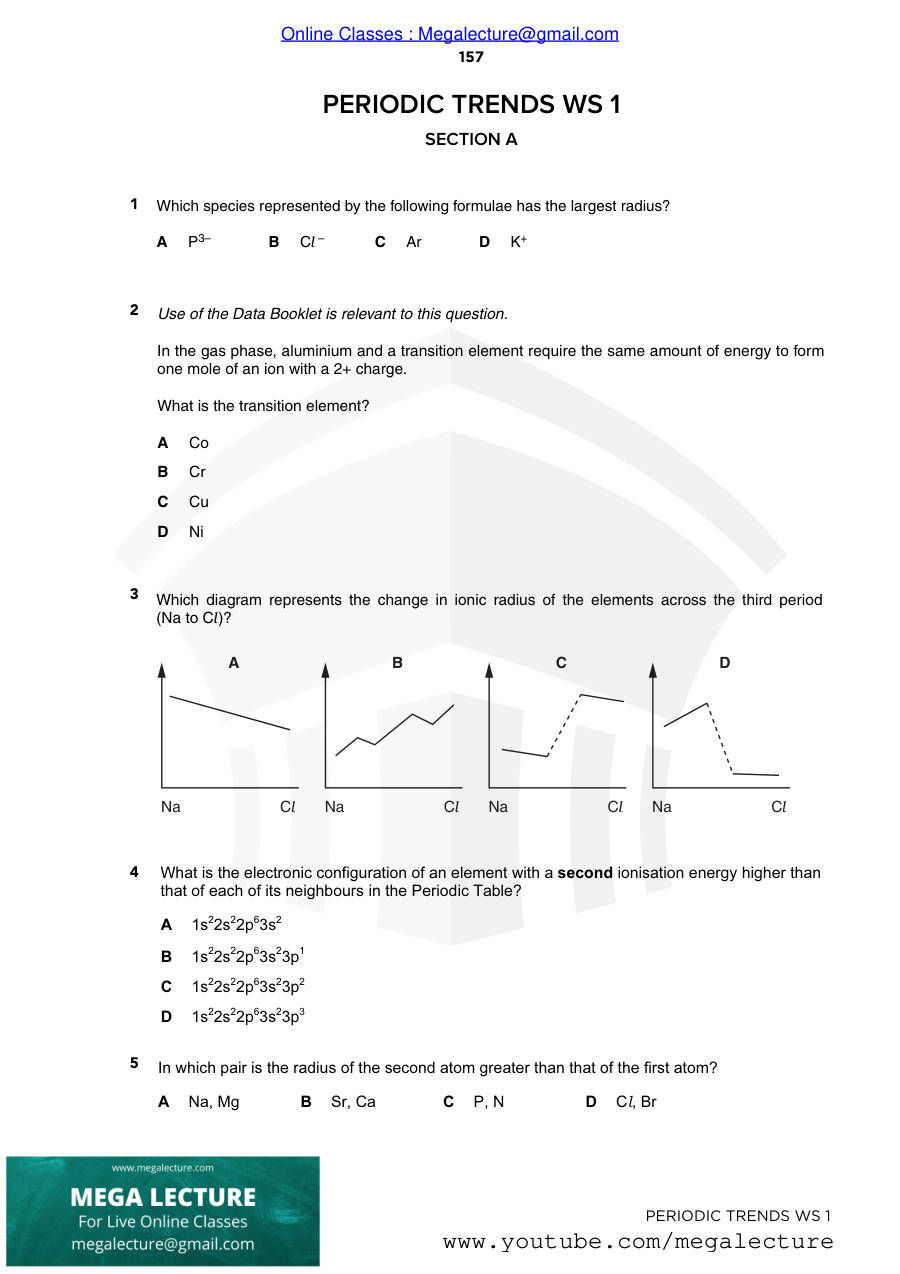
Opens inside this page. Prefer your own PDF app? Open the PDF.
Chemistry batch classes: coming soon. Small live classes at a lower fee than one-to-one. Join the waiting list
Check yourself
5 quick questions on The Periodic Table: chemical periodicity
Tap an answer to see if you are right, and why. Free, no sign-up.
Start the free test👍 22 students found these notes useful
Was this note useful?
Full text of Periodic Trends — Worksheet
PERIODIC TRENDS WS 1
SECTION A
Which species represented by the following formulae has the largest radius?
A P3– B Cl – C Ar D K+
Use of the Data Booklet is relevant to this question.
In the gas phase, aluminium and a transition element require the same amount of energy to form one mole of an ion with a 2+ charge.
What is the transition element?
A Co
B Cr
C Cu
D Ni
Which diagram represents the change in ionic radius of the elements across the third period (Na to Cl)?
Na Cl
A
Na Cl
B
Na Cl
C
Na Cl
D
What is the electronic configuration of an element with a second ionisation energy higher than that of each of its neighbours in the Periodic Table?
A 1s22s22p63s2
B 1s22s22p63s23p1
C 1s22s22p63s23p2
D 1s22s22p63s23p3
In which pair is the radius of the second atom greater than that of the first atom?
A Na, Mg B Sr, Ca C P, N D Cl, Br
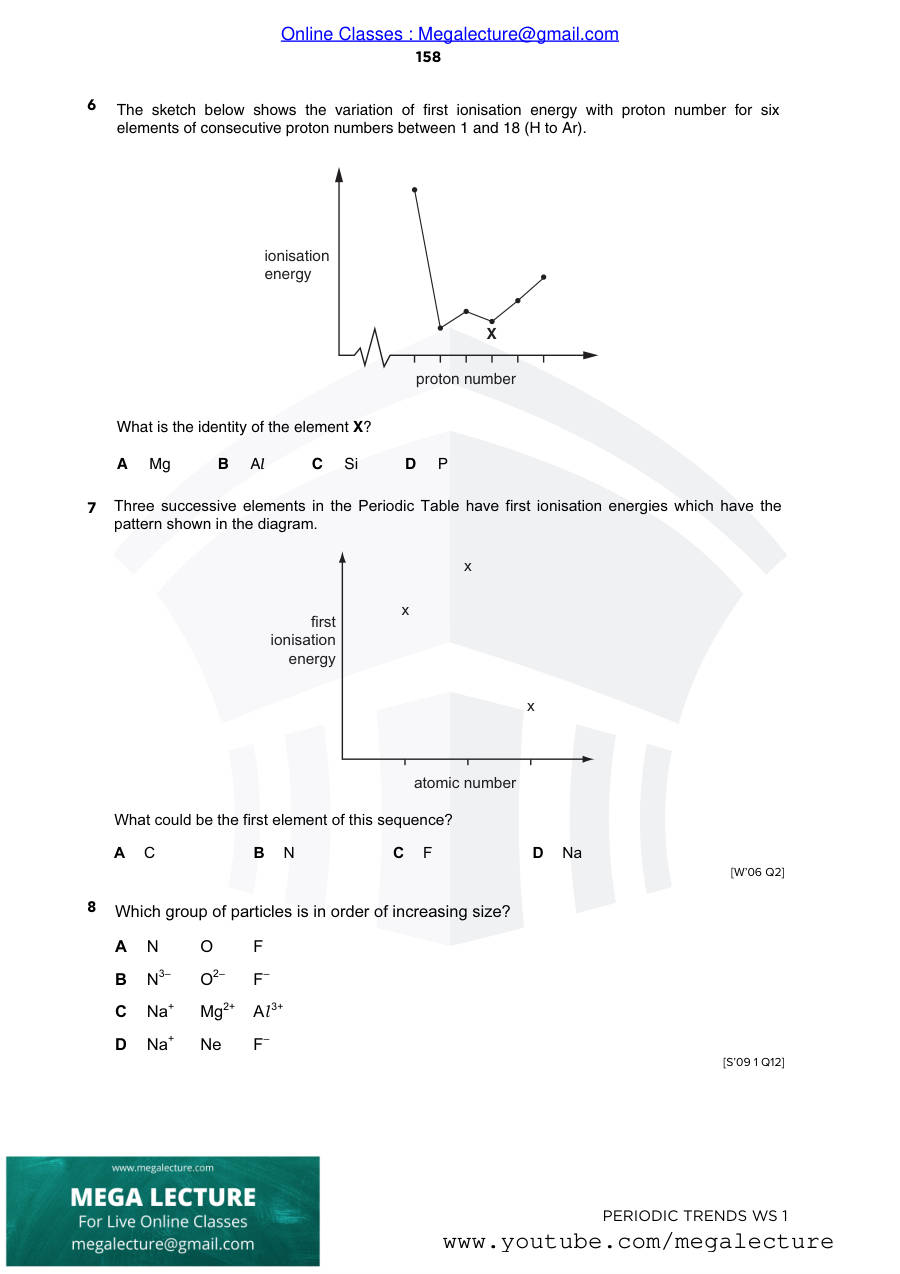
The sketch below shows the variation of first ionisation energy with proton number for six elements of consecutive proton numbers between 1 and 18 (H to Ar).
What is the identity of the element X?
A Mg B Al C Si D P
X proton number ionisation energy
Three successive elements in the Periodic Table have first ionisation energies which have the pattern shown in the diagram.
first ionisation energy atomic number x x x
What could be the first element of this sequence?
A C B N C F D Na
[W’06 Q2]
Which group of particles is in order of increasing size?
A N O F
B N3– O2– F–
C Na+ Mg2+ Al 3+
D Na+ Ne F–
[S’09 1 Q12]
Use of the Data Booklet is relevant to this question.
The sketch graph shows the variation of one physical or chemical property with another for the Group II elements.
y x
What are the correct labels for the axes?
x-axis y-axis
A atomic number mass number
B atomic number melting point
C first ionisation energy atomic number
D first ionisation energy atomic radius
[W’07 1 Q14]
Why is the first ionisation energy of phosphorus greater than the first ionisation energy of silicon?
A A phosphorus atom has one more proton in its nucleus.
B The atomic radius of a phosphorus atom is greater.
C The outer electron in a phosphorus atom is more shielded.
D The outer electron in a phosphorus atom is paired.
[W’10 1 Q13]
The value of the second ionisation energy of calcium is 1150 kJ mol–1
.
Which equation correctly represents this statement?
A Ca(g) Ca2+(g) + 2e− ; ∆H o = +1150 kJ mol–1
B Ca+(g) Ca2+(g) + e− ; ∆H o = +1150 kJ mol–1
C Ca+(g) Ca2+(g) + e− ; ∆H o = –1150 kJ mol–1
D Ca(g) Ca2+(g) + 2e− ; ∆H o = –1150 kJ mol–1
[S’12 2 Q18]
Sodium and sulfur react together to form sodium sulfide, Na2S.
How do the atomic radius and ionic radius of sodium compare with those of sulfur?
atomic radius ionic radius
A sodium > sulfur sodium > sulfur
B sodium > sulfur sodium < sulfur
C sodium < sulfur sodium > sulfur
D sodium < sulfur sodium < sulfur
[M’1 Q12]
From which particle is the removal of an electron the most difficult?
A Cl –(g) B F–(g) C K+(g) D Na+(g)
[W’11 2 Q3]
The species Ne, Na+ and Mg2+ are isoelectronic. This means that they have the same number of electrons.
In which order do their radii increase?
smallest largest
A Ne Na+ Mg2+
B Ne Mg2+ Na+
C Mg2+ Ne Na+
D Mg2+ Na+ Ne
[S’14 3 Q16]
The diagram shows the first ionisation energies of 11 consecutive elements.
X Y atomic number first ionisation energy / kJ mol–1
Which type of elements are labelled X and Y ?
A Group I metals
B Group II metals
C halogens
D noble gases
[S’11 12 Q15]
Use of the Data Booklet is relevant to this question.
Which graph correctly shows relative electronegativity plotted against relative atomic radius for the elements Na, Mg, Al and Si?
electronegativity atomic radius
A
Si
Al
Mg
Na electronegativity atomic radius
B
Si
Al
Mg
Na electronegativity atomic radius
C
Si
Al
Mg
Na electronegativity atomic radius
D
Si
Al
Mg
Na
The graph below shows the variation of the first ionisation energy with the number of protons for some elements.
first ionisation energy / kJ mol–1 proton number
Q
R
S
T
U
V
W
X
Y
Which statement is correct?
A Elements Q and Y are in the same period in the Periodic Table.
B The general increase from elements R to Y is due to increasing atomic radius.
C The small decrease between elements S and T is due to decreased shielding.
D The small decrease between elements V and W is due to repulsion between paired electrons.
[W’13 3 Q18]
Which property increases in value going down Group II?
A electronegativity
B ionic radius
C maximum oxidation number
D second ionisation energy
[W’13 2 Q14]
Consecutive elements X, Y and Z are in Period 3 of the Periodic Table. Element Y has the highest first ionisation energy and the lowest melting point of these three elements.
What are the identities of X, Y and Z?
A sodium, magnesium, aluminium
B magnesium, aluminium, silicon
C aluminium, silicon, phosphorus
D silicon, phosphorus, sulfur
[M’16 Q12]
Why is the ionic radius of a chloride ion larger than the ionic radius of a sodium ion?
A A chloride ion has one more occupied electron shell than a sodium ion.
B Chlorine has a higher proton number than sodium.
C Ionic radius increases regularly across the third period.
D Sodium is a metal, chlorine is a non-metal.
[W’12 1 Q13]
Why is the ionic radius of a chloride ion larger than the ionic radius of a sodium ion?
A A chloride ion has one more occupied electron shell than a sodium ion.
B Chlorine has a higher proton number than sodium.
C Ionic radius increases regularly across the third period.
D Sodium is a metal, chlorine is a non-metal.
[S’12 1 Q13]
Sodium and sulfur react together to form sodium sulfide, Na2S.
How do the atomic radius and ionic radius of sodium compare with those of sulfur?
atomic radius ionic radius
A sodium < sulfur sodium > sulfur
B sodium < sulfur sodium < sulfur
C sodium > sulfur sodium > sulfur
D sodium > sulfur sodium < sulfur
[S’16 2 Q12]
Which element has the second smallest atomic radius in its group and the third lowest first ionisation energy in its period?
A boron
B calcium
C magnesium
D sodium
[S’18 1 Q13]
Element X has a higher first ionisation energy than element Y.
Two students state what they believe is one factor that helps to explain this.
student 1 “X has a higher first ionisation energy than Y because an atom of X has more protons in its nucleus than an atom of Y.” student 2 “X has a higher first ionisation energy than Y because X has a smaller atomic radius than Y.”
Only one of the two students is correct.
What could X and Y be?
X Y
A carbon boron
B magnesium aluminium
C oxygen nitrogen
D oxygen sulfur
[S’18 1 Q10]
SECTION B
For each of the questions in this section, one or more of the three numbered statements 1 to 3 may be correct. Decide whether each of the statements is or is not correct (you may find it helpful to put a tick against the statements that you consider to be correct). The responses A to D should be selected on the basis of
A B C D
1, 2 and 3 are correct
1 and 2 only are correct
2 and 3 only are correct
1 only is correct
No other combination of statements is used as a correct response.
1 The first ionisation energies of successive elements in the Periodic Table are represented in the graph.
A B C D E F G H I J K L M N O P Q R S T element first ionisation energy / kJ mol
_ 1
Which of these statements about this graph are correct?
Elements B, J and R are in Group 0 of the Periodic Table.
Atoms of elements D and L contain 2 electrons in their outer shells.
Atoms of elements G and O contain half-filled p orbitals.
Which of the following influence the size of the ionisation energy of an atom?
the amount of shielding by the inner electrons the charge on the nucleus the distance between the outer electrons and the nucleus
Compound X is made from two elements. One element has the second highest value of first ionisation energy in its group and the other element has the third highest value of first ionisation energy in its group.
Which compounds could be compound X?
calcium chloride magnesium bromide potassium sulfide
Why is the first ionisation energy of aluminium less than that of magnesium?
The outer electron in the aluminium atom is more shielded from the nuclear charge.
The outer electron in the aluminium atom is in a higher energy orbital.
The outer electron in the aluminium atom is further from the nucleus.
Compound X is made from two elements. One element has the second highest value of first ionisation energy in its group and the other element has the third highest value of first ionisation energy in its group.
Which compounds could be compound X?
calcium chloride magnesium bromide potassium sulfide
[S’16 3 31]
X is an element that has
- its outer electrons in the 4th principal quantum shell,
- a higher 1st ionisation energy than calcium.
What could be the identity of X?
bromine krypton xenon
PERIODIC TRENDS WS 2
1 The first six ionisation energies of an element X are given below.
- Define the term first ionisation energy.
..........................................................................................................................................
..........................................................................................................................................
..........................................................................................................................................
.................................................................................................................................... [3]
- Write an equation, with state symbols, for the second ionisation energy of element X.
.................................................................................................................................... [2]
- Use the data given above to deduce in which Group of the Periodic Table element X is placed. Explain your answer.
Group ...............................................................................................................................
explanation ......................................................................................................................
..........................................................................................................................................
..........................................................................................................................................
.................................................................................................................................... [3]
The first ionisation energies (I.E.) for the elements of Group IV are given below.
- Explain the trend shown by these values in terms of the atomic structure of the elements.
..........................................................................................................................................
..........................................................................................................................................
..........................................................................................................................................
..........................................................................................................................................
.................................................................................................................................... [4]
[Total: 12] first second third fourth fifth sixth ionisation energy / kJ mol–1 element C Si Ge Sn Pb
1st I.E. / kJ mol–1
The Periodic Table we currently use is derived directly from that proposed by Mendeleev in 1869 after he had noticed patterns in the chemical properties of the elements he had studied.
The diagram below shows the first ionisation energies of the first 18 elements of the Periodic Table as we know it today.
He
H
Ne
Li Na
Ar proton number first ionisation energy /kJ mol-1
15 16
- Give the equation, including state symbols, for the first ionisation energy of fluorine.
......................................................................................................................................[2]
- Explain why there is a general increase in first ionisation energies from sodium to argon.
..........................................................................................................................................
..........................................................................................................................................
..........................................................................................................................................
......................................................................................................................................[3]
- (i) Explain why the first ionisation energy of aluminium is less than that of magnesium.
..................................................................................................................................
..................................................................................................................................
..................................................................................................................................
- Explain why the first ionisation energy of sulphur is less than that of phosphorus.
..................................................................................................................................
..................................................................................................................................
..................................................................................................................................
[4]
3 Magnesium will react on heating with chlorine, or oxygen, or nitrogen to give the chloride, or oxide, or nitride respectively. Each of these compounds is ionic and in them magnesium has the same +2 oxidation state.
- (i) Write an equation, with state symbols, for the second ionisation energy of magnesium.
..................................................................................................................................
- Use the Data Booklet to calculate the enthalpy change that occurs when one mole of gaseous magnesium ions, Mg2+, is formed from one mole of gaseous magnesium atoms.
Include a sign in your answer.
enthalpy change = ……………… kJ mol–1
[3]
4 Elements in the same period of the Periodic Table show trends in physical and chemical properties. On the grid below, draw a clear sketch to show the variation of the stated property. Below the grid, briefly explain the variation you have described in your sketch. You should refer to the important factors that cause the differences in the property you are describing.
Na Mg Al Si P S Cl atomic radius of element explanation ......................................................................................................................
..........................................................................................................................................
..........................................................................................................................................
..........................................................................................................................................
[3]
Barium, Ba, was discovered by Davy in 1808. The element gets its name from the Greek ‘barys’ meaning ‘heavy’.
- The table below compares some properties of barium with caesium.
element Cs Ba group atomic number atomic radius / pm
- Why do caesium and barium have different atomic numbers?
..................................................................................................................................... [1]
- State the block in the Periodic Table in which caesium and barium are found.
..................................................................................................................................... [1]
(iii) Explain why the atomic radius of barium is less than the atomic radius of caesium.
...........................................................................................................................................
...........................................................................................................................................
...........................................................................................................................................
..................................................................................................................................... [3]
- Predict and explain whether a barium ion is larger, smaller or the same size as a barium atom.
...........................................................................................................................................
...........................................................................................................................................
...........................................................................................................................................
..................................................................................................................................... [2]
This question is about the elements in Group II of the Periodic Table, magnesium to barium.
- Complete the table below to show the electronic configuration of calcium atoms and of strontium ions, Sr2+.
1s 2s 2p 3s 3p 3d 4s 4p 4d
Ca
Sr2+
[2]
- Explain the following observations.
- The atomic radii of Group II elements increase down the Group.
..................................................................................................................................
..................................................................................................................................
- The strontium ion is smaller than the strontium atom.
..................................................................................................................................
..................................................................................................................................
(iii) The first ionisation energies of the elements of Group II decrease with increasing proton number.
..................................................................................................................................
..................................................................................................................................
..................................................................................................................................
..................................................................................................................................
[4]
The alkali metals are a series of six elements in Group I of the Periodic Table. The first ionisation energy of these elements shows a marked trend as the Group is descended.
- Define the term first ionisation energy.
..........................................................................................................................................
..........................................................................................................................................
.................................................................................................................................... [2]
- (i) State and explain the trend in first ionisation energy as Group I is descended.
..................................................................................................................................
..................................................................................................................................
..................................................................................................................................
- Suggest how this trend helps to explain the increase in the reactivity of the elements as the Group is descended.
..................................................................................................................................
..................................................................................................................................
[3]
Although the actual size of an atom cannot be measured exactly, it is possible to measure the distance between the nuclei of two atoms. For example, the ‘covalent radius’ of the Cl atom is assumed to be half of the distance between the nuclei in a Cl 2 molecule. Similarly, the ‘metallic radius’ is half of the distance between two metal atoms in the crystal lattice of a metal. These two types of radius are generally known as ‘atomic radii’. The table below contains the resulting atomic radii for the elements of period three of the Periodic Table, Na to Cl.
element Na Mg Al Si P S Cl atomic radius / nm 0.186 0.160 0.143 0.117 0.110 0.104 0.099
- (i) Explain qualitatively this variation in atomic radius.
....................................................................................................................................
....................................................................................................................................
....................................................................................................................................
....................................................................................................................................
....................................................................................................................................
- Suggest why it is not possible to use the same type of measurement for argon, Ar.
....................................................................................................................................
....................................................................................................................................
[4]
- (i) Use the Data Booklet to complete the following table of radii of the cations and anions formed by some of the period three elements.
radius of cation / nm radius of anion / nm
Na+ Mg2+ Al 3+ P3– S2– Cl –
- Explain the differences in size between the cations and the corresponding atoms.
....................................................................................................................................
....................................................................................................................................
....................................................................................................................................
(iii) Explain the differences in size between the anions and the corresponding atoms.
....................................................................................................................................
....................................................................................................................................
....................................................................................................................................
[5]
10 The alkali metals are a series of six elements in Group I of the Periodic Table. The first ionisation energy of these elements shows a marked trend as the Group is descended.
- Define the term first ionisation energy.
..........................................................................................................................................
..........................................................................................................................................
.................................................................................................................................... [2]
- (i) State and explain the trend in first ionisation energy as Group I is descended.
..................................................................................................................................
..................................................................................................................................
..................................................................................................................................
- Suggest how this trend helps to explain the increase in the reactivity of the elements as the Group is descended.
..................................................................................................................................
..................................................................................................................................
[3]
- In a redox reaction, 0.83 g of lithium reacted with water to form 0.50 dm3 of aqueous lithium hydroxide.
2Li(s) + 2H2O(l) 2LiOH(aq) + H2(g)
- Calculate the amount, in moles, of lithium that reacted.
- Calculate the volume of hydrogen produced at room temperature and pressure.
(iii) Calculate the concentration, in mol dm–3, of the LiOH(aq) formed.
[5]
11 (b) The graph below shows the variation of the fi rst ionisation energies across Period 3.
Na Mg Si P S Ar Al Cl first ionisation energy / kJ mol–1
- Explain why the fi rst ionisation energy of Ar is greater than that of Cl.
.............................................................................................................................................
....................................................................................................................................... [1]
- Explain why the fi rst ionisation energy of Al is less than that of Mg.
.............................................................................................................................................
....................................................................................................................................... [1]
(iii) Explain why the fi rst ionisation energy of S is less than that of P.
.............................................................................................................................................
....................................................................................................................................... [1]
12 (a) Complete the full electronic confi guration of neon.
1s2 ........................................................................................................................................ [1]
- (i) Explain what is meant by the term fi rst ionisation energy.
.............................................................................................................................................
.............................................................................................................................................
....................................................................................................................................... [3]
- Explain why the fi rst ionisation energy of neon is greater than that of fl uorine.
.............................................................................................................................................
....................................................................................................................................... [2]
13 (a) Successive ionisation energies for the elements magnesium to barium are given in the table.
element 1st ionisation energy / kJ mol–1
2nd ionisation energy / kJ mol–1
3rd ionisation energy / kJ mol–1
Mg
Ca
Sr
Ba
- Explain why the fi rst ionisation energies decrease down the group.
.............................................................................................................................................
.............................................................................................................................................
.............................................................................................................................................
....................................................................................................................................... [3]
- Explain why, for each element, there is a large increase between the 2nd and 3rd ionisation energies.
.............................................................................................................................................
.............................................................................................................................................
....................................................................................................................................... [2]
- A sample of strontium, atomic number 38, gave the mass spectrum shown. The percentage abundances are given above each peak.
atomic mass units
0.56
9.86 7.00 7.00 7.00
82.58 percentage abundance
- Complete the full electronic confi guration of strontium.
1s2 2s2 2p6 ................................................................................................................... [1]
- Explain why there are four different peaks in the mass spectrum of strontium.
.............................................................................................................................................
....................................................................................................................................... [1]
(iii) Calculate the atomic mass, Ar, of this sample of strontium.
Give your answer to three signifi cant fi gures.
Ar = ............................. [2]
- A compound of barium, A, is used in fi reworks as an oxidising agent and to produce a green colour.
- Explain, in terms of electron transfer, what is meant by the term oxidising agent.
.............................................................................................................................................
....................................................................................................................................... [1]
- A has the following percentage composition by mass: Ba, 45.1; Cl , 23.4; O, 31.5.
Calculate the empirical formula of A.
empirical formula of A ........................................... [3]
14 (a) Successive ionisation energies for the elements fl uorine, F, to bromine, Br, are shown on the graph.
12 000
10 000 electrons removed ionisation energy / kJ mol–1
F
Cl
Br
- Explain why the fi rst ionisation energies decrease down the group.
.............................................................................................................................................
.............................................................................................................................................
.............................................................................................................................................
....................................................................................................................................... [3]
- Explain why there is an increase in the successive ionisation energies of fl uorine.
.............................................................................................................................................
.............................................................................................................................................
....................................................................................................................................... [2]
The fifth to eighth ionisation energies of three elements in the third period of the Periodic Table are given. The symbols used for reference are not the actual symbols of the elements.
ionisation energies, kJ mol–1 fifth sixth seventh eighth
X 21 269 25 398 29 855
Y 27 107 31 671
Z 11 018 33 606
- State and explain the group number of element Y.
group number ...............................
explanation .........................................................................................................................
.............................................................................................................................................
[1]
- State and explain the general trend in first ionisation energies across the third period.
.............................................................................................................................................
.............................................................................................................................................
....................................................................................................................................... [2]
(iii) Explain why the first ionisation energy of element Y is less than that of element X.
.............................................................................................................................................
.............................................................................................................................................
.............................................................................................................................................
....................................................................................................................................... [2]
- Complete the electronic configuration of element Z.
1s2 ................................................................................................................................. [1]
The fifth to eighth ionisation energies of three elements in the third period of the Periodic Table are given. The symbols used for reference are not the actual symbols of the elements.
ionisation energies, kJ mol–1 fifth sixth seventh eighth
X 27 107 31 671
Y 11 018 33 606
Z 11 996 13 842
- State and explain the group number of element Y.
group number ...............................
explanation .........................................................................................................................
.............................................................................................................................................
[1]
- State and explain the general trend in first ionisation energies across the third period.
.............................................................................................................................................
.............................................................................................................................................
....................................................................................................................................... [2]
(iii) Complete the electronic configuration of element X.
1s2 ................................................................................................................................. [1]
17 The elements in the third period exhibit periodicity in both their chemical and physical properties.
- A graph of the atomic and ionic radii across the third period is shown.
0.25
0.20
0.15
0.10
0.05
0.00 atomic or ionic radius / nm atoms and ions Na Na+ Mg Mg2+ Al Al 3+ Si Si4+ P3– P S2– S Cl – Cl
= atomic radius / nm = ionic radius / nm
- Explain the decrease in atomic radius across the third period.
.............................................................................................................................................
.............................................................................................................................................
.............................................................................................................................................
....................................................................................................................................... [2]
- Explain why, for sodium to silicon, the ionic radii are less than the atomic radii.
.............................................................................................................................................
....................................................................................................................................... [1]
(iii) Explain why, for phosphorus to chlorine, the ionic radii are greater than the atomic radii.
.............................................................................................................................................
.............................................................................................................................................
....................................................................................................................................... [2]
- The first ionisation energies of the elements across the third period show a general increase.
Aluminium and sulfur do not follow this general trend.
- Explain why aluminium has a lower first ionisation energy than magnesium.
.............................................................................................................................................
.............................................................................................................................................
....................................................................................................................................... [2]
[S’18 1 Q3]
Sir James Jeans, who was a great populariser of science, once described an atom of carbon as being like six bees buzzing around a space the size of a football stadium.
- (i) Suggest what were represented by the six bees in this description.
...................................................................................................................................
- Explain (in terms of an atom of carbon) what stopped the bees from flying away from the space of the football stadium.
...................................................................................................................................
...................................................................................................................................
(iii) What is missing from Jeans’ description when applied to an atom of carbon?
...................................................................................................................................
...................................................................................................................................
[3]
- The diagram below represents the energy levels of the orbitals in atoms of the second period, lithium to neon.
- Label the energy levels to indicate the principal quantum number and the type of orbital at each energy level.
- In the space below, sketch the shapes of the two types of orbital.
energy nucleus
(iii) Complete the electron configurations of nitrogen and oxygen on the energy level diagrams below, using arrows to represent electrons.
- Explain, with reference to your answer to (iii), the relative values of the first ionisation energies of nitrogen and oxygen. The values are given in the Data Booklet and should be quoted in your answer.
...................................................................................................................................
...................................................................................................................................
...................................................................................................................................
...................................................................................................................................
[6]
- (i) State the formulae of the negatively charged ions formed by these elements in simple binary compounds (nitrides and oxides).
...................................................................................................................................
- Why do nitrogen and oxygen form negative ions, but not positive ions, in simple binary compounds?
...................................................................................................................................
...................................................................................................................................
...................................................................................................................................
[2]
[Total : 11] nitrogen oxygen
