
AS Level · Chemistry 9701 · Atomic Structure & Electrons
Atomic Structure Notes 1
The Daily 5 Five questions a day on AS Chemistry: two minutes, new every day, with a streak to keep Play today’s →
Opens inside this page. Prefer your own PDF app? Open the PDF.
Chemistry batch classes: coming soon. Small live classes at a lower fee than one-to-one. Join the waiting list
Check yourself
5 quick questions on Atomic structure
Tap an answer to see if you are right, and why. Free, no sign-up.
Start the free test👍 21 students found these notes useful
Was this note useful?
Full text of Atomic Structure Notes 1
Atoms, molecules and stoichiometry
This topic illustrates how quantitative relationships can be established when different substances react. (The term relative formula mass or Mr will be used for all compounds including ionic.)
1.1 Relative masses of atoms and molecules
1.3 The determination of relative atomic masses, Ar
Atomic structure
2.1 Particles in the atom
2.2 The nucleus of the atom
ATOMIC STRUCTURE
FAHAD HAMEED ATOMIC STRUCTURE
Physical chemistry
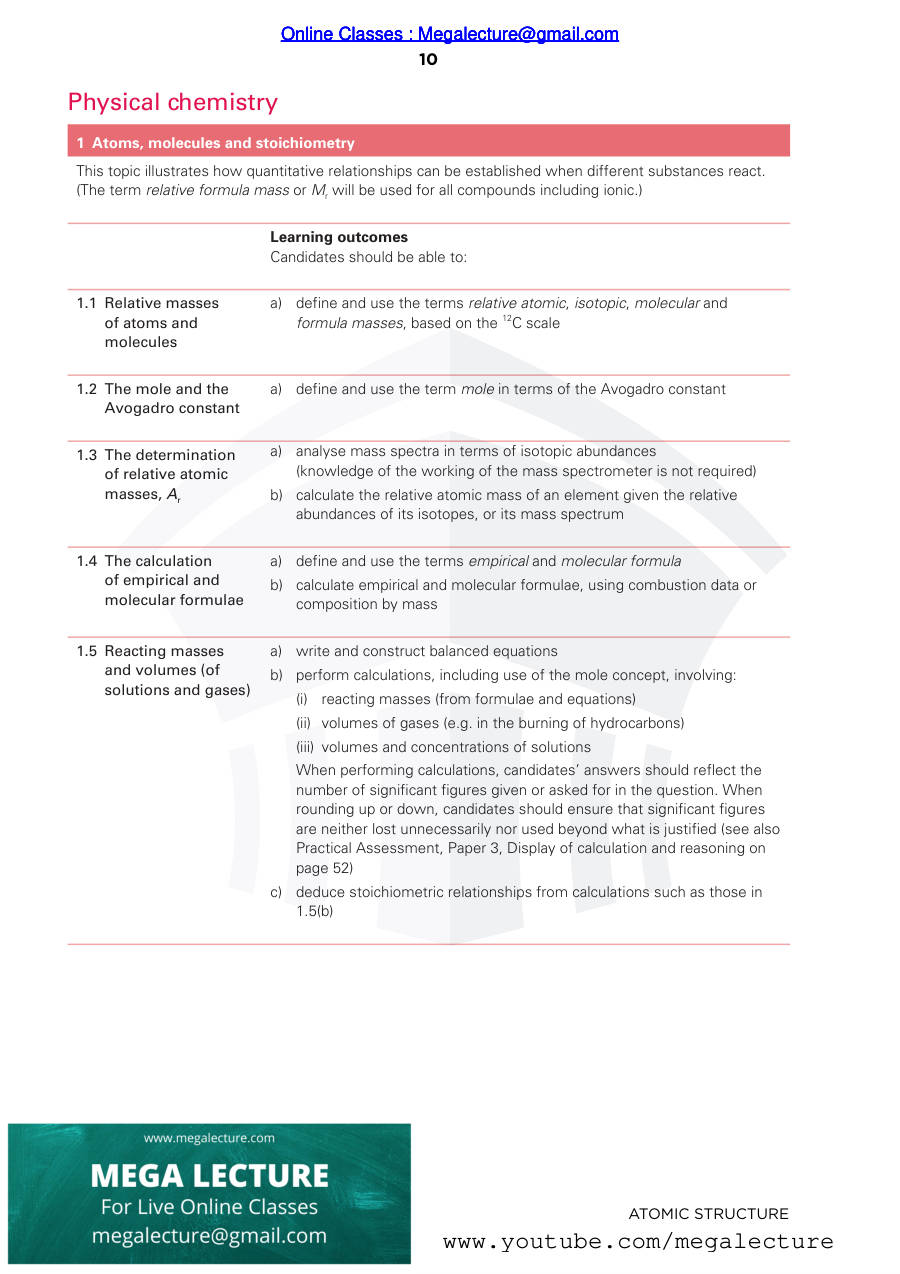
1 Atoms, molecules and stoichiometry
This topic illustrates how quantitative relationships can be established when different substances react. (The term relative formula mass or Mr will be used for all compounds including ionic.)
Learning outcomes Candidates should be able to:
1.1 Relative masses of atoms and molecules
- define and use the terms relative atomic, isotopic, molecular and formula masses, based on the 12C scale
1.2 The mole and the Avogadro constant
- define and use the term mole in terms of the Avogadro constant
1.3 The determination of relative atomic masses, Ar
- analyse mass spectra in terms of isotopic abundances
(knowledge of the working of the mass spectrometer is not required)
- calculate the relative atomic mass of an element given the relative abundances of its isotopes, or its mass spectrum
1.4 The calculation of empirical and molecular formulae
- define and use the terms empirical and molecular formula
- calculate empirical and molecular formulae, using combustion data or composition by mass
1.5 Reacting masses and volumes (of solutions and gases)
- write and construct balanced equations
- perform calculations, including use of the mole concept, involving:
- reacting masses (from formulae and equations)
- volumes of gases (e.g. in the burning of hydrocarbons)
(iii) volumes and concentrations of solutions
When performing calculations, candidates’ answers should reflect the number of significant figures given or asked for in the question. When rounding up or down, candidates should ensure that significant figures are neither lost unnecessarily nor used beyond what is justified (see also Practical Assessment, Paper 3, Display of calculation and reasoning on page 52)
- deduce stoichiometric relationships from calculations such as those in
1.5(b)
2 Atomic structure
This topic describes the type, number and distribution of the fundamental particles which make up an atom and the impact of this on some atomic properties.
Learning outcomes Candidates should be able to:
2.1 Particles in the atom
- identify and describe protons, neutrons and electrons in terms of their relative charges and relative masses
- deduce the behaviour of beams of protons, neutrons and electrons in electric fields
- describe the distribution of mass and charge within an atom
- deduce the numbers of protons, neutrons and electrons present in both atoms and ions given proton and nucleon numbers and charge
2.2 The nucleus of the atom
- describe the contribution of protons and neutrons to atomic nuclei in terms of proton number and nucleon number
- distinguish between isotopes on the basis of different numbers of neutrons present
- recognise and use the symbolism x y A for isotopes, where x is the nucleon number and y is the proton number
WHAT WE KNOW ABOUT ATOMS
Atoms are mostly empty space!
Atoms have 2 charged particles:
• Positively charged protons.
• Negatively charged electrons.
Atoms have 1 uncharged particle called a neutron.
The total number of protons, neutrons and electrons in any one atom determines its properties.
WHAT WE KNOW ABOUT ATOMS
the nucleus is very small; it contains the protons and the neutrons most of the volume of the atom is occupied by the electrons
THE STRUCTURE OF ATOMS
Mass / g Charge / C Relative mass Relative charge
PROTON 1.672 x 10⁻²⁴ 1.602 x 10⁻¹⁹ +1
NEUTRON 1.675 x 10⁻²⁴
ELECTRON 9.109 x 10⁻²⁸ 1.602 x 10⁻¹⁹ -1
EXAMPLE
Calculate the mass of a carbon-12 atom.
A neutral 12C atom has 6 protons, 6 neutrons, and 6 electrons. Therefore, its mass is:
(6 x 1.672 x 10-24) + (6 x 1.675 x 10-24) + (6 x 9.109 x 10-28)
= 2.0089 x 10⁻²³ g
BEHAVIOUR OF SUB ATOMIC PARTICLES
beam of particles e– p+ n
–
+
ISOTOPES
Isotopes are atoms with:
the same number of protons and electrons but different number of neutrons.
the same atomic number but different mass number
Chemical properties of isotopes are identical, whereas, physical properties (such as density) can differ.
ISOTOPES
protium deuterium neutron electron proton protons
1H 1H 1H
neutrons isotopic symbol tritium
ISOTOPES
Isotope Mass relative to hydrogen Relative abundance boron-10 10.0 20% boron-11 11.0 80% neon-20 20.0 91% neon-22 22.0 9% magnesium-24 24.0 79% magnesium-25 25.0 10% magnesium-26 26.0 11%
RELATIVE MASSES
The 12C (carbon-12) isotope is chosen as a standard and given a relative mass of exactly 12.
Important relative masses measured against this standard are:
Relative Atomic Mass (Ar)
The relative atomic mass (Ar) of an element is the weighted average mass of the naturally occurring isotopes of the element relative to one-twelfth the mass of the Carbon-12 isotope.
RELATIVE MASSES Relative Isotopic Mass
The relative isotopic mass of an element is the mass of an atom of the isotope of the element relative to one twelfth of the mass of an atom of the isotope carbon-12.
Relative Molecular Mass (Mr)
The relative molecular mass (Mr) of a compound is the mass of a molecule of that compound relative to one-twelfth the mass of the Carbon-12 isotope.
RELATIVE MASSES Relative Formula Mass
Used for ionic compounds and any formula of a species or ion e.g. NaCl or OH— etc…
SKILL CHECK 1
A How many protons, electrons and neutrons are present in a sulphide ion, S2-? Sulphur has atomic number 16 and mass number 32.
B How many protons, neutrons and electrons are present in a potassium ion, K+? Potassium has atomic number 19 and mass number 39.
MASS SPECTROMETER
A mass spectrometer is used to calculate the relative atomic mass of an atom by comparing it with the mass of a 12C atom.
You can also use a mass spectrometer to calculate the relative abundance of different isotopes of any element.
HOW DOES A MASS SPECTROMETER WORK?
inlet to inject sample heating filament to vaporize sample (stage 1) positive ions are accelerated in the electric field (stage 3) magnet (stage 4) lighest particles (deflected most) detector (stage 5) electron beam to ionize sample (stage 2)
S
N heaviest particles (deflected least)
HOW DOES A MASS SPECTROMETER WORK?
ZaZXigdc\jc hVbeaZ^dc^hZY
]^\]"ZcZg\n ZaZXigdch
+
–
+
HOW DOES A MASS SPECTROMETER WORK?
^dchVXXZaZgViZY
ZaZXig^X[^ZaY edh^i^kZ eaViZh cZ\Vi^kZ eaViZh
+
+ –
+ –
HOW DOES A MASS SPECTROMETER WORK?
bV\cZi^X[^ZaY
]ZVk^Zg^dch YZ[aZXiZY aZhh a^\]iZg^dch YZ[aZXiZY bdgZ
+
+
+
MASS SPECTRA
The mass spectrum is a plot of relative abundance (of each isotope) versus m/e or the mass number. The height of each peak indicates the relative abundance of the respective isotope.
BVhh/X]Vg\ZgVi^d c$p
&%#& &&#(
VgZVjcYZgeZV` ,-#+
') % '* '+
6WjcYVcXZ$
B\
MASS SPECTRA
BVhh/X]Vg\ZgVi^d c$p eZV`hYjZidB\' ^dch
') '* &' &( '+
6WjcYVcXZ$
B\
%
SKILL CHECK 2
The graph shows the mass spectrum of Neon.
- How many isotopes does Neon contain?
- What are the relative isotopic masses of the isotopes of Neon?
- What are the relative amounts of the isotopes of Neon?
SKILL CHECK 3
Calculate the average relative atomic mass of neon using the information below:
90.9%
0.3%
8.8%
Relative abundance/%
Mass/charge (m/e) ratio
SKILL CHECK 4
m/z
Relative abundance
19.9 (area under peak)
80.1 (area under peak)
Calculate the average relative atomic mass of an element producing the following peaks in its mass spectrum:
SKILL CHECK 5
Boron has two naturally occurring isotopes with the natural abundances shown. Calculate Boron’s relative atomic mass.
ISOTOPE NATURAL ABUNDANCE (%)
10B 19.9
11B 80.1
SKILL CHECK 6
Calculate the average relative atomic mass of lead using the information below:
Isotopic mass Relative abundance/%
SKILL CHECK 7
Calculate the average relative atomic mass of Germanium using the information below:
Mass/charge (m/e) ratio
Abundance / %
20.6 %
27.4 %
36.7 % 7.7 %
7.6 %
MASS SPECTRA: CALCULATING ABUNDANCE Naturally occurring potassium consists of potassium-39 and
potassium-41. Calculate the percentage of each isotope present if the average is 39.1:
Assume there are x nuclei of 39K in every 100, so there will be (100 – x) of 41K
This means that:
39x + 41 (100 – x) = 39.1
MASS SPECTRA: CALCULATING ABUNDANCE
therefore 39x + 4100 - 41x = 3910 thus
- 2x = - 190 x = 95
There will be 95% 39K and 5% 41K!
SKILL CHECK 8
Silver has two isotopes. 51.35% of the atoms are Silver-107 and 48.65% of the atoms are Silver-109. Calculate the relative atomic mass of Silver.
SKILL CHECK 9
The relative atomic mass of copper is 63.5. Calculate the relative abundance of the two copper isotopes with relative isotopic masses of 63.0 and 65.0
SKILL CHECK 10
Silver has two isotopes. 51.35% of the atoms are Silver-107 and 48.65% of the atoms are Silver-109. Calculate the relative atomic mass of Silver.
SKILL CHECK 11
A sample of element X contains 69% of 63X and 31% of 65X. What is the relative atomic mass of X in this sample?
SKILL CHECK 12
A sample of element X contains 69% of 63X and 31% of 65X. What is the relative atomic mass of X in this sample?
MASS SPECTRA: MOLECULAR IONS
Molecules also give peaks in their mass spectrum.
For example the mass spectrum of chlorine gaseous molecule includes both peaks of its isotopes and peaks of its molecular form (molecular ions):
MASS SPECTRA: MOLECULAR IONS
Cl2+ molecular ion produces three peaks:
peak at m/e @ 70: 35Cl - 35Cl Species responsible: 70Cl2+ peak at m/e @ 72: 35Cl - 37Cl Species responsible: 72Cl2+ peak at m/e @ 74: 37Cl - 37Cl Species responsible: 74Cl2+
