
GCSE · Biology · AQA GCSE Biology Notes: Bioenergetics (Topic 4)
AQA GCSE Biology Notes: Bioenergetics (Topic 4)
Opens inside this page. Prefer your own PDF app? Open the PDF.
Check yourself
5 quick questions on GCSE Biology
Tap an answer to see if you are right, and why. Free, no sign-up.
Start the free testWas this note useful?
Full text of AQA GCSE Biology Notes: Bioenergetics (Topic 4)
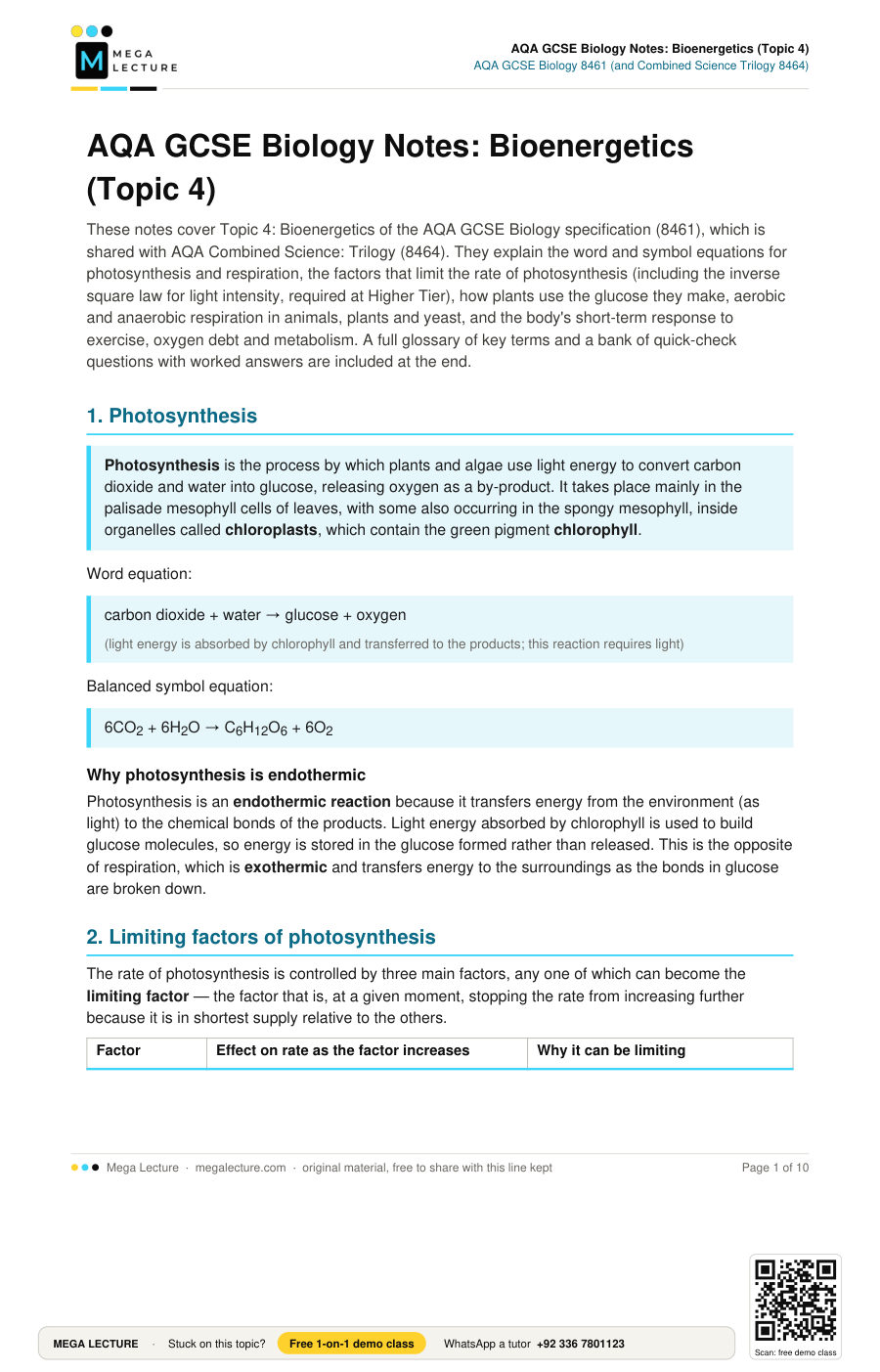
These notes cover Topic 4: Bioenergetics of the AQA GCSE Biology specification (8461), which is shared with AQA Combined Science: Trilogy (8464). They explain the word and symbol equations for photosynthesis and respiration, the factors that limit the rate of photosynthesis (including the inverse square law for light intensity, required at Higher Tier), how plants use the glucose they make, aerobic and anaerobic respiration in animals, plants and yeast, and the body's short-term response to exercise, oxygen debt and metabolism. A full glossary of key terms and a bank of quick-check questions with worked answers are included at the end.
1. Photosynthesis
Photosynthesis is the process by which plants and algae use light energy to convert carbon dioxide and water into glucose, releasing oxygen as a by-product. It takes place mainly in the palisade mesophyll cells of leaves, with some also occurring in the spongy mesophyll, inside organelles called chloroplasts, which contain the green pigment chlorophyll.
Word equation:
carbon dioxide + water → glucose + oxygen
(light energy is absorbed by chlorophyll and transferred to the products; this reaction requires light)
Balanced symbol equation:
6CO2 + 6H2O → C6H12O6 + 6O2
Why photosynthesis is endothermic
Photosynthesis is an endothermic reaction because it transfers energy from the environment (as light) to the chemical bonds of the products. Light energy absorbed by chlorophyll is used to build glucose molecules, so energy is stored in the glucose formed rather than released. This is the opposite of respiration, which is exothermic and transfers energy to the surroundings as the bonds in glucose are broken down.
2. Limiting factors of photosynthesis
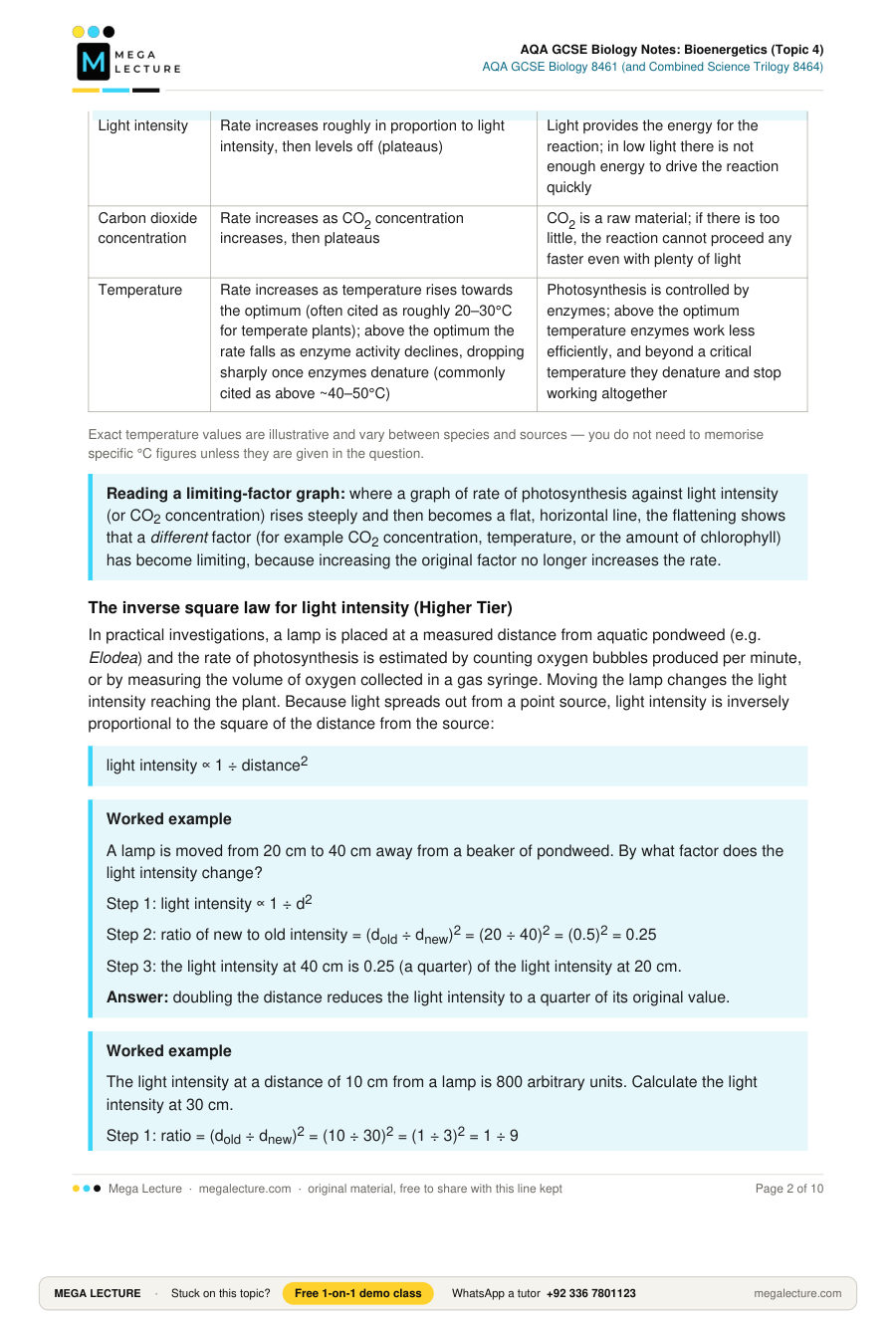
The rate of photosynthesis is controlled by three main factors, any one of which can become the limiting factor — the factor that is, at a given moment, stopping the rate from increasing further because it is in shortest supply relative to the others.
| Factor | Effect on rate as the factor increases | Why it can be limiting |
|---|---|---|
| Light intensity | Rate increases roughly in proportion to light intensity, then levels off (plateaus) | Light provides the energy for the reaction; in low light there is not enough energy to drive the reaction quickly |
| Carbon dioxide concentration | Rate increases as CO2 concentration increases, then plateaus | CO2 is a raw material; if there is too little, the reaction cannot proceed any faster even with plenty of light |
| Temperature | Rate increases as temperature rises towards the optimum (often cited as roughly 20–30°C for temperate plants); above the optimum the rate falls as enzyme activity declines, dropping sharply once enzymes denature (commonly cited as above ~40–50°C) | Photosynthesis is controlled by enzymes; above the optimum temperature enzymes work less efficiently, and beyond a critical temperature they denature and stop working altogether |
Exact temperature values are illustrative and vary between species and sources — you do not need to memorise specific °C figures unless they are given in the question.
Reading a limiting-factor graph: where a graph of rate of photosynthesis against light intensity (or CO2 concentration) rises steeply and then becomes a flat, horizontal line, the flattening shows that a different factor (for example CO2 concentration, temperature, or the amount of chlorophyll) has become limiting, because increasing the original factor no longer increases the rate.
The inverse square law for light intensity (Higher Tier)
In practical investigations, a lamp is placed at a measured distance from aquatic pondweed (e.g. Elodea) and the rate of photosynthesis is estimated by counting oxygen bubbles produced per minute, or by measuring the volume of oxygen collected in a gas syringe. Moving the lamp changes the light intensity reaching the plant. Because light spreads out from a point source, light intensity is inversely proportional to the square of the distance from the source:
light intensity ∝ 1 ÷ distance2
Worked example
A lamp is moved from 20 cm to 40 cm away from a beaker of pondweed. By what factor does the light intensity change?
Step 1: light intensity ∝ 1 ÷ d2
Step 2: ratio of new to old intensity = (dold ÷ dnew)2 = (20 ÷ 40)2 = (0.5)2 = 0.25
Step 3: the light intensity at 40 cm is 0.25 (a quarter) of the light intensity at 20 cm.
Answer: doubling the distance reduces the light intensity to a quarter of its original value.
Worked example
The light intensity at a distance of 10 cm from a lamp is 800 arbitrary units. Calculate the light intensity at 30 cm.
Step 1: ratio = (dold ÷ dnew)2 = (10 ÷ 30)2 = (1 ÷ 3)2 = 1 ÷ 9
Step 2: new intensity = 800 × (1 ÷ 9) = 88.9 units (3 s.f.)
Answer: approximately 88.9 arbitrary units.
Required practical: investigating light intensity and the rate of photosynthesis
Aim: to find out how light intensity affects the rate of photosynthesis in an aquatic plant such as Elodea.
Method outline:
- Cut a length of pondweed and place it, cut end up, in a boiling tube of water with a small amount of sodium hydrogencarbonate solution (to provide a source of dissolved carbon dioxide).
- Set up a lamp at a measured distance from the tube and leave the plant to acclimatise for a short time.
- Count the number of oxygen bubbles given off from the cut end in one minute, or measure the volume of gas collected using a gas syringe or an inverted funnel and graduated tube.
- Repeat at several different lamp distances, keeping everything else the same, and repeat each distance at least twice to calculate a mean.
Independent variable: distance of the lamp from the pondweed (used to calculate relative light intensity).
Dependent variable: number of bubbles per minute, or volume of gas produced per minute.
Control variables: temperature of the water (kept constant, e.g. using a water bath), concentration of dissolved carbon dioxide, and the length/species of pondweed used.
Counting bubbles is a quick but imprecise method because bubble size can vary; measuring gas volume with a syringe gives more reliable, repeatable data.
Leaf structure and photosynthesis
Photosynthesis happens mainly in the palisade mesophyll cells near the top of the leaf, which are packed with chloroplasts and positioned to absorb the most light; carbon dioxide and oxygen diffuse to and from these cells via the spongy mesophyll's air spaces and the stomata. The full structure of the leaf as an organ (epidermis, both mesophyll layers, stomata, guard cells and the cuticle) is Organisation-topic content — see the Organisation notes for the labelled detail.
3. Uses of glucose made in photosynthesis
Plants do not only use glucose for respiration. Glucose made in photosynthesis is used by the plant in several ways:
- used in respiration, transferring energy for the plant's life processes
- converted into insoluble starch for storage, for example in roots, tubers and seeds, because starch does not affect the water potential of cells
- used to produce cellulose, which strengthens cell walls
- combined with nitrate ions absorbed from the soil to make amino acids, which are then built into proteins
- converted into lipids (fats and oils) for storage of energy, for example in seeds
Before being used or stored, sugars made in photosynthesis (mainly as sucrose) are moved out of the leaf to other parts of the plant by translocation, through living transport cells called the phloem.
4. Aerobic respiration
Respiration is an exothermic reaction that continuously occurs in living cells, transferring energy from glucose for use in cell processes such as movement, growth, repair, cell division, keeping warm and active transport.
Aerobic respiration uses oxygen to fully break down glucose and transfer a relatively large amount of energy. It takes place continuously in most plant and animal cells, mainly in the mitochondria.
Word equation:
glucose + oxygen → carbon dioxide + water
Symbol equation:
C6H12O6 + 6O2 → 6CO2 + 6H2O
5. Anaerobic respiration
Anaerobic respiration is the incomplete breakdown of glucose without using oxygen. Because the glucose is not fully oxidised, much less energy is transferred per glucose molecule than in aerobic respiration, and the products differ between animals and plants/yeast.
Anaerobic respiration in animals (muscles)
During vigorous exercise, the muscles may not receive oxygen fast enough for aerobic respiration alone to meet demand, so muscle cells also respire anaerobically, producing lactic acid.
glucose → lactic acid
The build-up of lactic acid in muscles is associated with muscle fatigue and cramp, and contributes to oxygen debt (see section 6).
Anaerobic respiration in plants and fungi (fermentation)
Plant cells (e.g. root cells in waterlogged soil) and single-celled fungi such as yeast can respire anaerobically. This process, when carried out by yeast, is called fermentation and produces ethanol and carbon dioxide instead of lactic acid.
Word equation:
glucose → ethanol + carbon dioxide
Symbol equation:
C6H12O6 → 2C2H5OH + 2CO2
Fermentation by yeast is used commercially in brewing (producing ethanol) and in bread-making (the carbon dioxide produced makes dough rise).
Comparing aerobic and anaerobic respiration
| Feature | Aerobic respiration | Anaerobic respiration |
|---|---|---|
| Oxygen needed? | Yes | No |
| Glucose breakdown | Complete | Incomplete |
| Energy transferred per glucose molecule | Relatively large | Relatively small |
| Products in animals | Carbon dioxide + water | Lactic acid |
| Products in plants/yeast | Carbon dioxide + water | Ethanol + carbon dioxide |
| When it dominates | Normal, resting conditions | Vigorous exercise (animals); low-oxygen conditions (plants, yeast) |
Evidence for respiration
Respiration in living organisms can be demonstrated experimentally. For example, if air is drawn through limewater from a container holding germinating seeds or small invertebrates, the limewater turns cloudy (milky) much faster than air from a container without organisms, because respiration releases carbon dioxide, which reacts with limewater to form an insoluble precipitate. A rise in temperature inside an insulated container of germinating seeds, compared with a container of dead (boiled) seeds, provides further evidence, since respiration is exothermic and transfers energy to the surroundings as heat.
6. Response to exercise, oxygen debt and metabolism
How the body responds to exercise
During exercise, muscles need more energy, so the demand for glucose and oxygen increases and more carbon dioxide must be removed. The body responds by:
- increasing heart rate, so blood carrying oxygen and glucose reaches the muscles faster and carbon dioxide is carried away more quickly
- increasing the rate and depth of breathing, so more oxygen is absorbed into the blood and more carbon dioxide is removed from it
- diverting more blood flow to the muscles
Oxygen debt
Oxygen debt is the extra oxygen the body needs after vigorous exercise to react with the lactic acid that has built up in the muscles during anaerobic respiration, converting it back into glucose (mainly in the liver). This is why breathing rate and heart rate stay high for some time after exercise stops.
Much of the lactic acid is carried in the blood to the liver, where it is converted back into glucose using the extra oxygen taken in during recovery.
Worked example
After a sprint, an athlete has an oxygen debt of 6 dm3. During recovery she breathes in an extra 1.5 dm3 of oxygen per minute above her resting rate. Calculate how many minutes of recovery are needed to repay the oxygen debt.
Step 1: time = oxygen debt ÷ extra oxygen taken in per minute
Step 2: time = 6 ÷ 1.5
Step 3: time = 4 minutes
Answer: 4 minutes.
Metabolism
Metabolism is the sum of all the chemical reactions that occur in a cell or in the body. The energy transferred by respiration is used to build larger molecules from smaller ones, for example:
- glucose is converted to starch, glycogen or cellulose for storage or structure
- glycerol and fatty acids are combined to form lipids
- glucose and nitrate ions are used to form amino acids, which are then joined to form proteins
Excess amino acids cannot be stored, so they are broken down in the liver in a process called deamination, forming urea, which is then excreted by the kidneys in urine.
Key terms
| Term | Definition |
|---|---|
| Photosynthesis | The process by which plants and algae use light energy to convert carbon dioxide and water into glucose, producing oxygen as a by-product. |
| Chlorophyll | The green pigment found in chloroplasts that absorbs light energy for use in photosynthesis. |
| Chloroplast | The organelle in plant and algal cells where photosynthesis takes place. |
| Endothermic reaction | A reaction that takes in energy from the surroundings; photosynthesis is endothermic. |
| Exothermic reaction | A reaction that transfers energy to the surroundings; respiration is exothermic. |
| Limiting factor | A factor, such as light intensity, carbon dioxide concentration or temperature, that restricts the rate of photosynthesis when it is in short supply. |
| Light intensity | The amount of light energy reaching a given area in a given time. |
| Carbon dioxide concentration | The amount of carbon dioxide present in the air or water surrounding a plant; a raw material for photosynthesis. |
| Optimum temperature | The temperature at which an enzyme-controlled reaction proceeds at its fastest rate. |
| Denature | A permanent change to the shape of an enzyme's active site, usually caused by high temperature or extreme pH, so it can no longer catalyse its reaction. |
| Inverse square law | The rule that light intensity from a point source is proportional to 1 divided by the square of the distance from the source. |
| Rate of photosynthesis | The speed at which a plant produces glucose, or the oxygen and carbon dioxide used to measure it, per unit time. |
| Glucose | A simple sugar; the direct product of photosynthesis and the substrate broken down in respiration. |
| Starch | An insoluble carbohydrate made from glucose, used by plants as a storage molecule. |
| Cellulose | A carbohydrate made from glucose that strengthens plant cell walls. |
| Lipid | A fat or oil, made from glycerol and fatty acids, used by cells for long-term energy storage. |
| Amino acid | A small molecule, made from glucose and nitrate ions in plants, that joins with others to form proteins. |
| Protein | A large molecule made of chains of amino acids, used for growth, repair and as enzymes. |
| Nitrate ion | A mineral ion absorbed from the soil by plant roots and combined with glucose to make amino acids. |
| Respiration | A continuous exothermic reaction in living cells that transfers energy from glucose for use in cell processes. |
| Aerobic respiration | The complete breakdown of glucose using oxygen, transferring a relatively large amount of energy. |
| Anaerobic respiration | The incomplete breakdown of glucose without using oxygen, transferring less energy than aerobic respiration. |
| Fermentation | Anaerobic respiration carried out by yeast, producing ethanol and carbon dioxide. |
| Lactic acid | The product formed in animal muscle cells during anaerobic respiration. |
| Ethanol | An alcohol produced, together with carbon dioxide, by fermentation in yeast. |
| Yeast | A single-celled fungus capable of respiring anaerobically to produce ethanol and carbon dioxide. |
| Mitochondria | The organelles (singular: mitochondrion) in cells where most aerobic respiration reactions take place. |
| Oxygen debt | The extra oxygen needed by the body after exercise to react with the lactic acid built up during anaerobic respiration, converting it back into glucose (mainly in the liver). |
| Metabolism | The sum of all the chemical reactions taking place in a cell or in the body. |
| Deamination | The breakdown of excess amino acids in the liver, producing urea. |
| Urea | A waste substance formed from the breakdown of excess amino acids and excreted by the kidneys in urine. |
| Heart rate | The number of times the heart beats in one minute. |
| Breathing rate | The number of breaths taken in one minute. |
| Depth of breathing | The volume of air moved into and out of the lungs with each breath. |
| Muscle fatigue | Temporary loss of power or efficiency in a muscle, associated with a build-up of lactic acid. |
| Palisade mesophyll | The layer of tall, tightly packed cells near the upper surface of a leaf that contains most of the chloroplasts and carries out most photosynthesis. |
| Spongy mesophyll | The layer of loosely packed leaf cells with large air spaces that allow gases to diffuse to and from the palisade cells. |
| Stomata | Small pores, mainly on the lower surface of a leaf, through which gases move in and out during photosynthesis and respiration. |
| Guard cell | A cell that changes shape to open or close a stoma, controlling gas exchange and water loss. |
| Cuticle | A waxy, waterproof layer covering the upper epidermis of a leaf that reduces water loss. |
| Independent variable | The factor that is deliberately changed in an investigation. |
| Dependent variable | The factor that is measured in an investigation as the independent variable is changed. |
| Control variable | A factor that is kept the same during an investigation so that it does not affect the result. |
| Mean | The average of a set of repeated results, found by adding them and dividing by the number of readings, used to improve reliability. |
| Word equation | An equation describing a reaction using the names of the reactants and products. |
| Symbol equation | An equation describing a reaction using the chemical formulae of the reactants and products. |
| Balanced equation | A symbol equation in which the number of atoms of each element is the same on both sides of the arrow. |
| Vigorous exercise | Exercise intense enough that the muscles' demand for oxygen exceeds the rate at which it can be supplied by the blood. |
| Recovery period | The time after exercise during which breathing and heart rate remain raised while the oxygen debt is repaid. |
| Liver | The organ that converts lactic acid carried in the blood back into glucose using oxygen taken in during recovery, and that carries out deamination. |
| Kidney | The organ that removes urea from the blood and excretes it as part of urine. |
| Enzyme | A biological catalyst, made of protein, that speeds up a specific reaction (such as those in photosynthesis or respiration) without being used up. |
| Translocation | The movement of dissolved sugars made in photosynthesis, mainly through the phloem, to other parts of the plant. |
| Phloem | Plant tissue made of living cells that transports dissolved sugars around the plant. |
| Glycogen | A storage carbohydrate made from glucose in animal cells, particularly in the liver and muscles. |
| Limewater test | A test in which limewater turns cloudy in the presence of carbon dioxide, used as evidence that respiration is occurring. |
Quick check
- Name the two raw materials needed for photosynthesis. [2]
- State the word equation for aerobic respiration. [2]
- Define the term "limiting factor" as it applies to photosynthesis. [1]
- Describe how the rate of photosynthesis changes as light intensity increases from a low starting level, and what happens to the rate at high light intensity. [2]
- Explain why photosynthesis is described as an endothermic reaction. [2]
- Explain why the rate of photosynthesis falls sharply at temperatures above about 45°C. [2]
- [HT] A lamp used in a pondweed experiment is moved from 15 cm to 45 cm from the plant. Calculate the factor by which the light intensity changes. Show your working. [3]
- Compare aerobic and anaerobic respiration in muscle cells, in terms of the products formed and the amount of energy transferred per glucose molecule. [4]
- Describe what happens to a person's breathing rate and heart rate during and immediately after vigorous exercise, and explain why these changes occur. [4]
- Explain what is meant by "oxygen debt" and describe how the body repays it. [3]
- A sprinter builds up an oxygen debt of 9 dm3. During recovery she breathes in an extra 1.8 dm3 of oxygen per minute above her resting rate. Calculate how many minutes of recovery are needed to repay the oxygen debt. [2]
- Discuss the claim that "anaerobic respiration is always less useful to an organism than aerobic respiration", using your knowledge of yeast and exercising muscle to support your answer. [4]
Answers
1. Carbon dioxide and water. [2] (1 mark each)
2. glucose + oxygen → carbon dioxide + water [2]
3. A limiting factor is a factor (such as light intensity, carbon dioxide concentration or temperature) whose availability restricts the rate of a reaction, even when the other factors needed are in plentiful supply. [1]
4. As light intensity increases from a low level, the rate of photosynthesis increases (roughly in proportion to light intensity); at higher light intensities the rate levels off and becomes constant (a horizontal plateau) because another factor, such as carbon dioxide concentration or temperature, has become limiting. [2]
5. Photosynthesis is endothermic because it transfers energy from the environment, in the form of light, into the chemical bonds of the products formed; the glucose produced stores more energy than the carbon dioxide and water it was made from, so energy has been taken in overall. [2]
6. Above about 45°C the enzymes that catalyse the reactions of photosynthesis begin to denature, so their active site changes shape and they can no longer catalyse the reaction as effectively, causing the rate to fall. [2]
7. [HT] ratio = (15 ÷ 45)2 = (1/3)2 = 1/9, so the light intensity falls to one ninth (1/9) of its original value. [3] (1 mark for correct method, 1 mark for correct ratio, 1 mark for correct conclusion)
8. Aerobic respiration uses oxygen and completely breaks down glucose into carbon dioxide and water, transferring a relatively large amount of energy; anaerobic respiration in muscle cells does not use oxygen, only partially breaks down glucose into lactic acid, and transfers much less energy per glucose molecule. [4]
9. Both breathing rate and depth, and heart rate, increase during exercise, to deliver oxygen and glucose to the muscles more quickly and remove carbon dioxide faster; they remain raised for some time after exercise stops because extra oxygen is needed to deal with the lactic acid that built up during anaerobic respiration (oxygen debt) before the body can return to its resting state. [4]
10. Oxygen debt is the extra oxygen the body needs after exercise to react with the lactic acid that accumulated in the muscles during anaerobic respiration. It is repaid by continuing to breathe faster and more deeply than at rest so that lactic acid, carried in the blood to the liver, can be converted back into glucose using this extra oxygen. [3]
11. time = oxygen debt ÷ extra oxygen per minute = 9 ÷ 1.8 = 5 minutes. [2]
12. A good answer recognises that although anaerobic respiration transfers less energy per glucose molecule and produces lactic acid (causing fatigue) or ethanol, it is still valuable: it allows muscles to keep contracting for short, intense bursts of activity when the blood cannot supply oxygen fast enough (e.g. sprinting), and it allows yeast to survive, grow and be used commercially when no oxygen is available. The conclusion should be that anaerobic respiration is not simply worse, but suited to different circumstances from aerobic respiration. [4]
