
A Level · Chemistry 9701 · Thermodynamics & Energetics
Set A
Need more than one subject? All-notes pass: unlimited downloads of every note for a year: unlimited downloads of every note on the site, PKR 999 a year. All packs and courses.
Opens inside this page. Prefer your own PDF app? Open the PDF.
Chemistry batch classes: coming soon. Small live classes at a lower fee than one-to-one. Join the waiting list
Check yourself
5 quick questions on A Level Chemistry
Tap an answer to see if you are right, and why. Free, no sign-up.
Start the free test👍 17 students found these notes useful
Was this note useful?
Full text of Set A
ENTROPY Fahad H. Ahmad www.megalecture.com www.youtube.com/megalecture
Free notes, practice tests and live classes Back to megalecture.com www.MEGALECTURE.com s/16/qp41 www.MEGALECTURE.com
S/16/qp42 www.MEGALECTURE.com
S/16/qp43 www.MEGALECTURE.com m/17/qp42 www.MEGALECTURE.com www.MEGALECTURE.com www.MEGALECTURE.com w/16/qp43 www.MEGALECTURE.com
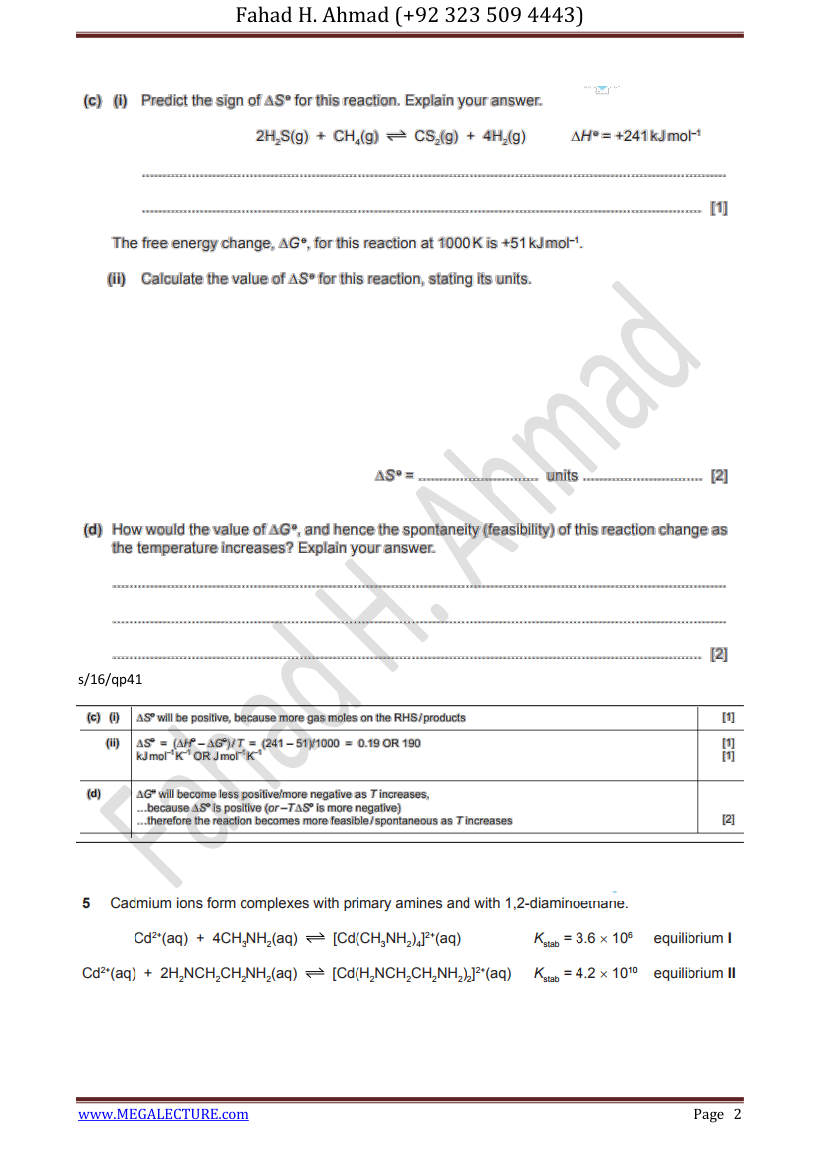
2016 Specimen Paper Question on Entropy
www.MEGALECTURE.com www.MEGALECTURE.com
Marking Scheme www.MEGALECTURE.com
IB QUESTIONS on ENTROPY
- Which change leads to an increase in entropy?
A. CO2(g) → CO2(s)
B. SF6(g) → SF6(l)
C. H2O(l) → H2O(s)
D. NaCl(s) → NaCl(aq)
(Total 1 mark)
- The reaction between but-1-ene and water vapour produces butan-1-ol.
C4H8(g) + H2O(g) → C4H9OH(l)
The standard entropy values (SO) for but-1-ene, water vapour and butan-1-ol are 310, 189 and 228 J K–1 mol–1 respectively. What is the standard entropy change for this reaction in J K–1 mol–1?
A. –271
B. +271
C. –107
D. +107
(Total 1 mark)
- What are the signs of ∆Hο and ∆Sο for a reaction that is non-spontaneous at low temperature but spontaneous at high temperature?
Hο Sο
A. – –
B. + –
C. – +
D. + +
(Total 1 mark) www.MEGALECTURE.com
- Consider the following reaction:
N2(g) + 3H2(g) 2NH3(g)
- Suggest why this reaction is important for humanity.
(1)
- Using the average bond enthalpy values in Table 10 of the Data Booklet, calculate the standard enthalpy change for this reaction.
(4)
(iii) The absolute entropy values, S, at 238 K for N2(g), H2(g) and NH3(g) are 192, 131 and 193 J K–1 mol–1 respectively. Calculate ∆Sο for the reaction and explain the sign of ∆Sο. (2)
- Calculate ∆Gο for the reaction at 238 K. State and explain whether the reaction is spontaneous.
(3)
- If ammonia was produced as a liquid and not as a gas, state and explain the effect this would have on the value of ∆Hο for the reaction.
- (Total 12 marks)
- Which reaction causes a decrease in the entropy of the system?
A. CaCO3(s) → CaO(s) + CO2(g)
B. 2H2(g) + O2(g) → 2H2O(l)
C. 2C(s) + O2(g) → 2CO(g)
D. 2SO3(g) → 2SO2(g) + O2(g) (Total 1 mark) www.MEGALECTURE.com
- Consider the following reaction.
2CH3OH(g) + H2(g) → C2H6(g) + 2H2O(g)
- The standard enthalpy change of formation for CH3OH(g) at 298 K is –201 kJ mol–1 and for H2O(g) is –242 kJ mol–1. Using information from Table 11 of the Data Booklet, determine the enthalpy change for this reaction. (Check the Marking Scheme for Missing Data)
......................................................................................................................................
......................................................................................................................................
......................................................................................................................................
(2)
- The standard entropy for CH3OH(g) at 298 K is 238 J K–1 mol–1, for H2(g) is 131 J K–1 mol–1 and for H2O(g) is 189 J K–1 mol–1. Using information from Table 11 (Check Marking Scheme) of the Data Booklet, determine the entropy change for this reaction.
......................................................................................................................................
......................................................................................................................................
......................................................................................................................................
- www.MEGALECTURE.com
- Calculate the standard change in free energy, at 298 K, for the reaction and deduce whether the reaction is spontaneous or non-spontaneous.
......................................................................................................................................
......................................................................................................................................
......................................................................................................................................
......................................................................................................................................
......................................................................................................................................
......................................................................................................................................
- (Total 7 marks)
- What is the standard entropy change, ∆SO, for the following reaction?
2CO(g) + O2(g) → 2CO2(g)
CO(g) O2(g) CO2(g)
SO/J K–1 mol–1
A. –189
B. –173
C. +173
D. +189
(Total 1 mark) www.MEGALECTURE.com
- A reaction has a standard enthalpy change, ΔHO, of +10.00 kJ mol–1 at 298 K. The standard entropy change, ΔSO, for the same reaction is +10.00 J K–1 mol–1. What is the value of ΔGO for the reaction in kJ mol–1?
A. +9.75
B. +7.02
C. –240
D. –2970
(Total 1 mark)
- Which reaction has the greatest increase in entropy?
A. C3H8(g) + 5O2(g) → 3CO2(g) + 4H2O(g)
B. H2(g) + Cl2(g) → 2HCl(g)
C. N2(g) + 3H2(g) → 2NH3(g)
D. C2H4(g) + H2(g) → C2H6(g)
(Total 1 mark)
- Which reaction has the largest increase in entropy?
A. H2(g) + Cl2(g) → 2HCl(g)
B. Al(OH)3(s) + NaOH(aq) → Al(OH)4
–(aq) + Na+(aq)
C. Na2CO3(s) + 2HCl(aq) → 2NaCl(aq) + CO2(g) + H2O(l)
D. BaCl2(aq) + Na2SO4(aq) → BaSO4(s) + 2NaCl(aq)
(Total 1 mark) www.MEGALECTURE.com
- When hydrogen peroxide decomposes, the temperature of the reaction mixture increases.
2H2O2(aq) → O2(g) + 2H2O(l)
What are the signs of ∆H, ∆S and ∆G for this reaction?
∆H ∆S ∆G
A. – – –
B. – + –
C. + + –
D. – + +
(Total 1 mark)
- Which reaction has the greatest increase in entropy?
A. SO2(g) + 2H2S(g) → 2H2O(l) + 3S(s)
B. CaO(s) + CO2(g) → CaCO3(s)
C. CaC2(s) + 2H2O(l) → Ca(OH)2(s) + C2H2(g)
D. N2(g) + O2(g) → 2NO(g)
(Total 1 mark)
- ∆GO calculations predict that a reaction is always spontaneous for which of the following combinations of ∆HO and ∆SO?
A. +∆HO and +∆SO
B. +∆HO and –∆SO
C. –∆HO and –∆SO
D. –∆HO and +∆SO
(Total 1 mark) www.MEGALECTURE.com
- Some words used in chemistry can have a specific meaning which is different to their meaning in everyday English.
State what the term spontaneous means when used in a chemistry context.
................................................................................................................................................
................................................................................................................................................
(Total 1 mark)
- Propene can be hydrogenated in the presence of a nickel catalyst to form propane. Use the data below to answer the questions that follow.
Compound Formula ∆HO f / kJ mol–1 SO/ J K–1 mol–1
hydrogen H2(g) + 131 propane C3H8(g)
- 104 + 270 propene C3H6(g) + 20.4 + 267
- Outline why the value for the standard enthalpy change of formation of hydrogen is zero.
......................................................................................................................................
......................................................................................................................................
(1)
- Calculate the standard enthalpy change for the hydrogenation of propene.
......................................................................................................................................
......................................................................................................................................
......................................................................................................................................
......................................................................................................................................
- www.MEGALECTURE.com
(iii) Calculate the standard entropy change for the hydrogenation of propene.
......................................................................................................................................
......................................................................................................................................
......................................................................................................................................
......................................................................................................................................
(2)
- Determine the value of ∆GO for the hydrogenation of propene at 298 K.
......................................................................................................................................
......................................................................................................................................
......................................................................................................................................
......................................................................................................................................
(2)
- At 298 K the hydrogenation of propene is a spontaneous process. Determine the temperature above which propane will spontaneously decompose into propene and hydrogen.
......................................................................................................................................
......................................................................................................................................
......................................................................................................................................
......................................................................................................................................
- (Total 9 marks) www.MEGALECTURE.com
- (Not in Syllabus) What is the standard free energy change, ∆GO, in kJ, for the following reaction?
C2H5OH(l) + 3O2(g) → 2CO2(g) + 3H2O(g)
Compound ∆Gf O / kJ mol–1
C2H5OH(l) –175
CO2(g) –394
H2O(g) –229
O2(g)
A. –1650
B. –1300
C.
- 448
D. +1300
(Total 1 mark)
- Which reaction has the most negative change in entropy?
A. 2SO2(g) + O2(g) → 2SO3(g)
B. NH4Cl(s) → NH3(g) + HCl(g)
C. PbCl2(s) → Pb2+(aq) + 2Cl–(aq)
D. C(s) + O2(g) → CO2(g)
(Total 1 mark)
MARKING SCHEME
- D
[1]
- A
[1]
- D
[1] www.MEGALECTURE.com
- (i) fertilizers / increasing crop yields; production of explosives for mining; 1 max
- H = (sum of energies of bonds broken) – (sum of energies of bonds formed);
Can be implied by working.
correct substitution of values and numbers of bonds broken; correct substitution of values and numbers of bonds made; (H = (NN) + 3(H–H) – 6(N–H) = 944 + 3(436) – 6(388) =) –76.0 (kJ);
Allow ECF. Do not penalize for sig. fig. or units. Award [4] for correct final answer.
(iii) (Sο[2×193] – [192 + 3×131]) = –199 (J K–1 mol–1);
Allow ECF. four gaseous molecules generating two gaseous molecules / fewer molecules of gas;
- (Gο = Hο – TSο = –76.0 – 298(–0.199)) = –16.7 (kJ); Spontaneous; G is negative;
Do not penalize for SF.
- heat released when gas → liquid; Hο becomes more negative; [12]
- B
[1]
- (a) ∆HO reaction = Σ∆Hf
O(products) – Σ∆Hf
O(reactants) = [(1)(–85) + (2)(–242)] – [(2)(–201)]; = –167 (kJ/kJ mol–1); Award [1] for (+) 167.
- ∆SO reaction = ΣSO(products) – ΣSO(reactants) = [(1)(230) + (2)(189)] – [(2)(238) + (1)(131)];
www.MEGALECTURE.com
= 1 (J K–1/J K–1 mol–1);
- ∆GO reaction = (∆HO – T∆SO) = (–167) – (298)(0.001); Award [1] for correct substitution of values.
= –167 kJ/–167000 J; Units needed for mark in (c) only. Accept –167 kJ mol–1 or –167000 J mol–1.
spontaneous;
Award marks for final correct answers throughout in each of (a), (b) and (c). [7]
- B
[1]
- B
[1]
- A
[1]
- C
[1]
- B
[1] www.MEGALECTURE.com
- C
[1]
- D
[1]
- the reaction gives out (Gibbs Free) energy that can do work; ∆G for the reaction has a negative value; a reaction that occurs without adding energy (beyond that required to overcome energy barrier); 1 max [1]
- (i) by definition ∆Hh
O of elements (in their standard states) is zero / no reaction involved / OWTTE;
- ∆H = –104 – (+20.4); = –124.4 (kJ mol–1); Award [1 max] for 124.4 (kJ mol–1). Award [2] for correct final answer.
(iii) ∆S = 270 – (267 + 131); = –128 (J K mol–1); Award [1 max] for +128 (J K–1 mol–1). Award [2] for correct final answer.
- ∆G = ∆H – T∆S = –124.4 – ;
= –86.3 kJ mol–1; Units needed for the mark. Award [2] for correct final answer. Allow ECF if only one error in first marking point.
- ∆G = ∆H – T∆S = 0 / ∆H = T∆S;
T = = 972 K / 699 °C;
Only penalize incorrect units for T and inconsistent ΔS value once in (iv) and (v).
) ( −
/ 4. −
− www.MEGALECTURE.com
[9]
- B
[1]
- A
[1] www.MEGALECTURE.com
SHOEIFFAT QUESTIONS
www.MEGALECTURE.com www.MEGALECTURE.com
