
A Level · Accounting 9706 · Joint venture accounts: A Level Accounting notes and worked example
Joint venture accounts: A Level Accounting notes and worked example
The Daily 5 Five questions a day on A Level Accounting: two minutes, new every day, with a streak to keep Play today’s →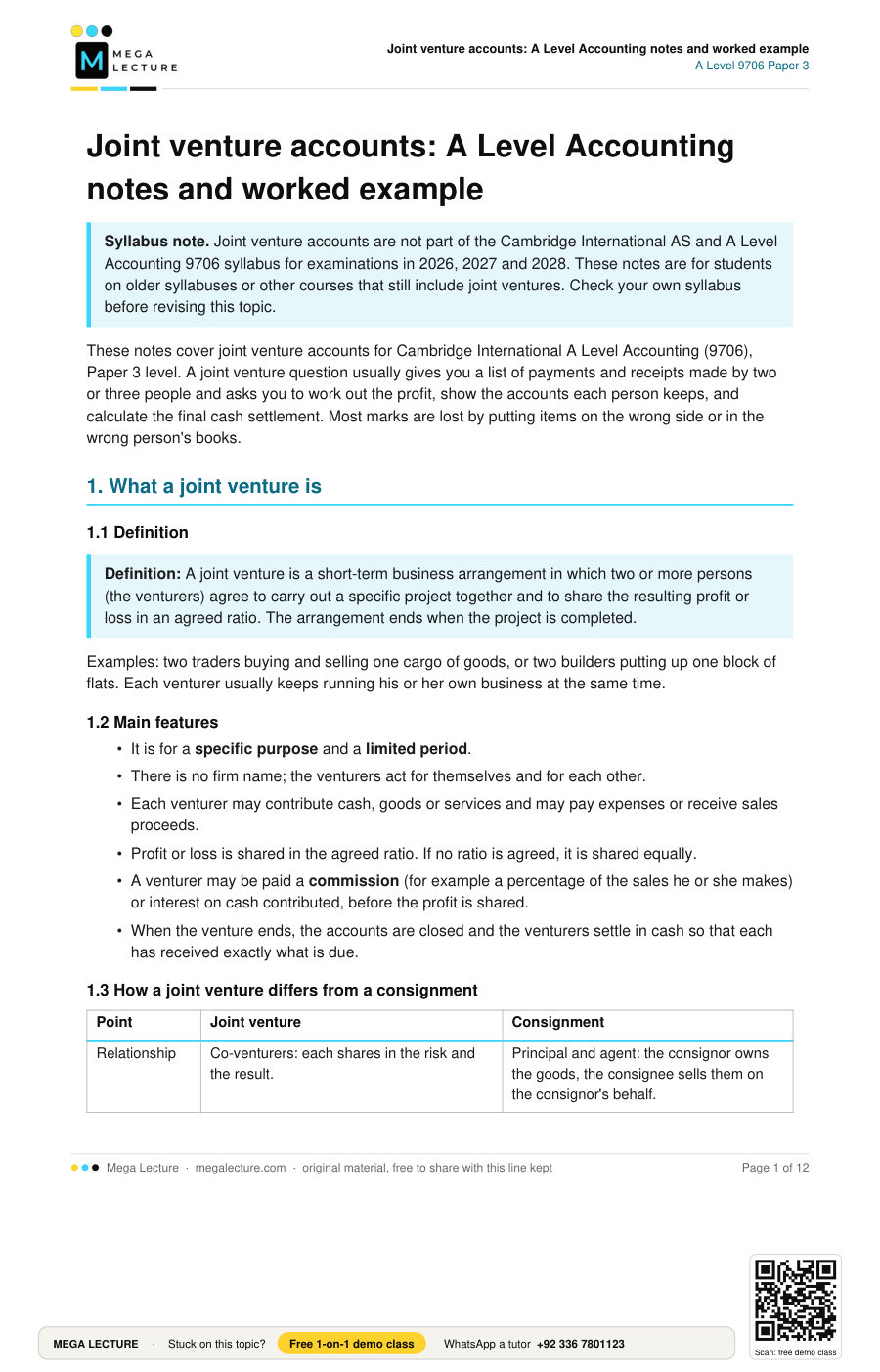
Opens inside this page. Prefer your own PDF app? Open the PDF.
Check yourself
5 quick questions on A Level Accounting
Tap an answer to see if you are right, and why. Free, no sign-up.
Start the free test👍 32 students found these notes useful
Was this note useful?
Full text of Joint venture accounts: A Level Accounting notes and worked example
Syllabus note. Joint venture accounts are not part of the Cambridge International AS and A Level Accounting 9706 syllabus for examinations in 2026, 2027 and 2028. These notes are for students on older syllabuses or other courses that still include joint ventures. Check your own syllabus before revising this topic.
These notes cover joint venture accounts for Cambridge International A Level Accounting (9706), Paper 3 level. A joint venture question usually gives you a list of payments and receipts made by two or three people and asks you to work out the profit, show the accounts each person keeps, and calculate the final cash settlement. Most marks are lost by putting items on the wrong side or in the wrong person's books.
1. What a joint venture is
1.1 Definition
Definition: A joint venture is a short-term business arrangement in which two or more persons (the venturers) agree to carry out a specific project together and to share the resulting profit or loss in an agreed ratio. The arrangement ends when the project is completed.Examples: two traders buying and selling one cargo of goods, or two builders putting up one block of flats. Each venturer usually keeps running his or her own business at the same time.
1.2 Main features
- It is for a specific purpose and a limited period.
- There is no firm name; the venturers act for themselves and for each other.
- Each venturer may contribute cash, goods or services and may pay expenses or receive sales proceeds.
- Profit or loss is shared in the agreed ratio. If no ratio is agreed, it is shared equally.
- A venturer may be paid a commission (for example a percentage of the sales he or she makes) or interest on cash contributed, before the profit is shared.
- When the venture ends, the accounts are closed and the venturers settle in cash so that each has received exactly what is due.
1.3 How a joint venture differs from a consignment
| Point | Joint venture | Consignment |
|---|---|---|
| Relationship | Co-venturers: each shares in the risk and the result. | Principal and agent: the consignor owns the goods, the consignee sells them on the consignor's behalf. |
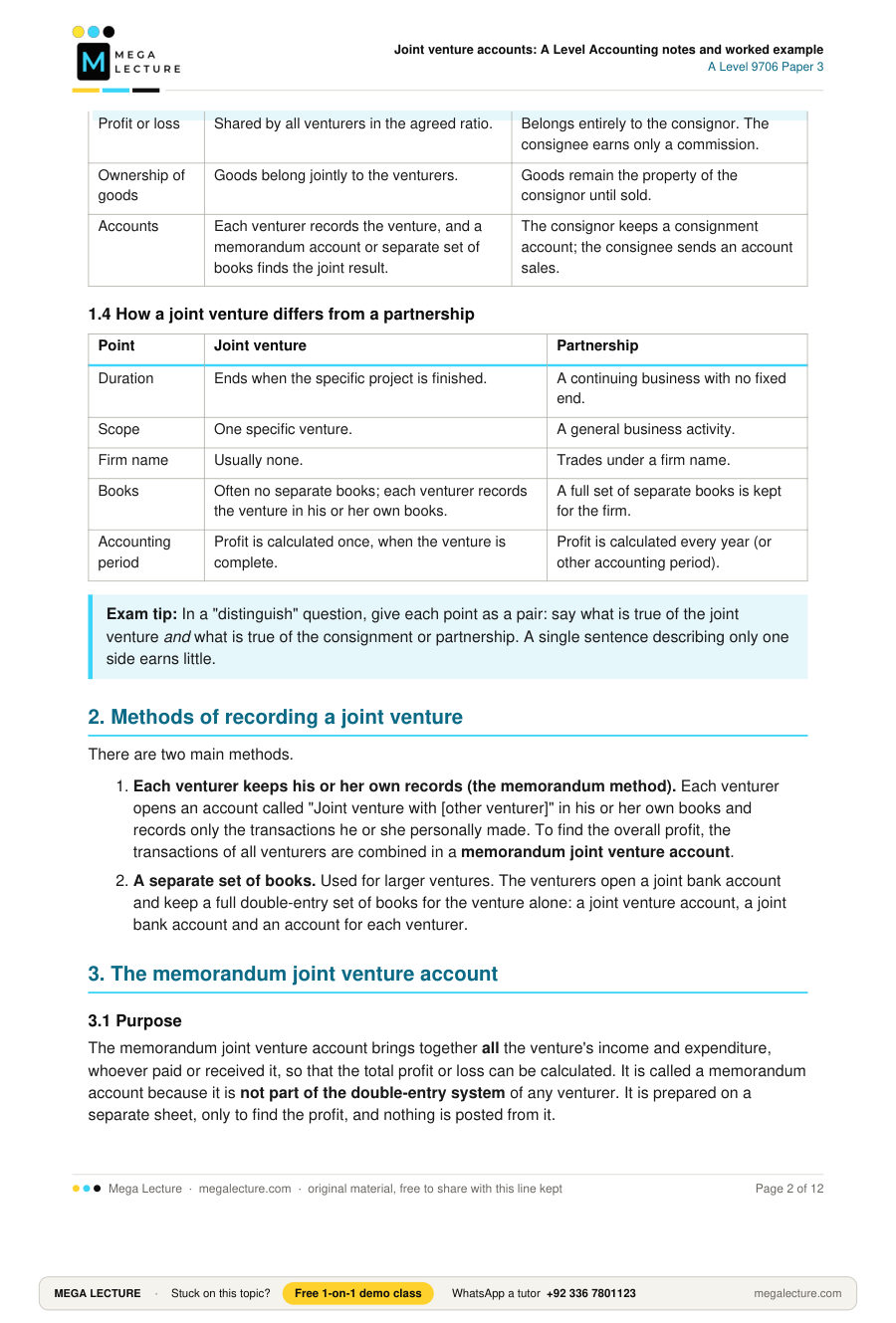
| Profit or loss | Shared by all venturers in the agreed ratio. | Belongs entirely to the consignor. The consignee earns only a commission. |
| Ownership of goods | Goods belong jointly to the venturers. | Goods remain the property of the consignor until sold. |
| Accounts | Each venturer records the venture, and a memorandum account or separate set of books finds the joint result. | The consignor keeps a consignment account; the consignee sends an account sales. |
1.4 How a joint venture differs from a partnership
| Point | Joint venture | Partnership |
|---|---|---|
| Duration | Ends when the specific project is finished. | A continuing business with no fixed end. |
| Scope | One specific venture. | A general business activity. |
| Firm name | Usually none. | Trades under a firm name. |
| Books | Often no separate books; each venturer records the venture in his or her own books. | A full set of separate books is kept for the firm. |
| Accounting period | Profit is calculated once, when the venture is complete. | Profit is calculated every year (or other accounting period). |
2. Methods of recording a joint venture
There are two main methods.
- Each venturer keeps his or her own records (the memorandum method). Each venturer opens an account called "Joint venture with [other venturer]" in his or her own books and records only the transactions he or she personally made. To find the overall profit, the transactions of all venturers are combined in a memorandum joint venture account.
- A separate set of books. Used for larger ventures. The venturers open a joint bank account and keep a full double-entry set of books for the venture alone: a joint venture account, a joint bank account and an account for each venturer.
3. The memorandum joint venture account
3.1 Purpose
The memorandum joint venture account brings together all the venture's income and expenditure, whoever paid or received it, so that the total profit or loss can be calculated. It is called a memorandum account because it is not part of the double-entry system of any venturer. It is prepared on a separate sheet, only to find the profit, and nothing is posted from it.
3.2 Layout
| Debit side | Credit side |
|---|---|
| Cost of goods bought (by any venturer) | Sales (by any venturer) |
| All expenses paid (by any venturer) | Goods taken over by a venturer at an agreed value |
| Commission and interest allowed to venturers | Loss shared (if there is a loss) |
| Profit shared (if there is a profit), in the agreed ratio |
4. Each venturer's account with the others
4.1 The "Joint venture with" account
In the memorandum method, each venturer opens one account, called "Joint venture with B" in A's books and "Joint venture with A" in B's books. This account records only what that venturer personally did.
- Debit: what the venturer paid for the venture (goods, expenses), commission due to him or her, and his or her share of profit.
- Credit: what the venturer received from the venture (sales proceeds), goods he or she took over, and his or her share of loss.
The balance on this account is the amount owed between the venturers. A debit balance means the other venturer owes this venturer money; a credit balance means this venturer owes money to the other.
4.2 Double entry in the venturer's own books
| Transaction | Debit | Credit |
|---|---|---|
| Venturer pays for goods or expenses | Joint venture with B | Bank (or Purchases, if goods come from own stock) |
| Venturer receives cash from sales | Bank | Joint venture with B |
| Venturer takes over unsold goods | Purchases (or Drawings if for personal use) | Joint venture with B |
| Commission earned by the venturer | Joint venture with B | Income statement (commission received) |
| Share of profit | Joint venture with B | Income statement (profit on joint venture) |
| Share of loss | Income statement | Joint venture with B |
| Cash settlement received | Bank | Joint venture with B |
| Cash settlement paid | Joint venture with B | Bank |
5. Sharing profit and settlement
The profit (or loss) is found from the memorandum account and then shared in the agreed ratio. Each venturer's share is entered in his or her own "Joint venture with" account. After this, the balances on the venturers' accounts are equal and opposite: one has a debit balance and the other a credit balance of exactly the same amount. The venturer with the credit balance pays that amount to the other, and both accounts close.
Check: If the two balances are not equal, there is an error. With three venturers, the debit balances added together must equal the credit balances added together.6. Worked example: memorandum method
QuestionAli and Bilal agree to buy, repair and sell a batch of used laptops. Profits and losses are shared Ali 3/5, Bilal 2/5. Bilal is to receive a commission of 5% on the sales he makes. Each venturer keeps his own records.
1. Ali buys laptops for $12 000 and pays repair costs of $1 500.
2. Bilal pays advertising of $800 and transport of $700.
3. Bilal sells laptops for $20 000 cash.
4. Ali sells the rest for $3 000 cash, except one laptop which he keeps for his own use at an agreed value of $400.
5. The venture is then closed and the amount due is settled by cheque.
Prepare (a) the memorandum joint venture account, (b) the Joint venture with Bilal account in Ali's books, (c) the Joint venture with Ali account in Bilal's books.
6.1 Working
Commission to Bilal = 5% × $20 000 = $1 000.
Total debits before profit = 12 000 + 1 500 + 800 + 700 + 1 000 = $16 000.
Total credits = 20 000 + 3 000 + 400 = $23 400.
Profit = 23 400 − 16 000 = $7 400. Ali 3/5 = $4 440; Bilal 2/5 = $2 960.
6.2 (a) Memorandum joint venture account
| Debit | $ | Credit | $ |
|---|---|---|---|
| Purchases (Ali) | 12 000 | Sales (Bilal) | 20 000 |
| Repairs (Ali) | 1 500 | Sales (Ali) | 3 000 |
| Advertising (Bilal) | 800 | Goods taken by Ali | 400 |
| Transport (Bilal) | 700 | ||
| Commission (Bilal) | 1 000 | ||
| Profit: Ali (3/5) | 4 440 | ||
| Profit: Bilal (2/5) | 2 960 | ||
| Total | 23 400 | Total | 23 400 |
6.3 (b) Ali's books: Joint venture with Bilal
| Debit | $ | Credit | $ |
|---|---|---|---|
| Bank: purchases | 12 000 | Bank: sales | 3 000 |
| Bank: repairs | 1 500 | Drawings: laptop taken | 400 |
| Income statement: share of profit | 4 440 | Bank: settlement from Bilal | 14 540 |
| Total | 17 940 | Total | 17 940 |
6.4 (c) Bilal's books: Joint venture with Ali
| Debit | $ | Credit | $ |
|---|---|---|---|
| Bank: advertising | 800 | Bank: sales | 20 000 |
| Bank: transport | 700 | ||
| Income statement: commission | 1 000 | ||
| Income statement: share of profit | 2 960 | ||
| Bank: settlement to Ali | 14 540 | ||
| Total | 20 000 | Total | 20 000 |
Settlement: before the cheque, Ali's account shows a debit balance of 17 940 − 3 400 = $14 540 (owed to him) and Bilal's account shows a credit balance of 20 000 − 5 460 = $14 540 (owed by him). The two agree, so Bilal pays Ali $14 540.
Sense check: Ali spent $13 500 and received $3 000 cash plus a $400 laptop. He should end up with his outlay back plus his profit: 13 500 + 4 440 = $17 940, and 3 000 + 400 + 14 540 = $17 940. Correct.
7. Separate set of books method
7.1 Accounts opened
- Joint bank account: each venturer pays in his or her contribution; all payments and receipts of the venture pass through it.
- Joint venture account: a real double-entry account (not a memorandum), with the same layout as the memorandum account. Its balance is the profit or loss.
- A capital (personal) account for each venturer: credited with cash paid in, commission and share of profit; debited with goods taken over, share of loss and the final repayment.
7.2 Double entries
| Transaction | Debit | Credit |
|---|---|---|
| Venturer pays cash into joint bank | Joint bank | Venturer's capital |
| Goods bought or expenses paid from joint bank | Joint venture | Joint bank |
| Goods or expenses paid personally by a venturer | Joint venture | Venturer's capital |
| Sales banked | Joint bank | Joint venture |
| Goods taken over by a venturer | Venturer's capital | Joint venture |
| Commission to a venturer | Joint venture | Venturer's capital |
| Profit shared | Joint venture | Each venturer's capital |
| Final repayment to each venturer | Venturer's capital | Joint bank |
At the end, the balance in the joint bank account is exactly enough to pay off every venturer's capital account, and all accounts close.
8. Worked example: separate set of books
QuestionUse the same venture, ratio and commission as in section 6, but this time Ali and Bilal open a joint bank account. Ali pays in $14 000 and Bilal pays in $2 000. All purchases ($12 000), repairs ($1 500), advertising ($800) and transport ($700) are paid from the joint bank account, and all sales ($20 000 and $3 000) are paid into it. Ali takes one laptop at $400. Bilal's commission is credited to his account. Prepare the joint venture account, the joint bank account and the venturers' capital accounts, and show the final settlement.
8.1 Joint venture account
| Debit | $ | Credit | $ |
|---|---|---|---|
| Joint bank: purchases | 12 000 | Joint bank: sales | 23 000 |
| Joint bank: repairs | 1 500 | Ali: laptop taken | 400 |
| Joint bank: advertising | 800 | ||
| Joint bank: transport | 700 | ||
| Bilal: commission | 1 000 | ||
| Profit: Ali | 4 440 | ||
| Profit: Bilal | 2 960 | ||
| Total | 23 400 | Total | 23 400 |
The profit is the same, $7 400, because the method of recording does not change what the venture earned.
8.2 Venturers' capital accounts
| Debit | Ali $ | Bilal $ | Credit | Ali $ | Bilal $ |
|---|---|---|---|---|---|
| Joint venture: laptop | 400 | Joint bank: cash paid in | 14 000 | 2 000 | |
| Joint bank: repayment | 18 040 | 5 960 | Joint venture: commission | 1 000 | |
| Joint venture: profit | 4 440 | 2 960 | |||
| Total | 18 440 | 5 960 | Total | 18 440 | 5 960 |
8.3 Joint bank account
| Debit | $ | Credit | $ |
|---|---|---|---|
| Ali: capital | 14 000 | Joint venture: purchases | 12 000 |
| Bilal: capital | 2 000 | Joint venture: repairs | 1 500 |
| Joint venture: sales | 23 000 | Joint venture: advertising | 800 |
| Joint venture: transport | 700 | ||
| Ali: repayment | 18 040 | ||
| Bilal: repayment | 5 960 | ||
| Total | 39 000 | Total | 39 000 |
Before the repayments the joint bank balance is 39 000 − 15 000 = $24 000, which equals 18 040 + 5 960. The bank account, both capital accounts and the joint venture account all close to nil.
Exam tip: In the separate books method there is no "amount owed by one venturer to the other". Instead, each venturer is repaid from the joint bank account. If the question says one venturer pays the other directly, you are in the memorandum method.9. Common errors
- Recording the other venturer's transactions in a venturer's own "Joint venture with" account. Each venturer records only his or her own.
- Forgetting to deduct commission or interest before sharing the profit.
- Leaving goods taken over off the credit side of the memorandum account.
- Sharing a loss on the wrong side: a loss is a credit in the memorandum account and in each venturer's "Joint venture with" account.
Quick check
- Define a joint venture. [2]
- State two differences between a joint venture and a consignment. [4]
- State two differences between a joint venture and a partnership. [4]
- Explain why the memorandum joint venture account is described as "memorandum". [2]
- Explain how unsold goods taken over by a venturer at the end of a venture are treated in the memorandum joint venture account and in that venturer's own books. [3]
- In the separate set of books method, explain what the balance on the joint bank account represents just before the venture is closed. [2]
- Practice question 1 (memorandum method). Chen and Dara share profits equally. Chen buys timber for $8 000 and pays carriage of $400. Dara pays labour of $2 600 to make the timber into furniture and sells all of it except one table for $15 000. Dara is entitled to a commission of 2% on her sales. Chen takes over the remaining table at an agreed value of $500. Prepare (a) the memorandum joint venture account, (b) the Joint venture with Dara account in Chen's books, (c) the Joint venture with Chen account in Dara's books, showing the final settlement. [12]
- Practice question 2 (separate set of books). Eve and Faiz share profits in the ratio 2:1. They open a joint bank account into which Eve pays $9 000 and Faiz $6 000. From the joint bank account they pay $11 000 for goods and $1 240 for expenses. Sales of $16 500 are banked. Faiz takes over the unsold goods at $600. Prepare the joint venture account and the venturers' capital accounts, and calculate the amount paid to each venturer from the joint bank account when the venture closes. [10]
- Practice question 3 (a loss, memorandum method). Gul and Hina share profits and losses in the ratio 3:2. Gul buys goods for $10 000 and pays freight of $600. Hina pays storage of $400 and sells goods for $9 800. Hina receives a commission of 5% on her sales. Gul takes over the unsold goods at $300. Prepare (a) the memorandum joint venture account, (b) each venturer's account with the other, and state who pays whom, and how much, on settlement. [10]
1. A joint venture is a short-term business arrangement in which two or more persons agree to carry out a specific project together and share the profit or loss in an agreed ratio. It ends when the project is completed.
2. Any two: (i) in a joint venture the profit or loss is shared by all venturers, whereas in a consignment it belongs wholly to the consignor and the consignee earns only commission; (ii) joint venturers are co-owners, whereas a consignor and consignee are principal and agent; (iii) in a joint venture the goods belong jointly to the venturers, whereas consigned goods remain the property of the consignor until sold.
3. Any two: (i) a joint venture is for one specific project and ends when it is complete, whereas a partnership is a continuing business; (ii) a joint venture usually has no firm name, whereas a partnership trades under one; (iii) a joint venture often has no separate books, whereas a partnership keeps a full set; (iv) joint venture profit is calculated once at the end, whereas partnership profit is calculated each accounting period.
4. It is not part of the double-entry system of any venturer. It is prepared only as a working to combine all the venturers' transactions and calculate the total profit or loss, and no entries are posted from it.
5. In the memorandum account the agreed value is entered on the credit side, as if the goods were sold to the venturer. In the venturer's own books: debit Purchases (or Drawings if taken for personal use), credit Joint venture with the other venturer.
6. It is the total amount owed by the venture to the venturers: each venturer's capital, plus commission and share of profit, less goods taken over (and less any share of loss). It is exactly enough to repay all the venturers' capital accounts.
7. Working: commission = 2% × 15 000 = $300. Debits = 8 000 + 400 + 2 600 + 300 = $11 300. Credits = 15 000 + 500 = $15 500. Profit = $4 200, so Chen $2 100 and Dara $2 100.
(a) Memorandum joint venture account
| Debit | $ | Credit | $ |
|---|---|---|---|
| Timber (Chen) | 8 000 | Sales (Dara) | 15 000 |
| Carriage (Chen) | 400 | Table taken by Chen | 500 |
| Labour (Dara) | 2 600 | ||
| Commission (Dara) | 300 | ||
| Profit: Chen | 2 100 | ||
| Profit: Dara | 2 100 | ||
| Total | 15 500 | Total | 15 500 |
(b) Chen's books: Joint venture with Dara
| Debit | $ | Credit | $ |
|---|---|---|---|
| Bank: timber | 8 000 | Purchases: table taken | 500 |
| Bank: carriage | 400 | Bank: settlement from Dara | 10 000 |
| Income statement: share of profit | 2 100 | ||
| Total | 10 500 | Total | 10 500 |
(c) Dara's books: Joint venture with Chen
| Debit | $ | Credit | $ |
|---|---|---|---|
| Bank: labour | 2 600 | Bank: sales | 15 000 |
| Income statement: commission | 300 | ||
| Income statement: share of profit | 2 100 | ||
| Bank: settlement to Chen | 10 000 | ||
| Total | 15 000 | Total | 15 000 |
Settlement: Dara pays Chen $10 000. Check: Chen's outlay 8 400 + profit 2 100 = 10 500 = table 500 + cash 10 000.
8. Working: debits = 11 000 + 1 240 = $12 240; credits = 16 500 + 600 = $17 100; profit = $4 860. Eve 2/3 = $3 240; Faiz 1/3 = $1 620.
Joint venture account
| Debit | $ | Credit | $ |
|---|---|---|---|
| Joint bank: goods | 11 000 | Joint bank: sales | 16 500 |
| Joint bank: expenses | 1 240 | Faiz: goods taken over | 600 |
| Profit: Eve | 3 240 | ||
| Profit: Faiz | 1 620 | ||
| Total | 17 100 | Total | 17 100 |
Capital accounts
| Debit | Eve $ | Faiz $ | Credit | Eve $ | Faiz $ |
|---|---|---|---|---|---|
| Joint venture: goods taken | 600 | Joint bank: cash paid in | 9 000 | 6 000 | |
| Joint bank: repayment | 12 240 | 7 020 | Joint venture: profit | 3 240 | 1 620 |
| Total | 12 240 | 7 620 | Total | 12 240 | 7 620 |
Joint bank before repayment: receipts 9 000 + 6 000 + 16 500 = 31 500; payments 11 000 + 1 240 = 12 240; balance $19 260. Eve is paid $12 240 and Faiz $7 020, total 19 260, so the joint bank account closes.
9. Working: commission = 5% × 9 800 = $490. Debits = 10 000 + 600 + 400 + 490 = $11 490. Credits = 9 800 + 300 = $10 100. Loss = 11 490 − 10 100 = $1 390. Gul 3/5 = $834; Hina 2/5 = $556.
(a) Memorandum joint venture account
| Debit | $ | Credit | $ |
|---|---|---|---|
| Goods (Gul) | 10 000 | Sales (Hina) | 9 800 |
| Freight (Gul) | 600 | Goods taken by Gul | 300 |
| Storage (Hina) | 400 | Loss: Gul | 834 |
| Commission (Hina) | 490 | Loss: Hina | 556 |
| Total | 11 490 | Total | 11 490 |
(b) Gul's books: Joint venture with Hina
| Debit | $ | Credit | $ |
|---|---|---|---|
| Bank: goods | 10 000 | Purchases: goods taken | 300 |
| Bank: freight | 600 | Income statement: share of loss | 834 |
| Bank: settlement from Hina | 9 466 | ||
| Total | 10 600 | Total | 10 600 |
Hina's books: Joint venture with Gul
| Debit | $ | Credit | $ |
|---|---|---|---|
| Bank: storage | 400 | Bank: sales | 9 800 |
| Income statement: commission | 490 | Income statement: share of loss | 556 |
| Bank: settlement to Gul | 9 466 | ||
| Total | 10 356 | Total | 10 356 |
Settlement: Hina pays Gul $9 466. Check: Gul spent 10 600 and bears a loss of 834, so he should recover 10 600 − 834 = 9 766, which is goods 300 + cash 9 466.
