
A Level · Accounting 9706 · Topic Notes (9706)
1. Manufacturing Accounts (PDF)
The Daily 5 Five questions a day on A Level Accounting: two minutes, new every day, with a streak to keep Play today’s →
Opens inside this page, as often as you like. This note is read online only; the whole set is in the study pack below.
Check yourself
5 quick questions on Financial accounting
Tap an answer to see if you are right, and why. Free, no sign-up.
Start the free test👍 34 students found these notes useful
Was this note useful?
Full text of 1. Manufacturing Accounts (PDF)
Resource Pack/Accounting/A Level (Paper 3) Make Accounting easy with Sir Muzammil Chapter 1
Financial Statements of Manufacturing Businesses Manufacturing business
A business that produces or manufactures goods i.e. car/cloth manufacturer
Manufacturing account
Manufacturing businesses prepare manufacturing account as part of their internal financial statements. A manufacturing account shows the costs of running and maintaining the factory in which a final product is made. A manufacturing business will also trade by selling its finished goods to wholesalers or retailers, so it will prepare a trading account in its income statement as well as manufacturing account
Types of inventory in manufacturing business
There are three types of inventory in manufacturing business.
Raw materials (main component of finished foods, wood for furniture) Work-in-progress (value of semi-finished goods or incomplete goods) Finished goods (end product)
Note:
All three types of closing inventory will appear as current assets in the Statement of Financial position.
Manufacturing cost
Manufacturing cost = Direct production cost + Indirect production cost
Direct production cost (Prime cost) A cost that can be easily identified or calculated on a single unit produced.
Direct material Direct labor Direct expenses (Royalty, Patents, Direct heating and lighting) Prime cost = raw material + direct labour + direct expenses Indirect production costs Cost that incurred in the manufacturing process but they cannot be traced directly to the goods being produced.
Mega Lecture For Live Classes, Recorded Lectures, Notes & Past Papers visit:
www.megalecture.com youtube.com/c/MegaLecture/ +92 336 7801123
Scan: free demo class
MEGA LECTURE · Free notes, practice tests and live classes Back to megalecture.com
Read these notes online, free
On megalecture.com, with a quick free test on this topic
Open free version
Make Accounting easy with Sir Muzammil
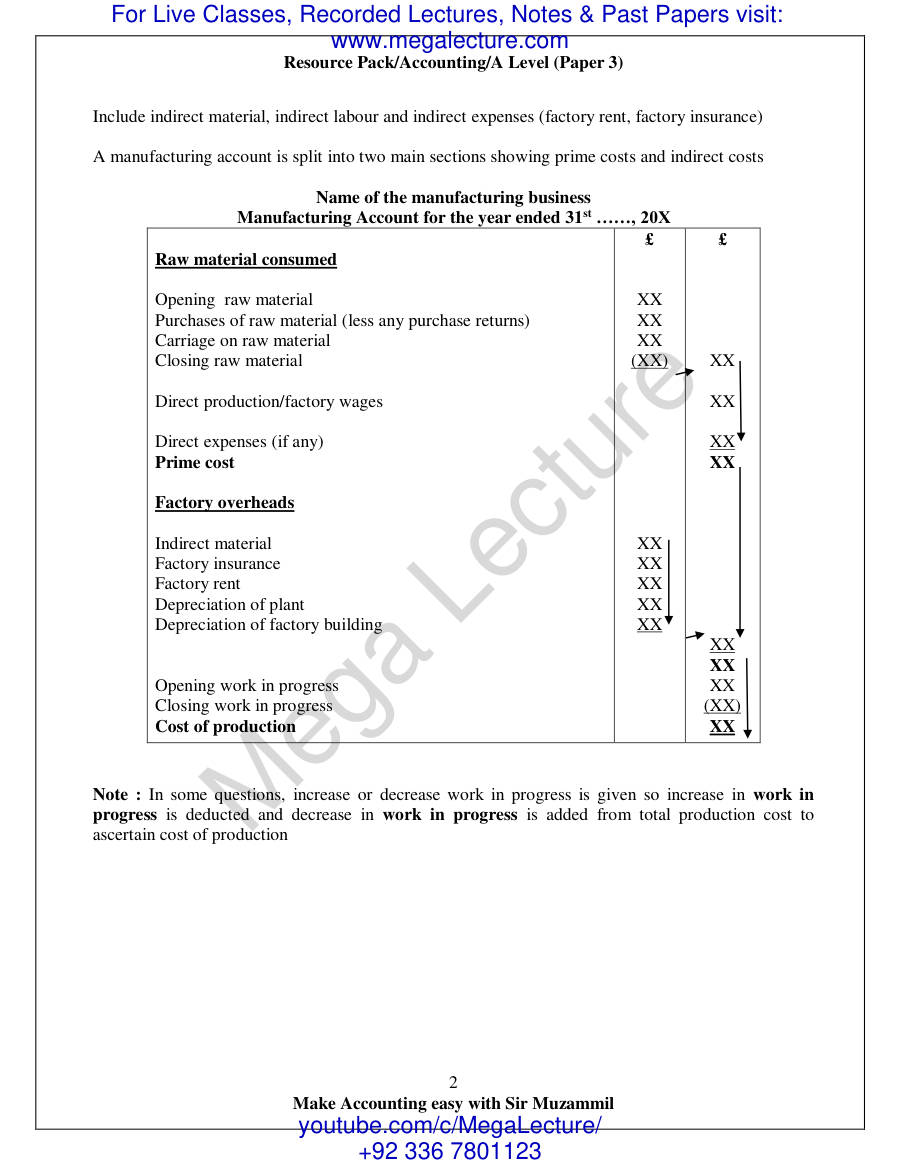
Include indirect material, indirect labour and indirect expenses (factory rent, factory insurance) A manufacturing account is split into two main sections showing prime costs and indirect costs
Name of the manufacturing business Manufacturing Account for the year ended 31st ……, 20X Raw material consumed
Opening raw material Purchases of raw material (less any purchase returns) Carriage on raw material Closing raw material Direct production/factory wages Direct expenses (if any)
Prime cost Factory overheads
Indirect material Factory insurance Factory rent Depreciation of plant Depreciation of factory building Opening work in progress Closing work in progress
Cost of production £
XX XX XX (XX)
XX XX XX XX XX
£
XX
XX
XX
XX
XX
XX
XX (XX)
XX
Note : In some questions, increase or decrease work in progress is given so increase in work in progress is deducted and decrease in work in progress is added from total production cost to ascertain cost of production
Mega Lecture youtube.com/c/MegaLecture/
Make Accounting easy with Sir Muzammil Practice Questions
- The financial year of Doshi Manufacturing Company ends on 31 January. The following trial balance was extracted from the books on 31 January 2017.
Mega Lecture youtube.com/c/MegaLecture/
Make Accounting easy with Sir Muzammil REQUIRED
- Select the relevant figures and prepare the manufacturing account for the year ended 31 January 2017. [12]
- Select the relevant figures and prepare the income statement for the year ended 31 January 2017. [11]
Mega Lecture youtube.com/c/MegaLecture/
Make Accounting easy with Sir Muzammil
- Yasmin opened a garment factory on 1 May 2015. She provided the following information.
REQUIRED
- Prepare the manufacturing account for the year ended 30 April 2016. [13]
- (i) Calculate the cost of sales for the year ended 30 April 2016. [4]
- Calculate the gross profit for the year ended 30 April 2016. [1]
Mega Lecture youtube.com/c/MegaLecture/
Make Accounting easy with Sir Muzammil
- The Mochudi Manufacturing Company was formed on 1 August 2013. The following information is available.
REQUIRED
- Prepare the manufacturing account of The Mochudi Manufacturing Company for the year ended 31 July 2014. [12]
- Prepare the income statement of The Mochudi Manufacturing Company for the year ended 31 July 2014. [10]
Mega Lecture youtube.com/c/MegaLecture/
Make Accounting easy with Sir Muzammil Manufacturing/Factory profit
Sometimes the managers of a business will wish to gauge how efficiently their factory is operating. They compare the price that the costs of goods produce in their factory with the cost of purchasing the same goods from an outside supplier. If it would be cheap to purchase the goods externally then it may be in the best interest of the business to cease manufacturing and purchase the goods. When the managers of a business transfer the total production cost to the trading account, gross profit is found by deducting the cost of sales from the sales revenue. This method does have a flaw- there is no indication of how profitable the factory is. We can determine the factory manufacturing profit by finding the difference between the cost of production and cost of goods purchasing externally
Importance of Transfer Price
Better control of manufacturing cost. Transferred price is compared with market price. Manufacturing department is a profit centre. Better way to measure the performance of the manufacturing department.
Drawbacks
However, the use of this technique does not improve overall profitability of the business. Can give an unrealistic view of the factory profitability unless other production prices are researched and used to set the transfer price.
Treatment of factory profit Transfer price = cost of production + factory profit Example 1
The following information is provided by El Sayed Manufacturing Company. Prime cost $86000 Cost of production $124000 Finished goods are transferred from factory to warehouse at cost plus 20% What will be the transfer price shown in manufacturing account?
Provision for Unrealized Profit (PURP)
The finished goods at the year-end are valued at cost plus the manufacturing profit margin. Unrealised profit should not be anticipated and the profit element should be removed from the inventory by creating a provision for unrealised profit. IAS 2 Lower of cost and net realisable value
Mega Lecture youtube.com/c/MegaLecture/
Make Accounting easy with Sir Muzammil
Prudence /not overstating profits/assets Realization
Treatment of Factory profit and PURP in Income Statement
Factory profit same amount is again added in gross profit in Income Statement PURP adjustment is same as provision for doubtful debts in Income Statement and is calculated as follows
F.G at transfer price = finished goods at cost (1+ mark-up) Increase/ Decreased in Provision of Unrealized Profit
Increase in Provision (Expense) Reduction in Provision (Income)
Dr Income Statement Dr Provision for Unrealized Profit Cr Provision for Unrealized Profit Cr Income Statement
T account of Provision for unrealised profit Statement of Financial Position (extract)
Once the factory profit on the closing finished goods has been calculated then the adjustment would have to be made in the Statement of Financial Position. The closing finished goods would appear as follows:
Current assets £
Finished goods at transfer price XX Less provision for unrealised profit (XX) Finished goods at cost XX
Mega Lecture youtube.com/c/MegaLecture/
Make Accounting easy with Sir Muzammil Past Paper Questions
Q # 1 Pakenham Ltd has a financial year end of 30 April each year. The manufacturing account showed the following:
Manufacturing account for the year ended 30 April 2010
$ $ Inventory of raw materials at 1 May 2009 12 000 Purchases of raw materials 162 000 Inventory of raw materials at 30 April 2010 (18 000) 156 000 Direct labour 160 000 Prime cost 316 000 Factory overheads Rent and rates 20 000 Electricity 72 000 Other 12 000 104 000 Factory cost of goods produced 420 000 Factory profit 63 000 483 000 Other information is as follows: 1 During the year ended 30 April 2010 sales were $602 000 and selling and administration costs were $39000. 2 Rent and rates are allocated on the basis of floor space. The factory occupies 100 m2 and the office and showroom 150 m2. 3 Electricity is allocated on the basis of usage with 80% being used in the factory. 4 Pakenham Ltd maintains a provision for unrealised profit account. The balance on this account was $4500 on 1 May 2009 and was $4800 on 30 April 2010. The rate of factory profit had remained constant during the year.
REQUIRED
- Prepare an income statement for the year ended 30 April 2010. [12]
- Calculate the value of inventory for inclusion in the balance sheet at 30 April 2010. [4]
June 2010
Mega Lecture youtube.com/c/MegaLecture/
Make Accounting easy with Sir Muzammil
Q # 2 Kelang Limited manufactures a single product. Goods are transferred from the production department to the sales department at a markup of 20%. The following balances have been extracted from the books of Kelang Limited at 31 December 2015
$ Non-current assets at cost
Property Manufacturing plant and machinery 350 000 Office equipment 120 000 Provision for depreciation at 1 January 2015
Property 120 000 Manufacturing plant and machinery 230 000 Office equipment 96 000 Inventories at 1 January 2015
Raw materials 24 600 Work in progress 66 800 Finished goods at transfer price 162 000 The following information was available for the year ended 31 December 2015. Direct wages 344 000 Indirect wages 69 000 Purchases of direct materials 287 000 Purchases of indirect materials 43 000 Carriage inwards on direct materials 3 700 Other factory overheads 32 500 Revenue 1562 000 Administrative expenses 374 000 Provision for unrealised profit at 1 January 2015 27 000 Water and electricity expenses 14 000 Additional information 1 Inventory at 31 December 2015 $ Raw materials Work in progress 72 200 Finished goods at transfer price 186 000 2 Depreciation is to be provided as follows: Property 5% on cost Manufacturing plant and machinery 20% reducing balance method Office equipment 15% on cost 3 Water and electricity expenses owing at 31 December 2015 amounted to $1500.
Mega Lecture youtube.com/c/MegaLecture/
Make Accounting easy with Sir Muzammil
4 The following expenses are to be allocated as: Factory Administration Depreciation on property 70% 30% Water and electricity 80% 20%
REQUIRED
- Prepare the manufacturing account for the year ended 31 December 2015. [8]
- Prepare the income statement for the year ended 31 December 2015. [7]
- Explain why finished goods inventory is not shown at transfer price in the statement of financial position. [3]
Additional information
Sim, the manager of the sales department, says ‘It does not make sense for the production department to transfer the goods manufactured to the sales department at a mark-up. As both departments belong to the same company, we should no longer do it.’
REQUIRED
- Recommend whether or not they should continue to transfer goods at a mark-up. Justify your answer giving two reasons to support your recommendation. [7]
March 2016
Q # 3 Kempes Limited is a company which manufactures a single product. Finished goods are transferred from the factory at production cost plus 15%. Unsold goods are stored in the warehouse. Selected balances extracted from the trial balance for the year ended 30 September 2015 were as follows: $ Revenue 1 845 000 Purchases of raw materials 794 750 Carriage inwards 4 250 Factory production wages 382 500 Factory supervisory wages 64 000 Administrative wages 115 000 General expenses 78 000 Depreciation: Factory plant and machinery 55 000 Office fixtures and fittings 37 500 Additional information 1 At 30 September 2015, there were accrued general expenses of $5000 and prepaid general expenses of $3000.
Mega Lecture youtube.com/c/MegaLecture/
Make Accounting easy with Sir Muzammil
65% of the general expenses relate to the factory. 2 Details of inventories were as follows.
1 October 2014 30 September 2015 $ $ Raw materials 110 000 125 000 Work in progress 17 500 14 000 Finished goods at transfer price 19 550 21 505
REQUIRED
- Prepare the manufacturing account for the year ended 30 September 2015. [9]
- Prepare the income statement for the year ended 30 September 2015. [6]
- Explain why a business might create a provision for unrealized profit. [3]
Additional information
The budgeted closing inventory value of finished goods at transfer price at 31 October 2015 was $18400.
REQUIRED
- Analyse the effect on the budgeted profit for the month of October 2015 due to the changes in the provision for unrealised profit. [2]
Additional information
The price at which the product could be bought from an outside supplier is expected to increase. It is now proposed to transfer finished goods at production cost plus 20%.
REQUIRED
- Advise the directors whether or not the mark-up should be increased. Justify your answer. [5]
June 2016
Q # 4 Alpha Limited is a manufacturing business making a single product. Each year it produces and sells 1000 units and the only inventory it keeps is that of raw materials. It provides the following information for the year ended 30 April 2016:
$ Revenue 95 000 Inventory of raw materials at 1 May 2015 1 000 Inventory of raw materials at 30 April 2016 3 100 Purchases of raw materials 12 200 Carriage inwards 1 100
Mega Lecture youtube.com/c/MegaLecture/
Make Accounting easy with Sir Muzammil
Factory workers’ wages 17 500 Factory supervisor’s salary 8 200 Office salaries 8 500 Rent 8 000 Factory overheads 9 700 General office expenses 10 000 Additional information 1 Rent is allocated 75% to the factory and 25% to the offices. 2 Production is transferred to finished goods at cost plus 25%.
REQUIRED
- Prepare, for the year ended 30 April 2016,
- the manufacturing account [8]
- the income statement. [7]
Additional information
Management has discovered that general office expenses are 50% fixed and 50% variable with the level of sales. At the start of May 2016 management expected that in the next year the business would only be able to sell 900 units. There are no expected changes to the selling price or costs per unit. There were two options. Option 1 To continue to produce 1000 units and have an inventory of finished goods at the next year end. Option 2 To reduce production to 900 units and continue to have no inventory of finished goods
REQUIRED
- Calculate the expected annual profit if option 1 is implemented. Start your calculation with your profit from (a) and adjust as appropriate. [5]
Additional information
The annual profit expected from option 2 was known to be $15 100.
REQUIRED
- Advise the management which of the two options it should implement. Justify your answer. [5]
Nov 2016
Mega Lecture youtube.com/c/MegaLecture/
Make Accounting easy with Sir Muzammil
Q # 5 M Limited manufactures a single product. The following balances have been extracted from the ledgers for the year ended 31 December 2015:
Additional information
1 Inventories at 31 December 2015 $ Raw materials at cost 11 750 Work-in-progress at cost 14 670 Finished goods at transfer price 15 750 2 Expenses are to be apportioned to the production department as follows: Rent 4/5 Heat, light and power 4/5 General expenses 3/4 3 Rent has been prepaid by $4000 at 31 December 2015. 4 Heat, light and power is in arrears by $3500 at 31 December 2015. 5 Completed goods are transferred at a mark-up on factory cost of 20%. 6 Depreciation is to be provided as follows:
Mega Lecture youtube.com/c/MegaLecture/
Make Accounting easy with Sir Muzammil
Plant and machinery 10% per annum on cost Motor vehicles 25% per annum on cost Office equipment 15% on the net book value
REQUIRED
- Prepare the manufacturing account for the year ended 31 December 2015. [9]
- Prepare the income statement for the year ended 31 December 2015. [10]
- Explain what is meant by the term transfer price. [2]
Additional information
10 000 units of the product were manufactured in the year, which is the maximum that can be produced. A supplier has offered to supply the product to M Limited for $60 per unit in the future. REQUIRED
- Advise the directors of M Limited whether or not they should accept this offer. Justify your answer on financial grounds. [4]
Nov 2016
Q # 6 Richard Ang is a sole proprietor manufacturing one type of sofa bed. The following balances are extracted from his books of account at 31 July 2016.
Additional information
1 Richard maintains a provision for unrealised profit account. Completed products are transferred from the factory at a mark-up of 20%. 2 Inventories at 31 July 2015 were: $ Raw materials 14 800 Work in progress 23 500 Finished goods (at cost) 32 000
Mega Lecture youtube.com/c/MegaLecture/
Make Accounting easy with Sir Muzammil
3 Inventories at 31 July 2016 were: $ Raw materials 16 400 Work in progress 20 200 Finished goods (at transfer price) 54 000 4 Unpaid direct wages at 31 July 2016 amounted to $3500. 5 Rent had been allocated to factory overheads and office overheads at $24 000 and $16 000 respectively. The allocation should have been in the ratio of 3 : 1 respectively. REQUIRED
- Prepare the manufacturing account for the year ended 31 July 2016. [7]
- Prepare an income statement for the year ended 31 July 2016. [7]
Additional information
Richard Ang thought of taking some of the finished goods inventory at 31 July 2016 to help his sister set up a furniture business on the same day. REQUIRED
- Prepare an extract from the statement of financial position of Richard Ang’s business at 31 July 2016 to show how inventories are recorded. [3]
- Explain why it is important for Richard to create a provision for unrealised profit. [4]
- State two advantages and two disadvantages to Richard Ang of helping his sister set up her business. [4]
June 2017
Mega Lecture youtube.com/c/MegaLecture/
Make Accounting easy with Sir Muzammil
Q # 7 Ted is the owner of a manufacturing business. The following information is available for the year ended 31 December 2016:
Additional information 1 Goods are transferred from the factory at a mark-up of 20%. Increase in provision for unrealised profit at 31 December 2016 amounted to $15 840 2 Inventory at 31 December 2016: $ Raw materials 67 000 Work in progress 102 000 Finished goods ? 3 Non-current assets are depreciated at 15% per annum using the reducing balance method. 4 At 31 December 2016: $ Rent owing Insurance and rates prepaid Insurance and rates, rent and heat and light are apportioned ¾ factory and ¼ general office. 5 Production for the year ended 31 December 2016 was 80000 units.
Mega Lecture youtube.com/c/MegaLecture/
Make Accounting easy with Sir Muzammil
REQUIRED
- Explain why a mark-up is added to the factory cost of production. [3]
- Prepare the manufacturing account for the year ended 31 December 2016. [10]
- Prepare the trading section of the income statement to show the gross profit for the year ended 31 December 2016. [6]
- Prepare an extract from the statement of financial position to show the value of finished goods inventory at 31 December 2016. [2]
Additional information
In February 2017, Ted was approached by an existing customer for an extra order of 5000 units. The budgeted production for 2017 was already set at the maximum production capacity. Ted considered whether or not to source the extra 5000 units from an external supplier at a cost of $28 per unit REQUIRED
- Advise Ted whether or not he should have accepted the extra order. Justify your answer. [4]
Nov 2017
Q # 8 Marco manufactures garden chairs. He transfers all finished goods from the factory at cost plus 25%. The following selected balances are available for the year ended 31 January 2018:
The following additional information is available.
Mega Lecture youtube.com/c/MegaLecture/
Make Accounting easy with Sir Muzammil
1 Inventories at 31 January 2018 were:
$ Raw materials 42 000 Work in progress 80 000 Finished goods at transfer price 150 000 2 Depreciation is to be charged as follows: machinery 15% per annum using the reducing balance method office equipment 5% per annum using the straight-line method. 3 Rent and rates have not been adjusted for $7000 owing at 1 February 2017 and $6000 paid in advance at 31 January 2018. Rent and rates are apportioned 60% to the factory and 40% to administration. 4 Heating and lighting are apportioned 80% to the factory and 20% to administration. 5 At 31 January 2018 wages due but unpaid were $10 000. Wages are apportioned 50% direct factory wages, 30% indirect factory wages and 20% administrative wages. Required
- Prepare the manufacturing account for Marco for the year ended 31 January 2018. [12]
- Prepare an extract from the statement of financial position at 31 January 2018 to show how inventories are recorded. [3]
- State two accounting concepts relating to the provision for unrealised profit. [2]
- (i) Explain why it is important for Marco to create a provision for unrealised profit. [4]
- Analyse the effect on profit if Marco does not create a provision for unrealised profit. [4]
March 2018
Mega Lecture youtube.com/c/MegaLecture/
Make Accounting easy with Sir Muzammil
Q # 9 JH Limited is a manufacturing business producing a single product. The transfer price of finished goods to the income statement is cost plus a fixed percentage for factory profit. This percentage has remained unchanged for many years. The following information is available for the year ended 31 October 2017.
The following information is also available. 1 Included in the distribution costs are:
$ Carriage inwards 18 000 Carriage outwards 34 000 2 Administrative expenses include an amount for buildings insurance of $60 000. The following items relating to building insurance have not been adjusted: An outstanding unpaid invoice of $3000 for the year ended 31 October 2017 A payment in advance of $1000 brought forward from the year ended 31 October 2016 The allocation of 75% of the total amount to the factory Required
- Explain why a manufacturing business might prepare a manufacturing account as part of its financial statements. [4]
- Prepare the manufacturing account for the year ended 31 October 2017 in as much detail as possible. [5]
- Prepare the income statement for the year ended 31 October 2017. [9]
Mega Lecture youtube.com/c/MegaLecture/
Make Accounting easy with Sir Muzammil Additional information
The selling price of one unit is based on the transfer price from the factory plus a mark-up. Bob, the financial director of JH Limited, has been notified that their main competitor has increased prices. He wishes to increase the fixed percentage of the transfer price by 5%. The other directors are concerned that this will affect profit.
- Advise the directors whether or not they should increase the transfer price. Justify your answer using any relevant calculations. [7]
June 2018
Q # 10 It is considered useful for a business to record all its manufacturing costs separately in a manufacturing account.
Required
- State three reasons why it is useful to a business to record its manufacturing costs in this way. [3]
Additional information
HT Limited is a manufacturing business that makes a single product. It provided the following information. 1 Factory profit had been accounted for at 20% on cost for some years. 2 The company earned a uniform gross margin of 40%. 3 Sales for the year ended 31 December 2017 amounted to $800 000. 4 The provision for unrealised profit account for the year ended 31 December 2017 was as follows:
- Prepare the trading account section of the income statement of the company for the year ended 31 December 2017. [5]
Additional information
The following information was also available for the year ended 31 December 2017.
Mega Lecture youtube.com/c/MegaLecture/
Make Accounting easy with Sir Muzammil
1 Prime costs were $250 000. 2 The value of work in progress decreased by $10 000.
- Prepare a summarised manufacturing account for the year ended 31 December 2017. This account should include a total for factory overheads. [6]
Additional information
Administrative expenses and distribution costs were $148 000 and $72000 respectively.
- Prepare a statement to calculate the profit for the year ended 31 December 2017. [6]
Additional information
The machinery in the factory is depreciated at the rate of 25% per annum using the reducing balance method. It currently has a net book value of $85 000. The directors are considering replacing all the old machinery with new machinery costing $160 000. The new machinery, if purchased, would cause direct labour costs to fall by $14 000 a year.
- Advise the directors whether or not they should proceed with the purchase of the new machinery. Justify your answer. [5]
Nov 2018
Q # 11 CL plc is a manufacturing business. Goods are transferred from the factory at a fixed percentage profit, which has remained unchanged for some years. The directors provided the following information for the year ended 31 December 2017.
The following information is also available: 1 The provision for unrealised profit account was as follows:
Mega Lecture youtube.com/c/MegaLecture/
Make Accounting easy with Sir Muzammil
2 Total rent for the business was $100 000 for the year. All of this had been included in administrative expenses. However, 50% of it related to the factory, 25% to the offices and 25% to the distribution centres 3 The taxation charge for the year was $39 400
Required
- Calculate the percentage of factory profit used by the company. [3]
- Prepare the manufacturing account for the year ended 31 December 2017 in as much detail as possible. [4]
- Prepare the income statement for the year ended 31 December 2017. [11]
Additional information
CL plc has the opportunity to buy in finished goods at a cost 5% lower than the cost of each unit it manufactures.
- Advise the directors whether or not they should take this opportunity. Justify your answer. [4]
- (i) State what is meant by the term ‘prime cost’. [1]
- State one example of a cost which would be included in prime cost. [1] (iii) State one example of a cost which would be included in factory overheads. [1]
Nov 2018
Mega Lecture youtube.com/c/MegaLecture/
Make Accounting easy with Sir Muzammil
Q # 12 L plc is a manufacturing business. The total prime cost for the year ended 31 December 2017 was $350000 The following selected balances were extracted from the company’s books of account at 31 December 2018.
The following information is available at 31 December 2018. 1 The prime cost for the year was 10% greater than the previous year. 2 Indirect wages are to be apportioned between the factory and office in the ratio 2 :3 respectively. 3 General expenses of $6000 were prepaid. General expenses are to be apportioned equally between the factory and the office. 4 A power bill of $4000 remained unpaid. 60% of the total power expense is charged to the factory. 5 The value of work in progress was $31 000. The following information is also available for the year ended 31 December 2018 1 A new item of factory plant was acquired on 31 October 2018 at a cost of $30 000. This transaction has not been recorded in the books of account. Factory plant is depreciated at 25% per annum using the reducing balance method. A full year’s depreciation is charged on assets acquired during the year. 2 Goods are transferred to the sales department at a mark-up of 20%
- Explain what is meant by:
- Prime cost [2]
- Work in progress. [2]
- Prepare the manufacturing account for the year ended 31 December 2018. [13]
Additional information
After the draft statement of financial position had been prepared it was noted that the inventory value of finished goods was $33000. This was the value at which these goods had been transferred from the manufacturing account.
Mega Lecture youtube.com/c/MegaLecture/
Make Accounting easy with Sir Muzammil
- Discuss whether the inventory should have been included at this value. Justify your answer by referring to relevant accounting concepts and appropriate calculations. [8]
May 2019
Q # 13 T plc is a manufacturing business. It accounts for factory profit at a rate which has not changed for some years. The following summarised information is available from its statements of financial position at 31 December 2018 and 31 December 2017
The following additional information is also available for the year ended 31 December 2018. 1 The change in retained earnings comes from the profit for the year and a dividend paid of $25 000. 2 There were no acquisitions or disposals of non-current assets. 3 Purchases of raw materials and production labour amounted to $246 000 and $195 500 respectively. 4 Distribution costs (excluding depreciation) amounted to $51 000 and administrative expenses (excluding depreciation) amounted to $81 000. 5 Factory overheads included $26 000 for factory rent and $31 100 for factory supervisory salaries.
- Prepare the manufacturing account for the year ended 31 December 2018. [8]
Mega Lecture youtube.com/c/MegaLecture/
Make Accounting easy with Sir Muzammil
- Prepare the income statement for the year ended 31 December 2018. [10]
Additional information
The directors have been increasing the inventory of raw materials because of fears that the price of raw materials will increase considerably in the future.
- Discuss the factors the directors should consider in deciding whether to increase the inventory of raw materials. [5]
- Explain why prime cost varies when production levels vary. [2]
Nov 2019
Q # 14 T Limited, a manufacturing company, extracted the following balances from its books of account for the year ended 31 December 2019
The following information is also available. 1 T Limited transfers the finished goods to the trading section of the income statement at total production costs plus a mark-up which is not constant. The transfer price represents the amount that T Limited would have had to pay if the goods were purchased from an outside supplier. 2 The transfer value for the year ended 31 December 2019 was $632400. The mark-up for the 2018 transfer value was 20%. 3 Inventory at 31 December 2019: $ Raw materials Work in progress Finished goods (at transfer price) 4 At 31 December 2019, rent and rates remaining unpaid amounted to $3000.
Mega Lecture youtube.com/c/MegaLecture/
Make Accounting easy with Sir Muzammil
5 The depreciation charge for the year 2019 amounted to $48000. 6 The following expenses are to be apportioned as follows:
- Prepare the manufacturing account for the year ended 31 December 2019. [8]
- Prepare the income statement for the year ended 31 December 2019. [7]
- Calculate the amount at which finished goods are included in inventory at 31 December 2019. [2]
- Explain, with the support of accounting concepts, the treatment of unrealised profit on finished goods in both the income statement and statement of financial position. [5]
- Advise the directors of T Limited whether or not they should continue basing the transfer price on the price paid to an outside supplier. Justify your answer. [3]
