
SAT · Practice tests · SAT Reading and Writing: Information and Ideas, study guide and worked solutions
SAT Reading and Writing: Information and Ideas, study guide and worked solutions
Need more than one subject? All-notes pass: unlimited downloads of every note for a year: unlimited downloads of every note on the site, PKR 999 a year. All packs and courses.
Opens inside this page. Prefer your own PDF app? Open the PDF.
Check yourself
5 quick questions on SAT
Tap an answer to see if you are right, and why. Free, no sign-up.
Start the free testWas this note useful?
Full text of SAT Reading and Writing: Information and Ideas, study guide and worked solutions
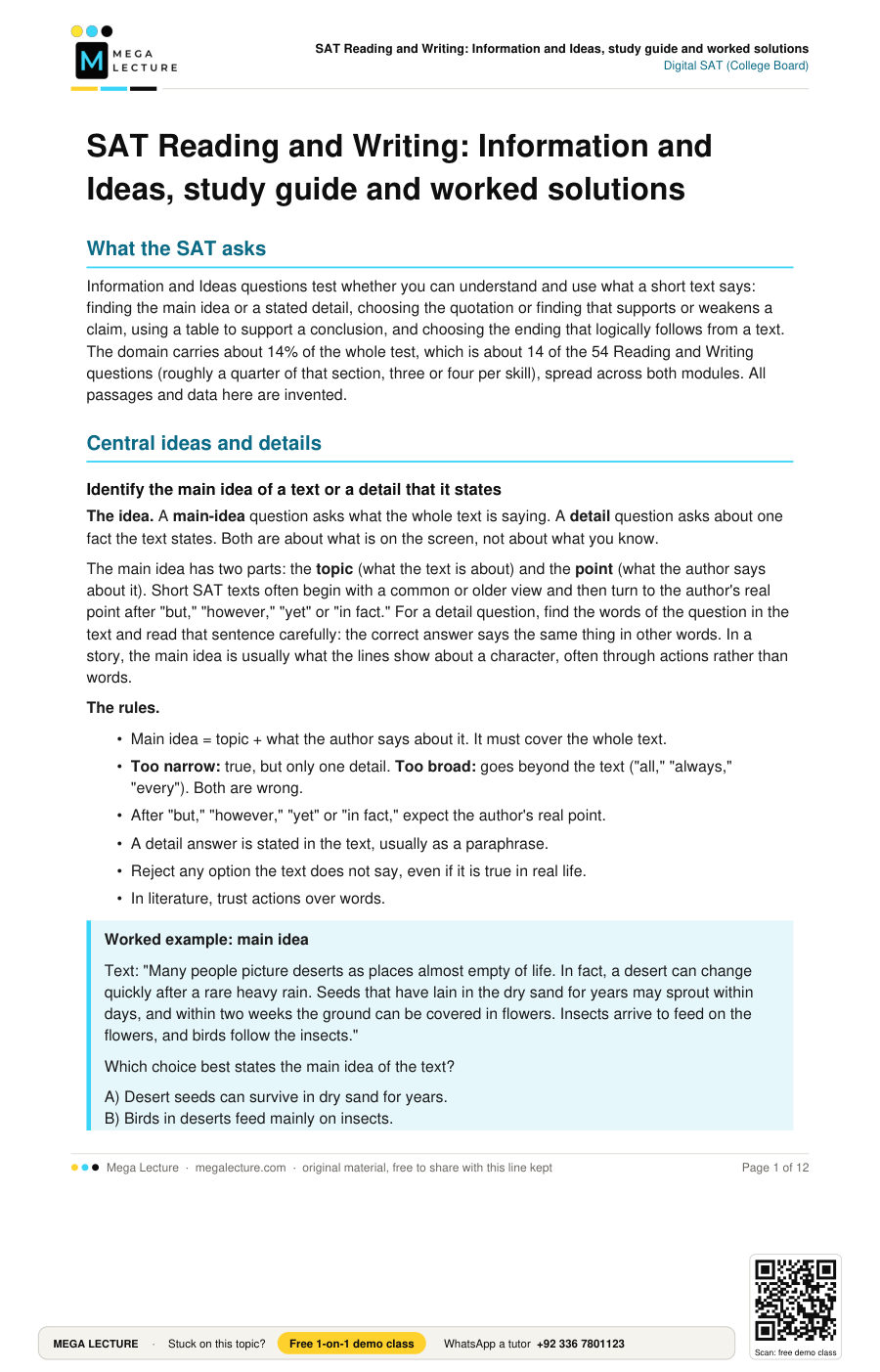
What the SAT asks
Information and Ideas questions test whether you can understand and use what a short text says: finding the main idea or a stated detail, choosing the quotation or finding that supports or weakens a claim, using a table to support a conclusion, and choosing the ending that logically follows from a text. The domain carries about 14% of the whole test, which is about 14 of the 54 Reading and Writing questions (roughly a quarter of that section, three or four per skill), spread across both modules. All passages and data here are invented.
Central ideas and details
Identify the main idea of a text or a detail that it states
The idea. A main-idea question asks what the whole text is saying. A detail question asks about one fact the text states. Both are about what is on the screen, not about what you know.
The main idea has two parts: the topic (what the text is about) and the point (what the author says about it). Short SAT texts often begin with a common or older view and then turn to the author's real point after "but," "however," "yet" or "in fact." For a detail question, find the words of the question in the text and read that sentence carefully: the correct answer says the same thing in other words. In a story, the main idea is usually what the lines show about a character, often through actions rather than words.
The rules.
- Main idea = topic + what the author says about it. It must cover the whole text.
- Too narrow: true, but only one detail. Too broad: goes beyond the text ("all," "always," "every"). Both are wrong.
- After "but," "however," "yet" or "in fact," expect the author's real point.
- A detail answer is stated in the text, usually as a paraphrase.
- Reject any option the text does not say, even if it is true in real life.
- In literature, trust actions over words.
Worked example: main idea
Text: "Many people picture deserts as places almost empty of life. In fact, a desert can change quickly after a rare heavy rain. Seeds that have lain in the dry sand for years may sprout within days, and within two weeks the ground can be covered in flowers. Insects arrive to feed on the flowers, and birds follow the insects."
Which choice best states the main idea of the text?
A) Desert seeds can survive in dry sand for years.
B) Birds in deserts feed mainly on insects.
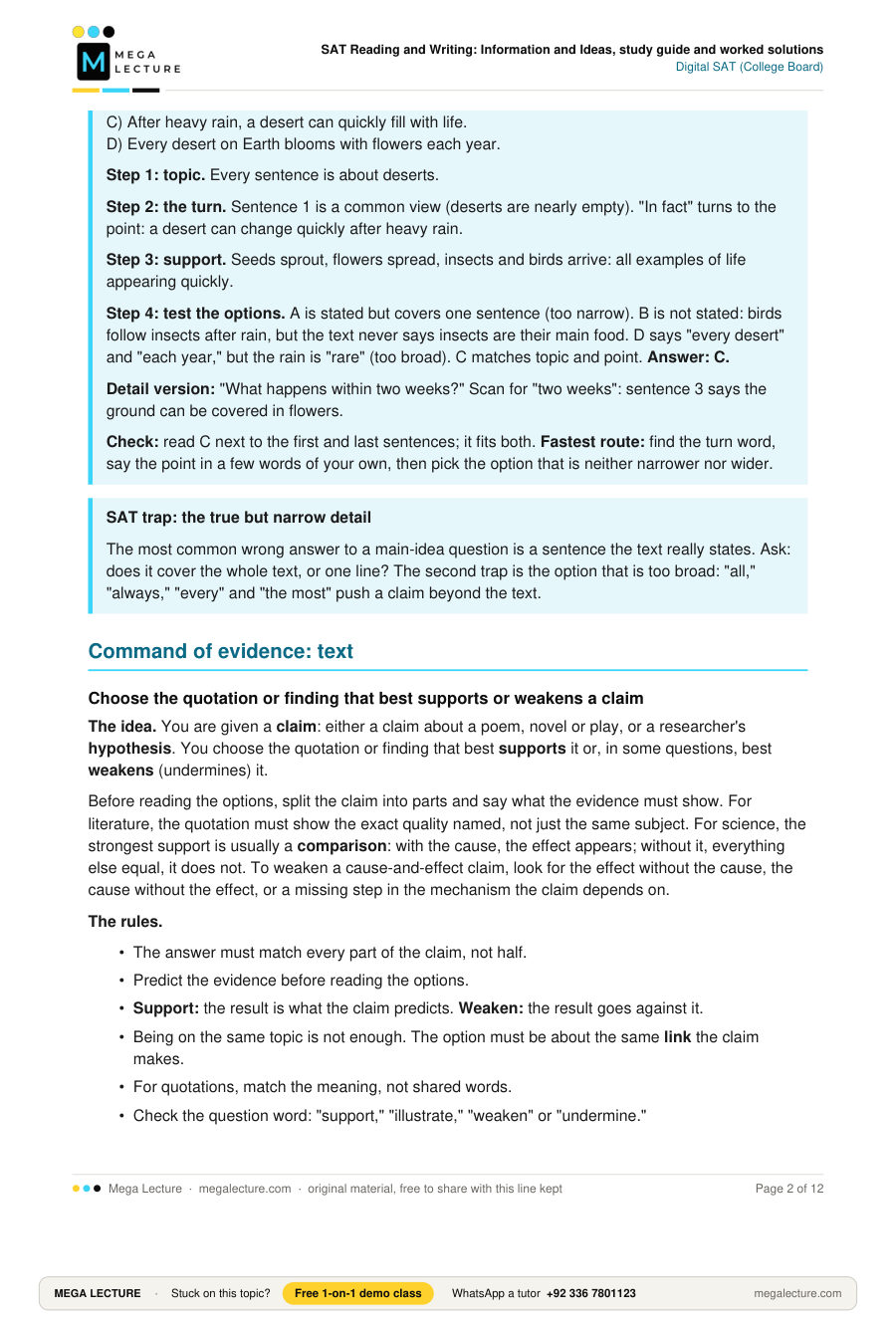
C) After heavy rain, a desert can quickly fill with life.
D) Every desert on Earth blooms with flowers each year.
Step 1: topic. Every sentence is about deserts.
Step 2: the turn. Sentence 1 is a common view (deserts are nearly empty). "In fact" turns to the point: a desert can change quickly after heavy rain.
Step 3: support. Seeds sprout, flowers spread, insects and birds arrive: all examples of life appearing quickly.
Step 4: test the options. A is stated but covers one sentence (too narrow). B is not stated: birds follow insects after rain, but the text never says insects are their main food. D says "every desert" and "each year," but the rain is "rare" (too broad). C matches topic and point. Answer: C.
Detail version: "What happens within two weeks?" Scan for "two weeks": sentence 3 says the ground can be covered in flowers.
Check: read C next to the first and last sentences; it fits both. Fastest route: find the turn word, say the point in a few words of your own, then pick the option that is neither narrower nor wider.
SAT trap: the true but narrow detail
The most common wrong answer to a main-idea question is a sentence the text really states. Ask: does it cover the whole text, or one line? The second trap is the option that is too broad: "all," "always," "every" and "the most" push a claim beyond the text.
Command of evidence: text
Choose the quotation or finding that best supports or weakens a claim
The idea. You are given a claim: either a claim about a poem, novel or play, or a researcher's hypothesis. You choose the quotation or finding that best supports it or, in some questions, best weakens (undermines) it.
Before reading the options, split the claim into parts and say what the evidence must show. For literature, the quotation must show the exact quality named, not just the same subject. For science, the strongest support is usually a comparison: with the cause, the effect appears; without it, everything else equal, it does not. To weaken a cause-and-effect claim, look for the effect without the cause, the cause without the effect, or a missing step in the mechanism the claim depends on.
The rules.
- The answer must match every part of the claim, not half.
- Predict the evidence before reading the options.
- Support: the result is what the claim predicts. Weaken: the result goes against it.
- Being on the same topic is not enough. The option must be about the same link the claim makes.
- For quotations, match the meaning, not shared words.
- Check the question word: "support," "illustrate," "weaken" or "undermine."
Worked example: a quotation that illustrates a claim
Text: "In a novel written for this guide, the narrator, Farah, describes the grandmother who raised her. A student claims that the novel portrays the grandmother as someone who hides her kindness behind a stern manner."
Which quotation most effectively illustrates the student's claim?
A) "My grandmother rose before dawn every day and never once slept late."
B) "She scolded me sharply for the torn sleeve, then sat up past midnight mending it so neatly that no one could find the tear."
C) "Everyone in the lane agreed that my grandmother was the kindest woman they had ever met."
D) "Her voice was stern when she spoke to the shopkeepers, and they always gave her a fair price."
Step 1: split the claim. She is kind; she seems stern; the sternness hides the kindness.
Step 2: predict. A line where she acts harshly on the surface but does something caring.
Step 3: test. A shows discipline, not kindness or sternness. B: "scolded me sharply" is the stern manner; "sat up past midnight mending it" is the hidden kindness. C shows kindness that everyone sees, so nothing is hidden. D shares the word "stern" but shows no kindness. Answer: B.
Check: if this line were the only evidence, would you believe the claim? Only B passes. Fastest route: look for a contrast between surface and reality; options that share one word with the claim are often traps.
SAT trap: right topic, wrong link
Wrong options are usually about the same subject as the claim but do not test its link. Ask of each option: "If this were true, would the claim be more likely (support) or less likely (weaken)?" And reread the question: many students pick a supporting finding when the question asks which one weakens.
Command of evidence: data
Choose the claim that data in a table best supports
The idea. A short text comes with a table. The text ends with a claim or a blank, and you choose the option that uses the data to support or complete it.
Read the claim first and decide what numbers would prove it. Then read the table's headings and units before any values. Every option must pass two tests. Accurate: do its numbers match the right row and column? Relevant: does it prove this claim?
The rules.
- For every number in an option, check the row, the column and the unit.
- A claim about change ("increased," "more than") needs at least two values compared.
- A claim that something caused a change needs a comparison with a group that did not get it.
- A percentage is not a count: 45% of 400 is 180, but 25% of 1,200 is 300.
- A rise from 40% to 46% is 6 percentage points.
Worked example: a claim that needs a comparison group
Text: "In 2025, two of a town's three clinics began opening from 5 p.m. to 8 p.m. on weekdays. The third kept its daytime hours. A health officer claims that the evening hours led to more visits, since ______"
| Clinic | Evening hours added? | Average weekly visits, 2024 | Average weekly visits, 2025 |
|---|---|---|---|
| North | Yes | 310 | 365 |
| East | Yes | 280 | 332 |
| South | No | 295 | 298 |
Which choice most effectively uses data from the table to complete the claim?
A) North had 365 weekly visits on average in 2025, more than any other clinic that year.
B) average weekly visits rose by 55 at North and by 52 at East but by only 3 at South, which did not add evening hours.
C) South had more weekly visits than East in 2024.
D) average weekly visits rose at all three clinics from 2024 to 2025.
Step 1: the claim. Evening hours caused more visits, so clinics with the change should rise much more than the clinic without it.
Step 2: the table. North 365 − 310 = 55; East 332 − 280 = 52; South 298 − 295 = 3.
Step 3: accuracy. All four options are accurate, so relevance decides.
Step 4: relevance. A is one clinic in one year: no change shown. C is about 2024, before the change. D is the trap: if visits rose everywhere, including where nothing changed, something else could explain it. Only B compares the clinics with the change against the one without. Answer: B.
Fastest route: name what the claim needs (change with the cause versus without) and find the option that mentions both groups.
SAT trap: accurate but not relevant
Wrong options are rarely misread numbers. Often three or four options are accurate and only one is relevant. Never stop at "this number is in the table." Also watch for a percentage used as a count, and one value offered for a claim about a trend.
Inferences
Choose the most logical completion of a text from what it says
The idea. The text ends with a blank, often after "this suggests that" or "therefore." You choose the ending that must follow from the facts. Think of a chain: fact, fact, fact, then one small step forward. That step is the answer.
A correct inference is modest, often using "may," "some" or "in part." Wrong options go too far, add new ideas, reverse cause and effect, or contradict a fact. Two things happening together does not prove that one causes the other.
The rules.
- Use every fact. An answer that ignores or contradicts one is wrong.
- Use the text only, not outside knowledge.
- Take one small step. Prefer the cautious option to the sweeping one.
- "If the hypothesis is correct, the study should find that...": pick the result the hypothesis predicts.
- Correlation does not prove cause.
Worked example: completing the text
Text: "At an inland settlement about 300 kilometers from the sea, archaeologists found bones of a fish species that lives only in salt water. No river connects the settlement to the coast. The settlement's pottery closely matches pottery from coastal villages of the same period. These findings suggest that the settlement's people ______"
A) lived on the coast and moved inland later.
B) caught the fish in a nearby river.
C) traded only fish with coastal villages.
D) may have obtained sea fish through contact with coastal communities.
Step 1: list the facts. Sea fish bones far inland; no river to the sea; pottery like coastal pottery.
Step 2: join them. The fish could not live nearby, and the pottery shows a link with the coast. Small step: the fish probably came through contact with the coast.
Step 3: test. A claims a move the text never mentions. B contradicts two facts. C says "only fish," far too strong. D is cautious and uses all three facts. Answer: D.
Check: point to a sentence for each part of D. Fastest route: cross out options that contradict a fact, then options with "only," "all," "proves" or "always," then choose.
SAT trap: the answer that sounds true in real life
Some wrong options sound true in real life but have no support in the text; others go too far or reverse cause and effect. For every word of your choice, you should be able to point to the sentence that supports it.
Practice set
Allow about 70 seconds per question.
Question 1
For years, city planners treated flat rooftops as wasted space. A study of 40 office buildings in one hot city found that buildings with planted roofs stayed about 3 °C cooler on their top floors in summer than similar buildings with bare roofs. Owners of the planted buildings also spent less on air conditioning, and some roofs produced vegetables for staff cafeterias.
Which choice best states the main idea of the text?
A) Office workers prefer vegetables grown on their own buildings.
B) Planted roofs kept top floors about 3 °C cooler in summer.
C) Planted roofs can bring practical benefits, so rooftops need not be seen as wasted space.
D) Every city should require new office buildings to have planted roofs.
Question 2
Chemist Nadia Ferro spent six years studying a red dye made from the bark of a mountain tree. Weavers in the valley below had used the dye for centuries, but their cloth lost its color after a few washes. Ferro found that adding a small amount of iron-rich clay to the dye bath made the color last far longer.
According to the text, what did Ferro discover?
A) Adding iron-rich clay to the dye bath helped the color resist fading.
B) The bark of the mountain tree can produce several different colors.
C) The weavers had used iron-rich clay in their dye for centuries.
D) The cloth faded because the weavers washed it too often.
Question 3
Samir had told everyone that he did not care about the school chess final. On the morning of the match, he ate breakfast quickly, then set up the board on the kitchen table and replayed his last three games, move by move, until his tea went cold. When his sister asked whether he was nervous, he laughed and said it was just a game, but he did not look up from the board.
Which choice best states the main idea of the text?
A) Samir is sure he will win the final because he has practiced so much.
B) Samir's sister doubts that he is good enough to win the final.
C) Samir has lost interest in chess and plays only to please his family.
D) Although Samir says the final does not matter to him, his actions suggest that it does.
Question 4
Textbooks often present the printing press as the invention that spread reading across early modern Europe. Printing did make books far cheaper. Yet historians studying parish records in one region have found that the share of adults who could sign their own names rose sharply only about a century after presses arrived, in the decades when villages first opened schools. Books, these historians conclude, were necessary for widespread literacy but did not produce it by themselves.
Which choice best states the main idea of the text?
A) Printed books became much cheaper after the printing press arrived.
B) In the region studied, wider literacy depended on schooling as well as on printed books.
C) The printing press had little effect on European life.
D) Parish records are the most reliable source of information about past literacy.
Question 5
"The Empty House" is a poem written for this guide. In it, the speaker returns to the house where she grew up, which has stood empty for many years. A student claims that the poem suggests the house still holds traces of the family that once lived in it.
Which quotation from the poem most effectively illustrates the student's claim?
A) "The gate hangs crooked on a single hinge, / and rain has stained the porch a darker brown."
B) "Beyond the fence the wheat fields roll for miles / beneath a sky as pale as watered milk."
C) "The kitchen wall still keeps the pencil marks / that measured every child from year to year."
D) "I reach the road and do not stop to knock, / for no one waits inside to let me in."
Question 6
Shore crabs on one rocky coast come in two shell colors, dark and pale. The coast's rocks are also of two kinds, dark volcanic rock and pale limestone. Birds that eat the crabs hunt by sight. A biologist hypothesizes that each crab chooses a hiding place that matches the color of its own shell.
Which finding, if true, would most directly support the biologist's hypothesis?
A) Dark-shelled crabs are more common on the coast than pale-shelled crabs.
B) Both dark-shelled and pale-shelled crabs hide more often at low tide than at high tide.
C) Crabs hiding among rocks are caught by birds less often than crabs in the open.
D) In a tank with equal areas of dark and pale rock, most dark-shelled crabs settled on dark rock and most pale-shelled crabs settled on pale rock.
Question 7
Aphids are small insects that damage crops. An agricultural researcher noticed that fields with a strip of wildflowers planted along the edge had fewer aphids than fields without such strips. She hypothesized that the wildflowers reduce aphids by attracting ladybird beetles, which eat aphids, into the fields.
Which finding, if true, would most directly weaken the researcher's hypothesis?
A) Fields with wildflower strips had no more ladybird beetles than fields without strips.
B) Fields with wildflower strips had fewer aphids in every year of the study.
C) Ladybird beetles were seen eating aphids in several fields with wildflower strips.
D) Wildflower strips also attract bees that pollinate crops in nearby fields.
Question 8
A student timed how long one spoonful of sugar took to dissolve, without stirring, in the same amount of water at four temperatures. The student concluded that sugar dissolves faster in warmer water.
| Water temperature (°C) | Time to dissolve (seconds) |
|---|---|
| 10 | 95 |
| 30 | 62 |
| 50 | 38 |
| 70 | 21 |
Which choice most effectively uses data from the table to support the student's conclusion?
A) The sugar dissolved in 62 seconds in water at 30 °C.
B) The time to dissolve fell from 95 seconds at 10 °C to 21 seconds at 70 °C.
C) The sugar dissolved in 38 seconds in water at 70 °C.
D) The time to dissolve increased steadily as the water temperature rose.
Question 9
Farmers in one district grew a new wheat variety, bred to cope with drought, beside the old variety for four years. An agronomist claims that the new variety's advantage over the old one was greatest in dry years.
| Year | Rainfall (mm) | Old variety yield (tonnes per hectare) | New variety yield (tonnes per hectare) |
|---|---|---|---|
| 2020 | 610 | 3.1 | 3.4 |
| 2021 | 340 | 1.8 | 2.9 |
| 2022 | 560 | 2.9 | 3.3 |
| 2023 | 300 | 1.5 | 2.7 |
Which choice most effectively uses data from the table to support the agronomist's claim?
A) The new variety's yield of 3.4 tonnes per hectare in 2020 was its highest in the four years.
B) The old variety's yield fell from 3.1 tonnes per hectare in 2020 to 1.5 tonnes per hectare in 2023.
C) In 2023, the year with the least rain, the new variety yielded 2.7 tonnes per hectare.
D) The new variety outyielded the old by 1.2 tonnes per hectare in 2023, when 300 mm of rain fell, but by only 0.3 tonnes per hectare in 2020, when 610 mm fell.
Question 10
A city official studied how students travel to three schools. She reported that although School P has the highest percentage of students who walk to school, School R has the largest number of students who walk.
| School | Total students | Percentage who walk to school |
|---|---|---|
| P | 400 | 45% |
| Q | 900 | 20% |
| R | 1,200 | 25% |
Which choice most effectively uses data from the table to support the official's report?
A) School P's 45% is the highest, but 25% of School R's 1,200 students (300 students) is more than 45% of School P's 400 students (180 students).
B) School R has 1,200 students, more than either of the other two schools.
C) School P and School Q each have 180 students who walk to school.
D) School R's 25% is higher than School Q's 20%.
Question 11
A team counted birds at a lake every morning for a year. One small songbird species was seen only from April to September. The team also found that a small fly, the songbird's main food at the lake, hatches there only in the warm months and is absent the rest of the year. Since the songbirds were absent whenever the flies were absent, the team concluded that the songbirds' presence at the lake ______
Which choice most logically completes the text?
A) has no connection with the food available at the lake.
B) proves that the songbirds cannot survive cold weather anywhere.
C) may depend on whether the flies they eat are available.
D) causes the flies to hatch during the warm months.
Question 12
In the eighteenth century, all goods reaching the inland markets of one region had to pass through a single port. The port's ship logs record the first arrival of tea in 1762. Letters written by inland merchants, however, describe buying and selling tea in 1760. Since the inland markets could have received tea only through the port, the letters suggest that ______
Which choice most logically completes the text?
A) tea was grown in the inland region before 1762.
B) some tea passed through the port before the ship logs record any arrival of tea.
C) the merchants' letters were actually written after 1762.
D) the ship logs are a complete record of all goods that passed through the port.
Question 13
In a survey of 2,000 adults, dog owners reported walking more minutes per day than people without dogs. One researcher hypothesized that owning a dog leads people to walk more. A second researcher pointed out that people who already like walking may be more likely to get a dog. To test the first hypothesis, the researchers followed adults who did not own dogs for two years, during which some of them adopted dogs. If the first researcher's hypothesis is correct, the study should find that ______
Which choice most logically completes the text?
A) the people who walked the most at the start were the most likely to adopt a dog.
B) the people who owned dogs at the start of the study walked more than the others.
C) the people who never adopted a dog walked more over the two years than those who did.
D) the people who adopted a dog walked more after adopting it than before, while the people who did not adopt showed no similar increase.
Question 14
Potters in one ancient settlement sometimes mixed crushed shell into their clay. In tests, pots made with shell-mixed clay cracked less often than plain clay pots when heated over a fire again and again. At one excavation, archaeologists found that cooking pots from a single layer of the site contained crushed shell, while storage jars from the same layer did not. This pattern suggests that the potters ______
Which choice most logically completes the text?
A) chose the clay mixture according to how a pot would be used.
B) did not know how to crush shell finely enough for storage jars.
C) made all their storage jars before they began making cooking pots.
D) added shell to their clay only because clay was scarce.
Solutions
1. Answer: C
The text opens with an old view (rooftops are wasted space), then gives three benefits: cooler top floors, lower air-conditioning costs, vegetables. C names the topic and the point and covers every sentence. A is not stated. B is accurate but only one finding (too narrow). D goes too far: one study in one city says nothing about what every city should require.
Skill: Central ideas and details.
2. Answer: A
Find "found": "Ferro found that adding a small amount of iron-rich clay to the dye bath made the color last far longer." A paraphrases it. B is never stated: the dye is described only as red. C mixes up the facts: the weavers used the dye for centuries; the clay was Ferro's addition. D invents a cause: the cloth faded after a few washes, not because of too many.
Skill: Central ideas and details.
3. Answer: D
Sentence 1 says Samir claims not to care. Every action then contradicts it: he replays three games "until his tea went cold," and while calling it "just a game," he "did not look up from the board." D captures this gap between words and actions. A is unsupported: he prepares, but nothing shows he is sure of winning. B is not stated: the sister only asks if he is nervous. C contradicts his careful study.
Skill: Central ideas and details.
4. Answer: B
The text grants one part of a common view, then turns with "Yet": literacy rose only when villages opened schools. The last sentence concludes that books were necessary but not enough. B combines books and schooling. A is the conceded detail before the turn. C contradicts the text, which calls books "necessary." D is never claimed.
Skill: Central ideas and details.
5. Answer: C
The claim has two parts: the house still holds something, and it is a trace of the family. In C the kitchen wall "still keeps" the "pencil marks / that measured every child": both parts. A shows decay, not the family. B describes the land outside. D is about the family's absence, not anything the house keeps.
Skill: Command of evidence: text.
6. Answer: D
The hypothesis links shell color to the color of rock chosen. D shows crabs choosing matching rock when both are equally available. A is about numbers of crabs, not hiding places. B is about timing and treats both colors alike. C is tempting because it fits the bird threat, but it does not say which rock each color picks, so it does not test the link.
Skill: Command of evidence: text.
7. Answer: A
The hypothesis is a chain: wildflowers bring in more ladybird beetles, and the beetles reduce aphids. If strip fields have no more beetles, the middle step is missing. A weakens it directly. B supports the original observation. C supports the hypothesis. D is about bees and pollination, outside the claimed link.
Skill: Command of evidence: text.
8. Answer: B
The conclusion is a trend, so it needs two values. B compares the coldest and warmest water: 95 seconds at 10 °C and 21 seconds at 70 °C, a fall of 95 − 21 = 74 seconds. A is accurate but one value shows no trend. C is inaccurate: 38 seconds was at 50 °C. D is inaccurate: the time decreased.
Skill: Command of evidence: data.
9. Answer: D
The claim is about the gap between varieties. Gaps: 2020: 3.4 − 3.1 = 0.3; 2021: 2.9 − 1.8 = 1.1; 2022: 3.3 − 2.9 = 0.4; 2023: 2.7 − 1.5 = 1.2. The two driest years had the largest gaps. D compares the driest year (1.2) with the wettest (0.3), with correct figures. A, B and C are accurate but irrelevant: A is one variety in a wet year, B is the old variety alone, C gives the new variety's yield with no comparison.
Skill: Command of evidence: data.
10. Answer: A
The report has two parts: P has the highest percentage, R the largest number. Counts: P: 0.45 × 400 = 180; Q: 0.20 × 900 = 180; R: 0.25 × 1,200 = 300. A states both parts correctly. B gives total students, not walkers. C is accurate but leaves out R. D compares R with Q, not with P, so it does not show R has more walkers than P.
Skill: Command of evidence: data.
11. Answer: C
The birds are present only when their main food is present. The modest step is that their presence may depend on the flies. A contradicts the pattern. B goes far beyond one lake. D reverses cause and effect: the birds eat the flies; nothing suggests they make flies hatch.
Skill: Inferences.
12. Answer: B
All goods came through the port, and tea was traded inland in 1760, so tea must have passed through the port by 1760, before the logs' first record in 1762. B uses every fact. A contradicts the statement that the inland markets could have received tea only through the port. C has no support. D contradicts the reasoning: complete logs would show tea before 1762.
Skill: Inferences.
13. Answer: D
If owning a dog causes more walking, adopters should walk more after adopting than before, and non-adopters should not show the same rise. D describes this before-and-after comparison with a comparison group. A would support the second researcher's idea. B is impossible: no one owned a dog at the start. C is the opposite of the prediction.
Skill: Inferences.
14. Answer: A
Shell-mixed clay survives repeated heating better; cooking pots (heated) had shell; storage jars (not heated) from the same layer did not. So the potters matched the mixture to the use. B fails because they clearly could crush shell for cooking pots. C claims an order the text never gives. D brings in an unmentioned cause; if clay were scarce, the jars would likely contain shell too.
Skill: Inferences.
