
SAT · Practice tests · How to prepare for the Digital SAT: format, scoring and an 8-week plan
How to prepare for the Digital SAT: format, scoring and an 8-week plan
Need more than one subject? All-notes pass: unlimited downloads of every note for a year: unlimited downloads of every note on the site, PKR 999 a year. All packs and courses.
Opens inside this page. Prefer your own PDF app? Open the PDF.
Check yourself
5 quick questions on SAT
Tap an answer to see if you are right, and why. Free, no sign-up.
Start the free testWas this note useful?
Full text of How to prepare for the Digital SAT: format, scoring and an 8-week plan
The Digital SAT is a test of reading, writing and math that lasts a little over two hours. It is not a test of new or difficult content. Most of the math is material you have already met in O Level, FSc, IB or the first year of A Level, and the reading and writing questions use short passages, not long chapters. What makes the SAT hard is the format: tight timing, careful wording and answer choices built around the mistakes students usually make. This guide explains the format and the scoring, shows what each section tests and gives you an 8-week plan you can follow alongside school or college.
Who takes the SAT from Pakistan
Most students in Pakistan who sit the SAT are applying to universities abroad, especially in the United States, where many colleges consider SAT scores as part of an application. Some universities in Canada, the Middle East, Asia and elsewhere also look at SAT scores, either as a requirement for some applicants or as an optional extra that can strengthen an application.
The SAT is also useful closer to home. Some Pakistani universities accept SAT scores on some of their admission routes, for example as an alternative to their own entry test for certain groups of applicants. Rules differ from one university to another, from one program to another and from one year to the next.
Because these rules change, this guide does not name any university policy, minimum score, fee or test date. Before you register, do two things:
- Check the test details, registration steps, fees and dates on collegeboard.org.
- Check the admissions page of every university you are applying to. Look for whether it accepts the SAT, what it asks for, and its deadline for receiving scores.
The SAT suits students from every system. O and A Level students, FSc students and IB students all take it, and each group has different strengths. The plan later in this guide shows where each group usually needs the most work.
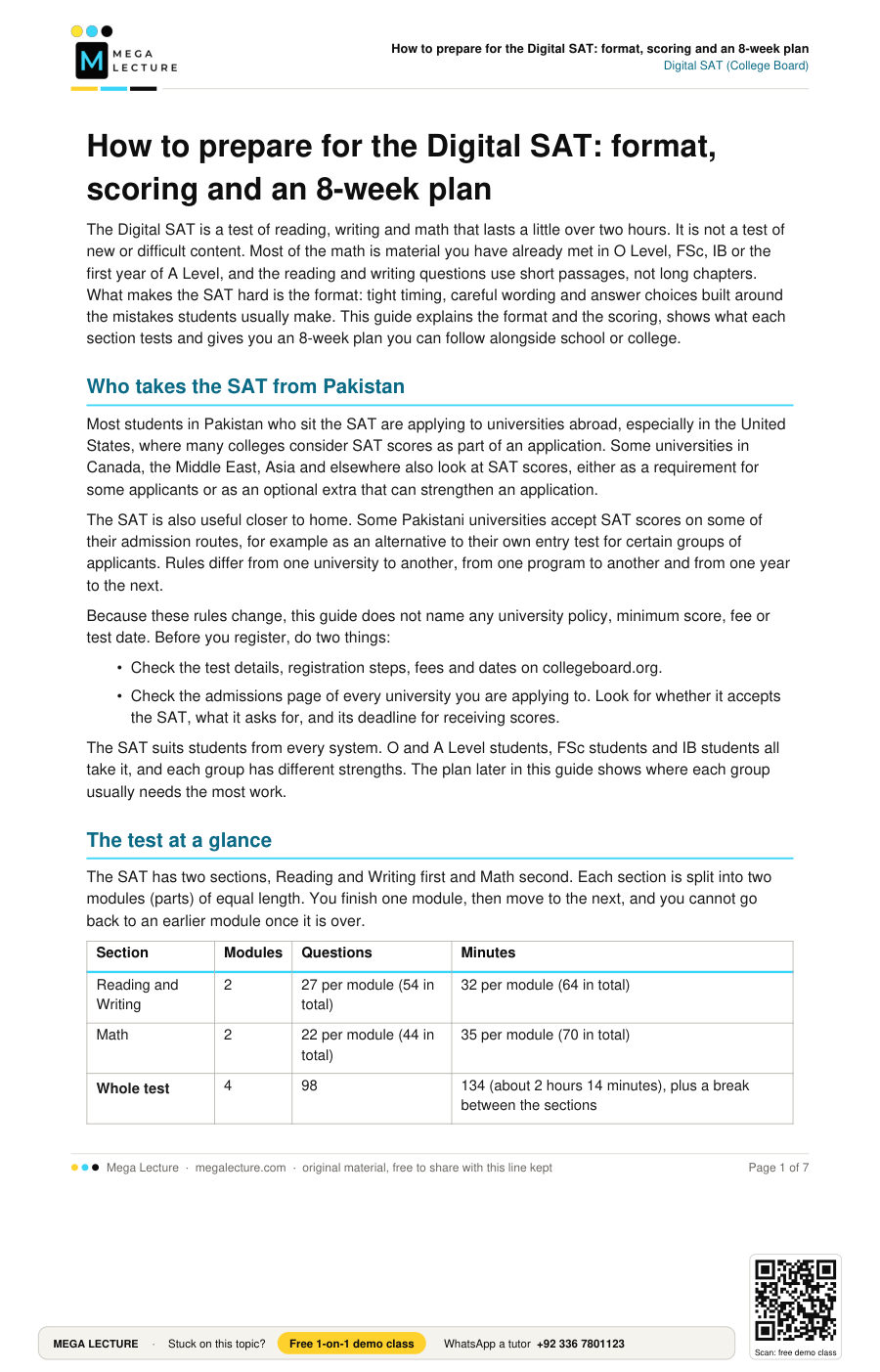
The test at a glance
The SAT has two sections, Reading and Writing first and Math second. Each section is split into two modules (parts) of equal length. You finish one module, then move to the next, and you cannot go back to an earlier module once it is over.
| Section | Modules | Questions | Minutes |
|---|---|---|---|
| Reading and Writing | 2 | 27 per module (54 in total) | 32 per module (64 in total) |
| Math | 2 | 22 per module (44 in total) | 35 per module (70 in total) |
| Whole test | 4 | 98 | 134 (about 2 hours 14 minutes), plus a break between the sections |
Adaptive modules, explained simply
Each section is "multistage adaptive." That sounds complicated, but the idea is simple. Everyone in a section starts with a first module that has a mix of easy, medium and hard questions. The app then looks at how you did. If you did well, your second module is a harder one. If you did less well, your second module is an easier one. Your section score depends on how many questions you answer correctly and on how difficult those questions were, so a strong first module opens the door to the higher part of the score range.
Scoring
- Your total score runs from 400 to 1600.
- It is the sum of two section scores: Reading and Writing (200 to 800) and Math (200 to 800).
- There is no penalty for wrong answers. A wrong answer and a blank answer both score zero, so you should answer every question, even if you have to guess.
Bluebook, Desmos and the reference sheet
- Bluebook is the College Board app in which you take the test. You can install it before test day and use it to try a full practice test, which is the best way to get used to the screen, the timer and the tools.
- Desmos, a graphing calculator, is built into Bluebook and is allowed on the whole Math section. You may also bring an approved calculator of your own; check the current calculator rules on collegeboard.org.
- A reference sheet of basic formulas (areas, volumes, special right triangles and a few others) can be opened in the app during Math.
Question types
In Reading and Writing, every question has its own short passage (or a pair of short passages) followed by one question with four options. In Math, about 75% of questions are four-option multiple choice and about 25% are student-produced responses, where you type your own answer into a box. For those, there are no options to check against, so careful working matters even more.
What is tested
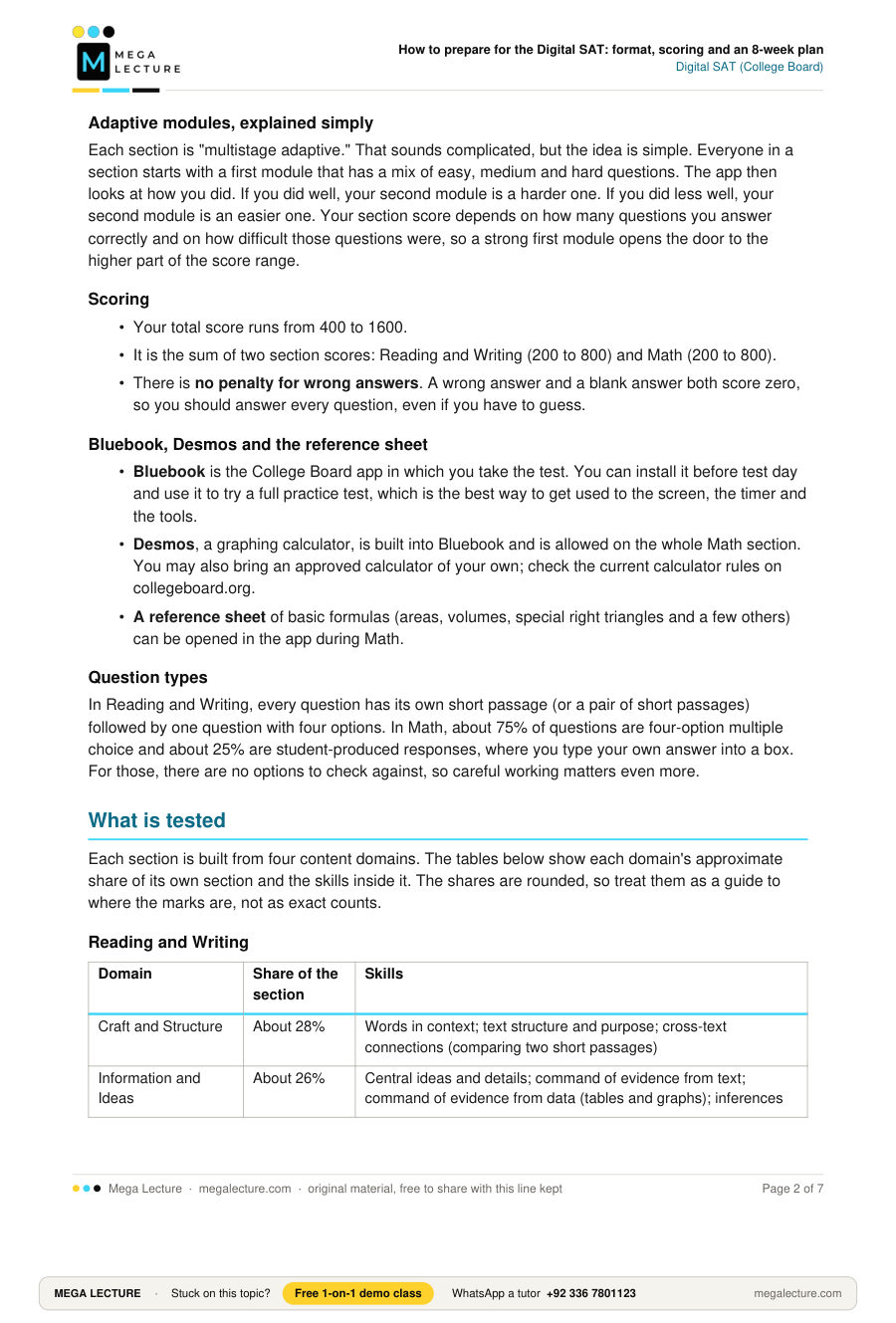
Each section is built from four content domains. The tables below show each domain's approximate share of its own section and the skills inside it. The shares are rounded, so treat them as a guide to where the marks are, not as exact counts.
Reading and Writing
| Domain | Share of the section | Skills |
|---|---|---|
| Craft and Structure | About 28% | Words in context; text structure and purpose; cross-text connections (comparing two short passages) |
| Information and Ideas | About 26% | Central ideas and details; command of evidence from text; command of evidence from data (tables and graphs); inferences |
| Standard English Conventions | About 26% | Boundaries (punctuation between and within sentences); form, structure and sense (agreement, verb forms, pronouns, modifiers) |
| Expression of Ideas | About 20% | Transitions (choosing the linking word that fits the logic); rhetorical synthesis (using notes to meet a stated goal) |
Math
| Domain | Share of the section | Skills |
|---|---|---|
| Algebra | About 35% | Linear equations in one variable; linear functions; linear equations in two variables; systems of two linear equations; linear inequalities |
| Advanced Math | About 35% | Equivalent expressions; nonlinear equations and systems; nonlinear functions (quadratics, exponentials, polynomials and others) |
| Problem-Solving and Data Analysis | About 15% | Ratios, rates, proportions and units; percentages; one-variable data; two-variable data; probability; samples, studies and margin of error |
| Geometry and Trigonometry | About 15% | Area and volume; lines, angles and triangles; right triangles and trigonometry; circles |
Two things stand out. First, Algebra and Advanced Math together make up about 70% of Math, so strong algebra is the single biggest lever on your Math score. Second, Reading and Writing is spread fairly evenly across its four domains, so you cannot rely on one strength. Grammar (Standard English Conventions) is often the quickest domain to improve, because it tests a fixed, learnable set of rules.
How the adaptive modules change your strategy
On a paper test, every question counts in the same way and you can move freely through the whole paper. The Digital SAT is different in three ways that should change how you work.
- Module 1 decides which module 2 you get. If you want a high score, module 1 is where you earn the chance. Accuracy here is worth more than speed.
- Each module is locked once it ends. You can move back and forth inside a module and change answers, but you cannot return to module 1 after starting module 2. Use the last minute or two of every module to answer anything you skipped.
- A harder module 2 should feel harder. If module 2 feels difficult, that is usually a good sign, not a bad one. Do not panic and do not rush. Keep working carefully, one question at a time.
SAT trap: rushing module 1
Many students race through module 1 to "save time for later." Time does not carry over between modules, so finishing module 1 five minutes early gains you nothing. Worse, the careless errors made while rushing can send you to the easier module 2, which limits how high your section score can go. Use the full time in module 1, check the questions you were unsure of and answer every question before the timer ends.
Two more strategy points follow from the format:
- Easy questions are worth protecting. Questions you find easy are where small slips (a sign error, a misread "NOT," a missed unit) cost you most. Read the question line again before you choose an answer.
- Hard questions can be skipped for now. Questions generally get harder as a module goes on (in Reading and Writing, within each group of similar questions), but a question you personally find hard can still come early. Flag it, move on and come back.
Pacing
Time per question
| Section | Time per module | Questions per module | Average time per question |
|---|---|---|---|
| Reading and Writing | 32 minutes | 27 | About 71 seconds |
| Math | 35 minutes | 22 | About 95 seconds |
These are averages. In Reading and Writing, grammar and transition questions are often quicker (around 40 to 50 seconds), which gives you extra time for inference, evidence and two-passage questions. In Math, a simple linear equation might take 30 seconds, while a multi-step word problem or a question with a parameter might take two to three minutes.
Flag and return
Bluebook lets you mark a question for review and shows you a map of the module, so you can see which questions are answered, unanswered or marked. Use a simple rule:
- If you have spent about twice the average time on a question (around 2 minutes in Reading and Writing, around 3 minutes in Math) and you are not close to an answer, choose your best guess, mark it for review and move on.
- When you reach the end of the module, go back to your marked questions with whatever time is left.
- With about one minute left, make sure every question has an answer. A guess can score; a blank cannot.
How to guess well
- Remove the options you can rule out first. Going from four options to two doubles your chance of being right.
- For a student-produced response question, type your best estimate rather than leaving it blank.
- Do not change an answer just because of a feeling. Change it only when you find a specific reason, such as an arithmetic slip or a word you misread.
An 8-week plan
This plan assumes about 6 to 8 hours of study a week, for example one hour on most weekdays and a longer session at the weekend. If you have more time, add more timed practice, not more reading about the test. If you have less time, stretch the plan to 10 or 12 weeks rather than skipping weeks.
| Week | Focus | What to do |
|---|---|---|
| 1 | Baseline | Install Bluebook and take one full timed practice test under real conditions. Record your section scores and list every question you got wrong by domain and skill. This list is your plan for the next weeks. |
| 2 | Algebra and grammar rules | Math: linear equations, linear functions, systems and inequalities. Reading and Writing: boundaries (when to use a period, semicolon, colon or comma). Do short untimed sets and check every mistake. |
| 3 | Advanced Math and grammar form | Math: equivalent expressions, quadratics, exponentials and function notation. Reading and Writing: subject-verb agreement, pronouns, verb tense and modifiers. Start timing your sets. |
| 4 | Data and evidence | Math: ratios, percentages, statistics, probability and reading graphs. Reading and Writing: command of evidence (text and data) and central ideas. Practice reading a table quickly and accurately. |
| 5 | Geometry, words and structure | Math: area, volume, triangles, right-triangle trigonometry and circles. Reading and Writing: words in context, text structure and purpose, and cross-text connections. Learn the Desmos shortcuts for graphs and systems. |
| 6 | Second full test | Take a second full timed practice test. Compare it with week 1. Spend the rest of the week on your three weakest skills only. |
| 7 | Inferences, transitions and hard Math | Reading and Writing: inferences, transitions and rhetorical synthesis. Math: harder Advanced Math and multi-step word problems. Do every set under strict time. |
| 8 | Final test and review | Take a third full practice test early in the week. Review mistakes, re-do questions you got wrong before, and rest for the last day or two. Check your test-day details on collegeboard.org. |
What you probably already know
FSc students. FSc Mathematics covers most of Algebra and Advanced Math: linear equations, systems, quadratics, functions and graphs. The usual gaps are data analysis (reading tables and scatterplots, mean and median, margin of error, interpreting a study) and reading speed in English. Spend less time on algebra and more on Problem-Solving and Data Analysis and on timed Reading and Writing.
O Level students. O Level Mathematics (and Additional Mathematics, if you took it) covers most of Algebra and Geometry, plus basic statistics and probability. The gaps are often in Advanced Math: exponential functions, function notation and questions with parameters. If your English is strong from O Level English Language, focus the Reading and Writing time on the grammar rules the SAT tests, which are American conventions and are tested in a very precise way.
A Level students. AS Mathematics covers all the algebra and functions the SAT needs and more. Your risk is overcomplicating: SAT questions usually have a short route. Practice speed and data questions, and use Desmos to check work rather than doing everything by hand.
IB students. IB Mathematics (either course) covers most of the content. IB students are often comfortable with data and graphs. The usual gaps are speed on simple algebra and the precise grammar rules in Standard English Conventions.
Everyone. Reading speed is the most common gap for students in Pakistan. Reading short English texts every day, such as news articles, science features and short essays, builds speed faster than any single technique.
Using Mega Lecture
Mega Lecture has free Digital SAT practice tests on quiz.megalecture.com, organized by domain, so you can practice exactly the skill your baseline test showed you need. The tests mark your answers straight away and explain each solution, which makes them a good fit for the skill weeks (weeks 2 to 5 and week 7) of the plan above. Use a full practice test in Bluebook for the timed full tests in weeks 1, 6 and 8.
Alongside the practice tests, Mega Lecture's Digital SAT guides take each domain in turn. Each guide explains the rules and methods, works through examples step by step, shows Desmos shortcuts for Math and points out the traps the SAT uses most often. A good routine is to read the guide for a domain, try a practice test on that domain, and then go back to the guide for any question you got wrong.
Common questions
Can I take the SAT more than once?
Yes. Many students take it two or three times, and scores often rise on a second attempt once the format feels familiar. Leave enough time between attempts to work on your weak skills. Check collegeboard.org for current test dates and registration rules.
What is superscoring?
Some universities "superscore": they take your best Reading and Writing score and your best Math score from different test dates and add them. Others look at a single sitting or ask to see all of your scores. Each university sets its own rule, so check its admissions page before you decide how many times to sit.
Can I use a calculator on every Math question?
Yes. The Desmos calculator in Bluebook can be used on the whole Math section, and you may bring an approved calculator of your own. A calculator helps most with graphs, systems of equations and checking answers. It does not replace knowing the method, and simple algebra is often faster by hand.
My English is not perfect. Can I still do well?
Yes. The passages are short, and the questions test careful reading, not difficult vocabulary. Students whose first language is not English often do very well in grammar, because they learned the rules formally. The main challenge is reading speed, which improves with daily reading and timed practice.
Do I need to know formulas by heart?
A reference sheet with basic formulas is available in the app, but opening it takes time. It is faster to know the common ones, such as the area of a circle and the Pythagorean theorem, and to use the sheet only to check. Some formulas you need, such as the slope formula, are not on the sheet at all.
How long should I prepare?
Eight weeks of steady practice is enough for most students who are already studying mathematics at O Level, FSc, A Level or IB. If your baseline test shows large gaps, or you have exams at the same time, give yourself 10 to 12 weeks.
Is the SAT the same as the old paper SAT?
No. The Digital SAT is shorter, adaptive and taken on a device, the reading passages are much shorter and a calculator is allowed on all of Math. Old paper practice books do not match the current format, so build your practice around the digital test.
