
MDCAT · Biology (PMDC curriculum) · How to prepare
How to prepare for MDCAT Biology: test format, unit weights and an 8-week plan
Need more than one subject? All-notes pass: unlimited downloads of every note for a year: unlimited downloads of every note on the site, PKR 999 a year. All packs and courses.
Opens inside this page. Prefer your own PDF app? Open the PDF.
Check yourself
5 quick questions on MDCAT Biology
Tap an answer to see if you are right, and why. Free, no sign-up.
Start the free testWas this note useful?
Full text of How to prepare for MDCAT Biology: test format, unit weights and an 8-week plan
Biology is the largest section of the MDCAT and the one where preparation pays back most directly. Almost every question comes from the FSc Part 1 and Part 2 content in the PMDC curriculum, most questions test a single idea, and there is no negative marking. This guide explains the format, shows how the 81 Biology questions are spread across the 16 units, tells you how questions are set, and gives you an 8-week plan that fits around FSc Part 2 classes.
The test
The MDCAT is one paper of 180 multiple-choice questions to be answered in 180 minutes. Each question has four options and exactly one correct answer: it is a single-best-answer test, so the paper avoids "all of the above" options to hide behind, and there is never more than one right choice. There is no negative marking: a wrong answer scores zero, the same as a blank. No calculator is allowed, so any number work in Biology (genetic ratios, percentages) is meant to be done in your head.
The paper is divided by subject. Biology carries 81 questions. The other sections are about 45 Chemistry, about 36 Physics, about 9 English and about 9 Logical Reasoning. Treat the non-Biology figures as approximate and confirm them, along with the total length, in the PMDC notice for the year you are sitting, because the split has been adjusted in the past.
Three consequences follow.
- With 180 questions in 180 minutes you have one minute per question on average. Biology questions are shorter to answer than Physics calculations, so you should aim to finish Biology faster than the average and carry the saved minutes forward.
- Because there is no negative marking, every question must have an answer on the sheet when time runs out. A guess has a one in four chance; a blank has none.
- Because every question has exactly one correct option, elimination works. If you can rule out two options with confidence, the guess becomes a coin toss in your favour.
The 16 Biology units
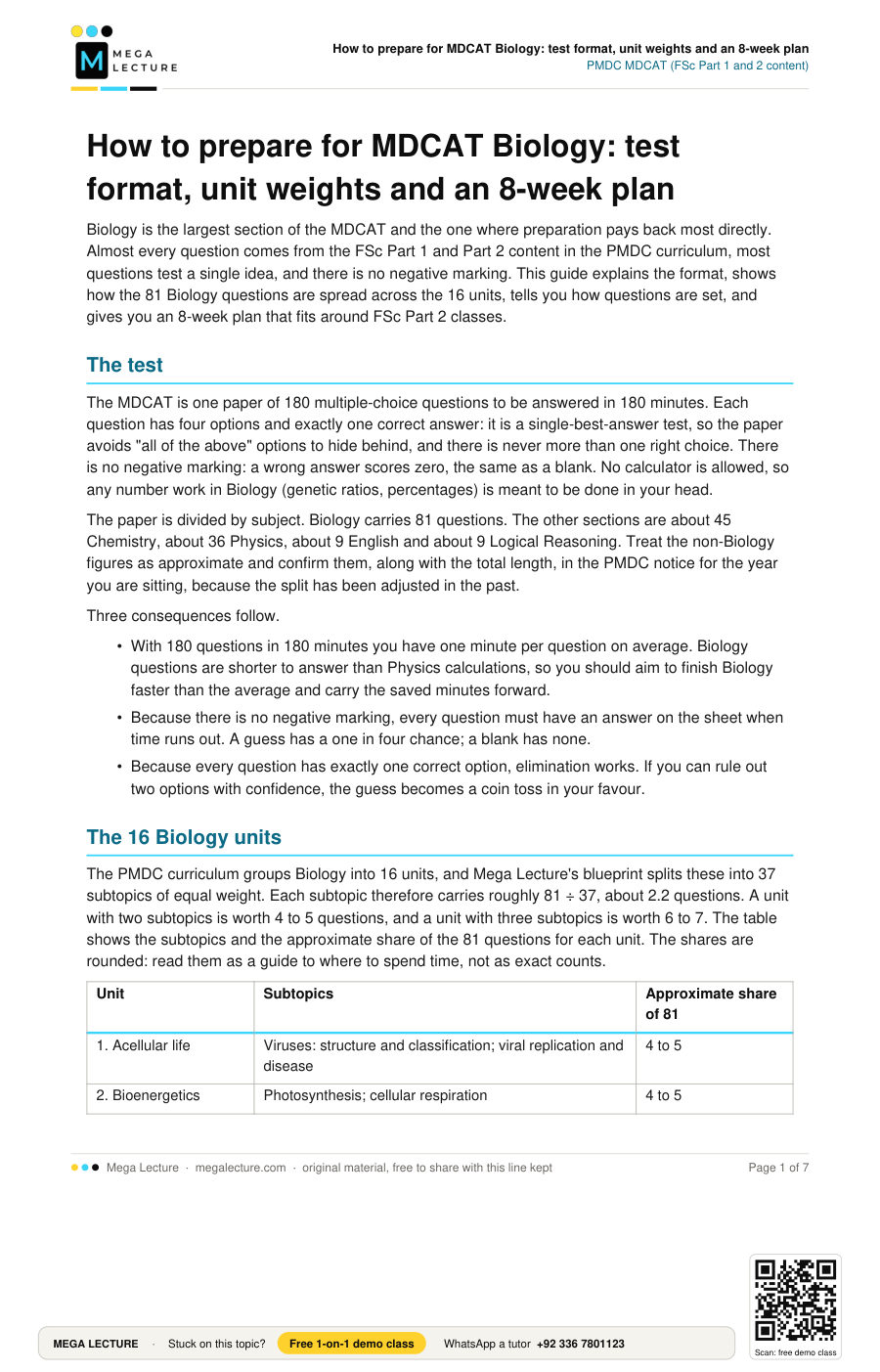
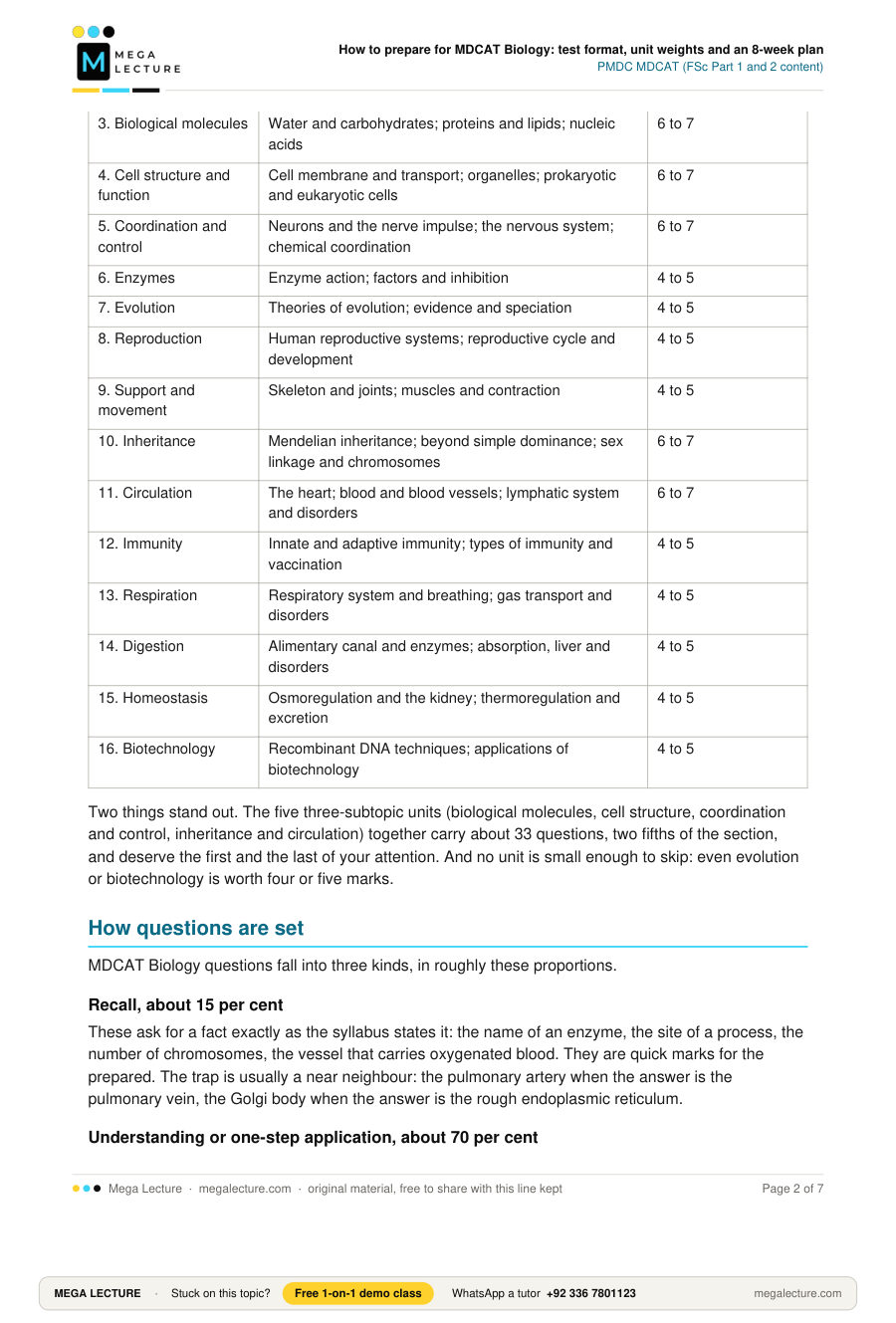
The PMDC curriculum groups Biology into 16 units, and Mega Lecture's blueprint splits these into 37 subtopics of equal weight. Each subtopic therefore carries roughly 81 ÷ 37, about 2.2 questions. A unit with two subtopics is worth 4 to 5 questions, and a unit with three subtopics is worth 6 to 7. The table shows the subtopics and the approximate share of the 81 questions for each unit. The shares are rounded: read them as a guide to where to spend time, not as exact counts.
| Unit | Subtopics | Approximate share of 81 |
|---|---|---|
| 1. Acellular life | Viruses: structure and classification; viral replication and disease | 4 to 5 |
| 2. Bioenergetics | Photosynthesis; cellular respiration | 4 to 5 |
| 3. Biological molecules | Water and carbohydrates; proteins and lipids; nucleic acids | 6 to 7 |
| 4. Cell structure and function | Cell membrane and transport; organelles; prokaryotic and eukaryotic cells | 6 to 7 |
| 5. Coordination and control | Neurons and the nerve impulse; the nervous system; chemical coordination | 6 to 7 |
| 6. Enzymes | Enzyme action; factors and inhibition | 4 to 5 |
| 7. Evolution | Theories of evolution; evidence and speciation | 4 to 5 |
| 8. Reproduction | Human reproductive systems; reproductive cycle and development | 4 to 5 |
| 9. Support and movement | Skeleton and joints; muscles and contraction | 4 to 5 |
| 10. Inheritance | Mendelian inheritance; beyond simple dominance; sex linkage and chromosomes | 6 to 7 |
| 11. Circulation | The heart; blood and blood vessels; lymphatic system and disorders | 6 to 7 |
| 12. Immunity | Innate and adaptive immunity; types of immunity and vaccination | 4 to 5 |
| 13. Respiration | Respiratory system and breathing; gas transport and disorders | 4 to 5 |
| 14. Digestion | Alimentary canal and enzymes; absorption, liver and disorders | 4 to 5 |
| 15. Homeostasis | Osmoregulation and the kidney; thermoregulation and excretion | 4 to 5 |
| 16. Biotechnology | Recombinant DNA techniques; applications of biotechnology | 4 to 5 |
Two things stand out. The five three-subtopic units (biological molecules, cell structure, coordination and control, inheritance and circulation) together carry about 33 questions, two fifths of the section, and deserve the first and the last of your attention. And no unit is small enough to skip: even evolution or biotechnology is worth four or five marks.
How questions are set
MDCAT Biology questions fall into three kinds, in roughly these proportions.
Recall, about 15 per cent
These ask for a fact exactly as the syllabus states it: the name of an enzyme, the site of a process, the number of chromosomes, the vessel that carries oxygenated blood. They are quick marks for the prepared. The trap is usually a near neighbour: the pulmonary artery when the answer is the pulmonary vein, the Golgi body when the answer is the rough endoplasmic reticulum.
Understanding or one-step application, about 70 per cent
The bulk of the paper. The stem describes a situation and asks you to apply one idea: what happens to enzyme activity when the pH moves away from the optimum, which hormone would rise after a sugary meal, which blood type can be given to a patient. You need to know the idea and recognise it in new words. Students who memorise the textbook but never practise lose most marks here, because the stem rarely uses the sentence they learnt.
Two-step reasoning, about 15 per cent
These need two linked steps: work out a genotype and then a probability; identify the organelle from a description and then say what fails when it is damaged; read a graph and then explain the shape. They take longer, which is why you bank time on recall questions, and they are where flagging pays off.
One example of each type follows. Try them before reading the answers.
Example 1 (recall). Which of the following carries oxygenated blood?
A. Pulmonary artery
B. Vena cava
C. Right ventricle
D. Pulmonary vein
Example 2 (understanding). A competitive inhibitor is added to an enzyme-catalysed reaction. Which change would most reduce the effect of the inhibitor?
A. Lowering the temperature by 10 °C
B. Raising the substrate concentration
C. Moving the pH away from the optimum
D. Adding more of the inhibitor
Example 3 (two-step reasoning). A woman with normal colour vision, whose father was colour blind, marries a man with normal colour vision. What is the probability that a son of theirs is colour blind?
A. 0
B. 25 per cent
C. 50 per cent
D. 100 per cent
1: D. The pulmonary vein returns oxygenated blood from the lungs to the left atrium. The pulmonary artery is the only artery in the adult body that carries deoxygenated blood, which is the trap in option A.
2: B. A competitive inhibitor competes with the substrate for the active site, so raising the substrate concentration out-competes it and restores the rate. Temperature and pH changes would slow the enzyme itself, and more inhibitor makes things worse.
3: C. Step one: the woman's father was colour blind, so he passed his only X chromosome (Xc) to her, and since she sees normally she is a carrier, XCXc. Step two: a son receives his X from his mother, and half of her X chromosomes carry the allele, so the probability is one half. The father's genotype does not affect sons for an X-linked trait.
8-week plan
This plan assumes you are still attending FSc Part 2 classes, so Part 1 units (which you have already studied once) come first for revision, and Part 2 units follow in the order most colleges teach them. Swap the Part 2 weeks around to match what your college is covering at the time: studying a unit for MDCAT in the week you meet it in class is the most efficient arrangement there is. Budget roughly 90 minutes a day on top of class work, with one lighter day a week.
| Week | Units | What to do |
|---|---|---|
| 1 | 3 Biological molecules; 6 Enzymes | Rebuild the foundations: carbohydrates, lipids, proteins, nucleic acids, then enzyme action and inhibition. Finish each subtopic with its unit test. These two units feed almost every other unit. |
| 2 | 4 Cell structure and function; 1 Acellular life; 2 Bioenergetics | Membrane transport and organelles, prokaryote versus eukaryote, viruses, then photosynthesis and respiration with their sites, inputs and outputs. Draw both energy pathways from memory at the end of the week. |
| 3 | 14 Digestion; 13 Respiration; 11 Circulation | The three Part 1 human systems. Learn enzymes by organ and pH, the breathing mechanism and gas transport, then the heart, vessels and blood. First Mini MDCAT at the weekend to set a baseline. |
| 4 | 12 Immunity; 15 Homeostasis | Innate and adaptive immunity and the four types of immunity, then the kidney, osmoregulation, thermoregulation and excretion. Review week 3's Mini MDCAT first. |
| 5 | 9 Support and movement; 5 Coordination and control | Skeleton, joints and muscle contraction, then neurons, the nerve impulse, the nervous system and hormones. Coordination is a three-subtopic unit, so give it four of the seven days. |
| 6 | 8 Reproduction; 10 Inheritance | Reproductive systems, the menstrual cycle and development, then Mendelian ratios, incomplete dominance, codominance, multiple alleles and sex linkage. Practise crosses on paper until a dihybrid ratio takes under a minute. |
| 7 | 7 Evolution; 16 Biotechnology; revision of the weakest five units | Finish the two remaining units in three days. Use your unit-test scores to pick the five weakest units and redo their tests in Practice mode. Second Mini MDCAT at the weekend. |
| 8 | Full papers and final revision | Three full-length timed papers on alternate days, each followed the next day by a review of every wrong or guessed answer. Light revision of definitions and traps in between. No new topics after mid-week. |
With more than eight weeks, stretch weeks 1 to 7 rather than week 8. With fewer, keep week 8 intact and compress the unit weeks.
Answering tactics
Time per question
The paper gives you 60 seconds a question on average. Aim to answer Biology at 40 to 45 seconds a question, which brings the 81 questions in at about an hour and leaves 20 to 27 minutes to carry into Physics and Chemistry, where calculations need them. Practise at that pace from week 3.
Flagging
Answer every question on the first pass. If a question is taking more than about 90 seconds, choose the best option you can see, mark the question number on your rough sheet, and move on. Come back to the flagged questions at the end of the section with whatever time you have banked. Never leave a flagged question blank "to fill in later": if time runs out, the provisional answer is still worth something.
Elimination
When the answer does not come at once, work the options rather than the stem. Cross out any option that contradicts a fact you are sure of. Usually two options go within seconds, and the remaining pair differs on one point that the stem decides. If you still cannot choose, pick one and flag it.
Never leave a blank
There is no negative marking. In the final minute of the paper, fill every unanswered question with a single letter. Do not spend that minute reasoning about one question; guessing all the blanks gains more.
Read "except" and "not" stems twice
Many lost marks come not from ignorance but from stems that ask for the false option: "All of the following are functions of the liver EXCEPT", "Which of the following is NOT a feature of prokaryotes". Three options are true statements, and a student scanning for a true statement picks the first one and moves on. Underline the word, and before marking check that your choice is the odd one out. In the same way, a stem that ends "in a plant cell" or "in the foetus" changes the answer: read it to the last word.
Common mistakes across units
- Mixing up the sites of processes: glycolysis in the cytoplasm, the Krebs cycle in the mitochondrial matrix, the electron transport chain on the inner mitochondrial membrane; the light reactions on the thylakoid membranes, the Calvin cycle in the stroma.
- Confusing the pulmonary artery and pulmonary vein, and more generally assuming that "artery" means oxygenated and "vein" means deoxygenated.
- Treating the dihybrid ratio 9:3:3:1 as the answer to every two-trait question, including test crosses (1:1:1:1) and crosses involving incomplete dominance or codominance.
- Forgetting that a competitive inhibitor can be overcome by extra substrate while a non-competitive inhibitor cannot, and that denaturation by heat is irreversible while a low-temperature slowdown is not.
- Counting the X chromosome a son receives from his father. Sons get their X from their mother; daughters get one from each parent.
- Confusing the four types of immunity: natural active (infection), artificial active (vaccination), natural passive (antibodies across the placenta or in milk) and artificial passive (injected antibodies or antiserum).
- Placing digestive enzymes in the wrong organ or at the wrong pH: pepsin works in the acidic stomach, trypsin and pancreatic lipase in the alkaline small intestine, salivary amylase in the mouth and not after the stomach.
- Calling viruses cells, or giving them ribosomes or metabolism. A virus has a nucleic acid core, a protein coat, sometimes an envelope and at most a few enzymes (the reverse transcriptase of HIV, for example), and nothing else; it replicates only inside a host cell.
- Reading an ATP yield question as a test of a single number. Textbooks teach both 36 and 38 ATP per glucose for aerobic respiration depending on the shuttle assumed, and the paper avoids the exact figure; what it does test is the yield of each stage and the contrast with the 2 ATP of anaerobic respiration.
- Learning diagrams without their labels. A description of a structure (a double-membraned organelle with cristae, a biconcave cell) is the MDCAT's favourite way to turn a diagram into an MCQ.
Using the free Mega Lecture practice tests
The Mega Lecture Biology practice tests are organised by the same 16 units and 37 subtopics as the table above, so they map directly onto the plan. There are three ways to use them.
Unit tests by subtopic
Each subtopic has its own test drawn from a bank of questions written in MDCAT style. Take the test for a subtopic as soon as you finish studying it, before you move on. A score below about 70 per cent means the subtopic needs another pass through the notes, not just another test. Retakes are drawn fresh, so a second attempt is a genuine second measurement.
The timed Mini MDCAT
The Mini MDCAT is a shorter paper drawn from all the units, timed at 60 seconds a question, which is the real paper's average pace. Use it as a baseline at the end of week 3, again at the end of week 7, and then as the full-paper practice in week 8. Its purpose is pace and stamina: do not pause it, do not look anything up, and review it the next day.
Practice mode with mini-notes
In Practice mode the test is untimed and each question is followed by an explanation and a short note on the topic: the idea, the rules, a common mistake and a worked example. This is the mode for reviews and for the five weakest units in week 7. Read the note for every question you got wrong or guessed, even if the guess was right.
The study cycle
- Study the subtopic from your notes or textbook.
- Take the subtopic's unit test under time.
- Review the test in Practice mode, reading the mini-note for each wrong or guessed answer, and write the point you missed on a single revision sheet for that unit.
- Move to the next subtopic. When the unit is finished, retake the weakest subtopic test.
- At the end of weeks 3, 7 and in week 8, take a Mini MDCAT, review it the next day, and update the revision sheets.
By the end of the plan your revision sheets hold every point you personally got wrong, the best last-week document you can have.
Last 48 hours checklist
- Stop learning new material. Read your revision sheets twice, once each day.
- Go over the ten common mistakes above and the "except" and "not" tactic one more time.
- Do one short Practice-mode session on the three-subtopic units (biological molecules, cell structure, coordination and control, inheritance, circulation) for confidence, not for learning.
- Re-read the current PMDC notice: the number of questions, the section split, the reporting time and what you are allowed to bring. Check your admit card, identity document and the route to the centre.
- Decide your pacing in advance: 40 to 45 seconds a Biology question, flag anything over 90 seconds, fill all blanks in the last minute.
- Sleep a full night before the test; nothing read after midnight is worth a slower mind for 180 questions.
- Eat a normal breakfast and arrive early.
