
CSS · International Relations · Critical theory in International Relations: Frankfurt School roots, Cox, Linklater and emancipation
Critical theory in International Relations: Frankfurt School roots, Cox, Linklater and emancipation
Opens inside this page. Prefer your own PDF app? Open the PDF.
Check yourself
5 quick questions on CSS International Relations
Tap an answer to see if you are right, and why. Free, no sign-up.
Start the free test👍 8 students found these notes useful
Was this note useful?
Full text of Critical theory in International Relations: Frankfurt School roots, Cox, Linklater and emancipation
This document covers critical theory for CSS International Relations Paper I: its Frankfurt roots, what Robert Cox and Andrew Linklater added, emancipation, the main criticisms, and its use in answers about the Global South and Pakistan, with a Quick check and worked answers.
1. Frankfurt School origins
1.1 Horkheimer: traditional and critical theory
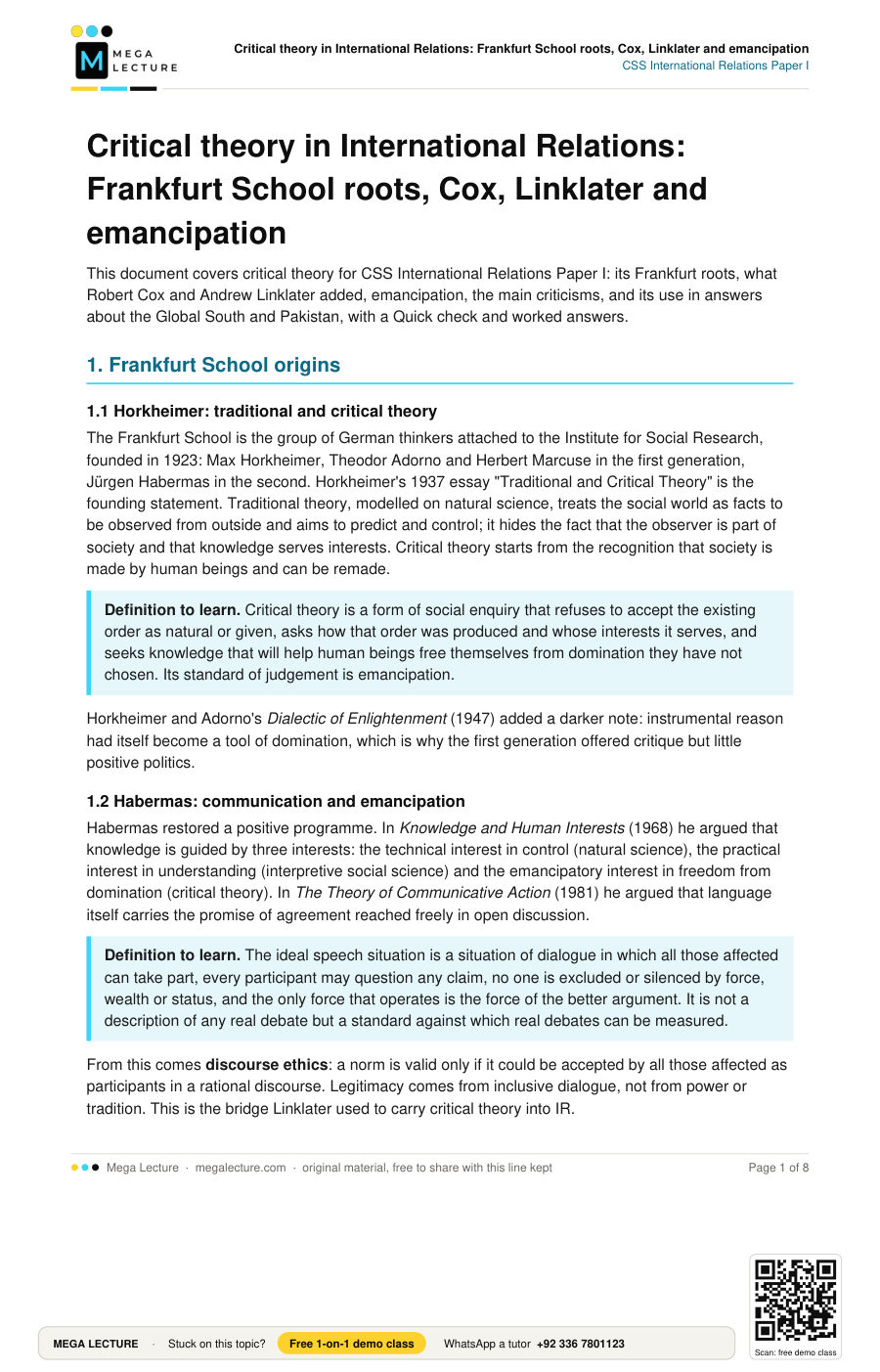
The Frankfurt School is the group of German thinkers attached to the Institute for Social Research, founded in 1923: Max Horkheimer, Theodor Adorno and Herbert Marcuse in the first generation, Jürgen Habermas in the second. Horkheimer's 1937 essay "Traditional and Critical Theory" is the founding statement. Traditional theory, modelled on natural science, treats the social world as facts to be observed from outside and aims to predict and control; it hides the fact that the observer is part of society and that knowledge serves interests. Critical theory starts from the recognition that society is made by human beings and can be remade.
Definition to learn. Critical theory is a form of social enquiry that refuses to accept the existing order as natural or given, asks how that order was produced and whose interests it serves, and seeks knowledge that will help human beings free themselves from domination they have not chosen. Its standard of judgement is emancipation.
Horkheimer and Adorno's Dialectic of Enlightenment (1947) added a darker note: instrumental reason had itself become a tool of domination, which is why the first generation offered critique but little positive politics.
1.2 Habermas: communication and emancipation
Habermas restored a positive programme. In Knowledge and Human Interests (1968) he argued that knowledge is guided by three interests: the technical interest in control (natural science), the practical interest in understanding (interpretive social science) and the emancipatory interest in freedom from domination (critical theory). In The Theory of Communicative Action (1981) he argued that language itself carries the promise of agreement reached freely in open discussion.
Definition to learn. The ideal speech situation is a situation of dialogue in which all those affected can take part, every participant may question any claim, no one is excluded or silenced by force, wealth or status, and the only force that operates is the force of the better argument. It is not a description of any real debate but a standard against which real debates can be measured.
From this comes discourse ethics: a norm is valid only if it could be accepted by all those affected as participants in a rational discourse. Legitimacy comes from inclusive dialogue, not from power or tradition. This is the bridge Linklater used to carry critical theory into IR.
2. Problem-solving theory versus critical theory: Robert Cox
2.1 The 1981 article
Robert W. Cox published "Social Forces, States and World Orders: Beyond International Relations Theory" in Millennium in 1981, the most cited critical text in IR.
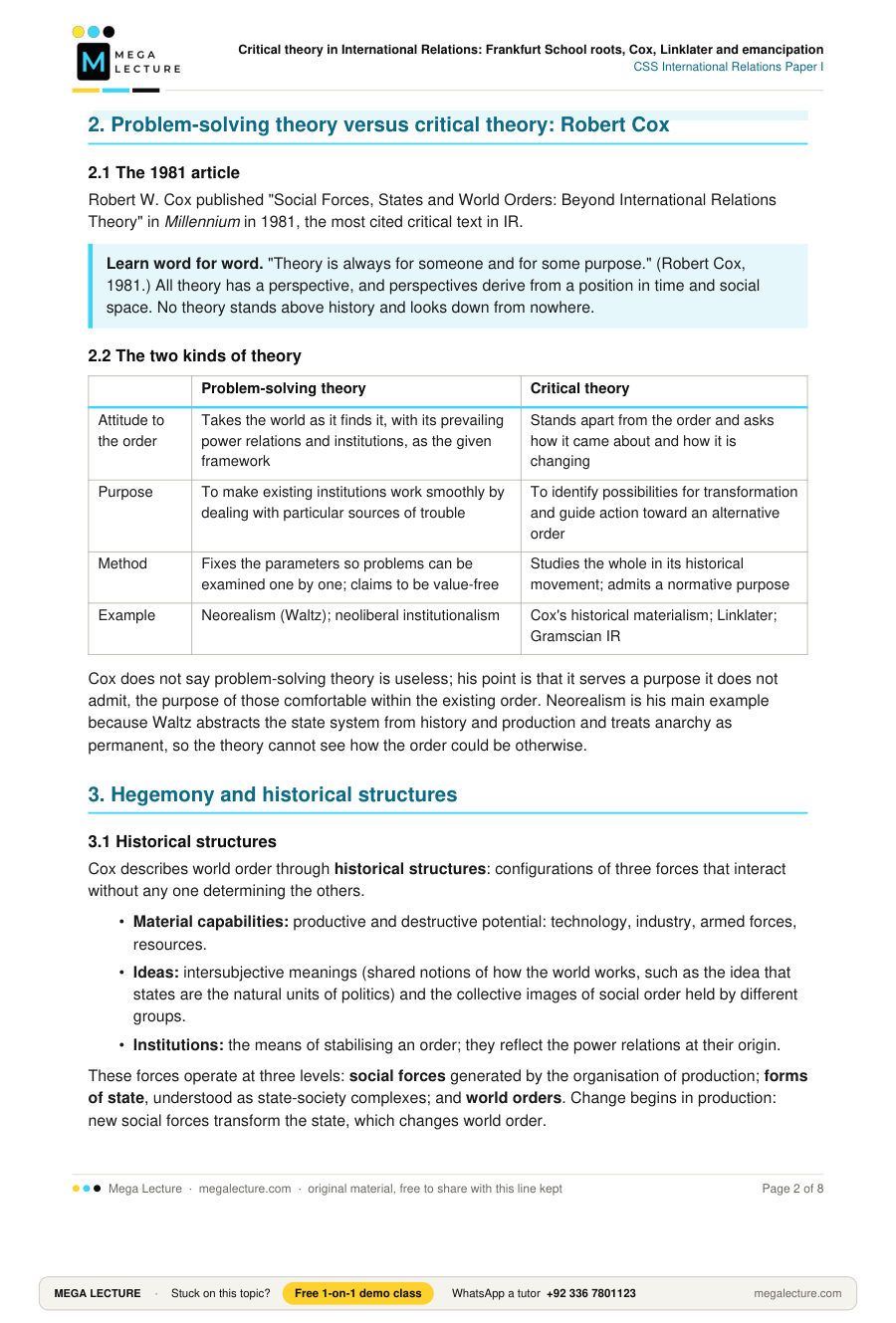
Learn word for word. "Theory is always for someone and for some purpose." (Robert Cox, 1981.) All theory has a perspective, and perspectives derive from a position in time and social space. No theory stands above history and looks down from nowhere.
2.2 The two kinds of theory
| Problem-solving theory | Critical theory | |
|---|---|---|
| Attitude to the order | Takes the world as it finds it, with its prevailing power relations and institutions, as the given framework | Stands apart from the order and asks how it came about and how it is changing |
| Purpose | To make existing institutions work smoothly by dealing with particular sources of trouble | To identify possibilities for transformation and guide action toward an alternative order |
| Method | Fixes the parameters so problems can be examined one by one; claims to be value-free | Studies the whole in its historical movement; admits a normative purpose |
| Example | Neorealism (Waltz); neoliberal institutionalism | Cox's historical materialism; Linklater; Gramscian IR |
Cox does not say problem-solving theory is useless; his point is that it serves a purpose it does not admit, the purpose of those comfortable within the existing order. Neorealism is his main example because Waltz abstracts the state system from history and production and treats anarchy as permanent, so the theory cannot see how the order could be otherwise.
3. Hegemony and historical structures
3.1 Historical structures
Cox describes world order through historical structures: configurations of three forces that interact without any one determining the others.
- Material capabilities: productive and destructive potential: technology, industry, armed forces, resources.
- Ideas: intersubjective meanings (shared notions of how the world works, such as the idea that states are the natural units of politics) and the collective images of social order held by different groups.
- Institutions: the means of stabilising an order; they reflect the power relations at their origin.
These forces operate at three levels: social forces generated by the organisation of production; forms of state, understood as state-society complexes; and world orders. Change begins in production: new social forces transform the state, which changes world order.
3.2 Hegemony in Gramsci and Cox
Cox's 1983 article "Gramsci, Hegemony and International Relations" took Antonio Gramsci's concept out of the domestic setting. For Gramsci, hegemony is rule by consent as well as coercion: the ruling class presents its interests as the interests of all, and its ideas become "common sense", spread through civil society (schools, press, associations) and not only the state.
Definition to learn. Hegemony in world order, for Cox, is a fit between material power, a prevailing collective image of world order (including certain norms) and a set of institutions which administer the order with a certain semblance of universality. The dominant state leads by consent, because others see the order as compatible with their interests, and not merely by domination.
Cox's examples are the British-led order of the mid nineteenth century and the American-led order after 1945. International organisations are the mechanism of hegemony: they embody the rules that ease the expansion of the order, they are products of it, they legitimise its norms, they co-opt elites from peripheral countries, and they absorb counter-hegemonic ideas.
3.3 Counter-hegemony
Because hegemony rests on consent, it can be contested through Gramsci's "war of position", the long struggle to build an alternative common sense. Neo-Gramscians such as Stephen Gill described the neoliberal hegemony of the 1980s and 1990s as "new constitutionalism", locking economic policy away from democratic control. Counter-hegemonic movements include labour and environmental networks and, from the Global South, the 1970s demand for a New International Economic Order.
4. Linklater and the moral boundaries of political community
4.1 The question
Andrew Linklater, from Men and Citizens in the Theory of International Relations (1982) to The Transformation of Political Community (1998), asks a question realism never puts: why should moral obligation stop at the border? The state divides citizens, owed justice, from foreigners, owed at most non-interference; Linklater argues that this boundary is a historical product and can be redrawn. His critical theory has three parts: normative (which exclusions, by state, nation, class, gender or race, could be justified in dialogue with those excluded?); sociological (how systems of inclusion and exclusion have been built and changed in history); and praxeological (what practical steps, through law, regional integration and institutions of dialogue, could widen the moral community).
4.2 The triple transformation
Learn word for word. Linklater's triple transformation of political community: (1) moral universalism, extending equal moral standing to all human beings beyond the state; (2) respect for difference, so that universalism does not erase cultural and national identities; and (3) reduction of material inequality, because dialogue among the rich and the destitute is not dialogue among equals.
The test of any boundary is whether it could be defended in a dialogue in which the excluded take part. The European Union, in which citizens can appeal beyond their state and share obligations across borders, is his example of a post-Westphalian community in the making. He does not propose a world state; he proposes overlapping communities and a cosmopolitan harm principle that forbids states to export harm to outsiders.
5. Emancipation and dialogue
5.1 What emancipation means in IR
Emancipation is the standard by which critical theory judges any order. It is not a blueprint for the good society; it is the removal of constraints that stop people doing what they would freely choose. The Welsh School of security studies (Ken Booth, Richard Wyn Jones) made this the centre of critical security studies.
Learn the sense. Security means the absence of threats. Emancipation is the freeing of people, as individuals and groups, from the physical and human constraints that stop them carrying out what they would freely choose to do. Security and emancipation are two sides of the same coin; emancipation, not power or order, produces true security. (Ken Booth, 1991.)
Implications: the referent object of security is the human being, not the state; the state can be a source of insecurity to its own people; and the goal of policy is the widening of freedom, not a balance of power.
5.2 Dialogue as method and goal
Dialogue is both the way to find out which norms are legitimate and the condition of a just order. Institutions are judged by how far those affected by decisions take part in making them; most fail the test in part, since the powerful set the agenda. Global civil society is a partial realisation of the ideal speech situation, and its exclusions show how far there is to go.
5.3 Worked example
Worked example: a critical theory reading of IMF conditionality.
Cox's question: whose interests does the practice serve? Loan conditions (fiscal targets, subsidy cuts, privatisation) protect creditors and the financial order, and are defended in problem-solving terms as the only way to restore confidence.
Historical structure: material capabilities (creditors' control of capital), ideas (markets know best, the borrower is at fault) and institutions (the IMF's weighted voting) fit together; the fit is hegemonic because borrowing governments consent and present the programme as their own.
Linklater's test: could the arrangement be justified in a dialogue in which those who bear the costs, the urban poor and public sector workers, took part as equals? They are not in the room, so it fails the test of legitimacy whatever its economic merits.
Emancipation: what alternative is historically possible? Debt relief tied to social protection, regional reserve pools, reform of voting shares, grounded in existing counter-hegemonic forces or it is utopian.
6. Critiques of critical theory
6.1 From the mainstream
Robert Keohane (1988) grouped critical theorists with other "reflectivists" and argued that they had no research programme: no testable claims, no agreed method, no way of knowing when they are wrong. Realists and the English School add that order must come before justice (Bull's argument). Reply: the demand for testability is itself a positivist assumption; critical claims are historical and normative, not predictive.
6.2 From post-structuralism and post-colonialism
Post-structuralists share the rejection of positivism but reject the Enlightenment confidence. The ideal speech situation assumes a universal reason all participants share; Foucault would ask whose reason, and note that every discourse, including that of emancipation, excludes someone. Post-colonial writers sharpen this: a theory built from Kant and Hegel may be one more universalism exported from the North, which decides the language of the dialogue and the terms of entry. Reply: without some standard of judgement, the critics cannot say why domination is wrong; Linklater's respect for difference is a partial answer.
6.3 From Marxism and feminism
Orthodox Marxists argue that Habermas and Linklater drifted from production and class to communication and ethics, and that dialogue will not redistribute wealth. Feminists note that the first generation said nothing about gender and that the ideal speech situation ignores how women's speech is discounted in practice. Linklater's third transformation is a direct answer to the Marxist point.
7. Relevance to the Global South and Pakistan
7.1 What critical theory offers the South
Despite the post-colonial critique, critical theory is closer to the experience of the South than any mainstream theory. Cox explains why decolonisation did not end domination: new states entered a hegemonic order fixed without them, and co-optation explains why Southern elites often defend it. Linklater's question applies to the refugee regime, the Security Council veto and climate negotiations in which those most harmed have least voice.
7.2 Applying the theory to Pakistan
- Hegemony and consent: Pakistan's repeated IMF programmes, its adoption of Financial Action Task Force standards and its alignment with the United States in the Cold War and after 2001 can be read as consent within a hegemonic order in which the alternatives were defined in advance.
- Counter-hegemony: Pakistan's role in the Non-Aligned Movement and the Group of 77, the 1970s demand for a New International Economic Order, and its leadership on the loss and damage fund agreed at COP27 (2022) used international institutions against the common sense of the order.
- Moral boundaries: the obligations owed to Afghan refugees hosted since 1979, and their later repatriation, test where the moral community ends, as does the treatment of Kashmiris by both states.
- Emancipation and security: military security against India has been the organising principle of the state; the Welsh School would measure security by citizens' freedom from violence, hunger, flood and illiteracy.
- Dialogue: those most affected by the India-Pakistan conflict (Kashmiris, divided families, border farmers) have no voice in decisions about it, which is part of the explanation of its persistence.
8. Exam answer structure
8.1 What the examiner wants
Marks are earned for: the Frankfurt roots stated briefly; Cox's distinction, quoted; the three forces of a historical structure; Linklater's dialogue test; emancipation defined; at least two critiques with replies; one worked application. Spend no more than a fifth of the answer on the Frankfurt School. Do not confuse critical theory with "critical theories" in general, and do not attribute the problem-solving distinction to Horkheimer (his pair is traditional and critical).
8.2 A model plan
Worked example: "Theory is always for someone and for some purpose. Discuss with reference to critical theory in International Relations." (2,000 to 2,500 words)
- Introduction (150 words): attribute the quotation; define critical theory; thesis: persuasive as a critique of positivist neutrality, incomplete as an alternative.
- The claim explained (400 words): problem-solving versus critical theory; why neorealism is problem-solving theory; the three forces of a historical structure.
- Linklater (300 words): moral boundaries, dialogue, triple transformation, emancipation.
- Application (400 words): one case worked through, such as IMF conditionality or the climate regime.
- Critiques and replies (500 words): Keohane, Bull, post-structuralist and post-colonial doubts, Marxist and feminist corrections.
- Conclusion (250 words): strongest as critique, weakest as prescription; still the most useful lens for a student of the Global South.
Quick check
- State Horkheimer's distinction between traditional and critical theory. (4 marks)
- Explain what Habermas means by the ideal speech situation and why it matters for critical theory in International Relations. (6 marks)
- Explain Cox's distinction between problem-solving theory and critical theory, and show why he classes neorealism as problem-solving theory. (8 marks)
- Define hegemony as Cox uses it and explain the role of international organisations in maintaining it. (8 marks)
- Explain Linklater's argument about the moral boundaries of political community and describe his triple transformation. (8 marks)
- Explain the claim that "security and emancipation are two sides of the same coin" and evaluate it with reference to Pakistan. (10 marks)
- Evaluate the post-structuralist and post-colonial critiques of critical theory. (8 marks)
- Compare critical theory with constructivism: what do they share and where do they differ? (8 marks)
1. Traditional theory, modelled on natural science, treats society as external facts to be observed, explained and predicted; it claims neutrality and aims at control. Critical theory recognises that society is made by human beings and that the theorist is part of it; it asks how the order was produced and whose interests it serves, and aims at emancipation, changing society so that people are free from domination they have not chosen. The distinction concerns the purpose of knowledge, not only its method.
2. The ideal speech situation is a standard of dialogue in which all affected can take part, anyone may question any claim, no one is silenced by force, wealth or status, and only the better argument counts. It is a yardstick, not a description. It matters for IR because Linklater uses it as the test of legitimacy: a border, treaty or institution is justified only if it could be defended in a dialogue in which the excluded took part as equals, which turns critical theory from pure critique into a method for judging institutions.
3. Problem-solving theory takes the world as it finds it, with its prevailing power relations and institutions, as the given framework, and works out how to make them run smoothly; fixing the parameters gives it precision but makes it conservative, since it helps keep the order in place. Critical theory stands apart from the order, asks how it came into being and how it is changing, and looks for an alternative. Neorealism is problem-solving theory because Waltz treats anarchy and the state system as permanent features abstracted from history and production, asks only how states manage within the structure, and so cannot see how it could change. It thereby serves those who benefit from the current distribution of power while presenting itself as value-free science.
4. Hegemony is leadership by consent as well as coercion: a fit between material power, a prevailing collective image of order including norms, and institutions that administer the order with a semblance of universality, so that other states and groups accept the order as compatible with their interests and its values become common sense. International organisations maintain hegemony in five ways: they embody the rules that ease the expansion of the order; they are products of it; they legitimise its norms; they co-opt elites from peripheral countries; and they absorb counter-hegemonic ideas, turning radical demands into technical adjustments. The Bretton Woods institutions after 1945 are the standard example.
5. The sovereign state divides humanity into citizens, owed justice, and foreigners, owed at most non-interference. Linklater argues that this moral boundary is a historical product, drawn differently in different eras (city, empire, religion, nation), so it can be redrawn. The test of any exclusion is whether it could be justified in open dialogue with those excluded; most exclusions by state, class, gender or race fail it. The triple transformation: moral universalism, extending equal moral standing to all human beings beyond the state; respect for difference, so that universalism does not erase national and cultural identities; and reduction of material inequality, because dialogue between rich and destitute is not dialogue among equals.
6. Booth's claim is that security is the absence of threats and emancipation is the freeing of people from the constraints that stop them doing what they would freely choose; since the main threats to most people are such constraints (poverty, violence, oppression), real security is produced by emancipation, not by power or order. The referent becomes the individual, and the state may itself be a source of insecurity. For Pakistan: deterrence of India has prevented full-scale war since 1971, which supports the view that order comes first; but the greatest losses of life and displacement in recent decades came from militancy, the 2022 floods and poverty, which military security does not address. Evaluation: the claim rightly asks whose security counts, but it stretches "security" until it means all good things and gives no way to rank threats; the best answer uses the emancipatory standard to judge priorities without abandoning the state's protective role.
7. Post-structuralists accept the rejection of positivism but reject reliance on universal reason: every discourse, including that of emancipation, produces exclusions, and the ideal speech situation assumes an agreement on what counts as a reason that is itself an effect of power. Post-colonial writers add that critical theory was built in Western universities from Kant and Hegel, and its cosmopolitan dialogue may be one more universalism exported from the North, deciding the language of the conversation and the conditions of entry as the "standard of civilisation" once did. Evaluation: the critiques land on the first generation, but Linklater's respect for difference is a partial answer, and without some standard the critics cannot say why domination or colonialism is wrong. The defensible position keeps the emancipatory standard but lets the South co-author its content.
8. Shared: both reject the view that structure is purely material; both hold that ideas, norms and institutions shape what states are and want; both see social facts as made by practice and therefore changeable; both can explain change, which neorealism cannot. Differences: constructivism (Wendt, Finnemore) is explanatory and aims to show how identities and norms produce outcomes without saying which outcomes are good; critical theory is explicitly normative and judges orders by emancipation. Constructivism treats ideas as largely independent of material power; Cox insists that ideas, material capabilities and institutions form one structure rooted in production. In short: constructivism tells us the world is socially made; critical theory asks who made it and for whom.
