
O Level & IGCSE · Maths 0580 · O Level and IGCSE Mathematics: formula sheet and key results (4024, 0580)
O Level and IGCSE Mathematics: formula sheet and key results (4024, 0580)
Need more than one subject? All-notes pass: unlimited downloads of every note for a year: unlimited downloads of every note on the site, PKR 999 a year. All packs and courses.
Opens inside this page. Prefer your own PDF app? Open the PDF.
Check yourself
5 quick questions on O Level & IGCSE Maths
Tap an answer to see if you are right, and why. Free, no sign-up.
Start the free testNew · free
O Level Mathematics written answers, marked like a real examiner
Answer a Paper 2 style question by typing or speaking. You get your mark point by point, what the examiner was looking for that you missed, and a model answer. 5 free answers a day with a free account.
Try a written question👍 14 students found these notes useful
Was this note useful?
Full text of O Level and IGCSE Mathematics: formula sheet and key results (4024, 0580)
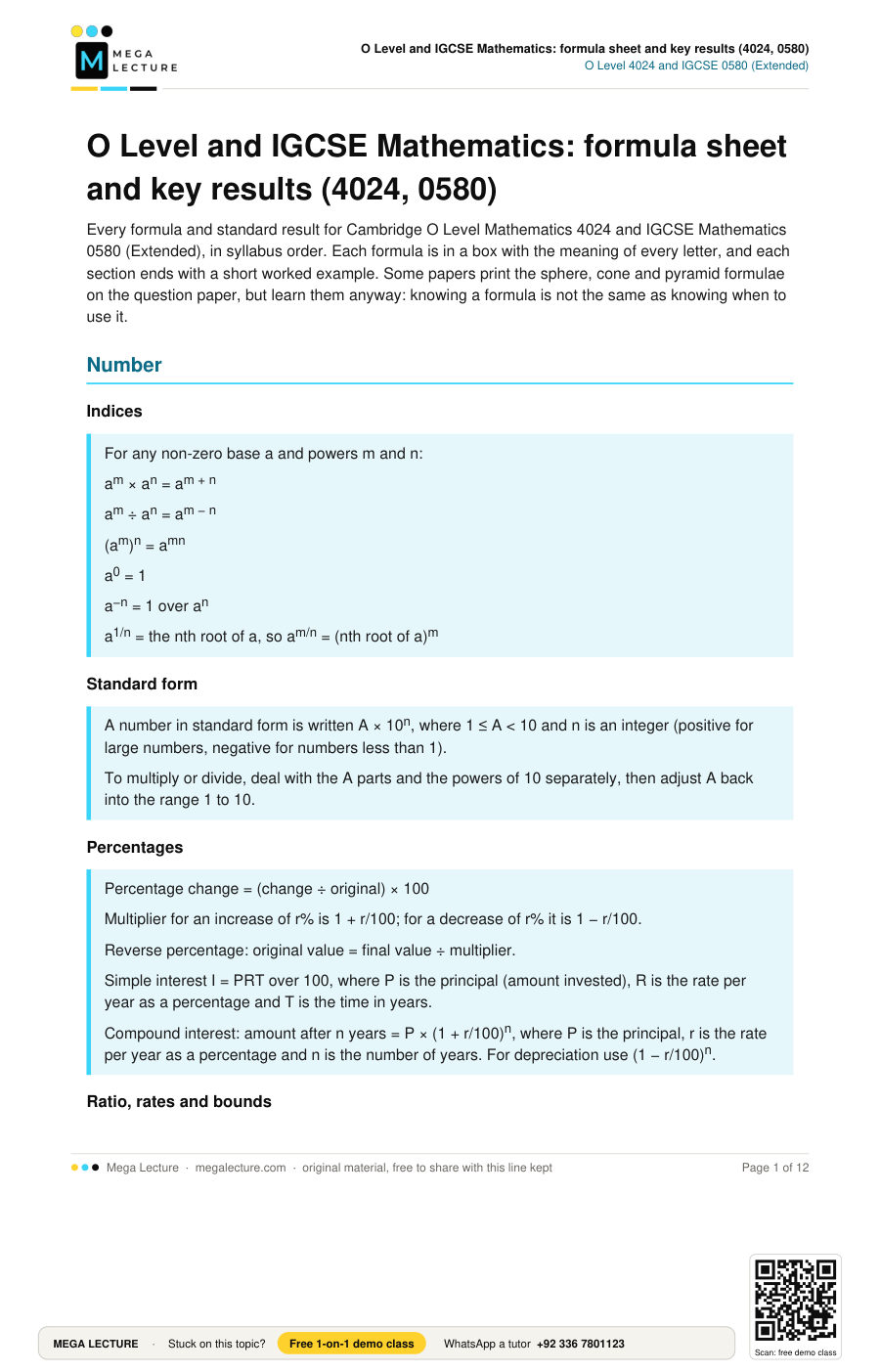
Every formula and standard result for Cambridge O Level Mathematics 4024 and IGCSE Mathematics 0580 (Extended), in syllabus order. Each formula is in a box with the meaning of every letter, and each section ends with a short worked example. Some papers print the sphere, cone and pyramid formulae on the question paper, but learn them anyway: knowing a formula is not the same as knowing when to use it.
Number
Indices
For any non-zero base a and powers m and n:
am × an = am + n
am ÷ an = am − n
(am)n = amn
a0 = 1
a−n = 1 over an
a1/n = the nth root of a, so am/n = (nth root of a)m
Standard form
A number in standard form is written A × 10n, where 1 ≤ A < 10 and n is an integer (positive for large numbers, negative for numbers less than 1).
To multiply or divide, deal with the A parts and the powers of 10 separately, then adjust A back into the range 1 to 10.
Percentages
Percentage change = (change ÷ original) × 100
Multiplier for an increase of r% is 1 + r/100; for a decrease of r% it is 1 − r/100.
Reverse percentage: original value = final value ÷ multiplier.
Simple interest I = PRT over 100, where P is the principal (amount invested), R is the rate per year as a percentage and T is the time in years.
Compound interest: amount after n years = P × (1 + r/100)n, where P is the principal, r is the rate per year as a percentage and n is the number of years. For depreciation use (1 − r/100)n.
Ratio, rates and bounds
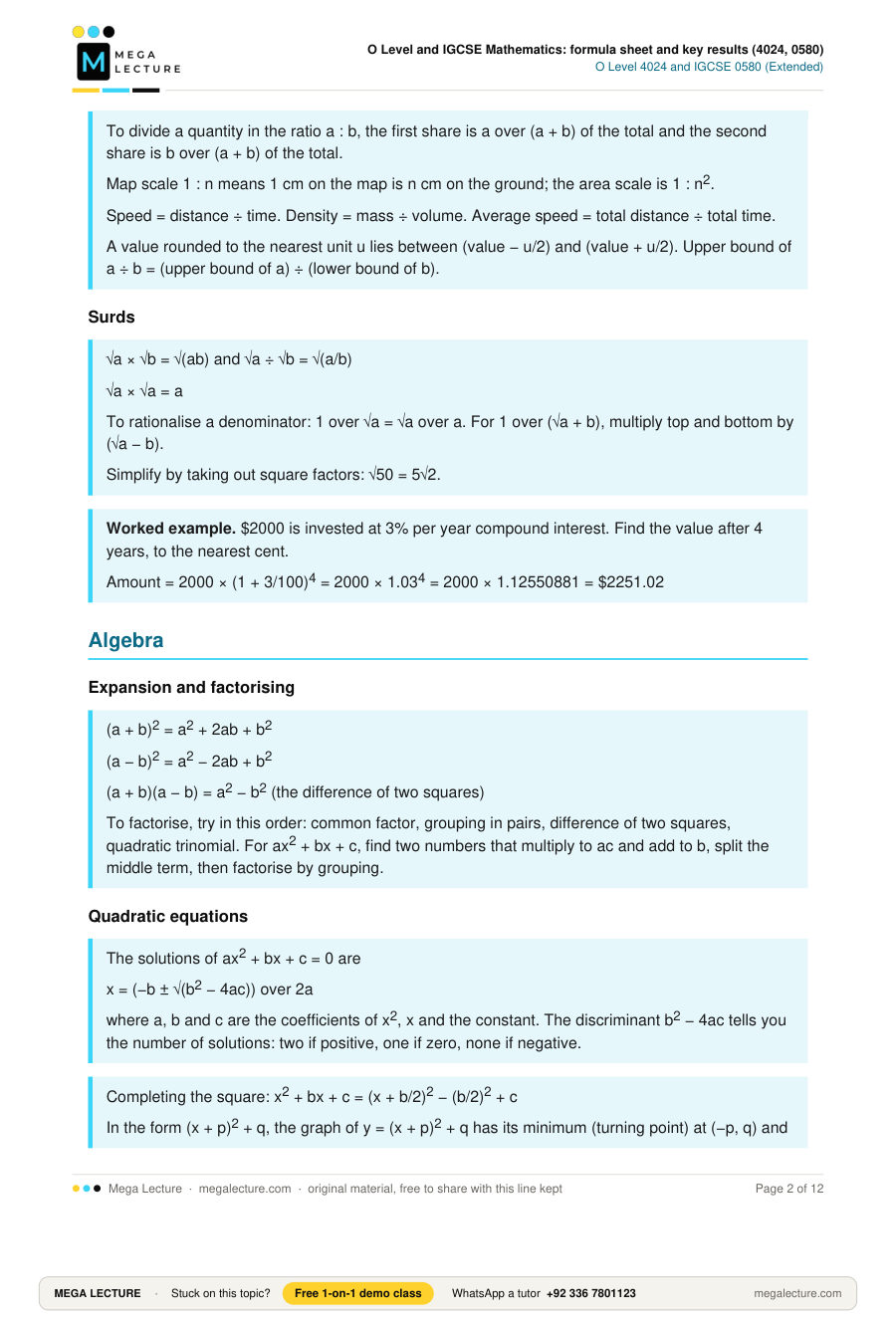
To divide a quantity in the ratio a : b, the first share is a over (a + b) of the total and the second share is b over (a + b) of the total.
Map scale 1 : n means 1 cm on the map is n cm on the ground; the area scale is 1 : n2.
Speed = distance ÷ time. Density = mass ÷ volume. Average speed = total distance ÷ total time.
A value rounded to the nearest unit u lies between (value − u/2) and (value + u/2). Upper bound of a ÷ b = (upper bound of a) ÷ (lower bound of b).
Surds
√a × √b = √(ab) and √a ÷ √b = √(a/b)
√a × √a = a
To rationalise a denominator: 1 over √a = √a over a. For 1 over (√a + b), multiply top and bottom by (√a − b).
Simplify by taking out square factors: √50 = 5√2.
Worked example. $2000 is invested at 3% per year compound interest. Find the value after 4 years, to the nearest cent.
Amount = 2000 × (1 + 3/100)4 = 2000 × 1.034 = 2000 × 1.12550881 = $2251.02
Algebra
Expansion and factorising
(a + b)2 = a2 + 2ab + b2
(a − b)2 = a2 − 2ab + b2
(a + b)(a − b) = a2 − b2 (the difference of two squares)
To factorise, try in this order: common factor, grouping in pairs, difference of two squares, quadratic trinomial. For ax2 + bx + c, find two numbers that multiply to ac and add to b, split the middle term, then factorise by grouping.
Quadratic equations
The solutions of ax2 + bx + c = 0 are
x = (−b ± √(b2 − 4ac)) over 2a
where a, b and c are the coefficients of x2, x and the constant. The discriminant b2 − 4ac tells you the number of solutions: two if positive, one if zero, none if negative.
Completing the square: x2 + bx + c = (x + b/2)2 − (b/2)2 + c
In the form (x + p)2 + q, the graph of y = (x + p)2 + q has its minimum (turning point) at (−p, q) and the line of symmetry is x = −p. If the coefficient of x2 is not 1, take it out as a factor first.
Simultaneous equations and inequalities
Two linear equations: make the coefficients of one unknown equal, then add or subtract to eliminate it, or substitute one equation into the other. One linear and one quadratic: make one unknown the subject of the linear equation, substitute into the quadratic, solve, then find the matching values of the other unknown.
Inequalities are solved like equations, except that multiplying or dividing by a negative number reverses the sign. On a number line an open circle means not included (< or >), a filled circle means included (≤ or ≥).
Sequences
Linear (arithmetic) sequence with first term a and common difference d: nth term = a + (n − 1)d, which can be written as dn + (a − d).
Quadratic sequence: the second differences are constant. The nth term is pn2 + qn + r, where p is half the second difference. Subtract pn2 from each term and find the linear nth term of what is left.
Geometric sequence with first term a and common ratio r: nth term = arn − 1.
Special sequences: square numbers n2, cube numbers n3, triangular numbers n(n + 1) over 2, powers 2n.
Functions
f(x) is the output of the function f for input x. The composite function fg(x) means f(g(x)): apply g first, then f.
The inverse function f−1(x) undoes f. To find it: write y = f(x), swap x and y, make y the subject.
Variation
y is directly proportional to x (y ∝ x) means y = kx for a constant k.
y is inversely proportional to x (y ∝ 1/x) means y = k over x.
The same pattern works for y ∝ x2 (y = kx2), y ∝ √x (y = k√x), y ∝ 1/x2 (y = k over x2) and so on. Find k from the pair of values given, then use the equation.
Worked example. Write x2 − 6x + 2 in the form (x + p)2 + q and hence state the minimum value of x2 − 6x + 2.
Half of −6 is −3, and (−3)2 = 9.
x2 − 6x + 2 = (x − 3)2 − 9 + 2 = (x − 3)2 − 7
So p = −3, q = −7, and the minimum value is −7 (when x = 3).
Mensuration
Perimeter and area of plane shapes
Rectangle with length l and width w: area = lw, perimeter = 2(l + w)
Triangle with base b and perpendicular height h: area = ½bh
Parallelogram with base b and perpendicular height h: area = bh
Trapezium with parallel sides a and b and perpendicular distance h between them: area = ½(a + b)h
Circle with radius r and diameter d: circumference = 2πr = πd, area = πr2
Arcs, sectors and segments
For a sector of a circle with radius r and angle θ degrees at the centre:
arc length = (θ over 360) × 2πr
sector area = (θ over 360) × πr2
perimeter of the sector = arc length + 2r
Area of a segment = sector area − area of the triangle formed by the two radii and the chord, where the triangle area is ½r2 sin θ.
Volume and surface area of solids
Cuboid with length l, width w and height h: volume = lwh, surface area = 2(lw + lh + wh)
Prism (constant cross-section): volume = area of cross-section × length
Cylinder with radius r and height h: volume = πr2h, curved surface area = 2πrh, total surface area of a closed cylinder = 2πrh + 2πr2
Pyramid with base area A and perpendicular height h: volume = ⅓Ah
Cone with radius r, perpendicular height h and slant height l: volume = ⅓πr2h, curved surface area = πrl, where l2 = r2 + h2
Sphere with radius r: volume = (4 over 3)πr3, surface area = 4πr2
Hemisphere: volume = (2 over 3)πr3, curved surface area = 2πr2, total surface area including the flat face = 3πr2
Units
1 m2 = 10 000 cm2, 1 cm2 = 100 mm2
1 m3 = 1 000 000 cm3, 1 litre = 1000 cm3, 1 cm3 = 1 ml
Worked example. A solid cone has radius 5 cm and perpendicular height 12 cm. Find its total surface area.
Slant height l = √(52 + 122) = √169 = 13 cm
Curved surface area = π × 5 × 13 = 65π
Base area = π × 52 = 25π
Total surface area = 65π + 25π = 90π = 283 cm2 (3 significant figures)
Geometry
Angle facts
Angles on a straight line add to 180°. Angles around a point add to 360°. Vertically opposite angles are equal.
With parallel lines: alternate angles are equal, corresponding angles are equal, co-interior (allied) angles add to 180°.
Angles in a triangle add to 180°. The exterior angle of a triangle equals the sum of the two opposite interior angles. Angles in a quadrilateral add to 360°.
Polygon with n sides: sum of interior angles = (n − 2) × 180°. Sum of exterior angles = 360°. For a regular polygon each exterior angle = 360° over n and each interior angle = 180° − exterior angle.
Pythagoras' theorem
In a right-angled triangle with hypotenuse c (the longest side, opposite the right angle) and shorter sides a and b: c2 = a2 + b2. The converse also holds.
Circle theorems
The angle at the centre is twice the angle at the circumference standing on the same arc.
The angle in a semicircle is 90°.
Angles in the same segment (standing on the same chord, on the same side) are equal.
Opposite angles of a cyclic quadrilateral add to 180°.
A tangent is perpendicular to the radius at the point of contact.
Two tangents from the same external point are equal in length.
Alternate segment theorem: the angle between a tangent and a chord equals the angle in the alternate segment.
The perpendicular from the centre to a chord bisects the chord. Equal chords are equidistant from the centre.
Similarity and congruence
Similar shapes have equal corresponding angles and corresponding sides in the same ratio. If the length scale factor is k, the area scale factor is k2 and the volume scale factor is k3.
Triangles are congruent (same shape and size) by SSS (three sides), SAS (two sides and the included angle), ASA (two angles and a corresponding side) or RHS (right angle, hypotenuse, one other side).
Bearings and constructions
A bearing is measured clockwise from north and written with three figures, for example 045°. Back bearing (of A from B, given the bearing of B from A): add 180° if the bearing is less than 180°, otherwise subtract 180°.
Loci: a fixed distance from a point is a circle; a fixed distance from a line is a pair of parallel lines; equidistant from two points is the perpendicular bisector of the line joining them; equidistant from two intersecting lines is the angle bisector.
Constructions are done with a pair of compasses and the arcs must be left visible: perpendicular bisector (equal arcs from both ends), angle bisector (an arc across both arms, then equal arcs from the crossing points), 60° angle (equilateral triangle).
Worked example. Two similar bottles have heights 8 cm and 12 cm. The smaller bottle holds 400 cm3. Find the capacity of the larger bottle.
Length scale factor k = 12 ÷ 8 = 1.5
Volume scale factor = k3 = 1.53 = 3.375
Capacity of larger bottle = 400 × 3.375 = 1350 cm3
Coordinate geometry
For two points (x1, y1) and (x2, y2):
gradient m = (y2 − y1) over (x2 − x1)
midpoint = ((x1 + x2) over 2, (y1 + y2) over 2)
distance (length of the line segment) = √((x2 − x1)2 + (y2 − y1)2)
Equation of a straight line: y = mx + c, where m is the gradient and c is the y-intercept (the value of y where the line crosses the y-axis).
A line with gradient m through the point (x1, y1) has equation y − y1 = m(x − x1).
Parallel lines have equal gradients. For perpendicular lines the product of the gradients is −1, so the perpendicular gradient is −1 over m (the negative reciprocal).
Worked example. Find the equation of the perpendicular bisector of the line joining A(2, 1) and B(6, 9).
Midpoint of AB = ((2 + 6)/2, (1 + 9)/2) = (4, 5)
Gradient of AB = (9 − 1)/(6 − 2) = 8/4 = 2
Perpendicular gradient = −1/2
Equation: y − 5 = −½(x − 4), so y = −½x + 7, which can also be written as x + 2y = 14.
Trigonometry
Right-angled triangles
For the angle θ in a right-angled triangle: the hypotenuse is opposite the right angle, the opposite side faces θ and the adjacent side is next to θ.
sin θ = opposite over hypotenuse (SOH)
cos θ = adjacent over hypotenuse (CAH)
tan θ = opposite over adjacent (TOA)
To find an angle use the inverse function: θ = sin−1(opposite ÷ hypotenuse), and similarly for cos−1 and tan−1.
The angle of elevation is measured upwards from the horizontal, the angle of depression downwards; the two are equal for the same pair of points (alternate angles).
Special angles
| Angle | sin | cos | tan |
|---|---|---|---|
| 0° | 0 | 1 | 0 |
| 30° | 1/2 | √3/2 | 1/√3 = √3/3 |
| 45° | 1/√2 = √2/2 | 1/√2 = √2/2 | 1 |
| 60° | √3/2 | 1/2 | √3 |
| 90° | 1 | 0 | undefined |
For an obtuse angle: sin (180° − x) = sin x and cos (180° − x) = −cos x, so if sin θ = 0.5 then θ is 30° or 150°. The graphs of sin x and cos x repeat every 360° and lie between −1 and 1; tan x repeats every 180°.
Any triangle
In triangle ABC, side a is opposite angle A, side b is opposite angle B and side c is opposite angle C.
Sine rule: a over sin A = b over sin B = c over sin C (use the form sin A over a = sin B over b to find an angle). Use it when you know a side and its opposite angle.
Cosine rule: a2 = b2 + c2 − 2bc cos A, or cos A = (b2 + c2 − a2) over 2bc to find an angle. Use it when you know two sides and the included angle, or all three sides.
Area of a triangle = ½ab sin C, where C is the angle between sides a and b.
Three dimensions
The diagonal of a cuboid with sides l, w and h has length √(l2 + w2 + h2).
Angle between a line and a plane: drop a perpendicular from the end of the line to the plane and use the right-angled triangle formed. Usually you first need Pythagoras in a triangle lying in the plane to find a missing length.
Worked example. In triangle PQR, PQ = 7 cm, QR = 9 cm and PR = 11 cm. Find angle PQR.
Angle Q is opposite PR = 11, so a = 11, b = 7, c = 9.
cos Q = (72 + 92 − 112) over (2 × 7 × 9) = (49 + 81 − 121) over 126 = 9 over 126 = 0.071428…
Q = cos−1(0.071428…) = 85.9° (1 decimal place)
Vectors
A column vector is written here as (x; y): x units across (positive to the right) and y units up. The vector from A to B, written with an arrow over AB on the exam paper, is called vector AB here.
Adding: (a; b) + (c; d) = (a + c; b + d). Subtracting works the same way component by component.
Multiplying by a number: k(a; b) = (ka; kb). The vector −a has the same length as a but the opposite direction.
Magnitude (length): |(x; y)| = √(x2 + y2)
If a and b are the position vectors of A and B (from the origin O), then vector AB = b − a.
Two vectors are parallel if one is a scalar multiple of the other. Three points A, B and C are collinear (on one straight line) if vector AB is a multiple of vector BC, since the two vectors share the point B.
Vector AC = vector AB + vector BC. The midpoint of AB has position vector ½(a + b).
Worked example. A is the point (1, 2) and B is the point (7, −6). Find vector AB and its magnitude.
Vector AB = b − a = (7; −6) − (1; 2) = (6; −8)
|AB| = √(62 + (−8)2) = √(36 + 64) = √100 = 10 units
Transformations
To describe a transformation fully, give its name and all its details:
Reflection: the equation of the mirror line (for example x = 2, y = −1, y = x, y = −x).
Rotation: the centre, the angle and the direction (clockwise or anticlockwise). A rotation of 180° needs no direction.
Translation: the column vector (x; y).
Enlargement: the centre and the scale factor k. Negative k puts the image on the opposite side of the centre, inverted; 0 < k < 1 makes it smaller. The image area is k2 times the object area.
Centre of enlargement: join corresponding points on object and image; the lines meet at the centre. Centre of rotation: the perpendicular bisectors of two such lines meet at the centre.
Matrices (older editions of 4024 only)
Matrices appeared in editions of 4024 examined up to 2024; syllabuses from 2025 describe transformations in words only. If your edition includes them, the image of a point is the matrix multiplied by the position vector written as a column. The table lists each matrix by its two rows.
| Transformation (all about the origin) | First row | Second row |
|---|---|---|
| Reflection in the x-axis | 1, 0 | 0, −1 |
| Reflection in the y-axis | −1, 0 | 0, 1 |
| Reflection in y = x | 0, 1 | 1, 0 |
| Reflection in y = −x | 0, −1 | −1, 0 |
| Rotation 90° anticlockwise | 0, −1 | 1, 0 |
| Rotation 90° clockwise | 0, 1 | −1, 0 |
| Rotation 180° | −1, 0 | 0, −1 |
| Enlargement scale factor k | k, 0 | 0, k |
For a 2 by 2 matrix with first row (a, b) and second row (c, d), the determinant is ad − bc. Its size is the area scale factor; a negative determinant means the shape has been turned over.
Worked example. Triangle T has vertices (1, 1), (3, 1) and (3, 2). It is enlarged with centre (0, 0) and scale factor −2. Find the vertices of the image.
Multiply each coordinate by −2: (−2, −2), (−6, −2) and (−6, −4).
The image is on the opposite side of the origin, inverted, with area 4 times that of T.
Probability
Probability = number of favourable outcomes over total number of equally likely outcomes, from 0 (impossible) to 1 (certain).
P(A does not happen) = 1 − P(A)
For mutually exclusive events (cannot happen together): P(A or B) = P(A) + P(B)
For independent events (one does not affect the other): P(A and B) = P(A) × P(B)
In general, P(A or B) = P(A) + P(B) − P(A and B), which is what a Venn diagram shows.
Tree diagrams: multiply along the branches for "and", add different routes for "or". Without replacement, the second set of probabilities changes because one item has gone.
Relative frequency = number of times the event happened over number of trials. Expected number of successes = probability × number of trials.
Worked example. A box holds 4 red and 6 green counters. Two are taken at random without replacement. Find the probability that they are different colours.
P(red then green) = 4/10 × 6/9 = 24/90
P(green then red) = 6/10 × 4/9 = 24/90
P(different colours) = 24/90 + 24/90 = 48/90 = 8/15
Statistics
Averages and spread
Mean = sum of all values over number of values.
Median = the middle value when the data are in order, the (n + 1) over 2 th value; for even n, the mean of the two middle values.
Mode = the value that occurs most often. Range = largest value − smallest value.
From a frequency table: mean = Σfx over Σf, where x is each value, f is its frequency and Σ means "the sum of".
Grouped data: use the midpoint of each class as x, giving an estimate of the mean. The modal class has the highest frequency (for equal widths) or the highest frequency density.
Cumulative frequency and histograms
Plot cumulative frequency at the upper boundary of each class. For n values, read the median at n over 2 on the cumulative frequency axis, the lower quartile at n over 4 and the upper quartile at 3n over 4.
Interquartile range (IQR) = upper quartile − lower quartile; it measures the spread of the middle half of the data.
Histogram with unequal class widths: frequency density = frequency over class width; the area of each bar (height × width) is the frequency.
Pie chart: angle of a sector = (frequency over total frequency) × 360°.
Scatter diagrams
Positive correlation: as one variable increases so does the other. Negative correlation: as one increases the other decreases. Strong or weak describes how close the points are to a line. A line of best fit passes through the mean point (mean of x, mean of y); use it only to estimate values within the range of the data.
Worked example. The table shows the masses of 40 parcels.
| Mass m (kg) | 0 < m ≤ 2 | 2 < m ≤ 5 | 5 < m ≤ 10 |
|---|---|---|---|
| Frequency | 10 | 18 | 12 |
Find each frequency density and an estimate of the mean mass.
Frequency densities: 10 ÷ 2 = 5, 18 ÷ 3 = 6, 12 ÷ 5 = 2.4
Midpoints: 1, 3.5, 7.5
Σfx = 10 × 1 + 18 × 3.5 + 12 × 7.5 = 10 + 63 + 90 = 163
Estimated mean = 163 ÷ 40 = 4.08 kg (3 significant figures).
Quick check
- Write 0.000 45 in standard form. Calculate (3 × 104) × (2 × 10−7), giving your answer in standard form.
- After a 15% increase, the price of a jacket is $92. Calculate the original price.
- Solve 2x2 − 5x − 3 = 0.
- Find the nth term of (a) the sequence 5, 9, 13, 17, … and (b) the sequence 2, 6, 12, 20, …
- A sector has radius 6 cm and angle 50°. Calculate (a) the arc length and (b) the sector area, giving your answers to 3 significant figures.
- A solid cone has radius 3 cm and perpendicular height 4 cm. Calculate (a) its volume and (b) its curved surface area, giving your answers to 3 significant figures.
- (a) Calculate the size of each interior angle of a regular decagon. (b) In a histogram, the class 20 < x ≤ 50 has frequency 12. Calculate the frequency density of this class.
- Find the equation of the line through (1, 2) that is perpendicular to the line y = 2x − 1. Give your answer in the form ax + by = c.
- A triangle has sides 7 cm, 8 cm and 9 cm. Calculate (a) its largest angle and (b) its area.
- A bag holds 5 red and 3 blue marbles. Two marbles are taken at random without replacement. Calculate the probability that they are the same colour.
1. 0.000 45 = 4.5 × 10⁻⁴. (3 × 104) × (2 × 10−7) = 6 × 10⁴ + (−7) = 6 × 10⁻³.
2. Multiplier for a 15% increase is 1.15. Original price = 92 ÷ 1.15 = $80.
3. a = 2, b = −5, c = −3. Discriminant = (−5)2 − 4 × 2 × (−3) = 25 + 24 = 49. x = (5 ± √49) over 4 = (5 ± 7) over 4, so x = 12/4 = 3 or x = −2/4 = −0.5.
4. (a) Common difference 4, first term 5: nth term = 4n + (5 − 4) = 4n + 1. (b) First differences 4, 6, 8; second difference 2, so p = 1 and the nth term starts n2. Subtracting n2 (1, 4, 9, 16) from the terms leaves 1, 2, 3, 4, which is n. So the nth term is n2 + n = n(n + 1).
5. (a) Arc length = (50/360) × 2π × 6 = 5.235… = 5.24 cm. (b) Sector area = (50/360) × π × 62 = 15.70… = 15.7 cm2.
6. (a) Volume = ⅓ × π × 32 × 4 = 12π = 37.7 cm3. (b) Slant height l = √(32 + 42) = 5 cm, so curved surface area = π × 3 × 5 = 15π = 47.1 cm2.
7. (a) Exterior angle = 360° ÷ 10 = 36°, so interior angle = 180° − 36° = 144°. (b) Class width = 50 − 20 = 30, so frequency density = 12 ÷ 30 = 0.4.
8. Gradient of y = 2x − 1 is 2, so the perpendicular gradient is −1/2. y − 2 = −½(x − 1) gives y = −½x + 5/2. Multiply by 2: 2y = −x + 5, so x + 2y = 5.
9. (a) The largest angle is opposite the longest side (9 cm). cos C = (72 + 82 − 92) over (2 × 7 × 8) = (49 + 64 − 81) over 112 = 32/112 = 2/7, so C = cos−1(2/7) = 73.4° (1 decimal place). (b) Area = ½ × 7 × 8 × sin 73.4° = 26.8 cm2 (3 significant figures).
10. P(red, red) = 5/8 × 4/7 = 20/56. P(blue, blue) = 3/8 × 2/7 = 6/56. P(same colour) = 20/56 + 6/56 = 26/56 = 13/28.
