
AS Level · Mathematics 9709 · Additional Mathematics 4037/0606: revision notes for the whole syllabus
Additional Mathematics 4037/0606: revision notes for the whole syllabus
The Daily 5 Five questions a day on AS Level Maths: two minutes, new every day, with a streak to keep Play today’s →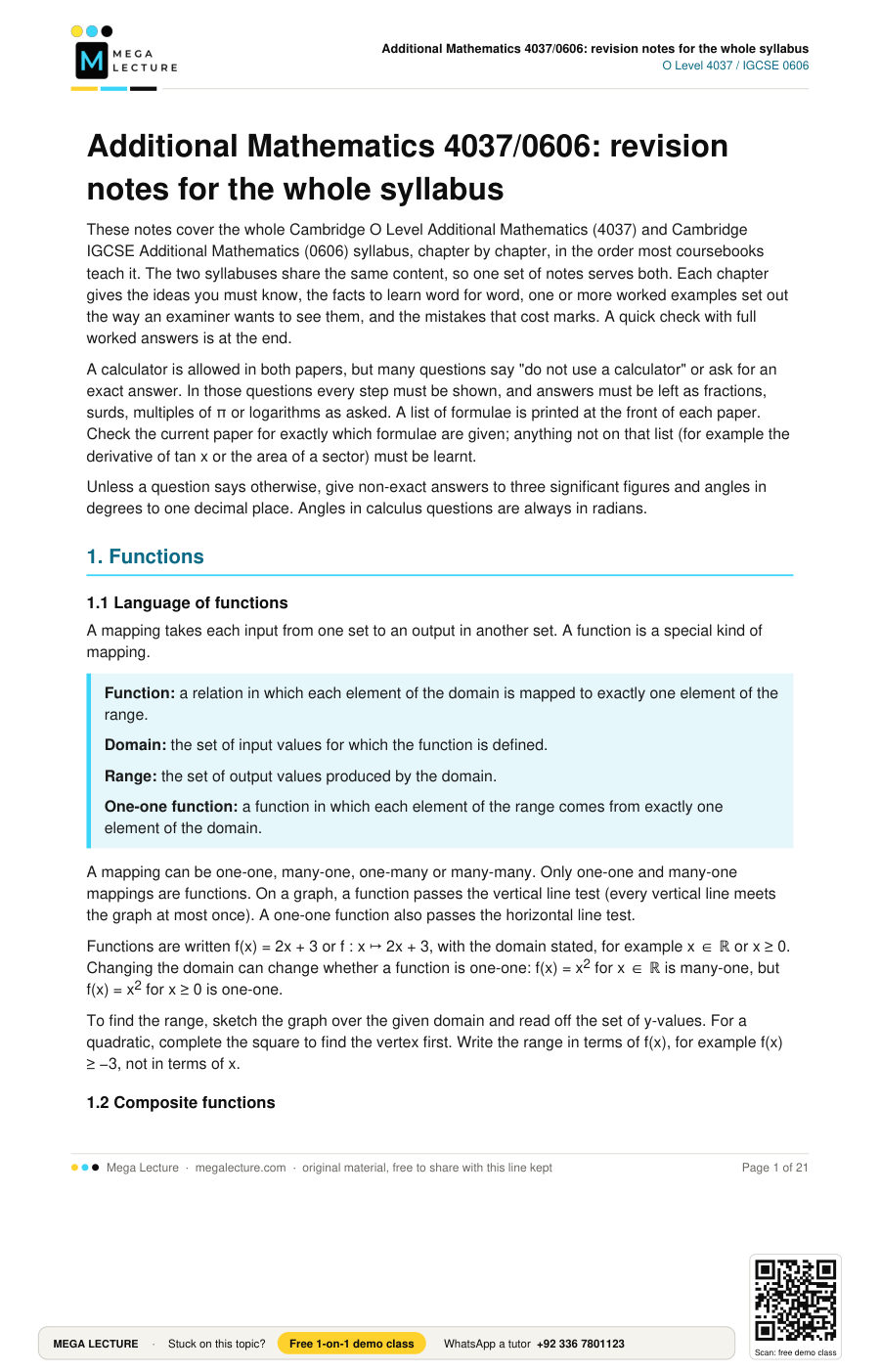
Opens inside this page. Prefer your own PDF app? Open the PDF.
Check yourself
5 quick questions on AS Level Maths
Tap an answer to see if you are right, and why. Free, no sign-up.
Start the free test👍 18 students found these notes useful
Was this note useful?
Full text of Additional Mathematics 4037/0606: revision notes for the whole syllabus
These notes cover the whole Cambridge O Level Additional Mathematics (4037) and Cambridge IGCSE Additional Mathematics (0606) syllabus, chapter by chapter, in the order most coursebooks teach it. The two syllabuses share the same content, so one set of notes serves both. Each chapter gives the ideas you must know, the facts to learn word for word, one or more worked examples set out the way an examiner wants to see them, and the mistakes that cost marks. A quick check with full worked answers is at the end.
A calculator is allowed in both papers, but many questions say "do not use a calculator" or ask for an exact answer. In those questions every step must be shown, and answers must be left as fractions, surds, multiples of π or logarithms as asked. A list of formulae is printed at the front of each paper. Check the current paper for exactly which formulae are given; anything not on that list (for example the derivative of tan x or the area of a sector) must be learnt.
Unless a question says otherwise, give non-exact answers to three significant figures and angles in degrees to one decimal place. Angles in calculus questions are always in radians.
1. Functions
1.1 Language of functions
A mapping takes each input from one set to an output in another set. A function is a special kind of mapping.
Function: a relation in which each element of the domain is mapped to exactly one element of the range.
Domain: the set of input values for which the function is defined.
Range: the set of output values produced by the domain.
One-one function: a function in which each element of the range comes from exactly one element of the domain.
A mapping can be one-one, many-one, one-many or many-many. Only one-one and many-one mappings are functions. On a graph, a function passes the vertical line test (every vertical line meets the graph at most once). A one-one function also passes the horizontal line test.
Functions are written f(x) = 2x + 3 or f : x ↦ 2x + 3, with the domain stated, for example x ∈ ℝ or x ≥ 0. Changing the domain can change whether a function is one-one: f(x) = x2 for x ∈ ℝ is many-one, but f(x) = x2 for x ≥ 0 is one-one.
To find the range, sketch the graph over the given domain and read off the set of y-values. For a quadratic, complete the square to find the vertex first. Write the range in terms of f(x), for example f(x) ≥ −3, not in terms of x.
1.2 Composite functions
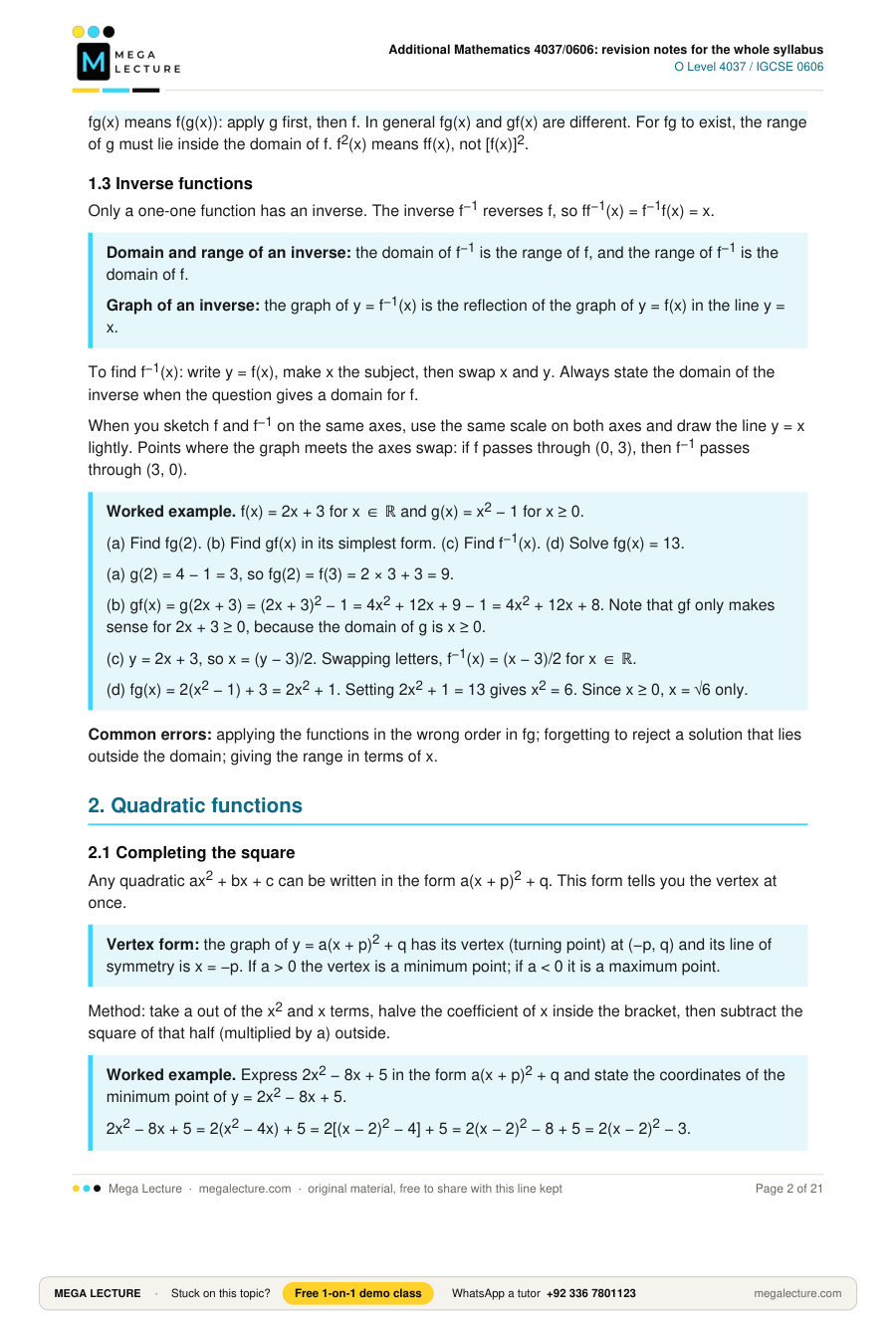
fg(x) means f(g(x)): apply g first, then f. In general fg(x) and gf(x) are different. For fg to exist, the range of g must lie inside the domain of f. f2(x) means ff(x), not [f(x)]2.
1.3 Inverse functions
Only a one-one function has an inverse. The inverse f−1 reverses f, so ff−1(x) = f−1f(x) = x.
Domain and range of an inverse: the domain of f−1 is the range of f, and the range of f−1 is the domain of f.
Graph of an inverse: the graph of y = f−1(x) is the reflection of the graph of y = f(x) in the line y = x.
To find f−1(x): write y = f(x), make x the subject, then swap x and y. Always state the domain of the inverse when the question gives a domain for f.
When you sketch f and f−1 on the same axes, use the same scale on both axes and draw the line y = x lightly. Points where the graph meets the axes swap: if f passes through (0, 3), then f−1 passes through (3, 0).
Worked example. f(x) = 2x + 3 for x ∈ ℝ and g(x) = x2 − 1 for x ≥ 0.
(a) Find fg(2). (b) Find gf(x) in its simplest form. (c) Find f−1(x). (d) Solve fg(x) = 13.
(a) g(2) = 4 − 1 = 3, so fg(2) = f(3) = 2 × 3 + 3 = 9.
(b) gf(x) = g(2x + 3) = (2x + 3)2 − 1 = 4x2 + 12x + 9 − 1 = 4x2 + 12x + 8. Note that gf only makes sense for 2x + 3 ≥ 0, because the domain of g is x ≥ 0.
(c) y = 2x + 3, so x = (y − 3)/2. Swapping letters, f−1(x) = (x − 3)/2 for x ∈ ℝ.
(d) fg(x) = 2(x2 − 1) + 3 = 2x2 + 1. Setting 2x2 + 1 = 13 gives x2 = 6. Since x ≥ 0, x = √6 only.
Common errors: applying the functions in the wrong order in fg; forgetting to reject a solution that lies outside the domain; giving the range in terms of x.
2. Quadratic functions
2.1 Completing the square
Any quadratic ax2 + bx + c can be written in the form a(x + p)2 + q. This form tells you the vertex at once.
Vertex form: the graph of y = a(x + p)2 + q has its vertex (turning point) at (−p, q) and its line of symmetry is x = −p. If a > 0 the vertex is a minimum point; if a < 0 it is a maximum point.
Method: take a out of the x2 and x terms, halve the coefficient of x inside the bracket, then subtract the square of that half (multiplied by a) outside.
Worked example. Express 2x2 − 8x + 5 in the form a(x + p)2 + q and state the coordinates of the minimum point of y = 2x2 − 8x + 5.
2x2 − 8x + 5 = 2(x2 − 4x) + 5 = 2[(x − 2)2 − 4] + 5 = 2(x − 2)2 − 8 + 5 = 2(x − 2)2 − 3.
Since (x − 2)2 ≥ 0, the least value is −3, when x = 2. The minimum point is (2, −3).
2.2 Sketching a quadratic
A good sketch shows the shape (∪ for a > 0, ∩ for a < 0), the y-intercept (0, c), the x-intercepts (roots, if any) and the vertex. Label every point you have worked out with its coordinates.
2.3 The discriminant
The roots of ax2 + bx + c = 0 are x = [−b ± √(b2 − 4ac)] / 2a. The expression b2 − 4ac is called the discriminant.
Nature of the roots of ax2 + bx + c = 0:
- b2 − 4ac > 0: two distinct real roots
- b2 − 4ac = 0: two equal real roots (one repeated root)
- b2 − 4ac < 0: no real roots
"Real roots" (which includes equal roots) means b2 − 4ac ≥ 0.
2.4 Where a line meets a curve
To decide how a straight line meets a quadratic curve, substitute the line into the curve to get one quadratic equation in x, then look at its discriminant.
- Discriminant > 0: the line cuts the curve at two points.
- Discriminant = 0: the line is a tangent to the curve.
- Discriminant < 0: the line does not meet the curve.
Worked example. Find the values of k for which the line y = kx − 3 is a tangent to the curve y = x2 + x + 1.
x2 + x + 1 = kx − 3, so x2 + (1 − k)x + 4 = 0.
For a tangent, b2 − 4ac = 0: (1 − k)2 − 4 × 1 × 4 = 0, so (1 − k)2 = 16 and 1 − k = ±4.
Hence k = −3 or k = 5.
Exam tip: when a question says "show that", every line of working must be written, and your last line must match the printed result exactly.
3. Inequalities
3.1 Linear inequalities
Solve a linear inequality like an equation, with one rule: multiplying or dividing both sides by a negative number reverses the inequality sign. For example, 5 − 3x < 11 gives −3x < 6, so x > −2.
3.2 Quadratic inequalities
Never "square root both sides" or divide by an expression that could be negative. Instead:
- Rearrange so that one side is 0.
- Find the critical values by solving the equation.
- Sketch the quadratic (just the shape and the roots).
- Read off where the graph is above the axis (> 0) or below it (< 0).
For a ∪-shaped graph with two distinct roots, "> 0" always gives two separate regions (x < smaller root or x > larger root), and "< 0" gives one region between the roots.
Worked example. (a) Solve x2 − x − 12 > 0. (b) Find the set of values of k for which x2 + kx + 9 > 0 for all real x.
(a) x2 − x − 12 = (x − 4)(x + 3), so the critical values are −3 and 4. The graph is ∪-shaped, and is above the x-axis outside the roots. Hence x < −3 or x > 4.
(b) A ∪-shaped quadratic is positive for all x when it never meets the x-axis, so b2 − 4ac < 0: k2 − 36 < 0, which gives (k − 6)(k + 6) < 0, so −6 < k < 6.
Inequalities in the discriminant appear often: "the line does not meet the curve" leads to discriminant < 0, and "the equation has two distinct real roots" leads to discriminant > 0. The result is then itself a quadratic inequality in k, solved by the method above.
4. Simultaneous equations
4.1 Two linear equations
Use elimination (make the coefficients of one unknown equal, then add or subtract) or substitution. Check your answers in the equation you did not use.
4.2 One linear and one non-linear equation
Always use substitution. Make x or y the subject of the linear equation (choose the one that avoids fractions), substitute into the non-linear equation, solve the resulting quadratic, and then find the matching value of the other unknown for each root. Give answers as pairs.
Worked example. Solve the simultaneous equations y = 2x − 1 and x2 + xy = 14.
Substitute: x2 + x(2x − 1) = 14, so 3x2 − x − 14 = 0.
Factorise: (3x − 7)(x + 2) = 0, so x = 7/3 or x = −2.
When x = 7/3, y = 14/3 − 1 = 11/3. When x = −2, y = −5.
The solutions are x = 7/3, y = 11/3 and x = −2, y = −5.
A common follow-up asks for the length of the chord joining the two intersection points, or the coordinates of its midpoint. Use the distance and midpoint formulae from chapter 9 on the two pairs you have found.
5. Indices and surds
5.1 Laws of indices
For a > 0 and any rational m, n:
- am × an = am + n
- am ÷ an = am − n
- (am)n = amn
- a0 = 1
- a−n = 1/an
- a1/n = the nth root of a
- am/n = (the nth root of a)m
With fractional indices, take the root first, then the power: 82/3 = (cube root of 8)2 = 22 = 4.
Equations with the unknown in the index can often be solved by writing both sides as powers of the same base and equating indices, for example 4x = 8x − 1 becomes 22x = 23x − 3, so 2x = 3x − 3 and x = 3.
Some equations are quadratics in disguise. In 22x − 5 × 2x + 4 = 0, notice that 22x = (2x)2. Let u = 2x: then u2 − 5u + 4 = 0, so (u − 1)(u − 4) = 0, u = 1 or 4, which gives x = 0 or x = 2. Remember that 2x is always positive, so a negative value of u gives no solution.
5.2 Surds
A surd is an irrational root such as √2 or √5. Key rules: √(ab) = √a × √b and √(a/b) = √a / √b. Simplify by taking out square factors: √72 = √36 × √2 = 6√2. Like surds can be added: 3√2 + 5√2 = 8√2.
Rationalising the denominator: to remove a surd from a denominator, multiply top and bottom by √b if the denominator is √b, or by the conjugate a − √b if the denominator is a + √b (and by a + √b if it is a − √b). This works because (a + √b)(a − √b) = a2 − b, which is rational.
Worked example. Without using a calculator, (a) find the value of 82/3 × 4−1/2, (b) express (3 + √2)/(3 − √2) in the form (a + b√2)/c where a, b and c are integers.
(a) 82/3 = 4 and 4−1/2 = 1/√4 = 1/2, so the product is 4 × 1/2 = 2.
(b) Multiply top and bottom by 3 + √2:
(3 + √2)(3 + √2) / [(3 − √2)(3 + √2)] = (9 + 6√2 + 2) / (9 − 2) = (11 + 6√2)/7.
Surd questions also appear inside other topics: lengths of sides in coordinate geometry, exact trigonometric values, and solutions of quadratics with the formula. Keep answers exact when the question asks for "exact" or says "without a calculator".
6. Factor and remainder theorems
6.1 The theorems
Remainder theorem: when a polynomial p(x) is divided by (x − a), the remainder is p(a). When p(x) is divided by (ax − b), the remainder is p(b/a).
Factor theorem: (x − a) is a factor of p(x) if and only if p(a) = 0. Likewise (ax − b) is a factor if and only if p(b/a) = 0.
Take care with signs: dividing by (x + 2) means a = −2, so the remainder is p(−2).
6.2 Factorising and solving cubics
- Find one root by trial: test x = ±1, ±2, ±3 and so on (factors of the constant term), and also simple fractions when the leading coefficient is not 1.
- Divide p(x) by the factor found (by long division or by comparing coefficients) to get a quadratic.
- Factorise the quadratic, or use the formula, or show it has no real roots using the discriminant.
Worked example. p(x) = 2x3 + ax2 − 13x + b. Given that (x − 2) is a factor of p(x) and that the remainder is 18 when p(x) is divided by (x + 1), find a and b. Hence solve p(x) = 0.
p(2) = 0: 16 + 4a − 26 + b = 0, so 4a + b = 10.
p(−1) = 18: −2 + a + 13 + b = 18, so a + b = 7.
Subtracting: 3a = 3, so a = 1 and b = 6.
p(x) = 2x3 + x2 − 13x + 6. Dividing by (x − 2) gives 2x2 + 5x − 3 (check: (x − 2)(2x2 + 5x − 3) = 2x3 + 5x2 − 3x − 4x2 − 10x + 6 = 2x3 + x2 − 13x + 6).
2x2 + 5x − 3 = (2x − 1)(x + 3), so p(x) = (x − 2)(2x − 1)(x + 3).
The solutions of p(x) = 0 are x = 2, x = 1/2 and x = −3.
Exam tip: "Show that (x − 2) is a factor" needs the substitution written out and the conclusion "p(2) = 0, so (x − 2) is a factor". A bare "= 0" loses the final mark.
7. Equations, inequalities and graphs
7.1 The modulus function
Modulus: |x| = x when x ≥ 0 and |x| = −x when x < 0. The modulus of a number is its distance from zero, so it is never negative.
To sketch y = |f(x)|, sketch y = f(x) first, then reflect in the x-axis every part that lies below the x-axis. Parts above the axis stay as they are. The graph of y = |ax + b| is a V shape with its vertex on the x-axis at x = −b/a.
The graph of y = |f(x)| where f is a quadratic or a cubic follows the same rule. For y = |x2 − 4x + 3| = |(x − 1)(x − 3)|, the part of the parabola between x = 1 and x = 3 (which dips to the vertex (2, −1)) is reflected upwards to give a local maximum at (2, 1).
7.2 Solving modulus equations
Two methods:
- Cases: |A| = B means A = B or A = −B. Check each answer in the original equation, because B must not be negative.
- Squaring: |A| = |B| is equivalent to A2 = B2. Squaring is safe here because both sides are non-negative.
Worked example. Solve |2x − 1| = |x + 4|.
Square both sides: 4x2 − 4x + 1 = x2 + 8x + 16, so 3x2 − 12x − 15 = 0, which simplifies to x2 − 4x − 5 = 0.
(x − 5)(x + 1) = 0, so x = 5 or x = −1.
Check: x = 5 gives |9| = |9|; x = −1 gives |−3| = |3|. Both are valid.
7.3 Modulus inequalities
For c > 0: |ax + b| < c means −c < ax + b < c. |ax + b| > c means ax + b < −c or ax + b > c.
Example: |x − 3| < 5 gives −5 < x − 3 < 5, so −2 < x < 8. For |A| < |B| square both sides and solve the resulting quadratic inequality. A sketch of both graphs on one set of axes is the best check.
7.4 Cubic graphs and inequalities
The graph of y = k(x − a)(x − b)(x − c) crosses the x-axis at a, b and c and the y-axis at −kabc. If k > 0 the graph rises from bottom left to top right; if k < 0 it falls from top left to bottom right. A repeated factor such as (x − a)2 means the graph touches the x-axis at x = a without crossing it.
Worked example. Solve (x + 2)(x − 1)(x − 4) ≥ 0.
The critical values are −2, 1 and 4. The leading coefficient is positive, so the graph is below the axis for x < −2, above between −2 and 1, below between 1 and 4, and above for x > 4.
Hence −2 ≤ x ≤ 1 or x ≥ 4.
7.5 Equations reducible to quadratics
Look for a hidden quadratic. In x − 5√x + 6 = 0, let u = √x: u2 − 5u + 6 = 0 gives u = 2 or 3, so x = 4 or 9. In x4 − 13x2 + 36 = 0, let u = x2: u = 4 or 9, so x = ±2 or ±3. Always go back to the original unknown, and reject values that are impossible (for example √x cannot be negative).
8. Logarithms and exponential functions
8.1 Definition and laws
Definition: if y = ax (a > 0, a ≠ 1) then x = loga y. A logarithm is the power to which the base must be raised to give the number.
Laws of logarithms (same base throughout):
- loga(xy) = loga x + loga y
- loga(x/y) = loga x − loga y
- loga(xk) = k loga x
- loga a = 1 and loga 1 = 0
- Change of base: loga b = logc b / logc a, and in particular loga b = 1 / logb a
lg x means log10 x and ln x means loge x, where e ≈ 2.718 is the base of natural logarithms. Because ln and e are inverse functions, eln x = x and ln(ex) = x.
Logarithms are only defined for positive numbers. After solving a log equation, reject any answer that makes the expression inside a logarithm zero or negative.
8.2 Graphs
y = ex passes through (0, 1), is always positive and has the x-axis as an asymptote. y = ln x passes through (1, 0), is defined only for x > 0 and has the y-axis as an asymptote. Each is the reflection of the other in y = x. For y = kenx + a, the horizontal asymptote is y = a and the y-intercept is k + a.
8.3 Solving equations
Worked example. (a) Solve 3x + 1 = 20, giving x to 3 significant figures. (b) Solve log2 x + log2(x − 2) = 3.
(a) Take logs: (x + 1) lg 3 = lg 20, so x + 1 = lg 20 / lg 3 = 2.7268..., giving x = 1.73.
(b) Combine: log2[x(x − 2)] = 3, so x(x − 2) = 23 = 8.
x2 − 2x − 8 = 0, so (x − 4)(x + 2) = 0, giving x = 4 or x = −2.
x = −2 is rejected because log2(−2) is undefined. The only solution is x = 4.
Equations with mixed bases, such as log3 x = 4 logx 3, are solved by changing to one base: logx 3 = 1/log3 x, so (log3 x)2 = 4, log3 x = ±2 and x = 9 or 1/9.
8.4 Straight line form (linear law)
Experimental data that follows a non-linear rule can be turned into a straight line by choosing suitable variables to plot. Compare with Y = mX + c.
| Relationship | Take logs | Plot | Gradient | Intercept |
|---|---|---|---|---|
| y = Axn | lg y = n lg x + lg A | lg y against lg x | n | lg A |
| y = Abx | lg y = x lg b + lg A | lg y against x | lg b | lg A |
| y = Aekx | ln y = kx + ln A | ln y against x | k | ln A |
Relationships without logs can also be made linear, for example y = ax2 + b/x becomes xy = ax3 + b, so plot xy against x3.
Worked example. Variables x and y are related by y = Axn. The graph of lg y against lg x is a straight line passing through (0.2, 1.1) and (0.8, 2.3). Find n and A.
Gradient n = (2.3 − 1.1)/(0.8 − 0.2) = 1.2/0.6 = 2.
lg y = 2 lg x + lg A. Using (0.2, 1.1): 1.1 = 0.4 + lg A, so lg A = 0.7 and A = 100.7 = 5.01 (3 s.f.).
9. Coordinate geometry and circles
9.1 Straight lines
For points (x1, y1) and (x2, y2):
- Gradient m = (y2 − y1)/(x2 − x1)
- Midpoint = ((x1 + x2)/2, (y1 + y2)/2)
- Distance = √[(x2 − x1)2 + (y2 − y1)2]
- Equation of a line: y − y1 = m(x − x1), or y = mx + c
- Parallel lines have equal gradients. Perpendicular lines have m1 × m2 = −1.
The perpendicular bisector of AB passes through the midpoint of AB and is perpendicular to AB. The point where two lines meet is found by solving their equations simultaneously.
The area of a triangle or quadrilateral with given vertices can be found by splitting into right-angled triangles and rectangles, or with the "shoelace" method: list the vertices in order round the shape, repeat the first at the end, and use area = ½ |sum of (x1y2 − x2y1) taken round the shape|.
9.2 Equation of a circle
Circle with centre (a, b) and radius r: (x − a)2 + (y − b)2 = r2.
Expanded form: x2 + y2 + 2gx + 2fy + c = 0 has centre (−g, −f) and radius √(g2 + f2 − c).
Useful circle facts: a tangent is perpendicular to the radius at the point of contact; the perpendicular bisector of any chord passes through the centre; the angle in a semicircle is a right angle, so if AB is a diameter the centre is the midpoint of AB.
To find where a line meets a circle, substitute the line into the circle equation. As with quadratics, the discriminant tells you whether the line is a secant (two points), a tangent (one point) or misses the circle.
To decide whether a point lies inside, on or outside a circle, compare its distance from the centre with the radius.
Worked example. A is (1, 2) and B is (5, 8).
(a) Find the equation of the perpendicular bisector of AB. (b) Find the equation of the circle with diameter AB. (c) Find the equation of the tangent to the circle at B.
(a) Midpoint (3, 5). Gradient of AB = 6/4 = 3/2, so the perpendicular gradient is −2/3. y − 5 = −2/3 (x − 3), so 3y − 15 = −2x + 6, giving 2x + 3y = 21.
(b) Centre (3, 5). r2 = (5 − 3)2 + (8 − 5)2 = 4 + 9 = 13. Equation: (x − 3)2 + (y − 5)2 = 13.
(c) Gradient of radius from (3, 5) to (5, 8) = 3/2, so the tangent gradient is −2/3. y − 8 = −2/3 (x − 5), so 3y − 24 = −2x + 10, giving 2x + 3y = 34.
Worked example. Find the centre and radius of the circle x2 + y2 − 6x + 4y − 12 = 0.
Complete the square: (x − 3)2 − 9 + (y + 2)2 − 4 − 12 = 0, so (x − 3)2 + (y + 2)2 = 25.
Centre (3, −2), radius 5.
10. Circular measure
10.1 Radians
Radian: one radian is the angle subtended at the centre of a circle by an arc whose length is equal to the radius of the circle.
π radians = 180°, so 1 radian ≈ 57.3°. To change degrees to radians multiply by π/180; to change radians to degrees multiply by 180/π.
Learn the common ones: 30° = π/6, 45° = π/4, 60° = π/3, 90° = π/2, 120° = 2π/3, 270° = 3π/2, 360° = 2π. Set your calculator to radian mode for this chapter and for all calculus.
10.2 Arc length and sector area
For a sector of radius r and angle θ radians:
- Arc length s = rθ
- Area of sector A = ½r2θ
- Area of segment = ½r2θ − ½r2 sin θ = ½r2(θ − sin θ)
The length of the chord is 2r sin(θ/2), found by splitting the isosceles triangle in half, or from the cosine rule. The perimeter of a sector is 2r + rθ; the perimeter of a segment is the arc plus the chord.
Worked example. A sector OAB has radius 8 cm and angle AOB = 1.2 radians. Find (a) the arc length AB, (b) the area of the sector, (c) the area of the segment between the arc AB and the chord AB, (d) the perimeter of that segment.
(a) s = 8 × 1.2 = 9.6 cm.
(b) A = ½ × 64 × 1.2 = 38.4 cm2.
(c) Triangle OAB = ½ × 64 × sin 1.2 = 32 × 0.93204 = 29.825 cm2. Segment = 38.4 − 29.825 = 8.57 cm2 (3 s.f.).
(d) Chord AB = 2 × 8 × sin 0.6 = 16 × 0.56464 = 9.034 cm. Perimeter = 9.6 + 9.034 = 18.6 cm (3 s.f.).
Common error: working out sin 1.2 with the calculator in degree mode. sin 1.2° is about 0.021, which gives a nonsense answer.
11. Trigonometry
11.1 The six ratios and exact values
sec θ = 1/cos θ, cosec θ = 1/sin θ, cot θ = 1/tan θ = cos θ / sin θ, and tan θ = sin θ / cos θ.
| θ | sin θ | cos θ | tan θ |
|---|---|---|---|
| 0 | 0 | 1 | 0 |
| 30° (π/6) | 1/2 | √3/2 | 1/√3 |
| 45° (π/4) | 1/√2 | 1/√2 | 1 |
| 60° (π/3) | √3/2 | 1/2 | √3 |
| 90° (π/2) | 1 | 0 | undefined |
These come from an equilateral triangle of side 2 cut in half (for 30° and 60°) and a right-angled isosceles triangle with equal sides 1 (for 45°).
11.2 Angles of any size
Angles are measured anticlockwise from the positive x-axis. In the first quadrant all ratios are positive; in the second only sin is positive; in the third only tan; in the fourth only cos. If α is the acute "reference angle", then the angles with the same sine are α and 180° − α; with the same cosine α and 360° − α; with the same tangent α and 180° + α.
11.3 Graphs
y = sin x and y = cos x have period 360° (2π) and amplitude 1. y = tan x has period 180° (π) and vertical asymptotes at 90°, 270° and so on.
For y = a sin(bx) + c and y = a cos(bx) + c (with b > 0): amplitude = |a|, period = 360°/b (or 2π/b), and the graph is shifted up by c, so the maximum value is c + |a| and the minimum is c − |a|. For y = a tan(bx) + c the period is 180°/b (or π/b).
To sketch y = |sin x| or y = |3 cos 2x − 1|, apply the modulus rule from chapter 7: reflect the negative parts in the x-axis.
11.4 Identities
sin2 θ + cos2 θ = 1
sec2 θ = 1 + tan2 θ
cosec2 θ = 1 + cot2 θ
The second and third come from dividing the first by cos2 θ and by sin2 θ. To prove an identity, start with the more complicated side and work towards the other side. Do not work on both sides at once, and do not "cross-multiply" an identity as if it were an equation.
Worked example (identity). Prove that (1 + sin θ)/cos θ + cos θ/(1 + sin θ) = 2 sec θ.
LHS = [(1 + sin θ)2 + cos2 θ] / [cos θ (1 + sin θ)]
= [1 + 2 sin θ + sin2 θ + cos2 θ] / [cos θ (1 + sin θ)]
= (2 + 2 sin θ) / [cos θ (1 + sin θ)] = 2(1 + sin θ) / [cos θ (1 + sin θ)] = 2/cos θ = 2 sec θ = RHS.
11.5 Solving trigonometric equations
- Use identities to get a single ratio (or a quadratic in one ratio).
- Find the principal value with the inverse function on your calculator.
- Use the quadrant rules or the graph to find every other solution in the given range.
- For an equation in a multiple angle such as 2x, change the range first (0° ≤ x ≤ 180° becomes 0° ≤ 2x ≤ 360°), solve for 2x, then divide.
Worked example. (a) Solve 2 cos2 x + 3 sin x = 3 for 0° ≤ x ≤ 360°. (b) Solve tan 2x = −1 for 0° ≤ x ≤ 180°.
(a) Replace cos2 x with 1 − sin2 x: 2 − 2 sin2 x + 3 sin x − 3 = 0, so 2 sin2 x − 3 sin x + 1 = 0.
(2 sin x − 1)(sin x − 1) = 0, so sin x = 1/2 or sin x = 1.
sin x = 1/2: x = 30° or 150°. sin x = 1: x = 90°. Solutions: x = 30°, 90°, 150°.
(b) Range for 2x is 0° to 360°. tan is negative in the second and fourth quadrants and the reference angle is 45°, so 2x = 135° or 315°, giving x = 67.5° or 157.5°.
Exam tip: never divide both sides by sin x or cos x; you lose the solutions where it equals zero. Factorise instead: sin x cos x = sin x becomes sin x (cos x − 1) = 0.
11.6 Non-right-angled triangles
The sine rule (a/sin A = b/sin B = c/sin C), the cosine rule (a2 = b2 + c2 − 2bc cos A) and the area formula (½ab sin C) are used inside coordinate geometry, circular measure and vector questions. Check the formula list on your paper to see which of these are printed.
12. Permutations and combinations
12.1 Factorials and arrangements
n! = n × (n − 1) × ... × 2 × 1, and 0! = 1. The number of ways to arrange n different objects in a line is n!.
Permutation: an arrangement in which order matters. The number of permutations of r objects chosen from n different objects is nPr = n!/(n − r)!.
Combination: a selection in which order does not matter. The number of combinations of r objects chosen from n different objects is nCr = n!/[r!(n − r)!].
Ask yourself: "If I swap two of the chosen items, is it a different outcome?" If yes, use permutations (arranging, forming numbers, filling different posts). If no, use combinations (choosing a team, a committee, a hand of cards).
12.2 Restrictions
- Fill restricted positions first. For "the number must be even", choose the last digit first.
- Items together: treat them as one block, arrange the blocks, then multiply by the arrangements inside the block.
- Items apart: total arrangements minus arrangements with them together.
- "At least" questions: add the separate cases, or use total minus the cases that fail.
Worked example. (a) How many 4-digit numbers can be formed from the digits 1, 2, 3, 4, 5, 6, 7 if no digit is repeated? (b) How many of these are even? (c) A committee of 5 is chosen from 6 men and 4 women. How many committees contain at least 3 women?
(a) 7P4 = 7 × 6 × 5 × 4 = 840.
(b) The last digit must be 2, 4 or 6 (3 ways). The other three places are filled from the remaining 6 digits in 6P3 = 120 ways. Total 3 × 120 = 360.
(c) 3 women and 2 men: 4C3 × 6C2 = 4 × 15 = 60. 4 women and 1 man: 4C4 × 6C1 = 1 × 6 = 6. Total = 66.
13. Series
13.1 Binomial expansion
For a positive integer n:
(a + b)n = an + nC1 an − 1b + nC2 an − 2b2 + ... + nCr an − rbr + ... + bn
The general term (the term in br) is nCr an − rbr.
The coefficients can be read from Pascal's triangle for small n (row 5 is 1, 5, 10, 10, 5, 1). Put brackets round each term: (3x)3 = 27x3, not 3x3. Keep negative signs inside the bracket: (1 − 2x)6 has b = −2x.
Worked example. (a) Find the coefficient of x3 in the expansion of (2 + 3x)5. (b) Find the first three terms of (1 − 2x)6 in ascending powers of x, and hence the coefficient of x2 in (3 + x)(1 − 2x)6.
(a) Term = 5C3 × 22 × (3x)3 = 10 × 4 × 27x3 = 1080x3. Coefficient = 1080.
(b) (1 − 2x)6 = 1 + 6(−2x) + 15(−2x)2 + ... = 1 − 12x + 60x2 + ...
In (3 + x)(1 − 12x + 60x2 + ...), the x2 terms come from 3 × 60x2 and x × (−12x). Coefficient = 180 − 12 = 168.
13.2 Arithmetic progressions
An arithmetic progression (AP) has a constant difference d between consecutive terms. With first term a:
- nth term un = a + (n − 1)d
- Sum of the first n terms Sn = ½n[2a + (n − 1)d] = ½n(a + l), where l is the last term
13.3 Geometric progressions
A geometric progression (GP) has a constant ratio r between consecutive terms. With first term a:
- nth term un = arn − 1
- Sum of the first n terms Sn = a(1 − rn)/(1 − r), r ≠ 1
- Sum to infinity S∞ = a/(1 − r), which exists only when −1 < r < 1
To test which type a sequence is: subtract consecutive terms (constant answer means AP) or divide them (constant answer means GP).
Worked example. (a) The 3rd term of an AP is 11 and the 8th term is 31. Find the sum of the first 20 terms. (b) A GP has first term 24 and common ratio 1/2. Find the sum to infinity and the least number of terms for which the sum exceeds 47.9.
(a) a + 2d = 11 and a + 7d = 31. Subtract: 5d = 20, so d = 4 and a = 3. S20 = ½ × 20 × [6 + 19 × 4] = 10 × 82 = 820.
(b) S∞ = 24/(1 − 1/2) = 48.
Sn = 48(1 − 0.5n) > 47.9, so 0.5n < 0.1/48 = 0.0020833.
Taking logs: n lg 0.5 < lg 0.0020833. Dividing by lg 0.5, which is negative, reverses the sign: n > 8.91. Least n = 9.
14. Vectors in two dimensions
14.1 Notation and basic operations
A vector has magnitude and direction. It may be written as a column vector, as xi + yj (where i and j are unit vectors along the x- and y-axes), as a in bold (underlined in handwriting), or as AB with an arrow over it. Add and subtract vectors component by component; multiplying by a scalar k multiplies each component by k.
Magnitude: the magnitude of xi + yj is √(x2 + y2).
Unit vector: a vector of magnitude 1. The unit vector in the direction of a is a/|a|.
Position vector: the position vector of a point A is the vector OA from the origin O to A. If A and B have position vectors a and b, then AB = b − a.
Two vectors are parallel when one is a scalar multiple of the other. Points A, B and C are collinear when AB is a multiple of BC (they are parallel and share the point B).
When two expressions for the same vector are written in terms of non-parallel vectors a and b, you can equate the coefficients of a and of b separately. This gives simultaneous equations for unknown scalars.
14.2 Dividing a line in a ratio
If P lies on AB with AP : PB = m : n, then OP = OA + (m/(m + n)) AB.
14.3 Velocity as a vector
A particle that starts at the point with position vector r0 and moves with constant velocity v has position vector r = r0 + tv after time t. Speed is the magnitude of the velocity. To give a velocity of a stated speed in a stated direction, multiply the unit vector in that direction by the speed. Two velocities acting together (for example a boat's own velocity and a current) are added as vectors to give the resultant velocity.
Worked example. Points P and Q have position vectors 2i + 5j and 8i − 3j. (a) Find PQ, |PQ| and the unit vector in the direction of PQ. (b) A particle moves from P towards Q with speed 25 m s−1. Find its velocity vector and its position vector after t seconds.
(a) PQ = (8i − 3j) − (2i + 5j) = 6i − 8j. |PQ| = √(36 + 64) = 10. Unit vector = 0.6i − 0.8j.
(b) Velocity = 25(0.6i − 0.8j) = 15i − 20j m s−1. Position after t seconds: r = (2 + 15t)i + (5 − 20t)j.
Worked example. OA = a and OB = b. P lies on AB with AP : PB = 1 : 2. Find OP in terms of a and b.
AB = b − a. OP = a + 1/3 (b − a) = 2/3 a + 1/3 b.
15. Differentiation
15.1 The derivative
The derivative dy/dx (or f′(x)) gives the gradient of the curve y = f(x) at any point, and the rate at which y changes with respect to x. The second derivative d2y/dx2 is the derivative of dy/dx.
Standard derivatives to learn (x in radians for the trigonometric functions):
| y | dy/dx |
|---|---|
| xn | nxn − 1 |
| (ax + b)n | an(ax + b)n − 1 |
| eax + b | aeax + b |
| ln(ax + b) | a/(ax + b) |
| sin(ax + b) | a cos(ax + b) |
| cos(ax + b) | −a sin(ax + b) |
| tan(ax + b) | a sec2(ax + b) |
Before differentiating, rewrite roots and fractions as powers: √x = x1/2, 4/x2 = 4x−2. A constant differentiates to zero.
15.2 Chain, product and quotient rules
Chain rule: if y is a function of u and u is a function of x, then dy/dx = dy/du × du/dx.
Product rule: if y = uv, then dy/dx = u dv/dx + v du/dx.
Quotient rule: if y = u/v, then dy/dx = (v du/dx − u dv/dx)/v2.
Worked example. Differentiate (a) y = x2e3x, (b) y = (ln x)/x, (c) y = √(4x + 1).
(a) Product rule with u = x2, v = e3x: dy/dx = x2 × 3e3x + e3x × 2x = xe3x(3x + 2).
(b) Quotient rule with u = ln x, v = x: dy/dx = (x × 1/x − ln x × 1)/x2 = (1 − ln x)/x2.
(c) y = (4x + 1)1/2, so dy/dx = ½ × 4 × (4x + 1)−1/2 = 2/√(4x + 1).
15.3 Tangents and normals
The gradient of the tangent at x = a is the value of dy/dx at x = a. The normal is perpendicular to the tangent, so its gradient is −1/(gradient of tangent). Use y − y1 = m(x − x1) for the equation.
Worked example. Find the equations of the tangent and normal to y = 2x2 − 3x at the point where x = 2.
At x = 2, y = 8 − 6 = 2. dy/dx = 4x − 3 = 5 at x = 2.
Tangent: y − 2 = 5(x − 2), so y = 5x − 8.
Normal: gradient −1/5. y − 2 = −1/5 (x − 2), so 5y − 10 = −x + 2, giving x + 5y = 12.
15.4 Stationary points
Stationary point: a point on a curve where dy/dx = 0.
Second derivative test: at a stationary point, if d2y/dx2 > 0 the point is a minimum; if d2y/dx2 < 0 it is a maximum. If d2y/dx2 = 0 the test fails, and you check the sign of dy/dx on each side of the point instead.
A function is increasing where dy/dx > 0 and decreasing where dy/dx < 0.
Worked example. Find the stationary points of y = x3 − 6x2 + 9x + 1 and determine their nature.
dy/dx = 3x2 − 12x + 9 = 3(x − 1)(x − 3) = 0, so x = 1 or x = 3.
x = 1: y = 1 − 6 + 9 + 1 = 5. x = 3: y = 27 − 54 + 27 + 1 = 1.
d2y/dx2 = 6x − 12. At x = 1 it equals −6 < 0, so (1, 5) is a maximum. At x = 3 it equals 6 > 0, so (3, 1) is a minimum.
Practical maximum and minimum problems (largest area, least cost) follow the same steps: write the quantity as a function of one variable using the given constraint, differentiate, set equal to zero, and use the second derivative to confirm a maximum or minimum.
15.5 Connected rates of change and small increments
Connected rates: dy/dt = dy/dx × dx/dt.
Small increments: if x changes by a small amount δx, then the change in y is approximately δy ≈ (dy/dx) × δx.
Worked example. The radius of a circular ink spot increases at 0.2 cm s−1. Find the rate at which its area is increasing when the radius is 5 cm.
A = πr2, so dA/dr = 2πr = 10π when r = 5.
dA/dt = dA/dr × dr/dt = 10π × 0.2 = 2π ≈ 6.28 cm2 s−1.
For small increments, a typical question: if y = 4/x and x increases from 2 to 2 + p where p is small, dy/dx = −4/x2 = −1 at x = 2, so δy ≈ −p, meaning y decreases by approximately p.
16. Integration
16.1 Integration as the reverse of differentiation
If dy/dx = f(x), then y = ∫f(x) dx. Every indefinite integral needs a constant of integration, + c. If the curve passes through a known point, substitute it to find c.
Standard integrals to learn (x in radians):
| f(x) | ∫f(x) dx |
|---|---|
| xn, n ≠ −1 | xn + 1/(n + 1) + c |
| (ax + b)n, n ≠ −1 | (ax + b)n + 1/[a(n + 1)] + c |
| eax + b | (1/a)eax + b + c |
| 1/(ax + b) | (1/a) ln(ax + b) + c |
| sin(ax + b) | −(1/a) cos(ax + b) + c |
| cos(ax + b) | (1/a) sin(ax + b) + c |
| sec2(ax + b) | (1/a) tan(ax + b) + c |
Expand brackets and split fractions before integrating: (x + 2)2/x2 = 1 + 4/x + 4/x2, which integrates to x + 4 ln x − 4/x + c. You cannot integrate a product by integrating each factor separately.
A common question type gives a derivative and asks you to use it "in reverse". For example, given that d/dx (x ln x) = ln x + 1, integrate both sides: x ln x = ∫ln x dx + x, so ∫ln x dx = x ln x − x + c.
Worked example. A curve has gradient function dy/dx = 6x2 − 4x and passes through the point (1, 5). Find the equation of the curve.
y = 2x3 − 2x2 + c. Substituting (1, 5): 5 = 2 − 2 + c, so c = 5.
The curve is y = 2x3 − 2x2 + 5.
16.2 Definite integrals and areas
The definite integral from a to b of f(x) is F(b) − F(a), where F is any integral of f. No + c is needed.
Area under a curve: the area between y = f(x), the x-axis and the lines x = a and x = b is the definite integral of f(x) from a to b, when the curve lies above the x-axis. A region below the x-axis gives a negative value: take its modulus, and integrate separately over parts above and below the axis.
The area between a line and a curve is the integral of (upper function − lower function) between their points of intersection. Alternatively, find the area under the curve and add or subtract a triangle or trapezium.
Worked example. (a) Find the area enclosed by y = 4x − x2 and the x-axis. (b) Find the area enclosed between this curve and the line y = x. (c) Find the exact value of the integral of cos 2x from 0 to π/6.
(a) The curve meets the x-axis at x = 0 and x = 4. Area = [2x2 − x3/3] from 0 to 4 = 32 − 64/3 = 32/3 square units.
(b) Intersection: x = 4x − x2, so x2 − 3x = 0 and x = 0 or 3. Between them the curve is above the line. Area = integral of (4x − x2 − x) from 0 to 3 = [3x2/2 − x3/3] from 0 to 3 = 13.5 − 9 = 4.5 square units.
(c) [½ sin 2x] from 0 to π/6 = ½ sin(π/3) − 0 = ½ × √3/2 = √3/4.
17. Kinematics
17.1 Displacement, velocity and acceleration
For a particle moving in a straight line, measure displacement s from a fixed point O, with one direction taken as positive.
Relationships: v = ds/dt and a = dv/dt = d2s/dt2. In reverse, s = ∫v dt and v = ∫a dt, with the constant found from given initial conditions.
The particle is at rest (instantaneously) when v = 0. It is at O when s = 0. It has maximum or minimum velocity when a = 0.
Displacement and distance are different. If the particle changes direction during a time interval (v changes sign), find the displacement at each time when v = 0 and add the separate distances. A sketch of s against t is the safest way to see this.
Units: s in m, v in m s−1, a in m s−2, t in s. Do not use the constant acceleration equations (v = u + at and so on) unless the acceleration is constant; in this topic it usually is not.
Worked example. A particle moves in a straight line so that t seconds after leaving a fixed point O its velocity is v = 3t2 − 12t + 9 m s−1.
(a) Find the times when the particle is at rest. (b) Find its acceleration when t = 0. (c) Find the total distance travelled in the first 4 seconds.
(a) 3(t2 − 4t + 3) = 3(t − 1)(t − 3) = 0, so t = 1 s and t = 3 s.
(b) a = 6t − 12, so a = −12 m s−2 at t = 0.
(c) s = t3 − 6t2 + 9t + c, and s = 0 when t = 0, so c = 0.
s(1) = 1 − 6 + 9 = 4, s(3) = 27 − 54 + 27 = 0, s(4) = 64 − 96 + 36 = 4.
From t = 0 to 1 it travels 4 m, from t = 1 to 3 it travels back 4 m to O, and from t = 3 to 4 it travels 4 m. Total distance = 12 m. (The displacement after 4 s is only 4 m.)
Exponential and trigonometric velocities work the same way. If v = 4e−0.5t, then a = −2e−0.5t, and the displacement from O (s = 0 at t = 0) is s = 8 − 8e−0.5t. As t increases, s approaches 8 m but never reaches it.
Quick check
Answer every question, showing full working. Questions marked (no calculator) must be done without a calculator. Full worked answers follow.
- f(x) = 3x − 2 for x ∈ ℝ and g(x) = 4/(x + 1) for x ≠ −1. (a) Find fg(x). (b) Find f−1(x) and g−1(x). (c) Solve gf(x) = 2. [6]
- (a) Express 3x2 − 12x + 7 in the form a(x + b)2 + c. (b) State the minimum value of 3x2 − 12x + 7 and the value of x at which it occurs. [4]
- Find the set of values of k for which the line y = 2x + k does not meet the curve y = x2 − 4x + 7. [4]
- (No calculator) Express (5 + √3)/(2 − √3) in the form a + b√3, where a and b are integers. [3]
- p(x) = x3 + ax2 + bx − 6. Given that (x − 1) is a factor of p(x) and that the remainder when p(x) is divided by (x − 2) is 12, (a) find a and b, (b) show that p(x) = 0 has exactly one real root. [6]
- Solve the equation |3x − 2| = x + 4. [3]
- (a) Solve log3(2x + 1) − log3(x − 1) = 2. (b) Solve e2x − 5ex + 6 = 0, giving exact answers. [6]
- A circle has equation x2 + y2 + 4x − 10y + 13 = 0. (a) Find its centre and radius. (b) Show that the point (2, 5) lies on the circle and state the equation of the tangent at that point. [5]
- A sector of a circle of radius 6 cm has a perimeter of 20 cm. Find the angle of the sector in radians and the area of the sector. [3]
- Solve 3 tan2 x − sec x − 1 = 0 for 0° ≤ x ≤ 360°. [5]
- A team of 5 is chosen from 7 boys and 5 girls. Find the number of different teams (a) with no restrictions, (b) containing exactly 2 girls, (c) if two particular boys must not both be in the team. [5]
- (a) Find the first three terms in the expansion of (1 + x/2)8 in ascending powers of x. (b) Use your answer to estimate 1.0058. [4]
- Points A and B have position vectors 2i − j and 6i + 2j. (a) Find |AB| and the unit vector in the direction of AB. (b) The point C has position vector OA + λAB and lies on the x-axis. Find λ and the position vector of C. [5]
- Find the coordinates of the stationary point on the curve y = 8√x − x, for x > 0, and determine its nature. [5]
- A particle moves in a straight line. Its acceleration t seconds after leaving O is a = 6t − 4 m s−2, and its initial velocity is 3 m s−1. (a) Find v and s when t = 2. (b) Show that the particle is never at rest. [6]
1. (a) fg(x) = 3 × 4/(x + 1) − 2 = 12/(x + 1) − 2, which can also be written (10 − 2x)/(x + 1).
(b) y = 3x − 2 gives x = (y + 2)/3, so f−1(x) = (x + 2)/3. y = 4/(x + 1) gives x + 1 = 4/y, so x = 4/y − 1 and g−1(x) = 4/x − 1 = (4 − x)/x, x ≠ 0.
(c) gf(x) = 4/(3x − 2 + 1) = 4/(3x − 1). Setting 4/(3x − 1) = 2 gives 3x − 1 = 2, so x = 1.
2. (a) 3x2 − 12x + 7 = 3(x2 − 4x) + 7 = 3[(x − 2)2 − 4] + 7 = 3(x − 2)2 − 5. So a = 3, b = −2, c = −5.
(b) Minimum value −5, when x = 2.
3. x2 − 4x + 7 = 2x + k, so x2 − 6x + (7 − k) = 0. For no intersection the discriminant is negative: 36 − 4(7 − k) < 0, so 36 − 28 + 4k < 0, 8 + 4k < 0, and k < −2.
4. Multiply top and bottom by (2 + √3): numerator (5 + √3)(2 + √3) = 10 + 5√3 + 2√3 + 3 = 13 + 7√3; denominator (2 − √3)(2 + √3) = 4 − 3 = 1. Answer: 13 + 7√3.
5. (a) p(1) = 0: 1 + a + b − 6 = 0, so a + b = 5. p(2) = 12: 8 + 4a + 2b − 6 = 12, so 4a + 2b = 10, that is 2a + b = 5. Subtracting the first equation: a = 0, so b = 5.
(b) p(x) = x3 + 5x − 6 = (x − 1)(x2 + x + 6). Check: (x − 1)(x2 + x + 6) = x3 + x2 + 6x − x2 − x − 6 = x3 + 5x − 6. For x2 + x + 6 = 0 the discriminant is 1 − 24 = −23 < 0, so it has no real roots. The only real root of p(x) = 0 is x = 1.
6. Case 1: 3x − 2 = x + 4, so x = 3. Check: |7| = 7. Valid.
Case 2: 3x − 2 = −(x + 4), so 4x = −2 and x = −1/2. Check: |−3.5| = 3.5 and x + 4 = 3.5. Valid.
Solutions: x = 3 or x = −1/2.
7. (a) log3[(2x + 1)/(x − 1)] = 2, so (2x + 1)/(x − 1) = 9. Then 2x + 1 = 9x − 9, 7x = 10 and x = 10/7. Check: x − 1 = 3/7 > 0 and 2x + 1 > 0, so the answer is valid.
(b) Let u = ex: u2 − 5u + 6 = 0, so (u − 2)(u − 3) = 0 and u = 2 or 3. ex = 2 gives x = ln 2; ex = 3 gives x = ln 3.
8. (a) (x + 2)2 − 4 + (y − 5)2 − 25 + 13 = 0, so (x + 2)2 + (y − 5)2 = 16. Centre (−2, 5), radius 4.
(b) Substituting (2, 5): 4 + 25 + 8 − 50 + 13 = 0, so the point lies on the circle. The radius from (−2, 5) to (2, 5) is horizontal, so the tangent at (2, 5) is vertical: x = 2.
9. Perimeter = 2r + rθ: 12 + 6θ = 20, so θ = 8/6 = 4/3 radians (1.33 rad to 3 s.f.). Area = ½ × 36 × 4/3 = 24 cm2.
10. Use tan2 x = sec2 x − 1: 3sec2 x − 3 − sec x − 1 = 0, so 3sec2 x − sec x − 4 = 0.
(3 sec x − 4)(sec x + 1) = 0, so sec x = 4/3 or sec x = −1.
sec x = 4/3 means cos x = 0.75: x = 41.4° or 360° − 41.4° = 318.6°.
sec x = −1 means cos x = −1: x = 180°.
Solutions: x = 41.4°, 180°, 318.6°.
11. (a) 12C5 = 792.
(b) 5C2 × 7C3 = 10 × 35 = 350.
(c) Teams containing both particular boys: choose the other 3 from the remaining 10 people, 10C3 = 120. Teams without both: 792 − 120 = 672.
12. (a) (1 + x/2)8 = 1 + 8(x/2) + 28(x/2)2 + ... = 1 + 4x + 7x2 + ...
(b) 1 + x/2 = 1.005 when x = 0.01. Estimate = 1 + 0.04 + 0.0007 = 1.0407.
13. (a) AB = (6i + 2j) − (2i − j) = 4i + 3j. |AB| = √(16 + 9) = 5. Unit vector = 0.8i + 0.6j.
(b) OC = (2 + 4λ)i + (−1 + 3λ)j. On the x-axis the j component is zero: −1 + 3λ = 0, so λ = 1/3. OC = (2 + 4/3)i = (10/3)i.
14. y = 8x1/2 − x, so dy/dx = 4x−1/2 − 1. Setting this to zero: 4/√x = 1, √x = 4, x = 16. Then y = 8 × 4 − 16 = 16. Stationary point (16, 16).
d2y/dx2 = −2x−3/2 = −2/64 = −1/32 at x = 16. This is negative, so (16, 16) is a maximum point.
15. (a) v = ∫(6t − 4) dt = 3t2 − 4t + c. When t = 0, v = 3, so c = 3 and v = 3t2 − 4t + 3. At t = 2, v = 12 − 8 + 3 = 7 m s−1.
s = ∫(3t2 − 4t + 3) dt = t3 − 2t2 + 3t + k. s = 0 when t = 0, so k = 0. At t = 2, s = 8 − 8 + 6 = 6 m.
(b) At rest would need 3t2 − 4t + 3 = 0. The discriminant is 16 − 36 = −20 < 0, so there are no real solutions. Since v = 3 > 0 at t = 0 and v is never zero, v is always positive and the particle is never at rest.
