
IB Diploma · Chemistry · SL / HL · Reactivity 1: What Drives Chemical Reactions?
Reactivity 1.1 Measuring Enthalpy Changes
Opens inside this page. Prefer your own PDF app? Open the PDF.
Full text of Reactivity 1.1 Measuring Enthalpy Changes
IB DP CHEMISTRY Reactivity 1: What Drives Chemical Reactions? Reactivity 1.1 Measuring Enthalpy Changes
Revision Notes · Standard and Higher Level Fahad H. Ahmad
+92 323 509 4443 | Megalecture.com
Original notes prepared for the IB Diploma Programme Chemistry course (2025 syllabus)
What the syllabus requires
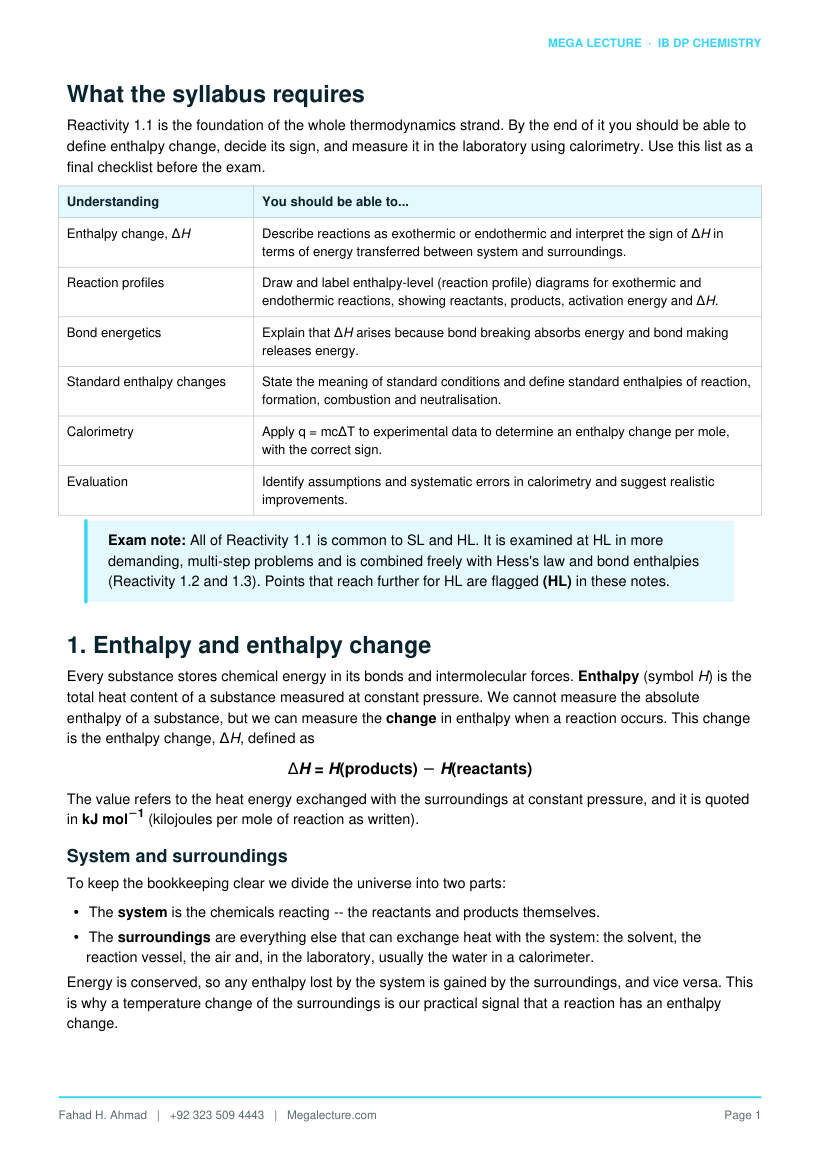
Reactivity 1.1 is the foundation of the whole thermodynamics strand. By the end of it you should be able to define enthalpy change, decide its sign, and measure it in the laboratory using calorimetry. Use this list as a final checklist before the exam.
Understanding You should be able to...
Enthalpy change, ΔH Describe reactions as exothermic or endothermic and interpret the sign of ΔH in terms of energy transferred between system and surroundings.
Reaction profiles Draw and label enthalpy-level (reaction profile) diagrams for exothermic and endothermic reactions, showing reactants, products, activation energy and ΔH.
Bond energetics Explain that ΔH arises because bond breaking absorbs energy and bond making releases energy.
Standard enthalpy changes State the meaning of standard conditions and define standard enthalpies of reaction, formation, combustion and neutralisation.
Calorimetry Apply q = mcΔT to experimental data to determine an enthalpy change per mole, with the correct sign.
Evaluation Identify assumptions and systematic errors in calorimetry and suggest realistic improvements.
Exam note: All of Reactivity 1.1 is common to SL and HL. It is examined at HL in more demanding, multi-step problems and is combined freely with Hess's law and bond enthalpies (Reactivity 1.2 and 1.3). Points that reach further for HL are flagged (HL) in these notes.
1. Enthalpy and enthalpy change
Every substance stores chemical energy in its bonds and intermolecular forces. Enthalpy (symbol H) is the total heat content of a substance measured at constant pressure. We cannot measure the absolute enthalpy of a substance, but we can measure the change in enthalpy when a reaction occurs. This change is the enthalpy change, ΔH, defined as
ΔH = H(products) − H(reactants)
The value refers to the heat energy exchanged with the surroundings at constant pressure, and it is quoted in kJ mol−1 (kilojoules per mole of reaction as written).
System and surroundings
To keep the bookkeeping clear we divide the universe into two parts:
- The system is the chemicals reacting -- the reactants and products themselves.
- The surroundings are everything else that can exchange heat with the system: the solvent, the reaction vessel, the air and, in the laboratory, usually the water in a calorimeter.
Energy is conserved, so any enthalpy lost by the system is gained by the surroundings, and vice versa. This is why a temperature change of the surroundings is our practical signal that a reaction has an enthalpy change.
Exothermic and endothermic
Exothermic reaction Endothermic reaction
Energy flow System releases heat to the surroundings System absorbs heat from the surroundings
Surroundings Temperature rises Temperature falls
Sign of ΔH ΔH is negative (−) ΔH is positive (+)
Enthalpy of products
Lower than reactants Higher than reactants
Everyday example
Combustion, neutralisation, most displacement reactions
Thermal decomposition, dissolving ammonium salts, photosynthesis
A useful memory hook: in an exothermic change heat exits the system, so the products hold less energy and ΔH is negative; in an endothermic change heat enters the system, so the products hold more energy and ΔH is positive.
Enthalpy-level (reaction profile) diagrams
A reaction profile plots enthalpy on the vertical axis against the progress of the reaction on the horizontal axis. The reactants and products sit at fixed enthalpy levels; the difference between them is ΔH. The hump between them is the activation energy, Ea -- the minimum energy needed to start breaking bonds (covered fully in Reactivity 2.2).
Figure 1. Reaction profiles. Left, an exothermic reaction: the product level lies below the reactants, so ΔH = H(products) −
H(reactants) = −184 kJ mol−1 (negative), with activation energy Ea = 100 kJ mol−1. Right, an endothermic reaction: the product level lies above the reactants, ΔH = +120 kJ mol−1 (positive), Ea = 150 kJ mol−1. Both climb the Ea barrier first.
Read the two diagrams carefully. In the exothermic profile the product level lies below the reactant level, so the arrow for ΔH points downward and ΔH is negative. In the endothermic profile the product level lies above the reactant level, the arrow points upward, and ΔH is positive. In both cases the reaction must first climb the activation-energy barrier, regardless of the overall sign of ΔH.
Exam technique: When you draw a profile, always label four things: the reactant level, the product level, Ea measured from the reactants to the top of the barrier, and ΔH as a vertical arrow between the two levels pointing in the correct direction. Marks are lost for unlabelled axes.
2. Why reactions have an enthalpy change
The origin of every ΔH is the rearrangement of chemical bonds. Two opposing energy processes happen in any reaction:
- Bond breaking is endothermic. Energy must be supplied to pull bonded atoms apart, so breaking bonds always absorbs energy from the surroundings.
- Bond making is exothermic. When new bonds form, energy is released to the surroundings.
The overall enthalpy change is the balance of the two:
ΔH ≈ (energy absorbed breaking bonds) − (energy released making bonds)
Figure 3. Bond-enthalpy balance for H2 + Cl2 → 2HCl. Breaking the reactant bonds absorbs +678 kJ mol−1 (H−H 436, Cl−Cl
242); forming two H−Cl bonds releases −862 kJ mol−1. The net ΔH = 678 − 862 = −184 kJ mol−1, so the reaction is exothermic.
If more energy is released forming the product bonds than is absorbed breaking the reactant bonds, the reaction is exothermic (ΔH negative). If breaking the reactant bonds costs more than is recovered, the reaction is endothermic (ΔH positive). This is exactly the reasoning you will formalise with average bond enthalpies in Reactivity 1.2.
Common misconception: It is wrong to say bond breaking releases energy. Breaking a bond always requires energy; it is the formation of the new, often stronger, bonds in the products that releases the energy which makes a reaction exothermic.
3. Standard enthalpy changes
The enthalpy change of a reaction depends slightly on the conditions (temperature, pressure and the states and concentrations of the substances). To make values comparable, chemists agree on a set of standard conditions and write the standard enthalpy change with a degree symbol: ΔH°.
Standard condition Agreed value
Pressure 100 kPa (1 bar)
Temperature a stated temperature, usually 298 K (25 °C)
Concentration of solutions 1 mol dm−3
State of each substance the state that is stable under these conditions
The symbol ΔH° (read as delta H standard) therefore means the enthalpy change measured with every substance in its standard state at 100 kPa and the stated temperature. Four particular standard enthalpy changes are named in the syllabus.
Standard enthalpy change
Definition (per mole, standard conditions)
Reaction, ΔH°r The enthalpy change when molar amounts of reactants react as shown in a balanced equation.
Formation, ΔH°f The enthalpy change when one mole of a compound is formed from its elements in their standard states. ΔH°f of any element in its standard state is zero by definition.
Combustion, ΔH°c The enthalpy change when one mole of a substance is completely burned in excess oxygen. Always negative.
Neutralisation, ΔH°neut The enthalpy change when an acid and a base react to form one mole of water. For strong acid + strong alkali it is close to −57 kJ mol−1.
Worked examples of the defining equations:
- Formation of liquid water: H2(g) + ½O2(g) → H2O(l), ΔH°f = −286 kJ mol−1.
- Combustion of methane: CH4(g) + 2O2(g) → CO2(g) + 2H2O(l), ΔH°c = −891 kJ mol−1.
- Neutralisation: HCl(aq) + NaOH(aq) → NaCl(aq) + H2O(l), ΔH°neut = −57.3 kJ mol−1.
HL link: (HL) Standard enthalpies of formation are the raw material of Hess's law calculations in Reactivity 1.2, where ΔH°r = ΣΔH°f(products) − ΣΔH°f(reactants). Get the definitions exact now and those cycles become routine.
4. Temperature, heat and enthalpy -- keep them separate
These three ideas are constantly confused in exams. They are not the same thing.
Quantity What it is Depends on amount?
Unit
Temperature, T A measure of the average kinetic energy of the particles. It tells you how hot something is, not how much energy it holds.
No (intensive) K or °C
Quantity What it is Depends on amount?
Unit
Heat, q Energy transferred between system and surroundings because of a temperature difference.
Yes (extensive) J or kJ
Enthalpy change, ΔH
The heat exchanged by a reaction at constant pressure, expressed per mole of reaction.
Quoted per mole kJ mol−1
A small cup of boiling water and a large tank of warm water can be at very different temperatures, yet the tank stores far more heat because it contains many more particles. Temperature is intensive (independent of amount); heat is extensive (depends on amount). A change in temperature (ΔT) of the surroundings is what we actually measure; we then convert it to heat with q = mcΔT, and finally to an enthalpy change per mole.
Note the sign convention: A temperature rise of the surroundings means the system released heat, so the reaction is exothermic and ΔH is negative. A temperature fall means the reaction absorbed heat, so ΔH is positive. The sign of ΔH is opposite to the sign of the surroundings' temperature change.
5. Calorimetry: measuring ΔH in the laboratory
Calorimetry measures the heat released or absorbed by a reaction by monitoring the temperature change of a known mass of water (or aqueous solution) that is in thermal contact with the reaction. The central equation is q = mcΔT where q is the heat energy transferred (J), m is the mass of water or solution being heated or cooled (g), c is the specific heat capacity of that water (4.18 J g−1 K−1), and ΔT is the temperature change of the water (K, numerically equal to a change in °C).
The four-step method
- Calculate the heat change of the water: q = mcΔT. 2. Find the amount (in moles) of the limiting reactant that produced that heat. 3. Divide to get the enthalpy change per mole: ΔH = − q / n. 4. Assign the sign: negative if the surroundings warmed (exothermic), positive if they cooled (endothermic), and convert J to kJ.
The minus sign in step 3 converts between the point of view of the surroundings (which gained heat q in an exothermic reaction) and the system (whose enthalpy fell by that amount).
Running the experiment well
The quality of a calorimetry result depends almost entirely on the technique. A reliable combustion experiment (a spirit burner heating water) follows this sequence:
- Weigh the burner and fuel; measure a known mass (or volume) of water into a thin copper calorimeter and record its starting temperature.
- Light the burner directly beneath the calorimeter, shielded from draughts, and stir the water gently.
- Extinguish the flame after a clear temperature rise (about 15 to 20 °C), record the maximum temperature and immediately reweigh the burner.
- The mass of fuel burned is the loss in mass of the burner; the heat gained is found from the water using q = mcΔT.
For reactions carried out in solution -- neutralisation, dissolution and displacement -- the reaction and the water being warmed are one and the same, so the solution is both system and calorimeter. These are done in an insulated polystyrene cup with a lid, and the best results come from a temperature-time graph.
The temperature-time (extrapolation) method
Because heat leaks away even as the reaction proceeds, the highest temperature you read is already lower than the true maximum. To correct for this, take temperature readings at regular intervals before and after mixing, plot temperature against time, and extrapolate the cooling portion of the graph back to the instant of mixing.
Figure 2. Temperature−time graph for a displacement reaction in an insulated cup. Extrapolating the cooling line back to the moment of mixing lifts the measured peak (28.9 °C) to a corrected maximum of 30.5 °C. With m = 50.0 g, c = 4.18 J g−1 K−1 and ΔT = 10.5 °C, q = 2.19 kJ and ΔH = − q/n = −219 kJ mol−1 (n = 0.0100 mol).
What we can measure this way
Enthalpy change Typical set-up Mass used in q = mcΔT
Combustion Spirit burner heating water in a metal calorimeter Mass of water heated
Neutralisation Acid + alkali mixed in an insulated cup Combined mass of the two solutions
Solution (dissolving) Solid dissolved in water in an insulated cup Mass of water (or of the final solution)
Displacement Metal added to a salt solution in an insulated cup Mass of the solution
Assumptions and systematic errors
Simple calorimetry always gives a value smaller in magnitude than the data-book figure, mainly because of the assumptions built into q = mcΔT:
- Heat loss to the surroundings. Not all the heat reaches (or stays in) the water; some warms the air, the thermometer and the container. This is the biggest error, and it makes both exothermic and endothermic values too small in magnitude.
- Incomplete combustion. In a spirit burner the fuel may burn to carbon and carbon monoxide (seen as soot), releasing less energy than complete combustion would.
- Evaporation of fuel from an open wick between weighings overstates the mass burned.
- The apparatus absorbs heat. We assume all heat goes to the water and ignore the heat capacity of the calorimeter itself.
- Non-standard conditions. The experiment is rarely done at exactly 298 K and 100 kPa, and we assume the solution has the density and specific heat capacity of pure water.
Improvements
- Insulate the calorimeter (lid, lagging, polystyrene cup) and shield the flame with a draught shield to cut heat loss.
- Position the flame close to a thin metal (copper) calorimeter and stir the water for even heating.
- Use a bomb calorimeter for combustion (excess oxygen ensures complete combustion; the whole apparatus is calibrated).
- For neutralisation, dissolution and displacement, plot temperature against time and extrapolate back to the moment of mixing to correct for heat loss during the reaction.
HL extension: (HL) A more rigorous experiment calibrates the calorimeter constant (the heat capacity of the vessel plus contents) so that the heat absorbed by the apparatus, not just the water, is included in q. This removes one of the assumptions above.
6. Worked calorimetry problems
Work through each example with the four-step method. Watch the sign, keep track of J versus kJ, and always finish with a value per mole.
Worked example 1 -- basic q = mcΔT
A beaker containing 150 g of water is heated from 18.0 °C to 43.0 °C. How much heat energy did the water absorb?
ΔT = 43.0 − 18.0 = 25.0 °C.
q = mcΔT = 150 × 4.18 × 25.0 = 15675 J ≈ 15.7 kJ.
This is the raw heat step that begins every calorimetry calculation -- nothing yet is per mole.
Worked example 2 -- enthalpy of combustion (spirit burner)
A spirit burner of ethanol, C2H5OH (M = 46.08 g mol−1), is used to heat 200.0 g of water. The temperature rises by 22.0 °C and the burner loses 1.15 g of fuel. Determine ΔHc of ethanol.
Step 1 q = mcΔT = 200.0 × 4.18 × 22.0 = 18392 J = 18.392 kJ (heat gained by the water).
Step 2 n(ethanol) = 1.15 / 46.08 = 0.02496 mol.
Step 3 ΔHc = − q / n = − 18.392 / 0.02496 = −737 kJ mol−1.
Step 4 The water warmed, so the reaction is exothermic and the sign is negative. The data-book value is −1367 kJ mol−1; our value is far smaller in magnitude, mainly because of heat loss and incomplete combustion -- a classic evaluation point.
Worked example 3 -- enthalpy of neutralisation
50.0 cm3 of 1.00 mol dm−3 HCl at 21.0 °C is mixed with 50.0 cm3 of 1.00 mol dm−3 NaOH at 21.0 °C in a polystyrene cup. The temperature rises to 27.8 °C. Find ΔHneut.
Step 1 Total volume = 100.0 cm3, so mass of solution ≈ 100.0 g (density 1.00 g cm−3). ΔT = 27.8 − 21.0 = 6.8 °C.
q = 100.0 × 4.18 × 6.8 = 2842 J = 2.842 kJ.
Step 2 n(H2O formed) = n(HCl) = 0.0500 dm3 × 1.00 = 0.0500 mol.
Step 3 ΔHneut = − 2.842 / 0.0500 = −56.8 kJ mol−1 -- close to the accepted −57.3 kJ mol−1.
Note: use the mass of the whole solution (100 g), never the mass of solute.
Worked example 4 -- enthalpy of solution (endothermic)
4.00 g of ammonium nitrate, NH4NO3 (M = 80.05 g mol−1), is dissolved in 50.0 g of water. The temperature falls from 21.0 °C to 14.8 °C. Find ΔHsol.
Step 1 ΔT = 21.0 − 14.8 = 6.2 °C (a fall). q = 50.0 × 4.18 × 6.2 = 1296 J = 1.296 kJ absorbed from the water.
Step 2 n(NH4NO3) = 4.00 / 80.05 = 0.04997 mol.
Step 3 The water cooled, so the system absorbed heat: ΔHsol is positive. ΔHsol = +1.296 / 0.04997 = +25.9 kJ mol−1.
Getting the sign right is worth a mark on its own: a temperature fall always gives a positive ΔH.
Worked example 5 -- enthalpy of displacement
Excess zinc powder is added to 50.0 cm3 of 0.200 mol dm−3 copper(II) sulfate solution. The temperature rises from 20.0 °C to 30.2 °C. Find ΔH for Zn(s) + Cu2+(aq) → Zn2+(aq) + Cu(s).
Step 1 mass of solution ≈ 50.0 g; ΔT = 30.2 − 20.0 = 10.2 °C. q = 50.0 × 4.18 × 10.2 = 2132 J = 2.132 kJ.
Step 2 Zn is in excess, so Cu2+ is limiting: n(Cu2+) = 0.0500 × 0.200 = 0.0100 mol.
Step 3 Exothermic (temperature rose): ΔH = − 2.132 / 0.0100 = −213 kJ mol−1 (accepted value ≈ −217 kJ mol−1).
Identifying the limiting reactant is essential -- the excess metal does not appear in the mole calculation.
Worked example 6 -- combustion, watch J vs kJ
Burning 0.720 g of methanol, CH3OH (M = 32.04 g mol−1), raises the temperature of 100.0 g of water by 14.5 °C. Find ΔHc.
q = 100.0 × 4.18 × 14.5 = 6061 J. Convert now: 6061 J = 6.061 kJ.
n(methanol) = 0.720 / 32.04 = 0.02247 mol.
ΔHc = − 6.061 / 0.02247 = −270 kJ mol−1.
If you forget to convert J to kJ you get an answer 1000 times too large (−270000). Always carry the unit through the division.
Worked example 7 -- using an extrapolated temperature
In a displacement experiment the measured peak temperature is 28.9 °C, but extrapolating the cooling curve back to the moment of mixing gives a corrected maximum of 30.5 °C. The starting temperature was 20.0 °C and 50.0 g of solution contained 0.0100 mol of the limiting reactant. Compare the two ΔH values.
Using the raw peak: ΔT = 28.9 − 20.0 = 8.9 °C; q = 50.0 × 4.18 × 8.9 = 1860 J; ΔH = − 1.860 / 0.0100 = −186 kJ mol−1.
Using the corrected maximum: ΔT = 30.5 − 20.0 = 10.5 °C; q = 50.0 × 4.18 × 10.5 = 2195 J; ΔH = − 2.195 / 0.0100 = −219 kJ mol−1.
The extrapolated value is more exothermic and closer to the true figure, because it compensates for the heat lost while the reaction was still going on.
Worked example 8 -- (HL) allowing for the calorimeter
(HL) When 0.0500 mol of a reaction releases heat into 100.0 g of solution, the temperature rises by 7.00 °C. The calorimeter itself has a heat capacity of 45 J K−1. Find ΔH, first ignoring and then including the calorimeter.
Water only: q = 100.0 × 4.18 × 7.00 = 2926 J.
Calorimeter also absorbs heat: q(cal) = 45 × 7.00 = 315 J.
Total heat released = 2926 + 315 = 3241 J = 3.241 kJ. ΔH = − 3.241 / 0.0500 = −64.8 kJ mol−1, versus −58.5 kJ mol−1 if the calorimeter is ignored.
Including the calorimeter constant removes one assumption and gives a larger (more accurate) magnitude.
7. Common pitfalls
- Sign of ΔH. Temperature up → exothermic → ΔH negative. Temperature down → endothermic → ΔH positive. The sign of ΔH is opposite to the sign of ΔT.
- Mass of solution, not solute. In q = mcΔT, m is the mass of water or solution being heated, never the mass of the fuel or solid that reacted.
- ΔT is a difference. Use final − initial. In K or °C the numerical value of ΔT is identical, so no conversion is needed for the difference.
- Per mole conversion. Divide the heat by the moles of the limiting reactant, or the substance the definition refers to (one mole of fuel, one mole of water for neutralisation).
- J versus kJ. q from mcΔT comes out in joules; enthalpy changes are quoted in kJ mol−1. Divide q by 1000 once, before or after dividing by moles.
- Significant figures. Quote ΔH to 3 significant figures, matching the precision of the data.
8. Quick reference
Item Statement
Enthalpy change ΔH = H(products) − H(reactants); unit kJ mol−1
Exothermic Releases heat; surroundings warm; ΔH negative; products below reactants
Endothermic Absorbs heat; surroundings cool; ΔH positive; products above reactants
Bond energetics Breaking bonds absorbs energy; making bonds releases energy
Standard conditions 100 kPa, stated T (usually 298 K), 1 mol dm−3 solutions; symbol ΔH°
Calorimetry q = mcΔT, with c(water) = 4.18 J g−1 K−1
Per mole ΔH = − q / n (q in kJ, n in mol)
Neutralisation (strong) ΔHneut ≈ −57 kJ mol−1 per mole of water formed
Some standard values worth recognising (298 K); use them to sense-check your own experimental answers.
Substance / reaction Change Value / kJ mol−1
Methane, CH4(g) ΔH°c −891
Ethanol, C2H5OH(l) ΔH°c −1367
Methanol, CH3OH(l) ΔH°c −726
Water, H2O(l) ΔH°f −286
Carbon dioxide, CO2(g) ΔH°f −394
Strong acid + strong alkali ΔH°neut −57.3
Dissolving NH4NO3(s) ΔH°sol +25.7
9. Test yourself
Attempt all eight without notes, then check against the full worked answers. Take c(water) = 4.18 J g−1 K−1 and assume solution densities of 1.00 g cm−3 throughout.
- 120 g of water is heated from 19.0 °C to 61.0 °C. Calculate the heat absorbed, in kJ.
- Burning 0.660 g of propan-1-ol, C3H7OH (M = 60.10), raises the temperature of 200.0 g of water by 18.5 °C. Find ΔHc.
- 25.0 cm3 of 2.00 mol dm−3 HCl is neutralised by 25.0 cm3 of 2.00 mol dm−3 NaOH; the temperature rises by 13.4 °C. Find ΔHneut per mole of water.
- 5.00 g of potassium nitrate, KNO3 (M = 101.1), dissolves in 100.0 g of water and the temperature falls by 3.0 °C. Find ΔHsol, with its sign.
- Excess magnesium is added to 50.0 cm3 of 0.500 mol dm−3 copper(II) sulfate; the temperature rises by 25.0 °C. Find ΔH per mole of Cu2+.
- A student's experimental ΔHc for a candle wax is only 40% of the data-book value. State three reasons and one improvement.
- Explain, in terms of system and surroundings, why an endothermic reaction feels cold and has a positive ΔH.
- (HL link) Write the equation, including state symbols, that represents the standard enthalpy of formation of ethanol, C2H5OH(l), and state why ΔH°f of O2(g) is zero.
Answers
- ΔT = 61.0 − 19.0 = 42.0 °C. q = 120 × 4.18 × 42.0 = 21067 J ≈ 21.1 kJ.
- q = 200.0 × 4.18 × 18.5 = 15466 J = 15.47 kJ. n = 0.660 / 60.10 = 0.01098 mol. ΔHc = − 15.47 / 0.01098 = −1409 kJ mol−1 (data-book −2021; heat loss and incomplete combustion account for the shortfall).
- mass = 50.0 g; q = 50.0 × 4.18 × 13.4 = 2801 J = 2.801 kJ. n(H2O) = 0.0250 × 2.00 = 0.0500 mol. ΔHneut = − 2.801 / 0.0500 = −56.0 kJ mol−1.
- q = 100.0 × 4.18 × 3.0 = 1254 J = 1.254 kJ (absorbed; temperature fell). n = 5.00 / 101.1 = 0.04946 mol. ΔHsol = +1.254 / 0.04946 = +25.4 kJ mol−1 (positive: endothermic).
- mass = 50.0 g; q = 50.0 × 4.18 × 25.0 = 5225 J = 5.225 kJ. n(Cu2+) = 0.0500 × 0.500 = 0.0250 mol (Mg in excess). ΔH = − 5.225 / 0.0250 = −209 kJ mol−1.
- Reasons: heat lost to the surroundings and to the apparatus; incomplete combustion (soot lowers the energy released); evaporation of wax or absorption of heat by the calorimeter; non-standard conditions. Improvement: shield the flame with a draught shield and insulate/lag the calorimeter, or use a bomb calorimeter.
- The reacting chemicals (the system) absorb heat energy from the surroundings (the water and container), so the surroundings lose energy and cool -- the mixture feels cold. Because the products end up with more enthalpy than the reactants, ΔH = H(products) − H(reactants) is positive.
- 2C(s, graphite) + 3H2(g) + ½O2(g) → C2H5OH(l). One mole of ethanol is formed from its elements in their standard states. ΔH°f of O2(g) is zero because O2(g) is an element already in its standard state, so no formation reaction (and no enthalpy change) is needed to make it.
