
IB Diploma · Chemistry · SL / HL · Structure 3: Classification of Matter
Structure 3.1 The Periodic Table: Classification of Elements
Need more than one subject? All-notes pass: unlimited downloads of every note for a year: unlimited downloads of every note on the site, PKR 999 a year. All packs and courses.
Opens inside this page. Prefer your own PDF app? Open the PDF.
Chemistry batch classes: coming soon. Small live classes at a lower fee than one-to-one. Join the waiting list
Check yourself
5 quick questions on Structure 3: Classification of matter
Tap an answer to see if you are right, and why. Free, no sign-up.
Start the free testWas this note useful?
Full text of Structure 3.1 The Periodic Table: Classification of Elements
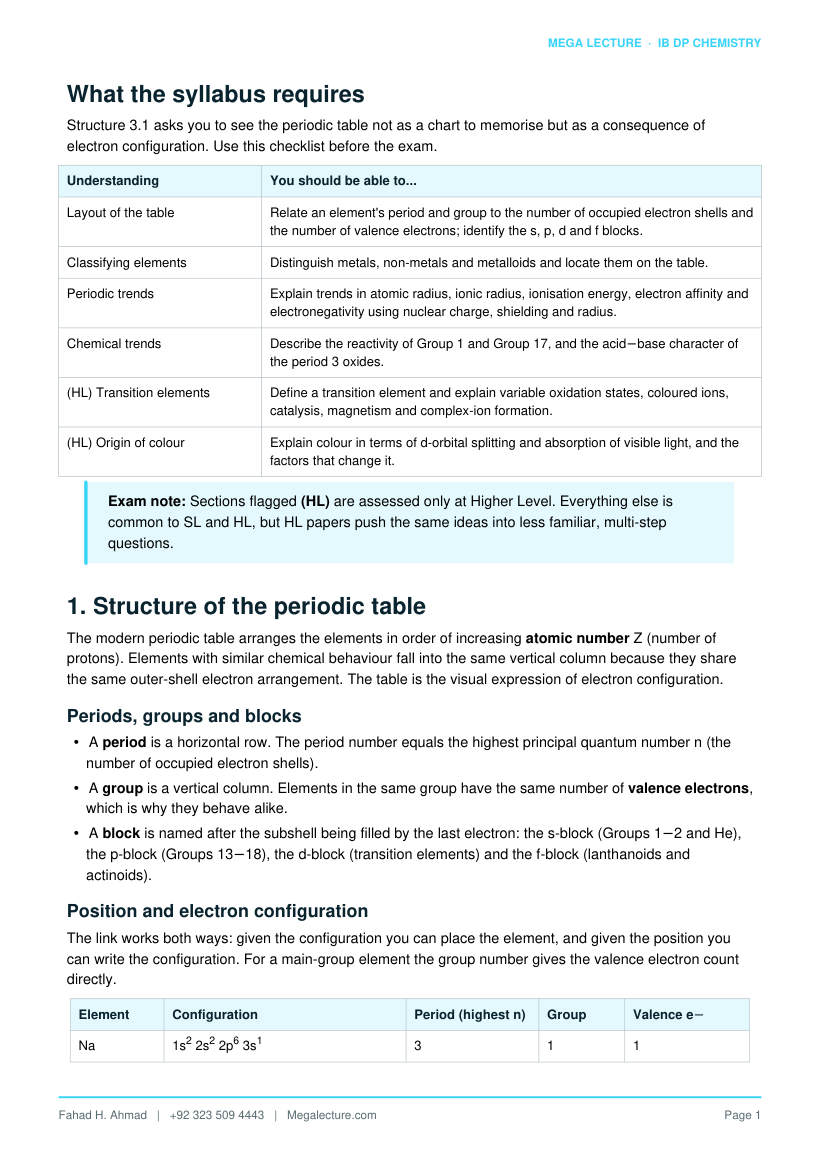
IB DP CHEMISTRY Structure 3: Classification of Matter Structure 3.1 The Periodic Table
Classification of Elements Revision Notes · Standard and Higher Level Fahad H. Ahmad
Original notes prepared for the IB Diploma Programme Chemistry course (first assessment 2025)
Free notes, practice tests and live classes Back to megalecture.com
What the syllabus requires
Structure 3.1 asks you to see the periodic table not as a chart to memorise but as a consequence of electron configuration. Use this checklist before the exam.
Understanding You should be able to...
Layout of the table Relate an element's period and group to the number of occupied electron shells and the number of valence electrons; identify the s, p, d and f blocks.
Classifying elements Distinguish metals, non-metals and metalloids and locate them on the table.
Periodic trends Explain trends in atomic radius, ionic radius, ionisation energy, electron affinity and electronegativity using nuclear charge, shielding and radius.
Chemical trends Describe the reactivity of Group 1 and Group 17, and the acid−base character of the period 3 oxides.
(HL) Transition elements Define a transition element and explain variable oxidation states, coloured ions, catalysis, magnetism and complex-ion formation.
(HL) Origin of colour Explain colour in terms of d-orbital splitting and absorption of visible light, and the factors that change it.
Exam note: Sections flagged (HL) are assessed only at Higher Level. Everything else is common to SL and HL, but HL papers push the same ideas into less familiar, multi-step questions.
1. Structure of the periodic table
The modern periodic table arranges the elements in order of increasing atomic number Z (number of protons). Elements with similar chemical behaviour fall into the same vertical column because they share the same outer-shell electron arrangement. The table is the visual expression of electron configuration.
Periods, groups and blocks
- A period is a horizontal row. The period number equals the highest principal quantum number n (the number of occupied electron shells).
- A group is a vertical column. Elements in the same group have the same number of valence electrons, which is why they behave alike.
- A block is named after the subshell being filled by the last electron: the s-block (Groups 1−2 and He), the p-block (Groups 13−18), the d-block (transition elements) and the f-block (lanthanoids and actinoids).
Position and electron configuration
The link works both ways: given the configuration you can place the element, and given the position you can write the configuration. For a main-group element the group number gives the valence electron count directly.
Element Configuration Period (highest n) Group Valence e−
Na 1s2 2s2 2p6 3s1
Element Configuration Period (highest n) Group Valence e−
Cl [Ne] 3s2 3p5
Ca [Ar] 4s2
As [Ar] 3d10 4s2 4p3
Group-number rule: For s- and p-block elements the number of valence electrons is the last digit of the group number for Groups 13−18 (e.g. Group 15 → 5 valence electrons), and equals the group number itself for Groups 1 and 2.
Metals, non-metals and metalloids
A diagonal staircase running from boron to astatine separates metals (to the left, the majority of elements) from non-metals (to the upper right). Elements lying along the staircase − B, Si, Ge, As, Sb, Te − are metalloids, showing intermediate properties (e.g. semiconduction).
Property Metals Non-metals
Electrical conductivity Good (delocalised electrons) Poor (insulators; C as graphite is an exception)
State at room temperature Mostly solid (Hg is liquid) Solids, liquids and gases
When they react Tend to lose electrons → form cations Tend to gain electrons → form anions
Oxides Basic (or amphoteric) Acidic (or neutral)
2. Periodicity of atomic properties
Periodicity means the repeating pattern of properties as Z increases. Almost every trend in this section is explained by the balance between three factors, so learn them as a toolkit and apply them again and again.
Factor What it does
Nuclear charge More protons pull the electrons in more strongly, so radius falls and the outer electrons are held more tightly.
Shielding (screening) Inner-shell electrons repel outer electrons and reduce the effective nuclear charge felt by the valence electrons.
Number of shells / distance Adding a shell places valence electrons further out; distance weakens the attraction to the nucleus.
Atomic radius
Across a period (left → right): radius decreases. Each step adds one proton and one electron to the same shell. Shielding stays roughly constant, so the effective nuclear charge rises and pulls the shell inwards.
Down a group: radius increases. Each element has one more occupied shell, so the valence electrons are further out and better shielded, outweighing the larger nuclear charge.
Figure 1. Atomic radius against atomic number. Radius falls across each period (Li−F, Na−Cl) as nuclear charge rises at nearly constant shielding, then jumps up at the start of the next period (Na) where a new shell is added.
Ionic radius
- Cations are smaller than their parent atoms. Losing electrons often empties the outer shell, and the remaining electrons feel a greater effective nuclear charge per electron, so they are drawn in. Example: Na is larger than Na+.
- Anions are larger than their parent atoms. Added electrons increase electron−electron repulsion while the nuclear charge is unchanged, so the electron cloud expands. Example: Cl is smaller than Cl−.
- Isoelectronic series: ions with the same number of electrons (e.g. N3−, O2−, F−, Na+, Mg2+, Al3+ all have 10 electrons). Within such a series, the radius decreases as nuclear charge increases, because the same 10 electrons are pulled by ever more protons.
Ranking tip: To order an isoelectronic series by size, just order by nuclear charge: most protons → smallest ion. So N3− > O2− > F− > Na+ > Mg2+ > Al3+.
First ionisation energy
First ionisation energy (IE1) is the energy to remove one mole of electrons from one mole of gaseous atoms: X(g) → X+(g) + e−. It measures how tightly the outermost electron is held.
Across a period: IE1 generally increases (rising nuclear charge, similar shielding, smaller radius). Down a group: IE1 decreases (more shells and more shielding place the outer electron further from the nucleus).
Two dips interrupt the rise across a period, and examiners love them:
- Group 13 dip (e.g. Al lower than Mg). The electron removed comes from a 3p orbital, which is higher in energy and slightly better shielded than the filled 3s pair, so it is easier to remove.
- Group 16 dip (e.g. S lower than P). In Group 16 the p-subshell reaches its fourth electron, forcing a pair into one p-orbital. Electron−electron repulsion within that pair makes one electron easier to remove than in the stable half-filled p3 arrangement of Group 15.
Successive ionisation energies: IE always rises for successive removals from the same atom. A large jump signals that the next electron comes from an inner shell − powerful evidence for the number of valence electrons and hence the group.
Figure 2. First ionisation energy against atomic number (Z = 1−20). IE1 peaks at the noble gases He, Ne and Ar (red) and drops to a minimum at each alkali metal Li, Na, K (green). Small dips B below Be and O below N (repeated at Al and S) reveal sub-shell structure.
Electron affinity
First electron affinity is the enthalpy change when one mole of gaseous atoms each gain an electron: X(g) + e− → X−(g). For most elements it is exothermic (negative) because the added electron is attracted to the nucleus. It becomes more exothermic across a period (stronger nuclear pull) and less exothermic down a group (electron added further out). Non-metals, especially the halogens, release the most energy.
Electronegativity
Electronegativity is the relative ability of an atom to attract a shared (bonding) pair of electrons. On the Pauling scale it increases across a period (rising nuclear charge, smaller radius) and decreases down a group (larger radius, more shielding). Fluorine is the most electronegative element (4.0); the noble gases are normally excluded.
Figure 3. Electronegativity (Pauling) against atomic number. It rises across each period (Li−F, Na−Cl) as the atom contracts and nuclear charge grows; fluorine is the highest at 4.0. Down a group it falls (F 4.0 > Cl 3.2 in Group 17).
Property Across a period (→) Down a group (→) Main reason
Atomic radius Decreases Increases Nuclear charge vs. shells / shielding
Ionisation energy Increases (2 dips) Decreases Attraction on the outer electron
Electron affinity More exothermic Less exothermic Pull on an incoming electron
Electronegativity Increases Decreases Pull on a bonding pair
3. Metallic character and melting points
Metallic character means the tendency to lose electrons and form positive ions. It tracks the opposite of ionisation energy and electronegativity.
- Across a period metallic character decreases (elements hold electrons more tightly), so non-metallic character increases.
- Down a group metallic character increases (outer electrons are lost more easily). The most metallic elements sit at the bottom left.
Melting points across period 3
The melting point across a period does not follow a single trend; it depends on the type of structure and bonding, which is why period 3 is a classic exam case.
Elements Structure and bonding Melting point trend
Na, Mg, Al Giant metallic lattice Rises: more valence electrons and higher charge give stronger metallic bonding (Al highest of the three)
Si Giant covalent (macromolecular) Highest of period 3: a strong 3-D network of covalent bonds must be broken
Elements Structure and bonding Melting point trend
P4, S8, Cl2 Simple molecular Low: weak London forces between molecules; S8 > P4 > Cl2 by molecule size
Ar Monatomic Lowest: very weak forces between single atoms
Watch the shape of the graph: Melting point climbs Na−Mg−Al, peaks sharply at Si, then collapses to the molecular non-metals. Always justify your answer by naming the structure, not just the position.
4. Group 1 and Group 17 reactivity
Group trends in reactivity are examined every year. The key point that trips students is that reactivity increases down Group 1 but decreases down Group 17 — and the explanation is the same idea applied to opposite processes.
Group 1: the alkali metals
Alkali metals react by losing their single valence electron to form a 1+ ion. Going down the group the outer electron is further from the nucleus and better shielded, so ionisation energy falls and the electron is lost more readily: reactivity increases down the group (Li < Na < K < Rb < Cs).
Reaction with water gives a metal hydroxide (an alkali) and hydrogen gas:
2Na(s) + 2H2O(l) → 2NaOH(aq) + H2(g)
Lithium fizzes gently; sodium melts into a ball that darts across the surface; potassium ignites the hydrogen with a lilac flame; rubidium and caesium react explosively. The vigour of these reactions is the visible evidence of the trend.
Group 17: the halogens
Halogens react by gaining one electron to form a 1− ion (or by sharing one in covalent bonds). Going down the group the incoming electron is added to a shell further from the nucleus and more shielded, so the attraction is weaker: reactivity decreases down the group (F2 > Cl2 > Br2 > I2).
Physical state also changes smoothly down the group as London forces grow with molecular size:
Halogen State at room temperature Colour
F2 Gas Pale yellow
Cl2 Gas Pale green
Br2 Liquid Red-brown
I2 Solid Grey-black (violet vapour)
Displacement reactions
A more reactive halogen displaces a less reactive one from a solution of its salt, because it is the stronger oxidising agent. For example chlorine displaces bromine:
Cl2(aq) + 2KBr(aq) → 2KCl(aq) + Br2(aq)
The solution turns orange as bromine forms. In ionic form, Cl2 + 2Br− → 2Cl− + Br2. Iodine cannot displace bromine or chlorine, confirming the reactivity order.
The word 'reactivity' means different things here: For a metal it means how easily it loses electrons, so reactivity rises down Group 1. For a non-metal it means how easily it gains electrons, so reactivity falls down Group 17. Never quote one trend as if it were universal.
5. Periodic trends in oxides
The acid−base character of an oxide follows the metal / non-metal divide, so it changes systematically across a period. This is the standard link between position and chemical behaviour.
- Metal oxides are basic. They react with acids to form a salt and water, and ionic ones dissolve to give alkaline solutions.
- Non-metal oxides are acidic. They react with bases, and many dissolve in water to form acids.
- Amphoteric oxides (e.g. Al2O3) react with both acids and bases, marking the changeover along the period.
Across period 3 the oxides move from basic through amphoteric to acidic:
Oxide Na2O, MgO Al2O3 SiO2 P4O10, SO3, Cl2O7
Character Basic Amphoteric Weakly acidic Acidic
Element type Metal Metal (borderline) Metalloid Non-metal
Representative reactions (qualitative)
- Basic oxide + acid: MgO(s) + 2HCl(aq) → MgCl2(aq) + H2O(l).
- Acidic oxide + base: SO3(g) + 2NaOH(aq) → Na2SO4(aq) + H2O(l).
- Acidic oxide + water: SO3(g) + H2O(l) → H2SO4(aq).
- Amphoteric oxide, both ways: Al2O3 + 6HCl → 2AlCl3 + 3H2O, and Al2O3 + 2NaOH + 3H2O → 2NaAl(OH)4.
Environmental link: Acidic non-metal oxides such as SO2, SO3 and the nitrogen oxides dissolve in atmospheric water to form the acids responsible for acid deposition − a favourite application question.
6. (HL) Transition elements
The d-block spans Groups 3−12. A transition element is defined as an element that forms at least one stable ion with a partially filled d subshell. This precise definition matters in the exam.
(HL) Two textbook exceptions: Scandium and zinc are d-block metals but are not classed as transition elements. Sc forms only Sc3+ ([Ar], empty d), and Zn forms only Zn2+ ([Ar]3d10, full
- − neither ion has a partially filled d subshell.
Remember also the filling anomaly: the 4s electrons are removed before the 3d electrons when a transition-metal ion forms. So Fe is [Ar]3d64s2 but Fe2+ is [Ar]3d6 and Fe3+ is [Ar]3d5.
Characteristic properties
Property Explanation
Variable oxidation states The 3d and 4s subshells are close in energy, so a variable number of electrons can be lost. Fe (+2, +3), Cu (+1, +2), Mn (+2 to +7) are common examples.
Coloured ions and complexes
Partially filled d orbitals split in a ligand field; ions absorb visible light on d−d transitions (see section 7).
Catalytic activity Variable oxidation states and the ability to bind reactant molecules let them provide low-energy pathways. Fe in the Haber process, V2O5 in the Contact process, Ni in hydrogenation.
Magnetic behaviour Unpaired d electrons make many complexes paramagnetic (attracted into a magnetic field); species with only paired electrons are diamagnetic.
Complex-ion formation The small, highly charged metal ions act as Lewis acids, accepting lone pairs from ligands (Lewis bases) to form dative covalent bonds.
Complexes and ligands
A complex ion is a central metal ion bonded to a number of ligands − molecules or ions with a lone pair (e.g. H2O, NH3, Cl−, CN−, OH−). The number of dative bonds to the central ion is the coordination number, commonly 6 (octahedral) or 4 (tetrahedral or square planar). Example: [Cu(H2O)6]2+ is octahedral with coordination number 6.
7. (HL) The origin of colour
In a free gaseous ion the five d orbitals have equal energy (degenerate). When ligands approach, their lone pairs repel the d electrons unequally and the d orbitals split into two energy levels separated by a gap ΔE.
A d electron can absorb a photon of visible light whose energy matches ΔE and jump to the higher level (a d−d transition). The wavelengths absorbed are removed from white light; the colour we see is the complementary colour of the light absorbed. For example a complex that absorbs red light appears green.
Because Sc3+ (empty d) and Zn2+ (full d) have no possible d−d transition, their compounds are colourless − a neat confirmation of the definition in section 6.
Factors that change the colour
Anything that changes the size of the split ΔE changes the energy, and hence the wavelength, absorbed − so the observed colour changes:
Factor Effect on colour
Identity of the ligand Different ligands split the d orbitals by different amounts (the spectrochemical series). Swapping ligands shifts the colour, e.g. pale blue [Cu(H2O)6]2+ turns deep blue [Cu(NH3)4(H2O)2]2+.
Oxidation state of the metal A higher charge pulls ligands closer and increases ΔE. Fe2+(aq) is pale green while Fe3+(aq) is yellow-brown.
Factor Effect on colour
Geometry / coordination number
Octahedral and tetrahedral fields split the orbitals differently, giving different ΔE and different colours.
Nature of the metal The number of d electrons and nuclear charge differ from metal to metal, so each ion has its own characteristic colours.
Naming simple complexes (qualitative)
You are expected to interpret, not derive, complex formulae. The overall charge is the sum of the metal-ion charge and the ligand charges. Worked logic:
- [Cu(H2O)6]2+: six neutral water ligands, so the copper is +2. Coordination number 6, octahedral.
- [Fe(CN)6]3−: six CN− ligands total 6−; overall 3− means iron is +3. Coordination number 6.
- [CuCl4]2−: four Cl− total 4−; overall 2− means copper is +2. Coordination number 4, tetrahedral.
8. Worked examples
Worked example 1 — predict and explain a trend
Explain why the atomic radius of sulfur is smaller than that of both sodium (same period) and oxygen (same group).
Sodium → sulfur: across period 3 the nuclear charge rises from 11 to 16 while electrons enter the same third shell, so shielding is nearly constant. The greater effective nuclear charge pulls the shell in, so S is smaller than Na.
Oxygen → sulfur: down Group 16 sulfur has an extra occupied shell (period 3 vs 2) and more shielding, so its valence electrons are further out. Hence S is larger than O.
Answer: the two comparisons use different factors − nuclear charge across, shell number down − and must be argued separately.
Worked example 2 — identify an element from properties
An element X is a soft, silvery solid that reacts vigorously with cold water to give an alkaline solution and a flammable gas, and burns with a lilac flame. Identify the group and a likely identity.
A soft metal that reacts vigorously with water to form an alkali plus hydrogen is a Group 1 alkali metal. The lilac flame colour is characteristic of potassium.
X is potassium (K): 2K + 2H2O → 2KOH + H2. The vigour (more than Na, less than Rb) fits its position in the group.
Worked example 3 — write a halogen reaction
Predict whether a reaction occurs when chlorine water is added to potassium iodide solution, and write the equation.
Chlorine is above iodine in Group 17, so it is the more reactive (stronger oxidising) halogen and will displace iodine.
Cl2(aq) + 2KI(aq) → 2KCl(aq) + I2(aq); ionically Cl2 + 2I− → 2Cl− + I2. The solution turns brown as iodine forms.
Worked example 4 — deduce oxide acidity
Element Q is in period 3 and forms an oxide that reacts with both dilute hydrochloric acid and sodium hydroxide solution. Identify Q and classify the oxide.
An oxide that reacts with both an acid and a base is amphoteric. In period 3 the amphoteric oxide is aluminium oxide, Al2O3.
Q is aluminium: Al2O3 + 6HCl → 2AlCl3 + 3H2O (acting as a base) and Al2O3 + 2NaOH + 3H2O → 2NaAl(OH)4 (acting as an acid).
Worked example 5 — explain an ionisation-energy dip (HL-style)
The first ionisation energies across period 3 rise overall, yet IE1(S) is lower than IE1(P). Explain.
Phosphorus has the configuration [Ne]3s23p3 − a stable half-filled p subshell with one electron in each p orbital.
Sulfur, [Ne]3s23p4, must place a second electron into one 3p orbital. The extra electron−electron repulsion in that paired orbital makes it easier to remove, so IE1(S) < IE1(P) despite the higher nuclear charge.
Worked example 6 — order an isoelectronic series
Place the ions O2−, F−, Na+ and Mg2+ in order of decreasing radius.
All four have 10 electrons (isoelectronic). Radius is set by nuclear charge: O has 8 protons, F 9, Na 11, Mg 12. More protons pull the same 10 electrons in more tightly.
Order (largest → smallest): O2− > F− > Na+ > Mg2+.
9. Common pitfalls
- Forgetting the two IE dips (Groups 13 and 16) and drawing a smooth rise across a period.
- Comparing ionic radii without checking whether the ions are isoelectronic − compare like with like.
- Saying 'reactivity increases down every group'. It increases down Group 1 but decreases down Group 17.
- Confusing electron affinity (adding an electron) with ionisation energy (removing one).
- Removing 3d electrons before 4s when writing transition-metal ions (HL) − the 4s electrons leave first.
- Calling Sc and Zn transition elements (HL). Their common ions have empty or full d subshells.
- Quoting a melting-point 'trend' across period 3 without naming the structure (metallic, giant covalent, molecular, monatomic).
10. Quick-reference trends
Quantity Across a period (→) Down a group (→)
Atomic radius Decreases Increases
First ionisation energy Increases (dips at Gp 13, 16) Decreases
Electron affinity More exothermic Less exothermic
Electronegativity Increases Decreases
Metallic character Decreases Increases
Non-metallic character Increases Decreases
Oxide character Basic → amphoteric → acidic More basic further down
Group 1 reactivity — Increases (electron lost more easily)
Group 17 reactivity — Decreases (electron gained less easily)
11. Test yourself
Attempt all eleven questions without notes; full answers follow.
- State the block, period and group of the element with configuration [Ar]3d104s24p4.
- Explain, in terms of structure, why silicon has the highest melting point in period 3.
- Arrange P3−, S2− and Cl− in order of increasing ionic radius and justify your order.
- Explain why the first ionisation energy of aluminium is lower than that of magnesium.
- Write a balanced equation for the reaction of potassium with water and state one observation.
- Predict whether bromine will displace chlorine from sodium chloride solution, and explain.
- Classify the oxides Na2O, Al2O3 and SO3 as basic, amphoteric or acidic, and give one equation for each with a suitable reagent.
- (HL) Define a transition element and explain why zinc does not qualify.
- (HL) Explain why aqueous copper(II) ions are blue whereas aqueous zinc ions are colourless.
- (HL) Deduce the oxidation state of the metal in [Fe(CN)6]4− and state its coordination number.
- Explain why electronegativity increases from left to right across a period.
Answers
- p-block (last electron in 4p); period 4 (highest n = 4); Group 16 (this is selenium, Se). Ignore the filled 3d in counting the block − it is the last subshell filled that matters.
- Silicon is a giant covalent (macromolecular) solid. Melting requires breaking many strong SiSi covalent bonds throughout the lattice, which needs far more energy than melting the metallic or simple-molecular elements of period 3.
- Increasing radius: Cl− < S2− < P3−. All three are isoelectronic (18 electrons). Cl has the most protons
- and P the fewest (15), so Cl− is pulled in most tightly and P3− least.
- Mg is [Ne]3s2; Al is [Ne]3s23p1. Aluminium's outer electron is in a 3p orbital, higher in energy and slightly shielded by the 3s pair, so it is removed more easily than an electron from magnesium's full 3s subshell − giving the Group 13 dip.
- 2K(s) + 2H2O(l) → 2KOH(aq) + H2(g). Observation: the metal fizzes and melts, moving rapidly on the surface, and the hydrogen ignites with a lilac flame.
- No reaction. Bromine is below chlorine in Group 17, so it is the less reactive (weaker oxidising) halogen and cannot displace the more reactive chlorine from its salt.
- Na2O basic: Na2O + 2HCl → 2NaCl + H2O. Al2O3 amphoteric: Al2O3 + 6HCl → 2AlCl3 + 3H2O (with acid) or + 2NaOH + 3H2O → 2NaAl(OH)4 (with base). SO3 acidic: SO3 + 2NaOH → Na2SO4 + H2O.
- (HL) A transition element forms at least one stable ion with a partially filled d subshell. Zinc forms only Zn2+, which is [Ar]3d10 − a completely full d subshell − so it is excluded.
- (HL) Cu2+ has a partially filled 3d subshell (3d9); its d orbitals split in the aqua-ligand field and it absorbs part of the visible spectrum by a d−d transition, appearing blue (the complementary colour). Zn2+ is 3d10
(full), so no d−d transition is possible and it is colourless.
- (HL) Six CN− ligands contribute 6−; the overall charge is 4−, so the iron must be +2. Coordination number 6 (octahedral).
- Across a period the nuclear charge increases while electrons enter the same shell and shielding is almost unchanged. The atom gets smaller and the effective nuclear charge felt by a bonding pair increases, so the atom attracts shared electrons more strongly − higher electronegativity.
