
IB Diploma · Chemistry · SL / HL · Structure 1: Models of the Particulate Nature of Matter
Structure 1.2 The Nuclear Atom
Opens inside this page. Prefer your own PDF app? Open the PDF.
Full text of Structure 1.2 The Nuclear Atom
IB DP CHEMISTRY Structure 1: Models of the Particulate Nature of Matter Structure 1.2 The Nuclear Atom
Revision Notes · Standard and Higher Level Fahad H. Ahmad
+92 323 509 4443 | Megalecture.com
Original notes prepared for the IB Diploma Programme Chemistry course (first assessment 2025)
What the syllabus requires
Structure 1.2 introduces the modern nuclear model of the atom: the particles it is built from, how we count them, why isotopes exist, and how spectra reveal the arrangement of electrons. Use this checklist as your final revision sweep.
Understanding You should be able to...
Subatomic particles State the relative masses and relative charges of the proton, neutron and electron, and describe the nuclear model of the atom.
Atomic number and mass number
Use Z and A to deduce the number of protons, neutrons and electrons in neutral atoms and in ions.
Isotopes Define isotopes and explain why they share chemical but differ in some physical properties.
Relative atomic mass Calculate Ar from isotopic abundances, and work backwards to find an unknown abundance.
Mass spectrometry Interpret a mass spectrum and use it to determine relative atomic mass.
Emission spectra Describe the hydrogen line emission spectrum as evidence for discrete electron energy levels.
Convergence (HL) Explain how the convergence of spectral lines relates to ionization energy.
Exam note: Most of Structure 1.2 is common to SL and HL. The one clearly flagged HL extension is the link between the convergence limit of an emission series and the ionization energy, covered in section 7.
1. Subatomic particles and the nuclear model
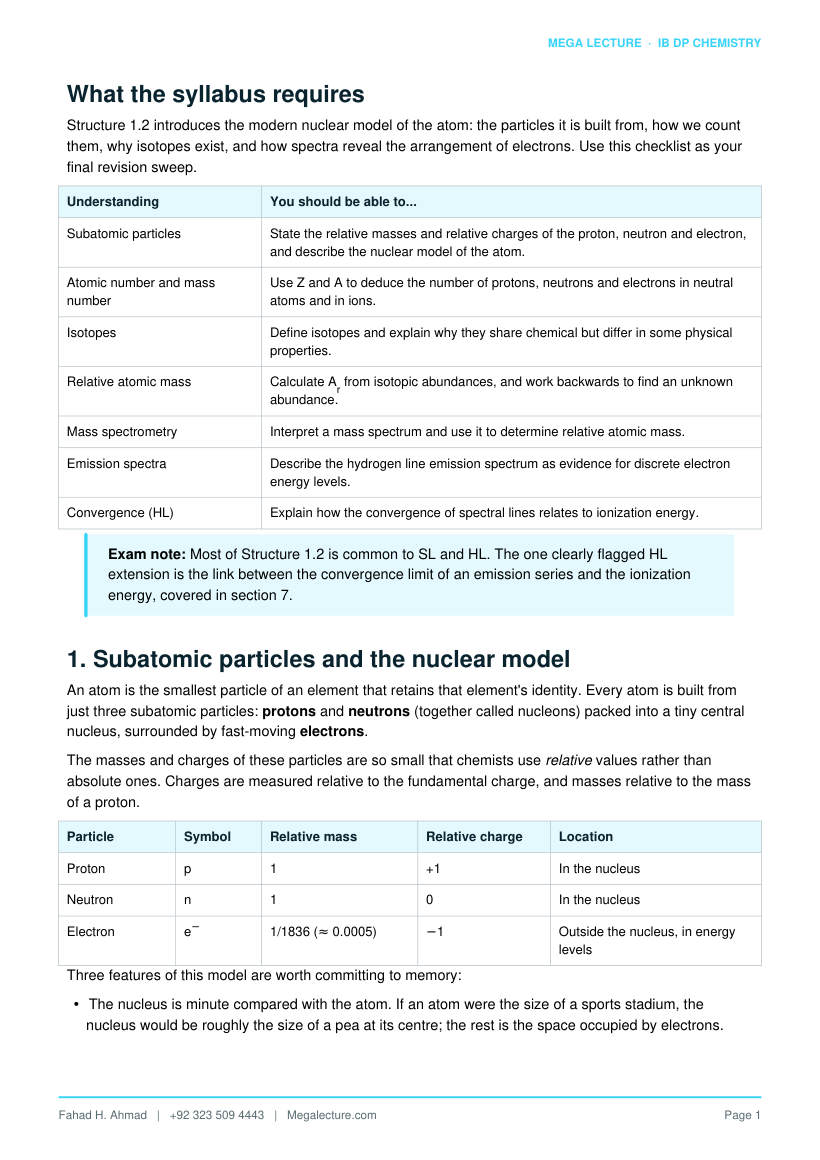
An atom is the smallest particle of an element that retains that element's identity. Every atom is built from just three subatomic particles: protons and neutrons (together called nucleons) packed into a tiny central nucleus, surrounded by fast-moving electrons.
The masses and charges of these particles are so small that chemists use relative values rather than absolute ones. Charges are measured relative to the fundamental charge, and masses relative to the mass of a proton.
Particle Symbol Relative mass Relative charge Location
Proton p +1 In the nucleus
Neutron n In the nucleus
Electron e− 1/1836 (≈ 0.0005) −1 Outside the nucleus, in energy levels
Three features of this model are worth committing to memory:
- The nucleus is minute compared with the atom. If an atom were the size of a sports stadium, the nucleus would be roughly the size of a pea at its centre; the rest is the space occupied by electrons.
- Almost all of the mass is concentrated in the nucleus, because the electron is about 1836 times lighter than a proton and is normally treated as having negligible mass.
- A neutral atom has equal numbers of protons and electrons, so their opposite charges cancel and the atom carries no overall charge.
Figure 3. The nuclear model of a lithium-7 atom: a dense central nucleus of 3 protons and 4 neutrons, surrounded by 3 electrons in two shells (2, 1). Almost all of the atom's mass lies in the tiny nucleus.
Common exam phrasing: “The mass of an atom is concentrated in the nucleus” and “the nucleus is positively charged” are standard one-mark statements. Learn them word for word.
Where the model came from
The nuclear model replaced the earlier idea of a uniform “plum-pudding” atom. When a thin gold foil was bombarded with positive particles, almost all passed straight through, but a very few bounced back sharply. The only explanation was that an atom is mostly empty space with its positive charge and mass concentrated in a tiny, dense, central nucleus. This is the model you use throughout the course, later refined to place electrons in defined energy levels (section 6).
2. Atomic number, mass number and isotope notation
Two whole numbers pin down the identity of any atom.
- The atomic number, Z, is the number of protons in the nucleus. It defines the element: every carbon atom has Z = 6, every oxygen atom has Z = 8. In a neutral atom, Z also equals the number of electrons.
- The mass number, A, is the total number of nucleons: protons plus neutrons. It is always a whole number for a specific atom.
Number of neutrons = A − Z
An atom is written in isotope (nuclide) notation with the mass number as a superscript and the atomic number as a subscript, both placed before the chemical symbol, for example 23
11Na or 35 17Cl. The superscript is always the larger number (it includes the protons counted in the subscript plus the neutrons).
Working out particles in atoms and ions
For a neutral atom: protons = electrons = Z, and neutrons = A − Z. For an ion, the nucleus is unchanged, so protons and neutrons are found exactly as for the atom; only the electron count changes. A positive ion (cation) has lost electrons, so it has fewer electrons than protons; a negative ion (anion) has gained electrons, so it has more electrons than protons.
Electrons = Z − (charge), taking the charge with its sign
Species Protons Neutrons Electrons
9F atom
9F− ion
12Mg atom
12Mg2+ ion
13Al3+ ion
Worked example 1 — particles in an ion
A sulfide ion is written 32
16S2−. State the number of protons, neutrons and electrons it contains.
Protons = Z = 16 (unchanged when the ion forms).
Neutrons = A − Z = 32 − 16 = 16.
The 2− charge means two electrons have been gained: electrons = 16 + 2 = 18.
Worked example 1b — identifying an element from its particles
A particle contains 19 protons, 20 neutrons and 18 electrons. Identify it and write its full symbol.
The element is set by the proton number: Z = 19 is potassium (K).
Mass number A = protons + neutrons = 19 + 20 = 39.
Electrons (18) are one fewer than protons (19), so the charge is +1. The species is 39
19K+.
3. Isotopes
Isotopes are atoms of the same element (same number of protons, same Z) that have different numbers of neutrons, and therefore different mass numbers A. Because the proton number is unchanged, isotopes occupy the same position in the periodic table — the word literally means “same place”.
Element Isotopes Protons Neutrons
Hydrogen 1H, 2 1H, 3 1H 1, 1, 1 0, 1, 2
Carbon 6C, 13 6C, 14 6C 6, 6, 6 6, 7, 8
Chlorine 17Cl, 37 17Cl 17, 17 18, 20
Same chemistry, different physics
Chemical properties are decided by the number and arrangement of electrons, which is set by the proton number. Since isotopes of an element have identical electron arrangements, they show identical chemical properties: they react in the same way and form the same compounds.
Their physical properties differ because these often depend on mass. Heavier isotopes have slightly higher density, higher melting and boiling points, and diffuse or effuse more slowly (they move more slowly at a given temperature). These differences are small but measurable.
Watch the wording: Isotopes have the same chemical properties but different physical properties. A frequent slip is to reverse this, or to confuse isotopes (different neutron numbers) with ions (different electron numbers).
Radioisotopes and their uses
Some isotopes have unstable nuclei and decay, emitting radiation; these are radioisotopes. You are expected to know their uses qualitatively:
- Carbon-14 dating. Living things absorb carbon-14 at a steady level. When they die, absorption stops and the 14C decays at a known rate, so the remaining amount dates organic remains up to tens of thousands of years old.
- Medical imaging and treatment. Cobalt-60 provides gamma radiation to target and destroy cancerous tumours; iodine-131 is used to diagnose and treat disorders of the thyroid gland, which naturally concentrates iodine.
- Tracers. Small amounts of a radioisotope can be followed through a system — for example to check the function of an organ or to detect leaks in pipelines.
4. Relative atomic mass from isotopic abundances
Because a normal sample of an element is a mixture of isotopes, the mass quoted in the periodic table is an average. The relative atomic mass, Ar, is the weighted mean mass of the atoms in a naturally occurring sample, measured on a scale where one atom of carbon-12 has a mass of exactly 12.
Ar = Σ (isotope mass × fractional abundance)
In practice: multiply each isotope mass by its percentage abundance, add the products, and divide by 100. The answer is a decimal, not a whole number, and lies between the lightest and heaviest isotope masses — closer to whichever isotope is more abundant.
Worked example 2 — chlorine
Chlorine consists of 75.0% 35Cl (mass 35) and 25.0% 37Cl (mass 37). Calculate Ar.
Ar = (35 × 75.0 + 37 × 25.0) / 100
= (2625 + 925) / 100 = 3550 / 100 = 35.5.
The value lies closer to 35 than to 37, as expected because 35Cl is the more abundant isotope.
Worked example 3 — three isotopes (magnesium)
Magnesium is 79.0% 24Mg, 10.0% 25Mg and 11.0% 26Mg. Find Ar to three significant figures.
Ar = (24 × 79.0 + 25 × 10.0 + 26 × 11.0) / 100
= (1896 + 250 + 286) / 100 = 2432 / 100 = 24.3.
Worked example 4 — finding an unknown abundance
Boron has two isotopes, 10B and 11B, and Ar = 10.8. Find the percentage abundance of each.
Let the abundance of 10B be x%. Then 11B is (100 − x)%.
10.8 = [10x + 11(100 − x)] / 100, so 1080 = 10x + 1100 − 11x.
1080 = 1100 − x, giving x = 20. So the sample is 20% 10B and 80% 11B.
Worked example 5 — finding an unknown isotope mass
Copper is 69.2% 63Cu (mass 63) and 30.8% of a second isotope. If Ar = 63.6, find the mass number of the second isotope.
63.6 = (63 × 69.2 + m × 30.8) / 100, so 6360 = 4359.6 + 30.8m.
30.8m = 2000.4, so m = 64.9 ≈ 65. The second isotope is 65Cu.
Method tip: Whenever an abundance or a mass is unknown, set it as x, write the weighted-mean equation, and solve. Always check the final Ar lies between the two isotope masses — if it does not, an arithmetic slip has crept in.
5. Mass spectrometry
A mass spectrometer is the instrument that measures isotope masses and abundances, allowing Ar to be found experimentally. At this level you need the four key stages and how to read the output.
Stage What happens Why
- Ionisation The sample is vaporised and bombarded so that atoms lose electrons, forming positive ions (typically 1+).
Only charged particles can be accelerated and deflected by fields.
- Acceleration The positive ions are accelerated by an electric field to high speed.
Gives all ions the same kinetic energy so mass differences show up.
- Deflection The moving ions pass through a magnetic field and follow curved paths.
Lighter ions (and more highly charged ions) are deflected more.
- Detection Ions strike a detector; the position and size of each signal are recorded.
Position gives mass/charge; signal size gives relative abundance.
The horizontal axis of a mass spectrum is the mass-to-charge ratio (m/z). When each ion carries a single positive charge (z = 1), the m/z value of a peak equals the mass of that isotope. The height (or the labelled percentage) of each peak gives the relative abundance of that isotope.
Figure 1. Mass spectrum of chlorine. Two peaks, 35Cl (75.77%) and 37Cl (24.23%), give the weighted-mean relative atomic mass Ar = (35×75.77 + 37×24.23)/100 = 35.48.
Reading a spectrum and finding A Worked example 6 — interpreting a spectrum (neon)
The mass spectrum of neon shows three peaks:
m/z = 20, relative abundance 90.5; m/z = 21, abundance 0.3; m/z = 22, abundance 9.2.
These correspond to 20Ne, 21Ne and 22Ne (each a 1+ ion). The abundances here already total 100, so:
Ar = (20 × 90.5 + 21 × 0.3 + 22 × 9.2) / 100
= (1810 + 6.3 + 202.4) / 100 = 2018.7 / 100 = 20.2.
If peak heights are not percentages: Sometimes abundances are given as raw peak heights (e.g. relative intensities). Divide by the total of all the heights instead of by 100 — the weighted-mean method is otherwise identical.
Worked example 6b — spectrum given as peak heights
The mass spectrum of an element X shows two peaks of relative height: m/z = 63 (height 6.9) and m/z = 65 (height 3.1). Calculate Ar.
Total height = 6.9 + 3.1 = 10.0.
Ar = (63 × 6.9 + 65 × 3.1) / 10.0
= (434.7 + 201.5) / 10.0 = 636.2 / 10.0 = 63.6 — the element is copper.
Figure 2. Mass spectrum of magnesium. Three peaks, 24Mg (78.99%), 25Mg (10.00%) and 26Mg (11.01%), give Ar = 24.32.
6. Emission spectra and electron energy levels
Electrons do not orbit the nucleus at any distance they please. They occupy fixed energy levels (shells). The strongest evidence for this comes from the light atoms emit, studied through emission spectra.
Continuous versus line spectra
White light passed through a prism gives a continuous spectrum: an unbroken band of colour from red to violet, with every wavelength present. In contrast, when an element is energised (for example in a discharge tube) and its light is spread out, only a few sharp coloured lines appear on a dark background — a line emission spectrum. Each element produces its own characteristic pattern of lines.
The hydrogen line spectrum and what it means
Hydrogen, with a single electron, gives the simplest line spectrum. Its existence is explained as follows: when an atom absorbs energy, its electron is excited to a higher energy level. This is unstable, so the electron falls back to a lower level. The energy lost is emitted as a single packet of light, a photon, whose energy exactly equals the gap between the two levels.
Ephoton = ΔE = Ehigher − Elower = hν
Because the energy levels are discrete (only certain values are allowed), only certain photon energies — and therefore only certain wavelengths — can be emitted. This is exactly why the spectrum is a set of separate lines rather than a continuous band. A continuous spectrum would be expected only if the electron could have any energy at all. The line spectrum is therefore direct evidence that electron energy is quantised.
Series of lines
The lines of hydrogen fall into groups (series), each defined by the level the electron falls to:
Series Electron falls to Region of spectrum
Lyman n = 1 Ultraviolet
Balmer n = 2 Visible (the lines we can see)
Paschen n = 3 Infrared
Transitions ending at n = 1 release the most energy (largest gap), so the Lyman series lies in the high-energy ultraviolet; transitions ending at n = 3 release less energy and appear in the infrared.
Energy, frequency and wavelength
Light can be described by its frequency or its wavelength, and these connect to the photon energy. The relationships you must be comfortable with are:
E ∝ ν and ν ∝ 1/λ so E ∝ 1/λ
In words: higher frequency means higher photon energy and shorter wavelength. Across the electromagnetic spectrum, energy increases in the order radio < microwave < infrared < visible < ultraviolet < X-ray < gamma. Within the visible region, red light has the lowest energy (longest wavelength) and violet the highest (shortest wavelength).
Worked example 6c — classifying a transition
In a hydrogen atom an electron falls from n = 4 to n = 2. State which series the emitted line belongs to and in which region of the spectrum it appears. How would the wavelength compare with a fall from n = 3 to n = 2?
The electron falls to n = 2, so the line is in the Balmer series, which lies in the visible region.
The n = 4 → 2 gap is larger than the n = 3 → 2 gap, so it emits a higher-energy photon. Higher energy means shorter wavelength, so the 4→2 line is at a shorter wavelength than the 3→2 line.
Exam link: A common question gives you a transition and asks which series it belongs to, or which colour/region the emitted line lies in. Work out the level the electron falls to for the series, and remember larger energy gaps mean shorter wavelengths.
7. Convergence and ionization energy (HL)
Look closely at any hydrogen emission series and you will notice the lines are not evenly spaced: as photon energy (and frequency) increases, the lines crowd closer and closer together until they merge at a convergence limit. This behaviour is a direct consequence of the energy levels themselves converging — the gaps between successive levels (n = 1, 2, 3, ...) get smaller as n increases.
The convergence limit marks the point at which the energy levels come together, which corresponds to n = ∞: the electron is no longer bound to the atom. In other words, the energy of the photon at the convergence limit of the series that ends at n = 1 (the Lyman series) equals the energy needed to remove the electron completely from the ground-state atom — the ionization energy.
H(g) → H+(g) + e−
The method for finding the ionization energy from a spectrum is therefore:
- Identify the convergence limit (highest-frequency line) of the Lyman series, where the lines merge.
- Read off its frequency ν (often given, or found from the wavelength).
- Calculate the energy of one photon from E = hν (h is Planck's constant).
- Multiply by the Avogadro constant to convert the energy per atom into an energy per mole (J mol−1).
Worked example 7 (HL) — ionization energy from convergence
For hydrogen, the Lyman series converges at a frequency of 3.28 × 10¹⁵ Hz. Given h = 6.63 × 10⁻³⁴ J s and NA = 6.02 × 10²³ mol−1, estimate the ionization energy of hydrogen.
Energy per atom: E = hν = 6.63 × 10−34 × 3.28 × 1015 = 2.17 × 10⁻¹⁸ J.
Per mole: E = 2.17 × 10−18 × 6.02 × 1023 = 1.31 × 10⁶ J mol−1.
That is ≈ 1310 kJ mol−1, in good agreement with the accepted first ionization energy of hydrogen.
Why the Lyman series? Only transitions down to n = 1 start counting energy from the ground state. The convergence limit of a series ending at n = 2 (Balmer) gives the energy to remove an electron already in the n = 2 level, not the ground-state ionization energy.
8. Common pitfalls
- Isotopes vs ions. Isotopes differ in neutrons (mass number); ions differ in electrons (charge). Changing neutrons never changes the charge.
- Ar vs mass number. Mass number A is a whole number for a single atom; relative atomic mass Ar is a weighted average for a sample and is usually a decimal. Do not round Ar to the nearest whole number.
- Ion electron counts. For a cation subtract electrons, for an anion add electrons — the sign of the charge tells you which. Protons and neutrons are never affected by ionisation.
- Forgetting to divide. In an Ar calculation, divide the sum of (mass × abundance) by the total abundance (100 if percentages).
- Spectrum direction. Emission lines come from electrons falling to lower levels; absorption comes from electrons being promoted. Structure 1.2 emission spectra are about the downward jumps.
- Energy and wavelength. Shorter wavelength means higher energy, not lower — an easy relationship to invert under pressure.
9. Quick reference
Item Key fact
Proton / neutron / electron Relative mass 1 / 1 / negligible; relative charge +1 / 0 / −1
Atomic number Z Number of protons; defines the element; = electrons in a neutral atom
Mass number A Protons + neutrons; neutrons = A − Z
Ion electrons Electrons = Z − charge (cation loses, anion gains)
Isotopes Same Z, different A; same chemical, different physical properties
Relative atomic mass Ar = Σ(mass × % abundance) / 100
Mass spectrometry Ionise → accelerate → deflect → detect; x-axis is m/z
Line spectrum Evidence for discrete (quantised) electron energy levels
Photon energy ΔE = hν; E ∝ frequency ∝ 1/wavelength
Series (H) Lyman → n=1 (UV); Balmer → n=2 (visible); Paschen → n=3 (IR)
Convergence (HL) Lyman limit → ionization energy of the ground-state atom
10. Test yourself
Attempt all eight questions without notes, then check against the full worked answers that follow.
- State the relative mass and relative charge of a proton, a neutron and an electron.
- An atom is written 56 26Fe. How many protons, neutrons and electrons are in the neutral atom, and how many electrons are in the Fe3+ ion?
- Explain why 16O and 18O have identical chemical properties but slightly different physical properties.
- Silicon is 92.2% 28Si, 4.7% 29Si and 3.1% 30Si. Calculate its relative atomic mass to three significant figures.
- Lithium (Ar = 6.94) has two isotopes, 6Li and 7Li. Calculate the percentage abundance of each.
- Outline the four stages by which a mass spectrometer analyses a sample, and state what the two axes of a mass spectrum represent.
- Explain how the line emission spectrum of hydrogen provides evidence that electrons occupy discrete energy levels.
- (HL) Describe what happens to the spacing of the lines in a hydrogen emission series as frequency increases, and state what the convergence limit of the Lyman series corresponds to.
Worked answers
- Proton: relative mass 1, charge +1. Neutron: relative mass 1, charge 0. Electron: relative mass negligible (≈ 1/1836), charge −1.
- Z = 26, so 26 protons and (in the neutral atom) 26 electrons; neutrons = 56 − 26 = 30. The Fe3+ ion has lost 3 electrons, so it has 26 − 3 = 23 electrons (still 26 protons and 30 neutrons).
- Both have 8 protons and therefore 8 electrons arranged identically, so their chemistry is the same. They differ only in neutron number (8 vs 10), so 18O has the greater mass — giving it a higher density and slightly higher melting and boiling points, and causing it to diffuse more slowly.
- Ar = (28 × 92.2 + 29 × 4.7 + 30 × 3.1) / 100 = (2581.6 + 136.3 + 93.0) / 100 = 2810.9 / 100 = 28.1.
- Let 6Li be x%: 6.94 = [6x + 7(100 − x)] / 100, so 694 = 700 − x, giving x = 6. The sample is 6% 6Li and 94% 7Li.
- Ionisation (atoms are turned into positive ions), acceleration (the ions are sped up by an electric field), deflection (a magnetic field bends lighter ions more), and detection (ions hitting the detector give a signal). The x-axis shows mass/charge ratio (m/z) and the y-axis shows relative abundance.
- An excited electron falls from a higher to a lower energy level, emitting a photon whose energy equals the gap between the levels (ΔE = hν). Only certain gaps exist, so only certain photon energies — and hence only certain wavelengths — are emitted, producing sharp lines rather than a continuous band. Fixed lines therefore prove that the electron energy is restricted to discrete levels.
- (HL) As frequency increases the lines get closer together and eventually merge at the convergence limit, because the energy levels themselves converge as n increases. The convergence limit of the Lyman series (transitions to n = 1) corresponds to the electron being removed completely from the ground-state atom (n = ∞), i.e. the ionization energy of hydrogen.
