
IB Diploma · Physics · SL / HL · Theme A: Space, Time and Motion
A.5 Galilean and Special Relativity (HL)
Opens inside this page. Prefer your own PDF app? Open the PDF.
Full text of A.5 Galilean and Special Relativity (HL)
IB DP PHYSICS Theme A: Space, Time and Motion A.5 Galilean and Special Relativity
Revision Notes · Higher Level only Fahad H. Ahmad
+92 323 509 4443 | Megalecture.com
Original notes prepared for the IB Diploma Programme Physics course (first assessment 2025)
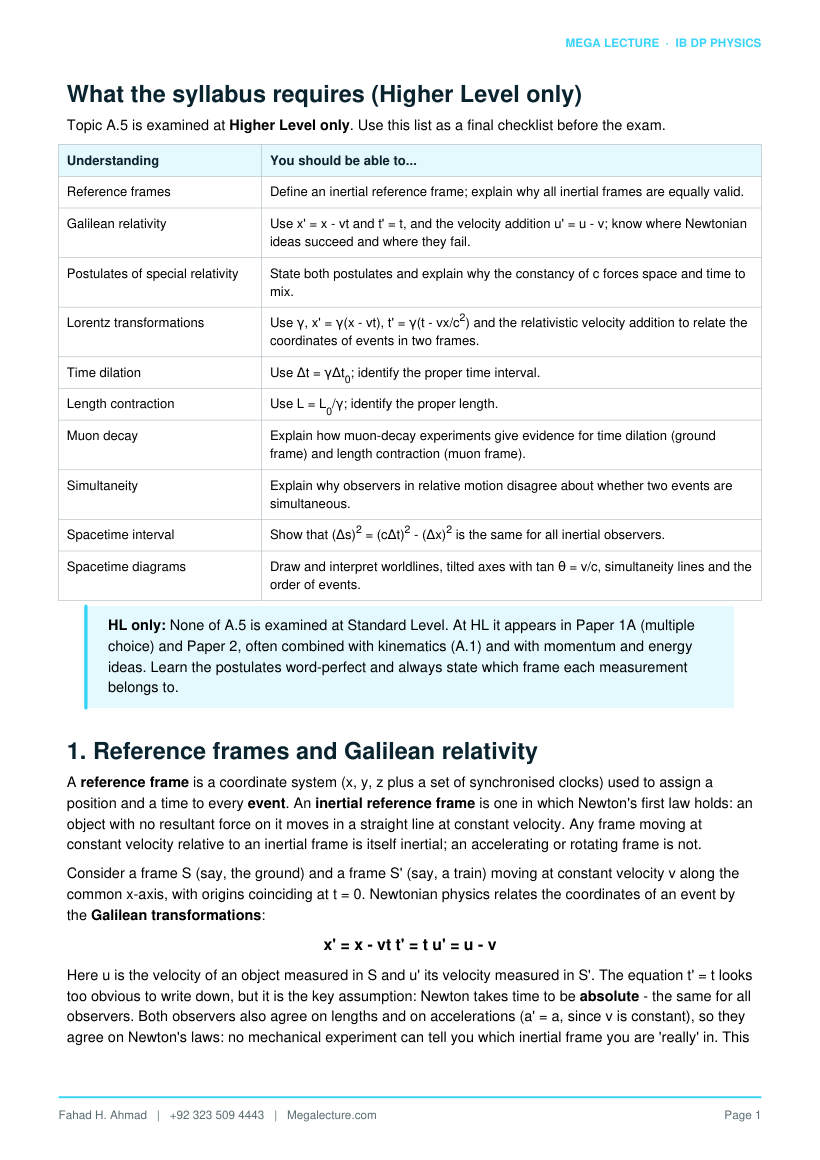
What the syllabus requires (Higher Level only)
Topic A.5 is examined at Higher Level only. Use this list as a final checklist before the exam.
Understanding You should be able to...
Reference frames Define an inertial reference frame; explain why all inertial frames are equally valid.
Galilean relativity Use x' = x - vt and t' = t, and the velocity addition u' = u - v; know where Newtonian ideas succeed and where they fail.
Postulates of special relativity State both postulates and explain why the constancy of c forces space and time to mix.
Lorentz transformations Use γ, x' = γ(x - vt), t' = γ(t - vx/c2) and the relativistic velocity addition to relate the coordinates of events in two frames.
Time dilation Use Δt = γΔt0; identify the proper time interval.
Length contraction Use L = L0/γ; identify the proper length.
Muon decay Explain how muon-decay experiments give evidence for time dilation (ground frame) and length contraction (muon frame).
Simultaneity Explain why observers in relative motion disagree about whether two events are simultaneous.
Spacetime interval Show that (Δs)2 = (cΔt)2 - (Δx)2 is the same for all inertial observers.
Spacetime diagrams Draw and interpret worldlines, tilted axes with tan θ = v/c, simultaneity lines and the order of events.
HL only: None of A.5 is examined at Standard Level. At HL it appears in Paper 1A (multiple choice) and Paper 2, often combined with kinematics (A.1) and with momentum and energy ideas. Learn the postulates word-perfect and always state which frame each measurement belongs to.
1. Reference frames and Galilean relativity
A reference frame is a coordinate system (x, y, z plus a set of synchronised clocks) used to assign a position and a time to every event. An inertial reference frame is one in which Newton's first law holds: an object with no resultant force on it moves in a straight line at constant velocity. Any frame moving at constant velocity relative to an inertial frame is itself inertial; an accelerating or rotating frame is not.
Consider a frame S (say, the ground) and a frame S' (say, a train) moving at constant velocity v along the common x-axis, with origins coinciding at t = 0. Newtonian physics relates the coordinates of an event by the Galilean transformations:
x' = x - vt t' = t u' = u - v
Here u is the velocity of an object measured in S and u' its velocity measured in S'. The equation t' = t looks too obvious to write down, but it is the key assumption: Newton takes time to be absolute - the same for all observers. Both observers also agree on lengths and on accelerations (a' = a, since v is constant), so they agree on Newton's laws: no mechanical experiment can tell you which inertial frame you are 'really' in. This is the principle of Galilean relativity.
Worked example 1 - Galilean velocity addition
A train travels at 30 m s-1 relative to the ground. A passenger throws a ball at 15 m s-1 relative to the train (a) towards the front, (b) towards the rear. Find the ball's velocity relative to the ground.
Take the direction of travel as positive. The ground velocity is u = u' + v.
- u = +15 + 30 = +45 m s-1.
- u = -15 + 30 = +15 m s-1 - still forwards, at half the train's speed.
Where Galilean physics succeeds - and where it fails
For everyday speeds (v much less than c) the Galilean rules are superbly accurate, and you should still use them for cars, aircraft and planets. The trouble begins with light. Maxwell's theory of electromagnetism (1865) predicts that light in a vacuum travels at c = 3.00 × 10⁸ m s-1 with no reference to any particular frame. Under Galilean rules an observer chasing a light beam at speed v should measure it moving at c - v, so light's speed should depend on the observer - but every experiment (most famously the Michelson-Morley experiment, 1887, which searched for the Earth's motion through a supposed 'ether') finds exactly c, in every direction, in every inertial frame. Galilean velocity addition therefore cannot be exactly right.
Exam note: A favourite short question: 'State the assumption about time made in Galilean relativity.' Answer: the time interval between two events is the same for all observers (time is absolute, t' = t).
2. The two postulates of special relativity
Einstein (1905) resolved the conflict by keeping the relativity principle and promoting the constancy of c to a law of nature. Learn both postulates word-perfect:
- Postulate 1: The laws of physics are the same in all inertial reference frames.
- Postulate 2: The speed of light in a vacuum is the same (c) for all inertial observers, regardless of the motion of the source or the observer.
Why constancy of c forces new kinematics
Speed is distance divided by time. If two observers in relative motion must both measure the same beam of light to travel at c, they cannot both be using the same distances and the same times. Something Galilean has to give, and it is the absolute nature of space and time: moving clocks run slowly (time dilation), moving objects are shortened along their motion (length contraction), and observers disagree about whether separated events are simultaneous. None of these are optical illusions or clock defects - they are properties of space and time themselves, and each has been confirmed experimentally (muon decay, particle-accelerator lifetimes, GPS clock corrections).
Common pitfall: Postulate 2 is about the speed of light in a vacuum as measured by inertial observers. Do not write 'nothing can travel faster than light' as a postulate - that is a consequence, not a postulate.
Galilean vs Einsteinian relativity at a glance
Question Galilean (Newtonian) answer Special relativity answer
Is time the same for everyone?
Yes - t' = t, time is absolute. No - Δt = γΔt0; moving clocks run slow.
Do observers agree on lengths?
Yes. No - lengths along the motion contract: L = L0/γ.
Do observers agree on simultaneity?
Yes, always. Only for events at the same place.
How do velocities add? u' = u - v u' = (u - v)/(1 - uv/c2)
Speed of light Depends on the observer (c - v etc.). Exactly c for every inertial observer.
What is invariant? Time intervals, lengths, accelerations. c, proper time, proper length, the interval (Δs)2.
When is it valid? Excellent approximation for v much less than c.
All speeds; reduces to Galilean results at low speed.
3. The Lorentz factor and the Lorentz transformations
Every result in special relativity is controlled by the Lorentz factor:
γ = 1 / (1 - v2/c2)1/2 (often written using β = v/c: γ = 1 / (1 - β2)1/2)
γ is never less than 1. At everyday speeds γ ≈ 1 and relativity hides inside Galilean physics; as v approaches c, γ grows without limit. This is why c is an unreachable speed limit for matter.
v/c 0.100 0.500 0.600 0.800 0.900 0.950 0.980 0.990 0.999
γ 1.005 1.155 1.250 1.667 2.294 3.203 5.025 7.089 22.4
Calculator habit: Work out γ once, write it down to 4 significant figures, and reuse it. The speeds 0.6c (γ = 1.25) and 0.8c (γ = 5/3) give exact fractions and appear constantly in exams.
Figure 1. The Lorentz factor γ = 1/√(1 - v2/c2) against v/c. It equals 1 at everyday speeds and diverges as v → c: γ ≈ 1.155,
1.667 and 7.089 at v/c = 0.5, 0.8 and 0.99.
The Lorentz transformations
An event is something that happens at one point in space at one instant: it has coordinates (x, t) in frame S and (x', t') in frame S'. With the standard set-up (S' moving at +v along x, origins coinciding at t = t' = 0), the Galilean rules are replaced by the Lorentz transformations:
x' = γ(x - vt) t' = γ(t - vx/c2)
Notice that t' now depends on position as well as time - space and time mix. The same equations with Δx and Δt relate the separations between two events. For v much less than c, γ tends to 1 and vx/c2 tends to 0, and the Galilean equations reappear - exactly as required.
Worked example 2 - transforming an event
Frame S' (a rocket) moves at v = 0.600c along the x-axis of frame S (Earth). An event has coordinates x = 300 m, t = 1.00 μs in S. Find its coordinates in S'.
Step 1: γ = 1/(1 - 0.6002)1/2 = 1/(0.640)1/2 = 1.25; v = 0.600 × 3.00 × 108 = 1.80 × 10⁸ m s-1.
Step 2: x' = γ(x - vt) = 1.25 × (300 - 1.80 × 108 × 1.00 × 10-6) = 1.25 × (300 - 180) = 150 m.
Step 3: vx/c2 = (1.80 × 108 × 300)/(9.00 × 1016) = 0.600 μs, so t' = 1.25 × (1.00 - 0.600) μs = 0.500 μs.
Keep the result - we reuse this event in Section 7 to test the invariant interval.
Relativistic velocity addition
If an object moves at velocity u along x as measured in S, its velocity in S' is
u' = (u - v) / (1 - uv/c2)
The Galilean numerator survives, but the new denominator stops speeds from ever combining to exceed c. Check the two limits: for small speeds the denominator is essentially 1 (Galilean result); and if u = c, then u' = (c - v)/(1 - v/c) = c - light has the same speed in both frames, exactly as Postulate 2 demands.
Worked example 3 - two ships approaching
Two spacecraft approach each other head-on, each moving at 0.700c relative to Earth. Find the speed of one craft as measured by the other.
Let S be Earth and let S' ride with craft A, so v = +0.700c. Craft B has u = -0.700c in S.
u' = (u - v)/(1 - uv/c2) = (-0.700c - 0.700c)/(1 - (-0.700)(0.700)) = -1.40c / 1.49 = -0.940c.
Each pilot measures the other approaching at 0.940c - not 1.40c. Speeds of material objects never combine to reach c.
4. Time dilation and proper time
The proper time interval Δt0 between two events is the time measured in the frame in which the two events happen at the same place - equivalently, the time read by a single clock that is present at both events. Any other inertial observer, for whom the events happen at different places, measures a longer interval:
Δt = γ Δt0
This is time dilation: 'moving clocks run slow'. It is symmetric - each observer sees the other's clocks running slowly - and this is consistent because the two observers are comparing different pairs of events, using clocks synchronised in different ways (Section 6).
Worked example 4 - the slow spacecraft clock
A spacecraft travels at 0.600c relative to Earth. The pilot's clock records 60.0 min between two ticks of an on-board experiment (both ticks happen at the spacecraft). How much time passes on Earth clocks between the two ticks?
Both events occur at the same place in the spacecraft frame, so Δt0 = 60.0 min is the proper time.
Δt = γΔt0 = 1.25 × 60.0 = 75.0 min.
Check the logic, not just the formula: the observer for whom the two events are at the same place always measures the shortest time between them.
Figure 2. A light clock. In its rest frame S0 the pulse bounces vertically over 2L, giving proper time Δt0 = 2L/c. In a frame where the clock moves at v the pulse traces a longer diagonal, so Δt = γΔt0. For L = 1 m at v = 0.8c: Δt0 ≈ 6.67 ns and Δt ≈
11.12 ns.
Experimental evidence: muon decay
Muons are unstable particles (mean lifetime τ = 2.2 μs in their rest frame) created by cosmic rays about 10 km up in the atmosphere and travelling towards the ground at speeds around 0.98c. Classically almost none should survive the trip - yet detectors at sea level count large numbers of them. This is a direct, quantitative test of relativity, and the exam expects you to tell the story from both frames.
Worked example 5 - muons from both frames
Muons are created 10.0 km above the ground, moving straight down at 0.980c (γ = 5.03). Their mean lifetime at rest is 2.2 μs. Estimate the fraction reaching the ground (a) classically, (b) using the ground frame, (c) using the muon frame.
- Classical (wrong) prediction. Journey time t = 1.00 × 10⁴ / (0.980 × 3.00 × 108) = 34.0 μs, which is 34.0/2.2 ≈ 15.5 lifetimes. Surviving fraction ≈ e-15.5 ≈ 2 × 10⁻⁷ - effectively none.
- Ground frame: time dilation. The muon's internal clock runs slow by γ = 5.03, so its lifetime observed from the ground is 5.03 × 2.2 = 11.1 μs. The 34.0 μs journey is then only 34.0/11.1 ≈ 3.1 lifetimes: fraction ≈ e-3.1 ≈ 0.05, i.e. about 5% survive.
- Muon frame: length contraction. The muon is at rest; the atmosphere rushes past at 0.980c, and its 10.0 km depth is contracted to L = L0/γ = 10.0/5.03 = 1.99 km. Journey time = 1.99 × 10³ / (2.94 × 10⁸) = 6.8 μs ≈ 3.1 lifetimes - the same 5% survive.
The two frames disagree about why (slow clock vs short atmosphere) but agree on the observable: how many muons arrive. That agreement is the whole point.
Exam technique: To identify the proper time, ask: 'in which frame do the two events happen at the same place?' The muon's creation and decay both happen at the muon, so the 2.2 μs lifetime is a proper time and every other observer measures a longer one.
5. Length contraction and proper length
The proper length L0 of an object (or of the distance between two fixed points) is its length measured in the frame in which it is at rest. An observer moving parallel to that length at speed v measures it shorter:
L = L0 / γ
Only lengths along the direction of relative motion contract; transverse dimensions are unchanged. Measuring a moving object's length means locating both ends at the same instant in your frame - which is precisely where simultaneity (Section 6) sneaks into the physics.
Figure 3. Length contraction L = L0/γ, along the direction of motion only. At v = 0.8c, γ = 1.667, so a proper length L0 is measured as L = 0.60 L0.
Worked example 6 - a contracted spacecraft
A spacecraft has proper length 100 m. It flies past a space station at 0.800c. (a) What length does the station measure? (b) The station has proper diameter 480 m; what diameter does the pilot measure along the flight direction?
- γ = 1/(1 - 0.8002)1/2 = 1/0.600 = 1.667 (= 5/3). L = 100/1.667 = 60.0 m.
- Contraction is symmetric - each measures the other's lengths contracted: L = 480/1.667 = 288 m.
Consistency check (muons again): Ground observers use a dilated lifetime with the full 10 km; the muon uses its ordinary 2.2 μs lifetime with a contracted 2 km. Time dilation in one frame and length contraction in the other are two descriptions of the same fact - never apply both corrections in the same frame.
Worked example 8 - a journey told in two frames
A spacecraft travels at 0.600c from Earth to a space station a distance 6.00 × 10¹¹ m away (measured in the Earth frame, in which the station is at rest). Find the journey time (a) for Earth observers, (b) for the pilot, and (c) show that the pilot's own account of the trip is self-consistent.
- Earth frame: t = d/v = 6.00 × 10¹¹ / (0.600 × 3.00 × 108) = 6.00 × 10¹¹ / 1.80 × 108 = 3330 s.
- Departure and arrival both happen at the spacecraft, so the pilot measures the proper time: Δt0 = Δt/γ = 3330/1.25 = 2670 s.
- Pilot's account: the Earth-station distance is a proper length of the Earth frame, so the pilot measures it contracted to L = 6.00 × 10¹¹/1.25 = 4.80 × 10¹¹ m, covered at 0.600c in 4.80 × 10¹¹ / 1.80 × 108 = 2670 s - the same answer. One frame uses time dilation, the other length contraction; both describe the same physics.
6. The relativity of simultaneity
Two events are simultaneous in a frame if they occur at the same time in that frame. Relativity's most counter-intuitive claim is that simultaneity is frame-dependent: events simultaneous in one frame are generally not simultaneous in another, unless they happen at the same point.
The lightning-and-train argument
Two lightning bolts strike the front and rear of a fast-moving train, leaving scorch marks on both train and track. Observer G stands on the platform exactly midway between the marks on the track; observer T sits at the exact middle of the train. Suppose the two flashes reach G at the same instant. Since the flashes travelled equal distances at the same speed c, G concludes the strikes were simultaneous in the ground frame.
Now follow the light in the ground frame as it travels towards T. The train carries T towards the flash from the front and away from the flash from the rear, so the front flash reaches T first. But in T's own frame, T is midway between the strike points on the train and light travels at c in both directions (Postulate 2) - so T is forced to conclude that the front bolt struck first. Neither observer is wrong; simultaneity is simply not absolute.
The leading-clocks rule (qualitative)
Take a row of clocks carefully synchronised in their own rest frame and moving past you at speed v. You will find them out of step with each other: the clock at the front (leading) end shows the earlier reading - 'the leading clock lags'. Quantitatively the offset is v L0/c2 for clocks a proper distance L0 apart, which is exactly the vx/c2 term in the Lorentz transformation for time. This rule is what makes time dilation mutually consistent for both observers.
Exam technique: In 'explain' questions on simultaneity, the marks are for: (1) both flashes travel at c in every frame (Postulate 2); (2) the moving observer moves towards one flash and away from the other; (3) equal distances + equal speed but unequal arrival times force unequal emission times in that frame. Never say the light 'goes faster' towards one observer.
7. Invariant quantities and the spacetime interval
Observers disagree about lengths, times and simultaneity - so what can they agree on? A quantity with the same value in all inertial frames is called an invariant. The invariants you must know:
- the speed of light in vacuum, c;
- the proper time interval Δt0 between two events and the proper length L0 of an object (all observers agree on what the rest-frame value is);
- the spacetime interval between two events:
(Δs)2 = (cΔt)2 - (Δx)2 = (cΔt')2 - (Δx')2
Time separations and space separations each change from frame to frame, but this particular combination does not - it plays the role that distance plays in ordinary geometry. Its sign classifies the relationship between two events:
Sign of (Δs)2 Name Physical meaning positive time-like A signal slower than light can link the events; they can be cause and effect. A frame exists where they happen at the same place, and there Δs/c is the proper time between them.
zero light-like Only light can link the events (Δx = cΔt).
negative space-like Nothing can link the events - no causal connection possible. A frame exists where they are simultaneous; the order of the events can differ between frames.
Worked example 7 - checking invariance
In frame S two events are separated by Δx = 900 m and Δt = 5.00 μs. Frame S' moves at 0.600c (γ = 1.25). Verify that the interval is invariant and interpret it.
In S: cΔt = 3.00 × 108 × 5.00 × 10-6 = 1500 m, so (Δs)2 = 15002 - 9002 = 2.25 × 10⁶ - 8.1 × 105 = 1.44 × 10⁶ m2.
Transform: Δx' = γ(Δx - vΔt) = 1.25 × (900 - 1.80 × 108 × 5.00 × 10-6) = 1.25 × (900 - 900) = 0.
Δt' = γ(Δt - vΔx/c2) = 1.25 × (5.00 - 1.80) μs = 4.00 μs, so cΔt' = 1200 m.
In S': (Δs)2 = 12002 - 02 = 1.44 × 10⁶ m2. Same value - invariant confirmed.
Interpretation: the interval is time-like, and S' is the frame where both events happen at the same place, so the proper time is Δt0 = Δs/c = 1200/(3.00 × 108) = 4.00 μs. Consistency check: Δt = γΔt0 = 1.25 × 4.00 = 5.00 μs.
The event of Worked example 2 (x = 300 m, t = 1.00 μs, taking the origin event as the second event) gives 3002 - 3002 = 0 in S and 1502 - 1502 = 0 in S': light-like in both frames.
8. Spacetime diagrams
A spacetime diagram plots position x horizontally and ct vertically (using ct rather than t gives both axes the unit of metres, so light travels along lines at 45°). A point on the diagram is an event; the history of an object is a continuous line of events called its worldline.
- An object at rest has a vertical worldline (x constant, time passing).
- Constant velocity gives a straight worldline with gradient c/v; the faster the object, the closer its worldline leans towards the 45° light line. Worldlines of massive objects are always steeper than 45°.
- Acceleration gives a curved worldline.
Adding a second observer: tilted axes
The axes of a frame S' moving at velocity v are drawn on the same diagram as follows. The ct' axis is the worldline of the S' origin (the line x = vt), and the x' axis is the set of events with t' = 0. Both are tilted from the unprimed axes towards the light line by the same angle θ, where tan θ = v/c
As v approaches c both axes close scissor-like onto the 45° light line. All events on a line parallel to the x' axis are simultaneous in S' (they share one value of t'), just as horizontal lines link events simultaneous in S.
x ct light: x = ct object at rest in S x' ct'
θ
θ
E events simultaneous with E in S'
Spacetime diagram for frames S (dark axes) and S' moving at v = 0.5c (blue axes, tilted by θ where tan θ = 0.5). The dashed blue line through event E is parallel to the x' axis: every event on it is simultaneous with E according to S', but they occur at different times according to S.
Reading simultaneity and event order
To find which events are simultaneous with a given event, draw a line through it parallel to the relevant space axis (horizontal for S, tilted for S'). Because the two sets of simultaneity lines are not parallel, two events simultaneous in S generally lie on different S' simultaneity lines - simultaneity is relative, now visible as pure geometry. For two events with space-like separation, even their time order can differ between frames; for time-like separated events the order is the same for all observers, so causality is protected.
Light cones (qualitative)
The two 45° light lines through an event divide spacetime into: the future light cone (events the given event can influence), the past light cone (events that can have influenced it), and the region outside the cone (space-like separated events - no causal contact possible, since influence would have to travel faster than light). All observers agree on which region an event lies in, because the light cone itself is built from invariant 45° light lines.
Exam technique: When drawing primed axes, tilt both axes towards the light line by equal angles (a common error is tilting only the ct' axis). Label the angle and quote tan θ = v/c.
9. Common pitfalls
- Mixing frames. Every distance, time and velocity belongs to a stated frame. Write 'in the Earth frame...' / 'in the muon frame...' at the start of each step.
- Misidentifying proper time. Δt0 is measured by the observer for whom both events are at the same place - not 'the stationary observer'. Using a dilated time as a proper time (or dividing when you should multiply) is the single most common A.5 error.
- Misidentifying proper length. L0 belongs to the frame in which the object (or separation) is at rest - for the atmosphere that is the ground frame, not the muon frame.
- Double-correcting. In any single frame you use either time dilation or length contraction for a given effect - never both together.
- Adding speeds Galilean-style near c. If two speeds are relativistic, use u' = (u - v)/(1 - uv/c2); answers above c are always wrong.
- Contracting the wrong dimension. Only lengths parallel to the relative velocity contract.
- Treating relativity as an illusion. Muon detection rates, GPS corrections and accelerator lifetimes are real, measured effects.
- Sloppy γ arithmetic. Square v/c first, subtract from 1, square-root, then take the reciprocal - and keep 4 significant figures until the final answer.
10. Quick reference
Result Statement
Inertial frame Frame in which Newton's first law holds; all inertial frames are equivalent.
Galilean transformation x' = x - vt; t' = t; u' = u - v (valid only for v much less than c)
Postulates
- Laws of physics the same in all inertial frames. 2. Speed of light in vacuum is c for all inertial observers.
Lorentz factor γ = 1/(1 - v2/c2)1/2; always at least 1; unbounded as v approaches c.
Lorentz transformations x' = γ(x - vt); t' = γ(t - vx/c2)
Velocity addition u' = (u - v)/(1 - uv/c2)
Time dilation Δt = γΔt0; proper time Δt0 measured where the two events are at the same place.
Length contraction L = L0/γ; proper length L0 measured in the object's rest frame; only along the motion.
Simultaneity Frame-dependent for spatially separated events; the leading clock lags.
Spacetime interval (Δs)2 = (cΔt)2 - (Δx)2: invariant. Positive = time-like, zero = light-like, negative = space-like.
Result Statement
Spacetime diagram Worldlines steeper than 45°; primed axes tilted towards the light line with tan θ = v/c; lines parallel to x' link events simultaneous in S'.
11. Test yourself
Attempt these without notes; full solutions follow. Take c = 3.00 × 10⁸ m s-1.
- A boat sails at 8.0 m s-1 relative to a river which flows at 3.0 m s-1. Using Galilean relativity, find the boat's speed relative to the bank when heading (a) downstream, (b) upstream, and state the assumption about time being made.
- Calculate γ for v = 0.800c. A charged pion has proper mean lifetime 2.6 × 10⁻⁸ s. Find its mean lifetime in the laboratory when moving at 0.800c, and the mean distance it travels before decaying.
- A spacecraft passes Earth at 0.900c. The crew watch a film lasting 10.0 min of on-board time. How long does the film take according to Earth observers?
- A tunnel has proper length 1.20 km. Find its length as measured by the pilot of a craft flying through it at 0.950c.
- A mothership moving at 0.800c relative to Earth launches a probe forwards at 0.600c relative to itself. Find the probe's speed relative to Earth.
- Frame S' moves at 0.800c along the x-axis of frame S. An event occurs at x = 600 m, t = 2.00 μs in S. Find x' and t'.
- Two events are separated by Δx = 600 m and Δt = 1.00 μs in frame S. (a) Evaluate the spacetime interval. (b) Can one event have caused the other? (c) Is there a frame in which they are simultaneous? At the same place?
- Muons travel at 0.995c (γ = 10.0) towards the ground from an altitude of 15.0 km (ground-frame value). Find the journey time in the ground frame, the journey time in the muon frame, and the atmosphere thickness in the muon frame.
- Lightning strikes both ends of a moving train, and the strikes are simultaneous in the ground frame. Explain, using Einstein's second postulate, which strike occurs first in the train frame.
- On a spacetime diagram for frame S, the axes of frame S' (speed 0.600c) are drawn. (a) Find the angle between the x and x' axes. (b) State which events are simultaneous in S' and explain why event order can differ between frames for space-like separated events only.
Answers
- (a) u = 8.0 + 3.0 = 11.0 m s-1. (b) u = 8.0 - 3.0 = 5.0 m s-1. Assumption: time is absolute - all observers measure the same time interval between events (t' = t).
- γ = 1/(1 - 0.64)1/2 = 1/0.600 = 1.667. Lab lifetime = γ × 2.6 × 10-8 = 4.3 × 10⁻⁸ s. Distance = 0.800 × 3.00 × 108 × 4.33 × 10-8 = 10.4 m (classically only 6.2 m - accelerator experiments confirm the longer value).
- The film runs at one place in the ship, so 10.0 min is proper time. γ = 1/(1 - 0.81)1/2 = 2.294. Δt = 2.294 × 10.0 = 22.9 min.
- The tunnel is at rest in the ground frame, so L0 = 1.20 km. γ = 1/(1 - 0.9025)1/2 = 3.203. L = 1200/3.203 = 375 m.
- Take S' as the mothership (v = 0.800c), u' = 0.600c; invert the addition formula: u = (u' + v)/(1 + u'v/c2) = (0.600c + 0.800c)/(1 + 0.480) = 1.40c/1.48 = 0.946c (not 1.40c).
- γ = 1.667, v = 2.40 × 10⁸ m s-1. x' = 1.667 × (600 - 2.40 × 108 × 2.00 × 10-6) = 1.667 × (600 - 480) = 200
- vx/c2 = (2.40 × 108 × 600)/(9.00 × 1016) = 1.60 μs, so t' = 1.667 × (2.00 - 1.60) μs = 0.667 μs.
- (a) cΔt = 300 m, so (Δs)2 = 3002 - 6002 = -2.7 × 10⁵ m2 (space-like). (b) No - a causal signal would need to travel 600 m in 1.00 μs, i.e. at 2c. (c) Simultaneous in some frame: yes (space-like). Same place in some frame: no - that would require a time-like interval.
- Ground frame: t = 1.50 × 10⁴ / (0.995 × 3.00 × 108) = 50.3 μs. Muon frame (proper time): 50.3/10.0 = 5.03 μs. Atmosphere thickness: 15.0/10.0 = 1.50 km. Check: 1.50 × 10³/(2.985 × 108) = 5.03 μs - consistent.
- Both flashes travel at c in the ground frame. The train observer at the midpoint moves towards the front flash and away from the rear flash, so the front flash arrives first. In the train frame that observer is midway between the strike marks and light also travels at c both ways (Postulate 2); unequal arrival times therefore mean the front strike happened first in the train frame.
- (a) tan θ = v/c = 0.600, so θ = 31.0° (the ct' axis makes the same angle with the ct axis). (b) Events on any line parallel to the x' axis share the same t'. For space-like separated events the simultaneity lines of different frames can cut the pair in either order, so their time order is frame-dependent; time-like separated events lie inside the light cone, where every frame agrees on the order - causality is preserved.
