
IB Diploma · Physics · SL / HL · Theme A: Space, Time and Motion
A.3 Work, Energy and Power
Opens inside this page. Prefer your own PDF app? Open the PDF.
Full text of A.3 Work, Energy and Power
IB DP PHYSICS Theme A: Space, Time and Motion A.3 Work, Energy and Power
Revision Notes · Standard and Higher Level Fahad H. Ahmad
+92 323 509 4443 | Megalecture.com
Original notes prepared for the IB Diploma Programme Physics course (first assessment 2025)
What the syllabus requires
By the end of A.3 you should be able to work confidently with each of the following. Use this list as a final checklist before the exam.
Understanding You should be able to...
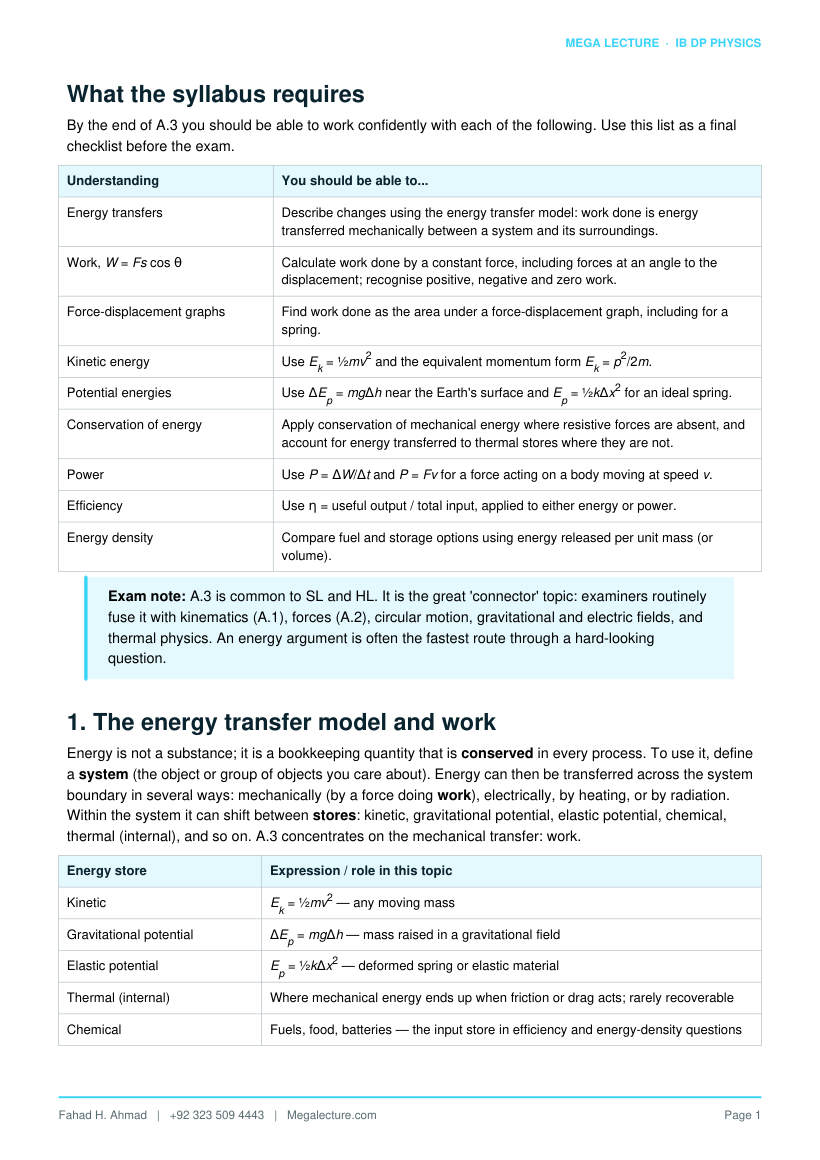
Energy transfers Describe changes using the energy transfer model: work done is energy transferred mechanically between a system and its surroundings.
Work, W = Fs cos θ Calculate work done by a constant force, including forces at an angle to the displacement; recognise positive, negative and zero work.
Force-displacement graphs Find work done as the area under a force-displacement graph, including for a spring.
Kinetic energy Use Ek = ½mv2 and the equivalent momentum form Ek = p2/2m.
Potential energies Use ΔEp = mgΔh near the Earth's surface and Ep = ½kΔx2 for an ideal spring.
Conservation of energy Apply conservation of mechanical energy where resistive forces are absent, and account for energy transferred to thermal stores where they are not.
Power Use P = ΔW/Δt and P = Fv for a force acting on a body moving at speed v.
Efficiency Use η = useful output / total input, applied to either energy or power.
Energy density Compare fuel and storage options using energy released per unit mass (or volume).
Exam note: A.3 is common to SL and HL. It is the great 'connector' topic: examiners routinely fuse it with kinematics (A.1), forces (A.2), circular motion, gravitational and electric fields, and thermal physics. An energy argument is often the fastest route through a hard-looking question.
1. The energy transfer model and work
Energy is not a substance; it is a bookkeeping quantity that is conserved in every process. To use it, define a system (the object or group of objects you care about). Energy can then be transferred across the system boundary in several ways: mechanically (by a force doing work), electrically, by heating, or by radiation. Within the system it can shift between stores: kinetic, gravitational potential, elastic potential, chemical, thermal (internal), and so on. A.3 concentrates on the mechanical transfer: work.
Energy store Expression / role in this topic
Kinetic Ek = ½mv2 — any moving mass
Gravitational potential ΔEp = mgΔh — mass raised in a gravitational field
Elastic potential Ep = ½kΔx2 — deformed spring or elastic material
Thermal (internal) Where mechanical energy ends up when friction or drag acts; rarely recoverable
Chemical Fuels, food, batteries — the input store in efficiency and energy-density questions
A tidy exam answer names the store energy leaves, the store it enters, and the mechanism of transfer (mechanically by a force doing work, electrically, by heating, or by radiation).
Work done by a constant force
When a constant force F acts on a body that undergoes displacement s, the work done by that force is
W = Fs cos θ where θ is the angle between the force and the displacement. Work is a scalar measured in joules (1 J = 1 N m); only the component of the force along the motion, F cos θ, transfers energy.
Figure 1. Work done by a force at angle θ to the displacement: only the component F cosθ along the motion transfers energy, so W = Fd cosθ. With F = 60 N, d = 25 m and θ = 30°, W = 60 · 25 · cos 30° ≈ 1299 J.
Case Angle θ Sign of work Physical meaning
Force along motion 0° (cos θ = 1) Positive Energy transferred to the body (e.g. engine thrust)
Force opposing motion 180° (cos θ = -1) Negative Energy transferred from the body (e.g. friction, drag)
Force perpendicular to motion
90° (cos θ = 0) Zero No energy transfer (e.g. normal force, tension in a circular path, gravity on a horizontal move)
Work from a force-displacement graph
If the force varies, W = Fs cos θ cannot be used directly. Instead, plot the force component along the motion against displacement: the work done is the area under the force-displacement graph. For a constant force the area is a rectangle; for a spring obeying Hooke's law it is a triangle; for any other curve, count squares or estimate the area.
Figure 2. Work done stretching an ideal spring equals the area under the force−displacement graph, 1/2 k x2. With k = 200 N m-1 and x = 0.15 m, the applied force rises linearly to F = kx = 30 N and the stored/transferred energy is 2.25 J.
Common misconception: Holding a heavy suitcase stationary, or carrying it horizontally at constant velocity, involves zero work on the suitcase by the lifting force: there is either no displacement, or the force is perpendicular to the displacement. You feel tired for biological reasons, not because mechanical work is done on the case.
Worked example 1 — sled pulled at an angle
A 40 kg sled is pulled 25 m across level snow by a rope with tension 60 N at 30° above the horizontal. A constant friction force of 12 N acts on the sled, which starts from rest. Find (a) the work done by the tension, (b) the work done by friction, (c) the net work on the sled, and (d) its final speed.
- W = Fs cos θ = 60 × 25 × cos 30° = 1.3 × 10³ J (1299 J).
- Friction acts at 180° to the motion: W = -12 × 25 = -300 J. The weight and the normal force are perpendicular to the motion and do no work.
- Net work = 1299 - 300 = 1.0 × 10³ J (999 J).
- By the work-energy theorem (Section 6), 999 = ½ × 40 × v2, so v = (2 × 999 / 40)1/2 = 7.1 m s-1.
Worked example 2 — work from a force-displacement graph
The driving force on a 5.0 kg trolley, initially at rest on a frictionless track, is constant at 50 N for the first 4.0 m of displacement and then decreases linearly to zero over the next 6.0 m. Use the force-displacement graph to find (a) the total work done, (b) the trolley's final speed.
- Work = area under the graph = rectangle + triangle = (50 × 4.0) + (½ × 6.0 × 50) = 200 + 150 = 350 J.
- All of this becomes kinetic energy: 350 = ½ × 5.0 × v2, so v = (2 × 350 / 5.0)1/2 = (140)1/2 = 12 m s-1 (11.8).
W = Fs cos θ would be wrong here — the force is not constant. The area method always works.
2. Kinetic energy
A body of mass m moving at speed v stores kinetic energy
Ek = ½mv2
Kinetic energy is a scalar and can never be negative. Because it depends on v2, doubling the speed quadruples the kinetic energy — the physics behind the rapid growth of braking distances with speed.
The momentum form
Since momentum p = mv, we can eliminate v = p/m:
Ek = ½m(p/m)2 = p2 / 2m
Both forms are in the data booklet. Choose whichever matches the information given:
Situation Convenient form
Speed known or wanted Ek = ½mv2
Momentum known or wanted (e.g. after a collision analysed with conservation of momentum)
Ek = p2/2m
Comparing two bodies with the same momentum Ek = p2/2m: the lighter body has the larger Ek
Comparing two bodies with the same kinetic energy p = (2mEk)1/2: the heavier body has the larger momentum
Worked example 3 — linking energy and momentum
A 0.020 kg bullet travels at 350 m s-1. Find its momentum and its kinetic energy, and confirm the two forms agree.
p = mv = 0.020 × 350 = 7.0 kg m s-1.
Ek = ½mv2 = ½ × 0.020 × 3502 = 1.2 × 10³ J (1225 J).
Check: p2/2m = 7.02 / (2 × 0.020) = 49 / 0.040 = 1225 J.
3. Gravitational potential energy (near the surface)
When a body of mass m is raised through a height change Δh close to the Earth's surface (where g is effectively constant), the gravitational potential energy of the Earth-body system changes by
ΔEp = mgΔh
Three points matter for exams:
- Only changes in potential energy are physical. You are free to place the zero (reference) level anywhere convenient — usually the lowest point in the problem — and Ep may then be negative for positions below it.
- Δh is the vertical height change only. A block moved along a slope, a bead on a curved wire and a lift going straight up gain the same ΔEp if their vertical rises are equal: gravitational potential energy change is path-independent.
- The formula assumes constant g, so it is a near-surface approximation. For rockets and satellites, Theme D replaces it with the general gravitational potential energy.
ΔEp is the work done against gravity to raise the body at constant speed: force mg upward, displacement Δh upward, so W = mgΔh. Equally, gravity does -mgΔh of work on the way up and +mgΔh on the way back down.
Exam technique: Declare your reference level in the first line of an energy solution (“take Ep = 0 at the lowest point”). It costs three seconds and prevents almost every sign error.
4. Elastic potential energy
An ideal spring stretched or compressed by Δx from its natural length obeys Hooke's law, FH = -kΔx, where k (N m-1) is the spring constant and the minus sign shows the force is restoring. The force you must apply to deform it grows linearly from 0 to kΔx, so the force-extension graph is a straight line through the origin and the stored energy is the triangular area beneath it:
Ep = ½ × base × height = ½ × Δx × kΔx = ½kΔx2
- The energy depends on Δx2: doubling the extension stores four times the energy.
- Extension and compression of an ideal spring store the same energy for the same |Δx|.
- Δx is measured from the natural length, never from another stretched position. The energy stored between extensions x1 and x2 is ½k(x2
2 - x1 2), which is not ½k(x2 - x1)2.
Worked example 4 — spring launcher
A toy launcher uses a spring of constant k = 200 N m-1 compressed by 0.15 m to fire a 0.050 kg ball. Ignoring friction, find (a) the energy stored, (b) the launch speed, (c) the maximum height if the ball is fired vertically.
- Ep = ½kΔx2 = ½ × 200 × 0.152 = 2.25 J (2.3 J).
- All the elastic energy becomes kinetic: 2.25 = ½ × 0.050 × v2, so v = (2 × 2.25 / 0.050)1/2 = (90)1/2 = 9.5 m s-1.
- All of it becomes gravitational potential energy: Δh = Ep / mg = 2.25 / (0.050 × 9.8) = 4.6 m above the launch point.
5. Conservation of mechanical energy
The mechanical energy of a system is the sum of its kinetic, gravitational potential and elastic potential energies. If the only forces doing work are gravity and ideal spring forces (no friction, no drag, no motor), mechanical energy is conserved:
Ek + Ep (gravitational) + Ep (elastic) = constant
Because gravitational potential energy change is path-independent, the speed gained in a frictionless descent depends only on the vertical drop — not on the shape of the track, the slope, or the route taken. This single idea solves pendulum, ramp, half-pipe and rollercoaster problems in one line.
Figure 3. Energy interchange for a 2 kg mass falling from h = 5 m (g = 9.8 m s-2): gravitational potential energy converts to kinetic energy as it falls, while the total mechanical energy stays constant at mgh = 98 J.
Worked example 5 — pendulum
A pendulum bob on a 2.0 m string is pulled aside until the string makes 60° with the vertical, then released from rest. Find its speed at the lowest point.
Height drop: Δh = L(1 - cos θ) = 2.0 × (1 - cos 60°) = 2.0 × 0.50 = 1.0 m.
Energy conservation: ½mv2 = mgΔh, so v = (2gΔh)1/2 = (2 × 9.8 × 1.0)1/2 = 4.4 m s-1. The mass cancels — the answer is the same for any bob.
Note the string tension does no work (it is always perpendicular to the motion), which is exactly why the energy method is legitimate here.
When friction is present
Resistive forces (friction, drag) do negative work and transfer mechanical energy to the thermal store of the surfaces and the air. Mechanical energy is then no longer conserved, but total energy still is. The working equation becomes:
initial mechanical energy = final mechanical energy + energy transferred to thermal stores and for a constant resistive force Ff acting over path length d (the actual distance along the track, not the displacement), the energy transferred thermally is Ffd.
Worked example 6 — ramp into a spring
A 1.5 kg block is released from rest at the top of a frictionless curved ramp of vertical height 1.25
- At the bottom it slides along a frictionless horizontal floor into a spring of constant k = 800 N m-1. Find (a) the speed at the bottom of the ramp, (b) the maximum compression of the spring, and (c) describe the subsequent motion.
- v = (2gΔh)1/2 = (2 × 9.8 × 1.25)1/2 = (24.5)1/2 = 4.9 m s-1. The curve of the ramp is irrelevant — only the vertical drop matters.
- At maximum compression the block is momentarily at rest, so all the energy is elastic: ½kΔx2 = mgΔh = 1.5 × 9.8 × 1.25 = 18.4 J, giving Δx = (2 × 18.4 / 800)1/2 = 0.21 m.
- The spring pushes the block back: elastic energy returns to kinetic, and with no friction anywhere the block leaves the spring at 4.9 m s-1 and rises back to exactly 1.25 m on the ramp. The motion repeats indefinitely.
Worked example 7 — rollercoaster with friction
A 500 kg rollercoaster car crests a hill at 2.0 m s-1 and descends 32 m vertically along a 60 m stretch of track, reaching the bottom at 23.0 m s-1. Find (a) the speed it would have if the track were frictionless, (b) the energy transferred to thermal stores, (c) the average resistive force.
- ½mv2 = ½mu2 + mgΔh: v2 = 2.02 + 2 × 9.8 × 32 = 631.2, so v = 25 m s-1 (25.1).
- Thermal energy = (½mu2 + mgΔh) - ½mv2 = ½ × 500 × (631.2 - 23.02) = 250 × 102.2 = 2.6 × 10⁴ J (25.6 kJ).
- Ff = 25 550 / 60 = 4.3 × 10² N. Note the 60 m track length is used here — friction acts along the path — while only the 32 m vertical drop appears in mgΔh.
Exam technique: “State the energy transfers” questions want store-to-store language: e.g. “gravitational potential energy decreases; most is transferred to kinetic energy and the remainder to the thermal store of the track and surroundings by friction.” Name the stores and the mechanism.
6. The work-energy theorem: energy or forces?
The net (resultant) work done on a body equals its change in kinetic energy:
Wnet = ΔEk = ½mv2 - ½mu2
Derivation (constant net force F along the motion): Wnet = Fs = mas. From kinematics, v2 = u2 + 2as, so as = (v2 - u2)/2. Substituting: Wnet = ½m(v2 - u2). The result in fact holds for varying forces and curved paths as well.
Choosing a method
Prefer an energy method when... Prefer forces + suvat when...
The path is curved or the slope varies (tracks, pendulums, half-pipes)
The question asks for time — energy equations contain no t; use suvat or impulse instead
You only need speeds at two positions, not the motion in between
The question asks for acceleration or an individual force at an instant
Forces vary in a complicated way but the net energy accounting is simple
Acceleration is constant and the geometry is a straight line, so suvat is quick
Several stores exchange energy (spring + gravity + friction)
You need direction information — energy is a scalar and carries none
Key idea: Energy methods trade detail for speed: they ignore everything about the journey except the start and end states. That is their power — and the reason they can never tell you the time taken.
7. Power
Power is the rate of energy transfer (or the rate of doing work):
P = ΔW / Δt measured in watts (1 W = 1 J s-1). A 60 W motor and a 600 W motor can lift the same crate to the same shelf — they transfer the same energy — but the larger motor does it ten times faster.
Power delivered by a force: P = Fv
For a force F acting on a body moving at speed v in the direction of the force:
P = ΔW / Δt = FΔs / Δt = Fv
With v the instantaneous speed this gives instantaneous power; with the average speed it gives average power (for constant F). If the force is at angle θ to the velocity, P = Fv cos θ.
The classic application: a vehicle travelling at constant speed has zero net force, so the driving force exactly balances the total resistive force. The engine's useful output power is then P = Fdrivev = Fresistv. Because drag grows roughly with v2, the power needed grows roughly with v3 — why high top speeds demand disproportionately large engines.
Worked example 8 — car on the flat and uphill
A 1200 kg car travels at a constant 30 m s-1 on a level road against total resistive forces of 620 N.
- Find the useful output power of the engine. (b) The car then climbs a hill of slope sin θ = 0.050 at the same constant speed with the same resistive forces. Find the new output power.
- Constant speed ⇒ driving force = 620 N. P = Fv = 620 × 30 = 1.9 × 10⁴ W (18.6 kW).
- Uphill the driving force must also balance the weight component along the slope: mg sin θ = 1200 × 9.8 × 0.050 = 588 N. Total force = 620 + 588 = 1208 N.
P = 1208 × 30 = 3.6 × 10⁴ W (36.2 kW) — nearly double, which is why cars slow on hills at fixed throttle.
Check via energy per second: the car gains height at v sin θ = 1.5 m s-1, so extra power = mg × 1.5 = 17.6 kW = 588 N × 30 m s-1.
Worked example 9 — climbing stairs
A 65 kg student runs up a flight of stairs of vertical height 4.2 m in 3.5 s. Estimate the student's useful power output.
Useful energy transferred = mgΔh = 65 × 9.8 × 4.2 = 2675 J.
P = ΔW/Δt = 2675 / 3.5 = 7.6 × 10² W — about one horsepower, sustainable only for seconds. This is an estimate: it ignores the kinetic energy gained and the (much larger) energy dissipated internally by muscles.
8. Efficiency
Every real machine transfers some input energy to useless stores — usually thermal, via friction and electrical heating. Efficiency measures the useful fraction:
η = useful energy output / total energy input = useful power output / total power input
η is dimensionless, lies between 0 and 1 (or 0% and 100%), and can be computed from energies or powers interchangeably because the times cancel. An efficiency above 1 would create energy and is impossible.
Energy accounting (Sankey reasoning)
A Sankey diagram is drawn as an arrow whose width represents power: the input enters on the left, the useful output continues to the right, and wasted transfers branch off, with total width conserved at every stage. In words, for a filament lamp taking 60 W of electrical power and emitting 3 W of visible light: 60 W in → 3 W useful light + 57 W to the thermal store of the surroundings, so η = 3/60 = 5%. For multi-stage systems, overall efficiency is the product of the stage efficiencies: a power station at 40% feeding a grid at 90% and a motor at 85% delivers overall η = 0.40 × 0.90 × 0.85 ≈ 0.31.
Worked example 10 — pump efficiency
An electric pump draws 2.5 kW from the mains and raises 15 kg of water per second through 12
- Find its efficiency.
Useful power = mgΔh per second = 15 × 9.8 × 12 = 1764 W.
η = 1764 / 2500 = 0.706 ≈ 0.71 (71%).
The remaining 0.74 kW is transferred to thermal stores in the motor windings, bearings and the water itself.
Exam technique: Always ask “useful for what?” — the question defines it. For a lamp, light is useful and heat is waste; for an electric heater, the ‘waste’ heat is the entire point and η ≈ 1.
9. Energy density of fuel sources
The energy density of a fuel is the energy released per unit mass (J kg-1); a per-unit-volume version (J m-3) is also used when storage space matters more than weight. It is the key figure of merit when energy must be carried: aircraft, cars, rockets, portable electronics.
Source Energy density (approx.)
Comment
Uranium-235 (fission) ~8 × 10¹³ J kg-1 About a million times any chemical fuel; tiny fuel mass, but heavy reactor and shielding
Hydrogen (chemical) ~1.4 × 10⁸ J kg-1 Highest of the chemical fuels per kg, but very low density: poor energy per unit volume unless compressed or liquefied
Petrol / diesel / kerosene ~4.5 × 10⁷ J kg-1 Excellent per kg and per litre; liquid at room temperature — why aviation still relies on kerosene
Coal ~3 × 10⁷ J kg-1 Solid; historically dominant for stationary power stations
Wood ~1.6 × 10⁷ J kg-1 Renewable but low density and low energy density
Source Energy density (approx.)
Comment
Lithium-ion battery ~9 × 10⁵ J kg-1 Roughly 50 times worse than petrol per kg — the central challenge of electric flight and long-range EVs
How to reason with it in an exam
- Mass of fuel needed = energy required / energy density. Remember to divide the useful energy by the machine's efficiency first to get the input energy the fuel must supply.
- For transport, high energy density means less fuel mass to carry, which itself reduces the energy needed — a compounding advantage (and, in reverse, the battery-mass spiral for electric aircraft).
- Energy density says nothing about cost, safety, emissions, or how fast the energy can be delivered (power) — comparisons should mention which criteria are being traded.
Worked example 11 — fuel for a journey
A car engine is 25% efficient and the car needs 0.45 MJ of useful mechanical energy per kilometre. Petrol has energy density 45 MJ kg-1. Find the mass of petrol used on a 100 km journey.
Input energy per km = 0.45 / 0.25 = 1.8 MJ. For 100 km: 180 MJ.
Mass = energy / energy density = 180 / 45 = 4.0 kg (roughly 5.4 litres).
10. Common pitfalls
- Using W = Fs when the force is at an angle — the cos θ factor is the most commonly dropped term in Paper 1.
- Treating work or energy as vectors. They are scalars: ‘negative work’ means energy leaves the body, not a direction.
- Using the track length in mgΔh (it needs the vertical height) or the vertical height in Ffd (friction needs the path length).
- Applying conservation of mechanical energy when friction or drag acts — check the force list before writing Ek + Ep = constant.
- Forgetting that Ek scales with v2: doubling speed doubles momentum but quadruples kinetic energy.
- Computing spring energy between two extensions as ½k(x2 - x1)2 instead of ½kx2 2 - ½kx1 2.
- Using P = Fv with the net force for a car at constant speed (the net force is zero!). Use the driving force, which equals the total resistance.
- Mixing energy efficiency and power efficiency incorrectly — they are the same number, but only if input and output are measured over the same time.
- Trying to find a time from an energy equation. Energy methods contain no t; switch to kinematics or P = ΔW/Δt.
11. Quick reference
Result Statement
Work done by a constant force W = Fs cos θ; area under a force-displacement graph for varying forces
Kinetic energy Ek = ½mv2 = p2/2m
Gravitational potential energy (near surface)
ΔEp = mgΔh (vertical height only; reference level is your choice)
Elastic potential energy Ep = ½kΔx2, with Δx measured from natural length
Work-energy theorem Wnet = ΔEk
Conservation (no resistive forces) Ek + Ep = constant; with friction, add Ffd to the thermal store
Power P = ΔW/Δt = Fv
Efficiency η = useful output / total input (energy or power); multi-stage: multiply stage efficiencies
Energy density energy released per unit mass (or volume) of fuel; mass needed = required input energy / energy density
12. Test yourself
Attempt these without notes; full answers follow. Take g = 9.8 m s-2 throughout.
- A box is dragged 8.0 m across a floor by a 45 N force at 25° above the horizontal. Calculate the work done by the force.
- A 20 kg crate is lowered 5.0 m at constant speed on a rope. Find the work done by (a) the tension, (b) gravity, and (c) the net work on the crate.
- An electron and a proton have equal momentum. Which has the greater kinetic energy? Justify your answer with an equation.
- The force needed to stretch a spring rises linearly from 0 to 120 N as the extension grows from 0 to 0.30
- Find (a) the energy stored at 0.30 m, (b) the spring constant.
- A 0.60 kg ball is dropped from 20 m and lands at 18 m s-1. How much energy is transferred to thermal stores by air resistance during the fall?
- A 900 kg car accelerates from rest to 27 m s-1 in 8.0 s on a level road. Ignoring resistive losses, find the average useful power developed.
- A winch draws 1500 W and raises a 100 kg load at a steady 0.90 m s-1. Find its efficiency.
- A car requires 0.90 MJ of input chemical energy per kilometre. Its fuel has energy density 45 MJ kg-1. Find the fuel mass used per 100 km.
- A cyclist (total mass 75 kg) rides at a constant 8.0 m s-1 against total resistive forces of 28 N. Find her power output (a) on level ground, (b) up a slope with sin θ = 0.052 at the same speed and resistance.
- A 2.0 kg block slides from rest down a frictionless ramp of vertical height 5.0 m, then along a rough horizontal floor where friction is 4.9 N. How far along the floor does it slide before stopping?
Answers
- W = Fs cos θ = 45 × 8.0 × cos 25° = 45 × 8.0 × 0.906 = 3.3 × 10² J (326 J).
- (a) Tension acts up, displacement is down: WT = -mgΔh = -(20 × 9.8 × 5.0) = -980 J. (b) Gravity: +980 J.
- Constant speed ⇒ ΔEk = 0 ⇒ net work = 0, consistent with (a) + (b).
- Ek = p2/2m. With p equal, Ek is inversely proportional to mass, so the electron (far smaller mass) has the greater kinetic energy.
- (a) Area under the graph = ½ × 0.30 × 120 = 18 J. (b) k = F/Δx = 120 / 0.30 = 4.0 × 10² N m-1. (Check: ½ × 400 × 0.302 = 18 J. )
- mgΔh = 0.60 × 9.8 × 20 = 117.6 J; final Ek = ½ × 0.60 × 182 = 97.2 J. Thermal transfer = 117.6 - 97.2 = 20 J.
- ΔEk = ½ × 900 × 272 = 3.28 × 10⁵ J; P = 3.28 × 10⁵ / 8.0 = 4.1 × 10⁴ W (41 kW).
- Useful power = mgv = 100 × 9.8 × 0.90 = 882 W. η = 882 / 1500 = 0.59 (59%).
- Energy per 100 km = 0.90 × 100 = 90 MJ. Mass = 90 / 45 = 2.0 kg.
- (a) P = Fv = 28 × 8.0 = 2.2 × 10² W. (b) Extra force = mg sin θ = 75 × 9.8 × 0.052 = 38 N; total = 66 N; P = 66 × 8.0 = 5.3 × 10² W.
- Energy at the bottom = mgΔh = 2.0 × 9.8 × 5.0 = 98 J. Friction removes it at 4.9 J per metre: d = 98 / 4.9 = 20 m.
