
IB Diploma · Physics · SL / HL · Theme A: Space, Time and Motion
A.1 Kinematics
Opens inside this page. Prefer your own PDF app? Open the PDF.
Full text of A.1 Kinematics
IB DP PHYSICS Theme A: Space, Time and Motion A.1 Kinematics
Revision Notes · Standard and Higher Level Fahad H. Ahmad
+92 323 509 4443 | Megalecture.com
Original notes prepared for the IB Diploma Programme Physics course (first assessment 2025)
What the syllabus requires
By the end of A.1 you should be able to work confidently with each of the following. Use this list as a final checklist before the exam.
Understanding You should be able to...
Distance and displacement Distinguish the scalar (path length) from the vector (net change of position), and choose the right one in calculations.
Speed and velocity Calculate average and instantaneous values; interpret the difference on a graph.
Acceleration Use a = Δv / Δt as a vector equation; recognise that velocity and acceleration can point in different directions.
Motion graphs Extract velocity from displacement-time graphs, acceleration and displacement from velocity-time graphs.
Equations of uniformly accelerated motion
Select and apply the four kinematic (suvat) equations where acceleration is constant.
Projectile motion Resolve motion into independent horizontal and vertical components; find time of flight, range and maximum height.
Fluid resistance Describe qualitatively the effect of drag on projectiles, and explain terminal speed.
Exam note: A.1 content is common to SL and HL. At HL it is examined in more demanding, multi-step contexts and is combined freely with Themes A.2, A.3 and D.
1. Describing motion
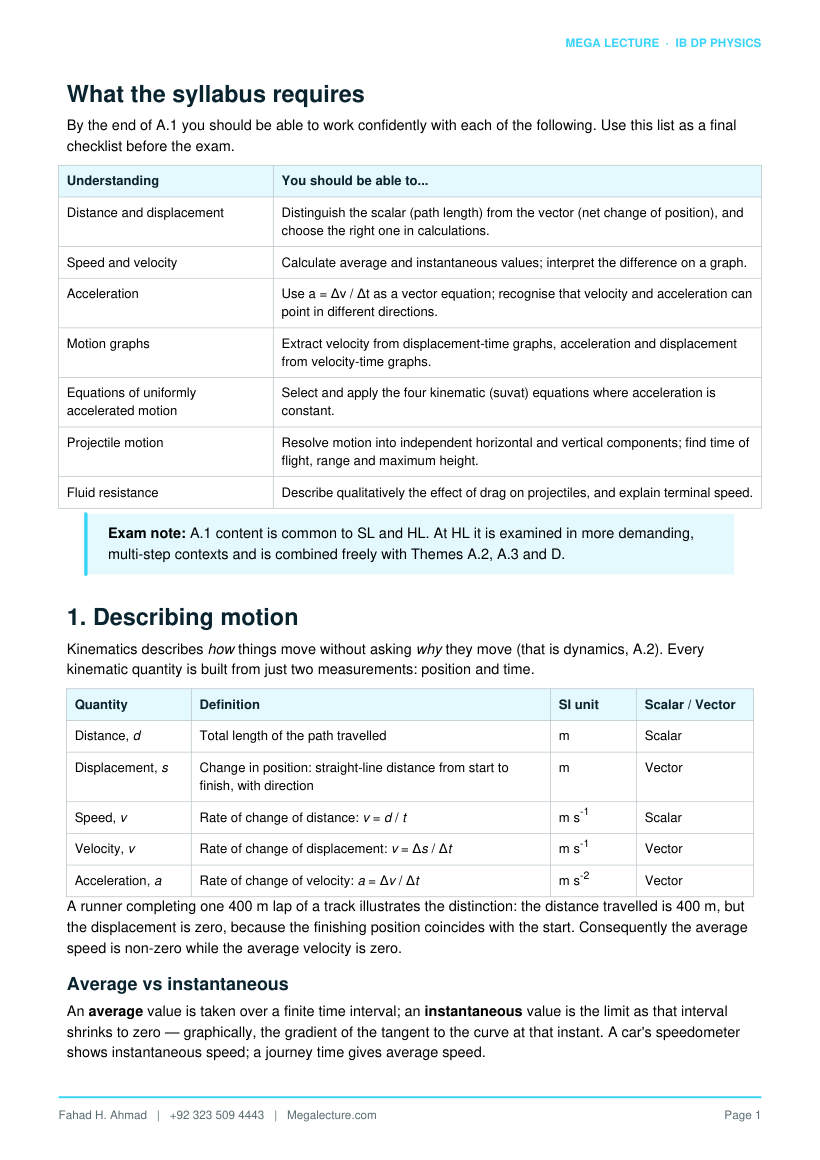
Kinematics describes how things move without asking why they move (that is dynamics, A.2). Every kinematic quantity is built from just two measurements: position and time.
Quantity Definition SI unit Scalar / Vector
Distance, d Total length of the path travelled m Scalar
Displacement, s Change in position: straight-line distance from start to finish, with direction m Vector
Speed, v Rate of change of distance: v = d / t m s-1 Scalar
Velocity, v Rate of change of displacement: v = Δs / Δt m s-1 Vector
Acceleration, a Rate of change of velocity: a = Δv / Δt m s-2 Vector
A runner completing one 400 m lap of a track illustrates the distinction: the distance travelled is 400 m, but the displacement is zero, because the finishing position coincides with the start. Consequently the average speed is non-zero while the average velocity is zero.
Average vs instantaneous
An average value is taken over a finite time interval; an instantaneous value is the limit as that interval shrinks to zero — graphically, the gradient of the tangent to the curve at that instant. A car's speedometer shows instantaneous speed; a journey time gives average speed.
Worked example 1 — average velocity
A cyclist rides 300 m due east in 40 s, then 400 m due north in 60 s. Find (a) the average speed,
- the magnitude of the average velocity.
- Average speed = total distance / total time = (300 + 400) / 100 = 7.0 m s-1
- Displacement = (3002 + 4002)1/2 = 500 m. Average velocity = 500 / 100 = 5.0 m s-1, directed 53° north of east.
Note the two answers differ because the path is not straight — a favourite exam trap.
2. Acceleration and its sign
Acceleration is any change of velocity — speeding up, slowing down, or changing direction. Because it is a vector, its sign carries meaning only once you have declared a positive direction, and you should do this explicitly at the start of every solution.
- Velocity and acceleration in the same direction: object speeds up.
- Velocity and acceleration in opposite directions: object slows down.
- Acceleration perpendicular to velocity: direction changes at constant speed (circular motion, A.2).
Common misconception: “Negative acceleration” does not automatically mean slowing down. A ball thrown upward with up defined positive has a = -9.8 m s-2 throughout: it slows on the way up and speeds up on the way down, with the same negative acceleration.
3. Graphs of motion
Graph questions reward one skill: knowing what the gradient and the area under each graph represent.
Graph Gradient gives Area under graph gives
Displacement-time (s-t) Velocity (no physical meaning)
Velocity-time (v-t) Acceleration Displacement
Acceleration-time (a-t) (rarely needed) Change in velocity
Reading the shapes
On an s-t graph: a straight line means constant velocity; a curve of increasing gradient means acceleration; a horizontal line means the object is at rest. On a v-t graph: a horizontal line means constant velocity; a straight sloping line means uniform acceleration; the graph crossing the time axis means the object reverses direction. Area below the axis counts as negative displacement.
Exam technique: When asked for distance (not displacement) from a v-t graph, add the magnitudes of the areas above and below the axis instead of letting them cancel.
Figure 1. Velocity−time graph for uniform acceleration. The shaded area under the line equals the displacement s = 45 m;
here a = 2 m s−2 and v(5 s) = 14 m s−1.
Figure 2. Displacement−time graph s = 4t + t2. The dashed tangent at t = 2 s has gradient equal to the instantaneous velocity v(2 s) = u + a·t = 8 m s−1, touching the curve at (2 s, 12 m).
4. Equations of uniformly accelerated motion
When acceleration is constant, the five quantities s (displacement), u (initial velocity), v (final velocity), a (acceleration) and t (time) are linked by four equations, each omitting exactly one quantity. All four appear in the data booklet.
v = u + at s = ut + ½at2 v2 = u2 + 2as s = ½(u + v)t
They are valid only while the acceleration is constant, and each symbol is a component along one chosen axis, carrying its own sign.
A reliable five-step method
- Sketch the situation and choose a positive direction. 2. List s, u, v, a, t and fill in known values with signs.
- Identify the unknown you want and the quantity you neither know nor want. 4. Pick the equation omitting that quantity. 5. Solve algebraically first, substitute last, and sanity-check the answer.
Worked example 2 — braking car
A car travelling at 28 m s-1 brakes uniformly and stops in a distance of 98 m. Find the deceleration and the stopping time.
Take the direction of motion as positive: u = 28, v = 0, s = 98.
v2 = u2 + 2as gives a = (0 - 282) / (2 × 98) = -4.0 m s-2 (magnitude 4.0 m s-2, opposing the motion).
s = ½(u + v)t gives t = 2 × 98 / 28 = 7.0 s.
Worked example 3 — ball thrown upward
A ball is thrown vertically upward at 15 m s-1. Ignoring air resistance, find (a) the maximum height,
- the total time to return to the thrower's hand.
Take up as positive: u = +15, a = -9.8 m s-2; at the top v = 0.
- v2 = u2 + 2as: 0 = 152 - 2 × 9.8 × s, so s = 225 / 19.6 = 11.5 m.
- Full flight: s = 0 = 15t - 4.9t2, so t = 15 / 4.9 = 3.1 s — exactly twice the time to the top, by symmetry.
5. Projectile motion
A projectile moves freely under gravity alone. The key idea — and the phrase examiners want to see — is that the horizontal and vertical components of the motion are independent: gravity acts vertically, so only the vertical component of velocity changes.
Horizontal component Vertical component
Acceleration zero g = 9.8 m s-2 downward
Velocity constant: vx = v cos θ changes: vy = v sin θ - gt
Equations to use x = vxt full suvat set, with signs
The single quantity linking the two directions is time. Almost every projectile problem is solved by finding the time from the vertical motion, then using it in the horizontal motion (or the reverse).
Worked example 4 — horizontal launch
A stone is thrown horizontally at 12 m s-1 from a cliff 45 m high. Find (a) the time of flight, (b) the horizontal range, (c) the speed on impact.
- Vertical (down positive): 45 = ½ × 9.8 × t2, so t = 3.0 s.
- Range = vxt = 12 × 3.0 = 36 m.
- vy = 9.8 × 3.0 = 29.4 m s-1; speed = (122 + 29.42)1/2 = 32 m s-1.
Launch at an angle
For launch speed v at angle θ above the horizontal over level ground, resolve first (vx = v cos θ, uy = v sin θ). The flight is symmetric: time up equals time down, the speed at any height is the same going up as coming down, and maximum height occurs when vy = 0. Range is greatest at θ = 45° in the absence of air resistance.
Exam technique: Never resolve g. Gravity is already vertical. Resolve only the initial velocity, and keep a consistent sign convention for the whole flight.
Figure 3. Projectile trajectory for launch speed 20 m s−1 at 40° above the horizontal (g = 9.8 m s−2). Range R ≈ 40.2 m and maximum height H ≈ 8.4 m.
6. Fluid resistance and terminal speed
Real objects move through air or liquid, which exerts a resistive force (drag) that always opposes the velocity and grows with speed. The syllabus requires a qualitative treatment.
Effect on projectiles
- Maximum height, range and final speed are all reduced.
- The path is no longer a symmetric parabola: the descent is steeper than the ascent.
- The optimum launch angle for range drops below 45°.
- The horizontal component of velocity is no longer constant — it decreases throughout the flight.
Terminal speed
For an object falling from rest: initially drag is zero, so the acceleration is g. As speed increases, drag increases, the resultant force (weight minus drag) shrinks, and the acceleration falls. When drag has grown equal to the weight, the resultant force is zero and the object falls at constant terminal speed. On a v-t graph this appears as a curve of steadily decreasing gradient flattening to a horizontal asymptote.
Link: Explain terminal speed with Newton's second law (A.2): as the resultant force tends to zero, so does the acceleration — not the velocity.
7. Common pitfalls
- Mixing distance with displacement, or speed with velocity, in vector equations.
- Using suvat where acceleration is not constant (for example while drag is significant).
- Dropping the sign of g, or switching sign convention halfway through a problem.
- Saying a projectile at the top of its flight has zero velocity — only the vertical component is zero; it still moves horizontally.
- Quoting answers to more significant figures than the data justifies (2-3 s.f. is standard).
- Forgetting that the gradient of a curved graph must be taken from a tangent, not a chord.
8. Quick reference
Result Statement
Average velocity v = Δs / Δt
Acceleration a = Δv / Δt
Suvat (constant a) v = u + at; s = ut + ½at2; v2 = u2 + 2as; s = ½(u+v)t
Projectile components vx = v cos θ (constant); vy = v sin θ - gt
Terminal speed reached when drag = weight, so resultant force and acceleration are zero
9. Test yourself
Attempt these without notes; answers below.
- A train accelerates uniformly from 8.0 m s-1 to 20 m s-1 over 1.2 km. Find the acceleration and the time taken.
- From a v-t graph, an object moves at +6.0 m s-1 for 4.0 s, then decelerates uniformly to -2.0 m s-1 during the next 4.0 s. Find the total displacement and total distance.
- A ball is kicked at 18 m s-1 at 30° above the horizontal on level ground. Find the time of flight and the range.
- Explain why a skydiver's acceleration decreases before the parachute opens, even though the motion remains downward.
- A stone dropped from a bridge takes 2.4 s to reach the water. Find the height of the bridge and the impact speed (ignore air resistance).
Answers
- a = (202 - 82) / (2 × 1200) = 0.14 m s-2; t = (20 - 8) / 0.14 = 86 s.
- First stage: +24 m. Second stage: area = ½(6.0 + (-2.0)) × 4.0 = +8.0 m net, made of +9.0 m (while positive, 3.0 s) and -1.0 m (final 1.0 s). Displacement = +32 m; distance = 24 + 9 + 1 = 34 m.
- uy = 18 sin 30° = 9.0 m s-1; t = 2 × 9.0 / 9.8 = 1.8 s. Range = 18 cos 30° × 1.8 = 29 m.
- Drag grows with speed, so the resultant force (weight - drag) decreases; by Newton's second law the acceleration decreases, approaching zero at terminal speed.
- h = ½ × 9.8 × 2.42 = 28 m; v = 9.8 × 2.4 = 24 m s-1.
