
CSS · Gender Studies · CSS Gender Studies: key concepts
CSS Gender Studies: key concepts
Opens inside this page. Prefer your own PDF app? Open the PDF.
Check yourself
5 quick questions on CSS Gender Studies
Tap an answer to see if you are right, and why. Free, no sign-up.
Start the free testWas this note useful?
Full text of CSS Gender Studies: key concepts
This document sets out the core conceptual toolkit for the Gender Studies optional subject in the CSS examination administered by the Federal Public Service Commission (FPSC). It follows the syllabus topic areas on the conceptual framework of sex and gender, feminist theory, gender and development, gender-based violence, and gender and law in Pakistan. Section numbers are not quoted here because FPSC periodically revises its syllabus documents; candidates should check the current year's syllabus topic list and map these notes onto it. Each concept is given a definition to learn precisely, a paragraph of explanation, worked illustrations, model answer outlines for eight CSS-style questions, a glossary, and a quick-check test.
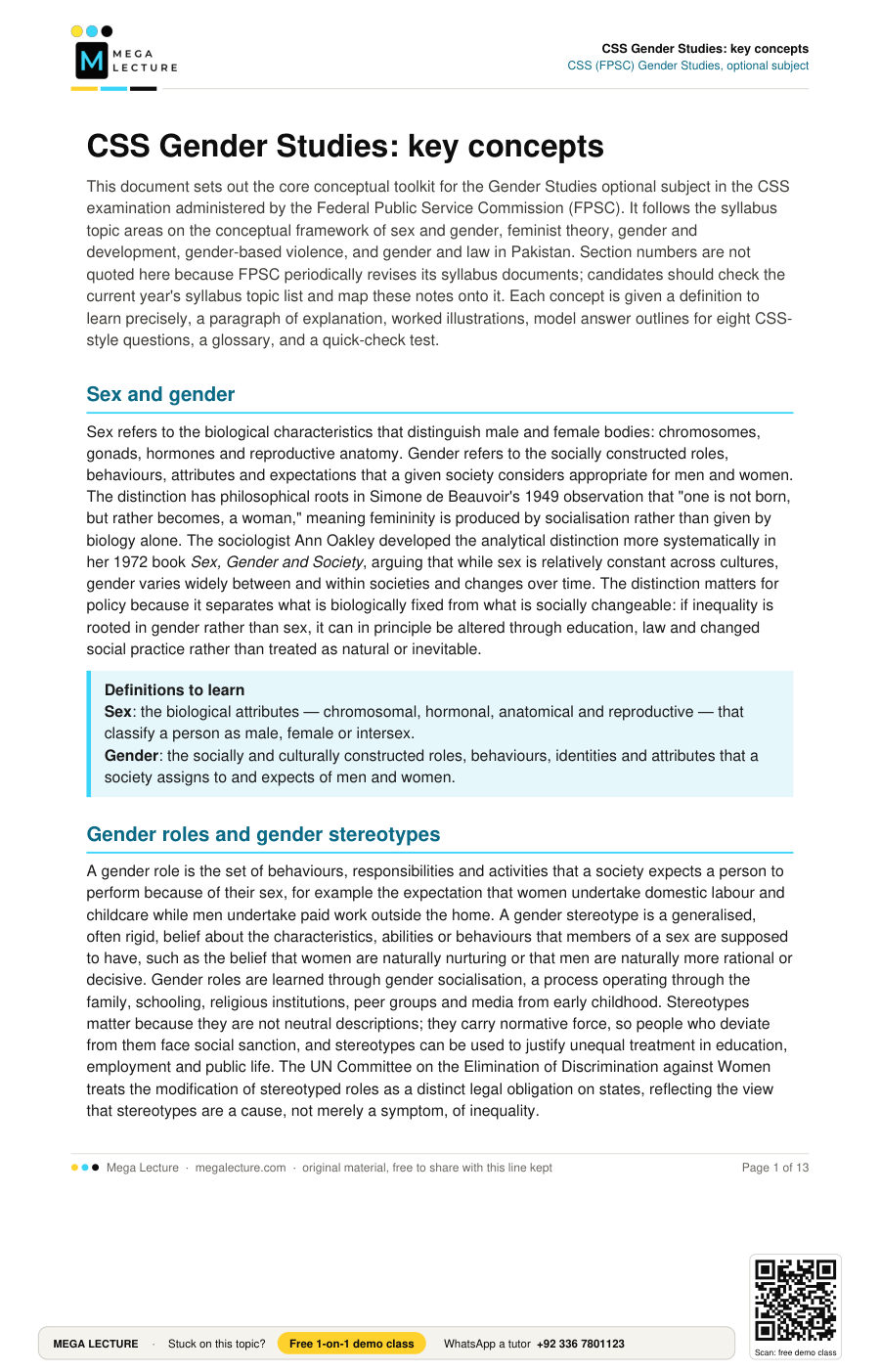
Sex and gender
Sex refers to the biological characteristics that distinguish male and female bodies: chromosomes, gonads, hormones and reproductive anatomy. Gender refers to the socially constructed roles, behaviours, attributes and expectations that a given society considers appropriate for men and women. The distinction has philosophical roots in Simone de Beauvoir's 1949 observation that "one is not born, but rather becomes, a woman," meaning femininity is produced by socialisation rather than given by biology alone. The sociologist Ann Oakley developed the analytical distinction more systematically in her 1972 book Sex, Gender and Society, arguing that while sex is relatively constant across cultures, gender varies widely between and within societies and changes over time. The distinction matters for policy because it separates what is biologically fixed from what is socially changeable: if inequality is rooted in gender rather than sex, it can in principle be altered through education, law and changed social practice rather than treated as natural or inevitable.
Definitions to learnSex: the biological attributes — chromosomal, hormonal, anatomical and reproductive — that classify a person as male, female or intersex.
Gender: the socially and culturally constructed roles, behaviours, identities and attributes that a society assigns to and expects of men and women.
Gender roles and gender stereotypes
A gender role is the set of behaviours, responsibilities and activities that a society expects a person to perform because of their sex, for example the expectation that women undertake domestic labour and childcare while men undertake paid work outside the home. A gender stereotype is a generalised, often rigid, belief about the characteristics, abilities or behaviours that members of a sex are supposed to have, such as the belief that women are naturally nurturing or that men are naturally more rational or decisive. Gender roles are learned through gender socialisation, a process operating through the family, schooling, religious institutions, peer groups and media from early childhood. Stereotypes matter because they are not neutral descriptions; they carry normative force, so people who deviate from them face social sanction, and stereotypes can be used to justify unequal treatment in education, employment and public life. The UN Committee on the Elimination of Discrimination against Women treats the modification of stereotyped roles as a distinct legal obligation on states, reflecting the view that stereotypes are a cause, not merely a symptom, of inequality.
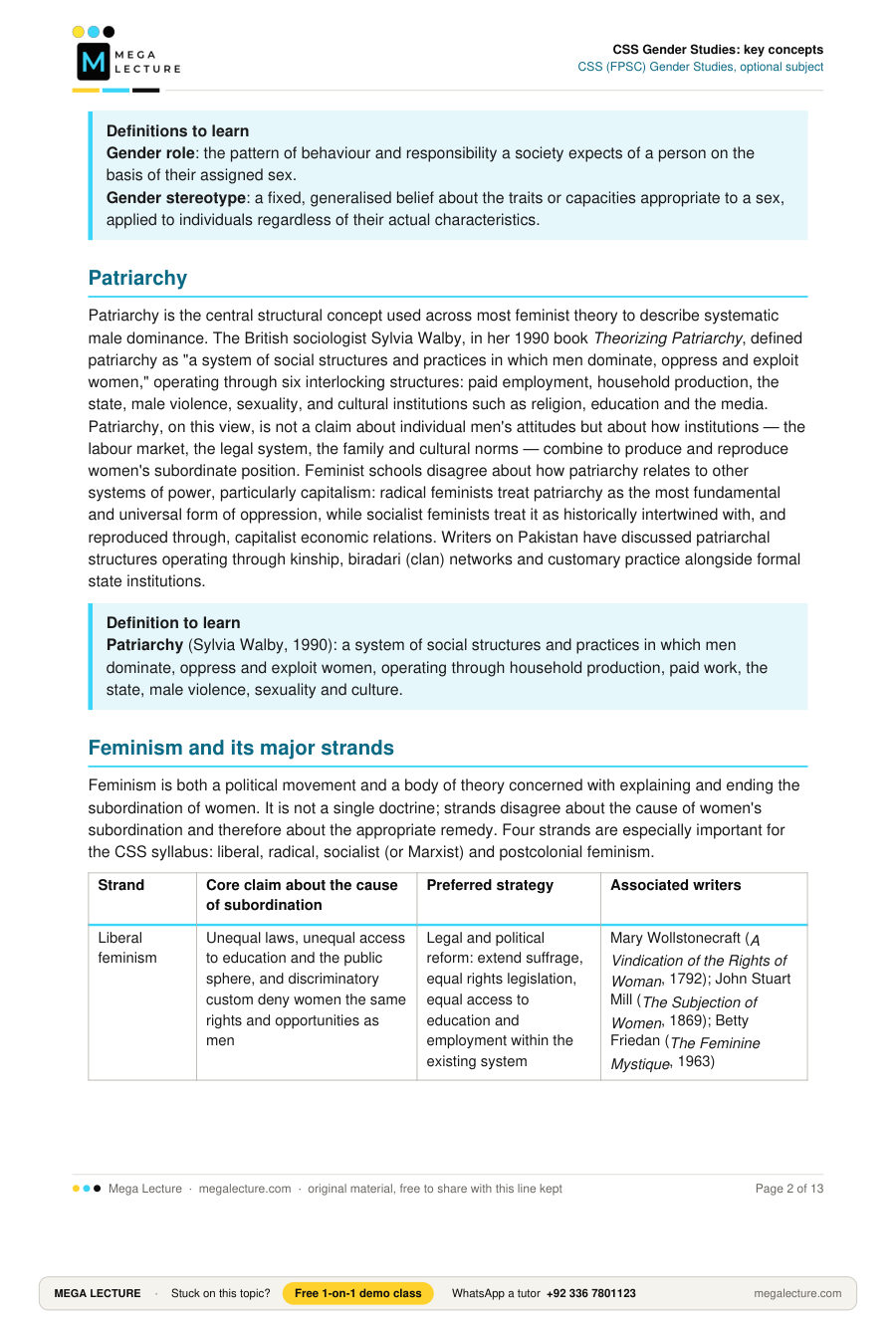
Definitions to learnGender role: the pattern of behaviour and responsibility a society expects of a person on the basis of their assigned sex.
Gender stereotype: a fixed, generalised belief about the traits or capacities appropriate to a sex, applied to individuals regardless of their actual characteristics.
Patriarchy
Patriarchy is the central structural concept used across most feminist theory to describe systematic male dominance. The British sociologist Sylvia Walby, in her 1990 book Theorizing Patriarchy, defined patriarchy as "a system of social structures and practices in which men dominate, oppress and exploit women," operating through six interlocking structures: paid employment, household production, the state, male violence, sexuality, and cultural institutions such as religion, education and the media. Patriarchy, on this view, is not a claim about individual men's attitudes but about how institutions — the labour market, the legal system, the family and cultural norms — combine to produce and reproduce women's subordinate position. Feminist schools disagree about how patriarchy relates to other systems of power, particularly capitalism: radical feminists treat patriarchy as the most fundamental and universal form of oppression, while socialist feminists treat it as historically intertwined with, and reproduced through, capitalist economic relations. Writers on Pakistan have discussed patriarchal structures operating through kinship, biradari (clan) networks and customary practice alongside formal state institutions.
Definition to learnPatriarchy (Sylvia Walby, 1990): a system of social structures and practices in which men dominate, oppress and exploit women, operating through household production, paid work, the state, male violence, sexuality and culture.
Feminism and its major strands
Feminism is both a political movement and a body of theory concerned with explaining and ending the subordination of women. It is not a single doctrine; strands disagree about the cause of women's subordination and therefore about the appropriate remedy. Four strands are especially important for the CSS syllabus: liberal, radical, socialist (or Marxist) and postcolonial feminism.
| Strand | Core claim about the cause of subordination | Preferred strategy | Associated writers |
|---|---|---|---|
| Liberal feminism | Unequal laws, unequal access to education and the public sphere, and discriminatory custom deny women the same rights and opportunities as men | Legal and political reform: extend suffrage, equal rights legislation, equal access to education and employment within the existing system | Mary Wollstonecraft (A Vindication of the Rights of Woman, 1792); John Stuart Mill (The Subjection of Women, 1869); Betty Friedan (The Feminine Mystique, 1963) |
| Radical feminism | Patriarchy is the most basic and universal system of oppression, predating and underlying class, rooted in men's control of women's bodies and sexuality | Challenge patriarchy directly, including within the family and personal relationships; the slogan "the personal is political" | Kate Millett (Sexual Politics, 1970); Shulamith Firestone (The Dialectic of Sex, 1970) |
| Socialist / Marxist feminism | Women's subordination is tied to the capitalist mode of production, particularly unpaid domestic labour, which reproduces the workforce at no cost to capital | Transform economic relations alongside gender relations; recognise and remunerate domestic and reproductive labour | Friedrich Engels (The Origin of the Family, Private Property and the State, 1884); Heidi Hartmann's "dual systems" theory (1979) |
| Postcolonial feminism | Mainstream Western feminism wrongly treats "woman" as a single universal category, ignoring how colonial history, race, class and religion shape women's experiences differently | Ground feminist analysis in local historical and cultural context rather than a single global template | Chandra Talpade Mohanty ("Under Western Eyes," 1984, boundary 2; reprinted Feminist Review, 1988); Gayatri Chakravorty Spivak |
Question: how would a liberal feminist and a radical feminist each explain the persistence of the gender pay gap?
A liberal feminist would point to unequal access to education, occupational segregation and weakly enforced equal-pay law, recommending closure of the gap through anti-discrimination legislation, pay transparency and equal access to training.
A radical feminist would argue that the pay gap reflects patriarchal control over the economic structure itself, including the devaluation of work coded as "feminine" (caregiving, teaching) and the unpaid domestic labour limiting women's paid hours, calling for a more fundamental revaluation of what counts as productive work, not only equal pay for the same job.
Approaches to gender and development: WID, WAD and GAD
As development policy began taking women's position seriously from the 1970s, three successive approaches emerged, each responding to weaknesses in the one before. Women in Development (WID), from the early 1970s, was influenced by Ester Boserup's 1970 study Woman's Role in Economic Development, which showed that development planning had often displaced women from productive roles they previously held. WID, reflecting a broadly liberal-feminist outlook, sought to integrate women into existing development programmes through income-generating projects and improved access to credit and training, without questioning the development model itself. Women and Development (WAD), from the later 1970s, drew on dependency theory to criticise WID for treating women's exclusion as an oversight rather than recognising that women were always integrated into production and that global capitalist and patriarchal structures actively generated their disadvantage; WAD focused more on class and international economic structure than on women in isolation. Gender and Development (GAD), from the 1980s and associated with socialist feminism, shifted the unit of analysis from "women" as a category to gender relations, and to the structures that produce inequality. GAD is closely associated with Caroline Moser's distinction between practical gender needs (immediate needs arising from women's existing roles, such as water access) and strategic gender needs (needs that, if met, would change women's subordinate position itself, such as legal rights). The Beijing Platform for Action (1995) formally adopted gender mainstreaming — a strategy closely aligned with the GAD perspective — as the preferred global strategy, cementing GAD's influence on international policy.
| Approach | Period | Theoretical root | Focus |
|---|---|---|---|
| WID | Early 1970s | Liberal feminism / modernisation theory | Integrate women into existing development projects; improve access to resources |
| WAD | Late 1970s | Dependency theory / neo-Marxism | Class and global economic structure; women already part of production |
| GAD | 1980s onward | Socialist feminism | Gender relations and structures of subordination; practical vs strategic needs |
Gender mainstreaming
Gender mainstreaming is a strategy for implementing gender equality goals across all policy areas. The UN Economic and Social Council defined it in 1997 as the process of assessing the implications for women and men of any planned action, including legislation, policies and programmes, so that the concerns and experiences of women and men become an integral part of the design, implementation, monitoring and evaluation of policy, rather than addressed through separate, "add-on" women's projects. It was adopted as a global strategy at the Beijing conference in 1995. In practice, mainstreaming requires tools such as sex-disaggregated data, gender budgeting (analysing how public spending affects women and men differently) and gender-impact assessment of new laws. Its advantage is avoiding the "ghettoising" of women's concerns into a single project; its main criticism, made by some GAD theorists, is that mainstreaming is often reduced to technical checklists that do not disturb underlying power relations, a problem sometimes called the "evaporation" of gender concerns as policy moves from design to implementation.
Definition to learnGender mainstreaming (ECOSOC, 1997): the strategy of assessing the implications for women and men of any planned policy action, so that gender concerns are integrated into the design, implementation, monitoring and evaluation of all policies and programmes, rather than treated separately.
Gender division of labour and unpaid care work
The gender division of labour refers to the way productive, reproductive and community tasks are allocated differently to men and women. Caroline Moser's "triple role" framework identifies three categories of work women in most societies typically combine: productive work (producing goods or services for income), reproductive work (bearing and raising children, and the unpaid domestic labour of cooking, cleaning and caring for family members, which reproduces the labour force), and community managing work (unpaid organisation of collective resources, such as arranging shared water access). Men typically perform productive work and a form of community politics work that is more often paid or status-bearing. Unpaid care work — domestic labour, childcare and elder care performed without wages — is economically essential yet typically excluded from national income accounts such as GDP, and time-use surveys consistently show women performing several times more unpaid care work than men in most countries, including Pakistan. Feminist economists argue this unequal burden limits women's time for paid work, education and political participation, making it a structural, not incidental, cause of inequality; Sustainable Development Goal 5 commits states to recognising and valuing unpaid care work through public services, infrastructure and shared household responsibility.
Moser's triple role frameworkProductive work: activities producing goods or services for payment or family use.
Reproductive work: childbearing, child-rearing and unpaid domestic labour that reproduces the household and workforce.
Community managing work: unpaid, voluntary work maintaining shared community resources and social relations.
Gender-based violence
Gender-based violence (GBV) is violence directed against a person because of their gender, or violence that disproportionately affects one gender. It is understood as both a cause and a consequence of unequal power relations between men and women, and is not limited to physical assault: it includes physical, sexual, psychological and economic forms, occurring in the family, the community, the workplace and through state action or inaction. The table below sets out the principal forms recognised in the literature and in Pakistani law and policy discussion.
| Form | Description |
|---|---|
| Domestic / intimate-partner violence | Physical, sexual, psychological or economic abuse by a spouse, partner or family member within the household |
| Sexual violence and harassment | Rape, sexual assault, and unwelcome sexual conduct, including harassment in public spaces and the workplace |
| Honour-based violence | Violence, including killing, committed against a person, usually a woman, for perceived transgression of family or community codes of honour |
| Acid violence | Deliberate use of corrosive substances to disfigure or kill, disproportionately targeted at women |
| Forced and child marriage | Marriage without free and full consent, or below the legal age; includes exchange-marriage practices such as watta satta and compensation marriages such as vani or swara, where girls are given in marriage to settle a dispute |
| Economic abuse | Denial of inheritance, property or income rights, or control of a person's economic resources, as a means of coercion |
| Trafficking and sexual exploitation | Recruitment, transport or harbouring of persons, often women and girls, by force, fraud or coercion for exploitation |
Gender and law in Pakistan
Pakistan's Constitution of 1973 provides the basic framework for gender equality, supplemented since by targeted legislation. Article 25 guarantees equality of all citizens before law; Article 25(2) specifically prohibits discrimination on the basis of sex alone; and Article 25(3) further permits the state to make special provision for the protection of women and children, so affirmative measures for women are constitutionally protected rather than an exception to equality. Article 27 prohibits discrimination in appointment to the service of Pakistan on the ground only of race, religion, caste, sex, residence or place of birth. Its main proviso permits reserving posts to redress under-representation of a class or area generally (a provision historically carrying a time limit running from the Constitution's commencing day, since extended by amendment — candidates should check the current constitutional text for the exact figure rather than treat it as unlimited or as specifically about sex), and a separate proviso permits reserving specified posts or services for one sex where the duties involved cannot be adequately performed by a member of the other sex. In practice, women's quotas in civil-service recruitment are administered mainly through FPSC and Establishment Division service rules and policy rather than directly through Article 27. Article 34 directs the state to ensure full participation of women in national life, and Article 35 directs the state to protect marriage, the family, the mother and the child. These are principles of policy and general equality guarantees rather than a single codified "women's rights" chapter, so specific protections have had to be built through ordinary legislation.
Key legislation
| Law | Year | Main purpose |
|---|---|---|
| Protection of Women (Criminal Laws Amendment) Act | 2006 | Moved the offence of rape (zina-bil-jabr) from the Hudood Ordinances into the Pakistan Penal Code, tried under ordinary criminal procedure and evidence law |
| Criminal Law (Amendment) Act (honour killing) | 2004, strengthened 2016 | Made killing in the name of "honour" a distinct offence and closed loopholes allowing compounding (forgiveness by heirs) to let perpetrators escape punishment |
| Protection Against Harassment of Women at the Workplace Act | 2010 | Requires organisations to adopt an internal code of conduct and complaint (inquiry) committee for workplace sexual harassment, and created the office of the Ombudsperson; amended in 2022 to widen coverage |
| Acid Control and Acid Crime Prevention Act | 2011 | Created specific, more severe offences and minimum sentences for acid-throwing attacks |
| Prevention of Anti-Women Practices (Criminal Law Amendment) Act | 2011 | Criminalised depriving women of inheritance, forced marriage, and marriage to the Quran (a custom preventing a woman from marrying and claiming inheritance) |
| Provincial domestic violence laws (e.g. Sindh 2013, Balochistan 2014, Punjab 2016, Khyber Pakhtunkhwa 2021, Islamabad Capital Territory circa 2021 — exact ICT enactment year should be confirmed against the official gazette before quoting it precisely) | 2013 onward | Create protection orders, protection committees and reporting mechanisms against domestic violence, enacted separately by each province after the Eighteenth Amendment devolved most social legislation |
| Transgender Persons (Protection of Rights) Act | 2018 | Recognises a person's right to self-identify their gender for official documents and prohibits discrimination against transgender persons in education, employment, healthcare and inheritance; the self-identification provisions were challenged and partly declared repugnant by the Federal Shariat Court in May 2023, with the matter pending before the Shariat Appellate Bench, so the Act's precise current legal effect on that point should be checked before being stated as settled |
| Elections Act | 2017 | Requires political parties to award at least five per cent of general seat tickets to women, and allows the Election Commission to void results in a constituency where women's turnout falls below ten per cent of votes cast |
Gender gaps in Pakistan: education, health and employment
In education, Pakistan has one of the widest and most persistent gender gaps in school enrolment and literacy in South Asia: the gap is small at the earliest primary grades in urban areas but widens markedly with each additional level of schooling, and is substantially larger in rural areas and lower-income households, so female literacy and secondary and tertiary enrolment consistently trail male rates by a wide margin nationally. In health, maternal mortality remains a significant public-health concern, with outcomes strongly linked to skilled birth attendance and facility-based delivery, both markedly lower in rural areas and among poorer households, producing large provincial and rural-urban disparities in maternal and reproductive health outcomes. In employment, female labour force participation in Pakistan is markedly and persistently lower than male participation and lower than the regional South Asian average; women's paid work is concentrated in agriculture and the informal sector, often unpaid or under-recorded as "family help," and a measurable gender pay gap persists even within the same sector and skill level, consistent with the gender division of labour and unpaid care burden discussed above limiting women's time and mobility for paid employment.
International frameworks
Two international instruments are essential reference points for the CSS syllabus. The Convention on the Elimination of All Forms of Discrimination against Women (CEDAW) was adopted by the UN General Assembly in 1979 and entered into force in 1981; it is often described as an international bill of rights for women, being the most comprehensive treaty addressing women's civil, political, economic, social and cultural rights. It obliges states parties to take all appropriate measures, including legislation, to eliminate discrimination against women in political and public life, employment, education, health and law, and specifically requires states to modify social and cultural patterns based on stereotyped roles for men and women. Pakistan ratified CEDAW in 1996, with certain reservations, and reports periodically to the CEDAW Committee. The Sustainable Development Goals, adopted in 2015, include Goal 5, "achieve gender equality and empower all women and girls," with targets covering ending discrimination and violence against women, eliminating harmful practices such as child marriage, recognising and valuing unpaid care work, ensuring women's full participation in leadership and decision-making, and universal access to sexual and reproductive health. These frameworks are reinforced by the Beijing Declaration and Platform for Action, adopted at the Fourth World Conference on Women in 1995, which identified twelve critical areas of concern and formally adopted gender mainstreaming — a strategy closely aligned with the GAD approach — as the preferred global strategy.
Definition to learnCEDAW (1979): the Convention on the Elimination of All Forms of Discrimination against Women, an international human rights treaty requiring states parties to eliminate discrimination against women in law and practice and to modify social and cultural patterns based on gender stereotypes.
CSS-style questions with model answer outlines
In the actual FPSC paper, eight questions of this kind are set and candidates attempt any FIVE, each carrying equal marks (typically 20, since optional-subject papers are marked out of 100). A full 20-mark answer usually runs to about 350–450 words, developing each outline point below with explanation, examples and named sources; the outlines shown here indicate structure and coverage only, not full answers.
Q1. Distinguish between sex and gender, and explain why the distinction matters for public policy.[20] Outline: (1) define sex as biological attributes; (2) define gender as socially constructed roles, citing de Beauvoir and Oakley; (3) explain gender is changeable through law, education and socialisation, whereas sex is biologically fixed; (4) give one policy example, such as equal access to education, that depends on the distinction; (5) conclude that conflating the two risks treating unequal social outcomes as natural and unchangeable. Q2. "Patriarchy, not capitalism, is the primary cause of women's subordination." Critically examine this statement with reference to at least two strands of feminist theory.[20] Outline: (1) state Walby's definition of patriarchy and its six structures; (2) present the radical feminist position supporting the statement, that patriarchy predates and is more fundamental than class relations; (3) present the socialist/Marxist counter-position, that patriarchy and capitalism are mutually reinforcing "dual systems" (Hartmann) and that domestic labour under capitalism is a material mechanism of subordination; (4) note the postcolonial caution that neither position is universal across societies and histories; (5) conclude that the two systems interact and their relative weight varies by context, rather than asserting a single "primary" cause. Q3. Compare the WID, WAD and GAD approaches to women and development. Which best explains the current international policy consensus?[20] Outline: (1) define each approach with its period and theoretical root; (2) explain the critique each made of its predecessor (WAD's critique of WID's liberal individualism; GAD's shift from "women" to gender relations and structures); (3) introduce Moser's practical/strategic needs distinction as GAD's key tool; (4) note Beijing's (1995) formal adoption of gender mainstreaming — a strategy closely aligned with GAD — and its influence on SDG 5; (5) conclude GAD best explains the current consensus, while noting WID-style project tools (income generation, credit access) persist in implementation. Q4. Explain the concept of gender mainstreaming. What are the main criticisms made of it in practice?[20] Outline: (1) give the ECOSOC 1997 definition precisely; (2) explain its origin as the Beijing (1995) global strategy and its advantage over stand-alone women's projects; (3) describe practical tools (sex-disaggregated data, gender budgeting, gender-impact assessment); (4) present the "evaporation" criticism, that mainstreaming can become a technical checklist leaving power relations unchanged, diluting accountability by making gender "everyone's responsibility and no one's"; (5) conclude that mainstreaming is necessary but not sufficient without dedicated institutional capacity and monitoring. Q5. Using Moser's triple role framework, explain why unpaid care work is described as a structural cause of gender inequality rather than a private, individual matter.[20] Outline: (1) state Moser's three categories and note women's typical combination of all three against men's concentration in productive and status-bearing work; (2) explain unpaid care work reproduces the labour force but is excluded from GDP, making it economically invisible despite being essential; (3) show the causal chain from unpaid care burden to reduced time for education, paid work and political participation; (4) cite SDG 5's target on valuing unpaid care work as evidence policy now treats it as structural; (5) conclude that because the burden is systematically distributed by gender across society, it is structural, not merely individual. Q6. Identify and briefly describe four forms of gender-based violence relevant to Pakistan, and explain the difference between physical and economic forms of abuse.[20] Outline: (1) select four forms from the table, e.g. domestic violence, honour-based violence, acid violence, forced/exchange marriage, giving one defining feature of each; (2) define physical abuse as direct bodily harm and economic abuse as control or denial of a person's income, property or inheritance used as coercion; (3) explain economic abuse is often less visible and less criminalised, which is why the Prevention of Anti-Women Practices Act (2011) was needed to address inheritance deprivation specifically; (4) conclude GBV is a spectrum of interlinked forms rather than physical violence alone. Q7. "The Constitution of Pakistan provides a sufficient framework for gender equality; the problem lies in legislation and enforcement." Discuss with reference to specific constitutional articles and laws.[20] Outline: (1) set out Article 25(2) and 25(3) (sex-based non-discrimination and permitted special provision for women), Article 27 (non-discrimination in service on grounds including sex, with a class/area reservation proviso and a separate sex-specific reservation proviso), Article 34 (full participation in national life) and Article 35 (protection of the family, mother and child); (2) argue the constitutional framework is broad and enabling but stated as general principles rather than detailed rights, which is why specific statutes such as the Protection Against Harassment of Women at the Workplace Act (2010) and provincial domestic violence laws were required; (3) note how the Eighteenth Amendment (2010) devolved many subjects to the provinces, producing uneven legislative coverage; (4) discuss enforcement gaps (under-resourced inquiry committees, low reporting, weak implementation) as distinct from the adequacy of the law on paper; (5) conclude the constitutional framework is necessary but not sufficient, requiring further legislative detail and enforcement capacity. Q8. Critically evaluate the claim that CEDAW and SDG 5 represent a single, coherent international consensus on gender equality.[20] Outline: (1) describe CEDAW (1979/1981) as a binding human rights treaty with a state reporting mechanism, and SDG 5 (2015) as a non-binding development goal with measurable targets; (2) identify continuity: both address violence, harmful practices and women's participation in public life, with SDG 5 building on CEDAW's language; (3) identify differences: CEDAW is legally binding on ratifying states (subject to reservations) while the SDGs are voluntary, and SDG 5 explicitly names unpaid care work and reproductive health targets that CEDAW's original text does not; (4) note Pakistan's own reservations to CEDAW as evidence that even a "binding" instrument accommodates divergent national interpretation; (5) conclude the two instruments are complementary rather than identical, so "single coherent consensus" overstates the uniformity while understating their genuine convergence of goals.Key terms
| Term | Definition |
|---|---|
| Sex | The biological attributes that classify a person as male, female or intersex |
| Gender | Socially constructed roles, behaviours and attributes assigned to men and women |
| Gender role | Behaviour and responsibility a society expects of a person because of their sex |
| Gender stereotype | A fixed, generalised belief about the traits appropriate to a sex |
| Patriarchy | A system of social structures and practices in which men dominate, oppress and exploit women (Walby, 1990) |
| Liberal feminism | Strand seeking equality through legal and political reform within the existing system |
| Radical feminism | Strand treating patriarchy as the most fundamental system of oppression |
| Socialist feminism | Strand linking women's subordination to capitalist economic relations and unpaid domestic labour |
| Postcolonial feminism | Strand critiquing Western feminism's universalising of "woman" and centring race, class and colonial history |
| WID | Women in Development: integrate women into existing development projects (1970s) |
| WAD | Women and Development: dependency-theory critique emphasising class and global economic structure |
| GAD | Gender and Development: focus on gender relations and structural subordination (1980s onward) |
| Practical gender needs | Moser's term for immediate needs arising from women's existing roles |
| Strategic gender needs | Moser's term for needs that, if met, would change women's subordinate position |
| Gender mainstreaming | Strategy of integrating gender concerns into the design and evaluation of all policy (ECOSOC, 1997) |
| Gender division of labour | The differential allocation of productive, reproductive and community tasks to men and women |
| Unpaid care work | Domestic, childcare and eldercare labour performed without wages, mostly by women |
| Gender-based violence | Violence directed at a person because of their gender, or disproportionately affecting one gender |
| Honour-based violence | Violence against a person for perceived transgression of family or community honour codes |
| Watta satta | Exchange-marriage custom in which a brother and sister from one family marry a sister and brother from another |
| CEDAW | Convention on the Elimination of All Forms of Discrimination against Women (1979) |
| SDG 5 | Sustainable Development Goal on gender equality (2015) |
| Beijing Platform for Action | Outcome document of the Fourth World Conference on Women (1995), adopting gender mainstreaming as the global strategy (a strategy closely aligned with the GAD approach) |
Quick check
- Define "gender" in one sentence.
- Distinguish between a gender role and a gender stereotype.
- State Sylvia Walby's definition of patriarchy.
- Name the four major strands of feminism discussed in this document.
- Which strand of feminism treats patriarchy as more fundamental than capitalism?
- Explain the difference between WID and WAD in no more than two sentences.
- What is the difference between a practical gender need and a strategic gender need?
- Give the ECOSOC definition of gender mainstreaming.
- Name the three categories in Moser's triple role framework.
- Identify two forms of gender-based violence and one law that addresses each in Pakistan.
- Critically comment on the view that the Constitution of Pakistan alone guarantees gender equality in practice.
- Evaluate whether SDG 5 adds anything to the obligations already contained in CEDAW.
2. A gender role is the actual pattern of behaviour and responsibility expected of a person because of their sex; a gender stereotype is the underlying generalised belief about the traits or abilities of that sex that justifies the expected role.
3. Patriarchy is "a system of social structures and practices in which men dominate, oppress and exploit women," operating through household production, paid work, the state, male violence, sexuality and culture (Walby, 1990).
4. Liberal, radical, socialist (Marxist) and postcolonial feminism.
5. Radical feminism.
6. WID (early 1970s) sought to integrate women into existing development projects through access to resources and income generation, without questioning the development model itself; WAD (late 1970s) argued from a dependency-theory perspective that women were already integrated into production and that global capitalist structures, not mere exclusion, caused their disadvantage.
7. A practical gender need is an immediate, material need arising from a woman's existing role (for example, access to clean water); a strategic gender need is a need that, if met, would change the underlying structure of women's subordination (for example, legal or political rights).
8. Gender mainstreaming is the process of assessing the implications for women and men of any planned policy action, so that gender concerns become an integral part of the design, implementation, monitoring and evaluation of all policies and programmes, rather than being addressed separately (ECOSOC, 1997).
9. Productive work, reproductive work and community managing work.
10. Acceptable answers include: domestic violence, addressed by provincial domestic violence laws (e.g. Sindh Domestic Violence Act, 2013); workplace sexual harassment, addressed by the Protection Against Harassment of Women at the Workplace Act (2010); acid violence, addressed by the Acid Control and Acid Crime Prevention Act (2011); inheritance deprivation and forced marriage, addressed by the Prevention of Anti-Women Practices Act (2011).
11. A good answer notes that the Constitution provides broad equality principles (Articles 25(2), 25(3), 27, 34 and 35) that enable but do not by themselves guarantee equality in practice, since these are general principles requiring specific legislation and effective enforcement machinery to have real effect; it should also note the Eighteenth Amendment's devolution of related subjects to the provinces, producing uneven legislative and enforcement coverage.
12. A good answer notes that SDG 5 is not legally binding, unlike CEDAW, but it restates and reinforces CEDAW's goals in measurable target form, explicitly adds emphasis on unpaid care work and reproductive health targets, and gives gender equality a place within a broader, time-bound global development agenda that CEDAW alone does not provide; the strongest answers judge the two as complementary rather than redundant.
