
CSS · Journalism · CSS Journalism and Mass Communication: study notes
CSS Journalism and Mass Communication: study notes
Opens inside this page. Prefer your own PDF app? Open the PDF.
Check yourself
5 quick questions on CSS Journalism
Tap an answer to see if you are right, and why. Free, no sign-up.
Start the free testWas this note useful?
Full text of CSS Journalism and Mass Communication: study notes
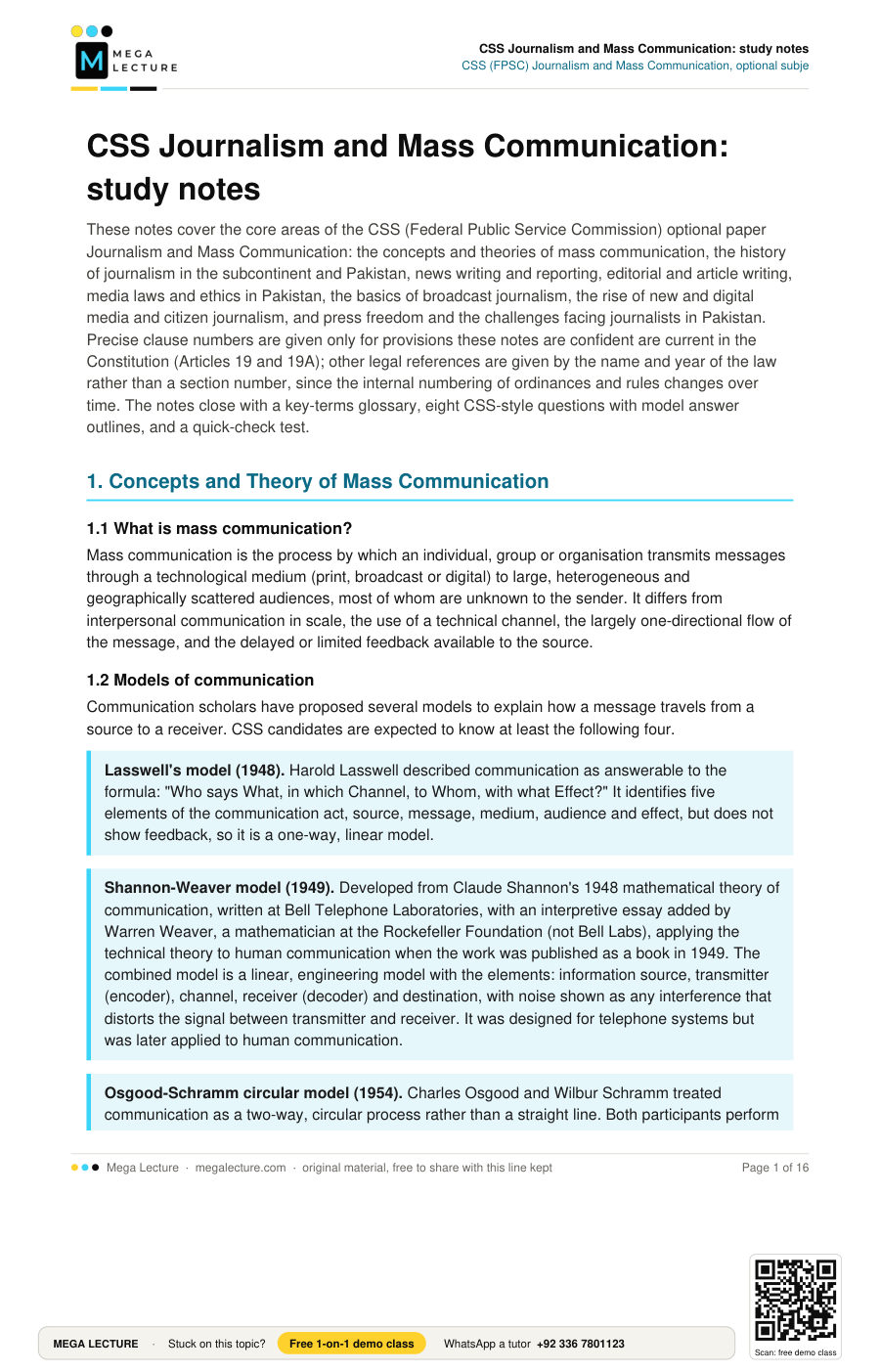
These notes cover the core areas of the CSS (Federal Public Service Commission) optional paper Journalism and Mass Communication: the concepts and theories of mass communication, the history of journalism in the subcontinent and Pakistan, news writing and reporting, editorial and article writing, media laws and ethics in Pakistan, the basics of broadcast journalism, the rise of new and digital media and citizen journalism, and press freedom and the challenges facing journalists in Pakistan. Precise clause numbers are given only for provisions these notes are confident are current in the Constitution (Articles 19 and 19A); other legal references are given by the name and year of the law rather than a section number, since the internal numbering of ordinances and rules changes over time. The notes close with a key-terms glossary, eight CSS-style questions with model answer outlines, and a quick-check test.
1. Concepts and Theory of Mass Communication
1.1 What is mass communication?
Mass communication is the process by which an individual, group or organisation transmits messages through a technological medium (print, broadcast or digital) to large, heterogeneous and geographically scattered audiences, most of whom are unknown to the sender. It differs from interpersonal communication in scale, the use of a technical channel, the largely one-directional flow of the message, and the delayed or limited feedback available to the source.
1.2 Models of communication
Communication scholars have proposed several models to explain how a message travels from a source to a receiver. CSS candidates are expected to know at least the following four.
Lasswell's model (1948). Harold Lasswell described communication as answerable to the formula: "Who says What, in which Channel, to Whom, with what Effect?" It identifies five elements of the communication act, source, message, medium, audience and effect, but does not show feedback, so it is a one-way, linear model.
Shannon-Weaver model (1949). Developed from Claude Shannon's 1948 mathematical theory of communication, written at Bell Telephone Laboratories, with an interpretive essay added by Warren Weaver, a mathematician at the Rockefeller Foundation (not Bell Labs), applying the technical theory to human communication when the work was published as a book in 1949. The combined model is a linear, engineering model with the elements: information source, transmitter (encoder), channel, receiver (decoder) and destination, with noise shown as any interference that distorts the signal between transmitter and receiver. It was designed for telephone systems but was later applied to human communication.
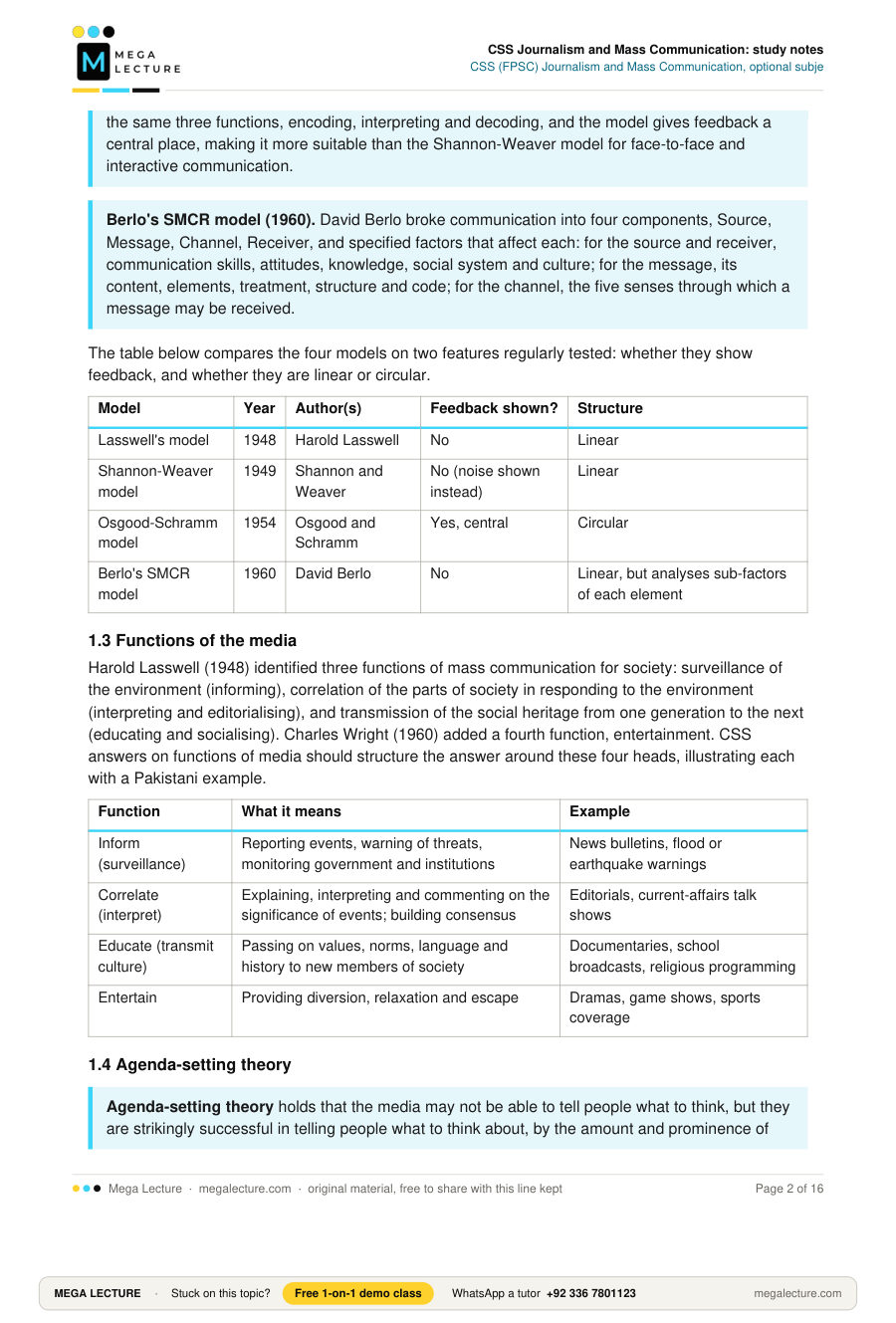
Osgood-Schramm circular model (1954). Charles Osgood and Wilbur Schramm treated communication as a two-way, circular process rather than a straight line. Both participants perform the same three functions, encoding, interpreting and decoding, and the model gives feedback a central place, making it more suitable than the Shannon-Weaver model for face-to-face and interactive communication.
Berlo's SMCR model (1960). David Berlo broke communication into four components, Source, Message, Channel, Receiver, and specified factors that affect each: for the source and receiver, communication skills, attitudes, knowledge, social system and culture; for the message, its content, elements, treatment, structure and code; for the channel, the five senses through which a message may be received.
The table below compares the four models on two features regularly tested: whether they show feedback, and whether they are linear or circular.
| Model | Year | Author(s) | Feedback shown? | Structure |
|---|---|---|---|---|
| Lasswell's model | 1948 | Harold Lasswell | No | Linear |
| Shannon-Weaver model | 1949 | Shannon and Weaver | No (noise shown instead) | Linear |
| Osgood-Schramm model | 1954 | Osgood and Schramm | Yes, central | Circular |
| Berlo's SMCR model | 1960 | David Berlo | No | Linear, but analyses sub-factors of each element |
1.3 Functions of the media
Harold Lasswell (1948) identified three functions of mass communication for society: surveillance of the environment (informing), correlation of the parts of society in responding to the environment (interpreting and editorialising), and transmission of the social heritage from one generation to the next (educating and socialising). Charles Wright (1960) added a fourth function, entertainment. CSS answers on functions of media should structure the answer around these four heads, illustrating each with a Pakistani example.
| Function | What it means | Example |
|---|---|---|
| Inform (surveillance) | Reporting events, warning of threats, monitoring government and institutions | News bulletins, flood or earthquake warnings |
| Correlate (interpret) | Explaining, interpreting and commenting on the significance of events; building consensus | Editorials, current-affairs talk shows |
| Educate (transmit culture) | Passing on values, norms, language and history to new members of society | Documentaries, school broadcasts, religious programming |
| Entertain | Providing diversion, relaxation and escape | Dramas, game shows, sports coverage |
1.4 Agenda-setting theory
Agenda-setting theory holds that the media may not be able to tell people what to think, but they are strikingly successful in telling people what to think about, by the amount and prominence of coverage they give to particular issues. The theory was tested empirically by Maxwell McCombs and Donald Shaw in their 1968 Chapel Hill study of undecided voters, published as "The Agenda-Setting Function of Mass Media" (1972); they found a strong correlation between the issues the local media emphasised and the issues voters ranked as most important.
A later refinement, second-level agenda-setting, argues that the media set not only which issues the public thinks about (object salience) but also which attributes or frames of those issues stand out (attribute salience), a link to framing theory that some writers treat as a separate concept.
1.5 Gatekeeping theory
Gatekeeping is the process by which information is filtered for dissemination, whether for publication, broadcast or other distribution. At each "gate", reporter, sub-editor, news editor, producer, someone decides whether a piece of information passes through or is rejected, reshaped or delayed. The concept was introduced by the social psychologist Kurt Lewin (1947), who used it to describe decisions within a channel, and applied to journalism by David Manning White in his 1950 case study of a wire-service editor he called "Mr Gates", who rejected the majority of the wire copy that reached his desk.
Gatekeeping decisions are shaped by news values (below), organisational policy, the owner's commercial or political interests, space and time constraints and, increasingly, algorithmic curation on digital platforms.
2. History of Journalism in the Subcontinent and Pakistan
2.1 The pre-independence press
The first newspaper printed in India was Hicky's Bengal Gazette, started by James Augustus Hicky in Calcutta in 1780; it was an English-language paper that criticised the East India Company's officials and was shut down within about two years. The Urdu press followed later: Jam-i-Jahan Numa, published in Calcutta from 1822, is generally regarded as the first Urdu newspaper, though it began as a partly Persian-language publication. Delhi Urdu Akhbar, edited from 1836 by Maulvi Muhammad Baqir, is remembered as an early and influential Urdu paper; Baqir was executed by the British after the 1857 uprising for his support of the rebellion, and is often described in histories of Urdu journalism as its first martyr.
Late-nineteenth and early-twentieth-century Muslim journalism grew around social reform and, later, nationalist and pan-Islamist politics. Sir Syed Ahmad Khan launched the reformist journal Tehzeeb-ul-Akhlaq in 1870 as part of the Aligarh movement. Zamindar, founded in 1903 by Munshi Siraj-ud-Din Ahmad and moved to Lahore around 1909-11 after his son Maulana Zafar Ali Khan took over as editor, became a leading pro-Khilafat and pro-Muslim League Urdu paper, and Zafar Ali Khan was repeatedly imprisoned and fined by the colonial government for his writing. Maulana Mohammad Ali Jauhar's English weekly Comrade (Calcutta and Delhi, from 1911) and Maulana Abul Kalam Azad's Urdu weekly Al-Hilal (Calcutta, from 1912) were prominent nationalist and pan-Islamist voices; Al-Hilal was banned by the government in 1914.
In the final years before independence, the press was closely tied to the Pakistan movement. Muhammad Ali Jinnah launched Dawn in Delhi in 1941 as a weekly and the official mouthpiece of the All-India Muslim League; it became a daily in 1942 and moved to Karachi on independence in August 1947, where it remains one of Pakistan's leading English dailies. Hameed Nizami founded the Urdu daily Nawa-i-Waqt in Lahore in 1940, timed to coincide with the Lahore Resolution.
2.2 Journalism in Pakistan: from independence to martial law
After 1947, Mian Iftikharuddin launched the English daily Pakistan Times in Lahore, with the poet Faiz Ahmed Faiz as its first editor; together with the Urdu daily Imroze and the weekly Lail-o-Nihar, it formed the Progressive Papers Limited group, associated with left-leaning and progressive politics. The colonial-era Press Act of 1910 continued to govern the press until it was replaced during Ayub Khan's martial law.
The table below summarises how successive periods of direct military rule affected the press; historians of Pakistani journalism generally treat this record as evidence that the press has repeatedly had to work under, and push back against, formal and informal state control.
| Period | Ruler | Key measures affecting the press |
|---|---|---|
| 1958-1969 | Ayub Khan | Government took over the Progressive Papers Limited group in 1959; the papers were later placed under the National Press Trust, formally established in 1964, giving the state control of a major newspaper chain; the Press and Publications Ordinance (PPO), 1963, replaced the 1910 Press Act and gave the government wide powers to demand security deposits from publishers and to forfeit or cancel a paper's declaration. |
| 1971-1977 | Zulfikar Ali Bhutto | Continued state ownership of the National Press Trust papers; several newspapers faced pressure or closure during this period, although Bhutto's government is also remembered for the 1973 Constitution's press-freedom guarantees (see 2.3). |
| 1977-1988 | Zia-ul-Haq | Martial law reimposed pre-censorship of newspapers; journalists faced arrest, and the Pakistan Federal Union of Journalists (PFUJ) launched a protest movement in 1978 against press curbs, during which a number of journalists were publicly flogged in Lahore; the PPO 1963 remained the main legal instrument of control through most of this era. |
| 1999-2008 | Pervez Musharraf | Unlike Ayub Khan (1958) and Zia-ul-Haq (1977), who formally proclaimed martial law, Musharraf's 1999 takeover was an extra-constitutional coup governed initially through a Provisional Constitution Order (PCO) rather than a formal martial law proclamation. The PPO 1963 was replaced by new press laws in 2002, and the same year saw the PEMRA Ordinance, which opened the electronic media to private ownership for the first time but also gave the state a new regulator with licensing and content powers; PEMRA's powers were later expanded by the 2007 Amendment Act, passed around the time of the November 2007 emergency (see 2.4). |
2.3 The 1973 Constitution and press freedom
Article 19 of the Constitution of Pakistan, 1973, guarantees freedom of speech and expression and freedom of the press, "subject to any reasonable restrictions imposed by law in the interest of the glory of Islam or the integrity, security or defence of Pakistan, or any part thereof, friendly relations with foreign States, public order, decency or morality, or in relation to contempt of court, or commission of or incitement to an offence."
Article 19A, inserted by the 18th Constitutional Amendment in 2010, adds a right of access to information: "Every citizen shall have the right to have access to information in all matters of public importance subject to regulation and reasonable restrictions imposed by law."
Article 19 is therefore not an unqualified guarantee: it protects press freedom while permitting the state to restrict it by law on the listed grounds, and CSS answers should present both halves of the Article rather than only the freedom it grants.
2.4 PEMRA and the regulation of electronic media
Until 2002, broadcast media in Pakistan (radio and television) was a state monopoly, run through Radio Pakistan and Pakistan Television Corporation (PTV). The Pakistan Electronic Media Regulatory Authority (PEMRA) was set up under the PEMRA Ordinance, 2002, to license and regulate private FM radio, television and cable/satellite distribution. Its powers were expanded by the PEMRA (Amendment) Act 2007, passed around the time several private news channels were briefly taken off air during the November 2007 emergency, which strengthened the regulator's ability to suspend licences and seize equipment for content violations. PEMRA today licenses broadcasters, issues a code of conduct for programme content, and adjudicates complaints against channels.
3. News Writing and Reporting
3.1 News values
News values are the criteria editors and reporters use, consciously or not, to judge whether an event is newsworthy and how much prominence to give it. The following are the values most commonly listed in journalism textbooks and tested in CSS papers.
| News value | Meaning |
|---|---|
| Timeliness | How recent the event is; news is perishable |
| Proximity | Geographic or cultural closeness of the event to the audience |
| Prominence | Involvement of well-known people, institutions or places |
| Consequence/impact | How many people are affected, and how seriously |
| Human interest | Emotional appeal; stories about ordinary people's struggles, courage or misfortune |
| Conflict | Disagreement, competition, war, controversy |
| Novelty/oddity | The unusual, the rare, the record-breaking |
| Currency | Connection to an issue already being discussed publicly |
3.2 The inverted pyramid
The inverted pyramid is the standard structure for hard-news reports: the most important information is placed first, in the opening paragraph (the lead), and supporting details follow in descending order of importance, so that a sub-editor can cut the story from the bottom without losing anything essential. The structure is popularly traced to Civil War-era telegraph reporting (1861-65), when correspondents are said to have filed key facts first in case the unreliable telegraph line failed partway through transmission; some journalism historians dispute this account, however, and instead link the inverted pyramid's spread to later wire-service (AP) practice and the developing norm of factual objectivity.
Worked example. Event: a fire at a garments factory in Karachi.
Lead (who, what, when, where): "A fire tore through a garments factory in Karachi's Korangi Industrial Area on Tuesday night, killing at least twelve workers and injuring thirty others, rescue officials said."
Second paragraph (how/why, and elaboration of the most important fact, casualties): details of how the fire started, timing, and the rescue operation.
Third paragraph: reaction from officials, the factory owner or the fire brigade.
Fourth paragraph: background, earlier fires at similar factories, safety-law context.
Fifth paragraph (least essential): procedural details, such as an inquiry being ordered.
Each fact is placed by its importance to the reader, not by the order in which it happened, which is why the structure is called "inverted": the climax comes first, unlike in a chronological narrative.
3.3 Types of leads
| Type of lead | Description |
|---|---|
| Summary lead | States the core facts (5 Ws and H) in the opening sentence; the standard hard-news lead |
| Delayed/soft lead | Opens with an anecdote, scene or detail and delays the main fact by a paragraph or two; common in feature writing |
| Question lead | Opens with a question to draw the reader in |
| Quotation lead | Opens with a striking direct quotation |
| Descriptive lead | Opens with vivid description of a scene, person or mood |
| Direct-address lead | Speaks to the reader directly ("you"), used sparingly, mainly in features |
3.4 Beats
A beat is a subject area or institution that a reporter covers regularly, which allows the reporter to build sources and expertise. Common beats in Pakistani newsrooms include crime and court reporting, parliamentary and political reporting, business and economic reporting, sports, health and education, foreign/diplomatic affairs, and city/metropolitan reporting. Beat reporters are distinguished from general-assignment reporters, who are sent to whichever story needs covering on a given day.
4. Editorial and Article Writing
Newspapers carry two main kinds of opinion writing, which CSS candidates are frequently asked to distinguish.
| Feature | Editorial | Article (opinion column) |
|---|---|---|
| Authorship | Unsigned; written by a member of the editorial board | Signed, with the writer's name and often their credentials |
| Voice | Represents the institutional view of the newspaper | Represents the personal view of the writer |
| Placement | Fixed position on the editorial page | Op-ed page or a named column slot |
| Purpose | To interpret, praise, criticise or campaign on an issue on the paper's behalf | To argue a personal case, explain a specialism, or entertain |
Editorials are conventionally classified by purpose:
- Interpretive editorial: explains the background and significance of a news event.
- Critical editorial: points out the shortcomings of a policy, institution or individual, often suggesting a remedy.
- Crusading/campaigning editorial: argues consistently, over a period, for a particular cause or reform.
- Commendatory/laudatory editorial: praises an achievement, person or decision.
- Entertaining/light editorial: a shorter, often humorous piece on a lighter subject.
A good editorial states its position early, supports it with evidence and reasoning, anticipates the opposing view, and ends with a clear conclusion or recommendation, the structure examiners look for when a CSS question asks candidates to write an editorial on a given issue.
5. Media Laws and Ethics in Pakistan
5.1 PEMRA Ordinance, 2002
The PEMRA Ordinance, 2002, created the Pakistan Electronic Media Regulatory Authority as the statutory body to license, regulate and, where necessary, penalise private broadcast and cable/satellite media. Its main functions are to grant and renew broadcast licences, prescribe a code of conduct for programme content (covering matters such as decency, national security, sectarian and hate content, and the protection of minors), and to investigate and act on complaints against licensees, up to suspending or cancelling a licence.
5.2 Defamation law
Defamation in Pakistan is primarily a civil-law matter under the Defamation Ordinance, 2002, which allows a person whose reputation has been harmed by a false published statement to sue for damages. The standard defences are truth/justification (the statement is substantially true), fair comment (an honest opinion on a matter of public interest, based on true facts), and privilege (statements made on a privileged occasion, such as in Parliament or in fair, accurate court reporting).
5.3 Right of access to information
The constitutional right created by Article 19A (see 2.3) is given practical effect at the federal level by the Right of Access to Information Act, 2017, which replaced an earlier and weaker Freedom of Information Ordinance of 2002, and set up a Pakistan Information Commission to hear appeals when a public body refuses to release information. Several provinces have their own right-to-information laws as well, reflecting the devolution of many subjects after the 18th Amendment.
5.4 Self-regulation and codes of conduct
Alongside statutory regulation, the Pakistani media has several self-regulatory bodies:
- All Pakistan Newspapers Society (APNS): represents newspaper and periodical owners and publishers.
- Council of Pakistan Newspaper Editors (CPNE): represents editors and promotes professional and ethical standards.
- Pakistan Federal Union of Journalists (PFUJ): the main trade union body for working journalists, with its own code of ethics and a long history of campaigning against press curbs.
- Pakistan Broadcasters Association (PBA): represents private television and radio owners and maintains a code of conduct for its members, alongside PEMRA's own code.
Codes of conduct in Pakistani journalism typically require accuracy, fairness and the right of reply, protection of sources, avoidance of incitement to violence or hatred, respect for privacy (except where public interest justifies intrusion), and care in reporting on children, victims of crime, and matters sub judice.
6. Broadcast Journalism Basics
Broadcast news, on radio and television, differs from print journalism in being time-bound, requiring a script written for the ear (and, on television, for the eye as well), and depending on a larger production team.
6.1 The newsroom workflow
- The assignment/planning desk allocates stories to reporters and camera crews for the day, based on the diary of scheduled events and breaking developments.
- Reporters gather facts, record interviews and, for television, gather visuals ("footage"), then file a script and material to the newsroom.
- Sub-editors/producers write or edit the script to fit the allotted time, select the running order ("rundown") of stories for the bulletin, and choose which visuals or graphics accompany each item.
- The bulletin/programme producer finalises the running order and timing for the whole bulletin or programme.
- In the studio, the anchor/newsreader presents the bulletin, usually reading from an autocue/teleprompter, while the production control room (director, vision mixer and technical staff) switches between cameras, graphics and pre-recorded packages in real time.
6.2 Anchoring
An anchor needs a clear, well-paced delivery; the ability to read an autocue naturally while maintaining eye contact with the camera; the ability to ad-lib and adjust when a running order changes at short notice, as often happens with breaking news; and the composure to interview guests, manage discussion programmes, and handle technical problems on air without unsettling the audience.
7. New/Digital Media and Citizen Journalism
Citizen journalism is the gathering, reporting and dissemination of news and information by members of the public, using accessible digital tools such as smartphones and social media, without formal journalistic training or institutional affiliation. It ranges from an eyewitness posting a photograph or video of a breaking event, to citizen-run blogs and community reporting projects.
Writers on digital media commonly point to several effects of new/digital media and citizen journalism on traditional journalism:
- Speed. Eyewitness accounts on social media can reach the public before a traditional newsroom can verify and broadcast a story, shrinking the news cycle from hours to minutes.
- Weakened gatekeeping. Because anyone with a phone and an internet connection can publish, the traditional editorial "gate" is bypassed; professional media increasingly monitor social media as a source, not only as a competitor.
- Verification pressure. Traditional outlets have had to build dedicated fact-checking and verification desks to sift citizen-sourced material, which is not subject to a newsroom's normal editorial checks before it is first posted.
- New revenue and business-model pressure. Advertising has migrated toward digital and social platforms, squeezing the traditional advertising revenue that funded newsroom staffing.
- A more contested agenda-setting process. Because social-media users and algorithms, not only editors, now influence which stories gain prominence, classical agenda-setting theory has had to be revised to account for a more diffuse, multi-directional flow of influence, a shift some communication scholars describe as a move toward networked agenda-setting.
In Pakistan, this shift is visible in the growth of digital-only news outlets and in television channels' heavy reliance on their own social-media pages and video platforms to distribute content and gauge audience reaction, alongside continued reliance on television for prime-time reach.
8. Press Freedom and Challenges Facing Journalists in Pakistan
International press-freedom organisations such as the Committee to Protect Journalists (CPJ) and Reporters Without Borders (RSF), along with domestic bodies such as the Pakistan Federal Union of Journalists (PFUJ) and Freedom Network, regularly document threats to journalists in Pakistan and rank Pakistan's press-freedom record; their assessments have consistently placed Pakistan among the more difficult and dangerous environments in the region for journalists, though the exact ranking and score change from year to year and should be checked in the current year's report rather than quoted from memory. The challenges these bodies most often highlight include the following.
- Physical safety. Journalists, particularly those covering conflict, crime, militancy and the tribal/border areas, have faced killings, abductions and assaults, and CPJ and RSF have repeatedly criticised the low rate of prosecution in such cases, a problem often described as "impunity".
- Self-censorship. Fear of violence, of losing advertising, or of regulatory action leads some journalists and outlets to avoid certain subjects, particularly coverage of the security establishment and of powerful political and business interests.
- Economic pressure and ownership concentration. Media houses are commercially dependent on advertising, a large share of which comes from government departments and state-owned enterprises; critics argue this gives the state indirect leverage over coverage. Ownership of major outlets is also concentrated in a small number of business groups with interests outside media, which media-ethics writers argue can create conflicts of interest.
- Regulatory and legal pressure. PEMRA's licensing and suspension powers, and cyber-crime provisions in laws such as the Prevention of Electronic Crimes Act (PECA), 2016, have been used, according to press-freedom bodies, in ways that go beyond their stated purpose and can have a chilling effect on reporting, particularly online.
- Cable/distribution blackouts. On a number of occasions, television channels have been taken off cable distribution networks without a formal, published PEMRA order, which press bodies have cited as an informal method of pressuring critical coverage.
Pakistani press bodies such as the PFUJ have historically responded to such pressures with public protest, strikes and legal challenges, continuing a tradition of resistance that CSS syllabi trace back to the movement against Zia-ul-Haq's press curbs in the late 1970s.
Key terms
| Term | Definition |
|---|---|
| Mass communication | Transmission of messages through a technological medium to large, scattered, heterogeneous audiences |
| Noise | In the Shannon-Weaver model, any interference that distorts a message between transmitter and receiver |
| Feedback | The receiver's response returning to the source, closing the communication loop |
| Agenda-setting | The theory that media coverage influences which issues the public regards as important |
| Gatekeeping | The process of filtering which information passes through successive editorial checkpoints to publication or broadcast |
| News values | The criteria (timeliness, proximity, prominence, impact, human interest, conflict, novelty, currency) used to judge newsworthiness |
| Inverted pyramid | News structure that places the most important facts first and the least important last |
| Lead (intro) | The opening sentence or paragraph of a news story |
| Beat | A subject area or institution a reporter covers on a regular, ongoing basis |
| Byline | The line giving the name of the writer of a signed article or report |
| Editorial | An unsigned opinion piece expressing a newspaper's institutional view |
| Op-ed | Signed opinion writing, traditionally printed opposite the editorial page |
| Sub judice | A matter currently under active consideration by a court, on which reporting is legally restricted |
| Defamation | A false published statement that harms a person's reputation |
| Fair comment | A defamation defence: an honest opinion, on true facts, about a matter of public interest |
| PEMRA | Pakistan Electronic Media Regulatory Authority; the statutory regulator of private broadcast media, set up in 2002 |
| Right to information | The legal right of citizens to access official records held by public bodies, subject to reasonable restrictions |
| Citizen journalism | News gathering and reporting by members of the public using accessible digital tools, outside formal news organisations |
| Anchor | The broadcast journalist who presents a news bulletin or programme in the studio |
| Rundown | The planned running order and timing of items in a broadcast bulletin or programme |
| National Press Trust | A state body established in 1964 to control the Progressive Papers Limited newspaper group (taken over by the government in 1959) and other newspapers subsequently acquired |
| Impunity | The absence of punishment for crimes against journalists, cited by press-freedom bodies as a driver of continuing violence against the press |
CSS-style questions and model answer outlines
Exam instructions (illustrative). Attempt FIVE questions in all, including Question No. 1, which is compulsory. All questions carry EQUAL marks (20 each).
This set of eight questions is a simplified, illustrative mark scheme for practice, not a literal past paper: FPSC's actual compulsory Question No. 1 is often set as a set of short notes rather than a full essay, a format not reproduced here.
Question 1 [20]
Explain any two models of communication and discuss their relevance to a working journalist.
Outline.
- Define communication and mass communication briefly.
- Explain Lasswell's model (who/what/channel/whom/effect): linear, no feedback; useful for identifying the elements a journalist controls (message, channel, intended audience).
- Explain the Shannon-Weaver model: source/encoder/channel/noise/decoder/receiver; useful for understanding how technical and semantic "noise" (jargon, poor signal, translation) can distort a journalist's message.
- Relevance for journalists: choosing the right channel for the audience, anticipating noise and misinterpretation, and, where the chosen model allows for it (Osgood-Schramm), using feedback (reader letters, phone-ins, social-media response) to judge how a story was received.
- Conclude that no single model fully captures modern, interactive journalism, since most were designed before digital feedback channels existed.
Question 2 [20]
What is agenda-setting theory? How does it relate to the concept of gatekeeping?
- Define agenda-setting (McCombs and Shaw, 1972): media coverage shapes which issues the public sees as important, not what conclusions people should draw about them.
- Give the Chapel Hill study as supporting evidence.
- Define gatekeeping (Lewin 1947; White 1950): the filtering of information at successive editorial checkpoints.
- Show the link: gatekeeping decisions (what to cover, how prominently) are the mechanism by which an agenda-setting effect is produced; an issue cannot set the public agenda unless it first passes through the gates.
- Note the difference in level: gatekeeping concerns a single decision to admit or reject a story; agenda-setting concerns the cumulative, society-level effect of many such decisions over time.
- Add a brief note on how digital and citizen journalism have weakened traditional gatekeeping, complicating agenda-setting.
Question 3 [20]
Trace the growth of the Urdu press in the subcontinent up to 1947.
- Start with Jam-i-Jahan Numa (Calcutta, 1822), generally cited as the first Urdu newspaper.
- Delhi Urdu Akhbar (from 1836, edited by Maulvi Muhammad Baqir), and Baqir's execution after 1857 as a landmark of state repression of the Urdu press.
- The reformist phase: Sir Syed Ahmad Khan's Tehzeeb-ul-Akhlaq (1870), part of the Aligarh movement, using journalism for social reform rather than political agitation.
- The nationalist/pan-Islamist phase: Zamindar (founded 1903, based in Lahore from around 1909 under Zafar Ali Khan) mobilising Muslim opinion on Khilafat and Muslim League politics; Al-Hilal (Azad, 1912) as a radical nationalist voice, banned in 1914.
- The Pakistan-movement phase: Nawa-i-Waqt (Nizami, Lahore, 1940) as an Urdu paper closely tied to the Muslim League's campaign for Pakistan.
- Conclude that the Urdu press moved, over more than a century, from a colonial-era information medium to a vehicle of religious reform and finally of nationalist mass mobilisation.
Question 4 [20]
"Journalism in Pakistan has repeatedly been placed under formal restriction during periods of military rule." Discuss with reference to at least two periods of military rule.
- State the thesis: press control has been a recurring feature of Pakistan's military governments, using both ownership and legal instruments, though the form of that control has varied.
- Ayub Khan (1958-69): takeover of the Progressive Papers Limited group in 1959, later placed under the National Press Trust (formally established 1964); the Press and Publications Ordinance 1963, replacing the 1910 Act, gave the state power over security deposits and declarations.
- Zia-ul-Haq (1977-88): reintroduction of pre-censorship; arrests of journalists; the PFUJ's 1978 protest movement and the public flogging of journalists in Lahore as a symbol of the era's press repression.
- Contrast with the Musharraf period (1999-2008): note that, unlike Ayub and Zia, who formally proclaimed martial law, Musharraf's 1999 takeover was an extra-constitutional coup initially governed through a Provisional Constitution Order rather than a formal martial-law proclamation; the PEMRA Ordinance 2002 opened the electronic media to private ownership, even as the government later used amended PEMRA powers (2007) against channels during the 2007 emergency.
- Conclude that state control has taken different forms in each era, direct ownership, pre-censorship, or regulatory licensing power, and has not always taken the specific legal form of a formal martial-law proclamation, but has recurred under every period of military rule, which is why constitutional guarantees and independent or self-regulatory bodies are treated as important safeguards.
Question 5 [20]
Explain the inverted pyramid structure of news writing. Why is it still taught in the age of digital and broadcast news?
- Define the inverted pyramid and note its popular origin story in Civil War-era telegraph reporting, flagging that some historians dispute this account and instead trace its spread to later wire-service practice and the norm of objectivity.
- Describe the structure: lead with the 5 Ws and H, then descending order of importance.
- Explain its two classic purposes: it lets an editor cut copy from the bottom to fit available space, and it lets a reader stop reading at any point while still having the core facts.
- Explain its continuing relevance: online readers scan and often do not finish an article, so front-loading the key facts remains effective; the structure also suits mobile notifications and headlines, which are, in effect, a further-compressed lead; broadcast bulletins likewise open each item with its most important fact before adding detail.
- Note its limits: it is unsuited to feature and narrative writing, which often uses a delayed lead instead.
Question 6 [20]
Distinguish between an editorial and a signed newspaper article. What are the different types of editorials?
- Give the comparison: authorship (unsigned/institutional versus signed/personal), voice, placement, and purpose.
- List and briefly describe the five types of editorial: interpretive, critical, crusading/campaigning, commendatory/laudatory, and entertaining/light.
- Give one example in outline of each type in a Pakistani context, such as an interpretive editorial explaining a new state budget, a critical editorial on a law-and-order failure, and a crusading editorial on a recurring civic issue such as urban flooding.
- Conclude with the structural elements of a good editorial: a clear opening position, supporting evidence, acknowledgement of the counter-view, and a firm conclusion.
Question 7 [20]
Critically examine the legal and self-regulatory framework governing the media in Pakistan.
- Set out the constitutional base: Article 19 (freedom of the press, subject to listed restrictions) and Article 19A (right to information, inserted by the 18th Amendment, 2010).
- Cover the main statutes: the PEMRA Ordinance 2002 (electronic media licensing and regulation, amended 2007); the Defamation Ordinance 2002 (civil liability, with truth, fair comment and privilege as defences); and the Right of Access to Information Act 2017 (federal RTI law and Pakistan Information Commission), noting that provincial RTI laws also exist.
- Cover self-regulation: APNS, CPNE, PFUJ and PBA, and their codes of conduct, alongside PEMRA's own code.
- Give a critical assessment, attributed to named bodies rather than the candidate's personal opinion: press-freedom organisations such as CPJ and RSF argue that regulatory powers, such as PEMRA licence suspension, and cyber-crime law, such as PECA 2016, have sometimes been used beyond their stated purpose; media-ethics writers note that self-regulatory bodies lack binding enforcement powers compared with a statutory regulator.
- Conclude that Pakistan has a fairly full legal and self-regulatory framework on paper, but independent monitors continue to report gaps between the formal framework and its application.
Question 8 [20]
What is citizen journalism? Discuss its impact on traditional journalism, with examples.
- Define citizen journalism and distinguish it from professional journalism: no formal training or institutional affiliation, and use of accessible digital tools.
- Give a generic example type: an eyewitness video of a road accident or a natural disaster reaching social media before a television crew arrives.
- Discuss the impact under headings: speed of news, weakened gatekeeping, the new verification burden on professional newsrooms, pressure on advertising revenue and business models, and a more contested, networked form of agenda-setting.
- Balance the discussion: weigh the benefits (breaking-news speed, giving a voice to under-reported communities and areas professional reporters cannot easily reach) against the risks (unverified or false information spreading quickly, and the loss of professional editorial standards such as source-checking).
- Conclude that citizen journalism now functions mainly as an input that professional journalism verifies and contextualises, rather than as a full replacement for it.
Quick check
- Define mass communication.
- Identify the four functions of media described by Lasswell and Wright.
- Name the model of communication that introduced the idea of "noise".
- State the formula used in Lasswell's model of communication.
- Explain the difference between agenda-setting and gatekeeping.
- Explain the inverted pyramid, and name one situation in which a delayed lead would be used instead.
- Distinguish between an editorial and an op-ed article.
- Name the ordinance under which PEMRA was established, and the year.
- Explain the effect of the 18th Amendment on the constitutional right to information.
- Discuss two challenges facing journalists in Pakistan today, according to press-freedom bodies.
- Critically examine whether citizen journalism has strengthened or weakened traditional gatekeeping.
- Evaluate the claim that Pakistan's legal framework for media is more developed than its practical enforcement.
Answers.
- Mass communication is the process of transmitting messages through a technological medium to large, scattered and heterogeneous audiences, most unknown to the sender.
- Surveillance (inform), correlation (interpret), cultural transmission (educate), and entertainment.
- The Shannon-Weaver model (1949).
- "Who says What, in which Channel, to Whom, with what Effect?"
- Gatekeeping is the filtering of individual items of information at editorial checkpoints; agenda-setting is the cumulative, society-level effect of such filtering decisions on which issues the public regards as important.
- The inverted pyramid places the most important facts first and the least important last; a delayed lead, which opens with an anecdote or scene before the main fact, is used instead mainly in feature writing.
- An editorial is unsigned and expresses the newspaper's institutional view; an op-ed or article is signed and expresses the individual writer's personal view.
- The PEMRA Ordinance, 2002.
- The 18th Amendment (2010) inserted Article 19A into the Constitution, giving citizens a right of access to information in matters of public importance, subject to regulation and reasonable restrictions imposed by law.
- Any two of: threats to physical safety and impunity for crimes against journalists; self-censorship; economic pressure and ownership concentration; regulatory or legal pressure, such as PEMRA licensing action or cyber-crime law; informal cable and distribution blackouts.
- Citizen journalism has weakened traditional gatekeeping by letting anyone publish directly to the public, bypassing editorial checkpoints; however, professional media have responded by creating new verification "gates" (fact-checking desks) to filter citizen-sourced content before using it, so gatekeeping has been relocated rather than eliminated.
- A reasoned answer should note that Pakistan has a fairly full formal framework (Article 19/19A, the PEMRA Ordinance 2002, the Defamation Ordinance 2002, the RTI Act 2017, and self-regulatory codes), while independent bodies such as CPJ and RSF have repeatedly reported gaps between this framework and journalists' practical safety and freedom to report, particularly on national-security-related subjects.
