
O Level & IGCSE · Physics 5054 / 0625 · Physics formula and quick-reference sheet
Physics formula and quick-reference sheet
Opens inside this page. Prefer your own PDF app? Open the PDF.
New: small group classes for O Level Physics are opening, at a lower fee than one-to-one. Join the waiting list
Check yourself
5 quick questions on O Level Physics
Tap an answer to see if you are right, and why. Free, no sign-up.
Start the free test5 of 6 students found these notes useful
Was this note useful?
Full text of Physics formula and quick-reference sheet
This sheet collects the core formulas a candidate needs for Cambridge O Level Physics (5054) and Cambridge IGCSE Physics (0625). It is grouped by topic — general physics, thermal physics, waves, electricity and magnetism, and radioactivity. For each formula you get the meaning and SI unit of every symbol and a one-line reminder of when to use it, plus worked examples for the formulas that most often go wrong in exams. Key constants and a final "Common mistakes" checklist on units and rearranging equations are included at the end.
5054 O Level Physics has no Core/Extended tiers, so every formula on this sheet applies. 0625 IGCSE Physics is examined at Core and Extended tier: items marked (0625 Extended/Supplement only) are quantitative content required only for Extended-tier 0625 candidates — Core-tier 0625 candidates need the underlying qualitative idea but are not examined on the formula itself. Always check your own tier against the current 0625 syllabus before treating this sheet as exhaustive.
1. General physics
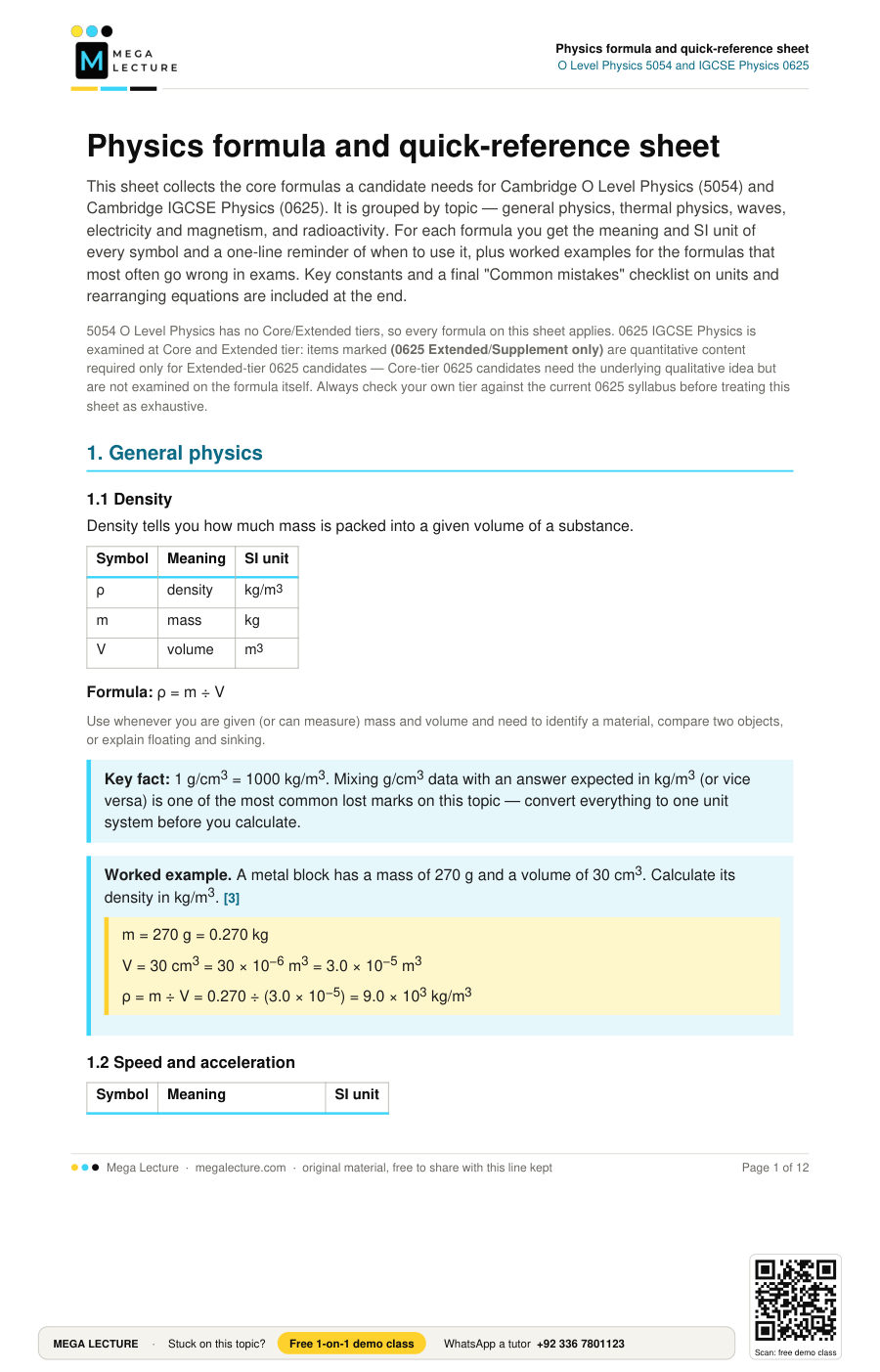
1.1 Density
Density tells you how much mass is packed into a given volume of a substance.
| Symbol | Meaning | SI unit |
|---|---|---|
| ρ | density | kg/m3 |
| m | mass | kg |
| V | volume | m3 |
Formula: ρ = m ÷ V
Use whenever you are given (or can measure) mass and volume and need to identify a material, compare two objects, or explain floating and sinking.
Key fact: 1 g/cm3 = 1000 kg/m3. Mixing g/cm3 data with an answer expected in kg/m3 (or vice versa) is one of the most common lost marks on this topic — convert everything to one unit system before you calculate.
Worked example. A metal block has a mass of 270 g and a volume of 30 cm3. Calculate its density in kg/m3. [3]
m = 270 g = 0.270 kg
V = 30 cm3 = 30 × 10−6 m3 = 3.0 × 10⁻⁵ m3
ρ = m ÷ V = 0.270 ÷ (3.0 × 10⁻⁵) = 9.0 × 10³ kg/m3
1.2 Speed and acceleration
| Symbol | Meaning | SI unit |
|---|---|---|
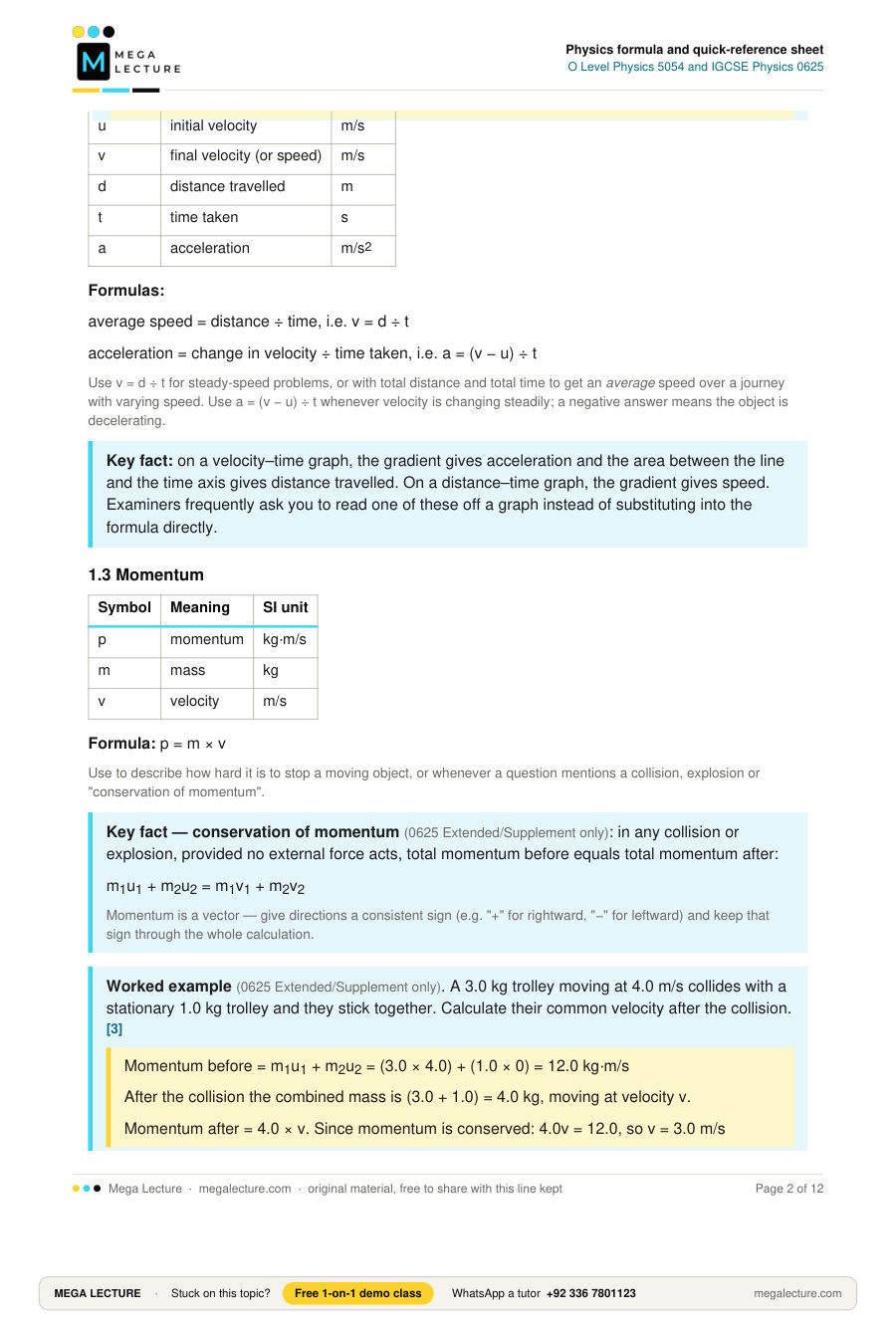
| u | initial velocity | m/s |
| v | final velocity (or speed) | m/s |
| d | distance travelled | m |
| t | time taken | s |
| a | acceleration | m/s2 |
Formulas:
average speed = distance ÷ time, i.e. v = d ÷ t
acceleration = change in velocity ÷ time taken, i.e. a = (v − u) ÷ t
Use v = d ÷ t for steady-speed problems, or with total distance and total time to get an average speed over a journey with varying speed. Use a = (v − u) ÷ t whenever velocity is changing steadily; a negative answer means the object is decelerating.
Key fact: on a velocity–time graph, the gradient gives acceleration and the area between the line and the time axis gives distance travelled. On a distance–time graph, the gradient gives speed. Examiners frequently ask you to read one of these off a graph instead of substituting into the formula directly.
1.3 Momentum
| Symbol | Meaning | SI unit |
|---|---|---|
| p | momentum | kg·m/s |
| m | mass | kg |
| v | velocity | m/s |
Formula: p = m × v
Use to describe how hard it is to stop a moving object, or whenever a question mentions a collision, explosion or "conservation of momentum".
Key fact — conservation of momentum (0625 Extended/Supplement only): in any collision or explosion, provided no external force acts, total momentum before equals total momentum after:
m1u1 + m2u2 = m1v1 + m2v2
Momentum is a vector — give directions a consistent sign (e.g. "+" for rightward, "−" for leftward) and keep that sign through the whole calculation.
Worked example (0625 Extended/Supplement only). A 3.0 kg trolley moving at 4.0 m/s collides with a stationary 1.0 kg trolley and they stick together. Calculate their common velocity after the collision. [3]
Momentum before = m1u1 + m2u2 = (3.0 × 4.0) + (1.0 × 0) = 12.0 kg·m/s
After the collision the combined mass is (3.0 + 1.0) = 4.0 kg, moving at velocity v.
Momentum after = 4.0 × v. Since momentum is conserved: 4.0v = 12.0, so v = 3.0 m/s
1.4 Force
| Symbol | Meaning | SI unit |
|---|---|---|
| F | resultant (unbalanced) force | N |
| m | mass | kg |
| a | acceleration | m/s2 |
Formula: F = m × a
Use whenever an object speeds up, slows down or changes direction and you know (or need) its mass or acceleration. F here must be the resultant force — if several forces act, add/subtract them (with direction) first.
Force as rate of change of momentum: F = Δp ÷ Δt = (mv − mu) ÷ t
This is an equivalent form of F = ma. Use it when a time interval and a change in momentum (or velocity) are given, especially in collision or impact questions.
Weight: W = m × g, where W is weight in newtons (N), m is mass in kg, and g is the gravitational field strength in N/kg. Weight is a force and changes with location; mass does not.
Key fact: mass and weight are not the same thing and examiners specifically test this. Mass (kg) is the amount of matter in an object and is constant everywhere. Weight (N) is the pull of gravity on that mass and depends on g at that location — an astronaut's mass is the same on the Moon as on Earth, but their weight is about one-sixth as much.
1.5 Work, energy and power
| Symbol | Meaning | SI unit |
|---|---|---|
| W | work done | J |
| F | force applied | N |
| d | distance moved in the direction of the force | m |
| Ek | kinetic energy | J |
| Ep | gravitational potential energy | J |
| h | height risen or fallen | m |
| P | power | W |
| t | time taken | s |
Formulas:
work done = force × distance moved in the direction of the force, i.e. W = F × d
kinetic energy: Ek = ½ × m × v2
gravitational potential energy: Ep = m × g × h
power = work done (or energy transferred) ÷ time taken, i.e. P = W ÷ t = E ÷ t
Use W = F × d for a force pushing, lifting or pulling something over a distance. Use the Ek and Ep formulas whenever a question involves speeding up, falling, or "energy transferred as height/speed changes". Use P = W ÷ t whenever a time is given alongside work or energy — power is a rate, so no time in the question usually means the answer should not be a power.
Key fact: efficiency = (useful energy output ÷ total energy input) × 100%. No real machine is 100% efficient — some energy is always transferred to the surroundings, usually by heating due to friction. State "no energy is created or destroyed" (conservation of energy), not that energy is "lost".
Worked example. A motor lifts a 15 kg load through a vertical height of 4.0 m in 5.0 s. Take g = 10 N/kg. Determine the useful power output of the motor. [4]
Useful energy gained = Ep = m × g × h = 15 × 10 × 4.0 = 600 J
P = E ÷ t = 600 ÷ 5.0 = 120 W
1.6 Pressure
| Symbol | Meaning | SI unit |
|---|---|---|
| p | pressure | Pa (= N/m2) |
| F | force acting at right angles to a surface | N |
| A | area over which the force acts | m2 |
| ρ | density of the liquid | kg/m3 |
| g | gravitational field strength | N/kg |
| h | depth below the liquid surface | m |
Formulas:
pressure = force ÷ area, i.e. p = F ÷ A
pressure in a liquid: p = ρ × g × h
Use p = F ÷ A for solids pressing on a surface (why a sharp knife or a drawing pin has a small area). Use p = ρgh for the extra pressure at a depth h below the surface of a liquid — it does not depend on the shape or width of the container, only on depth and density.
Key fact: atmospheric pressure acts in all directions, not just downward, and pushes on every surface exposed to the air. Total pressure at a depth h in an open liquid = atmospheric pressure + ρgh.
1.7 Moment of a force
| Symbol | Meaning | SI unit |
|---|---|---|
| M | moment of a force (turning effect) | N·m |
| F | force applied | N |
| d | perpendicular distance from the pivot to the line of action of the force | m |
Formula: M = F × d
Use for balancing, see-saw, lever and equilibrium questions. d must be the perpendicular distance from the pivot to the line of action of the force.
Key fact — principle of moments: for an object in equilibrium (balanced, not turning), the sum of the clockwise moments about a pivot equals the sum of the anticlockwise moments about the same pivot.
1.8 Hooke's Law
| Symbol | Meaning | SI unit |
|---|---|---|
| F | force (load) applied to a spring | N |
| k | spring constant | N/m |
| x (or e) | extension (increase in length from the natural, unstretched length) | m |
Formula: F = k × x
Use only up to the limit of proportionality — beyond this point the spring no longer obeys Hooke's Law and extension is no longer proportional to force, even though the spring may not yet be permanently deformed.
2. Thermal physics
2.1 Specific heat capacity
| Symbol | Meaning | SI unit |
|---|---|---|
| E (or Q) | thermal energy supplied or removed | J |
| m | mass of the substance | kg |
| c | specific heat capacity | J/(kg°C) |
| Δθ | change in temperature | °C |
Formula: E = m × c × Δθ
Use when a substance is heated or cooled without changing state — the temperature is changing but nothing is melting, freezing, boiling or condensing.
Key fact: specific heat capacity is defined as the energy needed to raise the temperature of 1 kg of a substance by 1°C (or 1 K — a change of 1°C equals a change of 1 K, even though the two scales have different zero points). Water has an unusually high specific heat capacity (about 4200 J/(kg°C)), which is why it heats up and cools down slowly.
Worked example. An electric kettle supplies 8.4 × 10⁴ J to heat 0.50 kg of water. Take the specific heat capacity of water as 4200 J/(kg°C). Show that the rise in temperature is 40°C. [3]
Rearranging E = mcΔθ: Δθ = E ÷ (m × c)
Δθ = 8.4 × 10⁴ ÷ (0.50 × 4200) = 8.4 × 10⁴ ÷ 2100 = 40°C
2.2 Specific latent heat
| Symbol | Meaning | SI unit |
|---|---|---|
| E | thermal energy supplied or removed during a change of state | J |
| m | mass changing state | kg |
| L | specific latent heat (of fusion for melting/freezing, of vaporisation for boiling/condensing) | J/kg |
Formula: E = m × L
Use only while a substance is changing state at a constant temperature — melting, freezing, boiling or condensing. Do not combine it with Δθ in the same term: temperature does not change during the change of state itself.
Key fact: specific latent heat of fusion applies to melting/freezing; specific latent heat of vaporisation applies to boiling/condensing, and is always the larger of the two for a given substance because separating molecules completely into a gas takes more energy than loosening a solid's structure into a liquid.
2.3 Gas law relationships
| Symbol | Meaning | SI unit |
|---|---|---|
| p | pressure of the gas | Pa |
| V | volume of the gas | m3 (or cm3, as long as it is used consistently on both sides) |
| T | absolute (Kelvin) temperature | K |
Formulas:
Boyle's Law (fixed mass of gas, constant temperature): p1V1 = p2V2 — 0625 Extended/Supplement only, not required for 0625 Core
Kelvin/Celsius conversion: T (K) = θ (°C) + 273
Use Boyle's Law when a gas is compressed or allowed to expand at constant temperature (pressure and volume change, temperature fixed). Always convert °C to K before using any formula containing T — kelvin is required whenever absolute temperature appears. How pressure changes with temperature at constant volume is examined qualitatively (see the key fact below) rather than as a formula to calculate with.
Key fact: the rise in gas pressure with temperature (at constant volume) and the rise in pressure with compression (at constant temperature) are both explained by the same particle model: gas pressure is caused by gas molecules colliding with the container walls. Squeezing the gas into a smaller volume increases the frequency of collisions per unit area; heating the gas increases the average speed (and hence the force) of the collisions.
Worked example (0625 Extended/Supplement only). A fixed mass of gas has a volume of 200 cm3 at a pressure of 1.0 × 10⁵ Pa. The gas is compressed at constant temperature until its pressure is 2.5 × 10⁵ Pa. Calculate the new volume. [3]
p1V1 = p2V2
(1.0 × 105) × 200 = (2.5 × 10⁵) × V2
V2 = (1.0 × 105 × 200) ÷ (2.5 × 10⁵) = 80 cm3
3. Waves
3.1 Wave speed equation
| Symbol | Meaning | SI unit |
|---|---|---|
| v | speed of the wave | m/s |
| f | frequency (number of complete waves passing a point per second) | Hz |
| λ | wavelength (distance between corresponding points on adjacent waves) | m |
| T | period (time for one complete wave to pass a point) | s |
Formulas:
v = f × λ
T = 1 ÷ f
Use v = fλ whenever you are given any two of speed, frequency and wavelength for a wave — water waves, sound waves or electromagnetic waves. Remember frequency and period are reciprocals of each other.
Key fact: all electromagnetic waves travel at the same speed in a vacuum (the speed of light, c). A change in colour/type of electromagnetic wave is a change in frequency and wavelength, not speed — so a higher-frequency EM wave must have a shorter wavelength, and vice versa.
3.2 Refractive index
| Symbol | Meaning | SI unit |
|---|---|---|
| n | refractive index (no unit — it is a ratio) | — |
| θi | angle of incidence, measured from the normal | degrees (°) |
| θr | angle of refraction, measured from the normal | degrees (°) |
| c | speed of light in a vacuum (or air) | m/s |
| v | speed of light in the medium (e.g. glass) | m/s |
Note: the degree (°) is the conventional unit for angles used throughout CAIE Physics papers, not strictly an SI unit (the SI unit of plane angle is the radian).
Formulas:
n = sin θi ÷ sin θr (light travelling from air into the medium)
n = c ÷ v
Use the sine formula whenever incidence and refraction angles are given or measured (typically for light entering glass or a similar block). Use n = c ÷ v when the two speeds of light are given instead of angles. Both formulas describe the same refractive index for a given medium.
Key fact — critical angle and total internal reflection: sin(critical angle) = 1 ÷ n. Total internal reflection can only happen when light travels from a denser medium (higher n) towards a less dense one (e.g. glass to air) and the angle of incidence inside the denser medium exceeds the critical angle.
Worked example. A ray of light in air strikes a glass block at an angle of incidence of 40° to the normal. The refractive index of the glass is 1.5. Determine the angle of refraction. [3]
n = sin θi ÷ sin θr, so sin θr = sin θi ÷ n
sin θr = sin 40° ÷ 1.5 = 0.643 ÷ 1.5 = 0.428
θr = sin−1(0.428) = 25° (to 2 significant figures)
4. Electricity and magnetism
4.1 Charge and current
| Symbol | Meaning | SI unit |
|---|---|---|
| Q | charge | C (coulomb) |
| I | current | A (ampere) |
| t | time | s |
Formula: Q = I × t
Use whenever a current flows for a given time and you need the total charge that has passed a point in a circuit, or vice versa.
4.2 Voltage (potential difference)
| Symbol | Meaning | SI unit |
|---|---|---|
| V | potential difference (voltage) | V (volt) |
| W (or E) | work done (energy transferred) as charge moves between two points | J |
| Q | charge that moves | C |
Formula: V = W ÷ Q
Use this definition when a question asks what a "volt" actually means, or gives energy transferred and charge and asks for a voltage (or the reverse). In circuit calculations, V = IR (below) is used far more often.
4.3 Resistance and Ohm's Law
| Symbol | Meaning | SI unit |
|---|---|---|
| V | potential difference across a component | V |
| I | current through the component | A |
| R | resistance | Ω (ohm) |
Formula: V = I × R
V = I × R is simply the definition of resistance and holds for any component at any instant, ohmic or not — it is still true for a filament lamp, even though the lamp's resistance changes with current. Ohm's Law is the separate, stronger statement that, for an ohmic conductor at constant temperature (and other physical conditions unchanged), current is directly proportional to voltage — so R stays constant, shown by a straight-line V–I graph through the origin. Non-ohmic components (e.g. a filament lamp) still obey V = IR at any instant, but their resistance is not constant.
4.4 Resistors in series and parallel
| Arrangement | Formula for total resistance | When to use |
|---|---|---|
| Series | Rtotal = R1 + R2 + R3 + … | Components joined end to end in a single loop; the same current flows through each one, and the total resistance is always bigger than the largest individual resistor. |
| Parallel | 1 ÷ Rtotal = 1 ÷ R1 + 1 ÷ R2 + … | Components connected across the same two points, each on its own branch; the same voltage is across each one, and the total resistance is always smaller than the smallest individual resistor. |
Key fact: in a series circuit, current is the same everywhere and voltages across components add up to the supply voltage. In a parallel circuit, voltage is the same across every branch and currents in the branches add up to the total current from the supply. Mixing these two rules up is one of the most common circuit errors.
Worked example. A 6.0 Ω resistor and a 3.0 Ω resistor are connected in parallel. Calculate the combined resistance. [3]
1 ÷ Rtotal = 1 ÷ 6.0 + 1 ÷ 3.0 = 0.167 + 0.333 = 0.500
Rtotal = 1 ÷ 0.500 = 2.0 Ω
4.5 Electrical power and energy
| Symbol | Meaning | SI unit |
|---|---|---|
| P | electrical power | W |
| I | current | A |
| V | voltage | V |
| R | resistance | Ω |
| E | electrical energy transferred | J (or kWh for household bills) |
| t | time | s (or h for kWh) |
Formulas:
P = I × V
P = I2 × R
P = V2 ÷ R
E = P × t
All three power formulas are equivalent (found by combining P = IV with V = IR) — pick whichever one uses the quantities you are already given, rather than calculating an in-between value you don't need. Use E = Pt to find total electrical energy transferred, with t in seconds for joules.
Key fact: "power" and "energy" are not interchangeable in an exam answer — power (W) is the rate of energy transfer; energy (J) is the total amount transferred. A 100 W device left on for 10 s transfers 1000 J, not 1000 W.
4.6 The transformer equation
0625 Extended/Supplement only — not required for 0625 Core candidates. Required throughout for 5054 O Level.
| Symbol | Meaning | SI unit |
|---|---|---|
| Vp | voltage across the primary coil | V |
| Vs | voltage across the secondary coil | V |
| Np | number of turns on the primary coil | — (no unit, a count) |
| Ns | number of turns on the secondary coil | — (no unit, a count) |
| Ip | current in the primary coil | A |
| Is | current in the secondary coil | A |
Formulas:
Vp ÷ Vs = Np ÷ Ns
for an ideal (100% efficient) transformer: Vp × Ip = Vs × Is
Use the turns-ratio formula to relate voltages and coil turns for a step-up or step-down transformer. Use the second formula (power in = power out) to find current in one coil given the current in the other, since an ideal transformer cannot create energy — as voltage steps up, current must step down, and vice versa.
Worked example (0625 Extended/Supplement only). A step-down transformer has 4600 turns on its primary coil and 200 turns on its secondary coil. The primary voltage is 230 V. Calculate the secondary voltage, and the secondary current if the primary current is 1.0 A (assume the transformer is ideal). [4]
Vp ÷ Vs = Np ÷ Ns, so Vs = Vp × (Ns ÷ Np)
Vs = 230 × (200 ÷ 4600) = 10.0 V
VpIp = VsIs, so Is = (Vp × Ip) ÷ Vs = (230 × 1.0) ÷ 10.0 = 23 A
5. Radioactivity
5.1 Half-life
| Symbol | Meaning | SI unit |
|---|---|---|
| t½ | half-life: the time taken for half the undecayed nuclei in a sample (or its activity) to decay | s (also commonly given in minutes, hours or years for slow decays) |
| N0 | initial number of undecayed nuclei (or initial activity/count rate) | — (a count, or Bq for activity) |
| N | number of undecayed nuclei (or activity/count rate) remaining after time t | — (or Bq) |
| n | number of half-lives that have passed | — (no unit) |
Formula: N = N0 × (½)n, where n = t ÷ t½ (0625 Extended/Supplement only for this quantitative form; the definition of half-life itself is required for all candidates)
Use whenever a question gives an initial count/activity, a half-life, and asks how much remains (or how long until a certain fraction remains). Half-life is a fixed property of a radioactive isotope — it does not depend on temperature, pressure or how much of the sample you have.
Key fact: after n half-lives, the fraction of the original undecayed sample remaining is (½)n: ½ after 1 half-life, ¼ after 2, ⅛ after 3, and so on. Background radiation is always present in count-rate measurements and, strictly, should be subtracted before a half-life calculation — many exam mark schemes expect this to be mentioned even if the arithmetic is not required.
Worked example (0625 Extended/Supplement only). A radioactive sample has an initial activity of 640 Bq. Its half-life is 3 hours. Determine its activity after 12 hours. [3]
Number of half-lives, n = t ÷ t½ = 12 ÷ 3 = 4
N = N0 × (½)n = 640 × (½)4 = 640 × (1 ÷ 16) = 40 Bq
6. Key constants
| Constant | Symbol | Value |
|---|---|---|
| Speed of light in a vacuum | c | 3.0 × 10⁸ m/s |
| Speed of sound in air (room temperature, approximate) | — | about 330–340 m/s — always use the value stated in the question if one is given, since it can vary slightly with temperature |
| Gravitational field strength near Earth's surface | g | 10 N/kg (equivalently 10 m/s2) is the standard value used unless a question tells you otherwise; a more precise value of 9.8 is sometimes used |
Key fact: g has two equivalent roles and two equivalent sets of units: as a gravitational field strength it is measured in N/kg (force per unit mass, used in W = mg); as a free-fall acceleration it is measured in m/s2 (used in a = (v − u) ÷ t for a falling object). The number is the same either way, so do not treat them as two different constants.
Common mistakes
- Not converting to SI units before substituting. Convert cm to m (÷100), cm2 to m2 (÷10 000), cm3 to m3 (÷1 000 000), g to kg (÷1000), and minutes or hours to seconds (×60 or ×3600) before you put numbers into a formula — not after.
- Forgetting to convert °C to K in gas law formulas. p1V1 = p2V2 can be used with any consistent pressure and volume units, but any formula containing T must use kelvin (T = θ + 273), never degrees Celsius directly.
- Confusing mass and weight. Mass is in kg and stays constant; weight is a force in N and equals mass × g. "How heavy" questions in newtons need W = mg, not just the mass value.
- Confusing energy and power. Power (W) is a rate; energy (J) is a total amount. Check whether the question gives/asks for a time — if there is no time involved, the answer is very unlikely to be a power.
- Wrong formula for parallel resistors. The parallel resistance formula gives 1 ÷ Rtotal, not Rtotal directly — a common slip is stopping after adding the reciprocals and forgetting the final step of taking the reciprocal of the sum.
- Incorrect rearranging of equations. When a symbol you want is on the bottom of a fraction (e.g. finding t from a = (v − u) ÷ t), multiply both sides by that symbol first, then divide, rather than trying to "flip" the equation in one step. Always redo the algebra symbolically before substituting numbers, and check the rearranged formula by substituting the original numbers back in.
- Not squaring (or rooting) correctly. In Ek = ½mv2, the v is squared but the ½ and m are not; when rearranging for v, divide by ½m first, then take the square root of the whole remaining expression, not just part of it.
- Mixing units of the same quantity. g/cm3 and kg/m3 in the same density calculation, or Ω and kΩ in the same resistance calculation, will give an answer that is out by a factor of 1000 (or more) — state the unit of every value as you write it down, not just at the end.
- Giving an answer without a unit, or with the wrong unit. A numerically correct answer with a missing or wrong unit usually loses the mark. Match the unit to what the formula's symbols require (check your own symbol/unit table for that formula).
- Ignoring significant figures given in the question. If data in the question is given to 2 significant figures, a final answer to 5 or 6 significant figures (straight from a calculator display) is generally not appropriate; round sensibly, but do not round intermediate working, only the final answer.
