
GCSE · Biology · AQA GCSE Biology Notes: Inheritance, Variation and Evolution (Topic 6)
AQA GCSE Biology Notes: Inheritance, Variation and Evolution (Topic 6)
Opens inside this page. Prefer your own PDF app? Open the PDF.
Check yourself
5 quick questions on GCSE Biology
Tap an answer to see if you are right, and why. Free, no sign-up.
Start the free testWas this note useful?
Full text of AQA GCSE Biology Notes: Inheritance, Variation and Evolution (Topic 6)
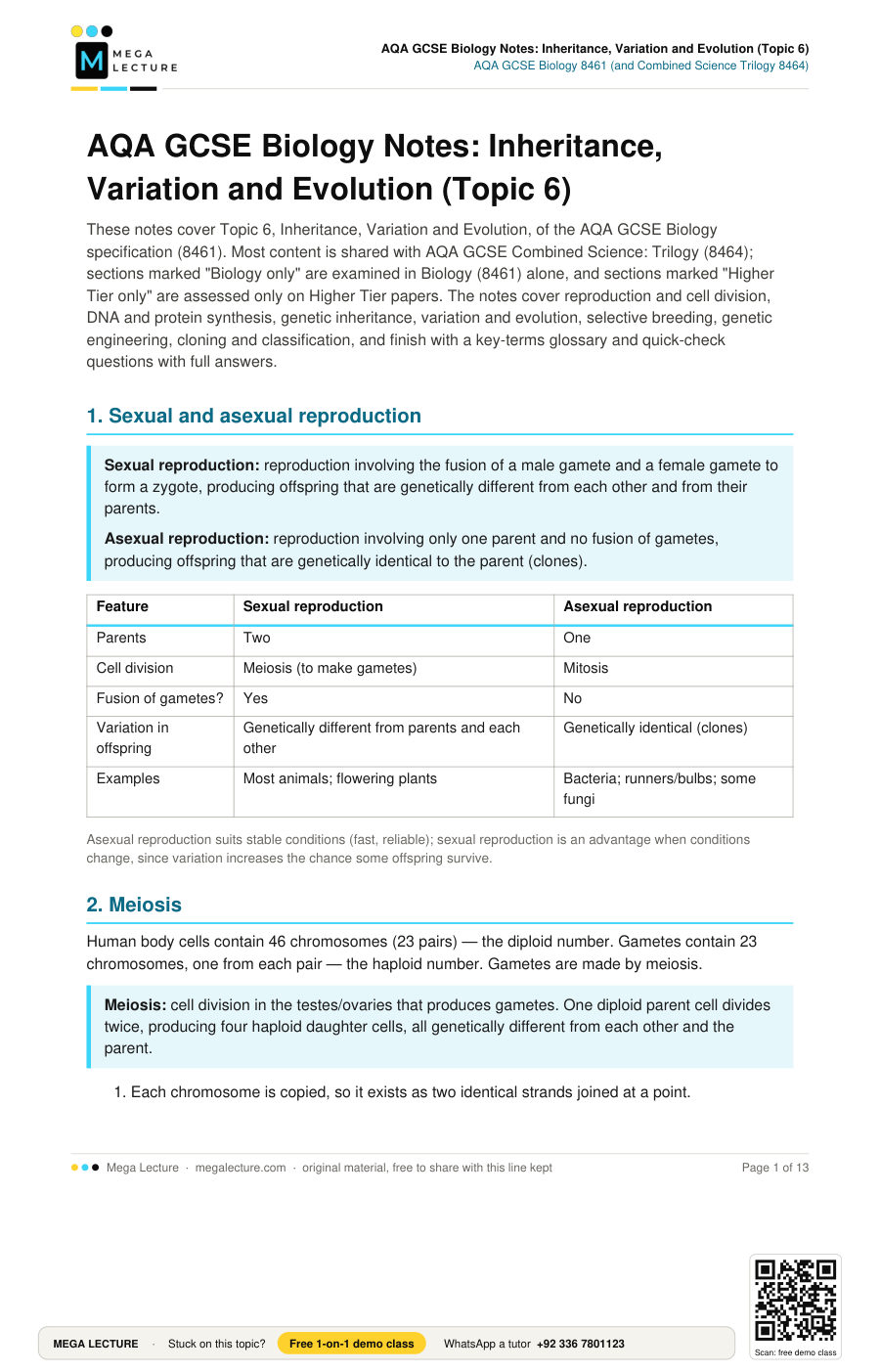
These notes cover Topic 6, Inheritance, Variation and Evolution, of the AQA GCSE Biology specification (8461). Most content is shared with AQA GCSE Combined Science: Trilogy (8464); sections marked "Biology only" are examined in Biology (8461) alone, and sections marked "Higher Tier only" are assessed only on Higher Tier papers. The notes cover reproduction and cell division, DNA and protein synthesis, genetic inheritance, variation and evolution, selective breeding, genetic engineering, cloning and classification, and finish with a key-terms glossary and quick-check questions with full answers.
1. Sexual and asexual reproduction
Sexual reproduction: reproduction involving the fusion of a male gamete and a female gamete to form a zygote, producing offspring that are genetically different from each other and from their parents.
Asexual reproduction: reproduction involving only one parent and no fusion of gametes, producing offspring that are genetically identical to the parent (clones).
| Feature | Sexual reproduction | Asexual reproduction |
|---|---|---|
| Parents | Two | One |
| Cell division | Meiosis (to make gametes) | Mitosis |
| Fusion of gametes? | Yes | No |
| Variation in offspring | Genetically different from parents and each other | Genetically identical (clones) |
| Examples | Most animals; flowering plants | Bacteria; runners/bulbs; some fungi |
Asexual reproduction suits stable conditions (fast, reliable); sexual reproduction is an advantage when conditions change, since variation increases the chance some offspring survive.
2. Meiosis
Human body cells contain 46 chromosomes (23 pairs) — the diploid number. Gametes contain 23 chromosomes, one from each pair — the haploid number. Gametes are made by meiosis.
Meiosis: cell division in the testes/ovaries that produces gametes. One diploid parent cell divides twice, producing four haploid daughter cells, all genetically different from each other and the parent.- Each chromosome is copied, so it exists as two identical strands joined at a point.
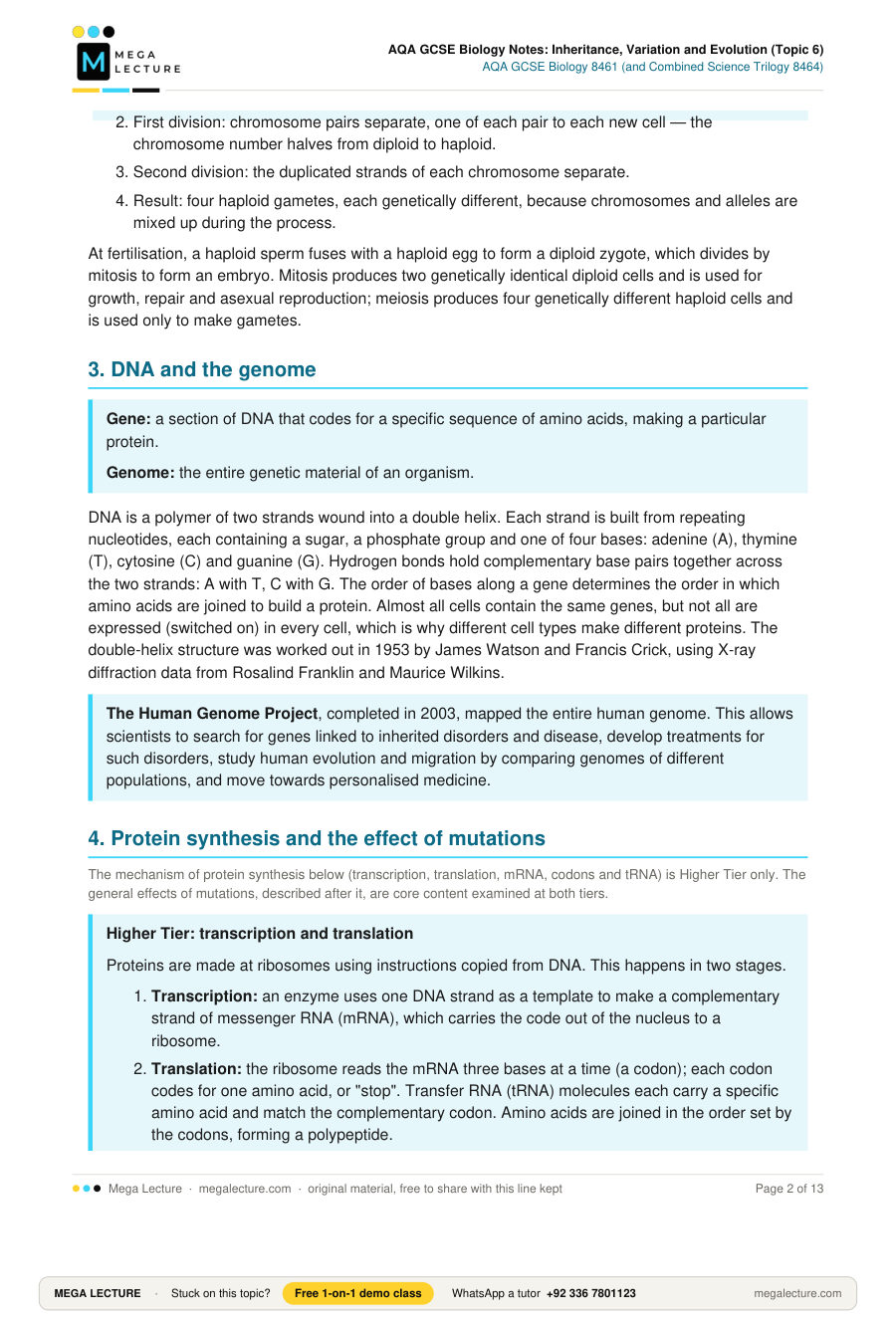
- First division: chromosome pairs separate, one of each pair to each new cell — the chromosome number halves from diploid to haploid.
- Second division: the duplicated strands of each chromosome separate.
- Result: four haploid gametes, each genetically different, because chromosomes and alleles are mixed up during the process.
At fertilisation, a haploid sperm fuses with a haploid egg to form a diploid zygote, which divides by mitosis to form an embryo. Mitosis produces two genetically identical diploid cells and is used for growth, repair and asexual reproduction; meiosis produces four genetically different haploid cells and is used only to make gametes.
3. DNA and the genome
Gene: a section of DNA that codes for a specific sequence of amino acids, making a particular protein.
Genome: the entire genetic material of an organism.
DNA is a polymer of two strands wound into a double helix. Each strand is built from repeating nucleotides, each containing a sugar, a phosphate group and one of four bases: adenine (A), thymine (T), cytosine (C) and guanine (G). Hydrogen bonds hold complementary base pairs together across the two strands: A with T, C with G. The order of bases along a gene determines the order in which amino acids are joined to build a protein. Almost all cells contain the same genes, but not all are expressed (switched on) in every cell, which is why different cell types make different proteins. The double-helix structure was worked out in 1953 by James Watson and Francis Crick, using X-ray diffraction data from Rosalind Franklin and Maurice Wilkins.
The Human Genome Project, completed in 2003, mapped the entire human genome. This allows scientists to search for genes linked to inherited disorders and disease, develop treatments for such disorders, study human evolution and migration by comparing genomes of different populations, and move towards personalised medicine.4. Protein synthesis and the effect of mutations
The mechanism of protein synthesis below (transcription, translation, mRNA, codons and tRNA) is Higher Tier only. The general effects of mutations, described after it, are core content examined at both tiers.
Higher Tier: transcription and translation
Proteins are made at ribosomes using instructions copied from DNA. This happens in two stages.
- Transcription: an enzyme uses one DNA strand as a template to make a complementary strand of messenger RNA (mRNA), which carries the code out of the nucleus to a ribosome.
- Translation: the ribosome reads the mRNA three bases at a time (a codon); each codon codes for one amino acid, or "stop". Transfer RNA (tRNA) molecules each carry a specific amino acid and match the complementary codon. Amino acids are joined in the order set by the codons, forming a polypeptide.
The polypeptide folds into a shape that depends on its amino acid sequence; this shape determines the protein's function, for example whether an enzyme's active site fits its substrate. Some non-coding DNA does not code for protein but controls whether, or how much, a gene is expressed.
Mutation: a random change in the DNA base sequence, occurring continuously.Most mutations have little or no effect on the protein produced, since many fall in non-coding DNA or do not change the amino acid sequence. Some change the amino acid sequence and so the protein's shape, which can stop it working (e.g. an enzyme's active site no longer fits its substrate); a mutation in a control region can change whether or how much a protein is made. Very rarely, a mutation produces a protein with an improved function, which can benefit the organism.
(Higher Tier) At gene level, a mutation changes the DNA base sequence, which can change the codon read during translation, and so change the amino acid sequence and shape of the protein produced.
5. Genetic inheritance, genetic diagrams and inherited disorders
Allele: a version of a gene. Dominant allele: expressed whenever present. Recessive allele: expressed only when two copies are present.
Genotype: an organism's combination of alleles for a gene. Phenotype: its observable characteristics, resulting from genotype and/or environment.
Homozygous: two identical alleles (e.g. FF, ff). Heterozygous: two different alleles (e.g. Ff).
A dominant allele is conventionally written as a capital letter, and the recessive allele for the same gene as the same letter in lower case. A Punnett square shows all possible offspring genotypes from a genetic cross.
Worked example: cystic fibrosis (recessive)Cystic fibrosis is caused by a recessive allele and causes thick, sticky mucus in the lungs, digestive system and pancreas. Let F = dominant normal allele, f = recessive cystic fibrosis allele. Two unaffected carrier parents are both Ff.
| F (Parent 1) | f (Parent 1) | |
|---|---|---|
| F (Parent 2) | FF | Ff |
| f (Parent 2) | Ff | ff |
Ratio 1 FF : 2 Ff : 1 ff. Only ff has cystic fibrosis, so the probability for each pregnancy is 1 in 4 (25%).
Worked example: polydactyly (dominant)Polydactyly (extra fingers/toes) is caused by a dominant allele D (normal = d). A heterozygous parent (Dd) crossed with an unaffected parent (dd) gives offspring 1 Dd : 1 dd — a 1 in 2 (50%) chance of polydactyly, since one dominant allele is enough for it to appear.
Worked example: reading a family tree (pedigree) for a recessive disorderThe table below describes a family tree for cystic fibrosis. Neither parent in Generation I has cystic fibrosis, but one of their children does.
| Generation | Individual | Sex | Phenotype | Parents |
|---|---|---|---|---|
| I | 1 | Male | Unaffected | — |
| I | 2 | Female | Unaffected | — |
| II | 3 | Female | Affected (has cystic fibrosis) | 1 × 2 |
| II | 4 | Male | Unaffected | 1 × 2 |
Reading the family tree: individuals 1 and 2 are both unaffected, yet their daughter (individual 3) is affected. This can only happen if the allele is recessive — if it were dominant, at least one affected parent would be needed. So individuals 1 and 2 must both be unaffected carriers, genotype Ff; individual 3 must be homozygous recessive, genotype ff.
Individual 4 is unaffected, so is FF or Ff. From the Punnett square above (1 FF : 2 Ff : 1 ff), among unaffected offspring the ratio is 1 FF : 2 Ff, so the probability that individual 4 is a carrier is 2 in 3.
In general: for a recessive disorder, two unaffected parents can have an affected child (both are unaffected carriers), and an affected individual can have unaffected parents. For a dominant disorder, an affected individual must have at least one affected parent, since the dominant allele must have come from somewhere.
6. Sex determination
Of the 23 human chromosome pairs, 22 are autosomes (same in both sexes); the 23rd pair are the sex chromosomes: females XX, males XY.
Worked example: sex determinationAll eggs carry an X chromosome; sperm carry X or Y in equal numbers.
| X (egg) | X (egg) | |
|---|---|---|
| X (sperm) | XX | XX |
| Y (sperm) | XY | XY |
Ratio 1 XX : 1 XY — a 50:50 chance of a girl or boy. Since only sperm carry a Y chromosome, the father's contribution determines biological sex.
7. Embryo screening
IVF embryos can be tested for alleles that cause serious genetic disorders before implantation (embryo screening/pre-implantation genetic diagnosis); only unaffected embryos are implanted.
Ethical issues: for — can prevent serious suffering and reduce long-term medical costs. Against — some see selecting/discarding embryos on genetic grounds as wrong, implying affected people are "less valuable"; concern it could extend to non-medical traits ("designer babies"); also cost, unequal access, and emotional impact on parents.
8. Variation
Variation: the differences between individuals of the same species.- Genetic variation arises mainly from meiosis, which mixes up which alleles end up in each gamete, and from random fertilisation during sexual reproduction, and from mutation, which is the only source of completely new alleles.
- Environmental variation results from differences in an organism's surroundings or lifestyle (e.g. diet, light).
- Most characteristics result from a combination of genetic and environmental factors (e.g. body mass).
Genetically-controlled variation (e.g. blood group) tends to be discontinuous (distinct categories); environmentally-influenced variation (e.g. height) tends to be continuous (a full range of values).
9. Evolution and natural selection
Evolution: a gradual change in the inherited characteristics of a population over many generations, driven by natural selection, which can lead to a new species.Charles Darwin developed the theory of evolution by natural selection, drawing on observations from his voyage on HMS Beagle, including the Galápagos finches, publishing it in 1859. Alfred Russel Wallace independently developed a similar theory around the same time; the two jointly first presented their ideas in 1858.
Natural selection, in stages:- Individuals in a population vary in their characteristics, due to mutation and inherited alleles.
- Some variation gives a survival advantage in the environment.
- Individuals with an advantage are more likely to survive and reproduce.
- Their alleles are more likely to be passed to the next generation.
- Over many generations, advantageous alleles become more common, gradually changing the population; over long enough timescales this can produce a new species.
Darwin's theory was only gradually accepted: it challenged religious beliefs, genes and DNA were not yet known (so there was no mechanism for inheritance), and fossil evidence at the time seemed insufficient. Jean-Baptiste Lamarck's earlier, rival theory — that characteristics acquired during an organism's lifetime (e.g. through use) could be inherited — is now considered largely wrong, since there is no mechanism by which lifetime changes can alter the DNA in gametes. Darwin's theory is now supported by fossils, DNA comparisons between species, and direct observation of natural selection today (e.g. antibiotic resistance), and is accepted as the best explanation for life's diversity.
Speciation
A new species can form (speciation) when two populations of the same species become so different that they can no longer interbreed to produce fertile offspring. This typically happens when populations are separated by a physical barrier, such as an ocean, mountain range or desert (geographical isolation), so that alleles can no longer be exchanged between them. Because the two areas usually differ slightly in their environments, natural selection favours different characteristics in each population; over many generations, the two populations accumulate enough genetic differences that, even if they later meet again, they can no longer interbreed successfully, and so form two separate species. The Galápagos finches observed by Darwin, each adapted to a different island's food source, are a classic example of this process.
Fossils and extinction
Fossils are the preserved remains or traces of organisms from millions of years ago. They form when hard parts do not decay or are gradually replaced by minerals, when decay is prevented entirely (e.g. amber, ice, peat), or as preserved traces such as footprints. Early life was soft-bodied and left few fossils, and much early evidence has been destroyed by geological activity, so scientists cannot be certain how life began, though the fossils that exist show a pattern of gradual change supporting evolution. A species becomes extinct when no individuals remain; causes include environmental change too rapid to adapt to, a new predator, disease or competitor, or a catastrophic event such as an asteroid impact or volcanic eruption.
Worked example: antibiotic resistanceBacteria reproduce rapidly and mutate continuously; occasionally a mutation gives resistance to an antibiotic. When exposed to that antibiotic, non-resistant bacteria die but resistant ones survive and reproduce, passing on the resistance allele. Without competition from killed bacteria, the resistant proportion of the population increases each generation until most bacteria are resistant (e.g. MRSA).
To slow resistance developing: doctors avoid prescribing antibiotics inappropriately (e.g. for viral or minor infections), patients complete full courses, and antibiotic use in farming is restricted. New antibiotics are costly and slow to develop, and are unlikely to keep pace with resistance evolving.
10. Selective breeding
Selective breeding (artificial selection): humans breeding plants/animals for desired genetic characteristics, by choosing and breeding from individuals that show them.- Select individuals showing the desired characteristic.
- Breed them together.
- Select offspring showing the characteristic most strongly.
- Repeat over many generations until all offspring show it strongly.
Examples: disease-resistant or higher-yield crops; farm animals bred for more meat/milk/eggs; dog breeds; ornamental flowers.
Selective breeding greatly reduces the gene pool, since only individuals with desired traits are bred, generation after generation. This can cause inbreeding, increasing the chance of inheriting harmful recessive alleles, and leaves the population with less variation, making it less able to respond to a new disease or environmental change.
11. Genetic engineering
Genetic engineering: changing an organism's genome by inserting a gene from a different organism to produce a desired characteristic.- The gene for the desired characteristic is cut from donor DNA using enzymes.
- It is inserted into a vector — commonly a bacterial plasmid or a virus.
- The vector carries and inserts the gene into the target organism's cells.
- Genes may be inserted at an early developmental stage so the whole organism grows with the new characteristic.
Examples: bacteria engineered with the human insulin gene produce insulin to treat diabetes; GM crops engineered for pest resistance, herbicide resistance, or improved nutrition.
Benefits/concerns of GM crops: benefits include higher yield and reduced pesticide use; concerns include herbicide-resistance genes spreading to wild plants via cross-pollination, uncertain long-term health effects, and reduced biodiversity. Some countries grow GM crops widely; others restrict them, reflecting differing confidence in long-term safety.
12. Cloning (Biology only)
Clone: an organism genetically identical to another.Plants: in tissue culture, small groups of cells from a parent plant are grown on nutrient agar gel with hormones, quickly producing many identical, disease-free plants. Cuttings — a simpler, older method — are stem sections cut from a parent plant, grown until they root, producing genetically identical new plants.
Animals: in embryo transplantation, cells are split from an early embryo (before specialising) and the resulting identical embryos transplanted into surrogate mothers. In adult cell cloning, the nucleus of an unfertilised egg cell is replaced with a nucleus from an adult body cell; an electric shock stimulates division to form an embryo, which is transplanted into a surrogate mother and develops into an offspring genetically identical to the nucleus donor (how Dolly the sheep was produced). Uses include studying gene function/disease and preserving endangered species.
13. Classification of living organisms (Biology only)
Organisms have traditionally been classified by structure and characteristics using Carl Linnaeus's hierarchy: kingdom, phylum, class, order, family, genus, species. Each species has a two-part (binomial) name — genus and species, e.g. Homo sapiens.
As chemical and DNA evidence became available, classification was revised to reflect evolutionary relationships more accurately. Carl Woese proposed the three-domain system, sitting above kingdom:
- Archaea: single-celled, no nucleus, often in extreme environments.
- Bacteria: single-celled, no nucleus, distinct cell chemistry from Archaea.
- Eukaryota: cells with a nucleus — protists, fungi, plants, animals.
Evolutionary trees show how species are related, using evidence from characteristics and, especially for closely related species, DNA sequences; branches joining nearer the tips indicate a more recent common ancestor (closer relationship).
Key terms
| Term | Definition |
|---|---|
| Sexual reproduction | Fusion of male and female gametes from two parents, giving genetically varied offspring. |
| Asexual reproduction | Reproduction from one parent with no gamete fusion, giving genetically identical offspring. |
| Gamete | A haploid sex cell (egg or sperm). |
| Fertilisation | Fusion of a male and female gamete nucleus to form a zygote. |
| Zygote | The diploid cell formed at fertilisation. |
| Diploid | Having two complete sets of chromosomes (46 in humans). |
| Haploid | Having one complete set of chromosomes (23 in human gametes). |
| Chromosome | A coiled DNA molecule carrying many genes. |
| Mitosis | Division producing two identical diploid cells; growth, repair, asexual reproduction. |
| Meiosis | Division producing four genetically different haploid gametes. |
| DNA | The double-helix polymer that carries genetic information. |
| Nucleotide | DNA's repeating unit: sugar, phosphate and one base. |
| Complementary base pairing | A pairs with T, C pairs with G. |
| Gene | A DNA section coding for one protein. |
| Genome | All the genetic material of an organism. |
| Human Genome Project | International project that mapped the human genome (completed 2003). |
| Allele | An alternative version of a gene. |
| Dominant allele | Expressed whenever present. |
| Recessive allele | Expressed only when two copies are present. |
| Genotype | An organism's combination of alleles for a gene. |
| Phenotype | An organism's observable characteristics. |
| Homozygous | Two identical alleles for a gene. |
| Heterozygous | Two different alleles for a gene. |
| Carrier | Has one recessive allele but does not show the disorder. |
| Punnett square | Diagram showing possible offspring genotypes from a cross. |
| Monohybrid cross | A cross tracking inheritance of one gene. |
| Family tree (pedigree) | Diagram of how a trait is inherited through a family. |
| Cystic fibrosis | Recessive disorder causing thick, sticky mucus in lungs/pancreas. |
| Polydactyly | Dominant condition causing extra fingers/toes. |
| Autosome | Any chromosome that is not a sex chromosome. |
| Sex chromosome | XX (female) or XY (male) chromosome pair. |
| Embryo screening | Testing IVF embryos for disorder-causing alleles before implantation. |
| Variation | Differences between individuals of a species. |
| Genetic variation | Variation caused by differences in genes/alleles. |
| Environmental variation | Variation caused by surroundings or lifestyle. |
| Continuous variation | A full range of values, no distinct categories (e.g. height). |
| Discontinuous variation | Distinct categories, no intermediates (e.g. blood group). |
| Mutation | A random change in a DNA base sequence. |
| Transcription | Copying a gene's DNA sequence into mRNA. |
| Translation | Building a polypeptide at a ribosome from mRNA codons. |
| mRNA | Carries the genetic code from nucleus to ribosome. |
| tRNA | Carries a specific amino acid to match an mRNA codon. |
| Codon | A three-base mRNA sequence coding for one amino acid. |
| Ribosome | Cell structure where proteins are assembled. |
| Polypeptide | A chain of amino acids that folds to form a protein. |
| Non-coding DNA | DNA that can control gene expression without coding for protein. |
| Evolution | Gradual change in a population's inherited characteristics over generations. |
| Natural selection | Better-suited organisms survive, reproduce and pass on advantageous alleles. |
| Species | Organisms that can breed to produce fertile offspring. |
| Speciation | Formation of a new species from an existing one. |
| Geographical isolation | Separation of populations by a physical barrier, preventing interbreeding and allele exchange. |
| Fossil | Preserved remains or traces of an ancient organism. |
| Extinction | Permanent disappearance of a species. |
| Antibiotic resistance | A bacterium's ability to survive an antibiotic, spread by natural selection. |
| MRSA | Bacteria resistant to several common antibiotics. |
| Selective breeding | Breeding chosen individuals with desired traits over generations. |
| Gene pool | The range of alleles present in a population. |
| Inbreeding | Breeding between close relatives, raising the risk of inherited disorders. |
| Genetic engineering | Inserting a gene from another organism to give a desired characteristic. |
| Vector | A plasmid or virus used to carry a gene into a cell. |
| Plasmid | A small circular loop of bacterial DNA, often used as a vector. |
| GM crop | A crop with a genome altered by genetic engineering. |
| Clone | An organism genetically identical to another. |
| Tissue culture | Cloning plants from cells grown on nutrient agar. |
| Cutting | A stem section grown to form a genetically identical plant. |
| Embryo transplantation | Splitting embryo cells and implanting identical embryos into surrogates. |
| Adult cell cloning | Inserting an adult cell's nucleus into an emptied egg cell to create a clone. |
| Classification | Organising organisms into groups by characteristics/relationships. |
| Binomial naming | A two-part scientific name: genus and species. |
| Domain | The highest rank in classification, above kingdom. |
| Three-domain system | Classification into Archaea, Bacteria and Eukaryota. |
| Evolutionary tree | A diagram showing species' relatedness via common ancestors. |
Quick check
- Name the type of cell division used to produce gametes. [1]
- Give two differences between sexual and asexual reproduction. [2]
- Describe the structure of a DNA molecule. [3]
- Define the terms genotype and phenotype. [2]
- Cystic fibrosis is caused by a recessive allele, f. Two parents are both carriers (Ff). Using a Punnett square, calculate the probability their child has cystic fibrosis. [4]
- The family tree below shows a family affected by polydactyly (dominant allele D; recessive d).
Generation Individual Sex Phenotype Parents I 1 Male Affected — I 2 Female Unaffected — II 3 Female Affected 1 × 2 II 4 Male Unaffected 1 × 2 a) State the genotype of individual 2. [1]
b) Individual 4 is unaffected. Explain what this tells you about individual 1's genotype. [2]
c) State the genotype of individual 3. [1] - [HT] Describe how the base sequence of a gene results in a protein being made, using the terms mRNA, codon and tRNA. [4]
- Explain why a mutation in a gene might change the protein it codes for. [3]
- A couple already have two sons and no daughters. Using a genetic diagram, explain why the father's chromosomes determine a baby's biological sex, and explain why having two sons already does not change the probability that their next child will be a son. [4]
- Evaluate the use of embryo screening to test for inherited disorders. [6]
- Explain, using natural selection, how a bacterial population can become resistant to an antibiotic. [5]
- Compare selective breeding and genetic engineering as ways to produce organisms with desired characteristics. [4]
- Describe how a plant could be cloned using tissue culture. [4]
- Suggest why scientists revised classification into the three-domain system as new evidence became available. [3]
1. Meiosis.
2. Any two: sexual has two parents, asexual one; sexual involves gamete fusion, asexual does not; sexual gives varied offspring, asexual gives identical clones; sexual uses meiosis, asexual uses mitosis.
3. Two strands coiled into a double helix; each strand made of nucleotides (sugar, phosphate, one of four bases); strands joined by hydrogen bonds between complementary base pairs, A−T and C−G.
4. Genotype: the alleles an organism has for a gene. Phenotype: the observable characteristic resulting from the genotype (and/or environment).
5. Parent 1 (Ff) produces gametes F and f; Parent 2 (Ff) produces gametes F and f.
| F | f | |
|---|---|---|
| F | FF | Ff |
| f | Ff | ff |
This gives 1 FF : 2 Ff : 1 ff. Only ff is affected, so the probability = 1 in 4 (25%).
6. a) Individual 2 is unaffected, so must be dd (the dominant allele D is always expressed, so an unaffected individual cannot carry it). b) Individual 4 is unaffected, so must be dd, meaning individual 4 inherited a d allele from each parent. Individual 2 is dd and can only pass on d; individual 1 must therefore also carry a d allele to give to individual 4, so individual 1 cannot be homozygous (DD) — individual 1 must be heterozygous, Dd. c) Individual 3 is affected, so has at least one D allele. Individual 2 can only give d, so individual 3's D allele must have come from individual 1, giving genotype Dd.
7. The DNA base sequence of the gene is copied (transcription) into a complementary strand of mRNA, which carries the code from the nucleus to a ribosome. At the ribosome (translation), the mRNA is read three bases at a time — each codon codes for a specific amino acid. tRNA molecules each carry a specific amino acid and pair with the complementary codon on the mRNA. The amino acids are joined together in the order set by the codons, building a polypeptide chain that folds to form the protein.
8. A mutation can change the DNA base sequence, changing the codons read at translation, changing the amino acid sequence of the protein; a different sequence can change the protein's shape (e.g. an enzyme's active site), stopping it working normally.
9. All eggs carry an X chromosome; sperm carry X or Y in equal numbers:
| X (egg) | X (egg) | |
|---|---|---|
| X (sperm) | XX | XX |
| Y (sperm) | XY | XY |
This gives 1 XX : 1 XY — a 50:50 chance of a girl or boy in each pregnancy. Since only sperm can carry a Y chromosome, it is the father's contribution that determines biological sex. Each fertilisation is an independent event — the sex chromosome a sperm carries does not depend on any previous pregnancy — so having two sons already does not change the probability for the next child, which remains 1 in 2 (50%).
10.
L1 (1–2 marks): A basic, one-sided answer — e.g. states one benefit or one concern, with little detail.
L2 (3–4 marks): Both benefits and concerns are given, with some supporting detail or examples, but the answer may not be well linked and may lack a clear conclusion.
L3 (5–6 marks): A sustained, balanced answer covering both benefits and concerns in detail, with points clearly explained and linked, ending in a justified conclusion.
Example full-mark (L3) answer: For — can prevent serious, painful or life-limiting inherited disorders being passed on, and can reduce long-term medical and care costs for families and health services. Against — some argue that selecting or discarding embryos on genetic grounds is wrong, and implies that people already living with the disorder are "less valuable"; there is concern the technology could be extended to non-medical traits ("designer babies"); the procedure is costly, so access may be unequal; and it can be emotionally difficult for parents. Overall, most people consider embryo screening acceptable for serious medical disorders, particularly where regulation restricts its use to medical conditions, but attitudes become more divided as the condition being screened for becomes less severe or more cosmetic.
11. Bacteria mutate randomly and reproduce fast; a rare mutation gives antibiotic resistance. Antibiotic exposure kills non-resistant bacteria; resistant ones survive, reproduce and pass on the resistance allele. With less competition, the resistant proportion rises each generation until most bacteria are resistant.
12. Both aim to produce organisms with desired characteristics. Selective breeding chooses and breeds existing individuals over many generations, using only alleles already present; genetic engineering directly inserts a specific gene, possibly from another species, in one step, introducing characteristics not previously present.
13. Cells are taken from a plant with the desired characteristics; grown under sterile conditions on nutrient agar containing plant hormones; the cells divide and develop into new plants genetically identical to the parent, quickly producing many identical plants.
14. New evidence, especially from DNA/chemical analysis, let scientists compare organisms' genetics directly rather than relying only on appearance; this showed some similar-looking organisms were not closely related, and some very different-looking organisms (e.g. certain single-celled organisms) were less closely related than thought, so classification was revised to reflect true evolutionary relationships.
