
CSS · Islamiyat · CSS Islamiat: Islamic history and civilisation study notes
CSS Islamiat: Islamic history and civilisation study notes
The Daily 5 Five questions a day on CSS Islamiyat: two minutes, new every day, with a streak to keep Play today’s →
Opens inside this page. Prefer your own PDF app? Open the PDF.
Check yourself
5 quick questions on CSS Islamiyat
Tap an answer to see if you are right, and why. Free, no sign-up.
Start the free test👍 8 students found these notes useful
Was this note useful?
Full text of CSS Islamiat: Islamic history and civilisation study notes
These notes are for the compulsory Islamic Studies paper (100 marks) in the CSS Competitive Examination set by the Federal Public Service Commission (FPSC). Non-Muslim candidates may take Comparative Study of Major Religions instead of this paper. The paper has two parts. Part I is objective: 20 multiple-choice questions for 20 marks. Part II is subjective: you attempt four questions of 20 marks each. Check the instructions on the current paper, because FPSC can change the format. The notes follow the numbered sections of the current FPSC syllabus. Section II covers the Seerah: the Prophet Muhammad (pbuh) as an individual, diplomat, educator, military strategist and peacemaker. Statesmanship is added because examiners often ask about it. Section III covers human rights, the status of women and the Farewell Sermon. Section IV covers Islamic civilisation and culture: its meaning, its features and its contributions. Section V covers Islam and the world: the impact of Islamic civilisation on the West, the impact of the West on the Muslim world, and the contemporary challenges facing the Ummah. Section VI covers public administration and governance, including the administration of the Prophet (pbuh) and of the Rightly Guided Caliphs. The Umayyad and Abbasid history and the outline of Islam in the subcontinent are background material. They supply evidence for Sections IV and V but are not syllabus items in themselves. In these notes, bold is used only for references you can check: Quranic verses (surah and verse number), hadith (collection) and early Seerah sources. The meanings are given in our own words and are not quoted from any published translation. At the end you will find eight CSS-style questions with answer outlines, a glossary, a self-test and fifteen practice MCQs.
How to use these notes. CSS examiners reward three things. First, accurate facts: names, dates and references. Second, a clear structure: an introduction, headings and a conclusion. Third, evidence: a verse, a hadith or a historical example for each main point. Learn the dates tables, the definition boxes and at least two references for each topic. For Part I, learn the dates, names and references, because the MCQs test them directly.1. Seerah: the Prophet (pbuh) as a model (syllabus Section II)
The Quran calls the Prophet (pbuh) the best example for believers (Surah Al-Ahzab 33:21): anyone who hopes in Allah and the Last Day should shape their conduct on his. It also describes his mission as mercy for all the worlds (Surah Al-Anbiya 21:107). CSS questions usually ask you to show this example in one role, such as individual, educator or peacemaker, and to connect it to modern needs.
Definitions to learnSeerah: the study of the life, character and mission of the Prophet Muhammad (pbuh), drawn from the Quran, hadith and the early biographies.
Uswa Hasanah: the "excellent model". It refers to the Prophet's (pbuh) conduct as the standard that Muslims follow in private and public life.
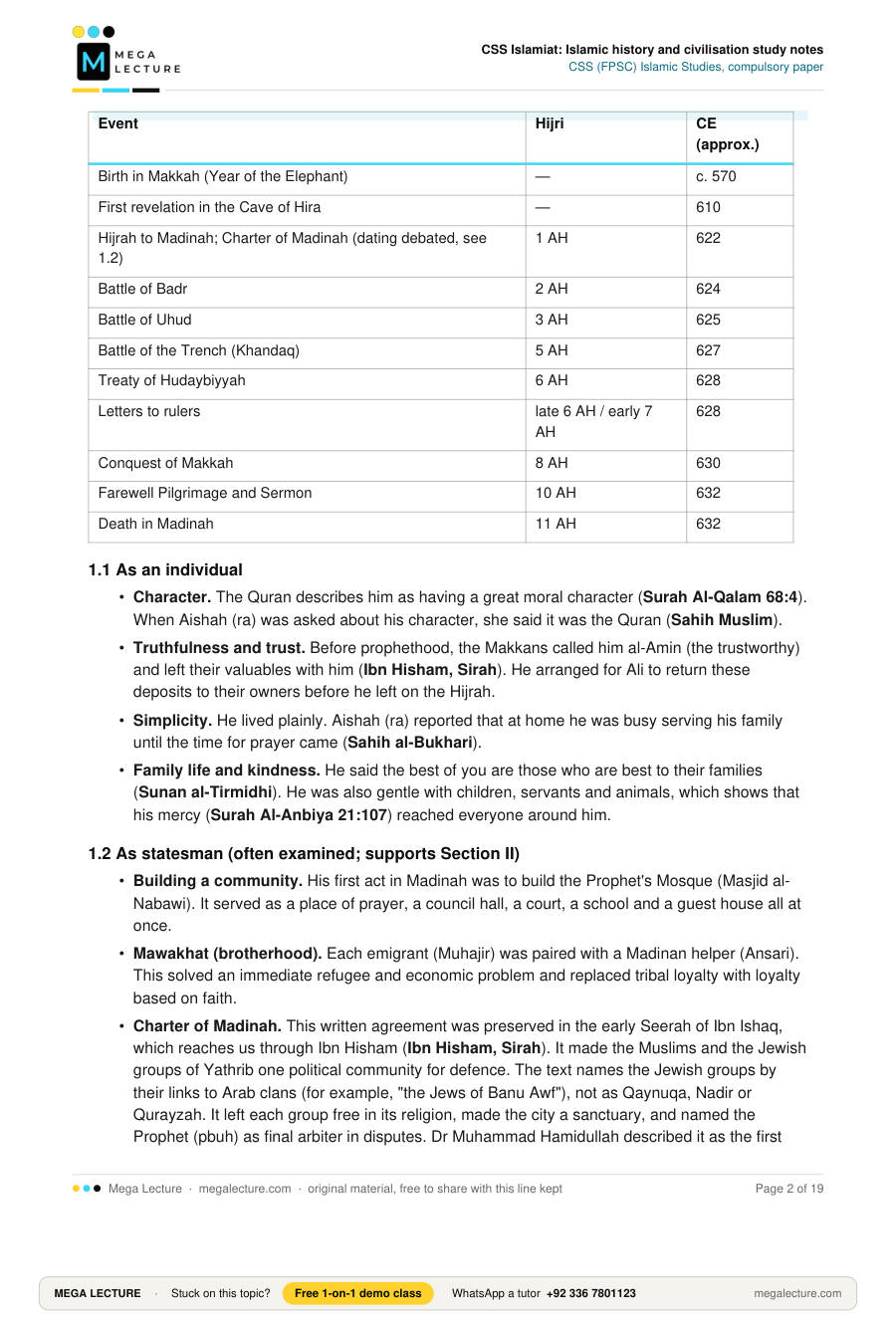
Key dates
| Event | Hijri | CE (approx.) |
|---|---|---|
| Birth in Makkah (Year of the Elephant) | — | c. 570 |
| First revelation in the Cave of Hira | — | 610 |
| Hijrah to Madinah; Charter of Madinah (dating debated, see 1.2) | 1 AH | 622 |
| Battle of Badr | 2 AH | 624 |
| Battle of Uhud | 3 AH | 625 |
| Battle of the Trench (Khandaq) | 5 AH | 627 |
| Treaty of Hudaybiyyah | 6 AH | 628 |
| Letters to rulers | late 6 AH / early 7 AH | 628 |
| Conquest of Makkah | 8 AH | 630 |
| Farewell Pilgrimage and Sermon | 10 AH | 632 |
| Death in Madinah | 11 AH | 632 |
1.1 As an individual
- Character. The Quran describes him as having a great moral character (Surah Al-Qalam 68:4). When Aishah (ra) was asked about his character, she said it was the Quran (Sahih Muslim).
- Truthfulness and trust. Before prophethood, the Makkans called him al-Amin (the trustworthy) and left their valuables with him (Ibn Hisham, Sirah). He arranged for Ali to return these deposits to their owners before he left on the Hijrah.
- Simplicity. He lived plainly. Aishah (ra) reported that at home he was busy serving his family until the time for prayer came (Sahih al-Bukhari).
- Family life and kindness. He said the best of you are those who are best to their families (Sunan al-Tirmidhi). He was also gentle with children, servants and animals, which shows that his mercy (Surah Al-Anbiya 21:107) reached everyone around him.
1.2 As statesman (often examined; supports Section II)
- Building a community. His first act in Madinah was to build the Prophet's Mosque (Masjid al-Nabawi). It served as a place of prayer, a council hall, a court, a school and a guest house all at once.
- Mawakhat (brotherhood). Each emigrant (Muhajir) was paired with a Madinan helper (Ansari). This solved an immediate refugee and economic problem and replaced tribal loyalty with loyalty based on faith.
- Charter of Madinah. This written agreement was preserved in the early Seerah of Ibn Ishaq, which reaches us through Ibn Hisham (Ibn Hisham, Sirah). It made the Muslims and the Jewish groups of Yathrib one political community for defence. The text names the Jewish groups by their links to Arab clans (for example, "the Jews of Banu Awf"), not as Qaynuqa, Nadir or Qurayzah. It left each group free in its religion, made the city a sanctuary, and named the Prophet (pbuh) as final arbiter in disputes. Dr Muhammad Hamidullah described it as the first written constitution in the world. When you use that phrase, attribute it to him. Historians differ on its dating: Hamidullah treats it as one document of 1 AH (622 CE), while W. M. Watt and R. B. Serjeant see it as several documents from different dates.
- Consultation and justice. He consulted his Companions before Badr, Uhud and the Trench. The Quran confirmed the practice after Uhud (Surah Aal-Imran 3:159). He also refused to make exceptions for powerful people. In the case of the Makhzumi woman who stole, he said that even his own daughter would face the same law (Sahih al-Bukhari; Sahih Muslim).
1.3 As diplomat
- Treaty of Hudaybiyyah (6 AH). Its terms looked unfavourable: a ten-year truce, a return the following year for Umrah, and fugitives from Makkah to be sent back while fugitives from Madinah would not be (Sahih al-Bukhari, Kitab al-Shurut). He still accepted it. The Quran called the outcome a clear victory (Surah Al-Fath 48:1). The peace allowed Islam to spread faster than war had.
- Letters to rulers. After Hudaybiyyah, in late 6 AH and early 7 AH, letters inviting rulers to Islam were sent to the Byzantine emperor Heraclius, the Persian king Khusrau Parvez, the Negus of Abyssinia and al-Muqawqis of Egypt. The letter to Heraclius and his questioning of Abu Sufyan are narrated in Sahih al-Bukhari. The letters show Islam's message addressed to the whole world and a practice of dealing formally with other states.
- Treatment of envoys and treaties. He kept agreements faithfully and protected envoys. This follows the Quranic principle that Muslims should accept peace when the other side inclines to it (Surah Al-Anfal 8:61).
1.4 As educator
- Mission defined as teaching. The first revelation begins with the command to read (Surah Al-Alaq 96:1–5). The Quran describes the Prophet's (pbuh) task as reciting the verses, purifying people, and teaching the Book and wisdom (Surah Al-Jumu'ah 62:2).
- Institutions. In Makkah, the house of al-Arqam was a meeting place for early believers. In Madinah, the Suffah (a raised area of the mosque) housed resident students, the Ahl al-Suffah. Abu Hurayrah was among them.
- Literacy policy. According to a report in Musnad Ahmad, some prisoners of Badr could win their freedom by teaching Muslim children to read and write.
- Method. He taught gradually, used questions and examples, adapted to his listener, and made learning a duty. His saying that seeking knowledge is an obligation on every Muslim is recorded in Sunan Ibn Majah. He also said the best people are those who learn the Quran and teach it (Sahih al-Bukhari). He set aside a day to teach women when they asked for one (Sahih al-Bukhari).
1.5 As military strategist and peacemaker
| Episode | Strategic or peacemaking lesson |
|---|---|
| Badr (2 AH) | He took a position that controlled the water. On the advice of al-Hubab ibn al-Mundhir, he moved to the well nearest the enemy and had the other wells stopped up (Ibn Hisham, Sirah). Accepting this advice is the standard example of his consultation in war. |
| Uhud (3 AH) | He posted archers on a hill to guard the rear. When they left their post, the battle turned, which shows how much discipline matters. |
| Trench (5 AH) | He adopted Salman al-Farsi's suggestion to dig a trench, a defensive technique new to Arabia. |
| Conquest of Makkah (8 AH) | The city was taken with almost no fighting, and he declared a general amnesty for his former persecutors. |
| Before prophethood | He took part in the Hilf al-Fudul, a pact to protect the wronged. He later said he would answer such a call even in Islam. He also settled the tribal dispute over placing the Black Stone (Ibn Hisham, Sirah, for both). |
2. Human rights, status of women and the Farewell Sermon (syllabus Section III)
2.1 Basis of human rights in Islam
In Islam, human rights come from Allah, not from a government or a treaty. No ruler may cancel them. Muslim writers draw on the jurists' framework of the maqasid al-shariah (objectives of the Shariah), developed by al-Ghazali and later by al-Shatibi. These classical jurists held that the Shariah exists to protect five essentials: religion, life, intellect, lineage and property.
| Right | Reference (meaning in own words) |
|---|---|
| Dignity of every human | Surah Al-Isra 17:70: Allah has honoured the children of Adam. |
| Life | Surah Al-Ma'idah 5:32: unjustly killing one person is like killing all humanity, and saving one is like saving all. |
| Equality | Surah Al-Hujurat 49:13: humans were made into nations and tribes so that they might know one another, and the most honoured before Allah is the most God-conscious. |
| Justice | Surah An-Nisa 4:135: stand firmly for justice even against yourselves or your relatives. |
| Freedom of belief | Surah Al-Baqarah 2:256: there is no compulsion in religion. |
| Privacy | Surah An-Nur 24:27: do not enter others' houses without permission. Surah Al-Hujurat 49:12: do not spy. |
| Property | Surah Al-Baqarah 2:188: do not consume one another's wealth unjustly. |
| Protection of non-Muslim citizens | Whoever kills a non-Muslim who lives under a covenant will not smell the fragrance of Paradise (Sahih al-Bukhari). |
2.2 Comparison with the UDHR
| Point | Islamic framework, as presented by Muslim writers such as Mawdudi and in the Cairo Declaration | Universal Declaration of Human Rights (1948) |
|---|---|---|
| Source | Divine revelation (Quran and Sunnah) | Agreement among states in the UN General Assembly |
| Can it be changed? | Its core cannot be changed by any authority | Can be reinterpreted or supplemented by later instruments |
| Balance | Rights come together with duties to Allah and to society | Mainly entitlements, with duties to the community mentioned briefly (Article 29) |
| Muslim statement | Cairo Declaration on Human Rights in Islam, adopted by OIC foreign ministers in 1990 | — |
2.3 Status of women
- Equal spiritual worth: men and women were created from a single soul (Surah An-Nisa 4:1), and both receive the same reward for good deeds (Surah An-Nahl 16:97).
- Economic rights: a share of inheritance (Surah An-Nisa 4:7), the bridal gift (mahr) as the wife's own property (Surah An-Nisa 4:4), and the right to own and manage wealth.
- Education: the duty to seek knowledge applies to women as well. The Prophet (pbuh) set aside a day to teach women (Sahih al-Bukhari). Sayyidah Aishah (ra) was among the leading narrators and jurists of her generation.
- Social and family rights: a woman is not to be married without her consent (Sahih al-Bukhari); husbands are told to live with their wives in kindness (Surah An-Nisa 4:19); and a wife may seek separation (khul'), as the wife of Thabit ibn Qays did with the Prophet's (pbuh) approval (Sahih al-Bukhari).
- Historical contrast: the Quran condemns the pre-Islamic burial of infant daughters (Surah At-Takwir 81:8–9).
2.4 The Farewell Sermon (Khutbat Hajjat al-Wida', 10 AH)
The Prophet (pbuh) gave the sermon during the Farewell Pilgrimage, at Arafat and in the days that followed. The main texts are in Sahih Muslim (the long hajj narration of Jabir ibn Abdullah) and Sahih al-Bukhari. The part about the equality of Arabs and non-Arabs is in Musnad Ahmad. The verse announcing that the religion had been perfected (Surah Al-Ma'idah 5:3) was revealed at Arafat during this pilgrimage, as Umar (ra) reported (Sahih al-Bukhari).
| Theme | Content (own words) | Source |
|---|---|---|
| Sanctity of life, property and honour | These are as sacred as this day, this month and this city. | Sahih al-Bukhari; Sahih Muslim |
| End of old injustices | Blood feuds and interest (riba) from the time of ignorance are cancelled. He began with his own family. The first blood claim he cancelled was that of the son of his cousin Rabi'ah ibn al-Harith, an infant who had been nursed among the Banu Sa'd and killed by the Hudhayl. The first riba he cancelled was the interest owed to his uncle al-Abbas ibn Abd al-Muttalib. | Sahih Muslim (hadith of Jabir) |
| Rights of women | Fear Allah in the treatment of women. Husbands and wives have rights over each other. | Sahih Muslim |
| Human equality | No Arab is superior to a non-Arab, and no white person to a black person, except by piety. | Musnad Ahmad |
| Guidance | He left among them the Book of Allah. Those who hold to it will not go astray. | Sahih Muslim |
| Accountability and transmission | He asked, "Have I conveyed?" When they said yes, he called Allah to witness and told those present to inform those absent. | Sahih Muslim; Sahih al-Bukhari |
3. Islamic civilisation and culture (syllabus Section IV)
Definitions to learnCivilisation (tamaddun / hadarah): the settled way of life of a society, including its institutions, knowledge, arts, laws and material achievements.
Culture (thaqafah): the beliefs, values, customs and behaviour a society shares, which shape its civilisation from within.
Islamic civilisation: the civilisation built on the worldview of Tawheed and the guidance of the Quran and Sunnah, and developed by Muslim societies of many races and regions.
3.1 Key features
- Tawheed: all life is lived under one God. This unites the spiritual and worldly sides of life.
- Dignity and equality of humans (Surah Al-Isra 17:70; Surah Al-Hujurat 49:13).
- Knowledge as worship: the Quran asks whether those who know and those who do not know can be equal (Surah Az-Zumar 39:9). It also teaches the prayer "My Lord, increase me in knowledge" (Surah Ta-Ha 20:114).
- Social justice and the rule of law, supported by zakat (Surah At-Tawbah 9:60 lists who may receive it).
- Moral values and self-purification (tazkiyah): the Prophet (pbuh) said he was sent to perfect good character (Muwatta Malik).
- Tolerance: no compulsion in religion (Surah Al-Baqarah 2:256). Protected non-Muslim communities (dhimmis) kept their places of worship and their own personal law.
- Universality and a middle path: the Ummah is described as a balanced community (Surah Al-Baqarah 2:143).
Sections 3.2 and 3.3 are background: dynastic history is not listed in the syllabus in its own right. Use it as evidence for the features and contributions of Islamic civilisation (Section IV) and its impact on the world (Section V).
3.2 Background: the Umayyad period (661–750 CE, capital Damascus)
- Founder: Mu'awiyah ibn Abi Sufyan (ruled 661–680). He built up the postal and intelligence service (barid) and a standing army, and continued the navy begun under Uthman.
- Abd al-Malik ibn Marwan (685–705): made Arabic the language of the government registers (diwans) and issued the first purely Islamic gold dinar in 77 AH (696–697 CE). The Dome of the Rock in Jerusalem was completed under him (c. 691–692).
- Script reform: dots and vowel marks were added to the Arabic script to prevent mistakes in reciting the Quran. Abu al-Aswad al-Du'ali is credited with the early vowel marks, and further work was done in the time of al-Hajjaj ibn Yusuf.
- Al-Walid I (705–715): the largest wave of conquests took place. Tariq ibn Ziyad crossed into Spain (711), Muhammad bin Qasim conquered Sindh (711–712), and Qutaybah ibn Muslim campaigned in Transoxiana. The Umayyad Mosque of Damascus was built.
- Umar ibn Abd al-Aziz (717–720): known for piety and fiscal justice. He removed unfair taxes on new converts (mawali). He ordered the written collection of hadith in his letter to Abu Bakr ibn Hazm (Sahih al-Bukhari, Kitab al-Ilm).
- End: the Abbasids defeated the Umayyads at the Battle of the Zab (750). Abd al-Rahman I escaped and founded the Umayyad emirate of Cordoba (756), which became a great centre of learning in Spain.
3.3 Background: the Abbasid period (750–1258 CE, capital Baghdad from 762)
- Al-Mansur founded Baghdad (762) as a planned round city.
- Institutions: the office of wazir (chief minister; the Barmakid family was prominent under Harun al-Rashid); a larger system of diwans; the office of chief judge (qadi al-qudat), first held by Abu Yusuf, author of Kitab al-Kharaj on taxation; the muhtasib, who supervised markets and public morals (hisbah); and the barid.
- Bayt al-Hikmah (House of Wisdom): a library and translation centre associated with Harun al-Rashid (786–809) and especially with al-Ma'mun (813–833). Greek, Persian and Indian works were translated into Arabic. Hunayn ibn Ishaq was a leading translator.
- Paper: paper-making spread from Central Asia after the Battle of Talas (751), and a paper mill was working in Baghdad by the late 8th century. This made books cheaper and more widely available.
- Law and hadith: the Sunni schools of law took shape around Abu Hanifa (d. 767), Malik (d. 795), al-Shafi'i (d. 820) and Ahmad ibn Hanbal (d. 855). The Ja'fari school is linked to Imam Ja'far al-Sadiq (d. 765). The two most famous hadith collections were compiled by al-Bukhari (d. 870) and Muslim (d. 875).
- Madrasas: the Nizamiyyah of Baghdad was founded in 1065 and opened in 1067 by the Seljuk wazir Nizam al-Mulk. Al-Ghazali taught there.
- End: the Mongols under Hulagu Khan sacked Baghdad in 1258.
3.4 Contributions to science and culture
| Scholar | Field | Contribution |
|---|---|---|
| Al-Khwarizmi (9th c.) | Mathematics | His book on al-jabr gave algebra its name. The word "algorithm" comes from his name. |
| Al-Kindi (9th c.) | Philosophy | Called "philosopher of the Arabs"; also wrote on cryptography and optics. |
| Abu Bakr al-Razi (d. c. 925) | Medicine | Separated smallpox from measles in his clinical writing; wrote the medical encyclopaedia al-Hawi. |
| Al-Farabi (d. 950) | Philosophy, music | Known as the "Second Teacher" after Aristotle; wrote on the virtuous city. |
| Ibn al-Haytham (d. c. 1040) | Optics | Kitab al-Manazir: showed that sight happens when light enters the eye, and tested his ideas by experiment. |
| Ibn Sina (d. 1037) | Medicine, philosophy | Al-Qanun fi al-Tibb, taught in European medical schools for centuries. |
| Al-Biruni (d. c. 1048) | Astronomy, geography | Measured the earth's radius; his Kitab al-Hind is an early scholarly study of Indian society. |
Many of these scholars worked at regional courts, such as those of the Samanids, Buyids, Ghaznavids and Fatimids, rather than in Baghdad. Historians still date their work to the "Abbasid era" or the "Islamic golden age".
Historians' views. Philip K. Hitti (History of the Arabs) regarded the early Abbasid period as the high point of Islamic civilisation. Ibn Khaldun (Muqaddimah) argued that the caliphate gradually turned into kingship (mulk) and that dynasties rise and fall with the strength of group solidarity (asabiyyah). George Sarton (Introduction to the History of Science) gave Muslim scientists a central place in medieval science. Dimitri Gutas (Greek Thought, Arabic Culture) showed that the Abbasid translation movement was a deliberate programme backed by the state and the elite. Both support the view that Arabic translations and commentaries preserved Greek learning and added to it before it passed to Europe through Spain and Sicily.
4. Islam and the world (syllabus Section V)
4.1 Impact of Islamic civilisation on Europe
- Translation centres. After Toledo passed to Castile (1085), scholars there translated Arabic works into Latin. Gerard of Cremona (d. 1187) translated Ibn Sina's Qanun and many other works. In Norman Sicily, al-Idrisi prepared his world geography (1154) for King Roger II.
- Mathematics. Leonardo Fibonacci's Liber Abaci (1202) spread the Hindu-Arabic numerals, which he had learned in North Africa, in Europe. Words such as algebra, algorithm, cipher and zenith come from Arabic.
- Philosophy. Ibn Rushd's (Averroes, d. 1198) commentaries on Aristotle were studied at Paris. Thomas Aquinas engaged with them.
- Medicine and science. Ibn Sina's Qanun and al-Razi's works were used in European medical teaching. Ibn al-Haytham's optics influenced later European writers on light.
4.2 Impact of Western civilisation on the Muslim world
- Colonial rule and the nation-state. From the 18th to the 20th century, most Muslim lands came under European rule or influence. After the First World War, nation-states replaced the multi-ethnic empires, and the Ottoman caliphate was abolished in 1924.
- Modern education and science. Muhammad Ali of Egypt sent students to Europe in the 19th century. In India, Sir Syed Ahmad Khan founded the MAO School at Aligarh (1875), which became the MAO College in 1877 (later Aligarh Muslim University, 1920).
- Printing and the press. Ibrahim Muteferrika's press in Istanbul printed its first book in 1729. Newspapers and printed books then spread across the Muslim world in the 19th century.
- Constitutionalism. Examples are the Ottoman constitution (1876) and Iran's constitutional revolution (1906).
- Muslim responses. Modernists such as Sir Syed and Muhammad Abduh sought to reconcile Islam with modern knowledge. Jamal al-Din al-Afghani called for pan-Islamic unity against colonial rule. Iqbal called for a reconstruction of religious thought through ijtihad. Revivalists such as Mawdudi argued for an Islamic order in its own right.
4.3 Background: Islam in the subcontinent in outline
This is background. It is useful for Section V and for questions linked to Pakistan, but it is not a separate syllabus item.
| Phase | Key facts |
|---|---|
| Early contact | Arab traders on the Malabar and Sindh coasts. |
| Sindh (711–712) | Muhammad bin Qasim took Debal and defeated Raja Dahir. Local communities were given protected status. |
| Ghaznavids and Ghurids | Mahmud of Ghazni's campaigns (c. 1000–1027); Lahore became a Muslim cultural centre. Muhammad Ghori won the second Battle of Tarain (1192). |
| Delhi Sultanate (1206–1526) | Founded by Qutb al-Din Aibak. A Persian-style administration, with iqta land grants. |
| Mughal Empire (1526–1857) | Babur won the first Battle of Panipat (1526). The empire ended after the War of 1857. |
- Sufis: Sufis spread Islam mainly by their example. Key figures: Ali Hujwiri (Data Ganj Bakhsh), Lahore, author of Kashf al-Mahjub; Khwaja Mu'in al-Din Chishti, Ajmer; Baha al-Din Zakariya, Multan; Nizam al-Din Awliya, Delhi.
- Reformers: Shaykh Ahmad Sirhindi (Mujaddid Alf Thani, 1564–1624); Shah Wali Allah (1703–1762), who translated the Quran into Persian and wrote Hujjat Allah al-Balighah; Sir Syed Ahmad Khan, founder of the MAO School at Aligarh (1875), which became the MAO College in 1877 (later Aligarh Muslim University, 1920); Dar al-Ulum Deoband (1866); and Allama Iqbal, whose lectures The Reconstruction of Religious Thought in Islam called ijtihad "the principle of movement" in Islam.
5. The Muslim Ummah: contemporary challenges (syllabus Section V)
| Challenge | Islamic response (with evidence) |
|---|---|
| Disunity and sectarianism | Hold together to Allah's rope and do not divide (Surah Aal-Imran 3:103). The OIC was founded in 1969 and has its headquarters in Jeddah. |
| Extremism and terrorism | Killing an innocent person is like killing all humanity (Surah Al-Ma'idah 5:32). Call people with wisdom and good advice (Surah An-Nahl 16:125). |
| Falling behind in education and science | Revive the Quranic command to reflect on creation (Surah Aal-Imran 3:190). Invest in research. |
| Interest-based economy and dependence | Trade is permitted and riba forbidden (Surah Al-Baqarah 2:275). Develop Islamic banking and zakat systems. |
| Islamophobia and media image | Engage through dialogue and good character. Verify news before acting on it (Surah Al-Hujurat 49:6). |
| Weak governance and corruption | Give trusts to those worthy of them and judge with justice (Surah An-Nisa 4:58). |
| Modern questions of law | Use disciplined ijtihad through institutions, not isolated individual rulings. |
6. Public administration and governance in Islam (syllabus Section VI)
6.1 The Islamic concept of the state
Definitions to learnSovereignty: Muslim political thought holds that ultimate authority belongs to Allah. The Quran says judgement belongs to Allah alone (Surah Yusuf 12:40), and rulers use authority as a trust (amanah) within the limits of the Shariah. Mawlana Mawdudi (Islamic Law and Constitution) built this into a political doctrine of divine sovereignty (hakimiyyah): legislation must stay within the limits set by the Quran and Sunnah. Sayyid Qutb held a similar view.
Khilafah: the Quran calls humankind Allah's vicegerent (khalifah) on earth (Surah Al-Baqarah 2:30). The classical definition comes from al-Mawardi: the caliphate succeeds prophethood in guarding religion and running worldly affairs. In the view of Mawdudi, vicegerency belongs to the whole community of believers ("popular vicegerency"), which delegates authority to its government.
Shura: the principle that public affairs are decided by mutual consultation.
- Purpose of the state: those given power should establish prayer, pay zakat, promote good and forbid wrong (Surah Al-Hajj 22:41). Messengers were sent so that people would uphold justice (Surah Al-Hadid 57:25).
- Consultation: believers run their affairs by consulting one another (Surah Ash-Shura 42:38).
- Obedience within limits: obey Allah, the Messenger and those in authority, and refer disputes back to Allah and the Messenger (Surah An-Nisa 4:59).
- Accountability: every person is a shepherd who will be questioned about his flock, and the ruler is included (Sahih al-Bukhari; Sahih Muslim). Religion is sincere advice (nasihah), including to leaders (Sahih Muslim).
- Merit: giving authority to unfit people is described as losing the trust (Sahih al-Bukhari).
- Classical theory: al-Mawardi (d. 1058), in al-Ahkam al-Sultaniyyah, set out seven qualifications for the caliph: justice; knowledge sufficient for ijtihad; sound hearing, sight and speech; sound limbs; sound judgement in public affairs; courage to defend the realm; and descent from Quraysh. He also set out the caliph's duties.
- Pakistan: the Objectives Resolution (1949) affirms that sovereignty belongs to Allah. The 1973 Constitution makes Islam the state religion (Article 2), makes the Objectives Resolution a substantive part of the Constitution (Article 2A), and says no law may be repugnant to the Quran and Sunnah (Article 227). It also provides for the Council of Islamic Ideology (Articles 228–230) and the Federal Shariat Court.
6.2 Public administration in Islam
- Concept: public office is a trust (amanah). The Quran commands that trusts be given to those worthy of them and that people be judged with justice (Surah An-Nisa 4:58).
- Traits of public servants: strength (competence) and trustworthiness. The Quran says that the best person to employ is one who is strong and trustworthy (Surah Al-Qasas 28:26). The Prophet (pbuh) declined to give office to people who asked for it (Sahih al-Bukhari; Sahih Muslim). He told Abu Dharr that office is a trust and will bring regret on the Day of Judgement to anyone who does not fulfil its duties (Sahih Muslim). Other traits are justice, honesty, humility and accessibility to the public.
- The Prophet's (pbuh) administration: he appointed governors, for example Attab ibn Asid over Makkah after the conquest (Ibn Hisham, Sirah); he sent zakat collectors to the tribes; and he used scribes, such as Zayd ibn Thabit for the revelation and Ali for the Hudaybiyyah treaty (Sahih al-Bukhari).
- Delegation of authority: he sent Mu'adh ibn Jabal to Yemen with instructions on teaching and collecting zakat (Sahih al-Bukhari). He approved Mu'adh's plan to judge by the Quran, then the Sunnah, then his own reasoning (Sunan Abi Dawud). So he delegated real decision-making power within clear limits.
- Kinds of accountability:
- Before Allah: every atom's weight of good or evil will be seen (Surah Az-Zalzalah 99:7–8).
- Before the people: Abu Bakr's first address invited the people to correct him (see 6.4).
- Judicial: caliphs appeared before qadis like any other citizen.
- Administrative: when the zakat collector Ibn al-Lutbiyyah kept gifts given to him, the Prophet (pbuh) publicly asked whether those gifts would have come to him had he stayed in his parents' house (Sahih al-Bukhari; Sahih Muslim). Umar's checks on his governors' assets continued this practice.
6.3 The Rightly Guided Caliphate (632–661 CE)
| Caliph | Years | Main achievements |
|---|---|---|
| Abu Bakr al-Siddiq | 11–13 AH / 632–634 | Suppressed the apostasy and the refusal to pay zakat (Riddah wars), including the Battle of Yamamah against Musaylimah. Sent Usamah's army. Had the Quran compiled into one collection under Zayd ibn Thabit. |
| Umar ibn al-Khattab | 13–23 AH / 634–644 | Conquests: Yarmuk (636), Qadisiyyah (c. 636–637), Jerusalem (c. 637–638), Egypt (640–642). Built most of the administrative system (see below). |
| Uthman ibn Affan | 23–35 AH / 644–656 | Sent standard copies of the Quran to the provinces. Founded the first Muslim navy under Mu'awiyah and won the naval battle of Dhat al-Sawari (c. 655). Killed by rebels in 656. |
| Ali ibn Abi Talib | 35–40 AH / 656–661 | Moved the capital to Kufa. Ruled through a period of civil strife (the Battles of the Camel and Siffin, the arbitration, and conflict with the Kharijites at Nahrawan). Martyred in 661. Famous for his knowledge and his judgements. |
6.4 Administration under the Rightly Guided Caliphs
- Election and accountability: caliphs took office by bay'ah (the oath of allegiance), after consultation. In his first address, Abu Bakr told the people to obey him only while he obeyed Allah and His Messenger, and to correct him if he went wrong (Ibn Hisham, Sirah).
- Majlis al-Shura: senior Companions advised on major decisions, such as whether to divide the conquered land of Iraq (Umar kept it as state land that paid kharaj). Before he died, Umar named a council of six to choose his successor.
- Provinces: each province (wilayah) was governed by a wali, with separate officials for revenue and justice. Governors declared their assets when appointed, and complaints against them were heard at the Hajj.
- Judiciary: Umar appointed qadis who were independent of the governors. The caliphs themselves appeared before judges.
- Finance: the Bayt al-Mal (public treasury) received zakat, ushr, kharaj, jizyah and one-fifth of the spoils (khums). A diwan registered those entitled to stipends.
- Other reforms of Umar: the Hijri calendar (c. 16–17 AH / 637–638 CE); the garrison cities (amsar) of Basra, Kufa and Fustat; land surveys; canals; night patrols; and help for the poor, including non-Muslims. The saying attributed to him, that he would be answerable even for a dog dying of hunger by the Euphrates, sums up his sense of accountability.
- Governance texts: governance studies also cite the letter to Malik al-Ashtar for its advice on justice and on caring for the common people. It is preserved in Nahj al-Balaghah, compiled by al-Sharif al-Radi (d. 1015), and scholars differ on how far its contents can be traced to Ali.
This contrast follows Ibn Khaldun (Muqaddimah, on the change from caliphate to kingship) and Mawdudi (Khilafat o Mulukiyat). It is a general pattern, not a rule for every ruler: Umar ibn Abd al-Aziz is widely recognised as an Umayyad exception who returned to the caliphal model.
| Feature | Rightly Guided Caliphate | Umayyad/Abbasid rule (as these writers describe it) |
|---|---|---|
| Succession | Consultation and bay'ah | Hereditary, with bay'ah as a formality |
| Treasury | A public trust | Often treated as the ruler's resource |
| Ruler's lifestyle | Simple; accessible to the public | Courts, palaces and ceremony |
| Strength | Moral authority and accountability | Administrative sophistication and patronage of learning |
7. Worked example: planning a 20-mark answer
Question: "The Charter of Madinah laid the foundation of a pluralistic state." Discuss. [20]Step 1 – Decode the command word. "Discuss" means presenting the argument, supporting it with evidence and noting its limits, then reaching a judgement.
Step 2 – Introduction (about 80 words). Explain the context: in 622 CE Yathrib was divided between the Aws and Khazraj, the Jewish groups and the newly arrived emigrants. Give a thesis: the Charter created a community based on shared defence and shared law, not on a single religion.
Step 3 – Body headings (about 8 to 10). (a) What the Charter was and how it was recorded (Ibn Hisham, Sirah), and the debate over its dating (Hamidullah compared with Watt and Serjeant). (b) One political community of different groups. (c) Freedom of religion for each group. (d) Mutual defence and shared costs. (e) Madinah declared a sanctuary. (f) The Prophet (pbuh) as final arbiter, which established the rule of law. (g) Replacing tribal blood revenge with justice. (h) Rights of allies and clients. Support each heading with one reference, for example Surah Al-Baqarah 2:256 for freedom of religion and Surah An-Nisa 4:58 for justice.
Step 4 – Critical balance. The Charter's protection depended on each side keeping its terms. According to the Seerah sources, the Banu Qaynuqa (2 AH), Banu Nadir (4 AH) and Banu Qurayzah (5 AH) broke their agreements with the Muslims. The first two were expelled, and Qurayzah was punished after it sided with the besiegers at the Trench. Note that the Charter itself does not name these three tribes, so historians differ on how they were bound by it. Cite Dr Muhammad Hamidullah's view that it was the first written constitution.
Step 5 – Relevance today. It offers a model for citizenship, minority rights and constitutional supremacy, including in Pakistan's Constitution.
Step 6 – Conclusion (about 60 words). Return to the thesis and agree with the statement, with the qualification that pluralism rested on mutual loyalty.
8. Eight CSS-style questions with answer outlines
These questions are original, but they cover the themes that CSS papers regularly set. Past papers have asked similar questions in different words.
Q1. How did the Prophet's (pbuh) first measures in Madinah turn a divided town into an organised state? Assess with reference to at least four measures. [20]
Introduction: Surah Al-Ahzab 33:21; the situation in Yathrib in 622. Points: the mosque as the centre of the state; Mawakhat; the Charter of Madinah (Ibn Hisham, Sirah); shura (Surah Aal-Imran 3:159); a system of justice with equality before the law (Sahih al-Bukhari, the Makhzumi woman); defence and alliances; zakat and the economy; appointing governors and teachers to tribes; the Hudaybiyyah diplomacy that secured the state. Conclusion: within ten years he had founded a state on faith, justice and consultation, and its institutions grew out of the needs of a real community.Q2. Discuss the Prophet's (pbuh) contribution as an educator and its relevance to Pakistan's education system. [20]
Introduction: Surah Al-Alaq 96:1–5; Surah Al-Jumu'ah 62:2. Points: knowledge made a duty (Sunan Ibn Majah); Dar al-Arqam and the Suffah; the ransom of Badr prisoners by teaching (Musnad Ahmad); women's education (Sahih al-Bukhari, the day set aside for women); teaching methods (gradual, practical, question-based, suited to the learner); character building (Muwatta Malik). Relevance: literacy gaps, curriculum focused on character, teacher training, female education. Conclusion: the Prophet's (pbuh) model joins knowledge with character and opens learning to everyone. A system that combined literacy with moral training and gave girls equal access would follow that model closely.Q3. Hazrat Umar (ra) is often credited with building the administrative framework of the early Islamic state. Assess three of his institutions and what each could teach a present-day civil service. [20]
Introduction: 634–644; the expansion made new institutions necessary. Points to choose from: Majlis al-Shura; provinces and walis; asset declarations and accountability; an independent judiciary; Bayt al-Mal and diwan; the kharaj policy on Iraqi land; the Hijri calendar; amsar; public welfare and night patrols; protection of non-Muslims. For each institution chosen, give its modern lesson: accountability bodies, separation of powers, a welfare state, merit (Surah An-Nisa 4:58; Surah Al-Qasas 28:26). Conclusion: Umar's institutions show that accountability, merit and public welfare can be built into the structure of a state. A modern civil service can borrow their spirit rather than their exact form.Q4. Highlight the contributions of Muslims to science and learning during the Abbasid period. [20]
Introduction: Quranic encouragement (Surah Aal-Imran 3:190; Surah Az-Zumar 39:9); Hitti's view of a golden age. Points: Bayt al-Hikmah and the translation movement (Gutas); paper; mathematics (al-Khwarizmi); medicine (al-Razi, Ibn Sina); optics (Ibn al-Haytham); astronomy and geography (al-Biruni); philosophy (al-Kindi, al-Farabi); law and hadith; madrasas (the Nizamiyyah, 1065–1067). Transmission to Europe through Spain and Sicily. Conclusion: lessons for a Muslim scientific revival today.Q5. How far do the themes of the Farewell Sermon anticipate the rights listed in the Universal Declaration of Human Rights (1948)? Assess with reference to three themes. [20]
Introduction: 10 AH, Arafat; Surah Al-Ma'idah 5:3 (Sahih al-Bukhari, Umar's report). Theme 1: sanctity of life, property and honour (Sahih al-Bukhari; Sahih Muslim) compared with UDHR Article 3 (life, liberty and security) and Article 17 (property). Theme 2: equality of Arab and non-Arab (Musnad Ahmad) compared with Articles 1 and 2 (equal dignity; non-discrimination). Theme 3: rights of women (Sahih Muslim) compared with Article 16 (equal rights in marriage). Other themes you could use: abolition of riba and blood feuds (Sahih Muslim). Evaluation: Muslim writers (e.g. Mawdudi, Human Rights in Islam) argue that the Sermon's rights are more secure because they rest on divine authority and cannot be repealed. On the other side, the UDHR is far more detailed and also mentions duties (Article 29). Claims that the Sermon was the "first" charter must reckon with earlier codes such as the Code of Hammurabi (c. 1750 BCE) and the Cyrus Cylinder (539 BCE), as well as the later Magna Carta (1215). Conclusion: the Sermon anticipates several core principles of the UDHR, from a different source and with duties attached. A strong answer accepts the overlap and explains the differences in basis and scope.Q6. Explain the Islamic concept of the state. How does it differ from the Western secular state? [20]
Introduction: sovereignty of Allah (Surah Yusuf 12:40) and khilafah as a trust (Surah Al-Baqarah 2:30; al-Mawardi's definition; Mawdudi's view). Points: purposes (Surah Al-Hajj 22:41; Surah Al-Hadid 57:25); shura (Surah Ash-Shura 42:38); obedience within limits (Surah An-Nisa 4:59); accountability (Sahih al-Bukhari; Sahih Muslim); rights of non-Muslims; al-Mawardi's seven conditions for the caliph. Pakistan: Objectives Resolution, Articles 2, 2A and 227. Conclusion: in this concept, the state has a moral purpose and limited, accountable authority. Pakistan's Constitution is one attempt to express it within a modern parliamentary system.| Point | Islamic state (as described by classical and modern Muslim thinkers) | Western secular state |
|---|---|---|
| Source of sovereignty | Allah; the people and rulers hold authority as a trust | The people or the nation (popular sovereignty) |
| Source of law | Quran and Sunnah as supreme; legislation and ijtihad work within their limits | The legislature, within a constitution made by the people |
| Role of morality | Law serves moral ends, such as justice and promoting good (Surah Al-Hajj 22:41) | Public law and private morality are largely kept apart; the law protects public order and rights |
| Religion and state | Joined; the state has religious duties | Separated; the state is neutral between religions |
| Rights of minorities | Protected by covenant (dhimmah) in classical law; freedom of religion and protection of minorities in modern Muslim constitutions (e.g. Pakistan, Articles 20 and 36) | Equal citizenship under general law |
Q7. Assess the impact of Islamic civilisation on medieval Europe, and of Western civilisation on the modern Muslim world. [20]
Introduction: civilisations borrow from each other; the Quranic purpose of human diversity is that people should know one another (Surah Al-Hujurat 49:13). Islamic impact on Europe: translation at Toledo (Gerard of Cremona) and Sicily (al-Idrisi); the Hindu-Arabic numerals (Fibonacci, 1202); Ibn Sina's Qanun in medical teaching; Ibn Rushd and scholastic philosophy; Arabic loanwords; Sarton's and Gutas's assessments. Western impact on the Muslim world: colonial rule and the nation-state; the end of the Ottoman caliphate (1924); modern education (Aligarh, 1875/1877); printing (Istanbul, 1729); constitutionalism (1876, 1906). Muslim responses: Sir Syed, al-Afghani, Abduh, Iqbal, Mawdudi. Conclusion: the exchange ran in both directions. Medieval Europe drew on Muslim learning, and modern Muslim societies have had to decide what to adopt from the West and on what Islamic principles.Q8. Which two contemporary challenges most threaten Muslim unity? Propose remedies grounded in the Quran and Sunnah. [20]
Introduction: the Ummah as a balanced community (Surah Al-Baqarah 2:143). Choose two and justify your choice, for example sectarian disunity and weak, unaccountable governance. Others you could discuss: extremism, the education gap, economic dependence and riba, Islamophobia, the Palestine and Kashmir disputes, climate and water stress. Remedies: unity (Surah Aal-Imran 3:103); a stronger OIC; accountable governance (Surah An-Nisa 4:58; the shepherd hadith, Sahih al-Bukhari; Sahih Muslim); dialogue (Surah An-Nahl 16:125); investment in research; Islamic finance (Surah Al-Baqarah 2:275); institutional ijtihad. Conclusion: the remedies share one root in unity, knowledge and accountable rule. The Ummah can recover its role as a balanced community only by acting on all three together.Key terms
| Term | Definition |
|---|---|
| Amsar | Garrison cities founded under Umar, such as Basra, Kufa and Fustat. |
| Barid | The state postal and intelligence service. |
| Bay'ah | The oath of allegiance given to a ruler. |
| Bayt al-Mal | The public treasury, held in trust for the community. |
| Dhimmi | A non-Muslim citizen protected by covenant in an Islamic state. |
| Diwan | A government register or department, first organised for stipends under Umar. |
| Hakimiyyah | Divine sovereignty as a political doctrine, chiefly associated with Mawdudi and Sayyid Qutb. |
| Hisbah / Muhtasib | The duty of enjoining good in public life, especially in markets; the officer who carries it out. |
| Ijtihad | The disciplined effort of a qualified scholar to derive rulings from the sources. |
| Jizyah | A tax on able-bodied non-Muslim men in return for protection and exemption from military service. |
| Kharaj | Land tax on conquered agricultural land. |
| Khilafah | Succession to the Prophet (pbuh) in guarding religion and governing the community (al-Mawardi); authority held as a trust. |
| Maqasid al-Shariah | The objectives of the Shariah: protecting religion, life, intellect, lineage and property. |
| Mawakhat | The brotherhood set up between the Muhajirun and the Ansar. |
| Qadi | A judge who applies Islamic law. |
| Riddah | Apostasy; the wars under Abu Bakr against rebel tribes. |
| Shura | Decision-making by mutual consultation. |
| Ushr | A tithe on produce from land owned by Muslims. |
| Wazir | Chief minister under the Abbasids. |
Quick check (self-test)
The marks show how much each answer needs. They are not CSS mark values: in the real paper, each Part II question carries 20 marks.
- State the year CE of the Hijrah and of the Farewell Pilgrimage. [2]
- Name the four rulers to whom the Prophet (pbuh) sent letters after Hudaybiyyah. [2]
- Identify the Quranic references for (a) consultation and (b) the equality of humankind. [2]
- Define Mawakhat and give one purpose it served. [2]
- List three administrative reforms of Hazrat Umar (ra). [3]
- Describe the two reforms of Abd al-Malik that gave the state an Islamic and Arab character. [3]
- Explain the function of the Bayt al-Hikmah. [3]
- Outline four themes of the Farewell Sermon, naming a collection for each. [4]
- Explain how the Islamic basis of human rights differs from that of the UDHR. [4]
- Discuss why Ibn Khaldun distinguished caliphate from kingship. [4]
- Evaluate the claim that the Treaty of Hudaybiyyah was a diplomatic victory. [5]
- Critically assess how far Pakistan's Constitution reflects the Islamic concept of the state. [6]
- Hijrah 622 CE; Farewell Pilgrimage 632 CE (10 AH).
- Heraclius (Byzantium), Khusrau Parvez (Persia), the Negus (Abyssinia) and al-Muqawqis (Egypt).
- (a) Surah Ash-Shura 42:38 or Surah Aal-Imran 3:159. (b) Surah Al-Hujurat 49:13.
- The pairing of each Muhajir with an Ansari. It housed and supported the refugees and replaced tribal loyalty with loyalty based on faith.
- Any three: provinces under walis; independent qadis; the diwan; Bayt al-Mal; the Hijri calendar; amsar; Majlis al-Shura; asset declarations by governors.
- He made Arabic the language of the government registers, replacing Greek and Persian. He issued a purely Islamic gold dinar (77 AH) in place of Byzantine-style coins.
- It was an Abbasid library and translation centre in Baghdad, linked to Harun al-Rashid and al-Ma'mun. Greek, Persian and Indian works were translated there, and it supported research in mathematics, astronomy and medicine.
- Sanctity of life and property (Sahih al-Bukhari); abolition of riba and blood feuds (Sahih Muslim); rights of women (Sahih Muslim); equality of Arab and non-Arab (Musnad Ahmad).
- Islamic rights come from Allah, who has honoured the children of Adam (Surah Al-Isra 17:70), so no state can remove them. They are balanced by duties: every person is a shepherd responsible for those in his care (Sahih al-Bukhari; Sahih Muslim), and trusts must be given to those worthy of them (Surah An-Nisa 4:58). UDHR rights rest on international agreement among states. They focus mainly on the individual's entitlements, with duties to the community mentioned briefly (Article 29).
- In the Muqaddimah, Ibn Khaldun argued that the Rightly Guided Caliphs ruled according to the Shariah for the community's welfare. Later rulers kept the Islamic framework but ruled more and more for dynastic power, based on group solidarity (asabiyyah). He saw this change as a natural cycle in how dynasties develop.
- For: by signing a formal treaty, the Quraysh accepted the Muslims as a party they had to negotiate with, in effect an equal party (the treaty narration in Sahih al-Bukhari, Kitab al-Shurut). The Quran called the outcome a clear victory (Surah Al-Fath 48:1). The truce also allowed preaching and the letters to rulers, and many tribes joined the Muslims. The Quraysh broke the truce, which led to the peaceful conquest of Makkah in 630. Against: the terms looked unequal and at first dismayed Companions such as Umar (Sahih al-Bukhari). Judgement: it was a strategic victory, because its long-term results outweighed its short-term concessions.
- Evidence that it reflects the Islamic concept: the Objectives Resolution affirms Allah's sovereignty and treats authority as a trust (Article 2A); Islam is the state religion (Article 2); the repugnancy clause (Article 227); the Council of Islamic Ideology and the Federal Shariat Court. Evidence of limits: the Council's advice is not binding on Parliament (Articles 229–230). In April 2022, the Federal Shariat Court ordered that riba be eliminated from the economy by 31 December 2027. The 26th Amendment (2024) amended Article 38(f) to set 1 January 2028 as the target date for eliminating riba. Judgement: base it on these facts. The constitutional text is Islamic in its foundations, while the advisory status of the Council and the riba timetable, which still runs to 2027–2028, show that implementation is still in progress.
Practice MCQs (Part I style)
Choose one answer for each. The answer key follows.
- Who described the Charter of Madinah as the first written constitution in the world? (a) Philip K. Hitti (b) Dr Muhammad Hamidullah (c) W. M. Watt (d) Ibn Khaldun
- Who suggested digging the trench in 5 AH? (a) Abu Bakr (b) al-Hubab ibn al-Mundhir (c) Salman al-Farsi (d) Zayd ibn Thabit
- "There is no compulsion in religion" is found in: (a) Surah Al-Baqarah 2:256 (b) Surah Al-Hujurat 49:13 (c) Surah An-Nisa 4:58 (d) Surah Al-Ma'idah 5:32
- In which year was the Treaty of Hudaybiyyah signed? (a) 2 AH (b) 5 AH (c) 6 AH (d) 8 AH
- The Quranic description of the ideal employee as "strong and trustworthy" is in: (a) Surah Al-Qasas (b) Surah Yusuf (c) Surah Ash-Shura (d) Surah Al-Hadid
- Which caliph sent standard copies of the Quran to the provinces? (a) Abu Bakr (b) Umar (c) Uthman (d) Ali
- Under which caliph was the Hijri calendar introduced? (a) Abu Bakr (b) Umar (c) Uthman (d) Umar ibn Abd al-Aziz
- The first purely Islamic gold dinar was issued by: (a) Mu'awiyah (b) Abd al-Malik (c) al-Walid I (d) al-Mansur
- Who wrote Kitab al-Kharaj? (a) Abu Hanifa (b) al-Mawardi (c) Abu Yusuf (d) al-Shafi'i
- Who wrote al-Ahkam al-Sultaniyyah? (a) al-Ghazali (b) al-Mawardi (c) Ibn Khaldun (d) Nizam al-Mulk
- Paper-making spread into the Muslim world after the Battle of Talas in: (a) 711 (b) 751 (c) 762 (d) 813
- Kitab al-Manazir, on optics, was written by: (a) Ibn Sina (b) al-Biruni (c) Ibn al-Haytham (d) al-Kindi
- The Nizamiyyah of Baghdad was founded by: (a) Harun al-Rashid (b) al-Ma'mun (c) Nizam al-Mulk (d) Hulagu Khan
- The Cairo Declaration on Human Rights in Islam was adopted in: (a) 1948 (b) 1969 (c) 1973 (d) 1990
- Which Article of the 1973 Constitution made the Objectives Resolution a substantive part of it? (a) Article 2 (b) Article 2A (c) Article 227 (d) Article 230
