
A Level · Business · Management by objectives: notes
Management by objectives: notes
Opens inside this page. Prefer your own PDF app? Open the PDF.
Check yourself
5 quick questions on A Level Business
Tap an answer to see if you are right, and why. Free, no sign-up.
Start the free testWas this note useful?
Full text of Management by objectives: notes
These revision notes cover management by objectives (MBO) for Cambridge International AS & A Level Business (9609) at AS Level. MBO is where several AS topics meet: business objectives, human resource management (including appraisal), motivation and management. The notes explain Peter Drucker's idea of MBO, how objectives cascade from the mission down to each employee, how to write SMART objectives, the five stages of the MBO cycle, the benefits and problems of MBO, and how it links to motivation theory and to staff appraisal. They also include a short invented case, worked examples, the most common exam mistakes, exam-style questions with mark guidance and model answers, and a quick check with answers.
Syllabus links: Business objectives (SMART objectives; corporate, departmental and individual objectives; mission). Human resource management (appraisal). Motivation (Mayo, Maslow, Herzberg, McClelland, Vroom; participation). Management (McGregor). In the exam, use MBO as a way of applying this named content to a case.
1. What is management by objectives?
Management by objectives (MBO): a way of managing in which the organisation's overall objectives are broken down into objectives for each department, team and individual. Managers and employees agree these objectives together, and performance is then monitored, appraised and rewarded against them.
The management writer Peter Drucker made the approach popular in his 1954 book The Practice of Management. Drucker argued that managers were often busy with activity rather than results. If every person knows exactly what they are aiming for, and how it helps the whole business, their effort goes into the things that matter.
MBO rests on three ideas:
- Alignment – every objective at a lower level should help achieve an objective at the level above.
- Agreement – a manager and the employee discuss and agree objectives together; they are not simply handed down.
- Measurement – progress is checked against the agreed objectives, and people are judged on results, not on effort or appearances.
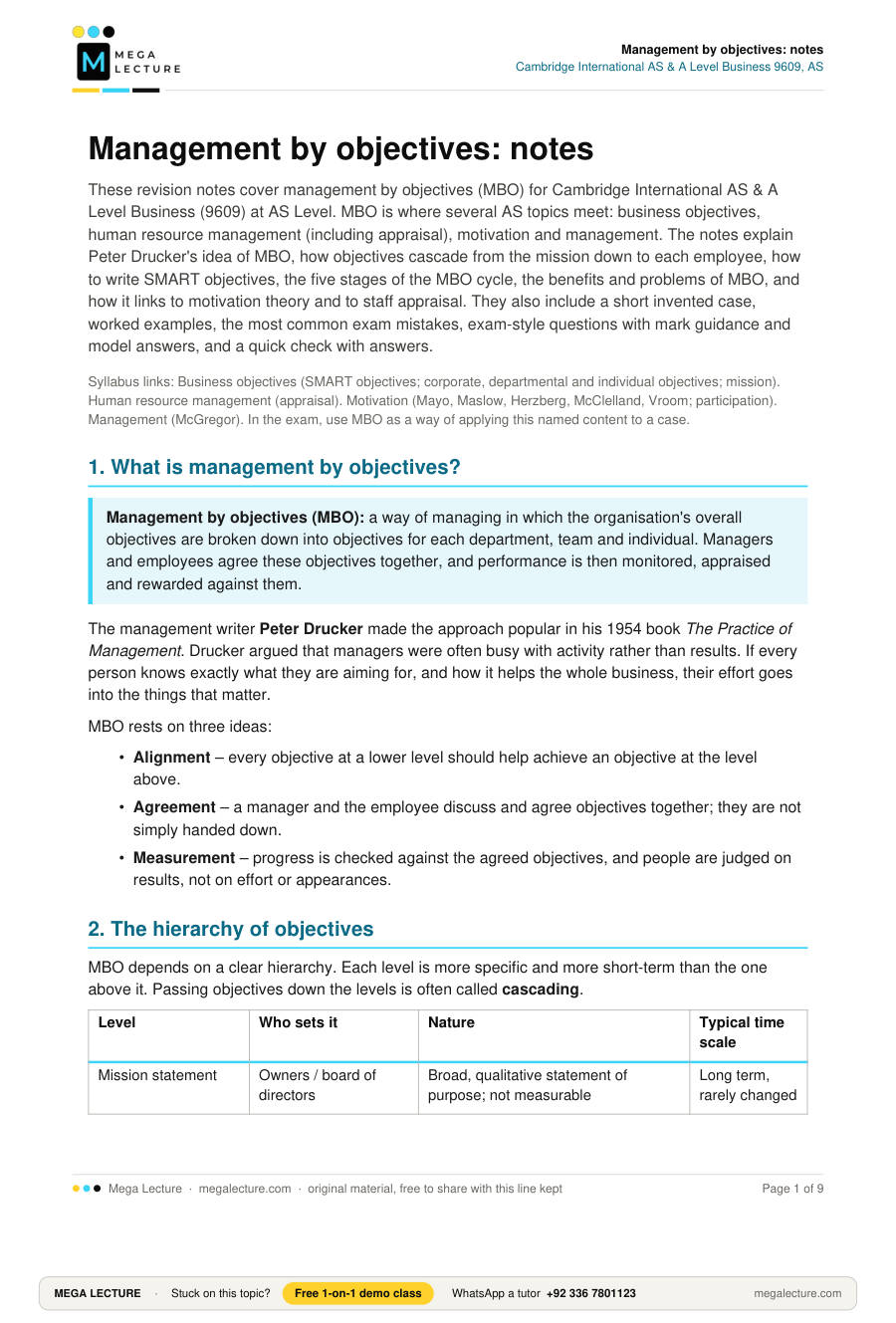
2. The hierarchy of objectives
MBO depends on a clear hierarchy. Each level is more specific and more short-term than the one above it. Passing objectives down the levels is often called cascading.
| Level | Who sets it | Nature | Typical time scale |
|---|---|---|---|
| Mission statement | Owners / board of directors | Broad, qualitative statement of purpose; not measurable | Long term, rarely changed |
| Corporate objectives | The board and senior managers | Measurable targets for the whole business (e.g. growth, market share, profit) | Usually 1–5 years |
| Departmental (functional) objectives | Heads of department with senior managers | Targets for marketing, operations, finance and HR that support corporate objectives | Usually 1 year or less |
| Team and individual objectives | Line manager, agreed with the employee | Personal targets that support the department's objectives | Months to a year |
Note: some textbooks put aims between the mission and corporate objectives. Strategies (plans for how the objectives will be achieved) follow each level. Objectives do not come straight from the mission without these links.
Diagram described in words: picture a pyramid. The mission is the narrow point at the top. Each layer below is wider because it holds more objectives, and each one is more detailed. The base holds the individual objectives of every employee. Arrows run downwards (objectives cascade) and upwards (results feed back to show whether the higher objectives are being met).
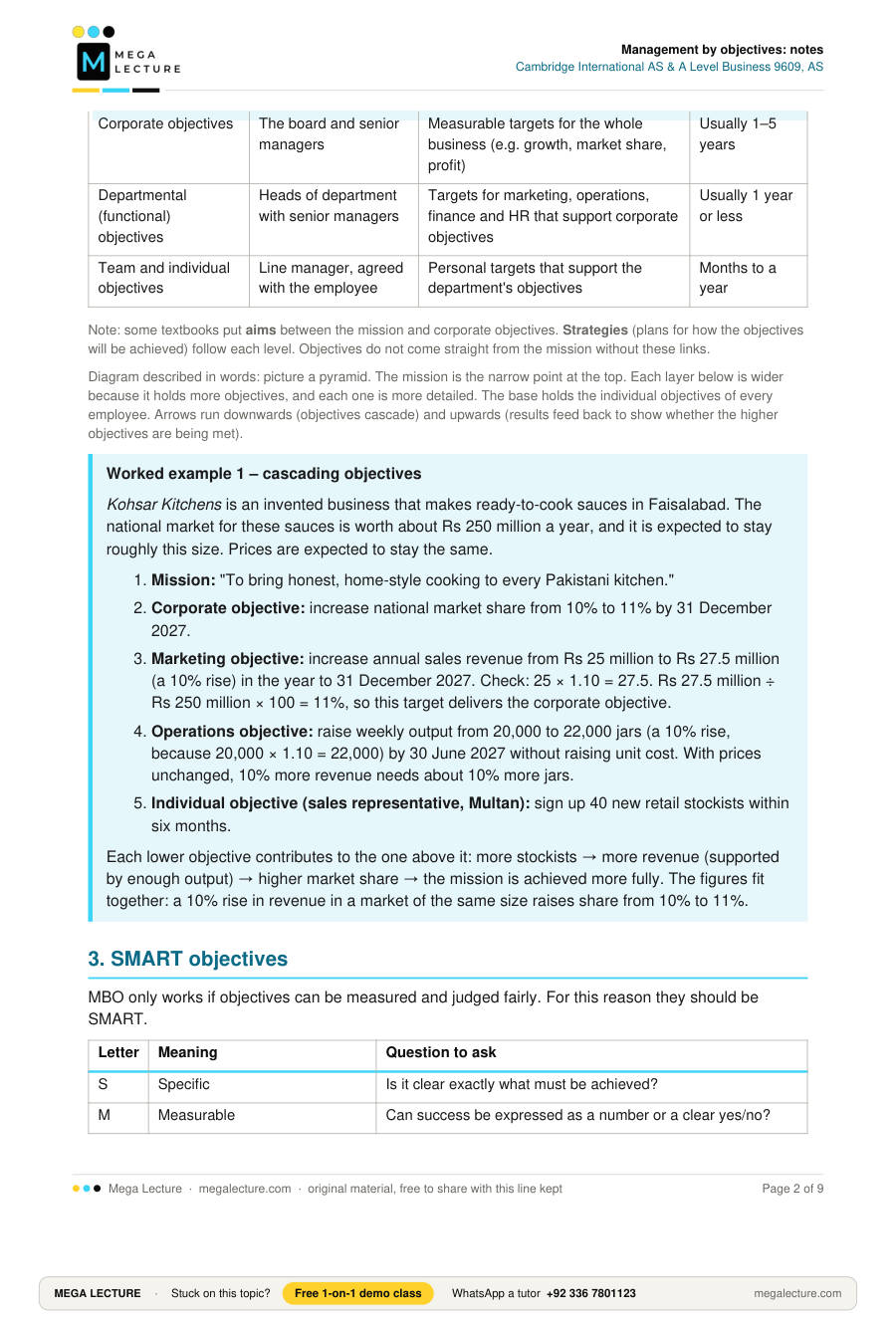
Worked example 1 – cascading objectives
Kohsar Kitchens is an invented business that makes ready-to-cook sauces in Faisalabad. The national market for these sauces is worth about Rs 250 million a year, and it is expected to stay roughly this size. Prices are expected to stay the same.
- Mission: "To bring honest, home-style cooking to every Pakistani kitchen."
- Corporate objective: increase national market share from 10% to 11% by 31 December 2027.
- Marketing objective: increase annual sales revenue from Rs 25 million to Rs 27.5 million (a 10% rise) in the year to 31 December 2027. Check: 25 × 1.10 = 27.5. Rs 27.5 million ÷ Rs 250 million × 100 = 11%, so this target delivers the corporate objective.
- Operations objective: raise weekly output from 20,000 to 22,000 jars (a 10% rise, because 20,000 × 1.10 = 22,000) by 30 June 2027 without raising unit cost. With prices unchanged, 10% more revenue needs about 10% more jars.
- Individual objective (sales representative, Multan): sign up 40 new retail stockists within six months.
Each lower objective contributes to the one above it: more stockists → more revenue (supported by enough output) → higher market share → the mission is achieved more fully. The figures fit together: a 10% rise in revenue in a market of the same size raises share from 10% to 11%.
3. SMART objectives
MBO only works if objectives can be measured and judged fairly. For this reason they should be SMART.
| Letter | Meaning | Question to ask |
|---|---|---|
| S | Specific | Is it clear exactly what must be achieved? |
| M | Measurable | Can success be expressed as a number or a clear yes/no? |
| A | Achievable (sometimes "Agreed") | Can it be reached with the resources available? |
| R | Realistic (or Relevant) | Is it sensible for this person, and does it support a higher objective? |
| T | Time-bound | Is there a deadline? |
Worked example 2 – rewriting a weak objective
A call-centre supervisor is given this weak objective: "Improve customer service."
- Specific? No – it does not say which part of service.
- Measurable? No – there is no number.
- Time-bound? No – there is no deadline.
SMART version: "Reduce the average time taken to answer a customer call from 90 seconds to 60 seconds by 31 March 2027, using the current number of staff."
This version is specific (call answering time) and measurable (seconds). It is achievable and realistic, because it uses existing staff and asks for a one-third cut rather than an impossible target. It is time-bound (31 March 2027).
4. The MBO cycle
MBO is a continuous cycle, not a one-off event.
| Stage | What happens |
|---|---|
| 1. Set | The board and senior managers set corporate objectives. These are turned into departmental objectives. |
| 2. Agree | Each manager meets each employee to discuss and agree individual objectives and the resources and support needed. |
| 3. Monitor | Progress is reviewed regularly (e.g. monthly). Problems are spotted early, and objectives may be adjusted if conditions change. |
| 4. Appraise | At the end of the period, performance is formally assessed against the agreed objectives. |
| 5. Reward | Success is recognised through praise, promotion, a bonus or training. The results feed into setting the next round of objectives. |
Diagram described in words: draw five boxes in a circle, Set → Agree → Monitor → Appraise → Reward, with an arrow from Reward back to Set.
Worked example 3 – appraising against an objective
The Multan sales representative from Worked example 1 agreed an objective of 40 new stockists in six months. She signed 34. The bonus scheme pays a bonus only if at least 90% of the target is reached.
- Percentage of target achieved = (actual ÷ target) × 100
- = (34 ÷ 40) × 100
- = 0.85 × 100 = 85%
- 85% < 90%, so no bonus is paid.
Evaluation: before deciding, the appraiser should ask why the target was missed. If a competitor cut prices in Multan in month 3, the shortfall may not be her fault. Refusing the bonus rigidly could demotivate a good employee. Examiners reward exactly this kind of judgement.
5. Advantages and drawbacks of MBO
| Advantages | Drawbacks |
|---|---|
| Coordination: all departments and staff work towards the same corporate objectives. | Time-consuming: agreeing and reviewing objectives with every employee takes many management hours. |
| Employees understand how their job contributes, which can raise motivation. | In practice objectives may be imposed, with "agreement" in name only. This removes the motivational benefit. |
| Appraisal and reward have a clear basis, so judgements seem fairer. | A focus on measurable targets can mean quality, teamwork or ethics are neglected (staff "hit the target but miss the point"). |
| Managers can delegate with confidence because responsibilities are clear. | Objectives can quickly go out of date in a fast-changing market, which makes the system inflexible. |
| Regular monitoring means problems are spotted early. | Some jobs are hard to measure (e.g. research, customer care), so their objectives may be artificial. |
| Missed objectives show where training is needed. | Pressure to meet targets may cause stress, or may encourage staff to push for easy targets at the "agree" stage. |
6. Links to motivation theory and appraisal
Participation
The "agree" stage gives employees a say in their own work. This links to Mayo's finding that workers respond to attention and involvement. It also links to Herzberg's motivators: achievement, recognition and responsibility. Being trusted to agree targets and plan how to reach them gives employees responsibility and a degree of empowerment. If it is combined with more challenging tasks, it can form part of job enrichment.
Goal-setting
Research on goal-setting (associated with Edwin Locke) suggests that specific, challenging goals which a person accepts lead to higher performance than vague goals such as "do your best". SMART objectives apply this idea directly.
Exam note: Locke is not a named syllabus theorist. In the exam, make the same point through Vroom (expectancy), McClelland (need for achievement) or Herzberg (achievement), and use Locke only as supporting context.
Other theories
- Maslow: meeting agreed objectives and being recognised for it satisfies esteem needs. Development objectives can support self-actualisation.
- McClelland: people with a high need for achievement are likely to respond well to measurable, moderately difficult targets.
- Vroom (expectancy): motivation is high only if employees believe three things. Effort will lead to meeting the objective (expectancy). Meeting it will be rewarded (instrumentality). They value the reward (valence). Unrealistic targets or unpaid bonuses break this chain.
Appraisal
MBO gives a formal appraisal system its content. The appraisal interview compares results with the agreed objectives, identifies training needs and sets objectives for the next period. The danger is that appraisal becomes linked only to pay, so employees see it as a judgement rather than a way to develop.
7. When does MBO suit a business?
| MBO is more suitable when… | MBO is less suitable when… |
|---|---|
| Output can be measured (sales, units, costs, complaints). | Work is creative or hard to quantify. |
| The market is fairly stable, so objectives stay relevant. | Conditions change rapidly and targets soon become obsolete. |
| Management style is democratic and trust is high. | Management is autocratic, so "agreement" is a formality. |
| Staff are skilled and want responsibility (McGregor's Theory Y view). | Staff are low-skilled or on short contracts, or staff turnover is high. |
| Managers have time and training to hold reviews. | A small business owner lacks the time and formal systems. |
| Rewards can be linked fairly to results. | Results depend mainly on team effort or outside factors. |
8. Case study: Zarina Tiles Ltd (invented)
Zarina Tiles Ltd makes ceramic floor tiles in Gujranwala and employs 180 people. Sana Qureshi, the new managing director, wants to grow profit after two flat years, so she introduces MBO. The board sets a corporate objective to raise net profit from Rs 30 million to Rs 36 million within two years. Production is asked to cut the percentage of broken tiles from 6% to 4% within 12 months. Sales must open 25 new dealers in Sindh within 12 months.
Line managers were given one week to hold objective meetings with all staff. Many kiln workers said their targets were "read out, not discussed". After six months the recorded breakage rate had fallen to 4.5%. However, two supervisors were found to be recording cracked tiles as "seconds" to meet their targets. Meanwhile the sales team, whose members had designed their own dealer plans, had already signed 19 dealers and asked for more responsibility.
Note: the target profit rise is (36 − 30) ÷ 30 × 100 = 20%.
Exam trap – percentages and percentage points
The recorded breakage rate fell from 6% to 4.5%. That is a fall of 1.5 percentage points (6 − 4.5 = 1.5), which is a 25% reduction in the breakage rate (1.5 ÷ 6 × 100 = 25%).
The target was a fall of 2 percentage points (6% → 4%), which is a 33% reduction (2 ÷ 6 × 100 ≈ 33%). So production achieved 75% of the planned improvement (1.5 ÷ 2 × 100 = 75%), and even this figure is probably overstated because of the misrecording.
When you compare two percentages, always say "percentage points" for the simple difference.
9. Common exam mistakes
- Treating a mission statement as an objective. Fix: a mission is broad and qualitative. An objective has a measure and a deadline.
- Writing "SMART" objectives with no deadline or no measure. Fix: check that every objective you write contains a number and a date.
- Describing MBO in general terms without using the case. Fix: after the definition, use case names and figures in every paragraph, e.g. Zarina's 6% breakage rate or the 19 dealers signed.
- Listing advantages and disadvantages with no judgement. Fix: end every "evaluate" answer with a clear decision and say what it depends on.
- Naming a motivation theory without linking it to the context. Fix: explain how the theory applies to these workers, e.g. why kiln workers had low expectancy.
- Confusing percentages with percentage points. Fix: see the exam trap box in Section 8.
10. Exam-style questions
- Define the term "management by objectives". [2]
- Explain one reason why objectives at Zarina Tiles should be SMART. [3]
- Calculate the percentage of the dealer target the sales team had achieved after six months. [2]
- Explain how the corporate objective at Zarina Tiles could be cascaded to the production department. [4]
- Analyse the reasons why the sales team responded better to MBO than the kiln workers. [8]
- Analyse how Vroom's expectancy theory could help explain the supervisors' behaviour. [8]
- Evaluate whether MBO will help Zarina Tiles achieve its profit objective. [12]
Guidance and mark schemes
Q1 [2]: an accurate definition needs both parts. First, objectives are broken down (cascaded) to departments and individuals. Second, they are agreed and performance is reviewed against them. One part only = 1 mark.
Q2 [3]: e.g. measurable targets let managers judge fairly whether breakage has actually fallen. Apply this to tiles: a measure such as "broken tiles as a % of output" is harder to argue about. Knowledge 1, application 1, explanation of the consequence 1.
Q3 [2]: (19 ÷ 25) × 100 = 76%. A correct answer (76%) earns 2 marks, even with no working. If the answer is wrong, a correct formula or method, e.g. (19 ÷ 25) × 100, earns 1 mark, so always show your working. Comment: 76% of a 12-month target after only 6 months puts the sales team well ahead of schedule.
Q4 [4]: explain the chain: profit objective → reduce costs → cut the breakage rate from 6% to 4% → shift and individual targets for kiln workers and supervisors. Credit knowledge of cascading, and application to Zarina's production department.
Q5 [8]: knowledge 2, application 2, analysis 4.
- Level 1 (1–2 marks): knowledge only, e.g. a definition of participation or MBO.
- Level 2 (3–4 marks): points applied to Zarina, e.g. the sales team designed their own plans while kiln targets were "read out".
- Level 3 (5–8 marks): developed analysis, with chains of reasoning that show the consequences for motivation and performance, using case evidence.
Possible reasons: participation versus imposed targets; the rushed one-week timetable; how measurable and controllable each target is (dealers signed vs breakage, which depends on kilns and materials); the kind of work and the skill level of the staff.
Model paragraph: "One reason is participation. The sales team designed their own dealer plans, so the 25-dealer target was genuinely agreed rather than imposed. This gave them responsibility, one of Herzberg's motivators, and made them more likely to believe the target was achievable. As a result they were committed to it: they had signed 19 dealers (76% of the target) after only six months of a 12-month period, and they even asked for more responsibility. By contrast, the kiln workers' targets were 'read out, not discussed' in a one-week rush. They had no ownership of the 4% breakage target, so it felt like a demand from above. For them, MBO worked like ordinary target-setting and gave none of the motivational benefit of the 'agree' stage."
Q6 [8]: knowledge 2, application 2, analysis 4 (levels as for Q5). Instrumentality and valence were high: the target mattered for reward or job security. Expectancy was low: the supervisors had no say in the target and did not believe honest effort could reach 4% in time. Because the honest route seemed unlikely to work, effort went into the route that did seem to lead to the reward, which was misrecording cracked tiles as "seconds". For the top of Level 3, add a comment such as: expectancy theory explains the pressure, but weak quality control is what made the misrecording possible.
Q7 [12]: knowledge 2, application 2, analysis 2, evaluation 6.
- Knowledge/application/analysis: developed points on both sides, using case evidence.
- Evaluation, lower level: a simple judgement with little support.
- Evaluation, top level: a justified judgement rooted in the case, saying what the outcome depends on.
Model outline:
- For: coordination behind a clear 20% profit target; the sales team is well motivated (19 of 25 dealers in six months, ahead of pace), so revenue should rise; the recorded breakage rate fell from 6% to 4.5%, which cuts waste costs.
- Against: kiln targets were imposed, so there is little commitment; misrecording means the reported fall to 4.5% is probably overstated, and the true breakage rate may be higher; "seconds" sold at lower prices, or cracked tiles reaching customers, could hurt profit and reputation; a one-week round of meetings suggests managers lack the time or training for MBO.
- Depends on: management style; how reliable the measurements are; whether two years is long enough; outside factors such as construction demand and costs of energy for the kilns.
- Judgement: "MBO can help Zarina reach its profit objective, but only if production targets are genuinely agreed and independent quality checks stop misrecording. The sales side shows that MBO works when staff take part in setting targets. On the production side, as MBO is currently run, it may produce better-looking figures rather than lower costs." Avoid a one-sided list; the best answers make a conditional judgement rooted in the case.
Mark splits follow the pattern used in recent 9609 mark schemes. Check them against the current specimen papers.
Key terms
| Term | Definition |
|---|---|
| Management by objectives | Managing by cascading organisational objectives to departments and individuals, agreeing them, and monitoring, appraising and rewarding performance against them. |
| Mission statement | A qualitative statement of the purpose and values of an organisation. |
| Corporate objective | A measurable target for the business as a whole. |
| Departmental objective | A target for one function that supports a corporate objective. |
| Cascading | Passing objectives down the hierarchy so that each level supports the one above. |
| SMART | Specific, measurable, achievable, realistic/relevant and time-bound. |
| Appraisal | A formal review of an employee's performance, usually against agreed objectives. |
| Participation | Involving employees in decisions that affect their work. |
| Percentage point | The simple difference between two percentages (e.g. 6% → 4.5% is a fall of 1.5 percentage points). |
Quick check
- State who is most associated with developing MBO. [1]
- State the four levels in the hierarchy of objectives, from top to bottom. [2]
- State what each letter of SMART stands for. [3]
- List the five stages of the MBO cycle in order. [2]
- Explain why a mission statement is not a SMART objective. [2]
- An employee's target is 250 orders and she processes 230. Calculate the percentage of the target achieved. [2]
- Rewrite "Make the website better" as a SMART objective. [2]
- Explain one link between MBO and Herzberg's two-factor theory. [3]
- Explain one drawback of MBO for a business in a fast-changing market. [3]
- Explain two ways MBO could support a staff appraisal system. [4]
- Evaluate whether MBO would suit a small software design studio. [12]
- Peter Drucker.
- Mission → corporate objectives → departmental (functional) objectives → team/individual objectives.
- Specific, Measurable, Achievable (or Agreed), Realistic (or Relevant), Time-bound. Marking: 5 correct = 3 marks; 3–4 correct = 2 marks; 1–2 correct = 1 mark.
- Set → Agree → Monitor → Appraise → Reward.
- It is a broad, qualitative statement of purpose with no measurable target or deadline, so there is no way to judge whether it has been achieved.
- (230 ÷ 250) × 100 = 0.92 × 100 = 92%.
- e.g. "Reduce the average page loading time of the website from 5 seconds to 2 seconds by 30 June 2027." Accept any answer with a measure and a deadline that is linked to a clear aim.
- Agreeing objectives gives responsibility, and meeting them brings achievement and recognition. These are all Herzberg motivators, so MBO may give lasting motivation rather than just removing dissatisfaction.
- Objectives agreed at the start of the year may soon become irrelevant (e.g. because a new competitor arrives). Staff then chase out-of-date targets or feel unfairly judged, and revising objectives often uses up management time.
- Any two, each explained (2 marks each). (1) Agreed objectives give a clear, measurable standard to review against, so appraisal seems fairer and less based on opinion. (2) Missed objectives reveal training needs, which the appraisal can then address. (3) The appraisal meeting sets the next period's objectives, which keeps the cycle going.
- For: skilled, motivated staff are likely to value participation, and project deadlines and client targets can be made SMART. Against: creative work is hard to measure; priorities change quickly as clients change their briefs; a small owner may lack the time for formal reviews; results often depend on team effort rather than individuals. Judgement: a light, flexible version works better than a rigid annual system, e.g. short-term project objectives agreed with each designer and reviewed every few weeks. Whether even this works depends on the owner's management style and how far client work can be measured.
