
NUST NET · Entry test preparation · NUST NET practice: English (30 MCQs)
NUST NET practice: English (30 MCQs)
Opens inside this page. Prefer your own PDF app? Open the PDF.
New: small group classes for NUST entry test are opening, at a lower fee than one-to-one. Join the waiting list
Check yourself
5 quick questions on NUST entry test
Tap an answer to see if you are right, and why. Free, no sign-up.
Start the free test13 of 16 students found these notes useful
Was this note useful?
Full text of NUST NET practice: English (30 MCQs)
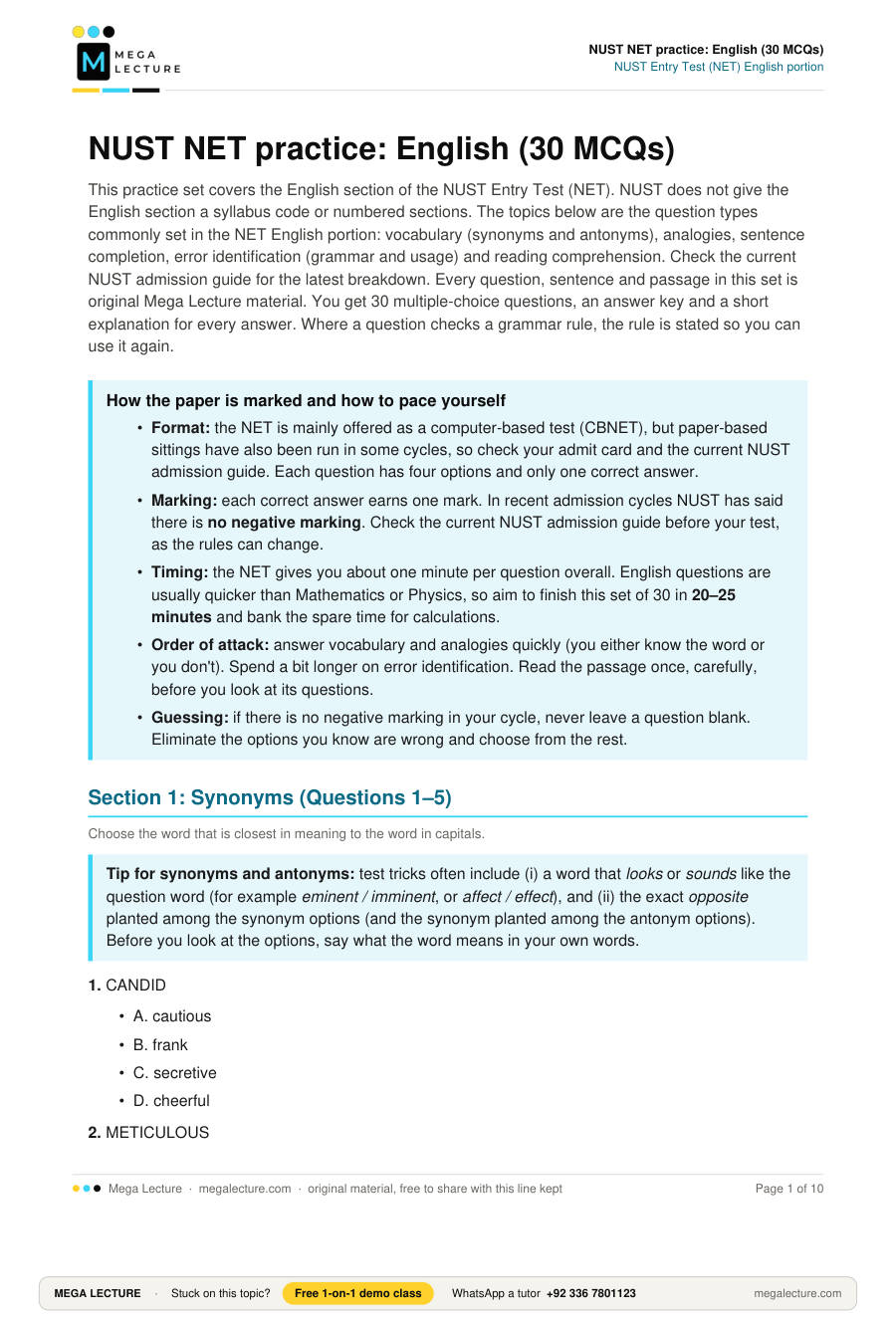
This practice set covers the English section of the NUST Entry Test (NET). NUST does not give the English section a syllabus code or numbered sections. The topics below are the question types commonly set in the NET English portion: vocabulary (synonyms and antonyms), analogies, sentence completion, error identification (grammar and usage) and reading comprehension. Check the current NUST admission guide for the latest breakdown. Every question, sentence and passage in this set is original Mega Lecture material. You get 30 multiple-choice questions, an answer key and a short explanation for every answer. Where a question checks a grammar rule, the rule is stated so you can use it again.
How the paper is marked and how to pace yourself
- Format: the NET is mainly offered as a computer-based test (CBNET), but paper-based sittings have also been run in some cycles, so check your admit card and the current NUST admission guide. Each question has four options and only one correct answer.
- Marking: each correct answer earns one mark. In recent admission cycles NUST has said there is no negative marking. Check the current NUST admission guide before your test, as the rules can change.
- Timing: the NET gives you about one minute per question overall. English questions are usually quicker than Mathematics or Physics, so aim to finish this set of 30 in 20–25 minutes and bank the spare time for calculations.
- Order of attack: answer vocabulary and analogies quickly (you either know the word or you don't). Spend a bit longer on error identification. Read the passage once, carefully, before you look at its questions.
- Guessing: if there is no negative marking in your cycle, never leave a question blank. Eliminate the options you know are wrong and choose from the rest.
Section 1: Synonyms (Questions 1–5)
Choose the word that is closest in meaning to the word in capitals.
Tip for synonyms and antonyms: test tricks often include (i) a word that looks or sounds like the question word (for example eminent / imminent, or affect / effect), and (ii) the exact opposite planted among the synonym options (and the synonym planted among the antonym options). Before you look at the options, say what the word means in your own words.1. CANDID
- A. cautious
- B. frank
- C. secretive
- D. cheerful
2. METICULOUS
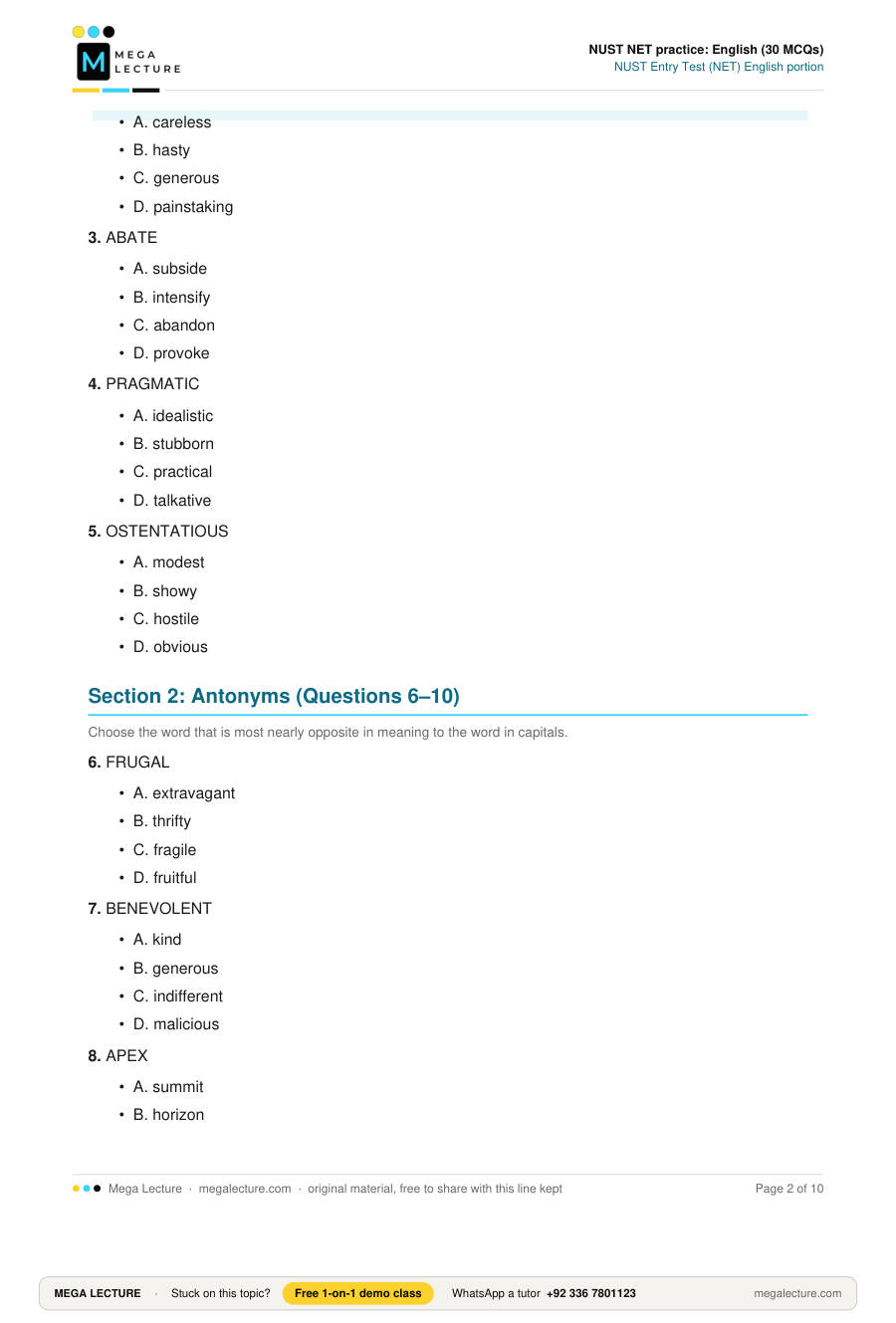
- A. careless
- B. hasty
- C. generous
- D. painstaking
3. ABATE
- A. subside
- B. intensify
- C. abandon
- D. provoke
4. PRAGMATIC
- A. idealistic
- B. stubborn
- C. practical
- D. talkative
5. OSTENTATIOUS
- A. modest
- B. showy
- C. hostile
- D. obvious
Section 2: Antonyms (Questions 6–10)
Choose the word that is most nearly opposite in meaning to the word in capitals.
6. FRUGAL
- A. extravagant
- B. thrifty
- C. fragile
- D. fruitful
7. BENEVOLENT
- A. kind
- B. generous
- C. indifferent
- D. malicious
8. APEX
- A. summit
- B. horizon
- C. base
- D. climax
9. TRANSIENT
- A. brief
- B. permanent
- C. transparent
- D. mobile
10. COHERENT
- A. muddled
- B. logical
- C. adhesive
- D. consistent
Section 3: Analogies (Questions 11–14)
Choose the pair of words whose relationship is most like the relationship between the words in capitals.
Method for analogies: turn the given pair into a short sentence that names the relationship, for example "A PETAL is part of a FLOWER." Then put each option into the same sentence. Only one option should fit exactly. If more than one fits, make your sentence more precise.11. CHEF : WHISK
- A. writer : novel
- B. judge : court
- C. tailor : needle
- D. farmer : harvest
12. DROUGHT : FAMINE
- A. rain : cloud
- B. hunger : food
- C. river : sea
- D. negligence : accident
13. SHELL : TORTOISE
- A. wool : sweater
- B. fur : fox
- C. bark : dog
- D. nest : tree
14. TIMID : COURAGE
- A. ignorant : knowledge
- B. wealthy : money
- C. honest : truth
- D. generous : gifts
Section 4: Sentence completion (Questions 15–20)
Choose the option that best completes the sentence.
15. Despite repeated warnings from the engineers, the committee __________ the design flaw, and the bridge had to be closed within a year.
- A. rectified
- B. highlighted
- C. investigated
- D. overlooked
16. The new timetable was meant to be a temporary trial, but students liked it so much that the school made it __________.
- A. obsolete
- B. provisional
- C. permanent
- D. illegal
17. Neither the students nor the teacher __________ aware that the exam had been rescheduled.
- A. was
- B. were
- C. are
- D. have been
18. She has been working at the research laboratory __________ 2021.
- A. for
- B. since
- C. from
- D. by
19. If I __________ you, I would accept the scholarship without a second thought.
- A. am
- B. will be
- C. had been
- D. were
20. Her argument was so __________ that even the members who had opposed her could find no flaw in it.
- A. feeble
- B. verbose
- C. cogent
- D. ambiguous
Section 5: Error identification (Questions 21–25)
Each sentence is divided into four parts. The letter in brackets comes just before the part it labels. Exactly one part contains an error of grammar or usage. Choose that part.
21. (A) Each of the players have (B) been given (C) a new kit (D) for the tournament.
22. (A) The committee members discussed (B) about the proposal (C) for nearly three hours (D) before reaching a decision.
23. (A) The manager, along with (B) his two assistants, (C) is expected (D) to arrive at tomorrow.
24. (A) Ayesha is one of those students (B) who always (C) submits their assignments (D) before the deadline.
25. (A) Mathematics are (B) a subject that (C) many first-year students find (D) challenging at first.
Checklist for error identification (check the parts in this order):- Subject–verb agreement: find the real subject. Ignore phrases that sit between the subject and the verb, such as of the boys (in "one of the boys"), as well as or together with.
- Prepositions: look for extra ones (enter into the room, order for a pizza, reach at the station) and missing or wrong ones.
- Tense consistency and the correct form after linking pairs such as hardly … when and no sooner … than.
- Pronouns: check that each one agrees with the noun it refers to.
- Word form: adjective or adverb, singular or plural noun.
Section 6: Reading comprehension (Questions 26–30)
Read the passage and answer the questions that follow. Base your answers only on what the passage states or clearly implies.
The Karez
For centuries, farmers in the dry valleys of Balochistan have relied on the karez, an underground channel that carries groundwater from the foot of the hills to fields and villages further downhill. A karez needs no pump and no fuel: gravity does all the work. Because the water travels below the surface, very little of it is lost to evaporation, even in the fierce summer heat. A line of vertical shafts, dug at intervals along the route, allows workers to climb down into the tunnel to clear silt and repair collapses.
Maintaining a karez has always been a shared duty. The families who draw water from it also contribute labour, and the flow is divided among them by time rather than by volume. In recent decades, however, many karez systems have run dry. Electric tube wells, which lift water quickly from deep underground, have lowered the water table below the level that the old channels can reach. Tube wells offer a faster reward, but they draw on reserves that may take generations to refill. Some planners now argue that the karez, far from being a relic, offers a lesson in living within the limits of the land.
26. Which of the following best expresses the main idea of the passage?
- A. The karez was first invented in Balochistan.
- B. The karez is a sustainable traditional water system that is now under threat.
- C. Tube wells are the best long-term solution to water shortage.
- D. Farmers in Balochistan no longer need to irrigate their fields.
27. According to the passage, why is very little karez water lost to evaporation?
- A. The water is moved quickly by pumps.
- B. The vertical shafts are sealed during summer.
- C. The water is shared among families by time.
- D. The water flows below the surface.
28. As used in the last sentence, the word relic most nearly means
- A. something that survives from an earlier time.
- B. an object kept and honoured because it belonged to a saint.
- C. a recent invention.
- D. a damaged tunnel.
29. Which of the following can most reasonably be inferred about tube wells?
- A. Like the karez, they need no fuel or power.
- B. They are usually maintained by the whole community.
- C. They can use up groundwater faster than it is naturally replaced.
- D. They raise the water table and so help the karez.
30. What is the purpose of the vertical shafts described in the passage?
- A. To let air cool the water before it reaches the fields
- B. To give workers access so they can clean and repair the tunnel
- C. To measure the share of water each family receives
- D. To lift water to the surface using buckets
Answer key
| Question | Answer | Question | Answer | Question | Answer |
|---|---|---|---|---|---|
| 1 | B | 11 | C | 21 | A |
| 2 | D | 12 | D | 22 | B |
| 3 | A | 13 | B | 23 | D |
| 4 | C | 14 | A | 24 | C |
| 5 | B | 15 | D | 25 | A |
| 6 | A | 16 | C | 26 | B |
| 7 | D | 17 | A | 27 | D |
| 8 | C | 18 | B | 28 | A |
| 9 | B | 19 | D | 29 | C |
| 10 | A | 20 | C | 30 | B |
Answer distribution: A = 8, B = 8, C = 7, D = 7.
