
NUST NET · Entry test preparation · NUST NET practice: chemistry (30 MCQs)
NUST NET practice: chemistry (30 MCQs)
Opens inside this page. Prefer your own PDF app? Open the PDF.
New: small group classes for NUST entry test are opening, at a lower fee than one-to-one. Join the waiting list
Check yourself
5 quick questions on NUST entry test
Tap an answer to see if you are right, and why. Free, no sign-up.
Start the free test13 of 16 students found these notes useful
Was this note useful?
Full text of NUST NET practice: chemistry (30 MCQs)
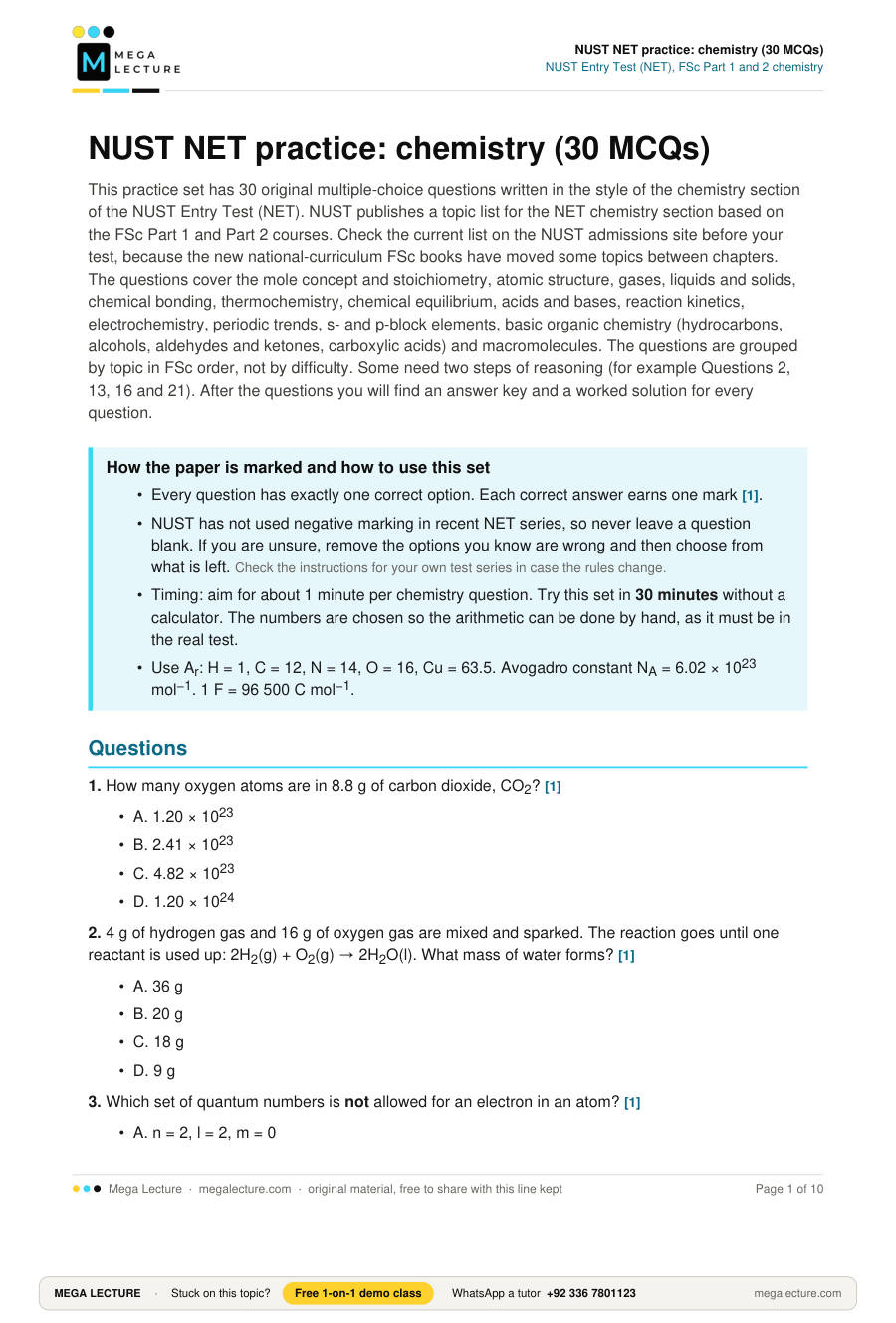
This practice set has 30 original multiple-choice questions written in the style of the chemistry section of the NUST Entry Test (NET). NUST publishes a topic list for the NET chemistry section based on the FSc Part 1 and Part 2 courses. Check the current list on the NUST admissions site before your test, because the new national-curriculum FSc books have moved some topics between chapters. The questions cover the mole concept and stoichiometry, atomic structure, gases, liquids and solids, chemical bonding, thermochemistry, chemical equilibrium, acids and bases, reaction kinetics, electrochemistry, periodic trends, s- and p-block elements, basic organic chemistry (hydrocarbons, alcohols, aldehydes and ketones, carboxylic acids) and macromolecules. The questions are grouped by topic in FSc order, not by difficulty. Some need two steps of reasoning (for example Questions 2, 13, 16 and 21). After the questions you will find an answer key and a worked solution for every question.
How the paper is marked and how to use this set
- Every question has exactly one correct option. Each correct answer earns one mark [1].
- NUST has not used negative marking in recent NET series, so never leave a question blank. If you are unsure, remove the options you know are wrong and then choose from what is left. Check the instructions for your own test series in case the rules change.
- Timing: aim for about 1 minute per chemistry question. Try this set in 30 minutes without a calculator. The numbers are chosen so the arithmetic can be done by hand, as it must be in the real test.
- Use Ar: H = 1, C = 12, N = 14, O = 16, Cu = 63.5. Avogadro constant NA = 6.02 × 10²³ mol−1. 1 F = 96 500 C mol−1.
Questions
1. How many oxygen atoms are in 8.8 g of carbon dioxide, CO2? [1]
- A. 1.20 × 10²³
- B. 2.41 × 10²³
- C. 4.82 × 10²³
- D. 1.20 × 1024
2. 4 g of hydrogen gas and 16 g of oxygen gas are mixed and sparked. The reaction goes until one reactant is used up: 2H2(g) + O2(g) → 2H2O(l). What mass of water forms? [1]
- A. 36 g
- B. 20 g
- C. 18 g
- D. 9 g
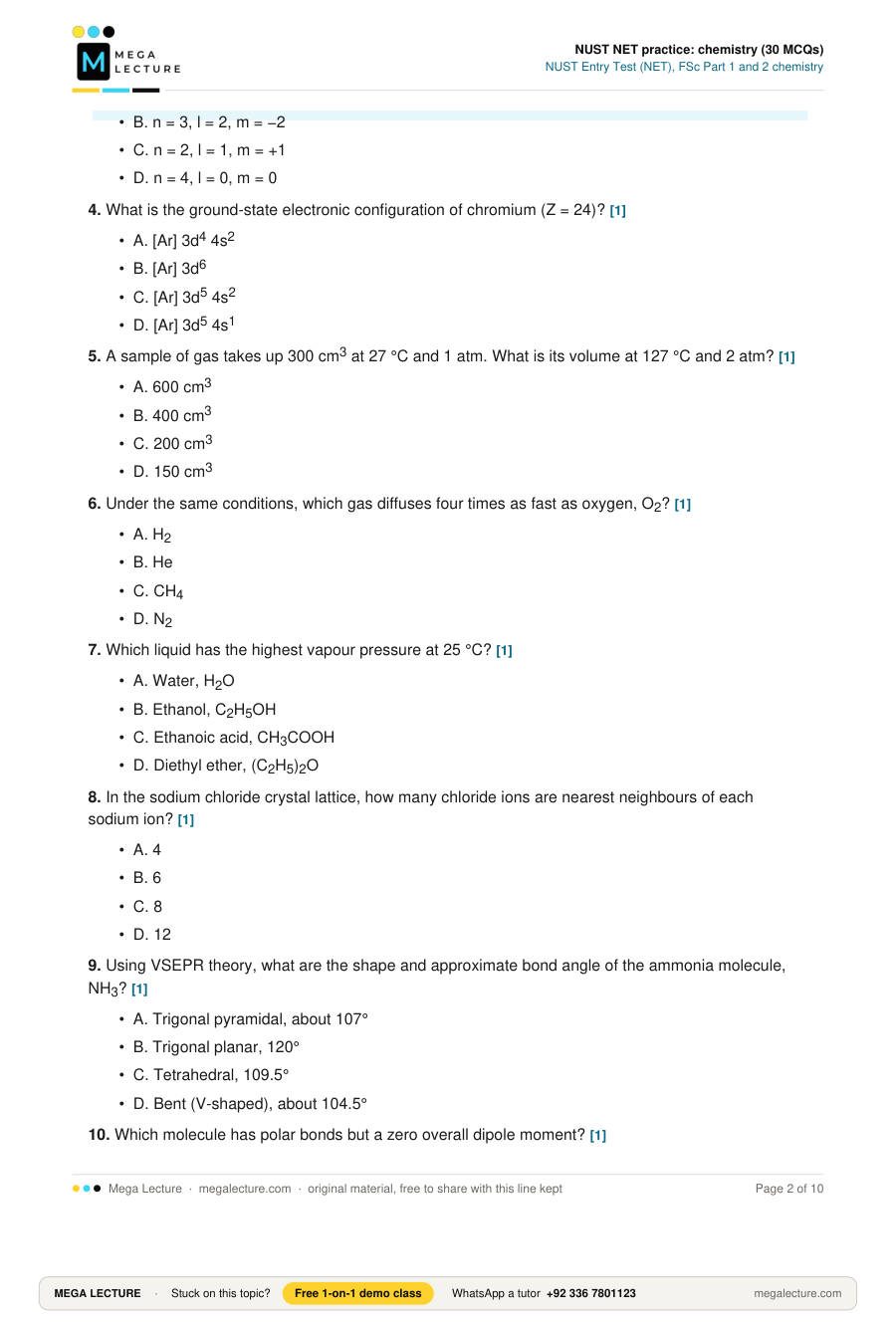
3. Which set of quantum numbers is not allowed for an electron in an atom? [1]
- A. n = 2, l = 2, m = 0
- B. n = 3, l = 2, m = −2
- C. n = 2, l = 1, m = +1
- D. n = 4, l = 0, m = 0
4. What is the ground-state electronic configuration of chromium (Z = 24)? [1]
- A. [Ar] 3d4 4s2
- B. [Ar] 3d6
- C. [Ar] 3d5 4s2
- D. [Ar] 3d5 4s1
5. A sample of gas takes up 300 cm3 at 27 °C and 1 atm. What is its volume at 127 °C and 2 atm? [1]
- A. 600 cm3
- B. 400 cm3
- C. 200 cm3
- D. 150 cm3
6. Under the same conditions, which gas diffuses four times as fast as oxygen, O2? [1]
- A. H2
- B. He
- C. CH4
- D. N2
7. Which liquid has the highest vapour pressure at 25 °C? [1]
- A. Water, H2O
- B. Ethanol, C2H5OH
- C. Ethanoic acid, CH3COOH
- D. Diethyl ether, (C2H5)2O
8. In the sodium chloride crystal lattice, how many chloride ions are nearest neighbours of each sodium ion? [1]
- A. 4
- B. 6
- C. 8
- D. 12
9. Using VSEPR theory, what are the shape and approximate bond angle of the ammonia molecule, NH3? [1]
- A. Trigonal pyramidal, about 107°
- B. Trigonal planar, 120°
- C. Tetrahedral, 109.5°
- D. Bent (V-shaped), about 104.5°
10. Which molecule has polar bonds but a zero overall dipole moment? [1]
- A. H2O
- B. NH3
- C. BF3
- D. CHCl3
11. What is the hybridisation of each carbon atom in ethyne, HC≡CH? [1]
- A. sp3
- B. sp2
- C. sp3d
- D. sp
12. You are given:
(1) S(s) + O2(g) → SO2(g), ΔH = −297 kJ mol−1
(2) S(s) + 1½O2(g) → SO3(g), ΔH = −395 kJ mol−1
What is ΔH for SO2(g) + ½O2(g) → SO3(g)? [1]
- A. −692 kJ mol−1
- B. −98 kJ mol−1
- C. +98 kJ mol−1
- D. −395 kJ mol−1
13. The enthalpy of neutralisation of a strong acid by a strong base is −57.3 kJ mol−1. How much heat is released when 100 cm3 of 1.0 mol dm−3 HCl is mixed with 50 cm3 of 1.0 mol dm−3 NaOH? [1]
- A. 5.73 kJ
- B. 2.87 kJ
- C. 57.3 kJ
- D. 8.60 kJ
14. What are the units of Kc for the reaction N2(g) + 3H2(g) ⇌ 2NH3(g)? [1]
- A. mol−2 dm6
- B. mol2 dm−6
- C. mol dm−3
- D. No units
15. Methanol is made industrially by the equilibrium CO(g) + 2H2(g) ⇌ CH3OH(g), ΔH = −91 kJ mol−1. Which change increases the amount of CH3OH at equilibrium? [1]
- A. Raising the temperature
- B. Adding a catalyst
- C. Removing some of the hydrogen
- D. Increasing the total pressure
16. A 1.0 dm3 flask at equilibrium contains 0.10 mol H2, 0.30 mol I2 and 0.60 mol HI. The reaction is H2(g) + I2(g) ⇌ 2HI(g). What is Kc? [1]
- A. 20
- B. 0.083
- C. 12
- D. 48
17. What is the pH of a 0.005 mol dm−3 solution of barium hydroxide, Ba(OH)2, at 25 °C? Assume it dissociates completely. [1]
- A. 12
- B. 2
- C. 11.7
- D. 13
18. Which mixture of aqueous solutions acts as a buffer? [1]
- A. HCl and NaCl
- B. NaOH and NaCl
- C. CH3COOH and CH3COONa
- D. HNO3 and KNO3
19. The rate equation for a reaction is rate = k[A]2[B]. If [A] is doubled and [B] is halved at the same time, what happens to the rate? [1]
- A. It stays the same
- B. It doubles
- C. It becomes four times as great
- D. It halves
20. A first-order reaction has a half-life of 20 minutes. What fraction of the reactant is left after 60 minutes? [1]
- A. 1/3
- B. 1/6
- C. 1/4
- D. 1/8
21. The standard electrode potentials are E°(Mg2+/Mg) = −2.37 V and E°(Ag+/Ag) = +0.80 V. What is the standard e.m.f. of a cell made from these two half-cells? [1]
- A. +3.17 V
- B. −3.17 V
- C. +3.97 V
- D. −1.57 V
22. A charge of 0.20 faraday is passed through aqueous copper(II) sulphate using inert electrodes. What mass of copper is deposited at the cathode? [1]
- A. 12.7 g
- B. 3.18 g
- C. 63.5 g
- D. 6.35 g
23. Going across Period 3 from sodium to chlorine, which property increases? [1]
- A. Atomic radius
- B. Metallic character
- C. Electronegativity
- D. Reducing power of the element
24. Which Group 2 sulphate is the least soluble in water? [1]
- A. MgSO4
- B. BaSO4
- C. CaSO4
- D. BeSO4
25. Which oxide is amphoteric? [1]
- A. SO2
- B. MgO
- C. P4O10
- D. Al2O3
26. Propene reacts with hydrogen bromide. What is the main product? [1]
- A. 2-bromopropane
- B. 1-bromopropane
- C. 1,2-dibromopropane
- D. Propane
27. Which alcohol gives a ketone when it is warmed with acidified potassium dichromate(VI)? [1]
- A. Methanol
- B. Ethanol
- C. Propan-2-ol
- D. 2-methylpropan-2-ol
28. Which carbonyl compound gives a yellow precipitate of iodoform (CHI3) when warmed with iodine and sodium hydroxide? [1]
- A. Methanal, HCHO
- B. Ethanal, CH3CHO
- C. Propanal, CH3CH2CHO
- D. Benzaldehyde, C6H5CHO
29. Which acid is the strongest? [1]
- A. CCl3COOH
- B. CH3COOH
- C. CH2ClCOOH
- D. CHCl2COOH
30. Which pair of monomers is used to make nylon-6,6? [1]
- A. Ethane-1,2-diol and benzene-1,4-dicarboxylic acid
- B. Hexane-1,6-diamine and ethanedioic acid
- C. Phenol and methanal
- D. Hexane-1,6-diamine and hexanedioic acid
Answer key
| Question | Answer | Question | Answer | Question | Answer |
|---|---|---|---|---|---|
| 1 | B | 11 | D | 21 | A |
| 2 | C | 12 | B | 22 | D |
| 3 | A | 13 | B | 23 | C |
| 4 | D | 14 | A | 24 | B |
| 5 | C | 15 | D | 25 | D |
| 6 | A | 16 | C | 26 | A |
| 7 | D | 17 | A | 27 | C |
| 8 | B | 18 | C | 28 | B |
| 9 | A | 19 | B | 29 | A |
| 10 | C | 20 | D | 30 | D |
Answer spread: A = 8, B = 7, C = 7, D = 8.
Worked solutions
1. B. M(CO2) = 12 + 2(16) = 44 g mol−1.
Moles of CO2 = 8.8 ÷ 44 = 0.20 mol.
Each CO2 molecule has 2 O atoms, so moles of O atoms = 2 × 0.20 = 0.40 mol.
Number of O atoms = 0.40 × 6.02 × 1023 = 2.41 × 10²³.
Trap: option A (1.20 × 10²³) is the number of CO2 molecules, not oxygen atoms.
2. C. Moles of H2 = 4 ÷ 2 = 2.0 mol. Moles of O2 = 16 ÷ 32 = 0.50 mol.
The equation needs 1 mol O2 for every 2 mol H2. So 2.0 mol H2 would need 1.0 mol O2, but only 0.50 mol is present. O2 is the limiting reagent.
0.50 mol O2 → 2 × 0.50 = 1.0 mol H2O = 1.0 × 18 = 18 g.
Check: 16 g O2 + 2 g H2 used = 18 g, and 2 g of H2 is left over. Option B (20 g) wrongly assumes that all of both gases react.
3. A. The azimuthal quantum number l can take values from 0 to (n − 1). When n = 2, l can only be 0 or 1, so l = 2 is not allowed. In B, C and D, l is less than n and m lies between −l and +l, so they are all allowed.
4. D. The expected filling would give [Ar] 3d4 4s2. However, a half-filled d subshell (3d5) is extra stable because of symmetry and exchange energy. One 4s electron therefore moves into 3d, giving [Ar] 3d5 4s1. Option C ([Ar] 3d5 4s2) has 25 electrons, so it is the configuration of manganese, not chromium. Copper is the other well-known exception: [Ar] 3d10 4s1.
5. C. Use the general gas equation, P1V1/T1 = P2V2/T2, with temperatures in kelvin.
T1 = 27 + 273 = 300 K; T2 = 127 + 273 = 400 K.
V2 = V1 × (P1/P2) × (T2/T1) = 300 × (1/2) × (400/300) = 200 cm3.
Doubling the pressure halves the volume, and heating from 300 K to 400 K multiplies it by 4/3.
6. A. Graham's law: rate ∝ 1/√M, so rate(X)/rate(O2) = √(M(O2)/M(X)).
4 = √(32/M(X)) → 16 = 32/M(X) → M(X) = 2 g mol−1, which is H2.
For comparison, He (M = 4) diffuses √8 ≈ 2.83 times as fast as O2.
7. D. Vapour pressure is highest when the forces between molecules are weakest. Water, ethanol and ethanoic acid all form hydrogen bonds between their molecules. Diethyl ether has no O−H group, so its molecules cannot hydrogen-bond to each other. They are held only by weak dipole–dipole and London forces. Ether is the most volatile of the four: its boiling point is about 35 °C.
8. B. NaCl has a face-centred cubic arrangement in which each Na+ sits at the centre of an octahedron of six Cl− ions, and each Cl− is surrounded by six Na+. The coordination is 6:6. Caesium chloride, which has larger cations, shows 8:8 coordination (option C).
9. A. Nitrogen has 5 valence electrons. Three are used in N−H bonds and two form one lone pair, giving 4 electron pairs in total. These pairs point roughly towards the corners of a tetrahedron. A lone pair repels more strongly than a bond pair, so the H−N−H angle closes from 109.5° to about 107°. Only the atoms are counted when naming the shape, so NH3 is trigonal pyramidal.
10. C. Each B−F bond is polar because F is much more electronegative than B. BF3 is trigonal planar with bond angles of 120°, so the three equal bond dipoles cancel and the resultant is zero. H2O (bent) and NH3 (pyramidal) are not symmetrical. CHCl3 is tetrahedral but has one C−H bond and three C−Cl bonds. The bond dipoles are unequal, so they do not cancel (compare CCl4, which is non-polar).
11. D. Each carbon in ethyne forms two σ bonds (one to H and one to the other C) and has no lone pairs. Two σ bonds need two hybrid orbitals, so the carbon is sp hybridised and linear (180°). The two unhybridised p orbitals on each carbon form the two π bonds of the triple bond.
12. B. Hess's law: the target equation is equation (2) minus equation (1).
Keep (2): S + 1½O2 → SO3, ΔH = −395
Reverse (1): SO2 → S + O2, ΔH = +297
Add them: SO2 + ½O2 → SO3. The S cancels, and 1½O2 − O2 = ½O2.
ΔH = −395 + 297 = −98 kJ mol−1.
Option A (−692) adds the two values without reversing equation (1). Option C has the wrong sign.
13. B. Moles of HCl = 1.0 × 100/1000 = 0.10 mol. Moles of NaOH = 1.0 × 50/1000 = 0.050 mol.
H+ + OH− → H2O reacts 1:1, so NaOH is limiting and only 0.050 mol of water forms.
Heat released = 0.050 × 57.3 = 2.865 ≈ 2.87 kJ.
Option A (5.73 kJ) wrongly uses the moles of HCl, which is in excess.
14. A. Kc = [NH3]2 / ([N2][H2]3).
Units = (mol dm−3)2 ÷ (mol dm−3)4 = (mol dm−3)−2 = mol−2 dm6.
Quick rule: power = (moles of gaseous products) − (moles of gaseous reactants) = 2 − 4 = −2.
15. D. There are 3 mol of gas on the left (1 CO + 2 H2) and only 1 mol on the right. By Le Chatelier's principle, increasing the pressure shifts the equilibrium towards the side with fewer gas molecules, so more CH3OH forms.
The forward reaction is exothermic (ΔH negative), so raising the temperature shifts the equilibrium in the endothermic (backward) direction and reduces the CH3OH. Removing H2 also shifts it to the left. A catalyst speeds up the forward and reverse reactions equally and does not change the equilibrium position.
16. C. The volume is 1.0 dm3, so the concentrations equal the numbers of moles.
Kc = [HI]2 / ([H2][I2]) = (0.60)2 / (0.10 × 0.30) = 0.36 / 0.030 = 12.
Moles of gas are equal on both sides, so Kc has no units and the volume would cancel even if it were not 1 dm3.
Option A (20) forgets to square [HI]: 0.60 / 0.030 = 20. Option B (0.083) turns the expression upside down: 0.030 / 0.36. Option D (48) doubles [HI] before squaring: (1.20)2 / 0.030 = 48.
17. A. Ba(OH)2 → Ba2+ + 2OH−, so [OH−] = 2 × 0.005 = 0.010 mol dm−3.
pOH = −log(0.010) = 2.
At 25 °C, pH + pOH = 14, so pH = 14 − 2 = 12.
Option C (11.7) comes from forgetting that each formula unit releases two OH− ions.
18. C. A buffer contains a weak acid and its conjugate base (or a weak base and its conjugate acid). Ethanoic acid is a weak acid, and ethanoate ions from CH3COONa are its conjugate base. Added H+ is removed by CH3COO−, and added OH− is removed by CH3COOH, so the pH hardly changes. The other options contain a strong acid or a strong base with its salt, which cannot resist changes in pH.
19. B. New rate = k(2[A])2(½[B]) = k × 4[A]2 × ½[B] = 2k[A]2[B].
The rate becomes 2 times the original, so it doubles.
20. D. The half-life of a first-order reaction is constant. 60 min ÷ 20 min = 3 half-lives.
Fraction left = (½)3 = 1/8, which is 12.5% of the starting amount.
21. A. The half-cell with the more positive E° (Ag+/Ag) is the cathode, where reduction happens. Magnesium is the anode, where oxidation happens.
E°cell = E°cathode − E°anode = (+0.80) − (−2.37) = +3.17 V.
A positive e.m.f. means the reaction Mg + 2Ag+ → Mg2+ + 2Ag is spontaneous.
Traps: electrode potentials are not multiplied by the number in the balanced equation, so option C (+3.97 V, from 2 × 0.80 + 2.37) is wrong. Option D (−1.57 V) comes from adding the two values instead of subtracting. Option B has the cathode and anode the wrong way round.
22. D. Cathode reaction: Cu2+(aq) + 2e− → Cu(s). One faraday is the charge on 1 mol of electrons.
0.20 F = 0.20 mol e− → 0.20 ÷ 2 = 0.10 mol Cu.
Mass = 0.10 × 63.5 = 6.35 g.
Option A (12.7 g) forgets that each Cu2+ ion needs two electrons.
23. C. Across a period the nuclear charge increases, but the shielding from inner electrons stays almost the same. The outer electrons are pulled in more tightly. As a result, atomic radius decreases, metallic character decreases and the elements become weaker reducing agents (Na is a strong reducing agent; Cl2 is an oxidising agent). Electronegativity increases from Na (about 0.9) to Cl (about 3.2).
24. B. The solubility of the Group 2 sulphates falls down the group. The lattice energy decreases only slightly, because the large sulphate ion dominates the ion spacing. The hydration energy of the cation falls much more steeply as the cation gets bigger. BeSO4 and MgSO4 are soluble, CaSO4 is sparingly soluble and BaSO4 is almost insoluble. This is why adding Ba2+ gives a white precipitate in the test for sulphate ions.
25. D. An amphoteric oxide reacts with both acids and bases. Aluminium oxide dissolves in acid to give Al3+ salts: Al2O3 + 6HCl → 2AlCl3 + 3H2O. It also dissolves in hot concentrated alkali to give aluminates: Al2O3 + 2NaOH + 3H2O → 2NaAl(OH)4 (written in many FSc books as Al2O3 + 2NaOH → 2NaAlO2 + H2O). MgO is basic, while SO2 and P4O10 are acidic.
26. A. This is electrophilic addition. By Markovnikov's rule, H adds to the carbon of the double bond that already has more hydrogen atoms (the CH2 end). Br then adds to the middle carbon. The reason is that this route goes through the more stable secondary carbocation, CH3C+HCH3.
CH3CH=CH2 + HBr → CH3CHBrCH3 (2-bromopropane).
Beyond FSc, for interest only: if peroxides are present, HBr adds the other way round and gives 1-bromopropane.
27. C. Secondary alcohols are oxidised to ketones: (CH3)2CHOH + [O] → (CH3)2C=O + H2O, giving propanone. Methanol and ethanol are primary alcohols and give aldehydes, which can be oxidised further to carboxylic acids. 2-methylpropan-2-ol is tertiary: it has no H on the carbon carrying the OH, so it is not oxidised under these conditions. The orange dichromate stays orange.
28. B. The iodoform test is positive for compounds that contain the CH3CO− group (or CH3CH(OH)−, which is first oxidised to it). Ethanal, CH3CHO, is the only aldehyde with this group. Methanal has no methyl group. In propanal the carbonyl carbon is joined to CH2, not CH3. Benzaldehyde has no methyl group at all. The yellow solid formed is CHI3.
29. A. Chlorine atoms pull electron density away from the carboxylate group (a −I effect). This spreads out the negative charge and stabilises the anion formed when the acid loses H+. The more Cl atoms there are on the α-carbon, the stronger the acid. The order is CCl3COOH > CHCl2COOH > CH2ClCOOH > CH3COOH, so trichloroethanoic acid is the strongest.
30. D. Nylon-6,6 is a condensation polyamide. Hexane-1,6-diamine, H2N(CH2)6NH2, and hexanedioic (adipic) acid, HOOC(CH2)4COOH, join through amide links (−CO−NH−) and lose water. Both monomers have six carbon atoms, which is where the name "6,6" comes from.
Why the other pairs are wrong: A (a diol and a dicarboxylic acid) gives a polyester, Terylene, not a polyamide. B does give a polyamide, but ethanedioic acid has only two carbon atoms, so the product would not be nylon-6,6. C (phenol and methanal) gives the thermosetting resin Bakelite.
Tip for revision: list every question you got wrong under its topic heading. If two or more wrong answers fall under the same topic, go back to that FSc chapter before you try another practice set.
