
NUST NET · Entry test preparation · NUST NET practice: physics (40 MCQs)
NUST NET practice: physics (40 MCQs)
Opens inside this page. Prefer your own PDF app? Open the PDF.
New: small group classes for NUST entry test are opening, at a lower fee than one-to-one. Join the waiting list
Check yourself
5 quick questions on NUST entry test
Tap an answer to see if you are right, and why. Free, no sign-up.
Start the free test13 of 16 students found these notes useful
Was this note useful?
Full text of NUST NET practice: physics (40 MCQs)
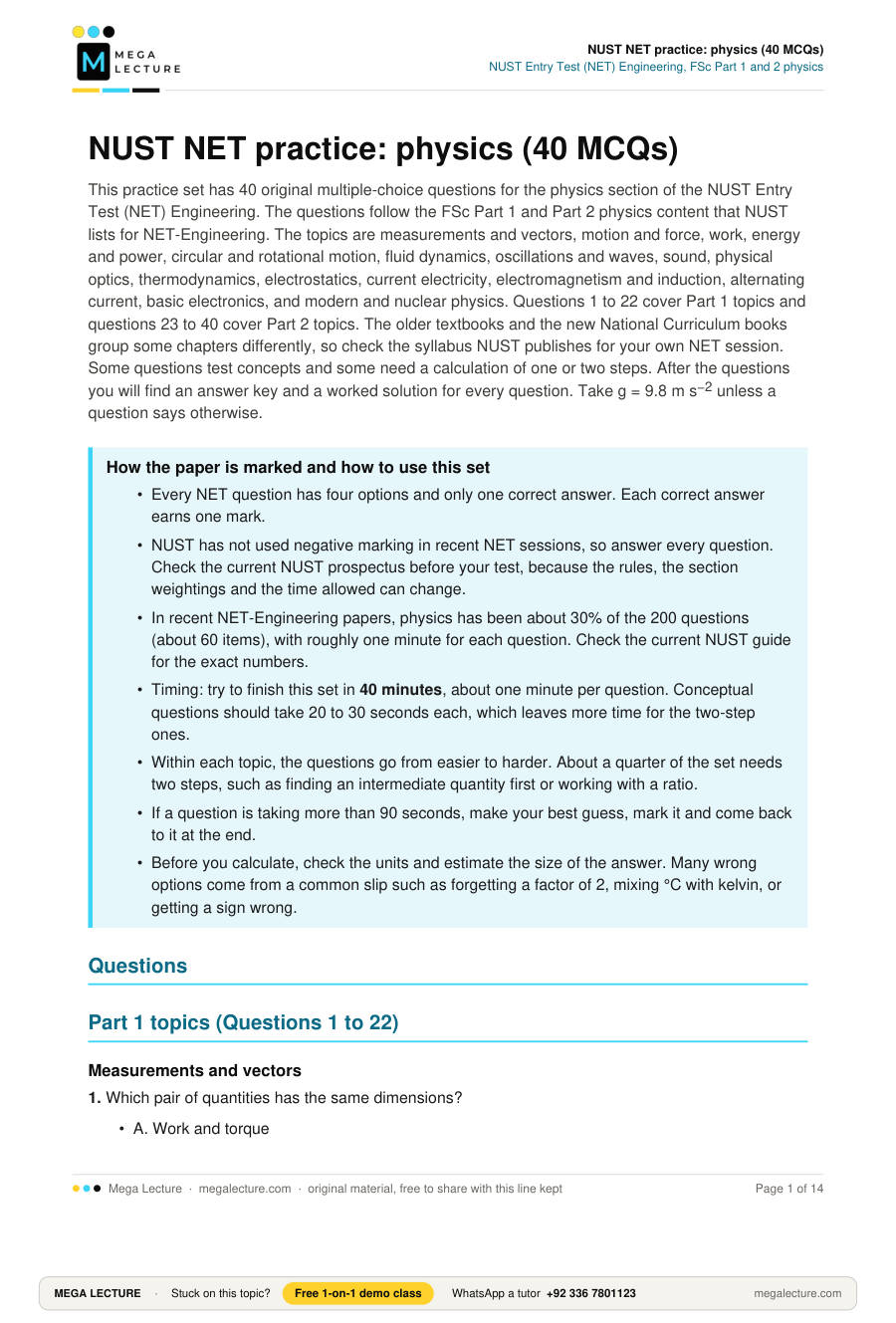
This practice set has 40 original multiple-choice questions for the physics section of the NUST Entry Test (NET) Engineering. The questions follow the FSc Part 1 and Part 2 physics content that NUST lists for NET-Engineering. The topics are measurements and vectors, motion and force, work, energy and power, circular and rotational motion, fluid dynamics, oscillations and waves, sound, physical optics, thermodynamics, electrostatics, current electricity, electromagnetism and induction, alternating current, basic electronics, and modern and nuclear physics. Questions 1 to 22 cover Part 1 topics and questions 23 to 40 cover Part 2 topics. The older textbooks and the new National Curriculum books group some chapters differently, so check the syllabus NUST publishes for your own NET session. Some questions test concepts and some need a calculation of one or two steps. After the questions you will find an answer key and a worked solution for every question. Take g = 9.8 m s−2 unless a question says otherwise.
How the paper is marked and how to use this set
- Every NET question has four options and only one correct answer. Each correct answer earns one mark.
- NUST has not used negative marking in recent NET sessions, so answer every question. Check the current NUST prospectus before your test, because the rules, the section weightings and the time allowed can change.
- In recent NET-Engineering papers, physics has been about 30% of the 200 questions (about 60 items), with roughly one minute for each question. Check the current NUST guide for the exact numbers.
- Timing: try to finish this set in 40 minutes, about one minute per question. Conceptual questions should take 20 to 30 seconds each, which leaves more time for the two-step ones.
- Within each topic, the questions go from easier to harder. About a quarter of the set needs two steps, such as finding an intermediate quantity first or working with a ratio.
- If a question is taking more than 90 seconds, make your best guess, mark it and come back to it at the end.
- Before you calculate, check the units and estimate the size of the answer. Many wrong options come from a common slip such as forgetting a factor of 2, mixing °C with kelvin, or getting a sign wrong.
Questions
Part 1 topics (Questions 1 to 22)
Measurements and vectors
1. Which pair of quantities has the same dimensions?
- A. Work and torque
- B. Torque and power
- C. Impulse and force
- D. Pressure and energy
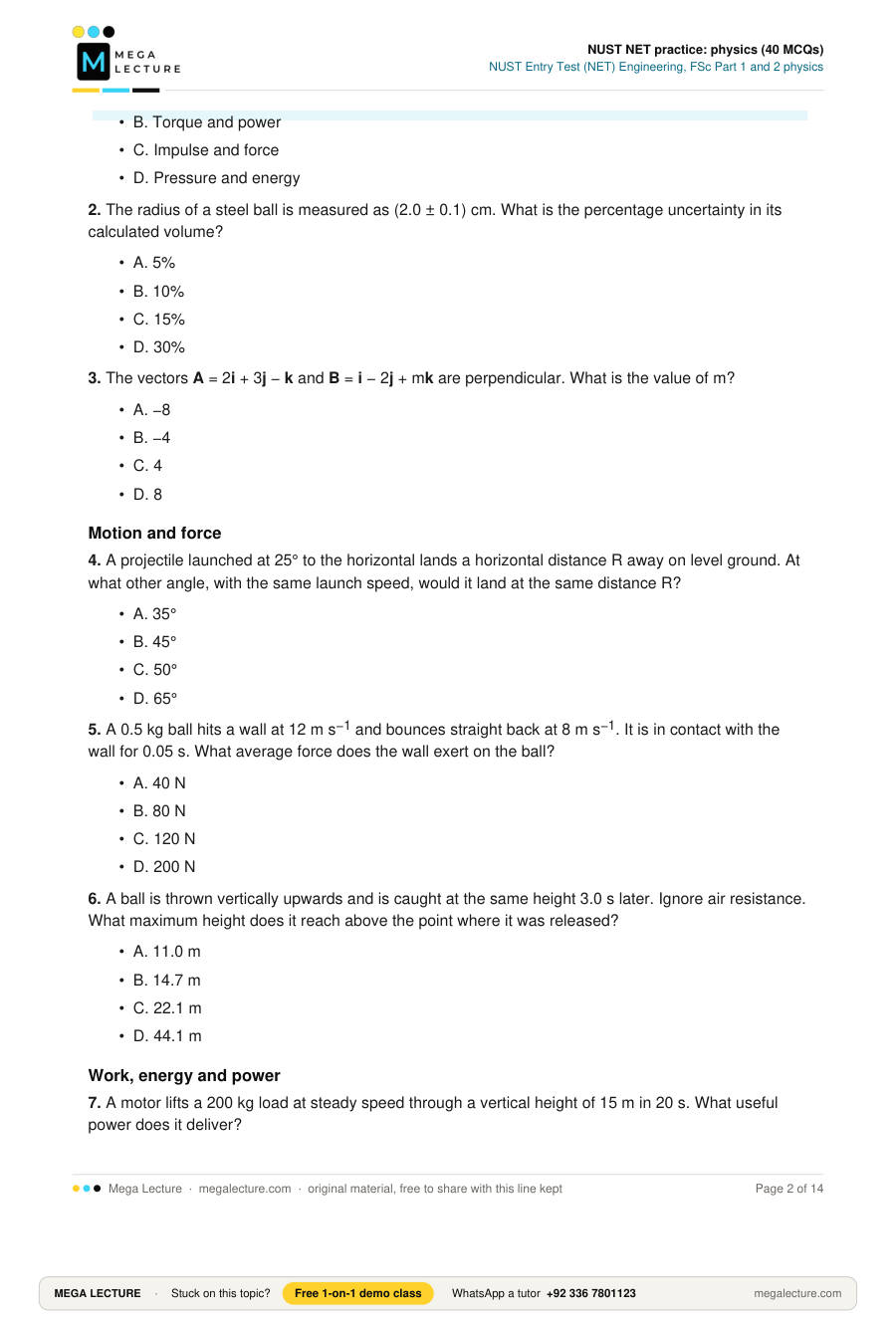
2. The radius of a steel ball is measured as (2.0 ± 0.1) cm. What is the percentage uncertainty in its calculated volume?
- A. 5%
- B. 10%
- C. 15%
- D. 30%
3. The vectors A = 2i + 3j − k and B = i − 2j + mk are perpendicular. What is the value of m?
- A. −8
- B. −4
- C. 4
- D. 8
Motion and force
4. A projectile launched at 25° to the horizontal lands a horizontal distance R away on level ground. At what other angle, with the same launch speed, would it land at the same distance R?
- A. 35°
- B. 45°
- C. 50°
- D. 65°
5. A 0.5 kg ball hits a wall at 12 m s−1 and bounces straight back at 8 m s−1. It is in contact with the wall for 0.05 s. What average force does the wall exert on the ball?
- A. 40 N
- B. 80 N
- C. 120 N
- D. 200 N
6. A ball is thrown vertically upwards and is caught at the same height 3.0 s later. Ignore air resistance. What maximum height does it reach above the point where it was released?
- A. 11.0 m
- B. 14.7 m
- C. 22.1 m
- D. 44.1 m
Work, energy and power
7. A motor lifts a 200 kg load at steady speed through a vertical height of 15 m in 20 s. What useful power does it deliver?
- A. 1470 W
- B. 1500 W
- C. 2940 W
- D. 29 400 W
8. A force F = (3i + 4j) N moves a body through a displacement d = (2i − j) m. How much work does the force do?
- A. 2 J
- B. 5 J
- C. 10 J
- D. 11.2 J
Circular and rotational motion
9. A car goes round an unbanked bend of radius 50 m at 14 m s−1. What is the smallest coefficient of static friction between the tyres and the road that stops the car from skidding?
- A. 0.2
- B. 0.3
- C. 0.4
- D. 0.5
10. An ice skater spinning on frictionless ice pulls in her arms, which halves her moment of inertia. What happens to her rotational kinetic energy?
- A. It doubles
- B. It halves
- C. It stays the same
- D. It becomes four times as large
11. A satellite orbits the Earth at a height above the surface equal to the Earth's radius, R = 6.4 × 10⁶ m. The value of g at the Earth's surface is 9.8 m s−2. What is the satellite's orbital speed, approximately?
- A. 4.0 km s−1
- B. 5.6 km s−1
- C. 7.9 km s−1
- D. 11.2 km s−1
Fluid dynamics
12. Water flows steadily through a horizontal pipe that narrows until its internal diameter is half the original value. By what factor does the speed of the water change in the narrow part?
- A. ¼
- B. ½
- C. 2
- D. 4
13. There is a small hole in the side of a large, open water tank, 5.0 m below the water surface. At what speed does water come out of the hole?
- A. 7.0 m s−1
- B. 9.9 m s−1
- C. 49 m s−1
- D. 98 m s−1
Oscillations and waves
14. A string 1.2 m long is fixed at both ends. Transverse waves travel along it at 240 m s−1. What is the frequency of its fundamental mode?
- A. 50 Hz
- B. 100 Hz
- C. 200 Hz
- D. 400 Hz
15. A mass m hanging from a spring oscillates vertically with a period of 0.40 s. The spring is cut into two equal halves, and a mass 4m is hung from one half. What is the new period of vertical oscillation?
- A. 0.28 s
- B. 0.57 s
- C. 0.80 s
- D. 1.13 s
Sound
16. Air behaves as an ideal gas. At what temperature is the speed of sound in air twice its value at 0 °C?
- A. 273 °C
- B. 546 °C
- C. 819 °C
- D. 1092 °C
17. A siren giving out 600 Hz moves at 34 m s−1 straight towards a listener who is standing still. The speed of sound is 340 m s−1. What frequency does the listener hear?
- A. 540 Hz
- B. 600 Hz
- C. 660 Hz
- D. 667 Hz
18. A tuning fork of unknown frequency makes 4 beats per second with a 256 Hz reference fork. A little wax is stuck on the prongs of the unknown fork, and it now makes 2 beats per second with the reference fork. What was the frequency of the unknown fork before the wax was added?
- A. 252 Hz
- B. 254 Hz
- C. 258 Hz
- D. 260 Hz
Physical optics
19. In a Young's double-slit experiment, the slits are 0.50 mm apart and the screen is 1.5 m from the slits. Light of wavelength 600 nm is used. What is the fringe spacing?
- A. 1.8 mm
- B. 3.6 mm
- C. 5.4 mm
- D. 18 mm
20. Light of wavelength 500 nm falls normally on a diffraction grating with 5000 lines per centimetre. At what angle to the normal is the second-order maximum?
- A. 14.5°
- B. 30°
- C. 45°
- D. 60°
Thermodynamics
21. A gas takes in 500 J of heat and does 200 J of work on its surroundings. What is the change in its internal energy?
- A. −300 J
- B. +200 J
- C. +300 J
- D. +700 J
22. A Carnot engine works between a hot reservoir at 527 °C and a cold reservoir at 127 °C. What is its efficiency?
- A. 24%
- B. 50%
- C. 76%
- D. 100%
Part 2 topics (Questions 23 to 40)
Electrostatics
23. Two point charges repel each other with a force F. One charge is doubled and the distance between them is halved. What is the new force?
- A. F
- B. 2F
- C. 4F
- D. 8F
24. A 2 µF capacitor and a 3 µF capacitor are connected in series across a 10 V supply. What is the potential difference across the 2 µF capacitor once they are fully charged?
- A. 4 V
- B. 5 V
- C. 6 V
- D. 10 V
25. A capacitor charged to a potential difference of 50 V stores 0.10 J of energy. What is its capacitance?
- A. 40 µF
- B. 80 µF
- C. 2.0 mF
- D. 4.0 mF
Current electricity
26. A cell has emf 12 V and internal resistance 1 Ω. It is connected to a 5 Ω resistor. What is the terminal potential difference of the cell?
- A. 2 V
- B. 8 V
- C. 10 V
- D. 12 V
27. Two bulbs rated "40 W, 220 V" and "25 W, 220 V" are connected in series across a 220 V supply. Assume their resistances do not change. Which statement is correct?
- A. The 25 W bulb glows more brightly
- B. The 40 W bulb glows more brightly
- C. Both glow equally brightly
- D. Both bulbs burn out
28. A Wheatstone bridge is made of four resistors. P = 10 Ω and Q = 20 Ω are in series on one side, and R = 15 Ω and S are in series on the other side. P and R are joined to one terminal of the cell, and Q and S to the other terminal. A galvanometer connects the junction of P and Q to the junction of R and S, and it reads zero. S is made of two equal resistors connected in parallel. What is the resistance of each of these two resistors?
- A. 7.5 Ω
- B. 15 Ω
- C. 30 Ω
- D. 60 Ω
Electromagnetism and induction
29. A proton moves at right angles to a uniform magnetic field and travels in a circle. Its speed is then doubled. Which statement is correct?
- A. The radius doubles and the period stays the same
- B. The radius doubles and the period doubles
- C. The radius stays the same and the period halves
- D. The radius halves and the period stays the same
30. A coil has 200 turns. The magnetic flux through each turn falls steadily from 0.030 Wb to 0.010 Wb in 0.10 s. What is the average emf induced in the coil?
- A. 40 V
- B. 60 V
- C. 80 V
- D. 400 V
31. A metal rod 0.50 m long slides at a steady 4.0 m s−1 along two parallel horizontal rails. There is a uniform magnetic field of 0.20 T at right angles to the plane of the rails, and the rod is at right angles to both the rails and the field. The ends of the rails are joined by a 2.0 Ω resistor. Ignore all other resistance. What current flows in the resistor?
- A. 0.10 A
- B. 0.20 A
- C. 0.40 A
- D. 0.80 A
Alternating current
32. A sinusoidal alternating voltage has a peak value of 311 V. What is its rms value?
- A. 156 V
- B. 198 V
- C. 220 V
- D. 440 V
33. A pure 0.10 H inductor is connected to a 220 V rms, 50 Hz supply. What rms current does it draw?
- A. 0.70 A
- B. 5.0 A
- C. 7.0 A
- D. 9.9 A
34. A series circuit contains a 30 Ω resistor, an inductor with reactance 90 Ω and a capacitor with reactance 50 Ω. The reactances are given at the supply frequency, and the supply is 100 V rms. What rms current flows?
- A. 0.59 A
- B. 0.70 A
- C. 2.0 A
- D. 3.3 A
Basic electronics
35. A logic gate with inputs A and B and output Y has the truth table below. Which gate is it?
| A | B | Y |
|---|---|---|
| 0 | 0 | 1 |
| 0 | 1 | 0 |
| 1 | 0 | 0 |
| 1 | 1 | 0 |
- A. AND
- B. OR
- C. NAND
- D. NOR
36. A transistor has current gain β = 100. The base current is 20 µA. What is the emitter current?
- A. 0.20 mA
- B. 1.98 mA
- C. 2.00 mA
- D. 2.02 mA
Modern and nuclear physics
37. Photons of energy 4.5 eV fall on a metal with a work function of 2.0 eV. What is the stopping potential for the emitted photoelectrons?
- A. 2.0 V
- B. 2.5 V
- C. 4.5 V
- D. 6.5 V
38. A nucleus of 23290Th gives out one α particle and then one β− particle. What is the final nucleus?
- A. 22889Ac
- B. 22888Ra
- C. 22887Fr
- D. 23291Pa
39. A radioactive isotope has a half-life of 5 days. How long does it take for 15/16 of a sample of this isotope to decay?
- A. 10 days
- B. 15 days
- C. 20 days
- D. 80 days
40. An electron and a proton have the same kinetic energy. Take the proton's mass as 1836 times the electron's mass and ignore relativistic effects. What is the ratio (de Broglie wavelength of the electron) ÷ (de Broglie wavelength of the proton)?
- A. 1/1836
- B. 1/43
- C. 1
- D. 43
Answer key
| Question | Answer | Question | Answer |
|---|---|---|---|
| 1 | A | 21 | C |
| 2 | C | 22 | B |
| 3 | B | 23 | D |
| 4 | D | 24 | C |
| 5 | D | 25 | B |
| 6 | A | 26 | C |
| 7 | A | 27 | A |
| 8 | A | 28 | D |
| 9 | C | 29 | A |
| 10 | A | 30 | A |
| 11 | B | 31 | B |
| 12 | D | 32 | C |
| 13 | B | 33 | C |
| 14 | B | 34 | C |
| 15 | B | 35 | D |
| 16 | C | 36 | D |
| 17 | D | 37 | B |
| 18 | D | 38 | A |
| 19 | A | 39 | C |
| 20 | B | 40 | D |
A, B, C and D are each the correct answer 10 times.
Worked solutions
1. A Work = force × distance, so its dimensions are [MLT−2][L] = [ML2T−2]. Torque = force × perpendicular distance, which also gives [ML2T−2]. They have the same dimensions even though they are different physical quantities: torque is a vector and work is a scalar. Power is [ML2T−3], impulse is [MLT−1] while force is [MLT−2], and pressure is [ML−1T−2] while energy is [ML2T−2].
2. C Percentage uncertainty in r = (0.1 ÷ 2.0) × 100% = 5%. Since V = (4/3)πr3, the percentage uncertainty in V is 3 × 5% = 15%. The constants 4/3 and π have no uncertainty. (5% is the answer if you forget the power of 3.)
3. B Two vectors are perpendicular when their dot product is zero. A·B = (2)(1) + (3)(−2) + (−1)(m) = 2 − 6 − m = −4 − m. Setting −4 − m = 0 gives m = −4.
4. D R = u2 sin 2θ ÷ g. Because sin 2θ = sin(180° − 2θ), the angles θ and 90° − θ give the same range. 90° − 25° = 65°. (45° gives the maximum range, not the same range. 50° is 2θ, not the other angle.)
5. D Take the direction away from the wall as positive. Initial velocity = −12 m s−1 and final velocity = +8 m s−1.
Δp = m(v − u) = 0.5 × (8 − (−12)) = 0.5 × 20 = 10 N s.
F = Δp ÷ Δt = 10 ÷ 0.05 = 200 N. (40 N comes from wrongly using 12 − 8 = 4 m s−1. 80 N and 120 N come from using only one of the two velocities.)
6. A Step 1: the motion is symmetrical, so the ball takes half of 3.0 s, which is 1.5 s, to reach the top. At the top v = 0, so u = gt = 9.8 × 1.5 = 14.7 m s−1.
Step 2: h = u2 ÷ 2g = 14.72 ÷ 19.6 = 216.09 ÷ 19.6 ≈ 11.0 m. As a check, h = ½g(1.5)2 = ½ × 9.8 × 2.25 ≈ 11.0 m.
(44.1 m comes from using the whole 3.0 s in ½gt2. 22.1 m comes from leaving out the 2 in u2 ÷ 2g. 14.7 is the launch speed, not a height.)
7. A Work done = mgh = 200 × 9.8 × 15 = 29 400 J.
P = W ÷ t = 29 400 ÷ 20 = 1470 W. (1500 W comes from taking g = 10 m s−2. 29 400 W is the work done in joules written as if it were a power.)
8. A W = F·d = (3)(2) + (4)(−1) = 6 − 4 = 2 J. Work is a scalar found from the dot product. 10 J comes from ignoring the minus sign in −j (6 + 4). 5 J is only the magnitude of F, and it is also what you get from multiplying the wrong components, 3 × (−1) + 4 × 2. 11.2 J is |F| × |d| = 5 × √5, which would be right only if the force and the displacement were in the same direction.
9. C On an unbanked road, friction provides the centripetal force. The condition for no skidding is μmg ≥ mv2 ÷ r, so μmin = v2 ÷ (rg) = 142 ÷ (50 × 9.8) = 196 ÷ 490 = 0.4.
10. A There is no external torque, so angular momentum L = Iω is conserved. If I becomes I/2, ω becomes 2ω.
Rotational K.E. = ½Iω2 = L2 ÷ 2I. L is constant and I halves, so the K.E. doubles. The extra energy comes from the work her muscles do in pulling her arms inwards.
11. B Step 1: the orbit radius is r = R + R = 2R. Gravity provides the centripetal force: GMm ÷ r2 = mv2 ÷ r, so v = √(GM ÷ r).
Step 2: at the surface g = GM ÷ R2, so GM = gR2. Then v = √(gR2 ÷ 2R) = √(gR ÷ 2) = √(9.8 × 6.4 × 106 ÷ 2) = √(3.14 × 10⁷) ≈ 5.6 × 10³ m s−1 = 5.6 km s−1.
(7.9 km s−1 is the speed for an orbit just above the surface. 11.2 km s−1 is the escape velocity from the surface. 4.0 km s−1 comes from wrongly assuming v ∝ 1/r and halving 7.9; in fact v ∝ 1/√r.)
12. D Equation of continuity: A1v1 = A2v2, and A ∝ d2. Halving the diameter makes the area ¼ of its original value, so the speed becomes 4 times as large. (2 comes from treating the speed as proportional to 1/d instead of 1/d2. ¼ and ½ get the direction of the change wrong: the water speeds up in the narrow part.)
13. B Torricelli's theorem, which follows from Bernoulli's equation, gives v = √(2gh) = √(2 × 9.8 × 5.0) = √98 ≈ 9.9 m s−1. (7.0 m s−1 comes from leaving out the 2. 49 and 98 come from forgetting the square root.)
14. B For the fundamental mode of a string fixed at both ends, there is a node at each end and one antinode in the middle, so L = λ/2 and λ = 2L = 2.4 m.
f1 = v ÷ λ = 240 ÷ 2.4 = 100 Hz. (200 Hz comes from taking λ = L. 50 Hz comes from taking λ = 4L, which applies to a pipe closed at one end.)
15. B Step 1: cutting the spring in half doubles its spring constant. Under the same force, each half stretches only half as much as the whole spring, so k becomes 2k.
Step 2: T = 2π√(m ÷ k), so T ∝ √(m ÷ k). The new period is 0.40 × √(4 ÷ 2) = 0.40 × √2 ≈ 0.57 s.
(0.80 s changes only the mass. 0.28 s changes only the spring. 1.13 s comes from wrongly assuming that cutting the spring halves k, which gives 0.40 × √8.)
16. C v ∝ √T, where T is in kelvin. To double v, T must be four times as large: 4 × 273 K = 1092 K.
Converting: 1092 − 273 = 819 °C. (1092 °C is the result if you forget to convert back from kelvin. 273 °C is 546 K, where T has only doubled, so the speed is only √2 times as large.)
17. D For a source moving towards a stationary observer, f′ = f × v ÷ (v − us).
f′ = 600 × 340 ÷ (340 − 34) = 600 × 340 ÷ 306 = 204 000 ÷ 306 ≈ 667 Hz.
660 Hz is the answer for an observer moving at 34 m s−1 towards a stationary source, and 540 Hz is the answer for an observer moving away from it. A moving source and a moving observer are not the same case.
18. D Four beats per second means the unknown fork is either 256 + 4 = 260 Hz or 256 − 4 = 252 Hz. Adding wax increases the mass of the prongs, so the frequency goes down.
If it were 252 Hz, going down would move it further from 256 Hz and the beats would increase.
If it were 260 Hz, going down would bring it closer to 256 Hz (to 258 Hz), and the beats would fall to 2 per second. This matches what happens, so the frequency was 260 Hz. A little wax lowers the frequency only slightly, so 260 → 258 Hz is the change that fits. A drop to 254 Hz would also give 2 beats, but it would need a much larger change of 6 Hz. (258 Hz is the frequency after the wax was added, not before.)
19. A Δy = λL ÷ d = (600 × 10−9 × 1.5) ÷ (0.50 × 10⁻³) = (9.0 × 10⁻⁷) ÷ (5.0 × 10⁻⁴) = 1.8 × 10⁻³ m = 1.8 mm. (3.6 mm and 5.4 mm are the distances of the second and third bright fringes from the centre, not the spacing. 18 mm comes from converting 0.50 mm wrongly, as 0.050 mm.)
20. B Grating spacing d = 1 cm ÷ 5000 = 2.0 × 10⁻⁴ cm = 2.0 × 10⁻⁶ m.
d sin θ = nλ, so sin θ = (2 × 500 × 10−9) ÷ (2.0 × 10⁻⁶) = 0.50, and θ = 30°. (14.5° is the first-order angle.)
21. C First law of thermodynamics: Q = ΔU + W, with Q positive for heat taken in and W positive for work done by the gas.
ΔU = Q − W = 500 − 200 = +300 J. The internal energy goes up. (+700 J comes from adding the work instead of subtracting it. −300 J has the sign the wrong way round.)
22. B Convert to kelvin: TH = 527 + 273 = 800 K and TC = 127 + 273 = 400 K.
η = 1 − TC ÷ TH = 1 − 400 ÷ 800 = 0.50 = 50%. (Using °C gives 1 − 127 ÷ 527 ≈ 76%, which is wrong. 24% is 127 ÷ 527, which is also based on °C.)
23. D F = kq1q2 ÷ r2. New force = k(2q1)q2 ÷ (r/2)2 = 2 × 4 × kq1q2 ÷ r2 = 8F. (2F takes account of only the doubled charge, and 4F takes account of only the halved distance.)
24. C Series combination: 1/C = 1/2 + 1/3 = 5/6, so C = 1.2 µF.
The charge on each capacitor is the same: Q = CV = 1.2 µF × 10 V = 12 µC.
V across the 2 µF capacitor = Q ÷ C = 12 µC ÷ 2 µF = 6 V. The 3 µF capacitor has 4 V across it, and 6 V + 4 V = 10 V as expected. In series, the smaller capacitor has the larger p.d. across it.
25. B The energy stored is E = ½CV2, so C = 2E ÷ V2 = (2 × 0.10) ÷ 502 = 0.20 ÷ 2500 = 8.0 × 10⁻⁵ F = 80 µF. (40 µF comes from leaving out the ½. 2.0 mF and 4.0 mF come from dividing by V instead of V2.)
26. C I = E ÷ (R + r) = 12 ÷ (5 + 1) = 2 A.
Terminal p.d. V = IR = 2 × 5 = 10 V. As a check, V = E − Ir = 12 − 2 × 1 = 10 V. (12 V is the emf, and 2 V is the p.d. lost across the internal resistance.)
27. A R = V2 ÷ P. For the 40 W bulb, R = 2202 ÷ 40 = 1210 Ω. For the 25 W bulb, R = 2202 ÷ 25 = 1936 Ω. In series both bulbs carry the same current, I = 220 ÷ (1210 + 1936) ≈ 0.070 A, so the power P = I2R is greater in the bulb with the larger resistance: about 9.5 W in the 25 W bulb and about 5.9 W in the 40 W bulb. The 25 W bulb glows more brightly. Neither bulb burns out, because each gets less than its rated 220 V.
28. D Step 1: with the galvanometer reading zero, the bridge is balanced, so P/Q = R/S. S = QR ÷ P = (20 × 15) ÷ 10 = 30 Ω.
Step 2: two equal resistors x in parallel have a combined resistance of x/2. So x/2 = 30 Ω and x = 60 Ω.
(30 Ω is S itself; it leaves out step 2. 7.5 Ω comes from turning the ratio upside down, S = PR ÷ Q, and 15 Ω comes from making that same mistake and then doubling.)
29. A The magnetic force provides the centripetal force: qvB = mv2 ÷ r, so r = mv ÷ qB, and r doubles when v doubles.
Period T = 2πr ÷ v = 2πm ÷ qB, which does not depend on speed. So T stays the same. This is the principle behind the cyclotron.
30. A Faraday's law: ε = N ΔΦ ÷ Δt = 200 × (0.030 − 0.010) ÷ 0.10 = 200 × 0.020 ÷ 0.10 = 40 V. Lenz's law gives the direction of the induced emf (the minus sign), but the question asks only for the size. (60 V uses 0.030 Wb as if the flux fell to zero. 80 V adds the two flux values instead of subtracting them. 400 V comes from dividing by 0.010 instead of 0.10.)
31. B Step 1: the motional emf is ε = BLv = 0.20 × 0.50 × 4.0 = 0.40 V.
Step 2: I = ε ÷ R = 0.40 ÷ 2.0 = 0.20 A.
(0.40 A treats the emf as if it were the current. 0.80 A comes from multiplying the emf by R instead of dividing.)
32. C For a sinusoidal voltage, Vrms = V0 ÷ √2 = 311 ÷ 1.414 ≈ 220 V. (198 V is the mean value over half a cycle, 0.637V0. 440 V multiplies by √2 instead of dividing. 156 V simply halves the peak.)
33. C Step 1: XL = 2πfL = 2 × 3.14 × 50 × 0.10 = 31.4 Ω.
Step 2: Irms = Vrms ÷ XL = 220 ÷ 31.4 ≈ 7.0 A.
(9.9 A is the peak current, 7.0 × √2. 5.0 A treats 220 V as a peak value and divides by √2 again. 0.70 A uses ω = 2πf = 314 as the reactance and forgets to multiply by L.)
34. C Step 1: the voltages across the inductor and the capacitor are in antiphase, so their reactances subtract. Z = √(R2 + (XL − XC)2) = √(302 + 402) = √2500 = 50 Ω.
Step 2: Irms = Vrms ÷ Z = 100 ÷ 50 = 2.0 A.
(3.3 A ignores both reactances, which is correct only at resonance. 0.70 A adds the reactances: √(302 + 1402) ≈ 143 Ω. 0.59 A adds all three values: 170 Ω.)
35. D The output is 1 only when neither input is 1. This is NOT-OR, the NOR gate: Y = (A + B) with a bar over it. For comparison, working down the table: AND gives 0, 0, 0, 1; OR gives 0, 1, 1, 1; NAND gives 1, 1, 1, 0.
36. D IC = βIB = 100 × 20 µA = 2000 µA = 2.00 mA.
IE = IB + IC = 0.02 mA + 2.00 mA = 2.02 mA. (2.00 mA is the collector current, not the emitter current. 1.98 mA subtracts the base current instead of adding it.)
37. B Einstein's photoelectric equation: K.E.max = hf − φ = 4.5 eV − 2.0 eV = 2.5 eV.
The stopping potential satisfies eV0 = K.E.max, so V0 = 2.5 V.
38. A α decay lowers A by 4 and Z by 2: 23290Th → 22888Ra.
β− decay leaves A unchanged and raises Z by 1: 22888Ra → 22889Ac.
The final nucleus is 22889Ac (actinium). (Ra-228 leaves out the β− decay. Fr-228 wrongly lowers Z in the β− decay. Pa-232 leaves out the α decay.)
39. C If 15/16 has decayed, 1/16 is left. Since 1/16 = (½)4, four half-lives have passed.
Time = 4 × 5 days = 20 days. Step by step, the fraction left goes 1 → ½ → ¼ → ⅛ → 1/16.
(15 days is three half-lives, after which 7/8 has decayed. 10 days is two half-lives, after which 3/4 has decayed. 80 days comes from multiplying 16 by the half-life.)
40. D Step 1: λ = h ÷ p, and K.E. = p2 ÷ 2m, so p = √(2m × K.E.).
Step 2: with the same K.E., λ ∝ 1/√m. So λe ÷ λp = √(mp ÷ me) = √1836 ≈ 43. The lighter electron has the longer wavelength.
(1/43 turns the ratio upside down. 1/1836 turns it upside down and also forgets the square root. 1 assumes that equal kinetic energy means equal wavelength.)
Mega Lecture original practice material. It is not endorsed by NUST. Check the current NET format in the official NUST admission guide.
