
O Level & IGCSE · Chemistry 5070 / 0620 · Transition elements: practice questions
Transition elements: practice questions
Opens inside this page. Prefer your own PDF app? Open the PDF.
New: small group classes for O Level & IGCSE Chemistry are opening, at a lower fee than one-to-one. Join the waiting list
Check yourself
5 quick questions on O Level & IGCSE Chemistry
Tap an answer to see if you are right, and why. Free, no sign-up.
Start the free test5 of 6 students found these notes useful
Was this note useful?
Full text of Transition elements: practice questions
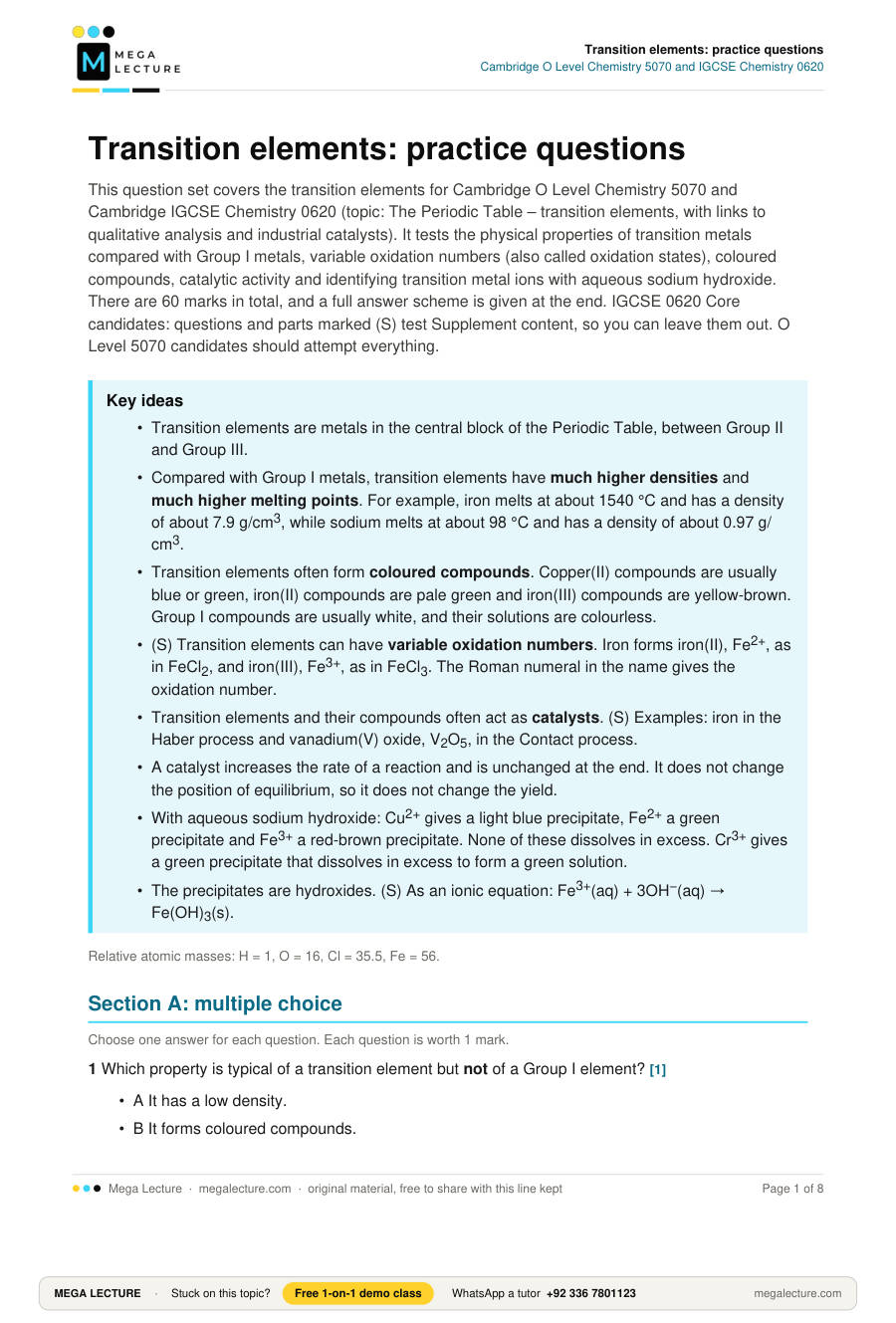
This question set covers the transition elements for Cambridge O Level Chemistry 5070 and Cambridge IGCSE Chemistry 0620 (topic: The Periodic Table – transition elements, with links to qualitative analysis and industrial catalysts). It tests the physical properties of transition metals compared with Group I metals, variable oxidation numbers (also called oxidation states), coloured compounds, catalytic activity and identifying transition metal ions with aqueous sodium hydroxide. There are 60 marks in total, and a full answer scheme is given at the end. IGCSE 0620 Core candidates: questions and parts marked (S) test Supplement content, so you can leave them out. O Level 5070 candidates should attempt everything.
Key ideas
- Transition elements are metals in the central block of the Periodic Table, between Group II and Group III.
- Compared with Group I metals, transition elements have much higher densities and much higher melting points. For example, iron melts at about 1540 °C and has a density of about 7.9 g/cm3, while sodium melts at about 98 °C and has a density of about 0.97 g/cm3.
- Transition elements often form coloured compounds. Copper(II) compounds are usually blue or green, iron(II) compounds are pale green and iron(III) compounds are yellow-brown. Group I compounds are usually white, and their solutions are colourless.
- (S) Transition elements can have variable oxidation numbers. Iron forms iron(II), Fe2+, as in FeCl2, and iron(III), Fe3+, as in FeCl3. The Roman numeral in the name gives the oxidation number.
- Transition elements and their compounds often act as catalysts. (S) Examples: iron in the Haber process and vanadium(V) oxide, V2O5, in the Contact process.
- A catalyst increases the rate of a reaction and is unchanged at the end. It does not change the position of equilibrium, so it does not change the yield.
- With aqueous sodium hydroxide: Cu2+ gives a light blue precipitate, Fe2+ a green precipitate and Fe3+ a red-brown precipitate. None of these dissolves in excess. Cr3+ gives a green precipitate that dissolves in excess to form a green solution.
- The precipitates are hydroxides. (S) As an ionic equation: Fe3+(aq) + 3OH−(aq) → Fe(OH)3(s).
Relative atomic masses: H = 1, O = 16, Cl = 35.5, Fe = 56.
Section A: multiple choice
Choose one answer for each question. Each question is worth 1 mark.
1 Which property is typical of a transition element but not of a Group I element? [1]
- A It has a low density.
- B It forms coloured compounds.
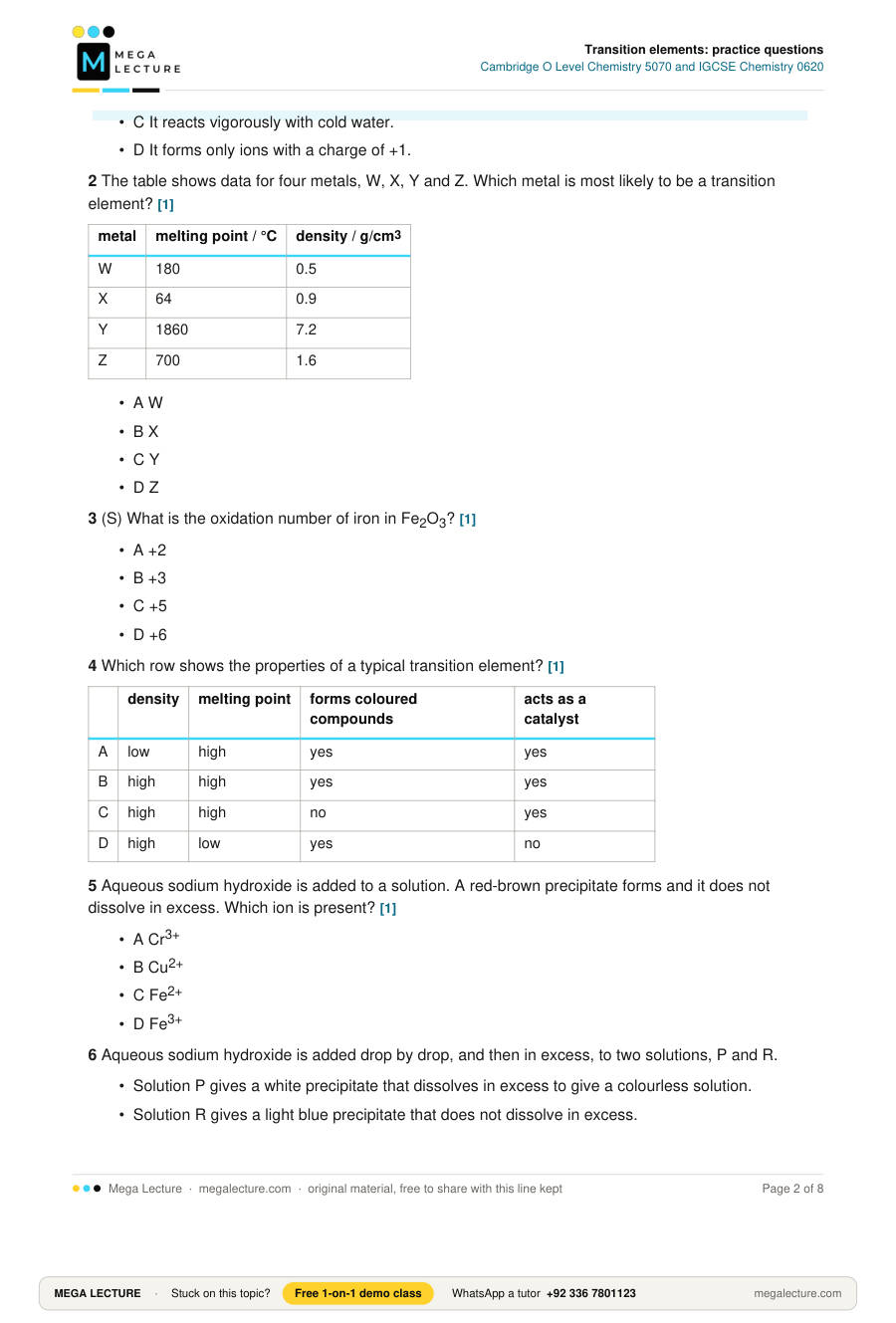
- C It reacts vigorously with cold water.
- D It forms only ions with a charge of +1.
2 The table shows data for four metals, W, X, Y and Z. Which metal is most likely to be a transition element? [1]
| metal | melting point / °C | density / g/cm3 |
|---|---|---|
| W | 180 | 0.5 |
| X | 64 | 0.9 |
| Y | 1860 | 7.2 |
| Z | 700 | 1.6 |
- A W
- B X
- C Y
- D Z
3 (S) What is the oxidation number of iron in Fe2O3? [1]
- A +2
- B +3
- C +5
- D +6
4 Which row shows the properties of a typical transition element? [1]
| density | melting point | forms coloured compounds | acts as a catalyst | |
|---|---|---|---|---|
| A | low | high | yes | yes |
| B | high | high | yes | yes |
| C | high | high | no | yes |
| D | high | low | yes | no |
5 Aqueous sodium hydroxide is added to a solution. A red-brown precipitate forms and it does not dissolve in excess. Which ion is present? [1]
- A Cr3+
- B Cu2+
- C Fe2+
- D Fe3+
6 Aqueous sodium hydroxide is added drop by drop, and then in excess, to two solutions, P and R.
- Solution P gives a white precipitate that dissolves in excess to give a colourless solution.
- Solution R gives a light blue precipitate that does not dissolve in excess.
Which conclusion is correct? [1]
- A P could contain Zn2+ ions, and R contains Cu2+ ions.
- B P could contain Fe2+ ions, and R contains Cu2+ ions.
- C P could contain Cr3+ ions, and R contains Fe3+ ions.
- D P could contain Ca2+ ions, and R contains Cr3+ ions.
7 A green precipitate forms when a few drops of aqueous sodium hydroxide are added to solution T. The precipitate dissolves in excess to give a green solution. Which ion is in solution T? [1]
- A Cr3+
- B Cu2+
- C Fe2+
- D Fe3+
8 (S) Vanadium(V) oxide is used in the Contact process. Which statement about vanadium(V) oxide is correct? [1]
- A It increases the equilibrium yield of sulfur trioxide.
- B It is used up as the reaction takes place.
- C It contains vanadium with an oxidation number of +5.
- D It is a compound of a Group I metal.
Section B: short answer
9 State two physical properties of iron that are different from those of sodium. For each one, say how they differ. [2]
10 Iron forms two chlorides. Write the formula of:
(a) iron(II) chloride [1]
(b) iron(III) chloride. [1]
11 Some steel wool is left in dilute sulfuric acid until no more bubbles form. This makes a pale green solution, X. A student adds a few drops of aqueous sodium hydroxide to a sample of X, and a green precipitate forms. The test-tube is left open to the air overnight. By the next morning, the top layer of the precipitate has turned red-brown.
(a) Identify the metal ion in solution X. [1]
(b) Name the green precipitate. [1]
(c) Suggest why only the top layer of the precipitate changes colour. [1]
12 (S) Write the ionic equation, with state symbols, for the reaction between aqueous copper(II) ions and aqueous hydroxide ions. [2]
13 (a) State what is meant by a catalyst. [1]
(b) (S) Explain why an iron catalyst is used in the manufacture of ammonia. [2]
14 (S) Chromium has variable oxidation numbers. Deduce the oxidation number of chromium in:
(a) Cr2O3 [1]
(b) K2Cr2O7. [1]
15 Two unlabelled bottles contain aqueous iron(II) sulfate and aqueous iron(III) sulfate. Describe how aqueous sodium hydroxide could be used to tell which solution is which. Give the observation for each solution. [3]
16 (S) Calculate the percentage by mass of iron in FeO and in Fe2O3. State which oxide contains the greater percentage of iron. Show your working. [3]
Section C: structured questions
17 The table gives information about four elements.
| element | melting point / °C | density / g/cm3 | colour of an aqueous solution of its chloride |
|---|---|---|---|
| potassium | 63 | 0.86 | colourless |
| sodium | 98 | 0.97 | colourless |
| copper | 1085 | 8.96 | blue-green (copper(II) chloride) |
| iron | 1538 | 7.87 | yellow-brown (iron(III) chloride) |
(a) Use the data to describe how the melting points and densities of the transition elements compare with those of the Group I elements. [2]
(b) Use the table to give one other difference between the transition elements and the Group I elements. [2]
(c) Suggest two reasons why iron, not sodium, is used to make structures such as bridges. [2]
(d) Element Q has a melting point of 1400 °C and a density of 8.5 g/cm3. It forms a green chloride, and it forms both Q2+ and Q3+ ions. Explain how this information shows that Q is a transition element. [2]
18 Iron reacts with dilute hydrochloric acid to form a pale green solution of iron(II) chloride and a gas.
(a) Write the balanced symbol equation for this reaction. [2]
(b) (S) Chlorine gas is bubbled through the iron(II) chloride solution, and iron(III) chloride forms.
(i) Write the balanced equation for this reaction. [1]
(ii) Explain, in terms of electrons, why the iron(II) ions are oxidised in this reaction. [2]
(c) State the colour change of the solution during the reaction in (b). [1]
(d) Describe how a sample of the final solution could be tested with aqueous sodium hydroxide to show that iron(III) ions are now present. Give the observation. [2]
19 (S) Transition elements and their compounds are important catalysts in industry.
(a) Write the equation for the reaction in the Haber process and name the catalyst. [2]
(b) In the Contact process, sulfur dioxide is converted into sulfur trioxide. Write the equation for this reaction, and name the catalyst and give its formula. [3]
(c) Vanadium also forms an oxide with the formula VO2. Deduce the oxidation number of vanadium in VO2. [1]
(d) Both processes use a catalyst and are carried out at about 450 °C. Explain how the catalyst reduces the costs of these processes, and state its effect on the yield at equilibrium. [2]
20 A student dissolves 3.25 g of anhydrous iron(III) chloride, FeCl3, in water. They add excess aqueous sodium hydroxide.
(a) Name the precipitate that forms and state its colour. [2]
(b) Write the balanced symbol equation for the reaction. [2]
(c) (S) Calculate the maximum mass of precipitate that could form. Show your working. [3]
(d) The student repeats the test with a solution of a chromium(III) salt instead. State what they would observe as aqueous sodium hydroxide is added, first a little at a time and then in excess. [1]
Total: Section A 8 marks, Section B 20 marks, Section C 32 marks = 60 marks.
Answers
1 B [1]
Group I metals have low densities (A), react vigorously with cold water (C) and form only +1 ions (D). Coloured compounds are typical of transition elements.
2 C [1]
Y has a high melting point and a high density, which is typical of a transition element. W and X have very low melting points and densities below 1 g/cm3, like Group I metals. Z has a moderate melting point and a low density, which is more like a Group II metal.
3 B [1]
3 O atoms × (−2) = −6. The two Fe atoms must add up to +6, so each Fe is +3.
4 B [1]
Transition elements have high densities and high melting points, form coloured compounds and act as catalysts. Each other row has one property wrong.
5 D [1]
The red-brown precipitate is iron(III) hydroxide.
6 A [1]
A white precipitate that dissolves in excess fits Zn2+ (or Al3+), not a coloured transition metal ion. Fe2+ and Cr3+ give green precipitates, and Ca2+ gives a white precipitate that does not dissolve in excess. A light blue precipitate that is insoluble in excess shows Cu2+.
7 A [1]
Fe2+ also gives a green precipitate, but that precipitate does not dissolve in excess.
8 C [1]
A catalyst does not change the equilibrium yield and it is not used up. Vanadium is a transition element, not a Group I metal.
9 Any two of the following, 1 mark each. Each answer must make a comparison: [2]
- Iron has a higher melting point (or boiling point) than sodium.
- Iron has a higher density than sodium.
- Iron is harder or stronger than sodium, which is soft enough to cut with a knife.
Do not award chemical properties, such as reactivity with water.
10 (a) FeCl2 [1]
(b) FeCl3 [1]
11 (a) Iron(II), Fe2+ [1]
(b) Iron(II) hydroxide. Allow Fe(OH)2. [1]
(c) The iron(II) hydroxide at the top is in contact with oxygen in the air, which oxidises it to red-brown iron(III) hydroxide. Allow "Fe2+ is oxidised to Fe3+ by air." [1]
12 Cu2+(aq) + 2OH−(aq) → Cu(OH)2(s) [2]
- 1 mark for the correct formulae, balanced.
- 1 mark for the correct state symbols.
13 (a) A substance that increases the rate of a reaction and is unchanged (chemically) at the end of the reaction. [1]
(b) Any two of the following, maximum 2: [2]
- It increases the rate of reaction, so more ammonia is made per hour. [1]
- It lowers the activation energy, so an acceptable rate is reached at a lower temperature, which saves energy or fuel costs. [1]
- It is not used up, so it can be reused. [1]
14 (a) +3. Working: 3 × (−2) = −6, so 2Cr = +6 and Cr = +3. [1]
(b) +6. Working: 2 × (+1) + 7 × (−2) = +2 − 14 = −12, so 2Cr = +12 and Cr = +6. [1]
15
- Put a small sample of each solution into a separate test-tube and add aqueous sodium hydroxide to each. [1]
- Iron(II) sulfate gives a green precipitate. [1]
- Iron(III) sulfate gives a red-brown precipitate. [1]
The precipitate colour must be linked to the correct solution. For iron(II), allow grey-green. For iron(III), accept red-brown and allow orange-brown. Do not accept "green solution" as an observation of a precipitate.
16
- FeO: Mr = 56 + 16 = 72, and % Fe = 56 ÷ 72 × 100 = 77.8% [1]
- Fe2O3: Mr = (2 × 56) + (3 × 16) = 160, and % Fe = 112 ÷ 160 × 100 = 70.0% [1]
- FeO contains the greater percentage of iron. [1]
Allow error carried forward for the conclusion if it follows correctly from the student's own values.
17 (a) [2]
- The transition elements (copper and iron) have much higher melting points than Group I (above 1000 °C, compared with below 100 °C). [1]
- The transition elements have much higher densities (about 7.9–9.0 g/cm3, or about 8–9 g/cm3, compared with less than 1 g/cm3). [1]
(b) Transition element chlorides give coloured solutions [1], but Group I chlorides give colourless solutions (allow: Group I chlorides are white) [1].
(c) Any two of the following: [2]
- Iron is strong or hard, while sodium is too soft or weak to bear loads.
- Sodium reacts vigorously with water or air, while iron reacts only slowly.
- Sodium reacts with rain water to form an alkali (sodium hydroxide) and hydrogen.
- Allow: sodium has a low melting point and would melt in a fire, while iron's melting point is high.
(d) [2]
- Q has a high melting point and a high density, like the transition elements. [1]
- It forms a coloured compound and/or it has more than one oxidation number (variable oxidation numbers). [1]
18 (a) Fe + 2HCl → FeCl2 + H2 [2]
- 1 mark for the correct formulae of FeCl2 and H2.
- 1 mark for balancing.
(b)(i) 2FeCl2 + Cl2 → 2FeCl3 [1]
Also accept the ionic equation 2Fe2+ + Cl2 → 2Fe3+ + 2Cl−.
(b)(ii) [2]
- Each Fe2+ ion loses one electron. [1]
- Oxidation is loss of electrons (and the oxidation number rises from +2 to +3). [1]
(c) The solution changes from (pale) green to yellow-brown. Both colours are needed. Allow "yellow" or "orange-brown" for the final colour. [1]
(d) [2]
- Add aqueous sodium hydroxide to a sample of the final solution. [1]
- A red-brown precipitate forms (insoluble in excess), which shows that Fe3+ ions are present. [1]
Also credit a comparison: before the chlorine is added, a green precipitate forms; afterwards, a red-brown precipitate forms. This test shows that Fe3+ is present. It cannot prove that no Fe2+ remains, because a small amount of green precipitate would be hidden by the red-brown one.
19 (a) [2]
- N2 + 3H2 ⇌ 2NH3. Correct balanced equation; allow → in place of ⇌. [1]
- The catalyst is iron. [1]
(b) [3]
- 2SO2 + O2 ⇌ 2SO3 [1]
- The catalyst is vanadium(V) oxide. [1]
- Its formula is V2O5. [1]
(c) +4. Working: 2 O atoms × (−2) = −4, so V = +4. [1]
This is different from +5 in V2O5, which shows that vanadium has variable oxidation numbers.
(d) [2]
- The catalyst gives a fast enough rate at a lower temperature, so less energy or fuel is needed (lower cost). Allow: the catalyst is not used up, so it can be reused. [1]
- It has no effect on the yield at equilibrium, because the position of equilibrium does not change. [1]
20 (a) [2]
- The precipitate is iron(III) hydroxide. Allow Fe(OH)3. [1]
- It is red-brown. Allow orange-brown. [1]
(b) FeCl3 + 3NaOH → Fe(OH)3 + 3NaCl [2]
- 1 mark for the correct formulae.
- 1 mark for balancing.
(c) Worked answer: [3]
- Mr of FeCl3 = 56 + (3 × 35.5) = 162.5, so the amount of FeCl3 = 3.25 ÷ 162.5 = 0.0200 mol. [1]
- The mole ratio FeCl3 : Fe(OH)3 is 1 : 1, so 0.0200 mol of Fe(OH)3 forms. Mr of Fe(OH)3 = 56 + 3 × (16 + 1) = 107. [1]
- Mass = 0.0200 × 107 = 2.14 g [1]
Allow error carried forward from a wrong Mr or a wrong number of moles.
(d) A green precipitate forms, and it dissolves in excess sodium hydroxide to give a green solution. Both parts are needed for the mark. [1]
