
O Level & IGCSE · Chemistry 5070 / 0620 · Polymers and macromolecules: practice questions
Polymers and macromolecules: practice questions
Opens inside this page. Prefer your own PDF app? Open the PDF.
New: small group classes for O Level & IGCSE Chemistry are opening, at a lower fee than one-to-one. Join the waiting list
Check yourself
5 quick questions on O Level & IGCSE Chemistry
Tap an answer to see if you are right, and why. Free, no sign-up.
Start the free test5 of 6 students found these notes useful
Was this note useful?
Full text of Polymers and macromolecules: practice questions
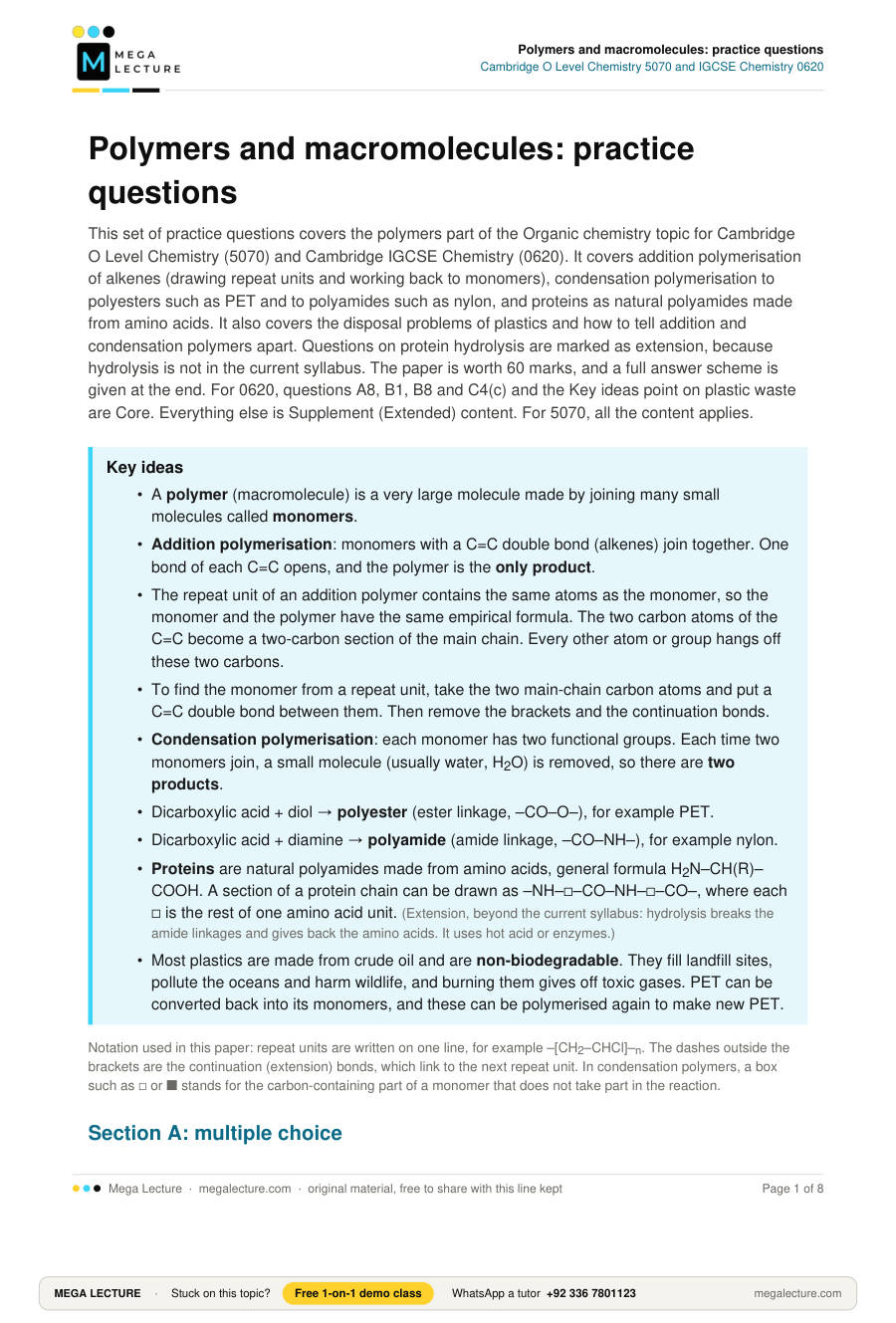
This set of practice questions covers the polymers part of the Organic chemistry topic for Cambridge O Level Chemistry (5070) and Cambridge IGCSE Chemistry (0620). It covers addition polymerisation of alkenes (drawing repeat units and working back to monomers), condensation polymerisation to polyesters such as PET and to polyamides such as nylon, and proteins as natural polyamides made from amino acids. It also covers the disposal problems of plastics and how to tell addition and condensation polymers apart. Questions on protein hydrolysis are marked as extension, because hydrolysis is not in the current syllabus. The paper is worth 60 marks, and a full answer scheme is given at the end. For 0620, questions A8, B1, B8 and C4(c) and the Key ideas point on plastic waste are Core. Everything else is Supplement (Extended) content. For 5070, all the content applies.
Key ideas
- A polymer (macromolecule) is a very large molecule made by joining many small molecules called monomers.
- Addition polymerisation: monomers with a C=C double bond (alkenes) join together. One bond of each C=C opens, and the polymer is the only product.
- The repeat unit of an addition polymer contains the same atoms as the monomer, so the monomer and the polymer have the same empirical formula. The two carbon atoms of the C=C become a two-carbon section of the main chain. Every other atom or group hangs off these two carbons.
- To find the monomer from a repeat unit, take the two main-chain carbon atoms and put a C=C double bond between them. Then remove the brackets and the continuation bonds.
- Condensation polymerisation: each monomer has two functional groups. Each time two monomers join, a small molecule (usually water, H2O) is removed, so there are two products.
- Dicarboxylic acid + diol → polyester (ester linkage, –CO–O–), for example PET.
- Dicarboxylic acid + diamine → polyamide (amide linkage, –CO–NH–), for example nylon.
- Proteins are natural polyamides made from amino acids, general formula H2N–CH(R)–COOH. A section of a protein chain can be drawn as –NH–□–CO–NH–□–CO–, where each □ is the rest of one amino acid unit. (Extension, beyond the current syllabus: hydrolysis breaks the amide linkages and gives back the amino acids. It uses hot acid or enzymes.)
- Most plastics are made from crude oil and are non-biodegradable. They fill landfill sites, pollute the oceans and harm wildlife, and burning them gives off toxic gases. PET can be converted back into its monomers, and these can be polymerised again to make new PET.
Notation used in this paper: repeat units are written on one line, for example –[CH2–CHCl]–n. The dashes outside the brackets are the continuation (extension) bonds, which link to the next repeat unit. In condensation polymers, a box such as □ or ■ stands for the carbon-containing part of a monomer that does not take part in the reaction.
Section A: multiple choice
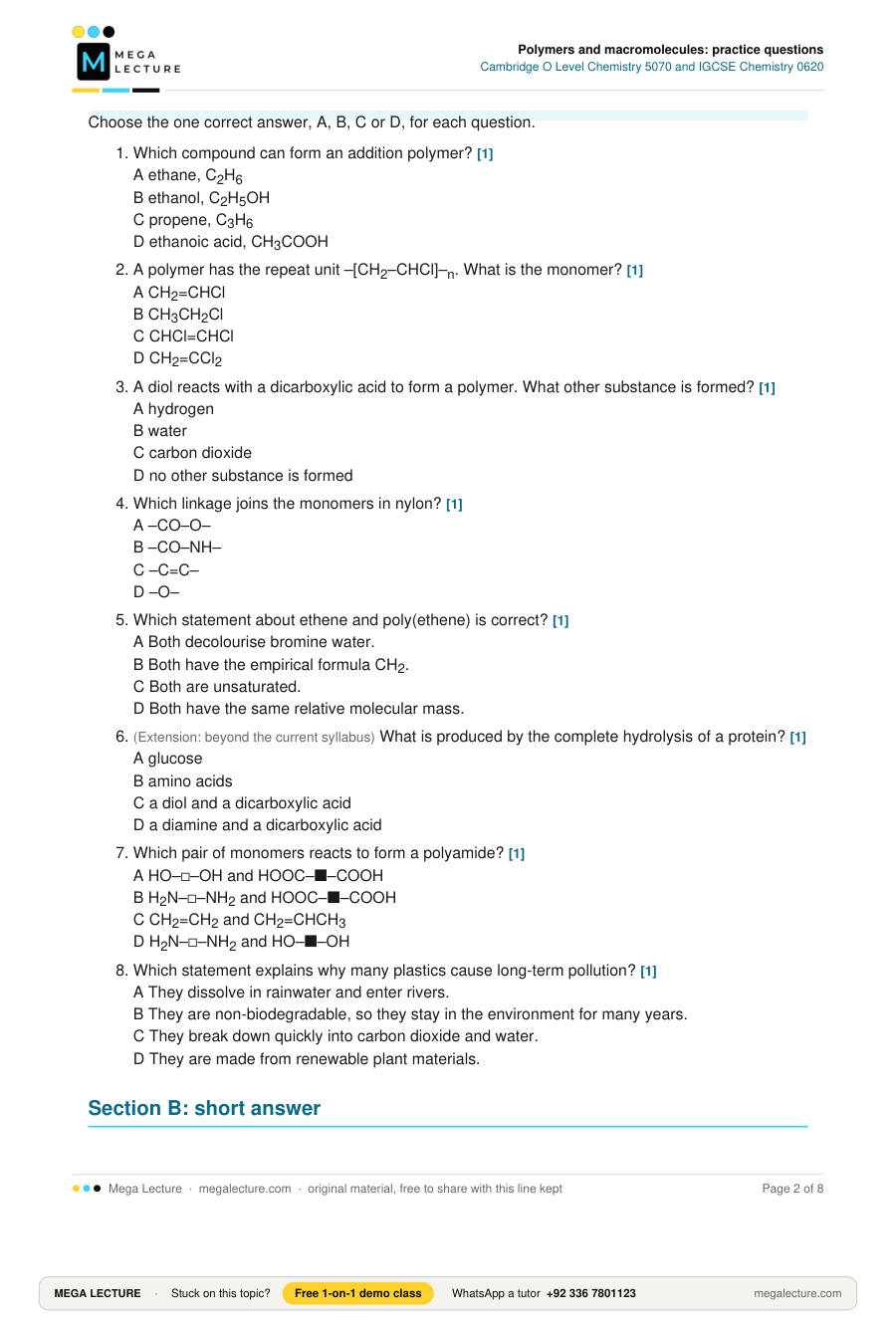
Choose the one correct answer, A, B, C or D, for each question.
- Which compound can form an addition polymer? [1]
A ethane, C2H6
B ethanol, C2H5OH
C propene, C3H6
D ethanoic acid, CH3COOH - A polymer has the repeat unit –[CH2–CHCl]–n. What is the monomer? [1]
A CH2=CHCl
B CH3CH2Cl
C CHCl=CHCl
D CH2=CCl2 - A diol reacts with a dicarboxylic acid to form a polymer. What other substance is formed? [1]
A hydrogen
B water
C carbon dioxide
D no other substance is formed - Which linkage joins the monomers in nylon? [1]
A –CO–O–
B –CO–NH–
C –C=C–
D –O– - Which statement about ethene and poly(ethene) is correct? [1]
A Both decolourise bromine water.
B Both have the empirical formula CH2.
C Both are unsaturated.
D Both have the same relative molecular mass. - (Extension: beyond the current syllabus) What is produced by the complete hydrolysis of a protein? [1]
A glucose
B amino acids
C a diol and a dicarboxylic acid
D a diamine and a dicarboxylic acid - Which pair of monomers reacts to form a polyamide? [1]
A HO–□–OH and HOOC–■–COOH
B H2N–□–NH2 and HOOC–■–COOH
C CH2=CH2 and CH2=CHCH3
D H2N–□–NH2 and HO–■–OH - Which statement explains why many plastics cause long-term pollution? [1]
A They dissolve in rainwater and enter rivers.
B They are non-biodegradable, so they stay in the environment for many years.
C They break down quickly into carbon dioxide and water.
D They are made from renewable plant materials.
Section B: short answer
- State what is meant by the terms monomer and polymer. [2]
- Tetrafluoroethene, CF2=CF2, forms the addition polymer poly(tetrafluoroethene), PTFE, which is used as a non-stick coating. Draw the repeat unit of PTFE. Show all the atoms and bonds. [2]
- A sample of poly(propene) has an average relative molecular mass of 126 000. Calculate the average number of propene monomer units in one polymer molecule. [Ar: C = 12, H = 1] [3]
- Ethene decolourises bromine water, but poly(ethene) does not. Explain this difference. [2]
- State three differences between addition polymerisation and condensation polymerisation. [3]
- Glycine is H2N–CH2–COOH and alanine is H2N–CH(CH3)–COOH. The –COOH group of glycine reacts with the –NH2 group of alanine. Write the structure of the compound formed and name the other product. [3]
- (Extension: beyond the current syllabus) A protein can be broken down into its amino acids by hydrolysis. State the conditions, or name a type of substance, that can be used to hydrolyse a protein. Name the linkage that is broken. [2]
- Describe two problems caused by disposing of plastics, and state one way that waste PET can be dealt with other than landfill. [3]
Section C: structured questions
Question C1: addition polymers
(a) Complete the table. [3]
| Monomer name | Monomer formula | Polymer name | Repeat unit |
|---|---|---|---|
| ethene | CH2=CH2 | poly(ethene) | –[CH2–CH2]–n |
| propene | CH2=CHCH3 | poly(propene) | (i) .......... |
| chloroethene | (ii) .......... | (iii) .......... | –[CH2–CHCl]–n |
(b) An addition polymer has the repeat unit –[CH(CH3)–CH(CH3)]–n. Deduce the structural formula of the monomer and name it. [2]
(c) Part of a chain of another addition polymer is shown: –CH2–CH(CN)–CH2–CH(CN)–CH2–CH(CN)–
(i) How many repeat units are shown? (ii) Give the structural formula of the monomer. [2]
You do not need to know the –CN group. Treat it like any other side group.
(d) Explain why addition polymerisation gives only one product. [1]
Question C2: polyesters
PET is made from two monomers. Monomer P is HOOC–■–COOH, where ■ is a C6H4 ring. Monomer Q is ethane-1,2-diol, HO–CH2–CH2–OH.
(a) Name the functional group in monomer P and the functional group in monomer Q. [2]
(b) Draw one repeat unit of PET. Show the ester linkage with all its atoms and bonds, and use ■ for the ring. [3]
(c) Name the other product of this polymerisation, and state how many molecules of it are formed for each repeat unit. [2]
(d) State why this type of polymerisation is called condensation polymerisation. [1]
Question C3: nylon and proteins
A nylon is made from a diamine, H2N–□–NH2, and a dicarboxylic acid, HOOC–■–COOH.
(a) Draw the repeat unit of this nylon, using □ and ■ for the carbon chains. [2]
(b) Name the linkage in nylon and name the natural polymers that have the same linkage. [1]
(c) State two differences between the monomers used to make nylon and the monomers that make up a protein. [2]
(d) A student separated a mixture of amino acids by paper chromatography. The amino acids are colourless, so the paper was sprayed with a locating agent. One spot moved 3.6 cm from the baseline. The solvent front moved 9.0 cm from the baseline.
(i) State why a locating agent was needed. (ii) Calculate the Rf value of this amino acid. Show your working. [3]
Question C4: telling polymers apart, and plastic waste
(a) Classify each of these polymers as an addition polymer or a condensation polymer: poly(chloroethene), nylon, PET, poly(propene), protein. [2]
(b) Part of the chain of polymer X is: –O–CH2–CH2–O–CO–CH2–CH2–CO–O–CH2–CH2–O–CO–CH2–CH2–CO–
Identify the type of polymer X is, and deduce the structural formulae of its two monomers. [3]
(c) Some councils burn plastic waste. Poly(chloroethene) contains chlorine. Explain two reasons why burning plastic waste such as this is harmful. [2]
(d) Suggest why PET can be chemically recycled back to its monomers more easily than poly(ethene) can. [1]
Total: Section A 8 marks, Section B 20 marks, Section C 32 marks. Total 60 marks.
Answers
Section A
A1 C. Propene is an alkene, so it has a C=C bond that can open. Ethane is saturated. Ethanol and ethanoic acid have no C=C bond. [1]
A2 A. Put a C=C bond between the two main-chain carbons: CH2=CHCl (chloroethene). [1]
A3 B. A water molecule is removed each time an ester linkage forms. [1]
A4 B. This is the amide linkage, –CO–NH–. Option A is the ester linkage found in polyesters. [1]
A5 B. Ethene is C2H4 and the repeat unit of the polymer is C2H4, so both have the empirical formula CH2. Poly(ethene) is saturated, so it does not decolourise bromine water, and its Mr is much larger. [1]
A6 B. Proteins are polyamides made from amino acids. Hydrolysis breaks the amide linkages and gives back the amino acids. [1]
Extension: beyond the current syllabus.
A7 B. A diamine and a dicarboxylic acid form amide linkages. Pair A gives a polyester, and pair C gives an addition polymer. Pair D cannot form amide or ester linkages, because neither monomer has a –COOH group. [1]
A8 B. Most plastics are not broken down by microorganisms, so they stay in landfill and in the sea. They do not dissolve in water. [1]
Section B
B1
- A monomer is a small molecule that can join to other small molecules (of the same kind or a different kind) to form a polymer. [1]
- A polymer is a very large molecule (macromolecule) made from many monomer units joined together. [1]
B2 The repeat unit is –[CF2–CF2]–n. Drawn in full, it is two carbon atoms joined by a single C–C bond, with two F atoms bonded to each carbon.
- Two carbon atoms joined by a single bond, each with two F atoms, and all bonds shown. [1]
- Continuation (extension) bonds shown at both ends. [1]
Brackets and n are not needed for the mark, but they are not penalised if they are drawn correctly. No mark for the first point if a C=C double bond is drawn in the repeat unit.
B3
- Step 1: Mr of propene, C3H6 = (3 × 12) + (6 × 1) = 42. [1]
- Step 2: each repeat unit has the same mass as one monomer, so number of units = 126 000 ÷ 42. [1]
- Step 3: = 3000 monomer units. [1]
A correct answer with no working gets 3 marks. If the Mr is wrong, allow error carried forward for Steps 2 and 3 (maximum 2 marks).
B4
- Ethene is unsaturated because it has a C=C double bond, and bromine adds across it. [1]
- Poly(ethene) is saturated. The double bonds were used up in polymerisation, so it has only C–C single bonds and there is no addition reaction with bromine. [1]
B5 Any three of these, with each difference stated for both types: [3]
- Addition: the polymer is the only product. Condensation: a small molecule, such as water, is also formed.
- Addition: the monomers have a C=C double bond. Condensation: each monomer has two functional groups, for example –OH, –COOH or –NH2.
- Addition: usually one type of monomer. Condensation: usually two different monomers, or one monomer with two different functional groups.
- Addition: the repeat unit has the same atoms (same formula) as the monomer. Condensation: the repeat unit has fewer atoms than the monomers put together.
- Addition: the main chain has only carbon atoms. Condensation: the chain includes linkages that contain O or N, such as ester or amide linkages.
B6
- H2N–CH2–CO–NH–CH(CH3)–COOH
- Amide linkage –CO–NH– shown correctly between the two units. [1]
- The rest of the structure is correct: a free –NH2 on the glycine end and a free –COOH on the alanine end, with the CH3 group on the alanine carbon. [1]
- Other product: water, H2O. [1]
The –OH from the –COOH of glycine and one H from the –NH2 of alanine leave together as H2O.
B7 (Extension: beyond the current syllabus)
- Heat with (fairly concentrated) hydrochloric acid for a long time, or use enzymes (proteases). Accept "hot acid". [1]
- The amide (peptide) linkage, –CO–NH–. [1]
B8 Any two problems: [2]
- Plastics are non-biodegradable, so they fill up landfill sites and stay there for hundreds of years.
- Plastic litter in rivers and oceans harms animals, which can swallow it or get trapped in it. It also breaks up into microplastics.
- Burning plastics releases toxic gases, such as carbon monoxide or hydrogen chloride. It also releases carbon dioxide, which is a greenhouse gas.
One way of dealing with PET: [1]
- Recycling. PET can be converted back into its monomers, which are then polymerised to make new PET. Melting it and remoulding it into new products is also accepted.
Section C
C1
(a) (i) –[CH2–CH(CH3)]–n. The CH3 must be a side group, not part of the main chain. [1]
(ii) CH2=CHCl [1]
(iii) poly(chloroethene), or PVC [1]
(b) Working: the two main-chain carbons each have one H and one CH3. Put a C=C bond between them.
Monomer: CH3–CH=CH–CH3 [1]
Name: but-2-ene [1]
(c) (i) 3. Each repeat unit is –CH2–CH(CN)–. [1]
(ii) CH2=CH–CN [1]
(d) All the atoms in the monomers become part of the polymer. Only the C=C bond opens, and no atoms are removed. [1]
C2
(a) P: carboxylic acid (–COOH). There are two of these groups, so P is a dicarboxylic acid. [1]
Q: alcohol, or hydroxyl (–OH). There are two of these groups, so Q is a diol. [1]
(b) Repeat unit: –[CO–■–CO–O–CH2–CH2–O]–n
- Ester linkage drawn in full: a carbon atom with a C=O double bond, single-bonded to an O atom, which is bonded to the CH2. [1]
- The ■ between two C=O groups, and –CH2–CH2– between two O atoms. [1]
- Continuation (extension) bonds at both ends. The unit must not end in –OH or –COOH. [1]
Brackets and n are not needed, but they are not penalised if they are drawn correctly. Accept any correct repeat unit that starts at a different point in the chain, for example –[O–CH2–CH2–O–CO–■–CO]–, provided it contains one of each monomer residue and has continuation bonds at both ends.
(c) Water. [1] Two molecules per repeat unit, because each repeat unit contains two ester linkages. [1]
(d) A small molecule (water) is removed each time two monomers join. [1]
C3
(a) –[CO–■–CO–NH–□–NH]–n
- Amide linkage –CO–NH– shown correctly, with C=O and N–H. [1]
- ■ between the two CO groups, □ between the two NH groups, and continuation bonds at both ends. [1]
Brackets and n are not needed, but they are not penalised if they are drawn correctly. Accept any correct repeat unit that starts at a different point in the chain, for example –[NH–□–NH–CO–■–CO]–, provided it contains one of each monomer residue and has continuation bonds at both ends.
(b) Amide linkage. Proteins have the same linkage. [1]
Both are needed for the mark: amide (linkage) and proteins.
(c) Any two of these: [2]
- Each nylon monomer has two of the same functional group (two –NH2 or two –COOH). Each amino acid has one –NH2 and one –COOH in the same molecule.
- Nylon uses only two kinds of monomer. A protein is made from many different amino acids (about 20 kinds in living things), which have different R groups.
- Nylon monomers are synthetic (made from crude oil). Amino acids are natural (made by living things).
Each point must compare the same feature of both types of monomer. The same idea cannot score twice.
(d) (i) Amino acids are colourless, so the spots cannot be seen until the locating agent reacts with them to form coloured spots. [1]
(ii) Rf = distance moved by the spot ÷ distance moved by the solvent front [1]
= 3.6 ÷ 9.0 = 0.40. Rf has no units. [1]
C4
(a) Addition: poly(chloroethene), poly(propene). Condensation: nylon, PET, protein.
All five correct: 2 marks. Three or four correct: 1 mark. [2]
(b) Working: the chain contains –CO–O– (ester) linkages and no N, so X is a polyester, made by condensation polymerisation. [1]
To find the monomers, break each ester linkage by adding –H to the O and –OH to the C=O.
Monomer 1: HO–CH2–CH2–OH (a diol) [1]
Monomer 2: HOOC–CH2–CH2–COOH (a dicarboxylic acid) [1]
(c) Any two of these: [2]
- Plastics containing chlorine release toxic, acidic gases such as hydrogen chloride.
- Incomplete combustion produces toxic carbon monoxide, and soot or smoke.
- Carbon dioxide is released, which adds to global warming (climate change).
(d) PET has ester linkages, which can be hydrolysed to give back the diol and the dicarboxylic acid. Poly(ethene) has only C–C and C–H bonds in an unreactive, saturated chain. It has no functional linkage that can be hydrolysed, so no simple reaction turns it back into ethene. [1]
