
IGCSE · Physics · Past papers · Paper 1 (Multiple Choice)
Answer Key
Need more than one subject? All-notes pass: unlimited downloads of every note for a year: unlimited downloads of every note on the site, PKR 999 a year. All packs and courses.
Opens inside this page. Prefer your own PDF app? Open the PDF.
Check yourself
5 quick questions on IGCSE Physics
Tap an answer to see if you are right, and why. Free, no sign-up.
Start the free testNew · free
O Level Physics written answers, marked like a real examiner
Answer a Paper 2 style question by typing or speaking. You get your mark point by point, what the examiner was looking for that you missed, and a model answer. 5 free answers a day with a free account.
Try a written question👍 33 students found these notes useful
Was this note useful?
Full text of Answer Key
www.megalecture.com · www.youtube.com/@megalecture
Fahad H. Ahmad
M.Eng NUS Singapore · B.Eng NUST · 15+ years of teaching experience in Singapore, UAE & Pakistan · 60,000+ subscribers and 20 million+ video lecture views.
IGCSEPHYSICS0625·TOPICALPASTPAPERS
Electromagnetism — Paper 1
Worked Answer Key (Multiple Choice)
Free notes, practice tests and live classes Back to megalecture.com
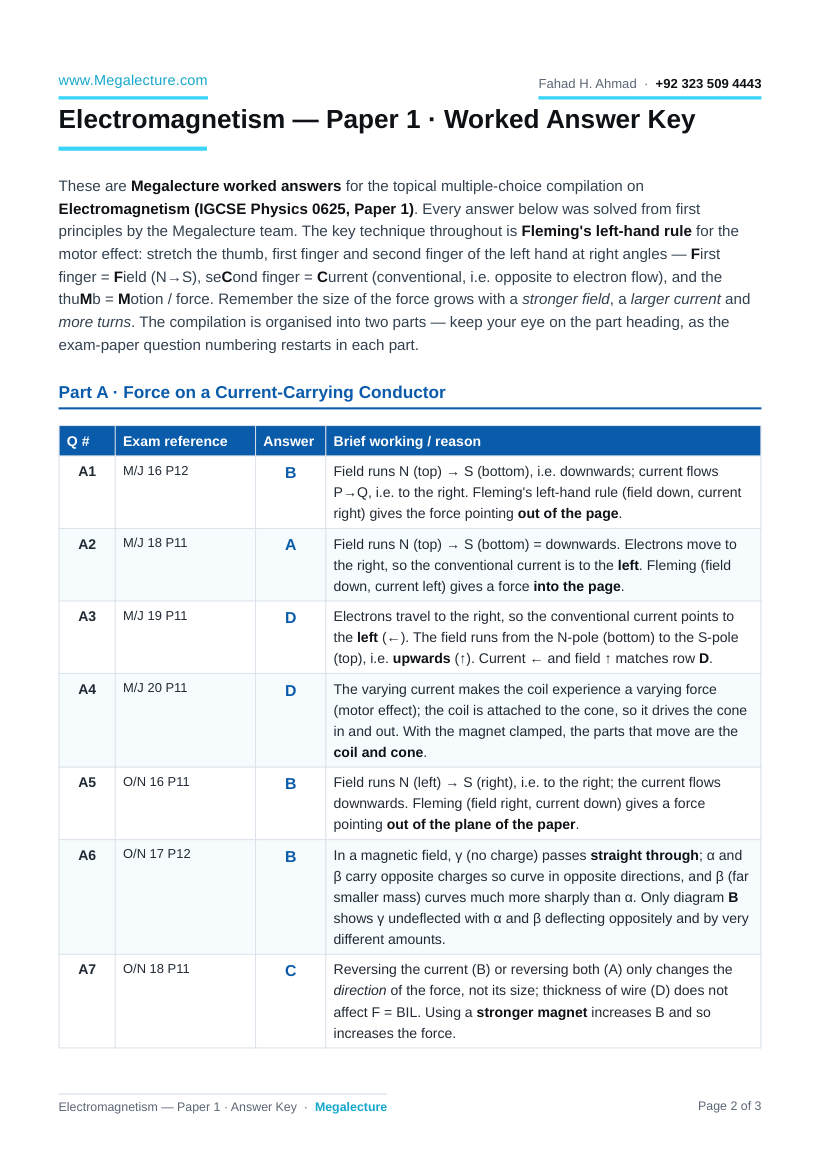
Electromagnetism — Paper 1 · Worked Answer Key
These are Megalecture worked answers for the topical multiple-choice compilation on
Electromagnetism (IGCSE Physics 0625, Paper 1). Every answer below was solved from first principles by the Megalecture team. The key technique throughout is Fleming's left-hand rule for the motor effect: stretch the thumb, first finger and second finger of the left hand at right angles — First finger = Field (N→S), seCond finger = Current (conventional, i.e. opposite to electron flow), and the thuMb = Motion / force. Remember the size of the force grows with a stronger field, a larger current and more turns. The compilation is organised into two parts — keep your eye on the part heading, as the exam-paper question numbering restarts in each part.
Part A · Force on a Current-Carrying Conductor Q # Exam reference Answer Brief working / reason A1
M/J 16 P12
B
Field runs N (top) → S (bottom), i.e. downwards; current flows
P→Q, i.e. to the right. Fleming's left-hand rule (field down, current right) gives the force pointing out of the page.
A2
M/J 18 P11
A
Field runs N (top) → S (bottom) = downwards. Electrons move to the right, so the conventional current is to the left. Fleming (field down, current left) gives a force into the page.
A3
M/J 19 P11
D
Electrons travel to the right, so the conventional current points to the left (←). The field runs from the N-pole (bottom) to the S-pole
(top), i.e. upwards (↑). Current ← and field ↑ matches row D.
A4
M/J 20 P11
D
The varying current makes the coil experience a varying force
(motor effect); the coil is attached to the cone, so it drives the cone in and out. With the magnet clamped, the parts that move are the coil and cone.
A5
O/N 16 P11
B
Field runs N (left) → S (right), i.e. to the right; the current flows downwards. Fleming (field right, current down) gives a force pointing out of the plane of the paper.
A6
O/N 17 P12
B
In a magnetic field, γ (no charge) passes straight through; α and
β carry opposite charges so curve in opposite directions, and β (far smaller mass) curves much more sharply than α. Only diagram B shows γ undeflected with α and β deflecting oppositely and by very different amounts.
A7
O/N 18 P11
C
Reversing the current (B) or reversing both (A) only changes the direction of the force, not its size; thickness of wire (D) does not affect F = BIL. Using a stronger magnet increases B and so increases the force.
Electromagnetism — Paper 1 · Answer Key · Megalecture
Part B · The D.C. Motor Q # Exam reference Answer Brief working / reason B1
M/J 16 P11
B
The split-ring commutator swaps the connections to the coil once each half turn, reversing the current so the coil keeps rotating the same way.
B2
M/J 16 P12
D
To turn the opposite way you must reverse the force, done by reversing the magnetic field (or the current, but not both). To turn faster you need a bigger force, so increase the current. Reverse field + increase current = row D.
B3
M/J 17 P12
D
A split-ring commutator does not change the current size or generate anything; its job is to reverse the direction of the current in the coil every half turn so rotation continues in one direction.
B4
M/J 19 P11
C
Frequency of rotation falls when the turning force is reduced. A lower voltage supply drives a smaller current, giving a smaller force and slower rotation. (More turns, stronger magnet and larger current all speed it up.)
B5
M/J 20 P12
C
The question asks which does not increase the turning effect. More current in either coil, or more turns, all increase it. Reversing the current in the electromagnet only changes the direction of the force — the magnitude of the turning effect is unchanged.
B6
O/N 16 P11
D
Coil Q uses twice the length of identical wire (2L), so it has greater resistance. With the same current I, the turning effect grows with the number of turns, and Q has 2N turns, so Q also has the greater turning effect. Greater resistance Q, greater turning effect Q = row
D.
B7
O/N 17 P12
D
The soft-iron cylinder (core) becomes strongly magnetised by the coil, concentrating the field lines and strengthening the magnetic field, which increases the turning force on the coil.
Note from Megalecture. The reliable routine for every "direction of force / deflection" item in Part A is: (1) fix the field direction N→S, (2) convert any electron beam to conventional current (opposite direction), then (3) apply Fleming's left- hand rule. These are original Megalecture worked solutions prepared for revision use.
Electromagnetism — Paper 1 · Answer Key · Megalecture
